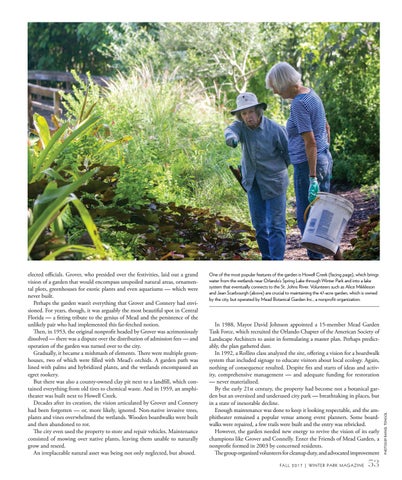
One of the most popular features of the garden is Howell Creek (facing page), which brings water from the wetlands near Orlando’s Spring Lake through Winter Park and into a lake system that eventually connects to the St. Johns River. Volunteers such as Alice Mikkleson and Jean Scarbourgh (above) are crucial to maintaining the 47-acre garden, which is owned by the city, but operated by Mead Botanical Garden Inc., a nonprofit organization.
In 1988, Mayor David Johnson appointed a 15-member Mead Garden Task Force, which recruited the Orlando Chapter of the American Society of Landscape Architects to assist in formulating a master plan. Perhaps predictably, the plan gathered dust. In 1992, a Rollins class analyzed the site, offering a vision for a boardwalk system that included signage to educate visitors about local ecology. Again, nothing of consequence resulted. Despite fits and starts of ideas and activity, comprehensive management — and adequate funding for restoration — never materialized. By the early 21st century, the property had become not a botanical garden but an oversized and underused city park — breathtaking in places, but in a state of inexorable decline. Enough maintenance was done to keep it looking respectable, and the amphitheater remained a popular venue among event planners. Some boardwalks were repaired, a few trails were built and the entry was rebricked. However, the garden needed new energy to revive the vision of its early champions like Grover and Connelly. Enter the Friends of Mead Garden, a nonprofit formed in 2003 by concerned residents. The group organized volunteers for cleanup duty, and advocated improvement FA L L 2 0 1 7 | W INT ER PARK MAGAZ IN E
53
PHOTOS BY RAFAEL TONGOL
elected officials. Grover, who presided over the festivities, laid out a grand vision of a garden that would encompass unspoiled natural areas, ornamental plots, greenhouses for exotic plants and even aquariums — which were never built. Perhaps the garden wasn’t everything that Grover and Connery had envisioned. For years, though, it was arguably the most beautiful spot in Central Florida — a fitting tribute to the genius of Mead and the persistence of the unlikely pair who had implemented this far-fetched notion. Then, in 1953, the original nonprofit headed by Grover was acrimoniously dissolved — there was a dispute over the distribution of admission fees — and operation of the garden was turned over to the city. Gradually, it became a mishmash of elements. There were multiple greenhouses, two of which were filled with Mead’s orchids. A garden path was lined with palms and hybridized plants, and the wetlands encompassed an egret rookery. But there was also a county-owned clay pit next to a landfill, which contained everything from old tires to chemical waste. And in 1959, an amphitheater was built next to Howell Creek. Decades after its creation, the vision articulated by Grover and Connery had been forgotten — or, more likely, ignored. Non-native invasive trees, plants and vines overwhelmed the wetlands. Wooden boardwalks were built and then abandoned to rot. The city even used the property to store and repair vehicles. Maintenance consisted of mowing over native plants, leaving them unable to naturally grow and reseed. An irreplaceable natural asset was being not only neglected, but abused.