VERSUS HERITAGE FOR TOMORROW Vernacular Knowledge for Sustainable Architecture
•
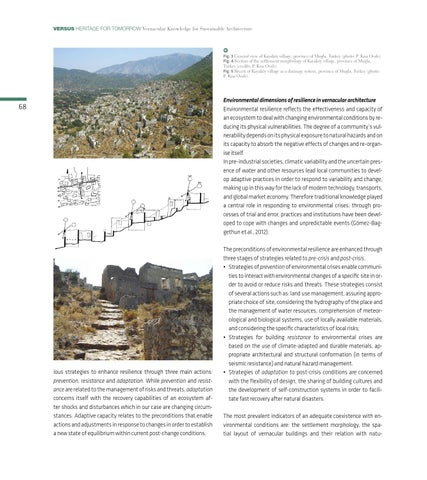
Fig. 3 General view of Kayaköy village, province of Mugla, Turkey (photo: P. Kısa Ovalı). Fig. 4 Section of the settlement morphology of Kayaköy village, province of Mugla, Turkey (credits: P. Kısa Ovalı). Fig. 5 Streets of Kayaköy village as a drainage system, province of Mugla, Turkey (photo: P. Kısa Ovalı).
Environmental dimensions of resilience in vernacular architecture Environmental resilience reflects the effectiveness and capacity of an ecosystem to deal with changing environmental conditions by reducing its physical vulnerabilities. The degree of a community’s vulnerability depends on its physical exposure to natural hazards and on its capacity to absorb the negative effects of changes and re-organise itself. In pre-industrial societies, climatic variability and the uncertain presence of water and other resources lead local communities to develop adaptive practices in order to respond to variability and change, making up in this way for the lack of modern technology, transports, and global market economy. Therefore traditional knowledge played a central role in responding to environmental crises: through processes of trial and error, practices and institutions have been developed to cope with changes and unpredictable events (Gómez-Baggethun et al., 2012).
68
ious strategies to enhance resilience through three main actions: prevention, resistance and adaptation. While prevention and resistance are related to the management of risks and threats, adaptation concerns itself with the recovery capabilities of an ecosystem after shocks and disturbances which in our case are changing circumstances. Adaptive capacity relates to the preconditions that enable actions and adjustments in response to changes in order to establish a new state of equilibrium within current post-change conditions.
The preconditions of environmental resilience are enhanced through three stages of strategies related to pre-crisis and post-crisis. • Strategies of prevention of environmental crises enable communities to interact with environmental changes of a specific site in order to avoid or reduce risks and threats. These strategies consist of several actions such as: land use management, assuring appropriate choice of site, considering the hydrography of the place and the management of water resources, comprehension of meteorological and biological systems, use of locally available materials, and considering the specific characteristics of local risks; • Strategies for building resistance to environmental crises are based on the use of climate-adapted and durable materials, appropriate architectural and structural conformation (in terms of seismic resistance) and natural hazard management. • Strategies of adaptation to post-crisis conditions are concerned with the flexibility of design, the sharing of building cultures and the development of self-construction systems in order to facilitate fast recovery after natural disasters. The most prevalent indicators of an adequate coexistence with environmental conditions are: the settlement morphology, the spatial layout of vernacular buildings and their relation with natu-