Vernacular Heritage contribution to Sustainable Architecture • Resilience and Intangible Heritage of Vernacular Architecture
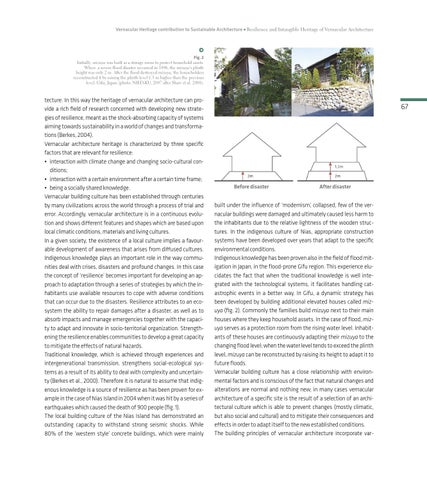
• Fig. 2 Initially, mizuya was built as a storage room to protect household assets. When a severe flood disaster occurred in 1896, the mizuya's plinth height was only 2 m. After the flood destroyed mizuya, the householders reconstructed it by raising the plinth level 1.3 m higher than the previous level. Gifu, Japan (photo: NIED-KU, 2007 after Shaw et al. 2008).
tecture. In this way the heritage of vernacular architecture can provide a rich field of research concerned with developing new strategies of resilience, meant as the shock-absorbing capacity of systems aiming towards sustainability in a world of changes and transformations (Berkes, 2004). Vernacular architecture heritage is characterized by three specific factors that are relevant for resilience: • interaction with climate change and changing socio-cultural conditions; • interaction with a certain environment after a certain time frame; • being a socially shared knowledge. Vernacular building culture has been established through centuries by many civilizations across the world through a process of trial and error. Accordingly, vernacular architecture is in a continuous evolution and shows different features and shapes which are based upon local climatic conditions, materials and living cultures. In a given society, the existence of a local culture implies a favourable development of awareness that arises from diffused cultures. Indigenous knowledge plays an important role in the way communities deal with crises, disasters and profound changes. In this case the concept of ‘resilience’ becomes important for developing an approach to adaptation through a series of strategies by which the inhabitants use available resources to cope with adverse conditions that can occur due to the disasters. Resilience attributes to an ecosystem the ability to repair damages after a disaster, as well as to absorb impacts and manage emergencies together with the capacity to adapt and innovate in socio-territorial organization. Strengthening the resilience enables communities to develop a great capacity to mitigate the effects of natural hazards. Traditional knowledge, which is achieved through experiences and intergenerational transmission, strengthens social-ecological systems as a result of its ability to deal with complexity and uncertainty (Berkes et al., 2000). Therefore it is natural to assume that indigenous knowledge is a source of resilience as has been proven for example in the case of Nias Island in 2004 when it was hit by a series of earthquakes which caused the death of 900 people (fig. 1). The local building culture of the Nias Island has demonstrated an outstanding capacity to withstand strong seismic shocks. While 80% of the ‘western style’ concrete buildings, which were mainly
67
Before disaster
After disaster
built under the influence of ‘modernism’, collapsed, few of the vernacular buildings were damaged and ultimately caused less harm to the inhabitants due to the relative lightness of the wooden structures. In the indigenous culture of Nias, appropriate construction systems have been developed over years that adapt to the specific environmental conditions. Indigenous knowledge has been proven also in the field of flood mitigation in Japan, in the flood-prone Gifu region. This experience elucidates the fact that when the traditional knowledge is well integrated with the technological systems, it facilitates handling catastrophic events in a better way. In Gifu, a dynamic strategy has been developed by building additional elevated houses called mizuya (fig. 2). Commonly the families build mizuya next to their main houses where they keep household assets. In the case of flood, mizuya serves as a protection room from the rising water level. Inhabitants of these houses are continuously adapting their mizuya to the changing flood level; when the water level tends to exceed the plinth level, mizuya can be reconstructed by raising its height to adapt it to future floods. Vernacular building culture has a close relationship with environmental factors and is conscious of the fact that natural changes and alterations are normal and nothing new; in many cases vernacular architecture of a specific site is the result of a selection of an architectural culture which is able to prevent changes (mostly climatic, but also social and cultural) and to mitigate their consequences and effects in order to adapt itself to the new established conditions. The building principles of vernacular architecture incorporate var-