Les principes de durabilité environnementale, socio-culturelle et socio-économique I principi di sostenibilità ambientale, socio-culturale e socio-economica Os princípios de sustentabilidade ambiental, sociocultural e socioeconómica Vernacular Heritage contribution to Sustainable Architecture • Research Method and Operative Approach Los principios de sostenibilidad medioambiental, sociocultural y socioeconómica
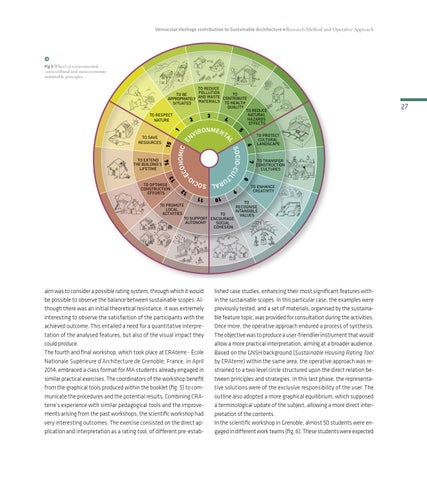
• Fig 5 Wheel of environmental, socio-cultural and socio-economic sustainable principles. TO REDUCE POLLUTION TO TO BE APPROPRIATELY AND WASTE CONTRIBUTE MATERIALS TO HEALTH SITUATED QUALITY TO REDUCE NATURAL TO RESPECT 3 HAZARDS 4 NATURE 2 EFFECTS
9
1
OM CON IC E -E
TO TRANSFER CONSTRUCTION CULTURES
TO ENHANCE CREATIVITY
10
11
15
TO PROTECT CULTURAL LANDSCAPE
8
S RAL OCIO TU
14
7
13
6
12
TO OPTIMISE CONSTRUCTION EFFORTS
SOCIO-CUL
TO EXTEND THE BUILDING’S LIFETIME
5
IRONMENTA NV
L
TO SAVE RESOURCES
TO TO PROMOTE RECOGNISE LOCAL INTANGIBLE ACTIVITIES TO VALUES TO SUPPORT ENCOURAGE AUTONOMY SOCIAL COHESION
12 from vernacular heritage aim was to consider a possible rating system, through which it would be possible to observe the balance between sustainable scopes. Although there was an initial theoretical resistance, it was extremely interesting to observe the satisfaction of the participants with the achieved outcome. This entailed a need for a quantitative interpretation of the analysed features, but also of the visual impact they could produce. The fourth and final workshop, which took place at CRAterre - École Nationale Supérieure d’Architecture de Grenoble, France, in April 2014, embraced a class format for MA students already engaged in similar practical exercises. The coordinators of the workshop benefit from the graphical tools produced within the booklet (fig. 5) to communicate the procedures and the potential results. Combining CRAterre’s experience with similar pedagogical tools and the improvements arising from the past workshops, the scientific workshop had very interesting outcomes. The exercise consisted on the direct application and interpretation as a rating tool, of different pre-estab-
lished case studies, enhancing their most significant features within the sustainable scopes. In this particular case, the examples were previously tested, and a set of materials, organised by the sustainable feature topic, was provided for consultation during the activities. Once more, the operative approach endured a process of synthesis. The objective was to produce a user-friendlier instrument that would allow a more practical interpretation, aiming at a broader audience. Based on the GNSH background (Sustainable Housing Rating Tool by CRAterre) within the same area, the operative approach was restrained to a two level circle structured upon the direct relation between principles and strategies. In this last phase, the representative solutions were of the exclusive responsibility of the user. The outline also adopted a more graphical equilibrium, which supposed a terminological update of the subject, allowing a more direct interpretation of the contents. In the scientific workshop in Grenoble, almost 50 students were engaged in different work teams (fig. 6). These students were expected
27