Technical and constructive strategies and solutions | EARTHQUAKE RESISTANT STRUCTURES
VERNACULAR CASE STUDY
#V2
WOODEN FRAME FILL WITH ADOBILLO BLOCK
ENVIRONMENTAL PRINCIPLES
VALPARAÍSO, CHILE
to respect environmental context and landscape to benefit of natural and climatic resources to reduce pollution and waste materials to contribute to human health and welfare to reduce natural hazards effects
SOCIO-CULTURAL PRINCIPLES
Author Natalia Jorquera
to protect the cultural landscape to transfer construction cultures to enhance innovative and creative solutions to recognise intangible values to encourage social cohesion
SOCIO-ECONOMIC PRINCIPLES to support autonomy to promote local activities to extend building's lifetime to save resources
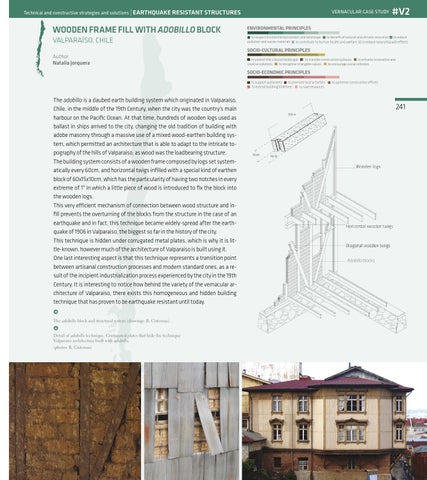
The adobillo is a daubed earth building system which originated in Valparaíso, Chile, in the middle of the 19th Century, when the city was the country's main harbour on the Pacific Ocean. At that time, hundreds of wooden logs used as ballast in ships arrived to the city, changing the old tradition of building with adobe masonry through a massive use of a mixed wood-earthen building system, which permitted an architecture that is able to adapt to the intricate topography of the hills of Valparaiso, as wood was the loadbearing structure. The building system consists of a wooden frame composed by logs set systematically every 60cm, and horizontal twigs infilled with a special kind of earthen block of 60x15x10cm, which has the particularity of having two notches in every extreme of 1" in which a little piece of wood is introduced to fix the block into the wooden logs. This very efficient mechanism of connection between wood structure and infill prevents the overturning of the blocks from the structure in the case of an earthquake and in fact, this technique became widely-spread after the earthquake of 1906 in Valparaiso, the biggest so far in the history of the city. This technique is hidden under corrugated metal plates, which is why it is little-known, however much of the architecture of Valparaiso is built using it. One last interesting aspect is that this technique represents a transition point between artisanal construction processes and modern standard ones, as a result of the incipient industrialization process experienced by the city in the 19th Century. It is interesting to notice how behind the variety of the vernacular architecture of Valparaiso, there exists this homogeneous and hidden building technique that has proven to be earthquake resistant until today.
• The adobillo block and structural system (drawings: R. Cisternas).
• Detail of adobillo technique. Corrugated plates that hide the technique Valparaiso architecture built with adobillo. (photos: R. Cisternas)
to optimise construction efforts
241
Adobillo blocks