VERSUS HERITAGE FOR TOMORROW Vernacular Knowledge for Sustainable Architecture
234
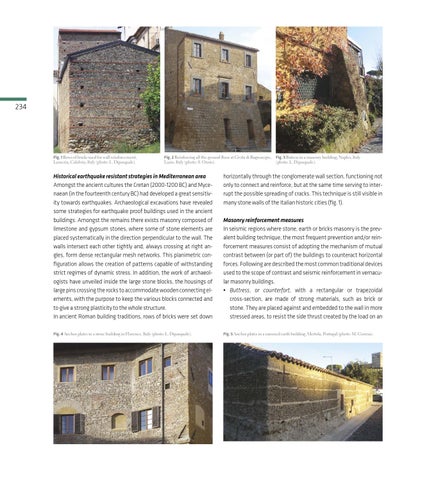
Fig. 1 Rows of bricks used for wall reinforcement, Lamezia, Calabria, Italy (photo: L. Dipasquale).
Fig. 2 Reinforcing all the ground floor at Civita di Bagnoregio, Lazio, Italy (photo: S. Onnis).
Fig. 3 Butress in a masonry building, Naples, Italy (photo: L. Dipasquale).
Historical earthquake resistant strategies in Mediterranean area Amongst the ancient cultures the Cretan (2000-1200 BC) and Mycenaean (in the fourteenth century BC) had developed a great sensitivity towards earthquakes. Archaeological excavations have revealed some strategies for earthquake proof buildings used in the ancient buildings. Amongst the remains there exists masonry composed of limestone and gypsum stones, where some of stone elements are placed systematically in the direction perpendicular to the wall. The walls intersect each other tightly and, always crossing at right angles, form dense rectangular mesh networks. This planimetric configuration allows the creation of patterns capable of withstanding strict regimes of dynamic stress. In addition, the work of archaeologists have unveiled inside the large stone blocks, the housings of large pins crossing the rocks to accommodate wooden connecting elements, with the purpose to keep the various blocks connected and to give a strong plasticity to the whole structure. In ancient Roman building traditions, rows of bricks were set down
horizontally through the conglomerate wall section, functioning not only to connect and reinforce, but at the same time serving to interrupt the possible spreading of cracks. This technique is still visible in many stone walls of the Italian historic cities (fig. 1).
Fig. 4 Anchor plates in a stone building in Florence, Italy (photo: L. Dipasquale).
Fig. 5 Anchor plates in a rammed earth building, Mertola, Portugal (photo: M. Correia).
Masonry reinforcement measures In seismic regions where stone, earth or bricks masonry is the prevalent building technique, the most frequent prevention and/or reinforcement measures consist of adopting the mechanism of mutual contrast between (or part of) the buildings to counteract horizontal forces. Following are described the most common traditional devices used to the scope of contrast and seismic reinforcement in vernacular masonry buildings. • Buttress, or counterfort, with a rectangular or trapezoidal cross-section, are made of strong materials, such as brick or stone. They are placed against and embedded to the wall in more stressed areas, to resist the side thrust created by the load on an