Architectural Strategies and Solutions | NATURAL AIR CONDITIONING DESIGN
CONTEMPORARY CASE STUDY
BARIS MARKET
ENVIRONMENTAL PRINCIPLES
KHARGA OASIS, EGYPT.
to respect environmental context and landscape to benefit of natural and climatic resources to reduce pollution and waste materials to contribute to human health and welfare to reduce natural hazards effects
Architect: Hassan Fathy, 1970
SOCIO-CULTURAL PRINCIPLES
author Adelina Picone
to protect the cultural landscape to transfer construction cultures to enhance innovative and creative solutions to recognise intangible values to encourage social cohesion
SOCIO-ECONOMIC PRINCIPLES to support autonomy to promote local activities to extend building's lifetime to save resources
208
#C1
to optimise construction efforts
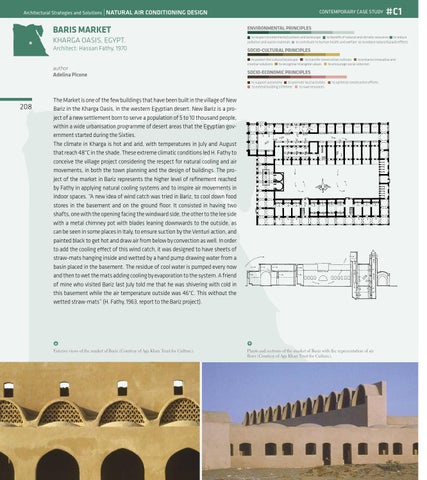
The Market is one of the few buildings that have been built in the village of New Bariz in the Kharga Oasis, in the western Egyptian desert. New Bariz is a project of a new settlement born to serve a population of 5 to 10 thousand people, within a wide urbanisation programme of desert areas that the Egyptian government started during the Sixties. The climate in Kharga is hot and arid, with temperatures in July and August that reach 48°C in the shade. These extreme climatic conditions led H. Fathy to conceive the village project considering the respect for natural cooling and air movements, in both the town planning and the design of buildings. The project of the market in Bariz represents the higher level of refinement reached by Fathy in applying natural cooling systems and to inspire air movements in indoor spaces. “A new idea of wind catch was tried in Bariz, to cool down food stores in the basement and on the ground floor. It consisted in having two shafts, one with the opening facing the windward side, the other to the lee side with a metal chimney pot with blades leaning downwards to the outside, as can be seen in some places in Italy, to ensure suction by the Venturi action, and painted black to get hot and draw air from below by convection as well. In order to add the cooling effect of this wind catch, it was designed to have sheets of straw-mats hanging inside and wetted by a hand pump drawing water from a basin placed in the basement. The residue of cool water is pumped every now and then to wet the mats adding cooling by evaporation to the system. A friend of mine who visited Bariz last July told me that he was shivering with cold in this basement while the air temperature outside was 46°C. This without the wetted straw-mats” (H. Fathy, 1963, report to the Bariz project).
•
•
Exterior views of the market of Bariz (Courtesy of Aga Khan Trust for Culture).
Plants and sections of the market of Bariz with the representation of air flows (Courtesy of Aga Khan Trust for Culture).