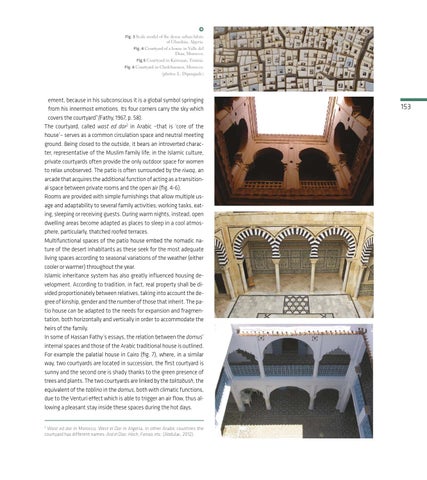
• Fig. 3 Scale model of the dense urban fabric of Ghardaia, Algeria. Fig. 4 Courtyard of a house in Valle del Draa, Morocco. Fig.5 Courtyard in Kairouan, Tunisia. Fig. 6 Courtyard in Chefchaouen, Morocco. (photos: L. Dipasquale)
ement, because in his subconscious it is a global symbol springing from his innermost emotions. Its four corners carry the sky which covers the courtyard”(Fathy, 1967, p. 58). The courtyard, called wast ed dar2 in Arabic –that is ‘core of the house’– serves as a common circulation space and neutral meeting ground. Being closed to the outside, it bears an introverted character, representative of the Muslim family life; in the Islamic culture, private courtyards often provide the only outdoor space for women to relax unobserved. The patio is often surrounded by the riwaq, an arcade that acquires the additional function of acting as a transitional space between private rooms and the open air (fig. 4-6). Rooms are provided with simple furnishings that allow multiple usage and adaptability to several family activities; working tasks, eating, sleeping or receiving guests. During warm nights, instead, open dwelling areas become adapted as places to sleep in a cool atmosphere, particularly, thatched roofed terraces. Multifunctional spaces of the patio house embed the nomadic nature of the desert inhabitants as these seek for the most adequate living spaces according to seasonal variations of the weather (either cooler or warmer) throughout the year. Islamic inheritance system has also greatly influenced housing development. According to tradition, in fact, real property shall be divided proportionately between relatives, taking into account the degree of kinship, gender and the number of those that inherit. The patio house can be adapted to the needs for expansion and fragmentation, both horizontally and vertically in order to accommodate the heirs of the family. In some of Hassan Fathy’s essays, the relation between the domus’ internal spaces and those of the Arabic traditional house is outlined. For example the palatial house in Cairo (fig. 7), where, in a similar way, two courtyards are located in succession, the first courtyard is sunny and the second one is shady thanks to the green presence of trees and plants. The two courtyards are linked by the taktabush, the equivalent of the tablino in the domus, both with climatic functions, due to the Venturi effect which is able to trigger an air flow, thus allowing a pleasant stay inside these spaces during the hot days.
2 Wast ed dar in Morocco, West el Dar in Algeria, in other Arabic countries the courtyard has different names: Ard el Diar, Hoch, Fanaa, etc. (Abdulac, 2012).
153