Urban and Local Strategies and Solutions | LANDSCAPE, WATER AND RESOURCES MANAGEMENT
CONTEMPORARY CASE STUDY
#C1
NANSEN PARK
ENVIRONMENTAL PRINCIPLES
OSLO, NORWAY.
to respect environmental context and landscape to benefit of natural and climatic resources to reduce pollution and waste materials to contribute to human health and welfare to reduce natural hazards effects
Architects: Atelier Dreiseitl author Bilge Özel
SOCIO-CULTURAL PRINCIPLES to protect the cultural landscape to transfer construction cultures to enhance innovative and creative solutions to recognise intangible values to encourage social cohesion
SOCIO-ECONOMIC PRINCIPLES to support autonomy to promote local activities to extend building's lifetime to save resources
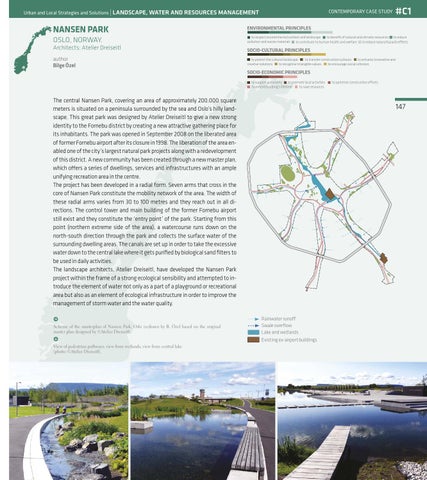
The central Nansen Park, covering an area of approximately 200.000 square meters is situated on a peninsula surrounded by the sea and Oslo’s hilly landscape. This great park was designed by Atelier Dreiseitl to give a new strong identity to the Fornebu district by creating a new attractive gathering place for its inhabitants. The park was opened in September 2008 on the liberated area of former Fornebu airport after its closure in 1998. The liberation of the area enabled one of the city’s largest natural park projects along with a redevelopment of this district. A new community has been created through a new master plan, which offers a series of dwellings, services and infrastructures with an ample unifying recreation area in the centre. The project has been developed in a radial form. Seven arms that cross in the core of Nansen Park constitute the mobility network of the area. The width of these radial arms varies from 30 to 100 metres and they reach out in all directions. The control tower and main building of the former Fornebu airport still exist and they constitute the ‘entry point’ of the park. Starting from this point (northern extreme side of the area), a watercourse runs down on the north-south direction through the park and collects the surface water of the surrounding dwelling areas. The canals are set up in order to take the excessive water down to the central lake where it gets purified by biological sand filters to be used in daily activities. The landscape architects, Atelier Dreiseitl, have developed the Nansen Park project within the frame of a strong ecological sensibility and attempted to introduce the element of water not only as a part of a playground or recreational area but also as an element of ecological infrastructure in order to improve the management of storm water and the water quality.
147
Scheme of the masterplan of Nansen Park, Oslo (redrawn by B. Özel based on the original master plan designed by ©Atelier Dreiseitl).
Rainwater runoff Swale overflow Lake and wetlands
•
Existing ex-airport buildings
•
View of pedestrian pathways; view from wetlands; view from central lake (photo: ©Atelier Dreiseitl).
to optimise construction efforts