Urban and Local Strategies and Solutions | UNDERGROUND SETTLEMENTS
VERNACULAR CASE STUDY
#V2
UNDERGROUND CITY OF DERINKUYU
ENVIRONMENTAL PRINCIPLES
CAPPADOCIA, TURKEY
to respect environmental context and landscape to benefit of natural and climatic resources to reduce pollution and waste materials to contribute to human health and welfare to reduce natural hazards effects
SOCIO-CULTURAL PRINCIPLES
author Bilge Özel
to protect the cultural landscape to transfer construction cultures to enhance innovative and creative solutions to recognise intangible values to encourage social cohesion
SOCIO-ECONOMIC PRINCIPLES to support autonomy to promote local activities to extend building's lifetime to save resources
to optimise construction efforts
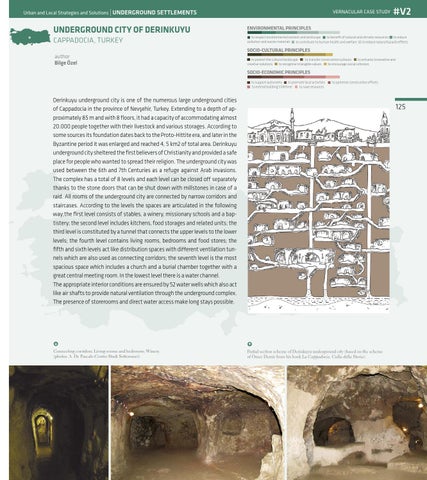
Derinkuyu underground city is one of the numerous large underground cities of Cappadocia in the province of Nevşehir, Turkey. Extending to a depth of approximately 85 m and with 8 floors, it had a capacity of accommodating almost 20.000 people together with their livestock and various storages. According to some sources its foundation dates back to the Proto-Hittite era, and later in the Byzantine period it was enlarged and reached 4, 5 km2 of total area. Derinkuyu underground city sheltered the first believers of Christianity and provided a safe place for people who wanted to spread their religion. The underground city was used between the 6th and 7th Centuries as a refuge against Arab invasions. The complex has a total of 8 levels and each level can be closed off separately thanks to the stone doors that can be shut down with millstones in case of a raid. All rooms of the underground city are connected by narrow corridors and staircases. According to the levels the spaces are articulated in the following way;the first level consists of stables, a winery, missionary schools and a baptistery; the second level includes kitchens, food storages and related units; the third level is constituted by a tunnel that connects the upper levels to the lower levels; the fourth level contains living rooms, bedrooms and food stores; the fifth and sixth levels act like distribution spaces with different ventilation tunnels which are also used as connecting corridors; the seventh level is the most spacious space which includes a church and a burial chamber together with a great central meeting room. In the lowest level there is a water channel. The appropriate interior conditions are ensured by 52 water wells which also act like air shafts to provide natural ventilation through the underground complex. The presence of storerooms and direct water access make long stays possible.
125
•
•
Connecting corridors; Living rooms and bedrooms; Winery. (photos: A. De Pascale-Centro Studi Sotterranei)
Partial section scheme of Derinkuyu underground city (based on the scheme of Ömer Demir from his book La Cappadocia. Culla della Storia).