Urban and Local Strategies and Solutions | PRODUCTIVE SETTLEMENTS
VERNACULAR CASE STUDY
#V1
THE MEDINA OF MARRAKESH
ENVIRONMENTAL PRINCIPLES
MARRAKESH, MOROCCO
to respect environmental context and landscape to benefit of natural and climatic resources to reduce pollution and waste materials to contribute to human health and welfare to reduce natural hazards effects
SOCIO-CULTURAL PRINCIPLES
author Bilge Özel
to protect the cultural landscape to transfer construction cultures to enhance innovative and creative solutions to recognise intangible values to encourage social cohesion
SOCIO-ECONOMIC PRINCIPLES to support autonomy to promote local activities to extend building's lifetime to save resources
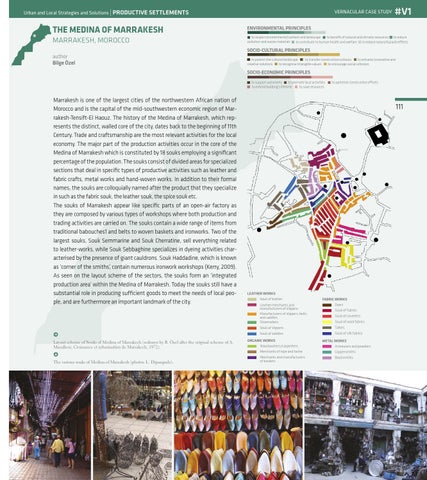
Marrakesh is one of the largest cities of the northwestern African nation of Morocco and is the capital of the mid-southwestern economic region of Marrakesh-Tensift-El Haouz. The history of the Medina of Marrakesh, which represents the distinct, walled core of the city, dates back to the beginning of 11th Century. Trade and craftsmanship are the most relevant activities for the local economy. The major part of the production activities occur in the core of the Medina of Marrakesh which is constituted by 18 souks employing a significant percentage of the population. The souks consist of divided areas for specialized sections that deal in specific types of productive activities such as leather and fabric crafts, metal works and hand-woven works. In addition to their formal names, the souks are colloquially named after the product that they specialize in such as the fabric souk, the leather souk, the spice souk etc. The souks of Marrakesh appear like specific parts of an open-air factory as they are composed by various types of workshops where both production and trading activities are carried on. The souks contain a wide range of items from traditional babouches1 and belts to woven baskets and ironworks. Two of the largest souks, Souk Semmarine and Souk Cherratine, sell everything related to leather-works, while Souk Sebbaghine specializes in dyeing activities characterised by the presence of giant cauldrons. Souk Haddadine, which is known as ‘corner of the smiths’, contain numerous ironwork workshops (Kerry, 2009). As seen on the layout scheme of the sectors, the souks form an ‘integrated production area’ within the Medina of Marrakesh. Today the souks still have a substantial role in producing sufficient goods to meet the needs of local people, and are furthermore an important landmark of the city.
• Layout scheme of Souks of Medina of Marrakech (redrawn by B. Özel after the original scheme of A. Mandleur, Croissance et urbanisation de Marrakech, 1972).
• The various souks of Medina of Marrakesh (photos: L. Dipasquale).
to optimise construction efforts
111
LEATHER WORKS Souk of leather Leather merchants and manufacturers of slippers Manufacturers of slippers, belts and saddles Shoemakers Souk of slippers Souk of saddles ORGANIC WORKS Woodworkers/carpenters Merchants of rope and twine Merchants and manufacturers of baskets
FABRIC WORKS Dyers Souk of fabrics Souk of coverlets Souk of wool fabrics Tailors Souk of silk fabrics METAL WORKS Armourers and jewellers Coppersmiths Blacksmiths