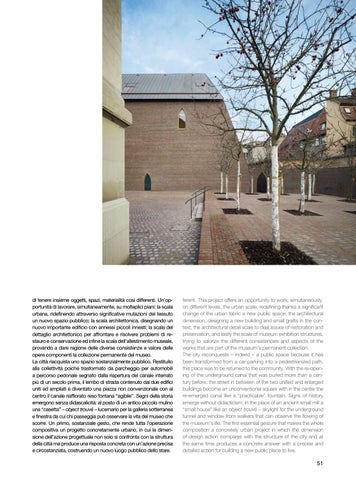
di tenere insieme oggetti, spazi, materialità così differenti. Un’opportunità di lavorare, simultaneamente, su molteplici piani: la scala urbana, ridefinendo attraverso significative mutazioni del tessuto un nuovo spazio pubblico; la scala architettonica, disegnando un nuovo importante edificio con annessi piccoli innesti; la scala del dettaglio architettonico per affrontare e risolvere problemi di restauro e conservazione ed infine la scala dell’allestimento museale, provando a dare ragione delle diverse consistenze e valore delle opere componenti la collezione permanente del museo. La città riacquista uno spazio sostanzialmente pubblico. Restituito alla collettività poiché trasformato da parcheggio per automobili a percorso pedonale segnato dalla riapertura del canale interrato più di un secolo prima, il lembo di strada contenuto dai due edifici uniti ed ampliati è diventato una piazza non convenzionale con al centro il canale riaffiorato reso fontana “agibile”. Segni della storia emergono senza didascalicità: al posto di un antico piccolo mulino una “casetta” – object trouvé – lucernario per la galleria sotterranea e finestra da cui chi passeggia può osservare la vita del museo che scorre. Un primo, sostanziale gesto, che rende tutta l’operazione compositiva un progetto concretamente urbano, in cui la dimensione dell’azione progettuale non solo si confronta con la struttura della città ma produce una risposta concreta con un’azione precisa e circostanziata, costruendo un nuovo luogo pubblico dello stare.
ferent. This project offers an opportunity to work, simultaneously, on different levels: the urban scale, redefining thanks a significant change of the urban fabric a new public space; the architectural dimension, designing a new building and small grafts in the context; the architectural detail scale to deal issues of restoration and preservation, and lastly the scale of museum exhibition structures, trying to valorize the different consistencies and aspects of the works that are part of the museum’s permanent collection. The city reconquests – indeed – a public space because it has been transformed from a car parking into a pedestrianized path, this place was to be returned to the community. With the re-opening of the underground canal that was buried more than a century before, the street in between of the two unified and enlarged buildings become an unconventional square with in the center the re-emerged canal like a “practicable” fountain. Signs of history emerge without didacticism: in the place of an ancient small mill a “small house” like an object trouvé – skylight for the underground tunnel and window from walkers that can observe the flowing of the museum’s life. The first essential gesture that makes the whole composition a concretely urban project in which the dimension of design action compares with the structure of the city and at the same time produces a concrete answer with a precise and detailed action for building a new public place to live.
51