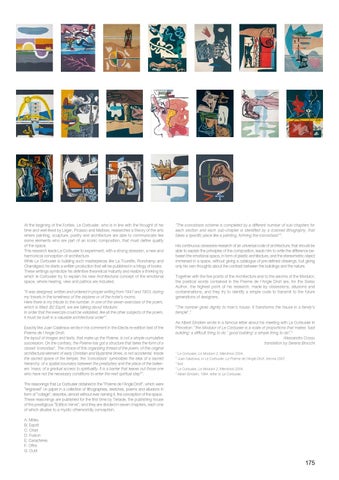
At the begining of the Forties, Le Corbusier, who is in line with the thought of his time and well-liked by Leger, Picasso and Matisse, researches a theory of the arts where painting, sculpture, poetry and architecture are able to communicate like some elements who are part of an iconic composition, that must define quality of the space. This research leads Le Corbusier to experiment, with a strong obsesion, a new and harmonical conception of architecture While Le Corbusier is building such masterpieces like La Tourette, Ronchamp and Chandigard, he starts a written production that will be published in a trilogy of books These writings symbolize his definitive theoretical maturity and realize a thinking by which le Corbusier try to explain his new Architectural concept of the emotional space, where hearing, view and pathos are included. “It was designed, written and ordered in proper writing from 1947 and 1953, during my travels in the loneliness of the airplane or of the hotel’s rooms. Here there is my tribute to the number, in one of the seven exercises of the poem, which is titled: B2 Esprit, we are talking about Modulor. In order that the exercize could be validated, like all the other subjects of the poem, it must be built in a valuable architectural order”1. Exactly like Juan Calatrava wrote in his comment in the Electa re-edition text of the Poème de l’Angle Droit: the layout of images and texts, that make up the Poème, is not a simple cumulative succession. On the contrary, the Poème has got a structure that takes the form of a closed ‘iconostasi’. The choice of this organizing thread of the poem, of this original architectural element of early Christian and Byzantine times, is not accidental. Inside the sacred space of the temple, the ‘iconostasis’ symbolizes the idea of a sacred hierarchy, of a spatial boundary between the presbytery and the place of the believers ‘mass, of a gradual access to spirituality. It is a barrier that leaves out those one who have not the necessary conditions to enter the next spiritual step”2.
“The iconostasis scheme is completed by a different number of sub-chapters for each section and each sub-chapter is identified by a lcolored lithography, that takes a specific place like a painting, forming the iconostasis”3. His continuous obsessive research of an universal code of architecture, that should be able to explain the principles of the composition, leads him to write the difference between the emotional space, in form of plastic architecture, and the stereometric object immersed in a space, without giving a catalogue of pre-defined drawings, but giving only his own thoughts about the contrast between the buildings and the nature. Together with the five points of the Architecture and to the axioms of the Modulor, the poetical words contained in the Poeme de l’Angle Droit are, for the Swiss Author, the highest point of his research, made by obsessions, allusions and contaminations, and they try to identify a simple code to transmit to the future generations of designers. “The number gives dignity to man’s house. It transforms the house in a family’s temple”.4 As Albert Einstein wrote in a famous letter about his meeting with Le Corbusier in Princeton: “the Modulor of Le Corbusier is a scale of proportions that makes ‘bad building’ a difficult thing to do ‘ good building’ a simple thing to do”.5 Alessandro Cossu translation by Serena Brocchi 1
Le Corbusier, Le Modulor 2, Mendrisio 2004. Juan Calatrava, in Le Corbusier, Le Poème de l’Angle Droit, Verona 2007 3 ibid. 4 Le Corbusier, Le Modulor 2, Mendrisio 2004. 5 Albert Einstein, 1964. letter to Le Corbusier. 2
The reasonings that Le Corbusier obtained in the “Poème de l’Angle Droit”, which were “engraved” on paper in a collection of lithographies, sketches, poems and allusions in form of “collage”, describe, almost without ever naming it, the conception of the space. These reasonings are published for the first time by Tèriade, the publishing house of the prestigious “Edition Verve”, and they are divided in seven chapters, each one of which alludes to a mystic otherworldly conception. A: Milieu B: Esprit C: Chair D: Fusion E: Caractères F: Offre G: Outil
175