The Devonport Flagstaff Page 16
Interview
April 4 2014
Home to Shore – Johnstone completes circle
Brad Johnstone was part of the 1978 Grand Slam All Black team. He has coached the Fijian and Italian national sides. But his heart has always been at North Shore Rugby Club. Johnstone has been named the club’s president for 2014. He spoke to Rob Drent.
Life for Brad Johnstone has come full circleand he couldn’t be happier. Almost 60 years ago he was a five-year-old playing his first games for North Shore Rugby club. Now he is at the club early on Saturday mornings again - watching his five-year-old granddaughter Alyah cutting her teeth on Rippa Rugby. “I was approached last year to be president. Now I’m back down the club on Saturday morning…just like my parents (Ron and Norma) used to do when we were kids… it completes the circle,” Johnstone says. “The club has been a huge part of my life – even when I was overseas I would always come back to the club,” he says. It is also a place of family history: Johnstone’s father Ron was a star player and was coach of the senior side when Brad first pulled on his boots; friendship: many of Johnstone’s lifelong friends were made at the club; and achievement: although a great Auckland player, All Black and coach, at the top of Johnstone’s list of achievements is fact he played for North Shore for 30 years including 167 senior games. Johnstone is grateful for the community-based Shore culture which allowed him to develop into what became a stellar rugby career. Johnstone was a tall, mobile prop who used to jump at number two in the lineout as well. He would have had the ball handling skills for today’s game; while today’s props are generally shorter and squatter for lifting, Johnstone was similar in size to Wyatt Crockett who has made it to the top. From 1971 to 1981 he played 126 games for Auckland, 62 as captain. He and Ron remain the only two father and sons to have each captained a Ranfurly Shield winning side. Selected for the New Zealand Juniors, Johnstone played 22 games – including famously beating the All Blacks in 1973. It wasn’t long before he made the
www.scapetech.co.nz scapetech@clear.net.nz
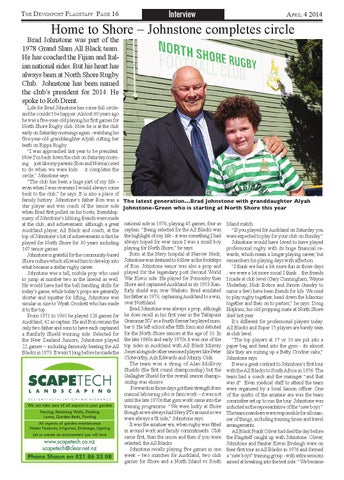
The latest generation…Brad Johnstone with granddaughter Alyah Johnstone-Green who is starting at North Shore this year national side in 1976, playing 45 games, four as captain. “Being selected for the All Blacks was the highlight of my life - it was something I had always hoped for ever since I was a small boy playing for North Shore,” he says. Born at the Navy hospital at Narrow Neck, Johnstone was destined to follow in the footsteps of Ron. Johnstone senior was also a prop and played for the legendary post Second World War Kiwis side. He played for Ponsonby then Shore and captained Auckland in its 1953 Ranfurly shield win over Waikato. Brad emulated his father in 1978, captaining Auckland to a win, over Northland. Brad Johnstone was always a prop, although he does recall in his first year in the Takapuna Grammar XV as a fourth former he played number 8. He left school after fifth form and debuted for the North Shore seniors at the age of 18. In the late 1960s and early 1970s it was one of the top sides in Auckland with All Black Murray Jones alongside other seasoned players like Peter Clotworthy, Ash Edwards and Johnny Olds. The team won a string of Alan McEvoy Shields (the first round championship) but the Gallagher Shield for the overall season championship was elusive. Forwards in those days got their strength from manual labouring jobs or farm work – it was not until the late 1970s that gym work came into the training programme. “We were lucky at Shore though as we always had Navy PTs around so we were always a fit side,” Johnstone says. It was the amatuer era, when rugby was fitted in around work and family commitments. Club came first, then the union and then if you were selected, the All Blacks. Johnstone recalls playing five games in one week – two matches for Auckland, two club games for Shore and a North Island vs South
Island match. “If you played for Auckland on Saturday you were expected to play for your club on Sunday.” Johnstone would have loved to have played professional rugby with its huge financial rewards, which mean a longer playing career, but remembers his playing days with affection. “I think we had a lot more fun in those days - we were a lot more social I think…the friends I made at club level (Gary Cunningham, Wayne Underhay, Nick Botica and Simon Gundry to name a few) have been friends for life. We used to play rugby together, head down the Masonic together and then on to parties,” he says. Doug Hopkins, his old propping mate at North Shore died last year It’s different for professional players today. All Blacks and Super 15 players are barely seen at club level. “The top players at 17 or 18 are put into a paper bag and head into the gym - its almost like they are mixing up a Betty Crocker cake,” Johnstone says. It was a great contrast to Johnstone’s first tour with the All Blacks to South Africa in 1976. The team had a coach and the manager “and that was it”. Even medical staff to attend the team were organised by a local liaison officer. One of the quirks of the amateur era was the team committee set up to run the tour. Johnstone was inducted as the representative of the “new boys.” The team members were responsible for all manner of things, including training times and travel arrangements. All Black Frank Oliver had died the day before the Flagstaff caught up with Johnstone. Oliver, Johnstone and flanker Kevin Eveleigh were on their first tour as All Blacks in 1976 and formed a “new boys” training group - with extra sessions aimed at breaking into the test side. “We became