IES UPDATE
Design for Safety Seminar and Master Class 2017 by Berina Tiong, Department of Building, NUS, and Dr Goh Yang Miang, Health and Safety Engineering Technical Committee, IES
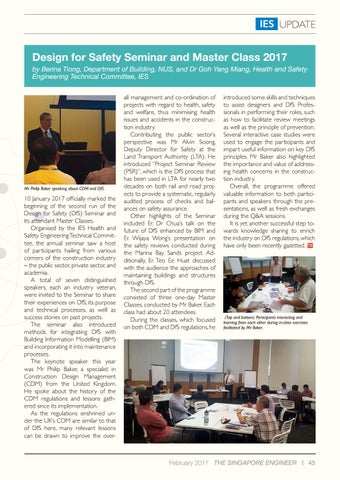
Mr Philip Baker speaking about CDM and DfS.
10 January 2017 officially marked the beginning of the second run of the Design for Safety (DfS) Seminar and its attendant Master Classes. Organised by the IES Health and Safety Engineering Technical Committee, the annual seminar saw a host of participants hailing from various corners of the construction industry – the public sector, private sector, and academia. A total of seven distinguished speakers, each an industry veteran, were invited to the Seminar to share their experiences on DfS, its purpose and technical processes, as well as success stories on past projects. The seminar also introduced methods for integrating DfS with Building Information Modelling (BIM) and incorporating it into maintenance processes. The keynote speaker this year was Mr Philip Baker, a specialist in Construction Design Management (CDM) from the United Kingdom. He spoke about the history of the CDM regulations and lessons gathered since its implementation. As the regulations enshrined under the UK’s CDM are similar to that of DfS here, many relevant lessons can be drawn to improve the over-
all management and co-ordination of projects with regard to health, safety and welfare, thus minimising health issues and accidents in the construction industry. Contributing the public sector’s perspective was Mr Alvin Soong, Deputy Director for Safety at the Land Transport Authority (LTA). He introduced “Project Seminar Review (PSR)”, which is the DfS process that has been used in LTA for nearly two decades on both rail and road projects to provide a systematic, regularly audited process of checks and balances on safety assurance. Other highlights of the Seminar included Er. Dr Chua’s talk on the future of DfS enhanced by BIM and Er. Wijaya Wong’s presentation on the safety reviews conducted during the Marina Bay Sands project. Additionally, Er. Teo Ee Huat discussed with the audience the approaches of maintaining buildings and structures through DfS. The second part of the programme consisted of three one-day Master Classes, conducted by Mr Baker. Each class had about 20 attendees. During the classes, which focused on both CDM and DfS regulations, he
introduced some skills and techniques to assist designers and DfS Professionals in performing their roles, such as how to facilitate review meetings as well as the principle of prevention. Several interactive case studies were used to engage the participants and impart useful information on key DfS principles. Mr Baker also highlighted the importance and value of addressing health concerns in the construction industry. Overall, the programme offered valuable information to both participants and speakers through the presentations, as well as fresh exchanges during the Q&A sessions. It is yet another successful step towards knowledge sharing to enrich the industry on DfS regulations, which have only been recently gazetted. TSE
(Top and bottom) Participants interacting and learning from each other during in-class exercises facilitated by Mr Baker.
February 2017 THE SINGAPORE ENGINEER
45