IES UPDATE
A step back into history - NUS Baba House By Er. Emily Tan, Chairman of Women in Science, Engineering & Research (WiSER) Committee & Mr Eng Zi Feng, 3rd-year undergraduate, Bachelor of Engineering (Civil), NUS Along Neil Road sits a beautiful three-storey terrace house, its exterior painted a pleasant powder-blue. With its intricate exterior ornaments and carvings, it stands out from its contemporaries in the Residential Historic District of Blair Plain. On 10 January 2017, the IES WiSER Committee organised a visit to this lesser-known historical gem: the NUS Baba House. It is a traditional pre-war Peranakan house, formerly owned by the late shipping tycoon Wee Bin and managed by the NUS Museum today. Nearly 20 of us spent a fascinating evening there. Having made ourselves comfortable, the curator started our tour with an introduction to the heritage of the past owners of the house, the Peranakan Chinese. They were the descendants of Chinese immigrants who came to the Malay Archipelago between the 15th and 17th centuries. Over time, many assimilated into local communities and married the natives, giving rise to the Peranakan and their unique culture. Our attention was brought to the elaborate dĂŠcor inside the House, a manifestation of the exquisite mixture of Chinese and Malay culture, practice and religion. A modern parallel will probably be the multicultural, multi-ethnic Singapore that we live in and are so proud of today. At the front yard, we were taken aback by the elaborate carvings of phoenixes and peonies on the exterior walls. Painstakingly constructed using broken pieces of pottery, these decorations signified the opulence and wealth of the household. Back in the main hall where business meetings were once held, we saw dozens of calligraphy scrolls (not
44
written by the owners) on the walls. We were told that it was common practice then to display such scrolls at home to impress visitors and business associates. The curator explained to us that a fair amount of engineering works had to be carried out upon NUS’ acquisition of the house in 2005 as the wooden floorboards of the old house had already reached the end of their lifespans. Apparently, in the process of conservation works, Chinese almanacs were discovered, hidden discreetly above the roof of the house. These almanacs were believed to help dispel bad luck and ward against evil spirits!
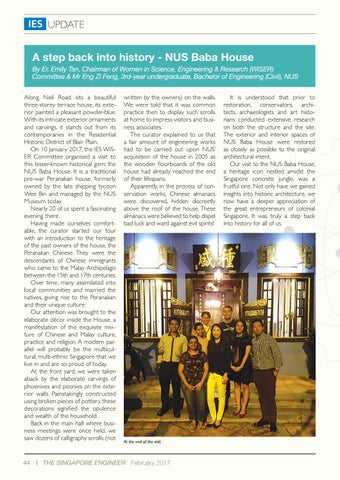
At the end of the visit.
THE SINGAPORE ENGINEER February 2017
It is understood that prior to restoration, conservators, architects, archaeologists and art historians conducted extensive research on both the structure and the site. The exterior and interior spaces of NUS Baba House were restored as closely as possible to the original architectural intent. Our visit to the NUS Baba House, a heritage icon nestled amidst the Singapore concrete jungle, was a fruitful one. Not only have we gained insights into historic architecture, we now have a deeper appreciation of the great entrepreneurs of colonial Singapore. It was truly a step back into history for all of us.