HEALTH & SAFETY ENGINEERING
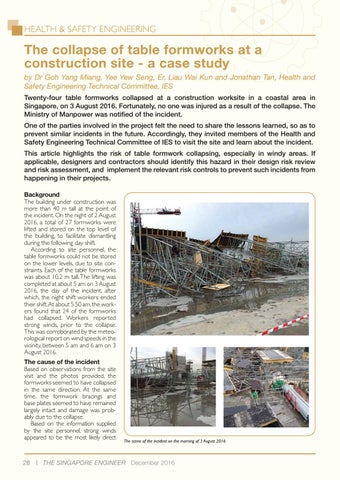
The collapse of table formworks at a construction site - a case study by Dr Goh Yang Miang, Yee Yew Seng, Er. Liau Wai Kun and Jonathan Tan, Health and Safety Engineering Technical Committee, IES Twenty-four table formworks collapsed at a construction worksite in a coastal area in Singapore, on 3 August 2016. Fortunately, no one was injured as a result of the collapse. The Ministry of Manpower was notiďŹ ed of the incident. One of the parties involved in the project felt the need to share the lessons learned, so as to prevent similar incidents in the future. Accordingly, they invited members of the Health and Safety Engineering Technical Committee of IES to visit the site and learn about the incident. This article highlights the risk of table formwork collapsing, especially in windy areas. If applicable, designers and contractors should identify this hazard in their design risk review and risk assessment, and implement the relevant risk controls to prevent such incidents from happening in their projects. Background The building under construction was more than 40 m tall at the point of the incident. On the night of 2 August 2016, a total of 27 formworks were lifted and stored on the top level of the building, to facilitate dismantling during the following day shift. According to site personnel, the table formworks could not be stored on the lower levels, due to site constraints. Each of the table formworks was about 10.2 m tall. The lifting was completed at about 5 am on 3 August 2016, the day of the incident, after which, the night shift workers ended their shift. At about 5.50 am, the workers found that 24 of the formworks had collapsed. Workers reported strong winds, prior to the collapse. This was corroborated by the meteorological report on wind speeds in the vicinity, between 5 am and 6 am on 3 August 2016. The cause of the incident Based on observations from the site visit and the photos provided, the formworks seemed to have collapsed in the same direction. At the same time, the formwork bracings and base plates seemed to have remained largely intact and damage was probably due to the collapse. Based on the information supplied by the site personnel, strong winds appeared to be the most likely direct
28
The scene of the incident on the morning of 3 August 2016
THE SINGAPORE ENGINEER December 2016