COVER STORY Project: Enhancing Sustainable Construction through an Innovative Prefabrication Solution - The Spiral Connector system
Organisation: Housing & Development Board Housing & Development Board (HDB) has, over the years, developed and implemented its own fully prefabricated building system, as par t of its effor ts to increase buildability, improve productivity, reduce material wastage and ensure safety in construction works, in order to achieve sustainable construction. Towards the late 1990s, the use of precast concrete was extended to critical structural concrete elements such as columns, beams and lift shafts. The Spiral Connector system was developed as a safe, reliable, cost-effective connection system for splicing precast components. It embraces the theory of ‘concrete confinement and shear action’, to generate the required strength for connecting reinforcement bars efficiently. The connector system has undergone rigorous tests to meet the high performance standards. Unique in its design, it has been patented in Singapore, China and India.
The Spiral Connector System. Image by HDB.
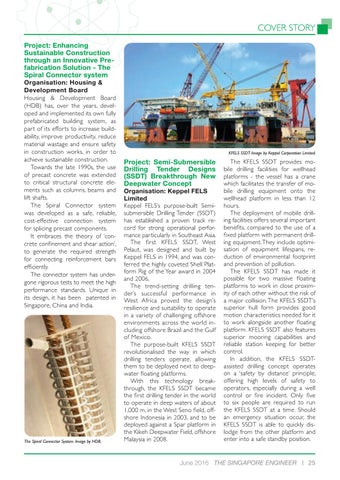
KFELS SSDT. Image by Keppel Corporation Limited.
Project: Semi-Submersible Drilling Tender Designs (SSDT) Breakthrough New Deepwater Concept
Organisation: Keppel FELS Limited Keppel FELS’s purpose-built Semisubmersible Drilling Tender (SSDT) has established a proven track record for strong operational performance particularly in Southeast Asia. The first KFELS SSDT, West Pelaut, was designed and built by Keppel FELS in 1994, and was conferred the highly coveted Shell Platform Rig of the Year award in 2004 and 2006. The trend-setting drilling tender’s successful performance in West Africa proved the design’s resilience and suitability to operate in a variety of challenging offshore environments across the world including offshore Brazil and the Gulf of Mexico. The purpose-built KFELS SSDT revolutionalised the way in which drilling tenders operate, allowing them to be deployed next to deepwater floating platforms. With this technology breakthrough, the KFELS SSDT became the first drilling tender in the world to operate in deep waters of about 1,000 m, in the West Seno field, offshore Indonesia in 2003, and to be deployed against a Spar platform in the Kikeh Deepwater Field, offshore Malaysia in 2008.
The KFELS SSDT provides mobile drilling facilities for wellhead platforms - the vessel has a crane which facilitates the transfer of mobile drilling equipment onto the wellhead platform in less than 12 hours. The deployment of mobile drilling facilities offers several impor tant benefits, compared to the use of a fixed platform with permanent drilling equipment. They include optimisation of equipment lifespans, reduction of environmental footprint and prevention of pollution. The KFELS SSDT has made it possible for two massive floating platforms to work in close proximity of each other without the risk of a major collision. The KFELS SSDT’s superior hull form provides good motion characteristics needed for it to work alongside another floating platform. KFELS SSDT also features superior mooring capabilities and reliable station keeping for better control. In addition, the KFELS SSDTassisted drilling concept operates on a ‘safety by distance’ principle, offering high levels of safety to operators, especially during a well control or fire incident. Only five to six people are required to run the KFELS SSDT at a time. Should an emergency situation occur, the KFELS SSDT is able to quickly dislodge from the other platform and enter into a safe standby position.
June 2016 THE SINGAPORE ENGINEER
25