illed
g-b Lon P h o to
by Na
th a n
lew
Cur
C la rk
BIRD WATCHING
“My f a v o r i t e w e a t h e r i s bird-c h i r p i n g w e a t h e r. ” -Te r r i G u i l l e m e t s
T
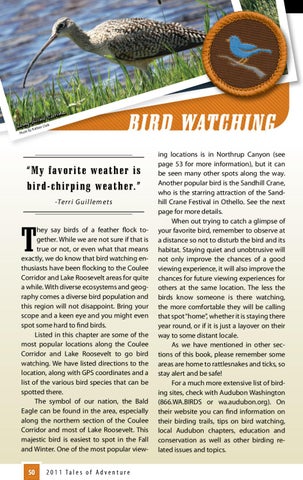
hey say birds of a feather flock together. While we are not sure if that is true or not, or even what that means exactly, we do know that bird watching enthusiasts have been flocking to the Coulee Corridor and Lake Roosevelt areas for quite a while. With diverse ecosystems and geography comes a diverse bird population and this region will not disappoint. Bring your scope and a keen eye and you might even spot some hard to find birds. Listed in this chapter are some of the most popular locations along the Coulee Corridor and Lake Roosevelt to go bird watching. We have listed directions to the location, along with GPS coordinates and a list of the various bird species that can be spotted there. The symbol of our nation, the Bald Eagle can be found in the area, especially along the northern section of the Coulee Corridor and most of Lake Roosevelt. This majestic bird is easiest to spot in the Fall and Winter. One of the most popular view-
50
2 0 1 1 Ta l e s o f A d ve n t u re
ing locations is in Northrup Canyon (see page 53 for more information), but it can be seen many other spots along the way. Another popular bird is the Sandhill Crane, who is the starring attraction of the Sandhill Crane Festival in Othello. See the next page for more details. When out trying to catch a glimpse of your favorite bird, remember to observe at a distance so not to disturb the bird and its habitat. Staying quiet and unobtrusive will not only improve the chances of a good viewing experience, it will also improve the chances for future viewing experiences for others at the same location. The less the birds know someone is there watching, the more comfortable they will be calling that spot “home”, whether it is staying there year round, or if it is just a layover on their way to some distant locale. As we have mentioned in other sections of this book, please remember some areas are home to rattlesnakes and ticks, so stay alert and be safe! For a much more extensive list of birding sites, check with Audubon Washington (866.WA.BIRDS or wa.audubon.org). On their website you can find information on their birding trails, tips on bird watching, local Audubon chapters, education and conservation as well as other birding related issues and topics.