Chatterjee Designs New Capital City
N
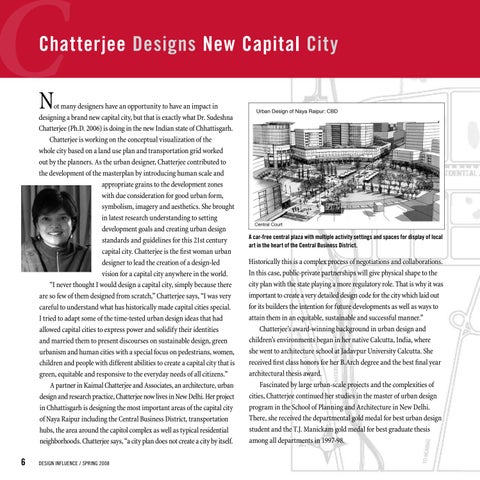
ot many designers have an opportunity to have an impact in designing a brand new capital city, but that is exactly what Dr. Sudeshna Chatterjee (Ph.D. 2006) is doing in the new Indian state of Chhattisgarh. Chatterjee is working on the conceptual visualization of the whole city based on a land use plan and transportation grid worked out by the planners. As the urban designer, Chatterjee contributed to the development of the masterplan by introducing human scale and appropriate grains to the development zones with due consideration for good urban form, symbolism, imagery and aesthetics. She brought in latest research understanding to setting development goals and creating urban design standards and guidelines for this 21st century capital city. Chatterjee is the first woman urban designer to lead the creation of a design-led vision for a capital city anywhere in the world. “I never thought I would design a capital city, simply because there are so few of them designed from scratch,” Chatterjee says, “I was very careful to understand what has historically made capital cities special. I tried to adapt some of the time-tested urban design ideas that had allowed capital cities to express power and solidify their identities and married them to present discourses on sustainable design, green urbanism and human cities with a special focus on pedestrians, women, children and people with different abilities to create a capital city that is green, equitable and responsive to the everyday needs of all citizens.” A partner in Kaimal Chatterjee and Associates, an architecture, urban design and research practice, Chatterjee now lives in New Delhi. Her project in Chhattisgarh is designing the most important areas of the capital city of Naya Raipur including the Central Business District, transportation hubs, the area around the capitol complex as well as typical residential neighborhoods. Chatterjee says, “a city plan does not create a city by itself.
DESIGN INFLUENCE / SPRING 2008
A car-free central plaza with multiple activity settings and spaces for display of local art in the heart of the Central Business District.
Historically this is a complex process of negotiations and collaborations. In this case, public-private partnerships will give physical shape to the city plan with the state playing a more regulatory role. That is why it was important to create a very detailed design code for the city which laid out for its builders the intention for future developments as well as ways to attain them in an equitable, sustainable and successful manner.” Chatterjee’s award-winning background in urban design and children’s environments began in her native Calcutta, India, where she went to architecture school at Jadavpur University Calcutta. She received first class honors for her B.Arch degree and the best final year architectural thesis award. Fascinated by large urban-scale projects and the complexities of cities, Chatterjee continued her studies in the master of urban design program in the School of Planning and Architecture in New Delhi. There, she received the departmental gold medal for best urban design student and the T.J. Manickam gold medal for best graduate thesis among all departments in 1997-98.
She worked as an urban designer and architect in the practice of Joseph Allen Stein (Stein Mani Chowfla Architects) until 2002. During her spare time, she actively devoted time to non-governmental organizations (NGOs) that design and enhance children’s environments such as parks, play schools and school for special needs children. With a goal to become an expert on research and design of children’s environments, especially in developing cities, Chatterjee began working as a research associate with the Habitat International Coalition’s Housing and Land Rights Network in Delhi. She developed work on children’s housing rights in South Asia, resulting in two international publications and gained first-hand networking with officials from the United Nations Child-Friendly Cities Secretariat in international conferences. This experience and networking greatly benefited her in designing her Ph.D. dissertation on child-friendly cities. In 2001 she won a Mellon short-term fellowship to attend an international seminar series titled “Contested Childhood in a Changing Global Order” held at the University of Michigan in Ann Arbor. Chatterjee made the decision prior to the seminar that she wanted to pursue a Ph.D. She chose to study at NC State so she could work with Robin Moore, director of the Natural Learning Initiative and professor in landscape architecture. Continuing to win awards for her research, Chatterjee’s dissertation was selected as the only NC State nominee to the national CGS/microfilms International Distinguished Dissertation awards in the field of Fine Arts/Humanities. Her dissertation is titled “Children’s Friendship with Place: An Exploration of Environmental Child Friendliness of Children’s Environments in Cities.” In April 2006, while Chatterjee was preparing for her dissertation defense in Raleigh, she was invited to serve as the News Archive Editor for the international peer-reviewed journal, “Children, Youth and Environments (CYE).” She has since contributed over 50 news stories on the subject to CYE and has been made a research affiliate of the Children, Youth and Environments Center for Research and Design at the University of Colorado, Boulder. Chatterjee also has a hand in designing several schools as developmentally adequate and child-friendly environments, including the first environmental school in the central Himalayas through community participation. She is also an integral part of a new initiative to provide sustainable community owned rural education in villages across India.
Her firm was selected to redesign the public spaces of Apollo Hospital, the largest, private hospital in New Delhi. Recently, Chatterjee was invited to Phnom Penh, Cambodia, by the World Education and Cambodia Living Arts (CLA) to understand how performing arts have been revived in that country through the intervention of organizations such as CLA. This preliminary research is exploring the possibility of a new arts-led planning vision of the city including creation of an arts district in Phnom Penh to promote the city as a venue for big international arts events. “I feel really happy that I had been given the opportunities to use my training in community and environmental design research to understand the needs of a community before developing policies or designs to bring in preferred change through physical interventions,” she says. Chatterjee continues to teach graduate courses in the School of Planning and Architecture in New Delhi, and work as an editor, writer and reviewer for CYE and EDRA. As for the future, she hopes to publish her dissertation into a monograph. She also wants to write a children’s book on some of the findings she feels have great value for environmental education. The Arab Urban Development Institute is spearheading an international initiative to create child-friendly cities across the Middle East by creating the right regional, national and local policies. Chatterjee has been engaged by AUDI as a resource person with international expertise on child-friendly cities to provide content and peer review regarding the new policies and guidelines emerging out of this initiative. However, her goal of making cities childfriendly through design is coming true by being an integral part of designing this Typical Residential Sector Layout – A multi-nodal open space system with pedestrian and cycle new capital city—a routes that connects the neighborhood end to once in a lifetime end and centers the diverse mix of housing types opportunity. around a shared community space. FEATURE ARTICLE