Affordable Housing Internship Program Launched
A
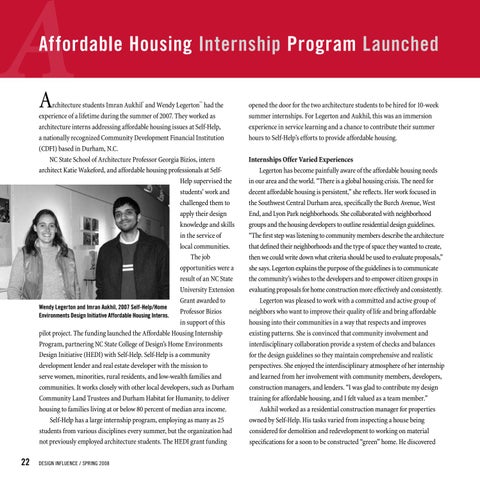
rchitecture students Imran Aukhil* and Wendy Legerton** had the experience of a lifetime during the summer of 2007. They worked as architecture interns addressing affordable housing issues at Self-Help, a nationally recognized Community Development Financial Institution (CDFI) based in Durham, N.C. NC State School of Architecture Professor Georgia Bizios, intern architect Katie Wakeford, and affordable housing professionals at SelfHelp supervised the students’ work and challenged them to apply their design knowledge and skills in the service of local communities. The job opportunities were a result of an NC State University Extension Grant awarded to Wendy Legerton and Imran Aukhil, 2007 Self-Help/Home Professor Bizios Environments Design Initiative Affordable Housing Interns. in support of this pilot project. The funding launched the Affordable Housing Internship Program, partnering NC State College of Design’s Home Environments Design Initiative (HEDI) with Self-Help. Self-Help is a community development lender and real estate developer with the mission to serve women, minorities, rural residents, and low-wealth families and communities. It works closely with other local developers, such as Durham Community Land Trustees and Durham Habitat for Humanity, to deliver housing to families living at or below 80 percent of median area income. Self-Help has a large internship program, employing as many as 25 students from various disciplines every summer, but the organization had not previously employed architecture students. The HEDI grant funding
22
DESIGN INFLUENCE / SPRING 2008
opened the door for the two architecture students to be hired for 10-week summer internships. For Legerton and Aukhil, this was an immersion experience in service learning and a chance to contribute their summer hours to Self-Help’s efforts to provide affordable housing. Internships Offer Varied Experiences Legerton has become painfully aware of the affordable housing needs in our area and the world. “There is a global housing crisis. The need for decent affordable housing is persistent,” she reflects. Her work focused in the Southwest Central Durham area, specifically the Burch Avenue, West End, and Lyon Park neighborhoods. She collaborated with neighborhood groups and the housing developers to outline residential design guidelines. “The first step was listening to community members describe the architecture that defined their neighborhoods and the type of space they wanted to create, then we could write down what criteria should be used to evaluate proposals,” she says. Legerton explains the purpose of the guidelines is to communicate the community’s wishes to the developers and to empower citizen groups in evaluating proposals for home construction more effectively and consistently. Legerton was pleased to work with a committed and active group of neighbors who want to improve their quality of life and bring affordable housing into their communities in a way that respects and improves existing patterns. She is convinced that community involvement and interdisciplinary collaboration provide a system of checks and balances for the design guidelines so they maintain comprehensive and realistic perspectives. She enjoyed the interdisciplinary atmosphere of her internship and learned from her involvement with community members, developers, construction managers, and lenders. “I was glad to contribute my design training for affordable housing, and I felt valued as a team member.” Aukhil worked as a residential construction manager for properties owned by Self-Help. His tasks varied from inspecting a house being considered for demolition and redevelopment to working on material specifications for a soon to be constructed “green” home. He discovered
Streetscape analysis by Wendy Legerton.
that balancing sustainability with affordability can be difficult. The goals of making a house cost-efficient and environmentally responsible require thoughtful negotiations and sometimes compromise. Aukhil also prepared the drawings required for town approval of a Self-Help development project in Goldsboro, N.C. Like Legerton, his job involved opportunities to meet with community members, listen to their needs and learn how his design training could be useful to local neighborhoods. Lessons Learned The practical experience of the internships was enriched by a commitment to understand and apply current thinking on service-learning pedagogy. During meetings with Bizios, Wakeford, and Dr. Patti Clayton, Director of the Center for Excellence in Curricular Engagement, the students were introduced to theoretical frameworks of service-learning and encouraged to examine the challenges and successes of their work in the field. Critical reflection essays written by the interns at the end of the summer provided valuable insight for both students and faculty. Aukhil learned that the practice of architecture is different than the
theory. “As an architect, you have to help fill the gaps between the contractors, lenders, politicians, responding to codes and regulations and differing opinions. It is a struggle,” he notes. “These lessons and reflections are invaluable to my understanding of housing design and construction,” he adds. Legerton continued to work as an intern at Self-Help during fall semester. The work has focused her career goals. “I will continue to ask, ‘How can I use my design training to serve the world’s greatest needs?’ When I look for jobs, I will look for firms that are involved in social and environmental justice work and value team building and interdisciplinary collaboration.” Aukhil stated that he would like to see this Affordable Housing Internship Program develop further, to include more organizations and more students. Indeed, HEDI is currently seeking funding to continue to support future interns in public service and specifically affordable housing. Professor Bizios points out that “such opportunities for students and recent graduates make the School of Architecture a leader in providing new models for architecture internships, integrating education and practice while serving the public.” * Imran Aukhil is a senior in the BEDA program and plans to graduate in May 2008. **Wendy Legerton received her M.Arch. degree in December 2007.
FEATURE ARTICLE
23