Croxton Excels in Sustainable Design
“L
iving green” and sustainability are popular terms these days, but environmental design is not a new concept for Randy Croxton (B.Arch. 1968). After graduating from the School of Architecture, Croxton worked in New York City with I.M. Pei until 1974, when he partnered with Harry Wolf and Marley Carroll (B.Arch. 1962) to found Wolf Associates, New York. In founding Croxton Collaborative Architects in 1978, Croxton says, “I felt at the time that architecture was dominated by the ‘star’ architect and a style-driven/superficial approach to design. My intention was to build a firm around a collaborative or team approach and, more importantly, to bring greater meaning and value to the design process by placing issues of site, community, environment and client mission first in criteria for design excellence. These deeper and unique insights would then inform the unique design/stylistic expression of each project. For our firm, there would be no repetitive ‘signature’ look; each project would be unique to its client, site and natural setting.” Early success came in 1984, with the firm’s receipt of the AIA National Honor Award for Design Excellence for the restoration/renovation of the landmark 1928 R.J. Reynolds Tobacco Company Headquarters in downtown Winston-Salem, N.C. Notably, this was completed in collaboration with Hammill-Walter Associates (Lloyd Walter, Jr. – B.Arch. 1960). In 1986, with the commission for the new headquarters of the Natural Resources Defense Council (NRDC), a final evolution of those principles emerged that has guided the work of the firm to this day. NRDC
18
DESIGN INFLUENCE / SPRING 2008
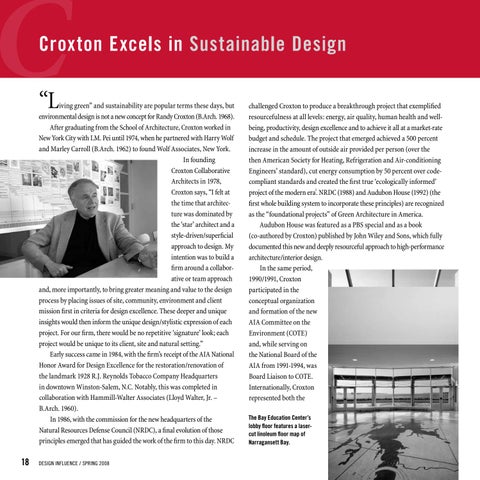
challenged Croxton to produce a breakthrough project that exemplified resourcefulness at all levels: energy, air quality, human health and wellbeing, productivity, design excellence and to achieve it all at a market-rate budget and schedule. The project that emerged achieved a 500 percent increase in the amount of outside air provided per person (over the then American Society for Heating, Refrigeration and Air-conditioning Engineers’ standard), cut energy consumption by 50 percent over codecompliant standards and created the first true ‘ecologically informed’ project of the modern era1. NRDC (1988) and Audubon House (1992) (the first whole building system to incorporate these principles) are recognized as the “foundational projects” of Green Architecture in America. Audubon House was featured as a PBS special and as a book (co-authored by Croxton) published by John Wiley and Sons, which fully documented this new and deeply resourceful approach to high-performance architecture/interior design. In the same period, 1990/1991, Croxton participated in the conceptual organization and formation of the new AIA Committee on the Environment (COTE) and, while serving on the National Board of the AIA from 1991-1994, was Board Liaison to COTE. Internationally, Croxton represented both the The Bay Education Center’s lobby floor features a lasercut linoleum floor map of Narragansett Bay.
The Bay Education Center’s three-tiered design in the administrative wing (left) maximizes daylight and features light “sails” (right) to reflect light to the ceiling and diffuse light into workstations.
AIA and the International Union of Architects (UIA) in the Preparatory Committee (PREP COMM) meetings at the United Nations in New York City prior to the Earth Summit in Rio de Janeiro in the summer of 1992. The core issue under negotiations was the Agenda 21 section on “Human Settlements” and how to define/incorporate the new concept of Sustainability2. Croxton was invited and presented Audubon House, as an exemplar of sustainability, at both the U.N. Earth Summit in 1992 and the U.N. Social Summit in Copenhagen in 1995. Importantly, Croxton also developed “metrics,” or measures of sustainability, which were presented at Rio de Janeiro in 1992 and formally incorporated in the first two National Institute of Standards and Technology (NIST) National Green Demonstration Projects completed by Croxton Collaborative in 1994. These models preceded the U.S. Green Building Council’s (USGBC) LEED 1.0 program by five years. Croxton was active in the conceptual organization and formation of the USGBC and delivered the first Pioneer of Green Design lecture at the USGBC National Convention in 2006. For the last three consecutive years (2005-2007) Croxton Collaborative Architects has won the profession’s highest award for sustainable design excellence, the National AIA COTE Top Ten Green Projects award. The firm was the primary author for the Sustainable Design Guidelines and Reference Manual for the redevelopment of the World Trade Center in New York City. In addition, they have received the 2004 EPA Region Two Environmental Quality Award for Leadership, the 2005 USGBC
National Leadership Award, the 2005 EPA Region One Phoenix Award for Outstanding Brownfield Redevelopment, and the first Annual Sustainability Award given by the City of Philadelphia in 2007. Croxton’s course “Architecture and Sustainability,” taught at Harvard’s Graduate School of Design in the Executive Education Program, is entering its 14th year and Croxton continues to lecture nationally and internationally. The new Ministry of Tourism Offices, an office complex of 250,000 square feet in Riyadh, Saudi Arabia, designed by Croxton Collaborative and located in the Diplomatic Quarter, was just fully occupied in December 2007. Looking back on his formative years at the then-School of Design, Croxton admits that it was many years past graduation that he attended school’s 50th Anniversary and fully understood Dean Kamphoefner’s conscious strategy of selecting strong, individualistic and innovative faculty. “The students’ impression may have been one of being pushed and pulled and having to defend many points of view, however, I feel that whatever levels of innovation or reconsideration I have been able to achieve in my career have been fundamentally facilitated by that experience,” says Croxton. 1 Climate = seasonal heating and cooling required. Building Type = commercial office building. 2 Sustainability is a concept first articulated in the United Nations Brundtland Commission Report: “Our Common
Future” 1987.
FEATURE ARTICLE
19