Wolflands Provides NC State Second Life
F
or students enrolled in distance education classes, one challenge is in having face-to-face interactions with their instructor and other students. At NC State, research being conducted by DELTA (Distance Education and Learning Technology Applications) is exploring how 3-D online learning environments can be used to simulate these interactions and provide other venues for students to hold meetings, engage in role-playing activities, simulate a real-world lab experience, or even allow prospective students to visit the campus and interact with current students—virtually. Linden Lab’s Second Life is one such tool the team at DELTA is exploring. Second Life is a virtual reality universe that is centered in a 3-D visual space. The use of Second Life has taken off quickly since its inception in 2003, with Linden Lab CEO Philip Rosedale reporting as many as 57,000 users logged in worldwide at any given time, and nearly 9 million accounts in total. Second Life has its own economy, where users purchase virtual clothing, homes and even pets using Linden Dollars. Popular television shows such as “CSI,” “Law and Order” and “The Office” have all aired episodes involving Second Life. Dozens of corporations, including BMW, Ben & Jerry’s and IBM, see the economic potential of this budding new
technology and have developed a presence in Second Life. More than 100 universities also have a presence in Second Life. Dr. Tom Miller, Vice Provost for DELTA, charged his team with investigating Second Life as part of their 3-D Online Learning Environments initiative in June 2007. “3-D virtual environments will have a very significant impact on online learning,” Miller said. “By providing mechanisms for virtual co-location for students and teachers to interact, they add back in a ‘learning community’ aspect which has always been a critical component of face-to-face instruction but has been sorely lacking in traditional online learning environments.” The DELTA Second Life team, with project leadership provided by Amanda Robertson (BGD 1997, MID 2004), has created an island for NC State named Wolflands. Wolflands is available to the public, though the island has not yet been publicized widely. DELTA is building the proof of concept and will continue to maintain and support Second Life during this research phase. “If the university decides that Second Life is a viable production tool, there would need to be resources established and training available for instructors,” said Robertson.
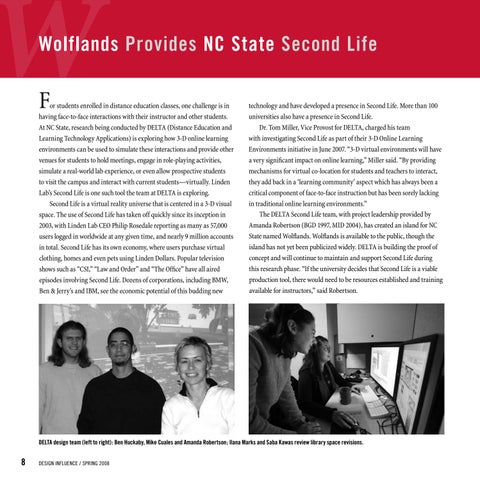
DELTA design team (left to right): Ben Huckaby, Mike Cuales and Amanda Robertson; Ilana Marks and Saba Kawas review library space revisions.
DESIGN INFLUENCE / SPRING 2008
Robertson and the Second Life team are not duplicating NC State’s campus in a photo-realistic way, but decided to make Wolflands a futuristic space—one that embraces the conventions established by Linden Lab. Flight, for example, is the main mode of navigation for characters, or avatars, in Second Life. “The approach to defining the design and development in Second Life has been to create an overall open atmosphere that embraced the navigation of avatars and the unique aspect afforded by this digital space,” said Robertson. “This is a huge collaboration effort amongst several talented people, including several faculty who were already familiar with Second Life and expressed an early interest in researching it with us.” The Second Life team includes Robertson, Ben Huckaby (BAD 2007, CSC 2006), Master of Art + Design student Saba Kawas, Senior Anni Albers Scholar Ilana Marks and Senior in Communication Studies student Alan Youngblood. The DELTA team is managed by College of Design alumnus Michael Cuales (MID 2000), DELTA’s Associate Director of Creative & Multimedia Production Services. D.H. Hill Library and the colleges of Design, Education, Engineering, Management and Textiles all have a presence on the Wolflands campus. Saba Kawas has developed the NCSU Library space and is eager to get applications in place to allow avatars to use library services. According to Robertson, “The library will serve as the hub of the island and provide resources and information for all who visit.” The DELTA team has worked closely with library staff to develop this space and define what services should be available. Kawas, an international student who majored in architectural engineering for her undergraduate degree, joined the DELTA team in August 2007. She fashioned the furniture in the Learning Commons on Wolflands to replicate the new look of the furniture in the real-life library. Kawas has even reproduced the Color Wall—which faces Hillsborough Street in D.H. Hill and was designed by the late Professor of Art + Design Joe Cox—in her rendering of the library in Second Life. Youngblood worked on the design for the Brickyard in Second Life, development of the asteroids, and is working on the Wolfline of Tomorrow, a tram-like spacecraft that will provide information about services and tours of Wolflands for visitors. Marks suggested the futuristic theme of NC State. “The application is more readily understandable by younger people of the gaming generation,” Marks said. She built the Wolflands version of Brooks Hall, translating
Top to bottom: College of Education students in Bookhenge; Futuristic view of the Bell Tower; College of Design holds critique in the spacecraft. FEATURE ARTICLE