DESIGNING FOR
DARKNESS By KATE HICKCOX
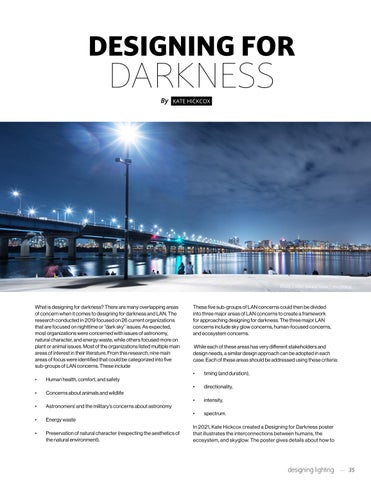
Photo Credit: Adobe Stock | zhu difeng
What is designing for darkness? There are many overlapping areas of concern when it comes to designing for darkness and LAN. The research conducted in 2019 focused on 26 current organizations that are focused on nighttime or “dark sky” issues. As expected, most organizations were concerned with issues of astronomy, natural character, and energy waste, while others focused more on plant or animal issues. Most of the organizations listed multiple main areas of interest in their literature. From this research, nine main areas of focus were identified that could be categorized into five sub-groups of LAN concerns. These include •
Human health, comfort, and safety
•
Concerns about animals and wildlife
•
Astronomers’ and the military’s concerns about astronomy
•
Energy waste
•
Preservation of natural character (respecting the aesthetics of the natural environment).
These five sub-groups of LAN concerns could then be divided into three major areas of LAN concerns to create a framework for approaching designing for darkness. The three major LAN concerns include sky glow concerns, human-focused concerns, and ecosystem concerns. While each of these areas has very different stakeholders and design needs, a similar design approach can be adopted in each case. Each of these areas should be addressed using these criteria: •
timing (and duration),
•
directionality,
•
intensity,
•
spectrum.
In 2021, Kate Hickcox created a Designing for Darkness poster that illustrates the interconnections between humans, the ecosystem, and skyglow. The poster gives details about how to
designing lighting
35