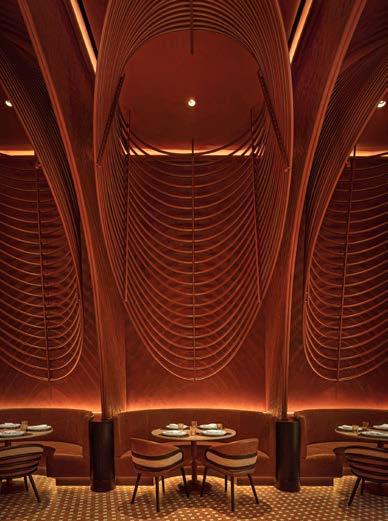
How do you illuminate an architectural and culinary journey through India’s legacy? That was the challenge facing Studio N at the Mausam restaurant in Dubai.
We catch up with South Korean luminaire designer Kwangho Lee
6 EDITOR’S NOTE
An introduction from our editor Ray Molony.
8 PROJECT: Lattice of light
By skillfully integrating light and space, Purilighting has accentuated a striking building’s transparency and lightness, transforming it into a vessel of light.
12 COVER STORY: Moghul journey
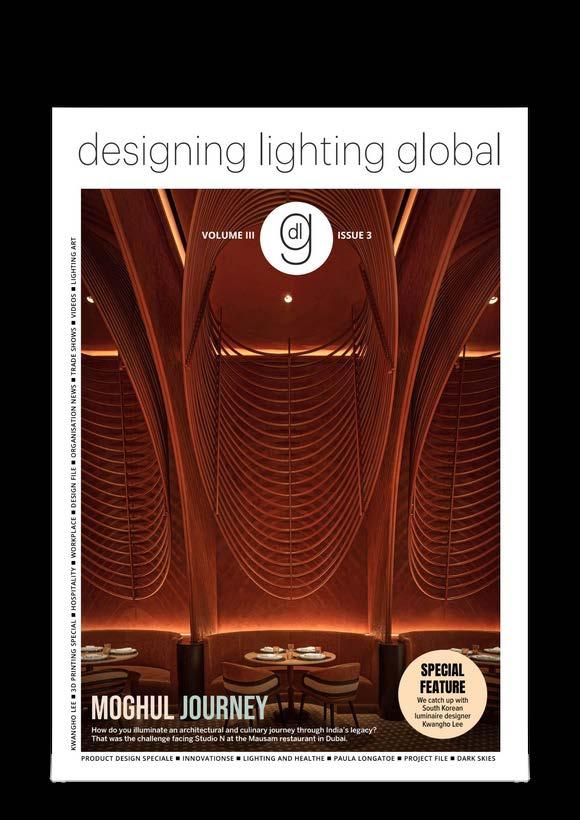
How do you illuminate an architectural and culinary journey through India’s legacy? That was the challenge facing Studio N at the Mausam restaurant in Dubai
18 PROJECT: Clockwork orange
The Vermilion Zhou Design Group regularly creates glamorous yet understated lighting schemes for Orange hotels, the latest of which doesn’t disappoint. Ray Molony reports.
26 PROJECT: Moonlit forest
At the heart of Xi’an’s bold new Cultural Centre Business District, a nocturnal wonderland has been created by Speirs Major Light Architecture, who drew on biophilic principles and natural light-play to create a rich, immersive nighttime journey.
34 URBAN LIGHTING: The role of light in restorative cites Gary Thornton, director of Nulty, says we need to say no to overly illuminated urban environments that do little for our sense of wellbeing.
40 LIGHTING AND HEALTH: Shedding light on psychiatric patients
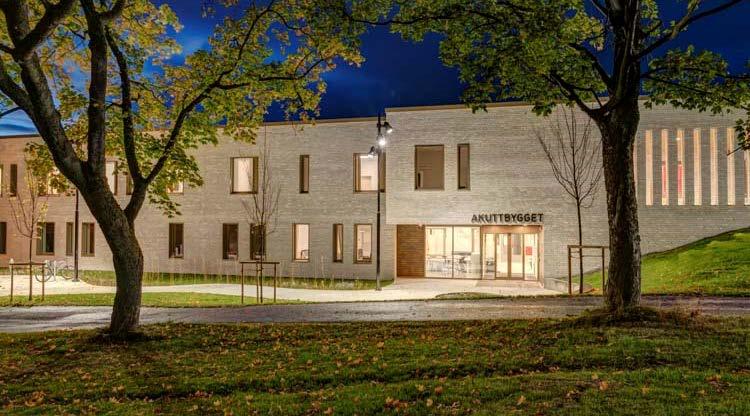
A Norwegian study found that psychiatric patients exposed to blueblocked lighting in the evening showed clinical improvements and reduced aggression.
VOLUME 3 ISSUE 3 2025
42 THE BUSINESS OF LIGHTING DESIGN
We dive into the bold and explosive universe of South Korean luminaire designer Kwangho Lee whose Bolda is the new and unconventional collection unveiled at Milan Design Week.
INNOVATIONS
We curate the stand-out designs this quarter.
48 SILHOUTTE AWARDS
We dive into the bold and explosive
The Silhouette Awards Celebrates and Elevates the Next Generation of Lighting Professionals.
52 OPINION
The more things change, the more they stay the same. Contractors ruined interiors with Cat 2 luminaires 30 years ago and they’re doing it again with LED panels, says lighting consultant David Tilley.
53 ORGANISATION NEWS
The latest reports from the lighting design community and its representative bodies.
54 TRADE SHOW CALENDAR
We mark your diary with all the big events in lighting design right into 2024.
We give you a heads up on what you can look forward to the next issue of designing lighting global.
We meet Paula Longato, Lighting Team Lead, Buro Happold, Europe
ON THE COVER: Mausam, Dubai by
Studio N for EMAAR Hospitality
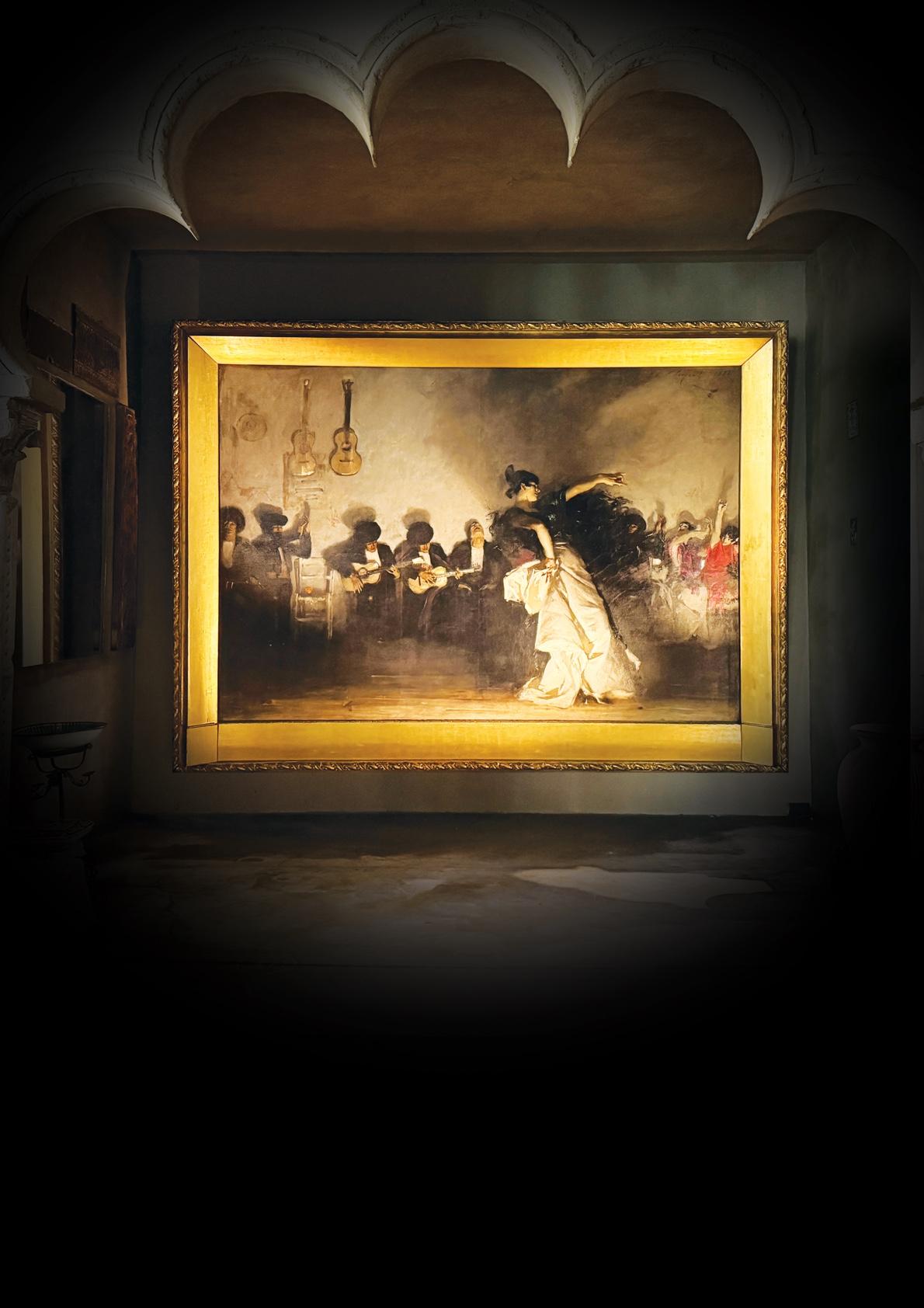
TRANSFORMING HOW MASTERPIECES ARE SEEN
The 6W Micro Spotlight delivers exceptional control in a discreet profile — engineered for galleries and low ceilings. Manual focus from 8º to 56º, onboard dimming, high CRI, and modular optics provide precise beam control for any installation.
Scan for the Isabella Stewart Gardner Museum case study — before/after results.
Photography: El Jaleo, Isabella Stewart Gardner Museum Lighting Design: Abernathy Lighting Design, a Studio of Eos Lightmedia
VOLUME 2 ISSUE 2 2024
Editor: Ray Molony
Editor: Ray Molony
Editor: Ray Molony
Publisher: Randy Reid
Publisher: Randy Reid
Publisher: Randy Reid
Associate Publisher, Advertising:
Cliff Smith
Associate Publisher, Advertising: Cliff Smith
Associate Publisher, Advertising: Cliff Smith
Director of Audience Development: Angie Hullfish
Director of Audience Development: Angie Hullfish
Staff Writers:
Parker Allen
Staff Writers: Parker Allen
Staff Writers: Parker Allen
Published by EdisonReport
1726C General George Patton Drive
Published by EdisonReport
Brentwood, TN 37027
Published by EdisonReport
Phone: +1 615 371 0961
1726C General George Patton Drive
1726C General George Patton Drive
www.designinglightingglobal.com
Brentwood, TN 37027
Brentwood, TN 37027
Phone: +1 615 371 0961
Phone: +1 615 371 0961
www.designinglightingglobal.com
www.designinglightingglobal.com
designing lighting global is focused on the Business of Lighting Design™ and provides business information to the lighting design community across the world. In addition to the website, designing lighting publishes bi-monthly online magazines featuring original content, interviews within the community and highlights successful and awardwinning lighting designs.
ISSN 2837-2360
designing lighting global is focused on the Business of Lighting Design™ and provides business information to the lighting design community across the world. In addition to the website, designing lighting publishes bi-monthly online magazines featuring original content, interviews within the community and highlights successful and awardwinning lighting designs.
designing lighting global is focused on the Business of Lighting Design™ and provides business information to the lighting design community across the world. In addition to the website, designing lighting publishes bi-monthly online magazines featuring original content, interviews within the community and highlights successful and awardwinning lighting designs.
Reproduction of the material contained in this publication may only be made with the written permission of designing lighting global.
Reproduction of the material contained in this publication may only be made with the written permission of designing lighting global.
Reproduction of the material contained in this publication may only be made with the written permission of designing lighting global.
Engagement with clients is key
BIGGER, STRONGER DESIGN PRACTICES CAN ONLY BENEFIT CLIENTS
BIGGER, STRONGER DESIGN PRACTICES CAN ONLY BENEFIT CLIENTS
Originally, the plan was to illuminate the soffit — that didn’t happen. LED strips under the banquettes? Value-engineered out.
Flos Romeo pendants? Swapped for distributor catalogue stock.
Daylight-linking and BMS control? Replaced with a wall switch.
The lighting design profession has come a long way, philosophically speaking, in recent years. First it came to an accommodation of sorts with those practices who create lighting designs and also supply the equipment. This manifested itself in the change of membership rules for the International Association of Lighting Designers to allow socalled design-and-supply members. Personally, I’ve always thought that their exclusion was a harsh rule, a purist view that doesn’t take into account the real world, especially in those territories which don’t have a culture of paying design fees. Additionally, there are some design-and-supply outfits which do superb lighting schemes. In my view, there’s good lighting and there’s bad lighting. It’s not about who’s supplying it.
The lighting design profession has come a long way, philosophically speaking, in recent years. First it came to an accommodation of sorts with those practices who create lighting designs and also supply the equipment. This manifested itself in the change of membership rules for the International Association of Lighting Designers to allow socalled design-and-supply members. Personally, I’ve always thought that their exclusion was a harsh rule, a purist view that doesn’t take into account the real world, especially in those territories which don’t have a culture of paying design fees. Additionally, there are some design-and-supply outfits which do superb lighting schemes. In my view, there’s good lighting and there’s bad lighting. It’s not about who’s supplying it.
Too often, reporting on lighting projects is a heart-breaking litany of What Might Have Been — a tale of thwarted ambition and compromise. Lighting specs seem the most disrespected of all building services. Does anyone argue about brickwork? Do Herman Miller chairs get swapped for Staples? (Actually, don’t answer that.)
Another IALD rule change that has just been the written into the code of ethics is that members should give sufficient weight to sustainability in their designs. This should be less controversial than the previous rule change. While it is an aspiration, it’s a laudable one and it does give designers some ammunition to protect their designs in the face of pressure to compromise.
Another IALD rule change that has just been the written into the code of ethics is that members should give sufficient weight to sustainability in their designs. This should be less controversial than the previous rule change. While it is an aspiration, it’s a laudable one and it does give designers some ammunition to protect their designs in the face of pressure to compromise.
Yes, all projects have constraints. But sometimes brilliance lies in working within them — like heritage sites where you can’t touch ceilings or move luminaire locations. Some of the best lighting schemes were born from constraint.
Budget is the most obvious — and abused — constraint. Yet it should be challenged. You’re building a billion-dollar facility to last a century... and you’re installing sixty-dollar fittings? Really?
Further in these pages I talk to the IALD’s CEO Christopher Knowlton about how lighting design practices can grow. Knowlton is no slouch at lighting design and has a roster of great projects to prove it. But he also has an MBA and is business minded, and he’s given a lot of thought to this topic. His diagnosis of the problem and his proposed remedies make interesting reading.
Further in these pages I talk to the IALD’s CEO Christopher Knowlton about how lighting design practices can grow. Knowlton is no slouch at lighting design and has a roster of great projects to prove it. But he also has an MBA and is business minded, and he’s given a lot of thought to this topic. His diagnosis of the problem and his proposed remedies make interesting reading.
My local wine warehouse installed cheap LED bollards. Half failed in months; some now have live cables exposed. Another win for “value engineering.”
I’m not saying everyone needs Louis Poulsen, but let’s aim for installations that last longer than celebrity marriages.
The lighting design profession has never lacked for creativity, or indeed the tools to create stunning projects. Rather, its weakness has traditionally been on the business side. For, as Knowlton points out, it is well financed and managed practices which can invest in its staff, its knowledge and its resources. And that can only be good for our clients.
Great lighting designers like Speirs Major Light Architects or Licht Kunst Licht know that early, passionate client engagement is key. Why hire creative experts and then hand decisions to contractors? The best results stay true to vision.
The lighting design profession has never lacked for creativity, or indeed the tools to create stunning projects. Rather, its weakness has traditionally been on the business side. For, as Knowlton points out, it is well financed and managed practices which can invest in its staff, its knowledge and its resources. And that can only be good for our clients.
Clients need to buy into the concept — and keep buying in. The most effective advocates have had a lighting epiphany. That’s why exemplar projects matter. Take clients to see them. Win them over with light — then they can compromise on bricks.
Ray Molony EDITOR
Ray Molony EDITOR
Ray MolonyEDITOR
Shape the future, connect spaces. Let ideas become reality. Experience how innovation and technology meet design and functionality.
The world’s leading trade fair for lighting and building services technology
The
the landscape.
By skillfully integrating light and space, Purilighting has accentuated a striking building’s transparency and lightness, transforming it into a vessel of light.
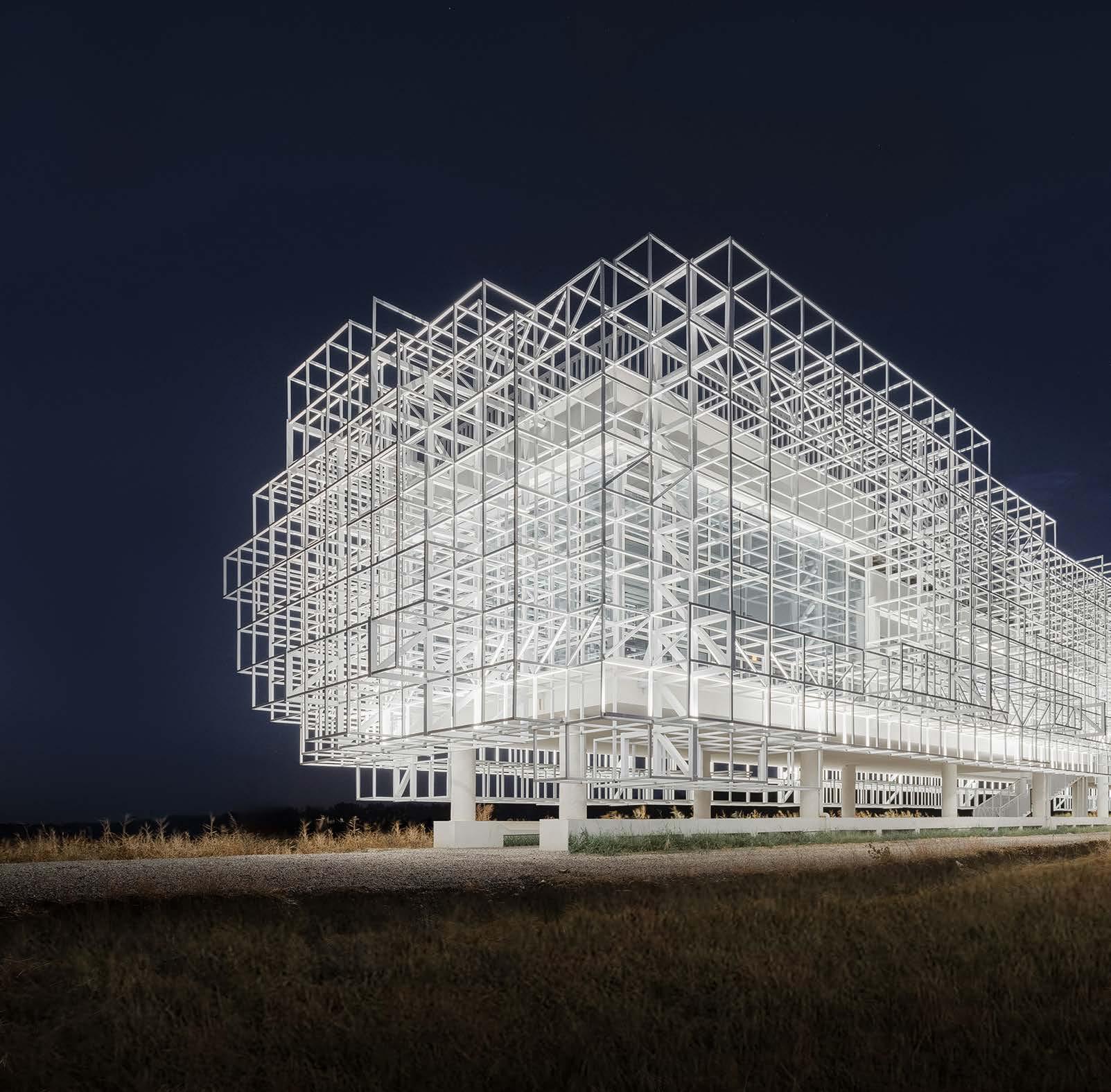
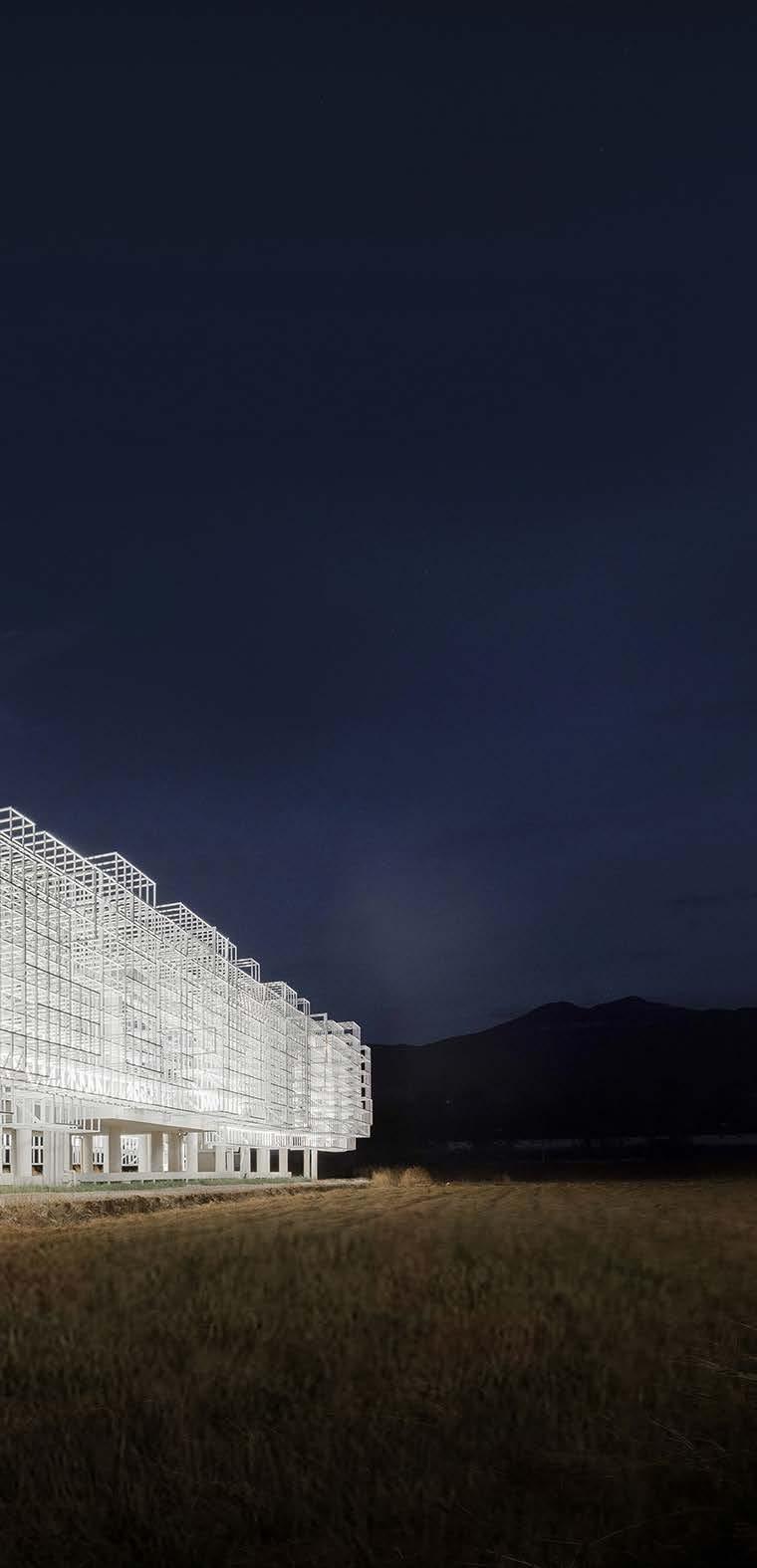
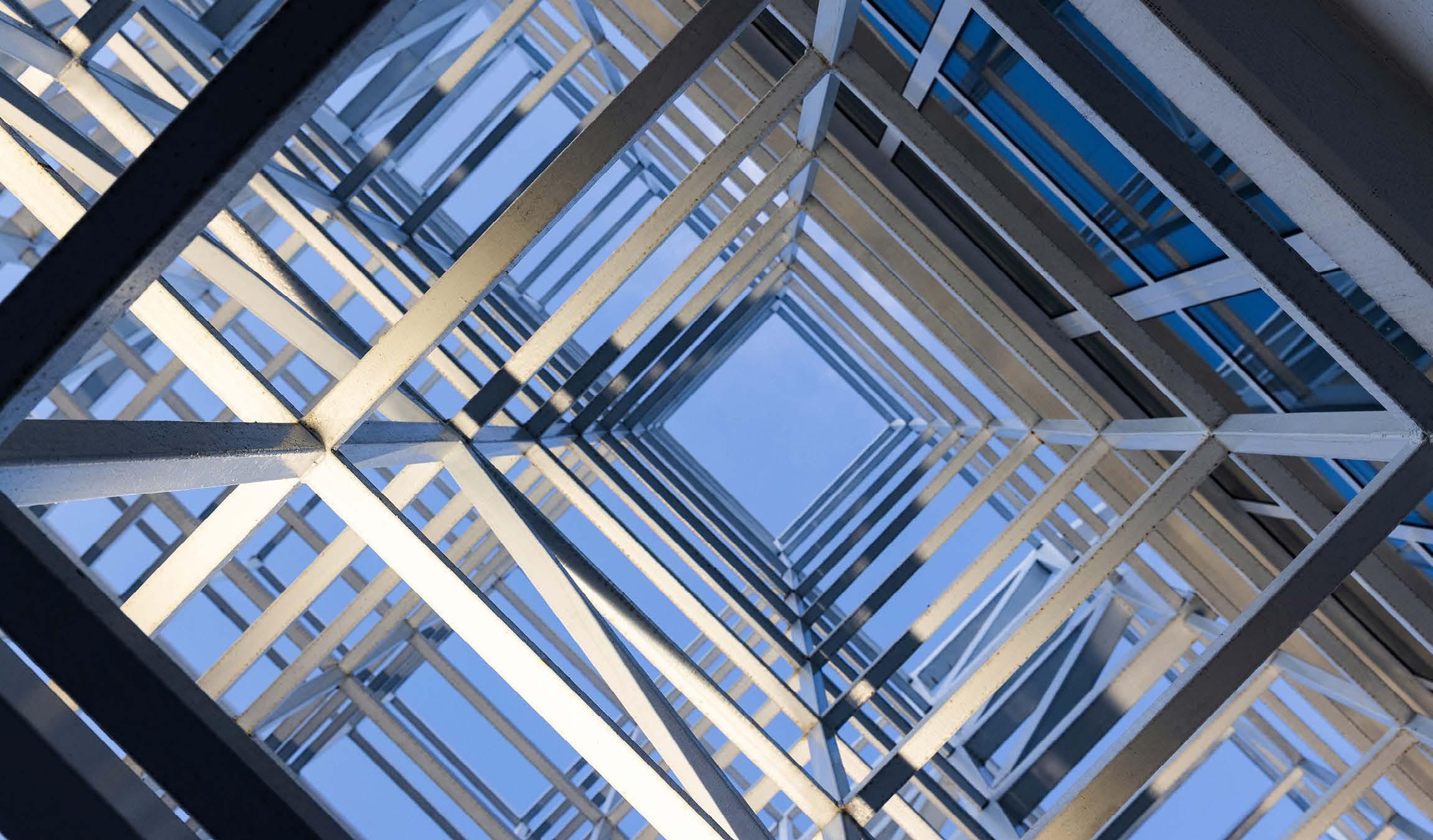
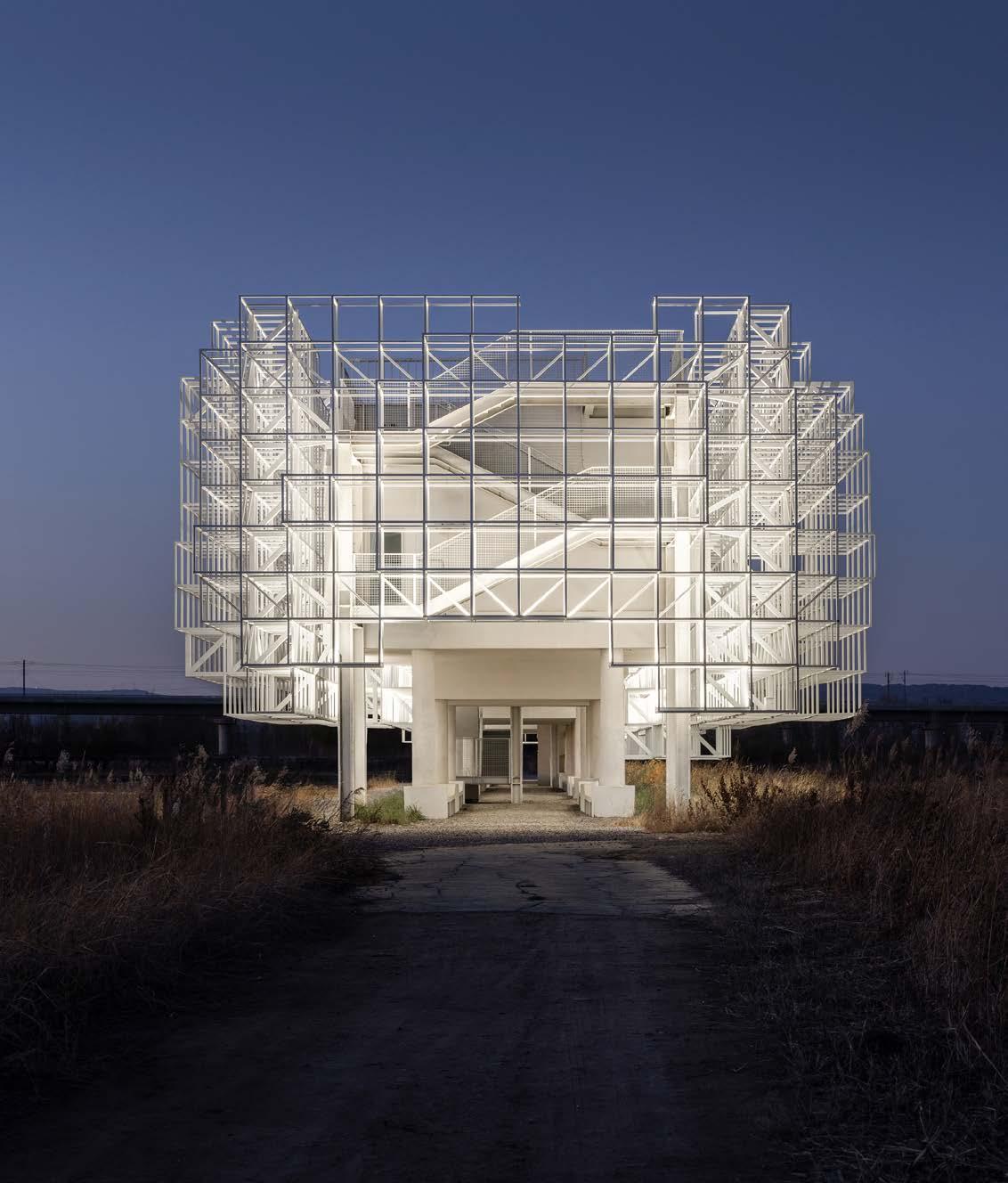
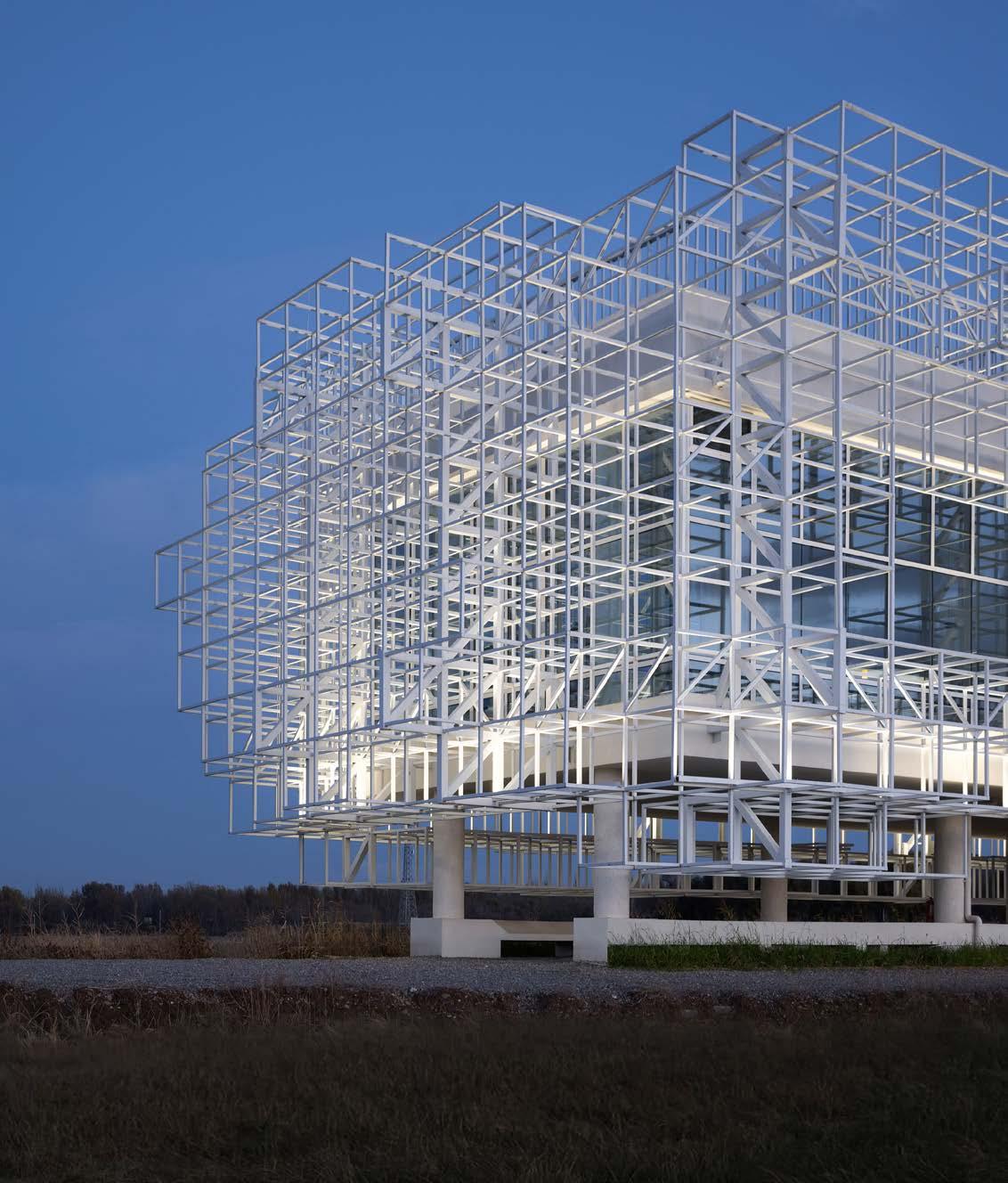
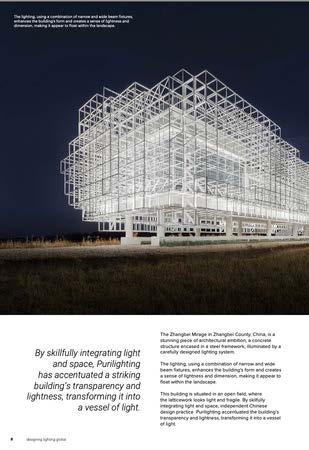
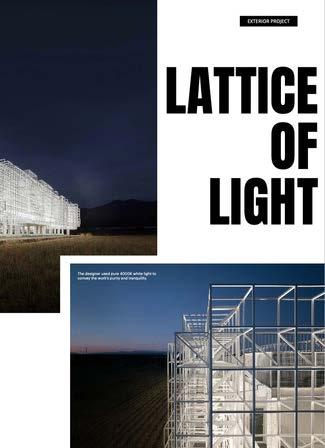
The Zhangbei Mirage in Zhangbei County, China, is a stunning piece of architectural ambition, a concrete structure encased in a steel framework, illuminated by a carefully designed lighting system.
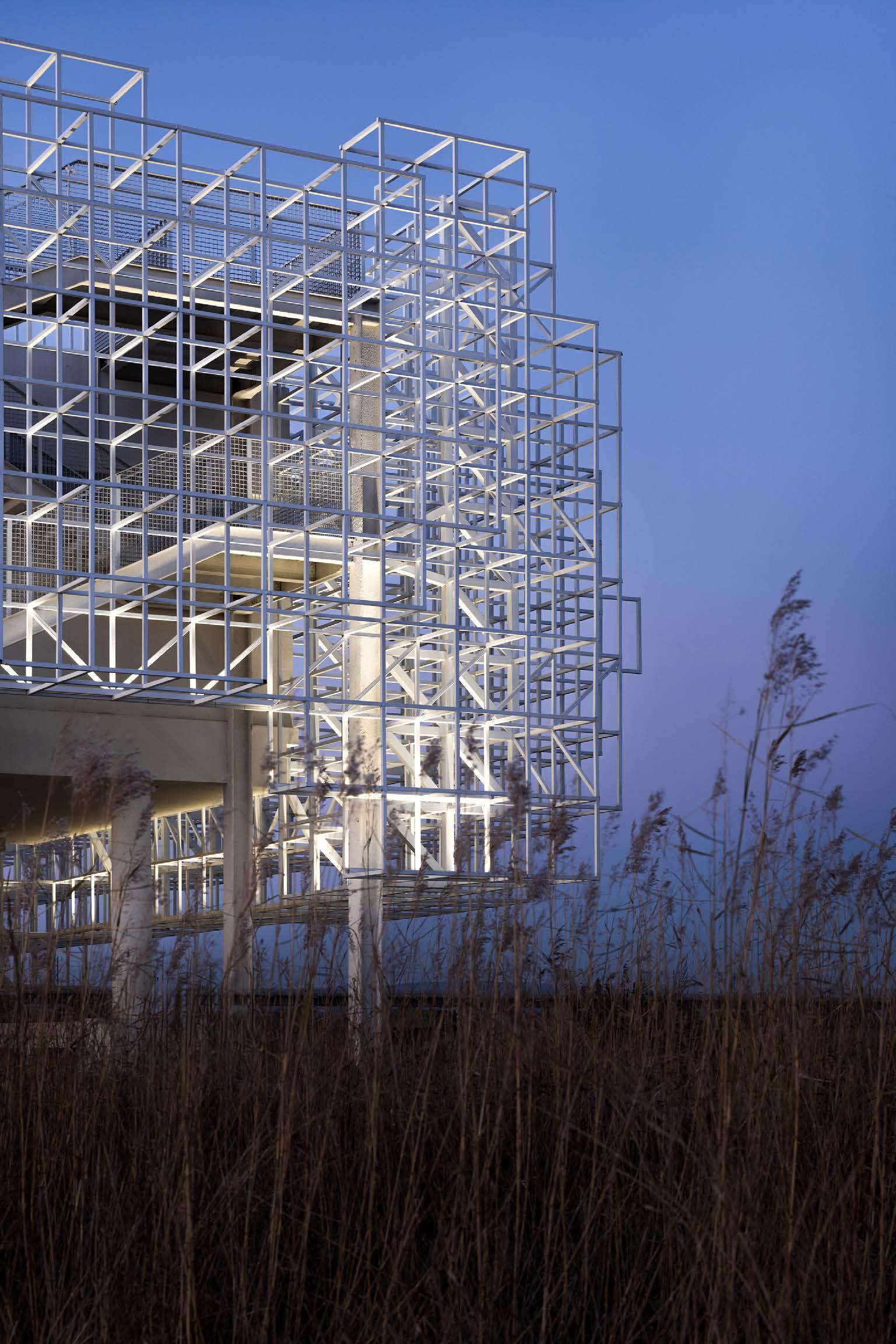
The lighting, using a combination of narrow and wide beam fixtures, enhances the building's form and creates a sense of lightness and dimension, making it appear to float within the landscape.
This building is situated in an open field, where the latticework looks light and fragile. By skilfully integrating light and space, independent Chinese design practice Purilighting accentuated the building’s transparency and lightness, transforming it into a vessel of light.
LATTICE OF LIGHT
The designer used pure 4000K white light to convey the work’s purity and tranquility.
The lighting, using a combination of narrow and wide beam fixtures, enhances the building's form and creates a sense of lightness and dimension, making it appear to float within the landscape.
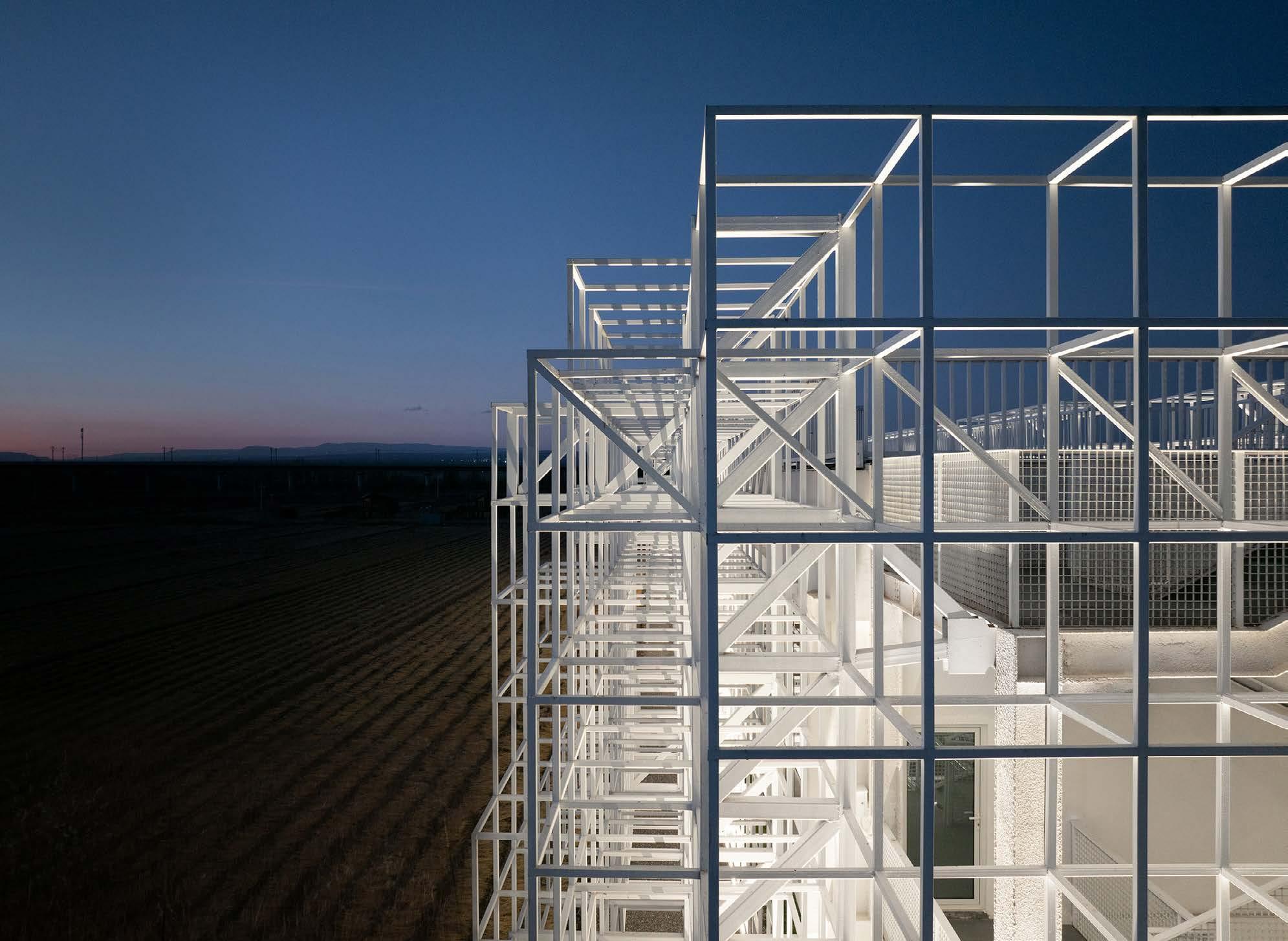
For the lighting design, the designer selected luminaires with different wattages and beam angles, including 36W with a 10-degree beam, and 48W with a 30-degree beam.
These fittings were seamlessly integrated into the steel framework using an uplighting approach, with various projection directions explored.
Compared to the softer interior illumination, the uplighting for the steel framework is slightly more pronounced, enhancing the sense of depth and creating a delicate balance between transparency and lightness.
This interplay results in a richer and more dynamic visual hierarchy.
The designer used pure 4000K white light to convey the work’s purity and tranquility. In the vast expanse of the open field, the building stands as a vessel of light, infusing the space with a serene and profound atmosphere.
Headquartered in Beijing, China, Purilighting is a professional consulting company specialising in light environment research, serving many lighting professional fields such as architectural lighting design, interior lighting design, landscape lighting design, urban lighting planning, and more.
In providing customers with professional light environment consulting services, the company’s philosophy is to not stick to a single design style, but rather to tailor precise solutions to each project.
Every project generates a creative process that adheres to the spirit of the craftsman, and they deeply interpret,
By skilfully integrating light and space, independent Chinese design practice Purilighting accentuated the building’s transparency and lightness, transforming it into a vessel of light.
For the lighting design, the designer selected luminaires with different wattages and beam angles, including 36W with a 10-degree beam, and 48W with a 30-degree beam.
understand, and experience the architecture itself before subsequently expressing and embodying its form in light.
Over the past 10 years, the company has set up branches in Los Angeles and Chengdu, China, and has designed and completed up to 500 projects, serving clients and partners that include real estate companies, commercial groups, hotel management companies, local design units, and government agencies.
Since its founding in 2012 by Fang Hu, Purilighting has
won several lighting design awards at home and abroad, including the IALD Lighting Design Award Glorious Excellence Award USA, the IES Lighting Design Award USA, the LDA Lighting Design Award UK, and the LIT Lighting Design Award USA. Additionally, awards in the comprehensive field include the US A+ Architectural Design Award, FRAME Design Award, Italy A 'Design Award, IDA Design Award, as well as domestic awards such as the China Lighting Design Award and the Asian Lighting Design Award.■
In the vast expanse of the open field, the building stands as a vessel of light, infusing the space with a serene and profound atmosphere.
The Zhangbei Mirage in Zhangbei County, China, is a stunning piece of architectural ambition, a concrete structure encased in a steel framework.
MOGHUL JOURNEY
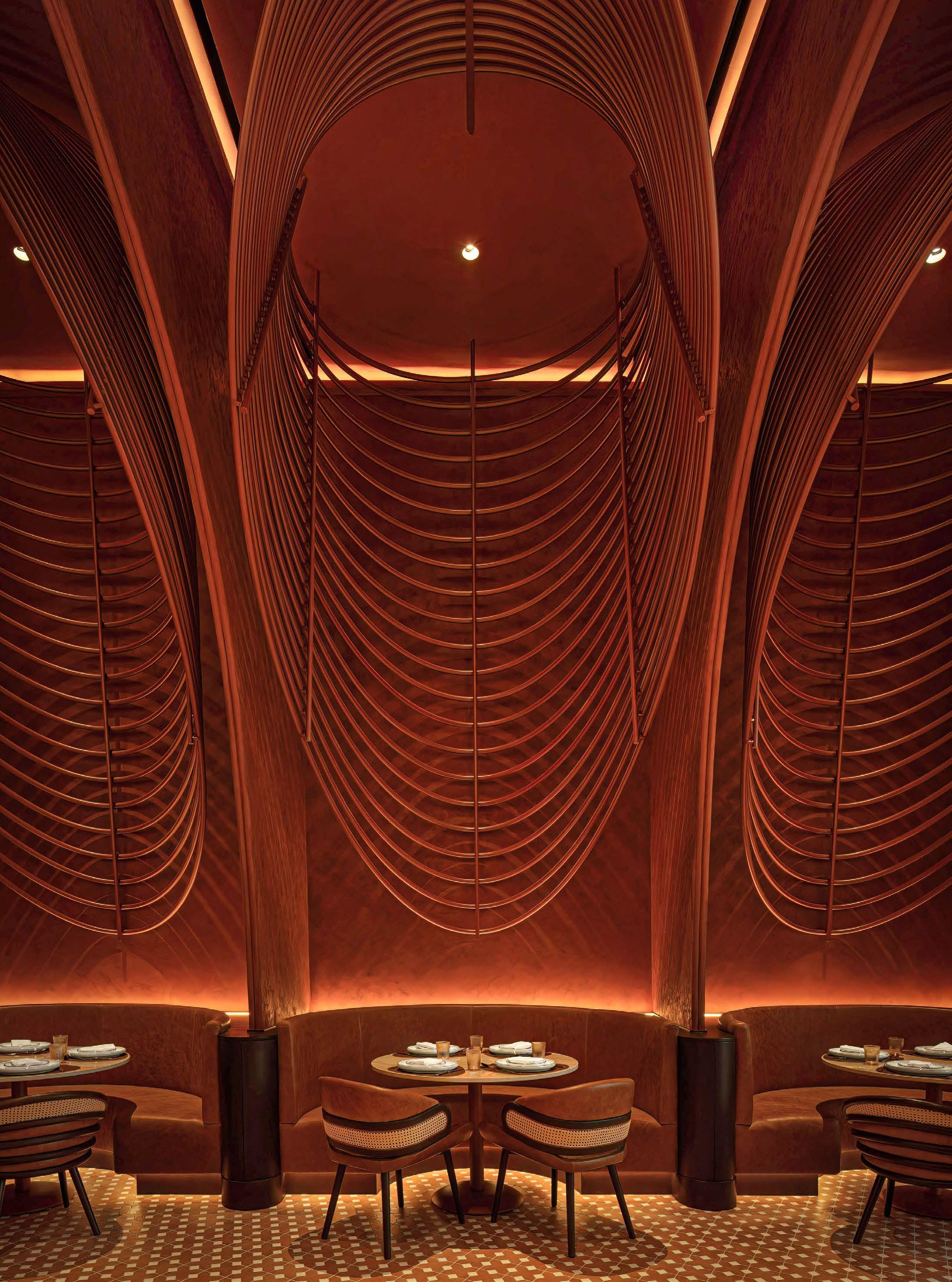
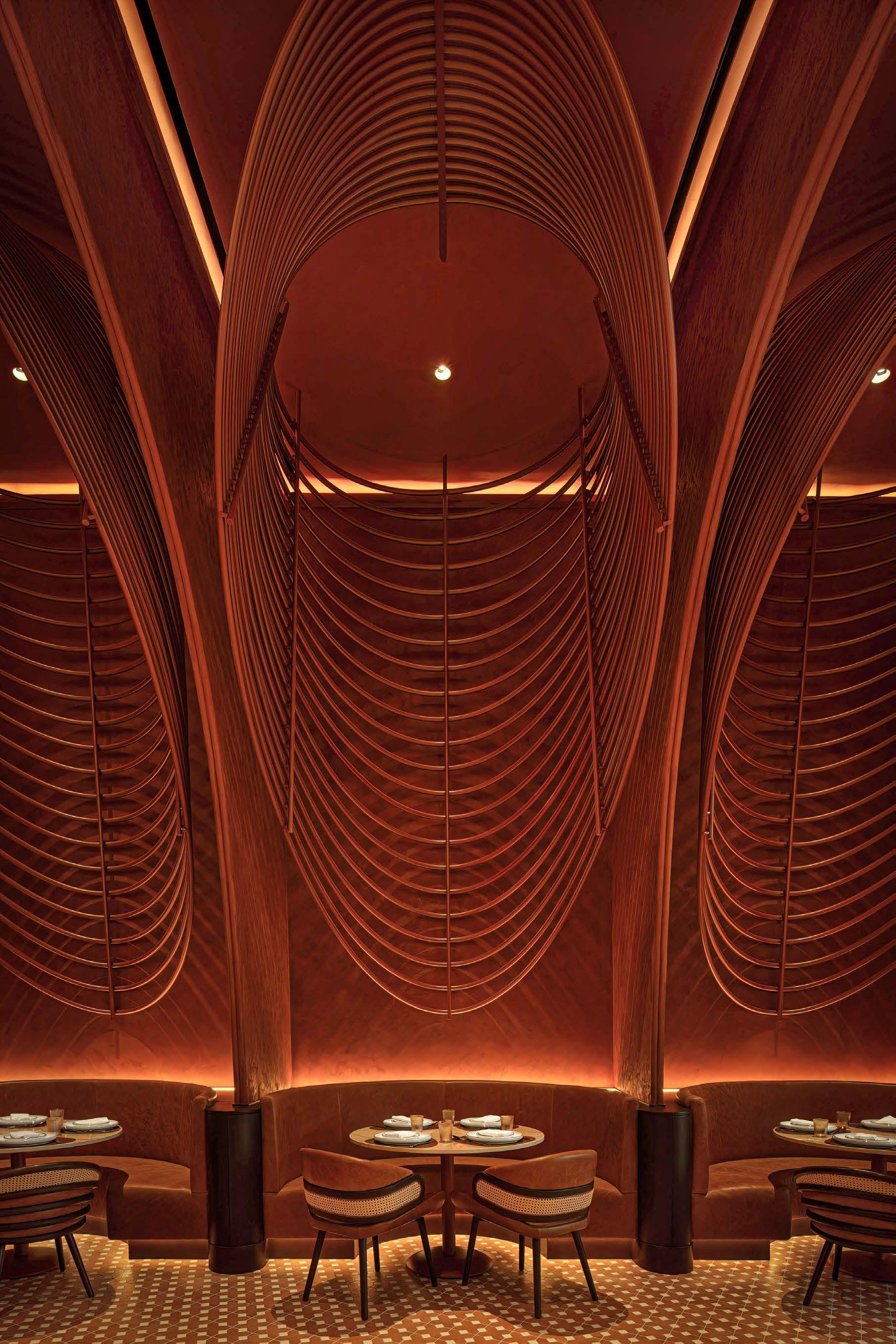
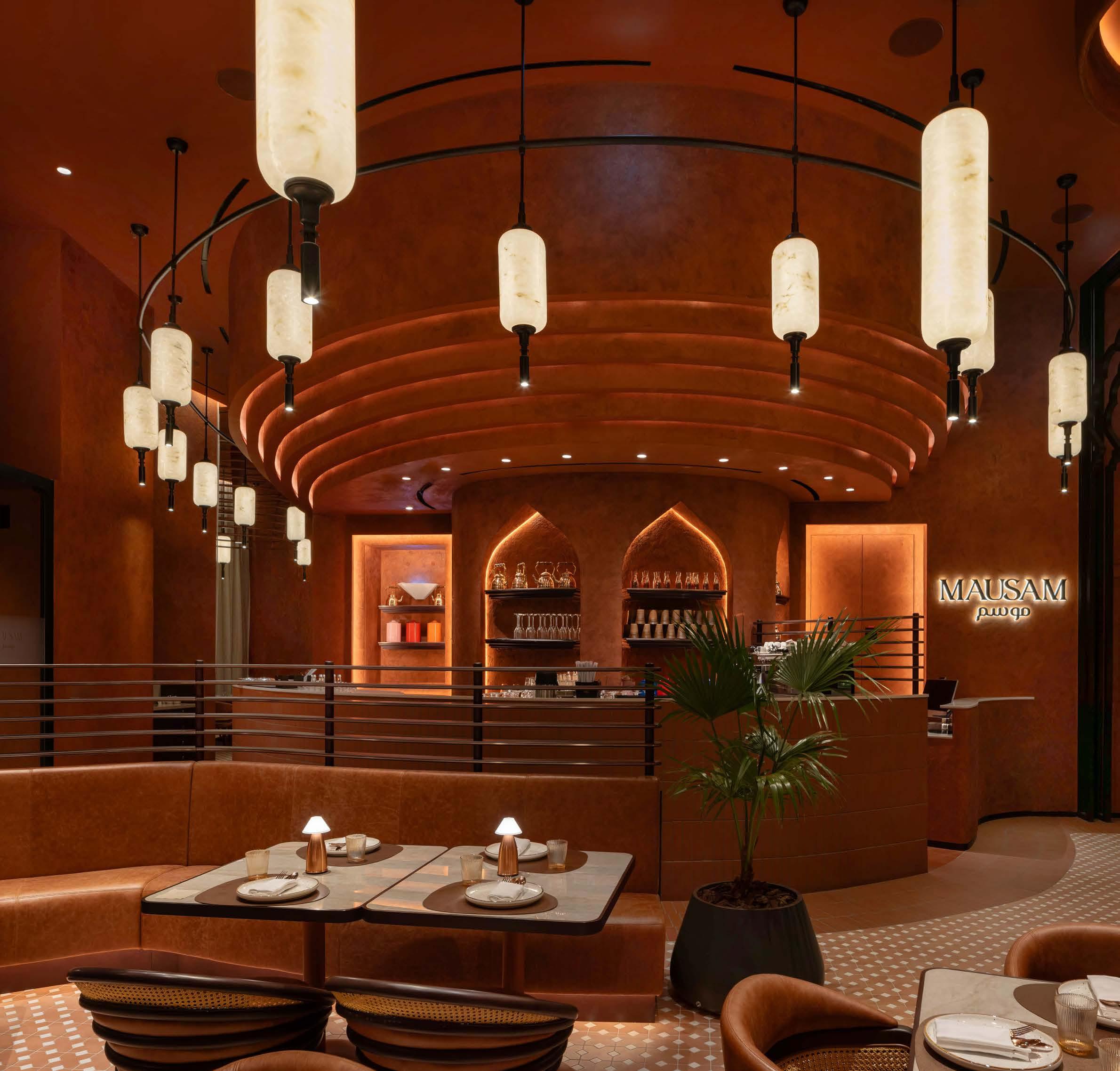
A key feature of Mausam’s interior design is the sculptural rings installation, which serves as both a visual focal point and a functional divider.
How do you illuminate an architectural and culinary journey through India’s legacy? That was the challenge facing Studio N at the Mausam restaurant in Dubai.
Designed by 4SPACE and located in the iconic Dubai Mall, Mausam is a striking exploration of architectural and cultural dialogue, where Indian heritage converges with modern luxury.
The design of this dining space is a sophisticated homage to India's architectural grandeur, embodied through a series of deliberate, refined gestures that channel both historical craftsmanship and contemporary design principles.
Inspired by the monumental Red Fort, Mausam offers an immersive spatial experience, blending intricate details with contemporary minimalism to create a narrative of elegance and sensory refinement.
The design vocabulary of Mausam takes cues from the historical and symbolic elements of Mughal architecture, reinterpreting these features through a modern lens. The defining architectural feature is the expansive, arching framework, which draws direct inspiration from the Red Fort’s Mughal arches.
These arches create a rhythmic spatial flow, guiding movement and framing the dining experience within a structure that feels both expansive and intimate. The incorporation of latticework details, a hallmark of Mughal design, adds tactile richness and a visual layering that enhances both the scale and intimacy of the space.
The material palette is a direct reference to India's rich architectural heritage, particularly the warm red sandstone that defines many of the country's iconic monuments.
Earthy terracotta tones are used throughout, grounding the space in cultural authenticity, while allowing for sophisticated interplay with brass accents and textured wall finishes. The integration of high-quality materials, such as engineered marble, cane, and leather, creates an atmosphere of refined opulence, softening the austere grandeur often associated with traditional Indian design.
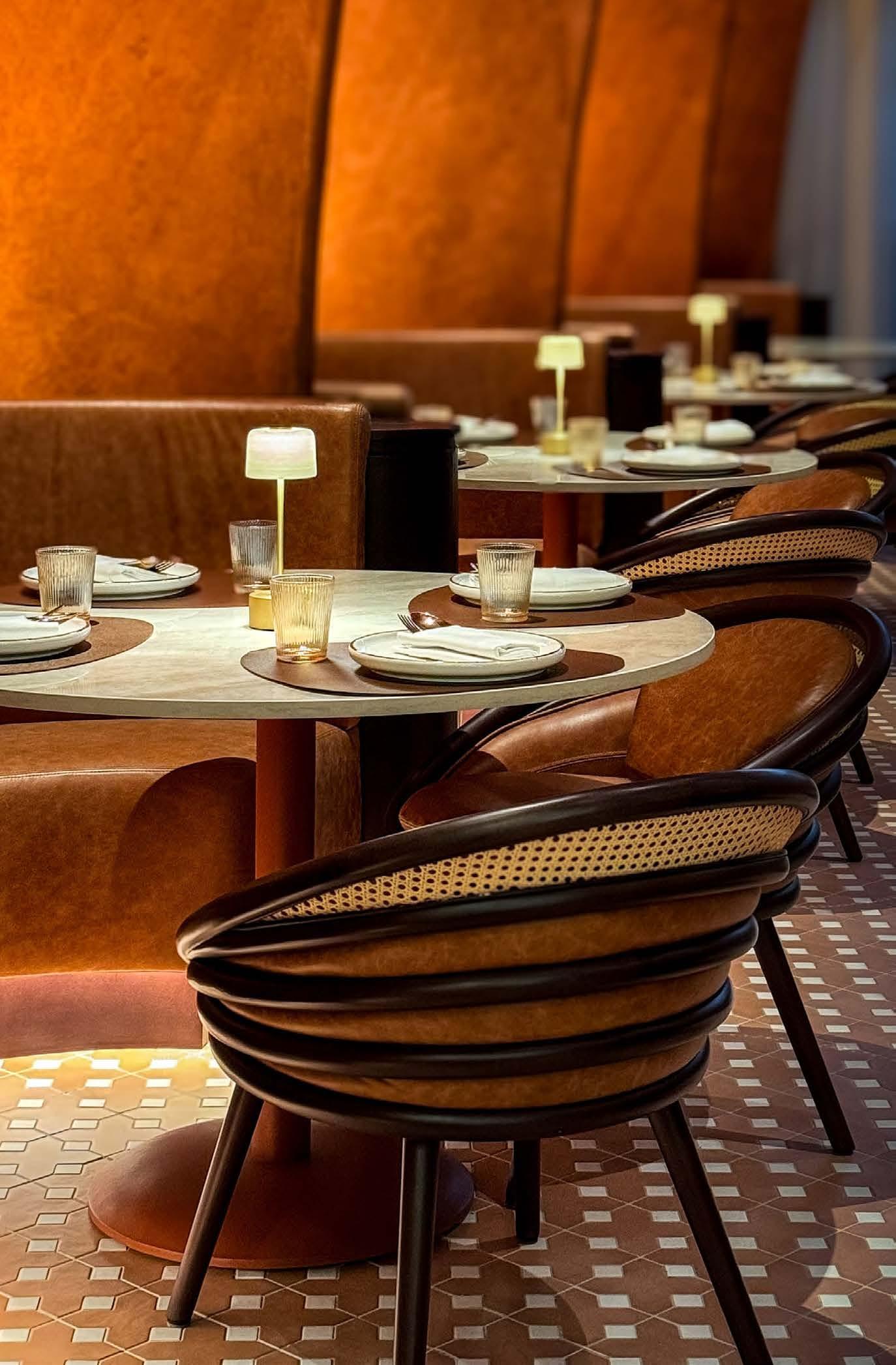
In terms of furniture, Mausam features custom-designed pieces that balance traditional craftsmanship with contemporary ergonomics. The juxtaposition of plush, upholstered banquettes and elegantly designed cane and leather chairs creates a dynamic seating arrangement
that allows for both openness and intimacy. The porcelain tile flooring, with its traditional Indian motifs, anchors the space in its cultural context, while contributing to the overall aesthetic cohesion of the interior. Lighting is thoughtfully integrated into the architecture, with lanternstyle pendants referencing traditional Indian lamps, casting a warm and inviting glow throughout the space. Recessed lighting enhances the sculptural quality of the architectural curves, further elevating the sense of drama.
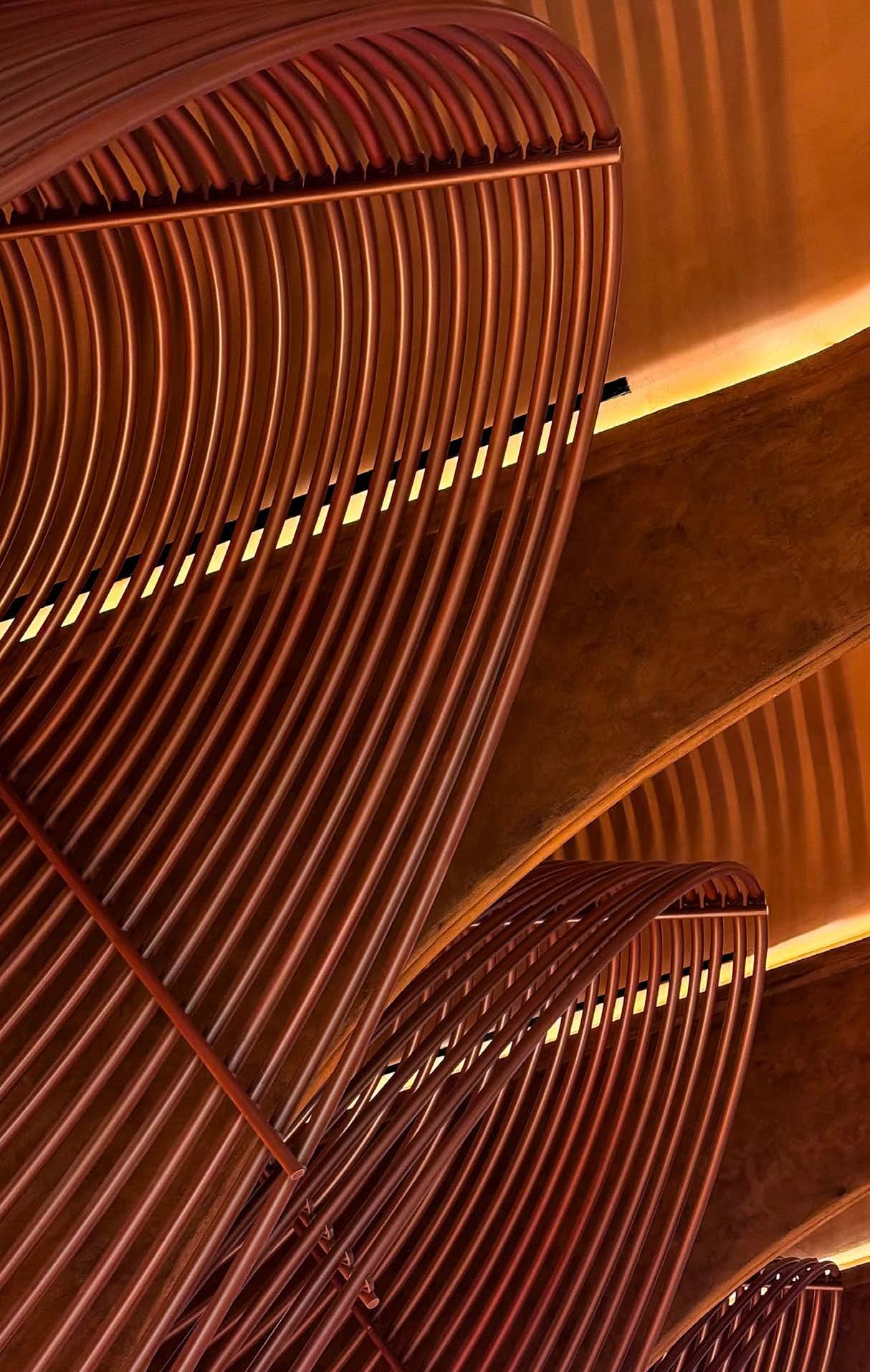
A key feature of Mausam’s interior design is the sculptural rings installation, which serves as both a visual focal point and a functional divider. This installation deconstructs the traditional domes and lattice structures found in historic Indian forts and palaces, presenting them in
a contemporary framework that suggests fluidity and motion. The curved metal rings, rising from the floor to the ceiling, are crafted from precision-engineered materials, their soft metallic finish and terracotta-hued patina evoking the warmth of Indian sandstone. The undulating forms create a dynamic spatial experience, offering a sense of depth and rhythm.
‘Our lighting scheme was designed to celebrate the architectural details of the scheme,’ Lama Arouri, managing director, Studio N, tells Designing Lighting Global, ‘especially the Mughal-inspired contours and earthy tones of the feature ceiling.’
As the ceiling consists of multiple, interlaced circular forms, we concealed soft lines of light within the metal rings to add depth and definition to the multilayered surface.
‘This interplay of light and surfaces is also evident at a lower level, where diffuse lines of light highlight the walls and cast light onto the decorative latticework to form patterns of light and shadow in each seating nook.
‘Throughout the restaurant, we layered different tones of light as a nod to the vibrancy of Indian spices. At restaurant level, 2700K was used to envelop diners
The design of this dining space is a sophisticated homage to India's architectural grandeur, embodied through a series of deliberate, refined gestures that channel both historical craftsmanship and contemporary design principles.
‘Our lighting scheme was designed to celebrate the architectural details of the scheme, especially the Mughalinspired contours and earthy tones of the feature ceiling’
— Lama Arouri, managing director, Studio N
in warmth and comfort. Higher up at ceiling level, the composition of light shifts to 3000K warm white to add visual richness.’
The lighting strategy employed within the rings accentuates the fluidity of the forms, with concealed LED strips casting a soft glow that shifts throughout the day.
This interplay of light and shadow not only highlights the installation’s sculptural presence, but also adds layers to the perception of the space, creating a more immersive and complex experience.
Beyond their visual impact, the rings also serve a functional purpose by subtly dividing the expansive restaurant into intimate dining zones, guiding guests through the space while maintaining a sense of openness.
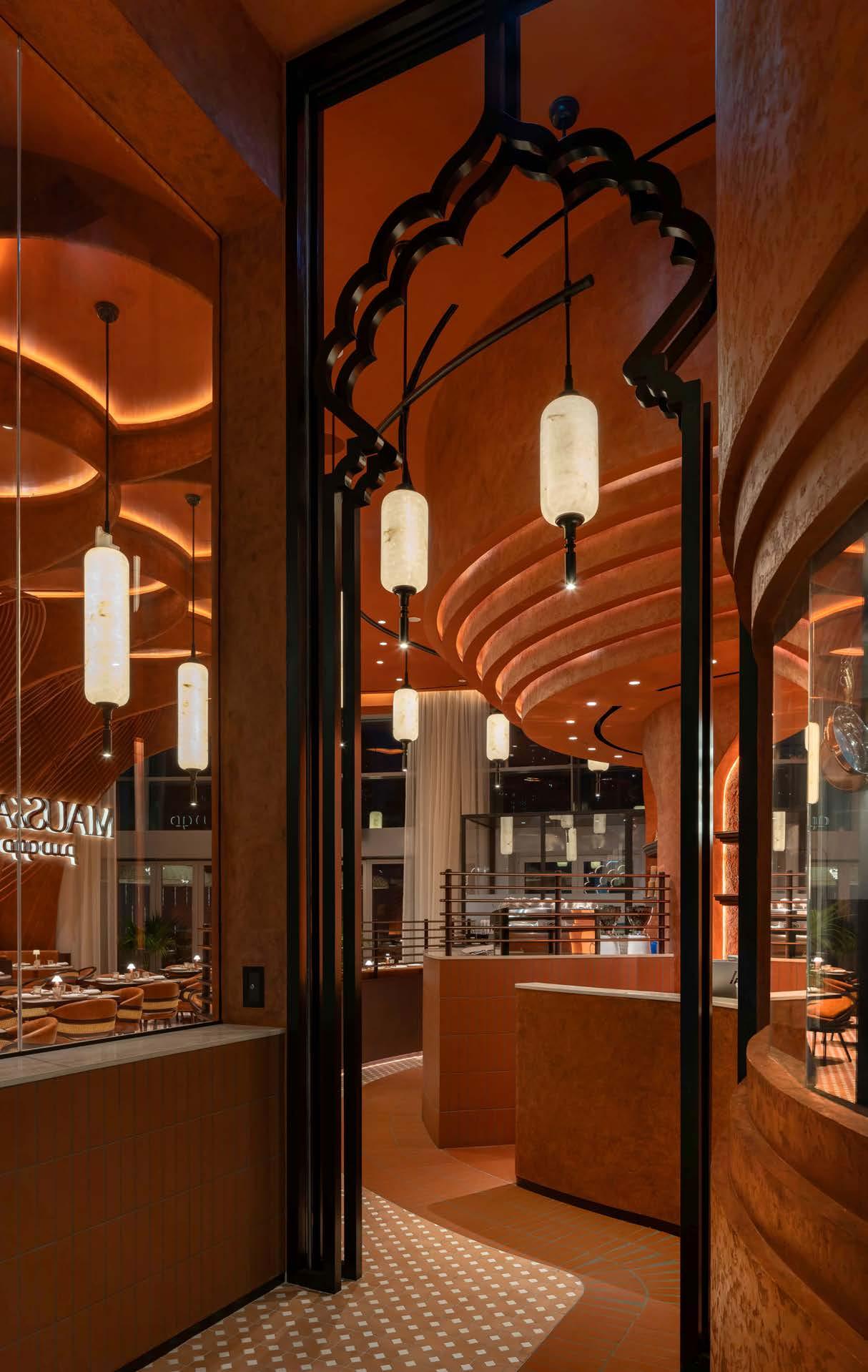
Mausam’s façade establishes a powerful visual identity, blending traditional Indian architectural motifs with contemporary elements. The exterior is clad in terracotta textures, referencing the red sandstone that defines many of India’s monumental structures.
The intricate detailing on the façade speaks to the rich legacy of Indian craftsmanship, while the bold, black metal arch framing of the entrance offers a modern reinterpretation of Mughalera gateways, creating a welcoming yet striking threshold.
In terms of furniture, Mausam features customdesigned pieces that balance traditional craftsmanship with contemporary ergonomics.
The transparency of the building’s frontage, with floorto-ceiling glass panels, allows for a glimpse of the architectural drama within. Passersby are drawn to the captivating rings installation, framed by the soft, ambient glow of lantern-style lighting. The façade’s design successfully blurs the boundary between the interior and exterior, creating an inviting presence within the urban fabric of Dubai Mall.
A central element of Mausam’s design is the open kitchen, which functions as both a performance space and a sensory experience.
Behind the transparent window, traditional Indian tandoors—clay ovens—take center stage, offering diners a direct view into the culinary process. This not only reinforces the restaurant’s commitment to authenticity, but also creates an engaging dialogue between the preparation of food and the experience of dining.
The copper and brass cookware reflect the rich culinary
heritage of India, while the visual connection to the kitchen allows both diners and mall visitors to experience the sensory excitement that defines Indian cuisine.
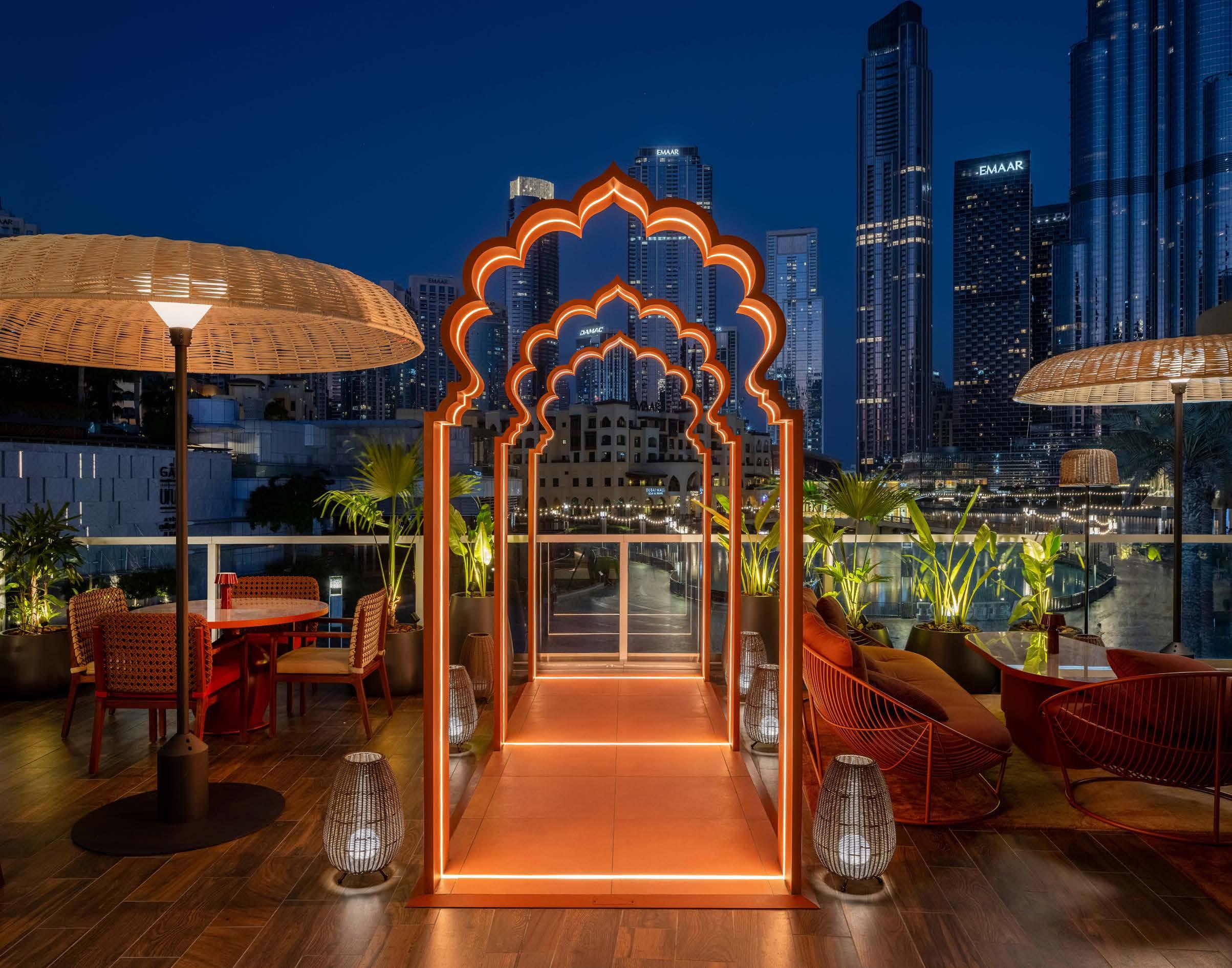
Mausam’s outdoor terrace offers a contemplative counterpoint to the opulence of the interior.
The panoramic views of the Burj Khalifa and the Dubai Fountain provide a dramatic backdrop, while a grand illuminated archway frames these views, creating a visual dialogue between the restaurant’s design and the iconic Dubai skyline.
The terrace seating arrangement, featuring woven rattan and plush deep-toned cushions, is designed to maximise the stunning vistas, while providing a variety of seating configurations, from intimate gatherings to larger social events.
The lighting design on the terrace mirrors the interior’s emphasis on warmth and softness. During the day, the
The lighting installation deconstructs the traditional domes and lattice structures found in historic Indian forts and palaces.
This interplay of light and shadow not only highlights the installation’s sculptural presence, but also adds layers to the perception of the space
space is flooded with natural light, creating a vibrant atmosphere, while at night, carefully curated ambient lighting—such as handcrafted woven floor lamps and subtle LED accents—transforms the terrace into a serene and enchanting space. The introduction of lush greenery enhances the sense of seclusion, creating a peaceful refuge in the midst of Dubai’s bustling cityscape.
Beyond its architectural and culinary offerings, Mausam represents a broader narrative—one that bridges the gap between tradition and modernity.
The restaurant’s design is not just a visual experience,
PROJECT CREDITS
LIGHTING DESIGN
Studio N
LIGHTING SUPPLIER
Huda Lighting
INTERIOR DESIGN, LEAD ARCHITECTURE AND MEP
4SPACE
but a cultural one, telling the story of India’s rich heritage while reinterpreting it for a contemporary, global audience.
Every detail, from the sculptural installations to the carefully selected materials, has been crafted to evoke the timeless elegance of India’s past, while offering a space where modern luxury and cultural legacy coexist in harmony.
The project is a result of collaborative partnerships with leading industry experts, each contributing their specialised knowledge to bring Mausam’s vision to life. ■
CLIENT EMAAR Hospitality
TABLETOPS
TAJ Mahal engineered stone by Cosentino
JOINERY & FURNITURE
Custom-designed by Al Huzaifa
CONTRACTOR
LAADS
The panoramic views of the Burj Khalifa and the Dubai Fountain provide a dramatic backdrop, while a grand illuminated archway frames these views.
CLOCKWORK ORANGE
The Vermilion Zhou Design Group regularly creates glamorous yet understated lighting schemes for Orange hotels, the latest of which doesn’t disappoint. Ray Molony reports.
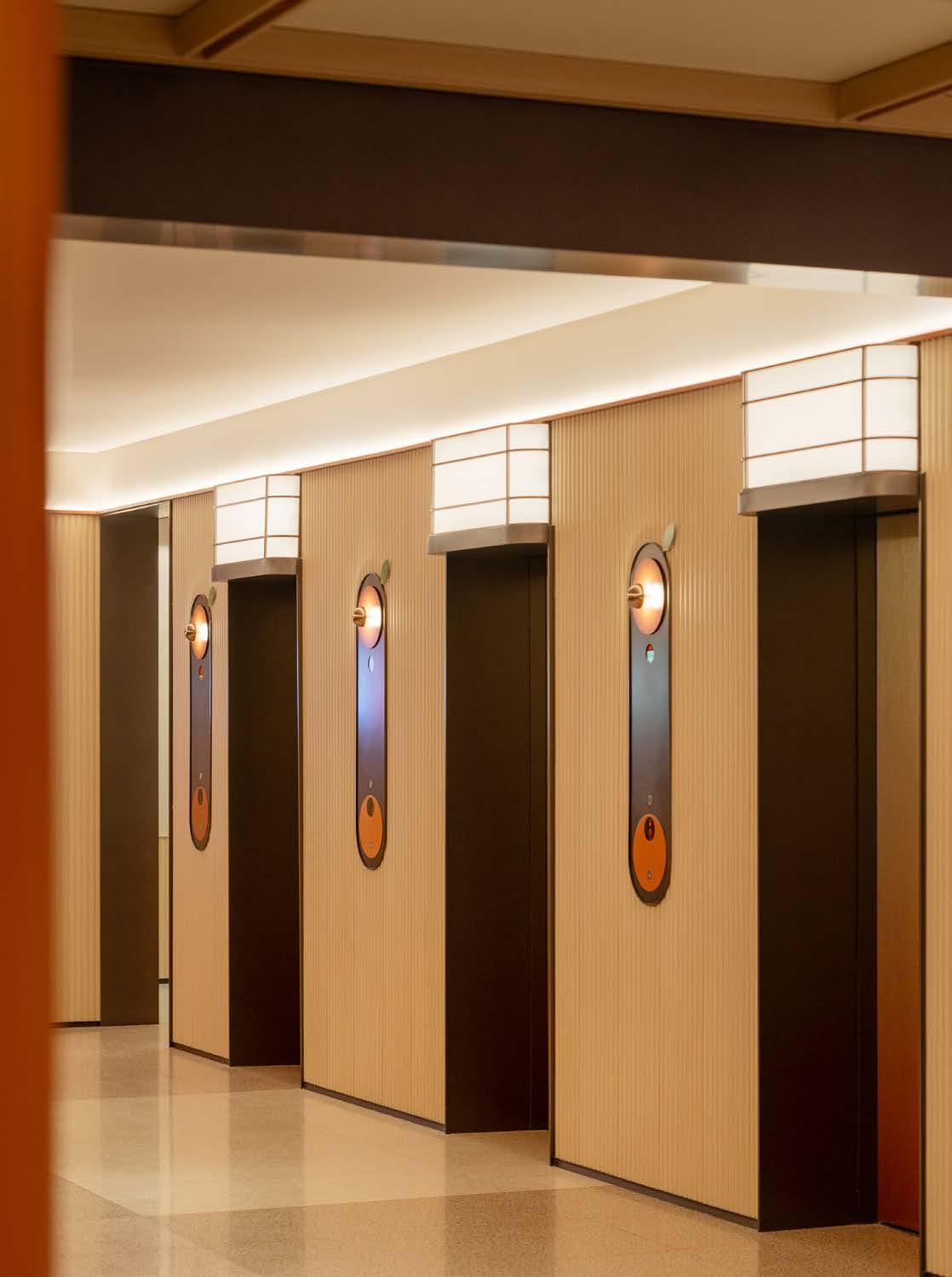
Upon entering, guests are greeted by a beautifully lift area, where lighting is designed to evoke a sense of sophistication and warmth.
A combination recessed lighting, and accent lights provides layered illumination that enhances textures and materials, such as the carpeting and wooden finishes.
Glamorous
‘Sunlight is not just a concept, but a tangible warmth flowing through the space; greenery is not mere decoration, but a source of healing and rejuvenation’
Even in back-of-house areas, recessed linear runs of LED provide general illumination. The retrained integrating lighting continues into the restaurant area. Local task lights illuminated the food.
Glamorous yet understated lighting has been a hallmark of the Orange hotel chain and its collaboration with Vermilion Zhou Design Group has been fruitful for both parties over the years.
At this, the latest edition in Shanghai, lighting designer Vera Chu has evolved the concept, while retaining its key values.
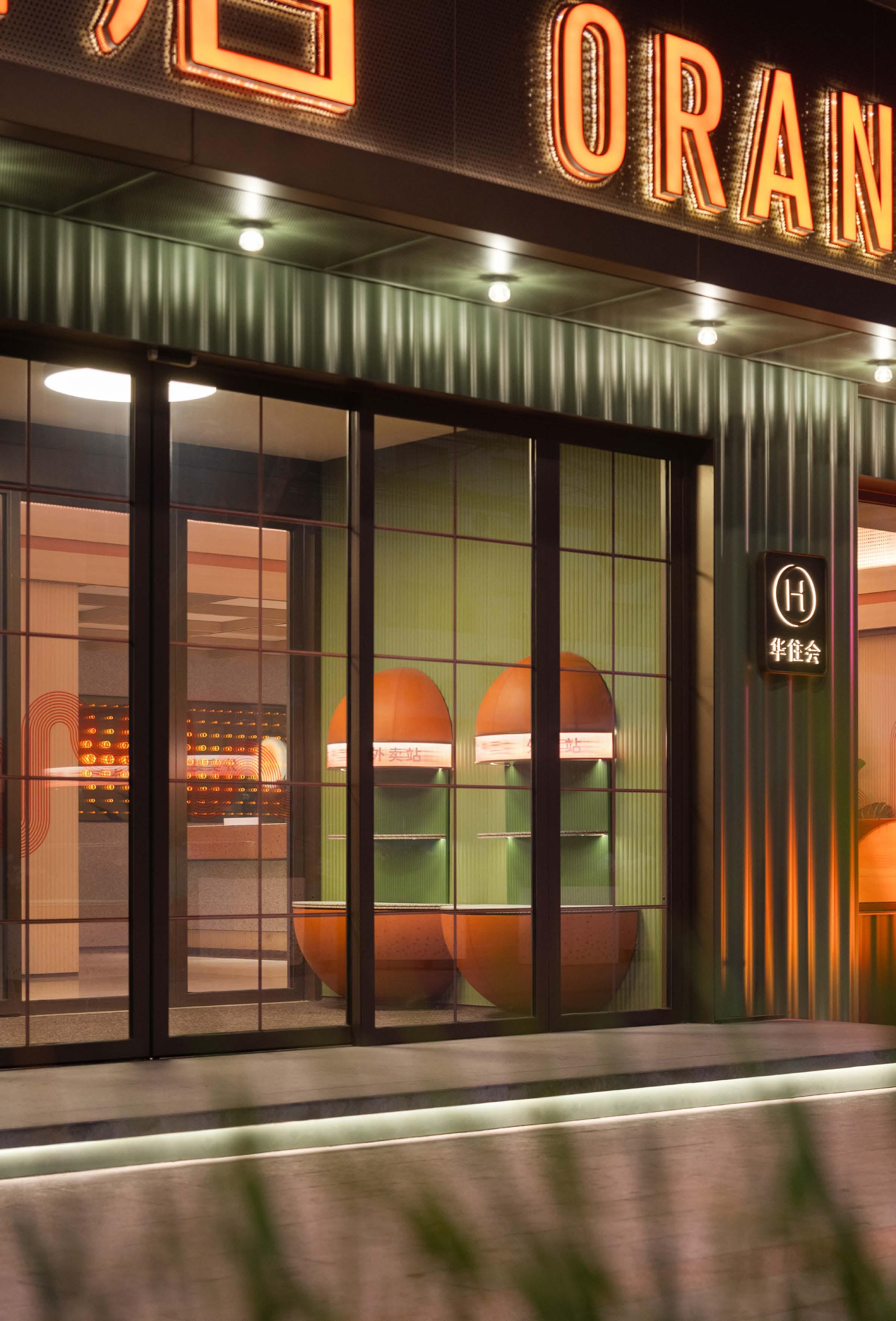
Inspired by Orange County, California, Orange Hotels embrace the spirit of sunshine, vitality and positivity say its backers. Vermilion Zhou Design has reinterpreted Southern California's relaxed, natural and healthy atmosphere, using light in the hotel spaces to soothe the tension of travel and make every journey more enjoyable.
The Orange Hotel 3.0 version – as it’s known – has further distilled the concept of ‘Lifestyles of Health and Sustainability’ as the core of the design philosophy, creating opportunities for travellers to reconnect with nature and themselves, even during busy journeys.
Here, sunlight is not just a concept, but a tangible warmth flowing through the space; greenery is not mere decoration, but a source of healing and rejuvenation, says the company.
Using orange, green, and brown as the primary palette, the design language draws from nature to create a warm, fresh, and alive space.
Starting from the construction phase, the team adopted eco-friendly, prefabricated building methods and selected renewable materials such as straw and orange peel derivatives, embedding sustainable development principles into every detail of hotel operations.
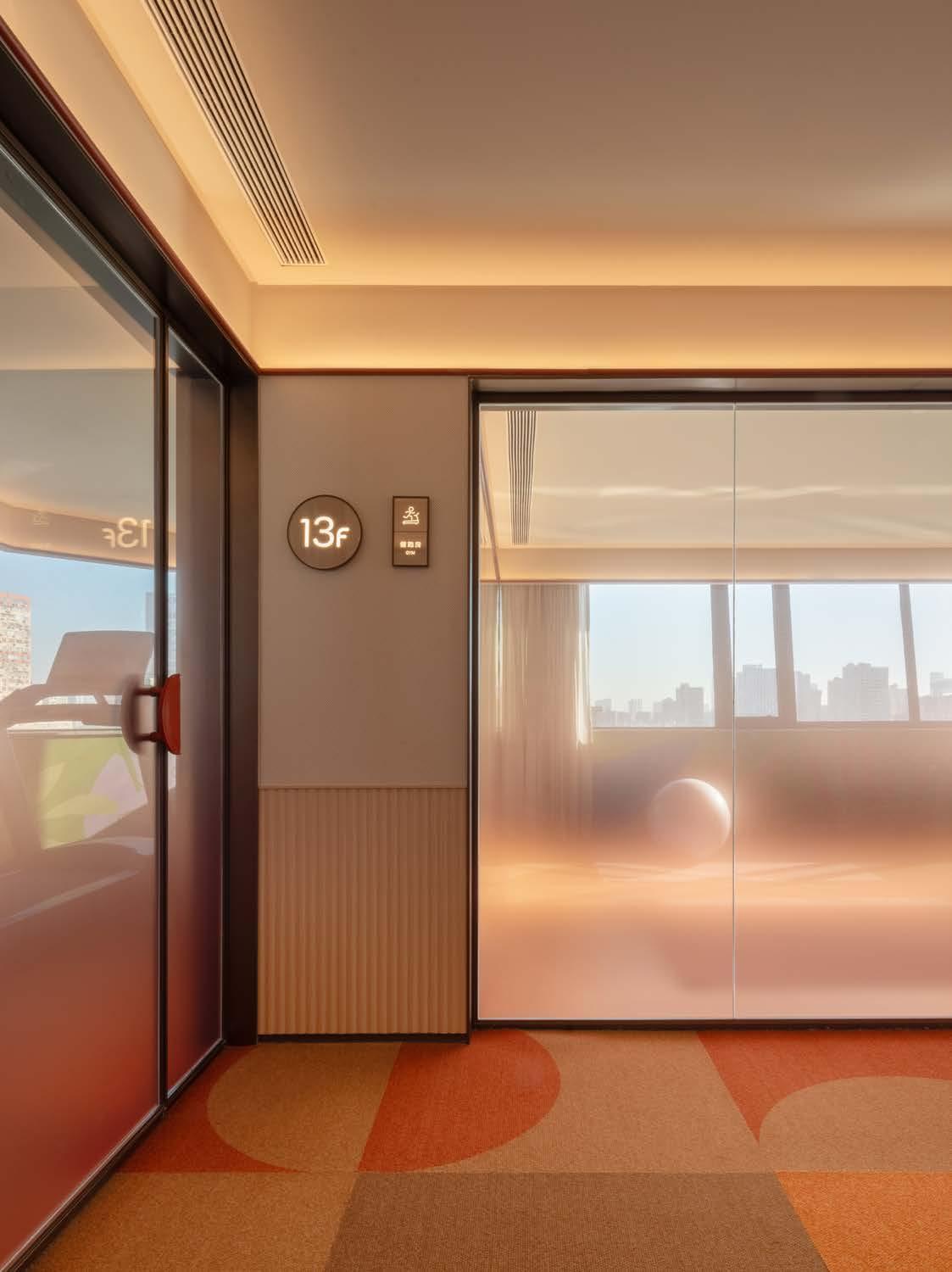
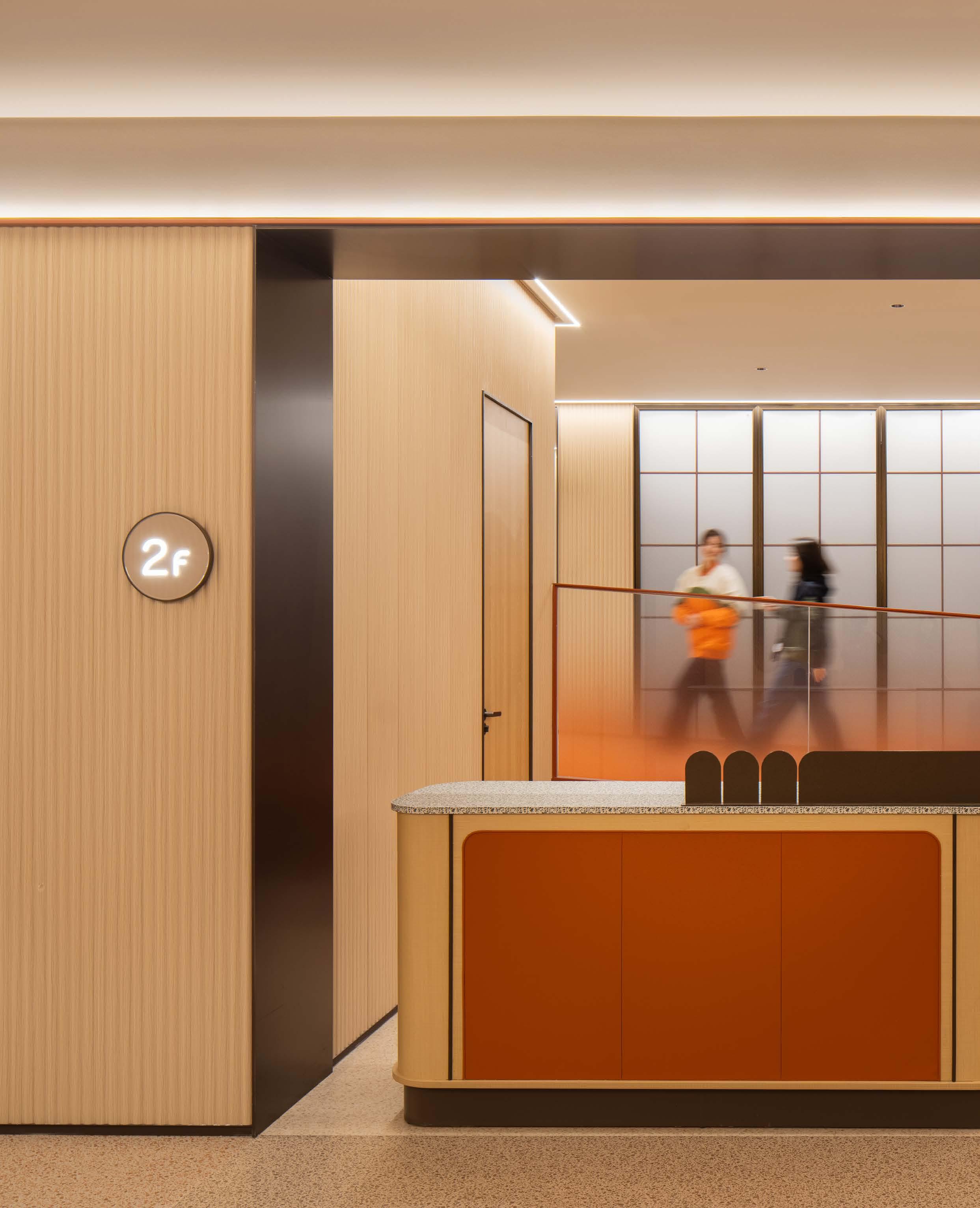
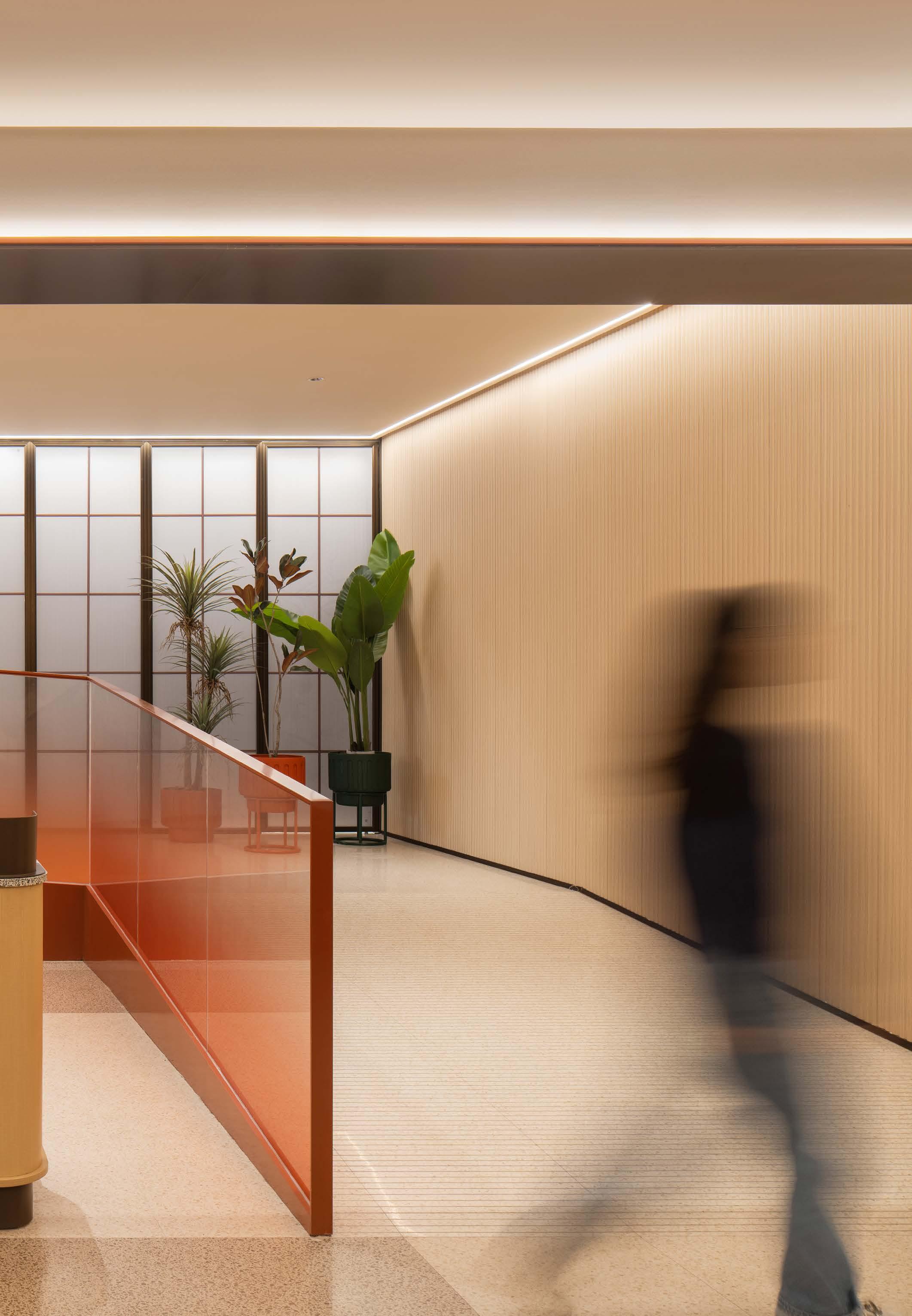
Upon entering, guests are greeted by a beautifully lit lobby area, where lighting is designed to evoke a sense of sophistication and warmth. An open, multifunctional lobby layout breaks away from the traditional hotel boundaries, creating a more welcoming and inclusive arrival experience.
A combination of recessed lighting, and accent lights provides layered illumination that enhances textures and materials, such as marble floors and wooden finishes.
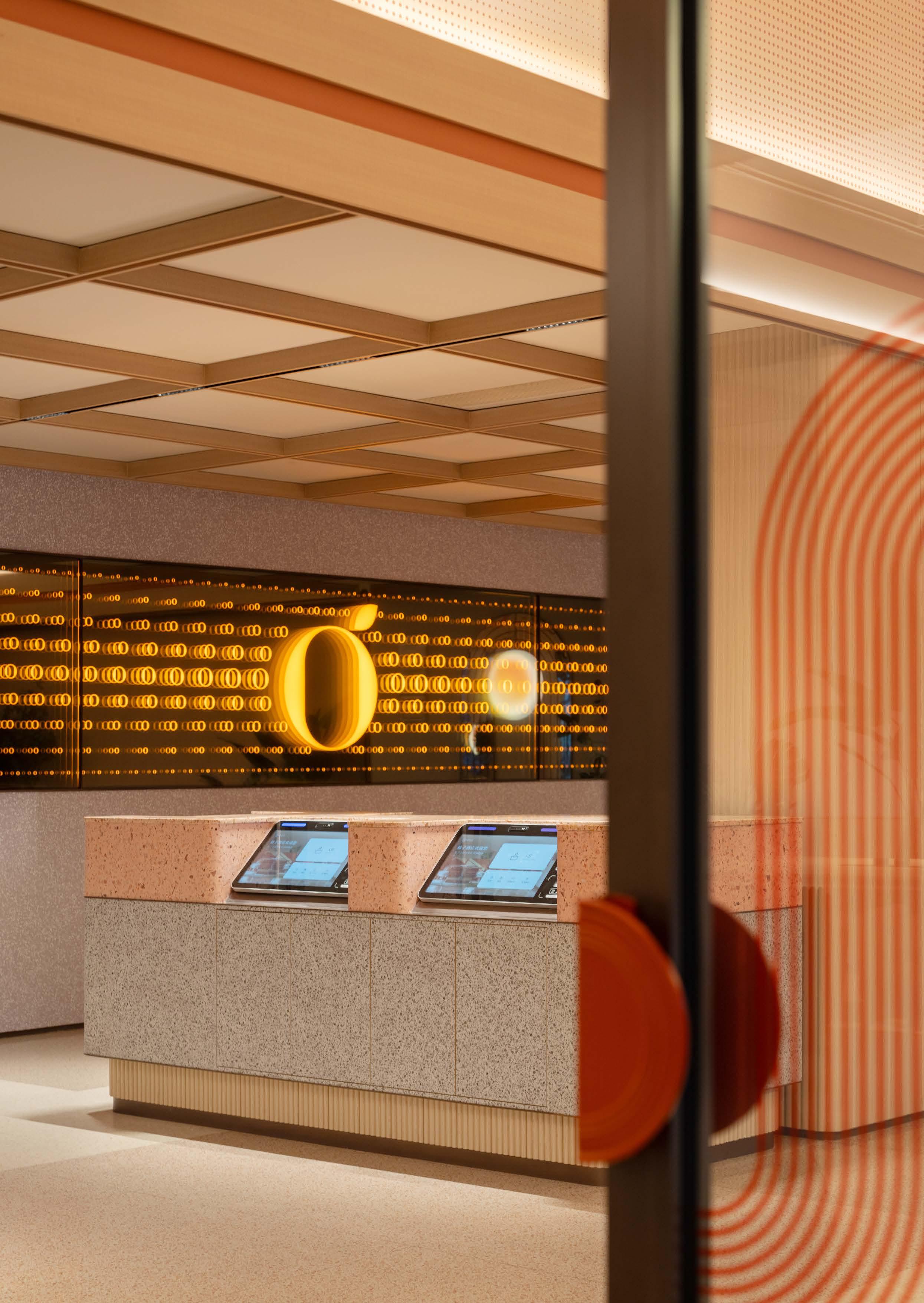
A feature wall includes warm circles of LED with infinity mirrors punctuated by larger O-rings of light.
By contrast the rest of the interior of hotel rooms are more functional, with cooler colour temperatures to create a calming and practical space. The wardrobes features a full ceiling of backlit LED, and the mirrors are side lit with twin linear elements.
Established in Shanghai in 2002, Vermilion Zhou Design Group has completed over a thousand interior design projects, encompassing various types such as public, commercial, office, hotel, restaurant, and residential spaces. The firm constantly strives to explore new possibilities.
It’s particularly strong with branded hotels, providing accommodation experiences for a staggering 100 million people.
Understanding the needs of different space users has been, it says, key to its designs.
Through precise task allocation in team collaboration, the group develops comprehensive design solutions, from conceptualisation to implementation, taking an interior design perspective.
Starting from what the practice says is a ‘contemporary Oriental mindset’, Vermilion Zhou Design Group emphasises the practicality and aesthetics of human experience in space, aiming to popularise designs that combine beauty and functionality, while assisting projects in achieving overall success.
The Vermilion Zhou Design Group says it treats each client and user's requirements with the utmost care and consideration, addressing their needs and exceeding expectations to provide the most suitable solutions.
The practice is also attuned to sustainability. It says it bears a greater sense of social responsibility, using fewer social resources and incorporating more environmentally-friendly materials in every design project. ■
The interior of the hotel rooms are functional, with cooler colour temperatures to create a calming and practical space. The wardrobes features a full ceiling of backlit LED, and the mirrors are side lit with twin linear elements.
Vermilion Zhou Design Group emphasises the practicality and aesthetics of human experience in space, aiming to popularise designs that combine beauty and functionality, while assisting projects in achieving overall success.
PROJECT CREDITS
Lighting Design: Vera Chu, Vermilion
Zhou Design Group
Creative Director: Kuang Ming (Ray) Chou
Concept Design: Ting Ho
Interior Design: Garvin Hung, Xin Wang, Weilong Tu
Furniture, fixtures and equipment design: SundiPhoto Credits: Te-Fan Wang
Other Credits Video: 8ID Studio
MOONLIT FOREST
At the heart of Xi’an’s bold new Cultural Centre Business District, a nocturnal wonderland has been created by Speirs Major Light Architecture, who drew on biophilic principles and natural light-play to create a rich, immersive nighttime journey.
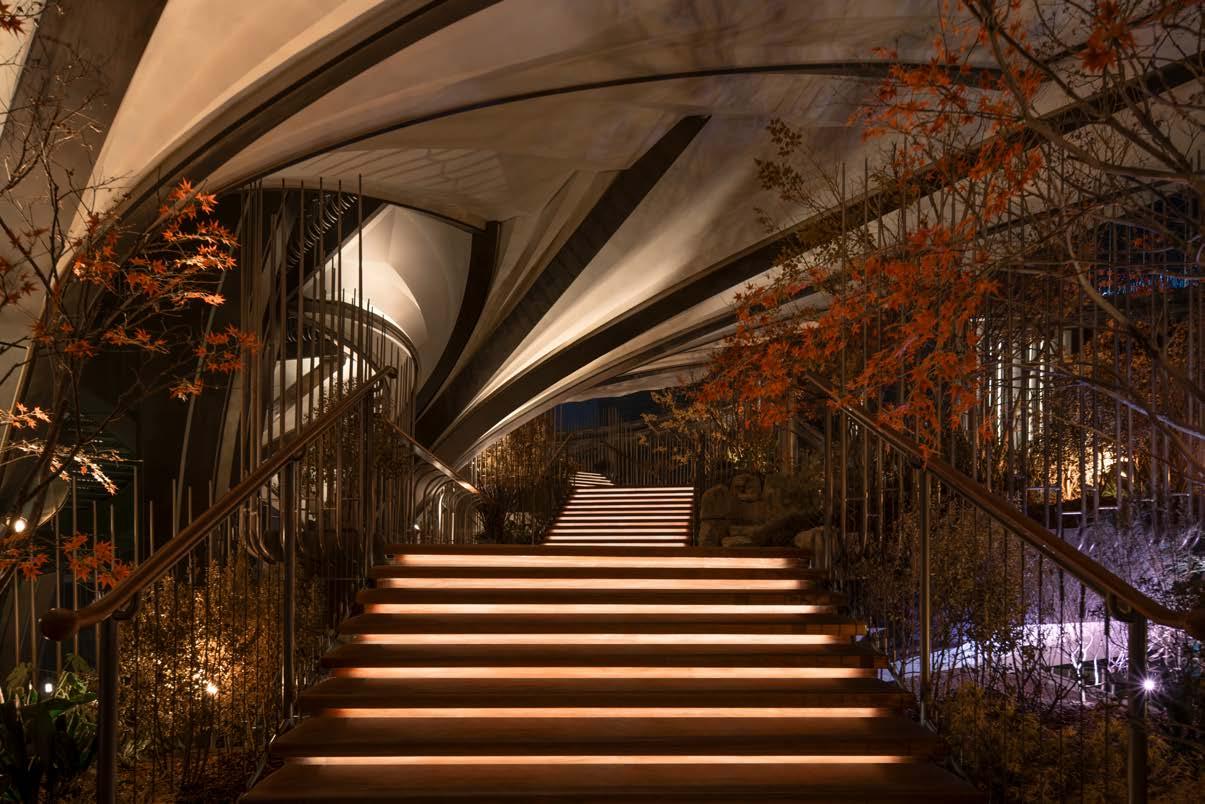
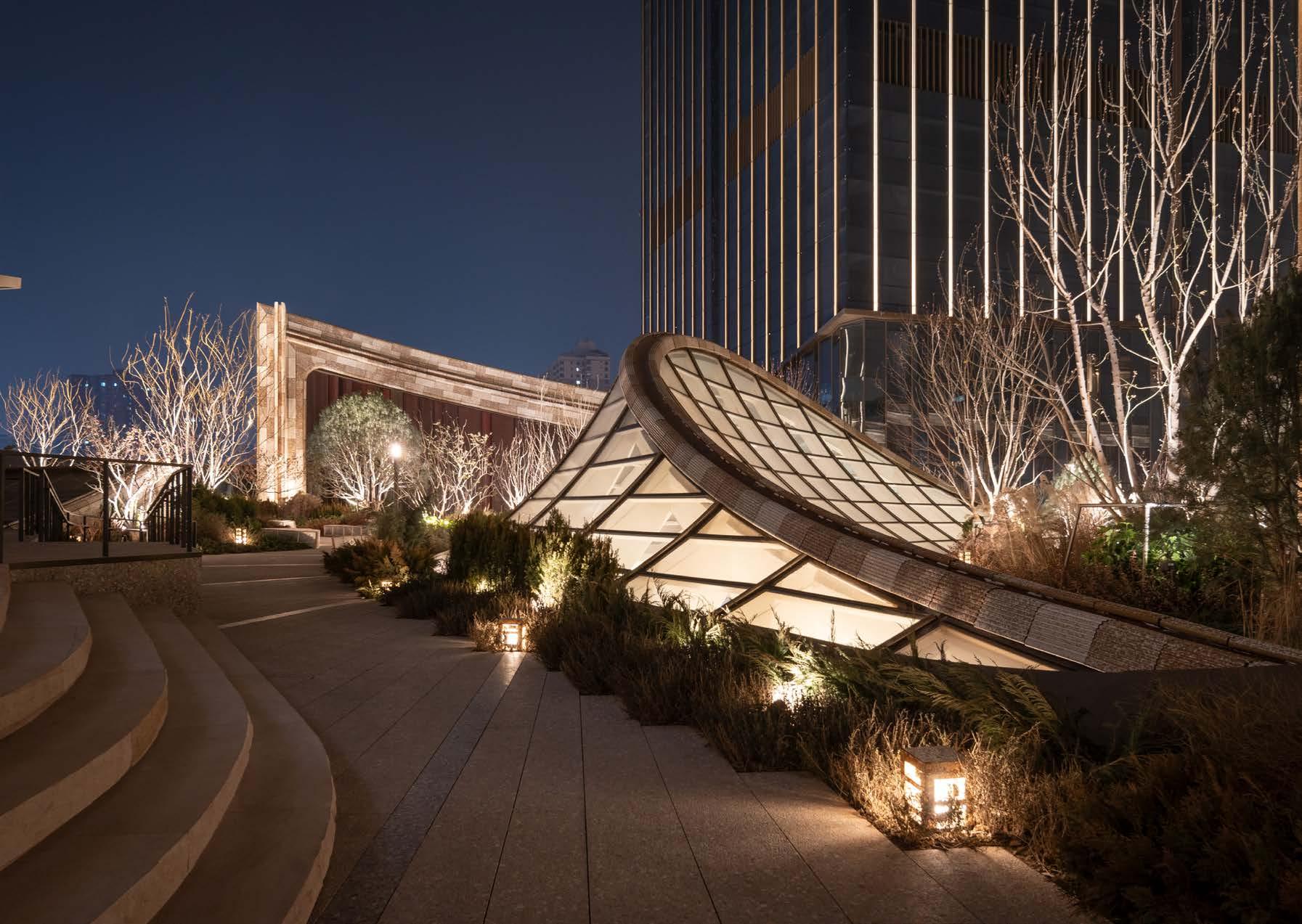
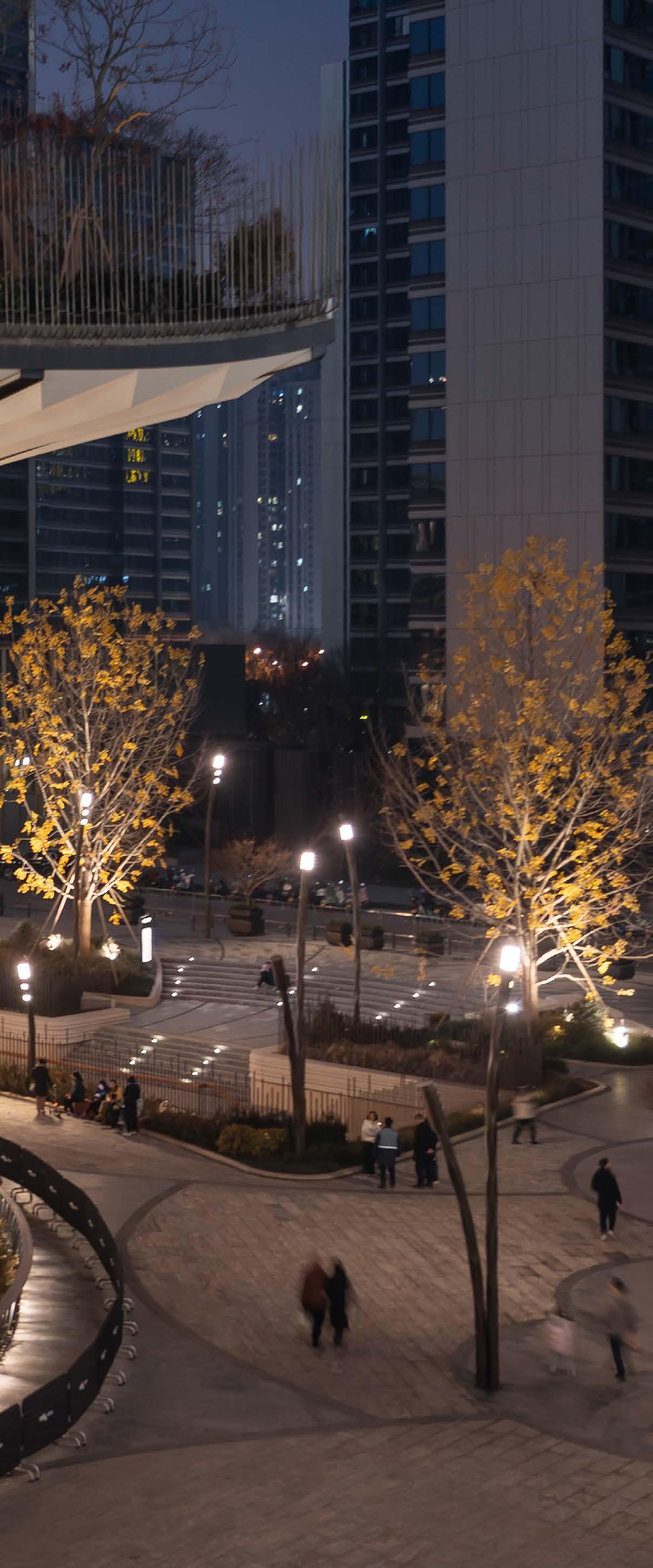
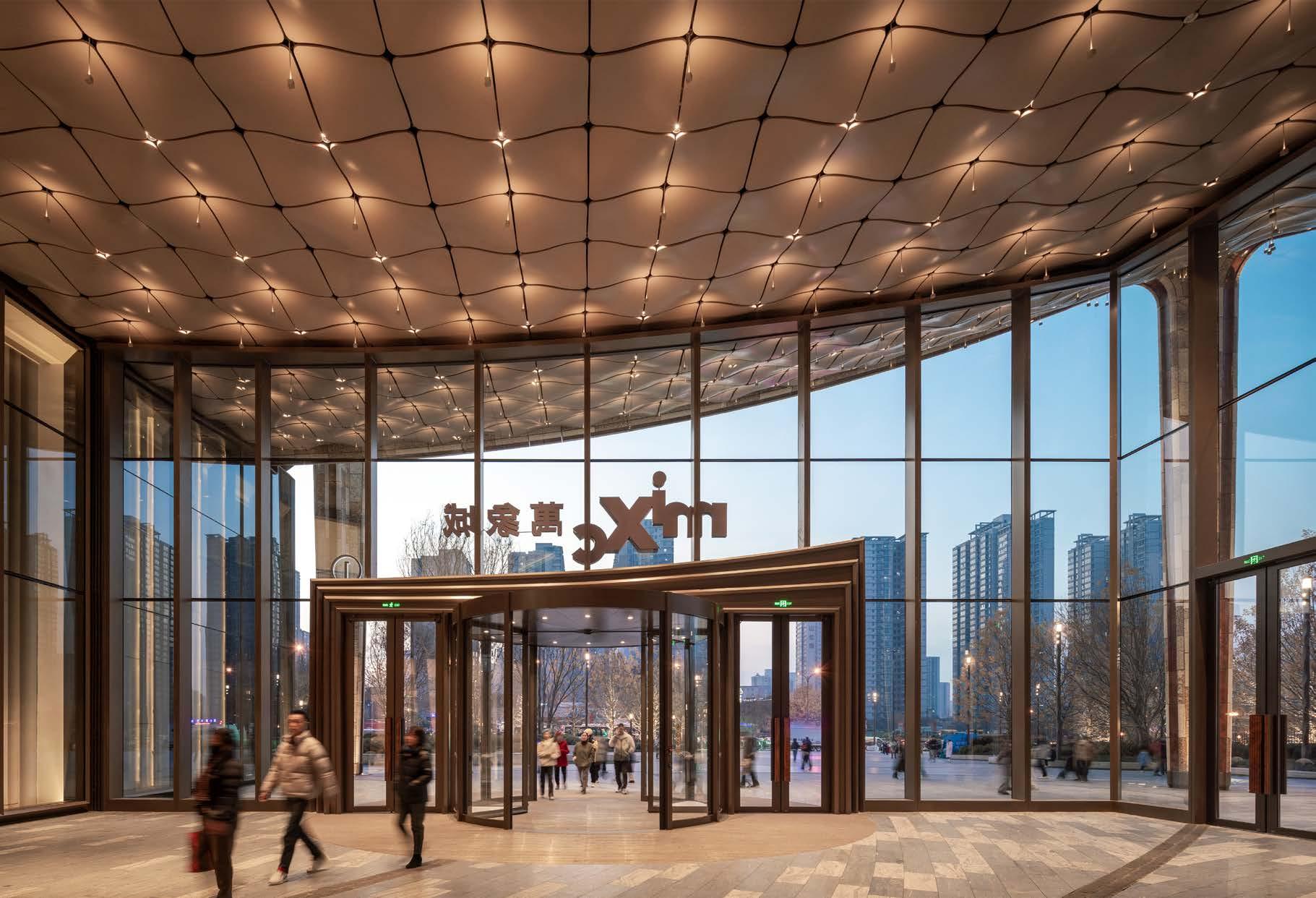
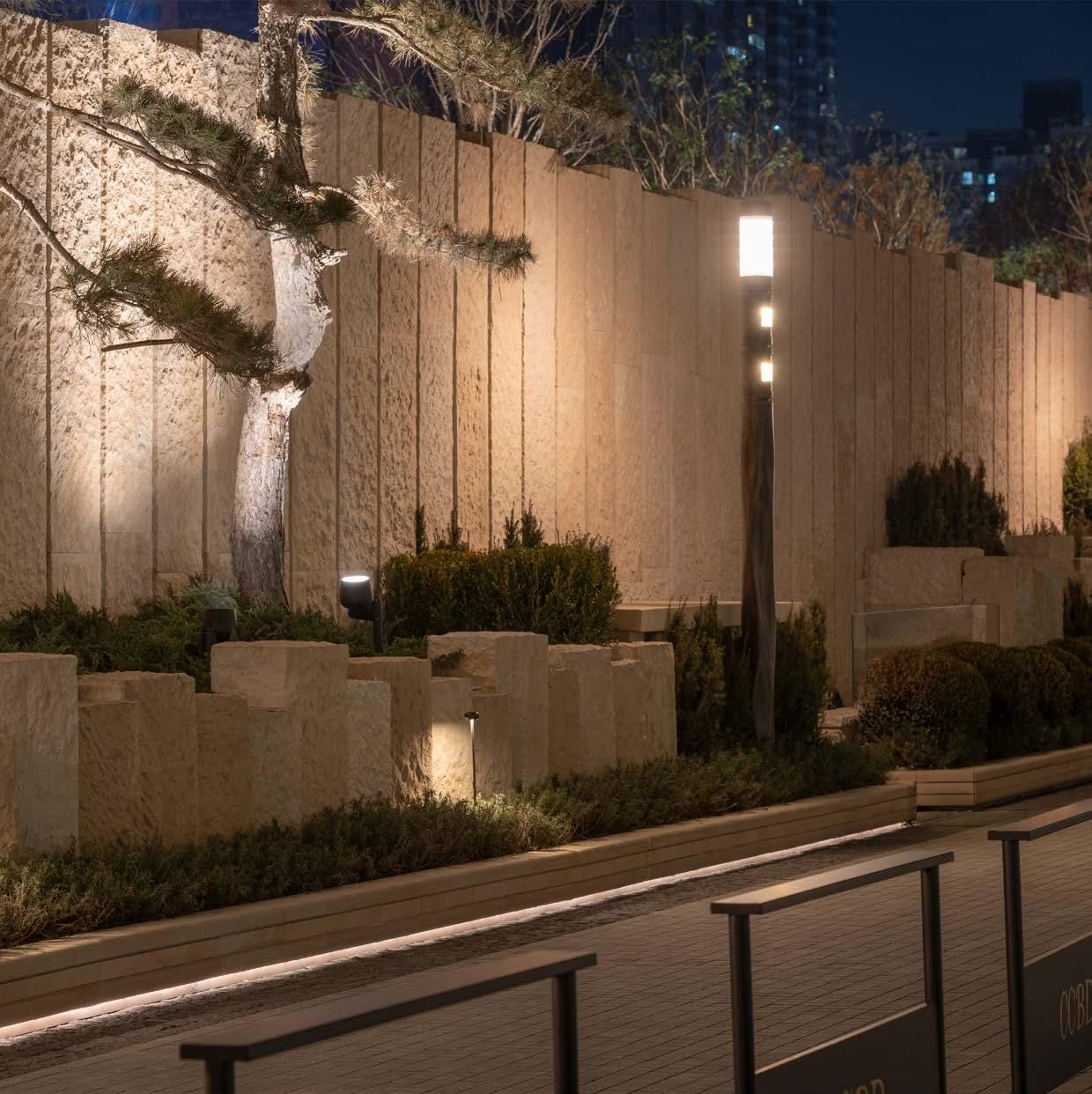
Visitors arriving after dark at the new Xi'an Centre Culture Business District (CCBD) are invited to take a walk in a forest in an experience created by renowned lighting design studio Speirs Major Light Architecture (SMLA).
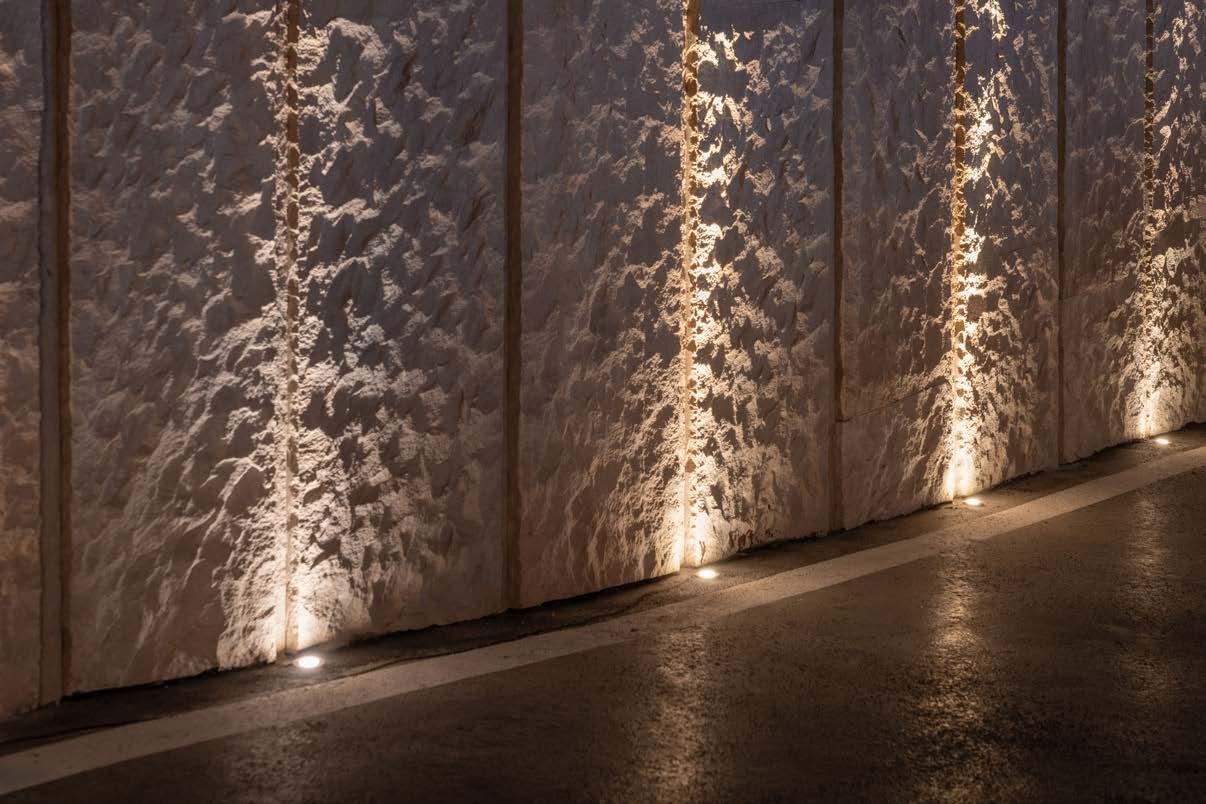
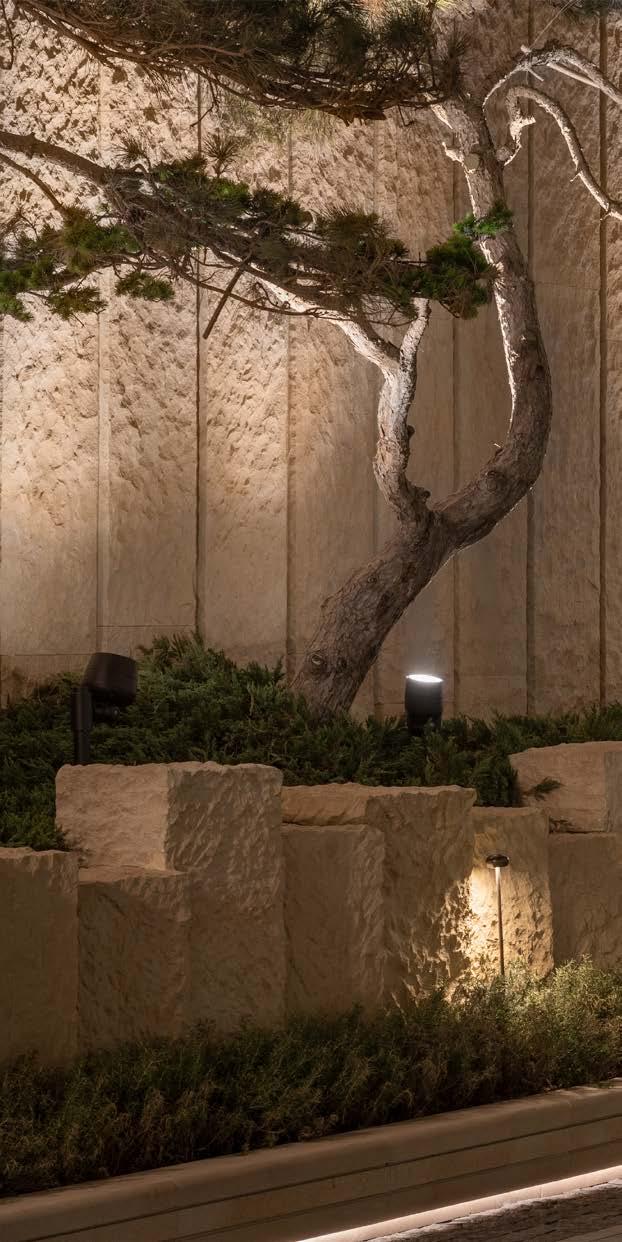
Drawing on biophilic design principles, the studio’s artful balance of light and shadow reveals and enhances the natural textures, patterns and material qualities of the architecture and landscape.
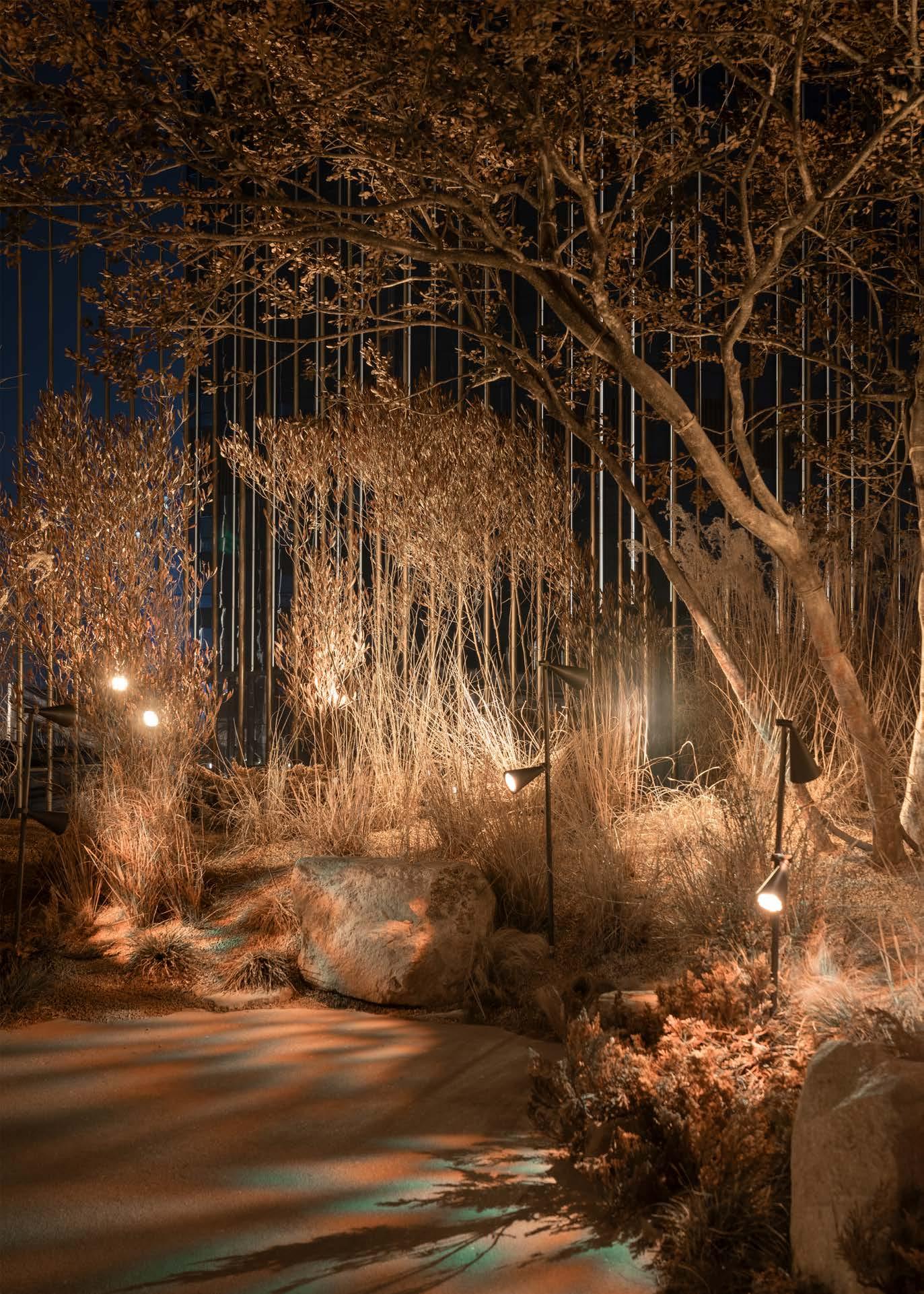
A series of magical luminous moments contribute to a new and unexpected sensory experience for the night, inspired by the way shafts of moonlight reveal treasures on the forest floor.
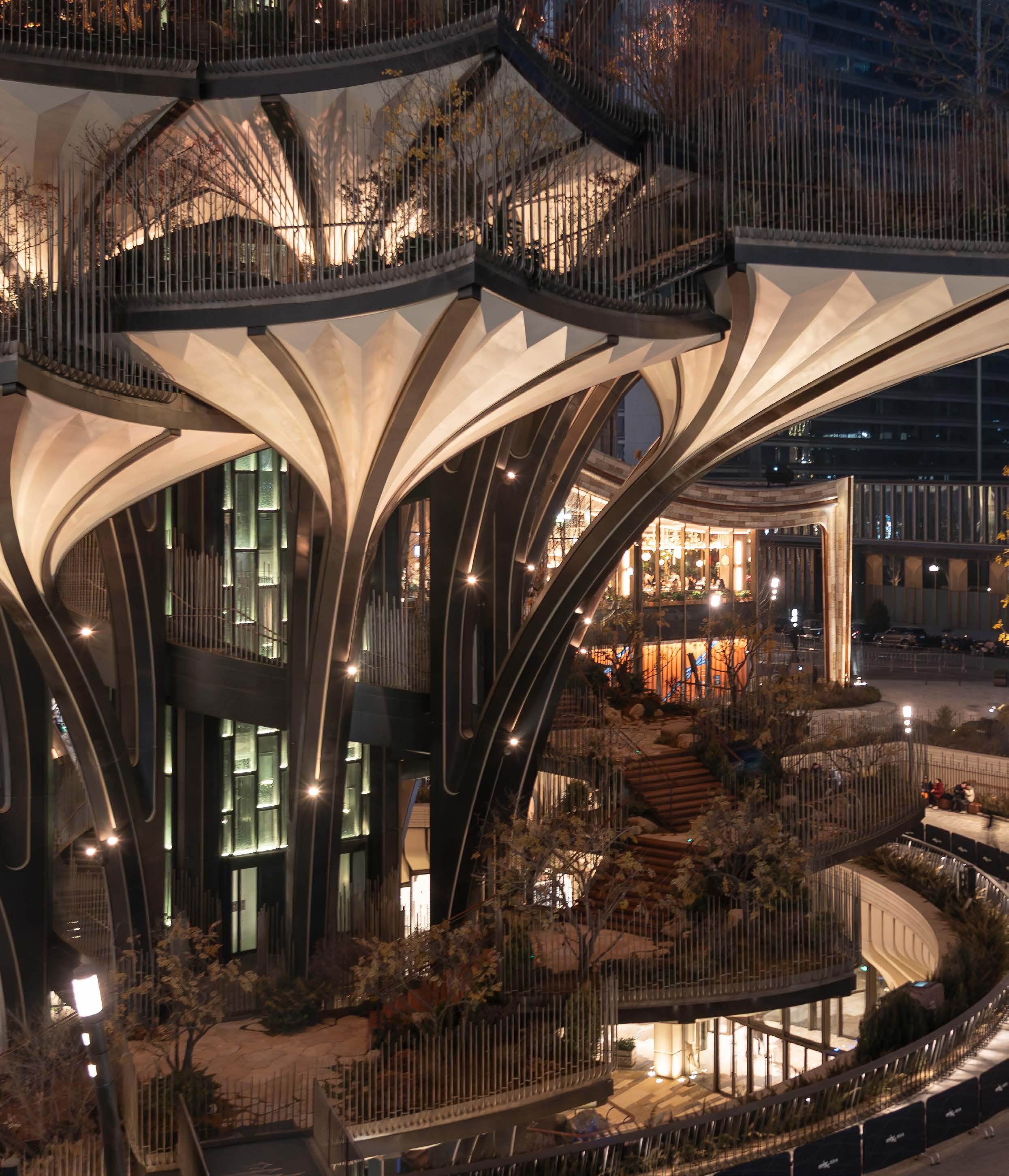
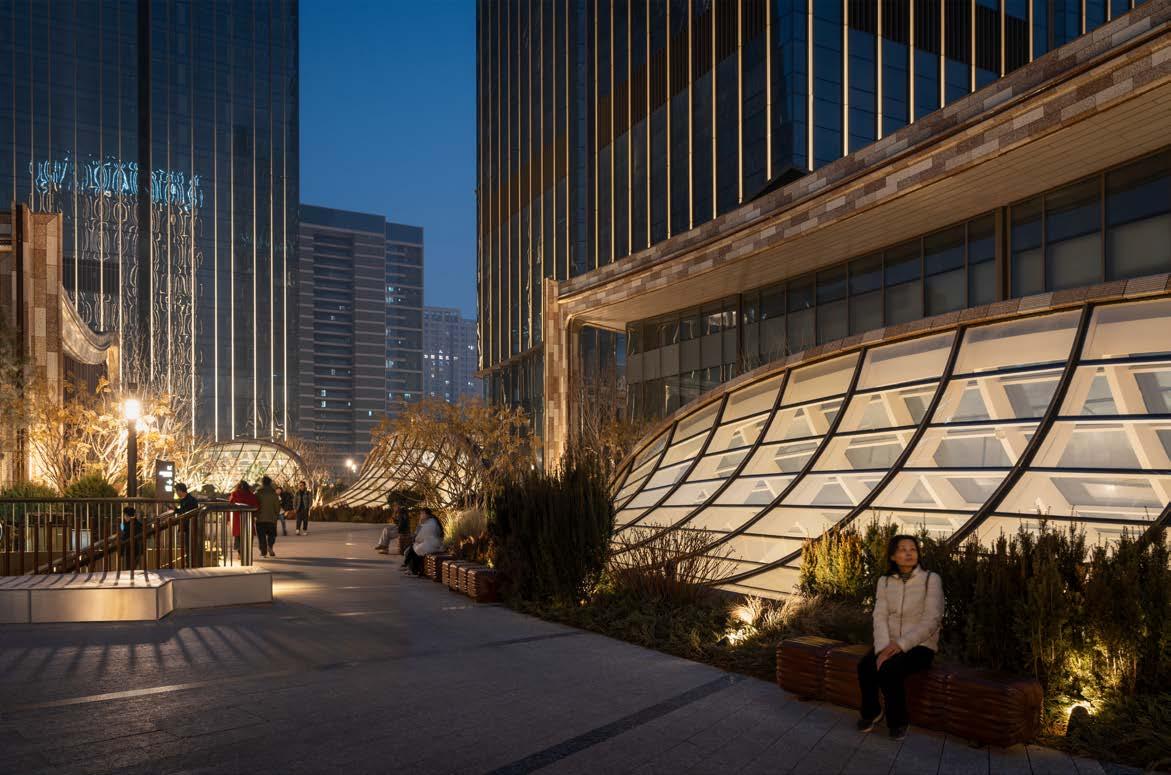
The CCBD district is a new 155,000m² development designed by Heatherwick Studio, blending a retail podium with walkable streets, terraces and open plazas, offices, apartments, accommodation, green spaces, and a vertical park – the Xi'an Tree. While the overall scale and ambition of the development is remarkable, there is also an immense richness in the materials and details at the human scale.
‘The holistic view of Xi’an CCBD is undeniably striking, but the more we delved into the project, the more we understood that the micro experience is what sets this project apart,’ says Keith Bradshaw, Senior Partner and CEO at SMLA.
‘Heatherwick’s attention to the materials and detailing creates a series of human touchpoints that are very special and personal. We were inspired to think about how we could enrich and expand on this concept for the nighttime experience, drawing attention to the handcrafted materials, and creating surprising and engaging moments of magic that draw on the language of light in a forest.
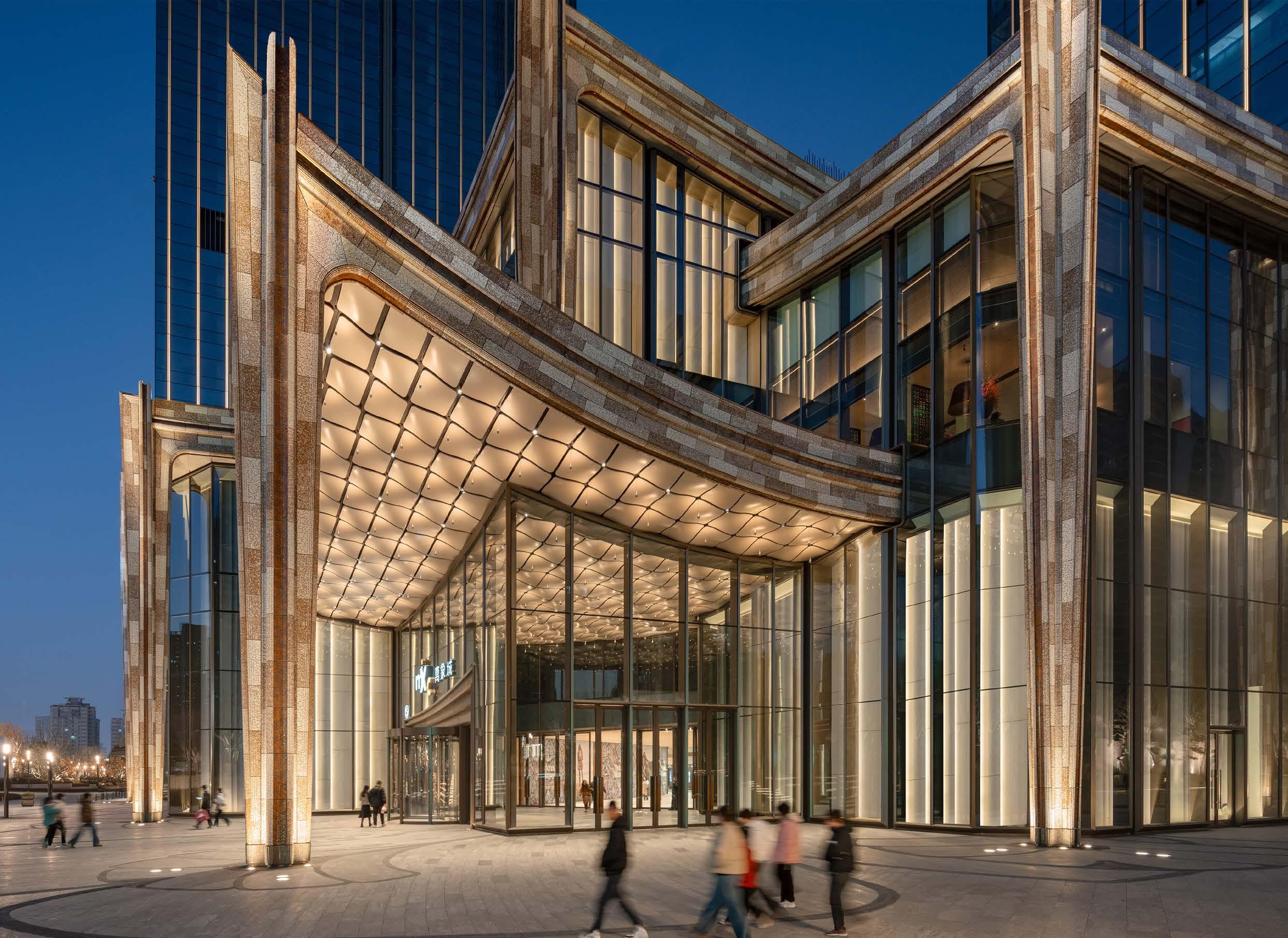
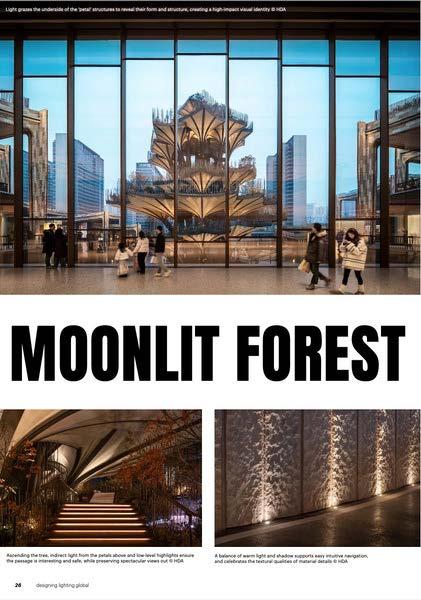
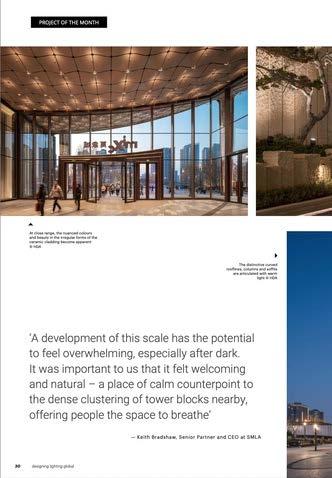
As night falls, warm, soft light reveals the curving rooflines and columns, drawing out the texture of the Terracotta-inspired ceramic cladding. Across façades, streets, and terraces, SMLA’s design balances light levels to make the site easy to navigate—while letting the retail spaces shine.
Bradshaw continues: ‘A development of this scale has the potential to feel overwhelming, especially after dark. It was important to us that it felt welcoming and natural – a place of calm counterpoint to the dense clustering of tower blocks nearby, offering people the space to breathe.
We grazed light across key forms and surfaces, picking up the naturally irregular organic qualities and rich colours of the cladding materials. We interspersed this with deliberate pockets of shadow to create contrast, which helps to make the key routes and features clear, while enveloping visitors in a soft ambient glow.’
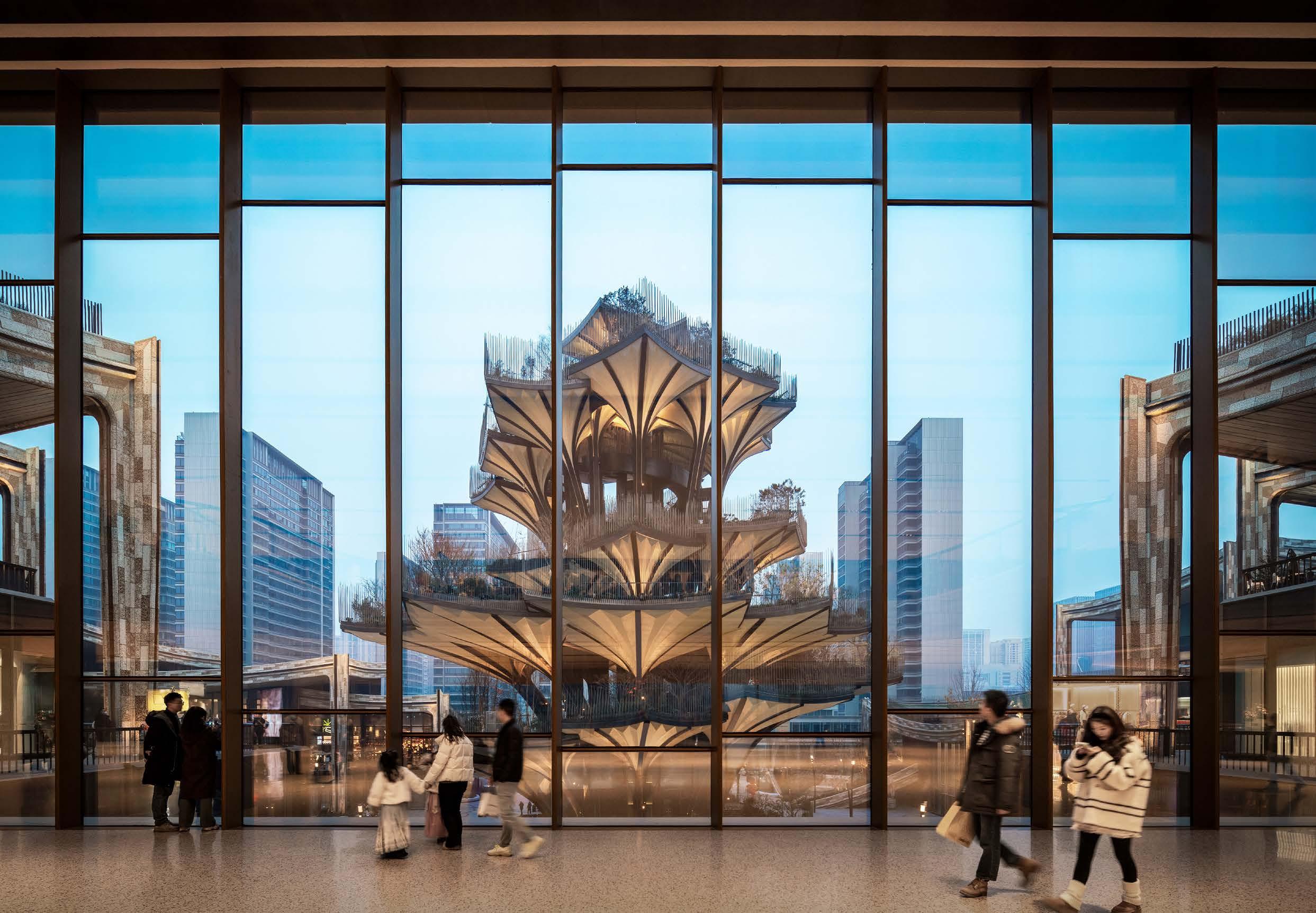
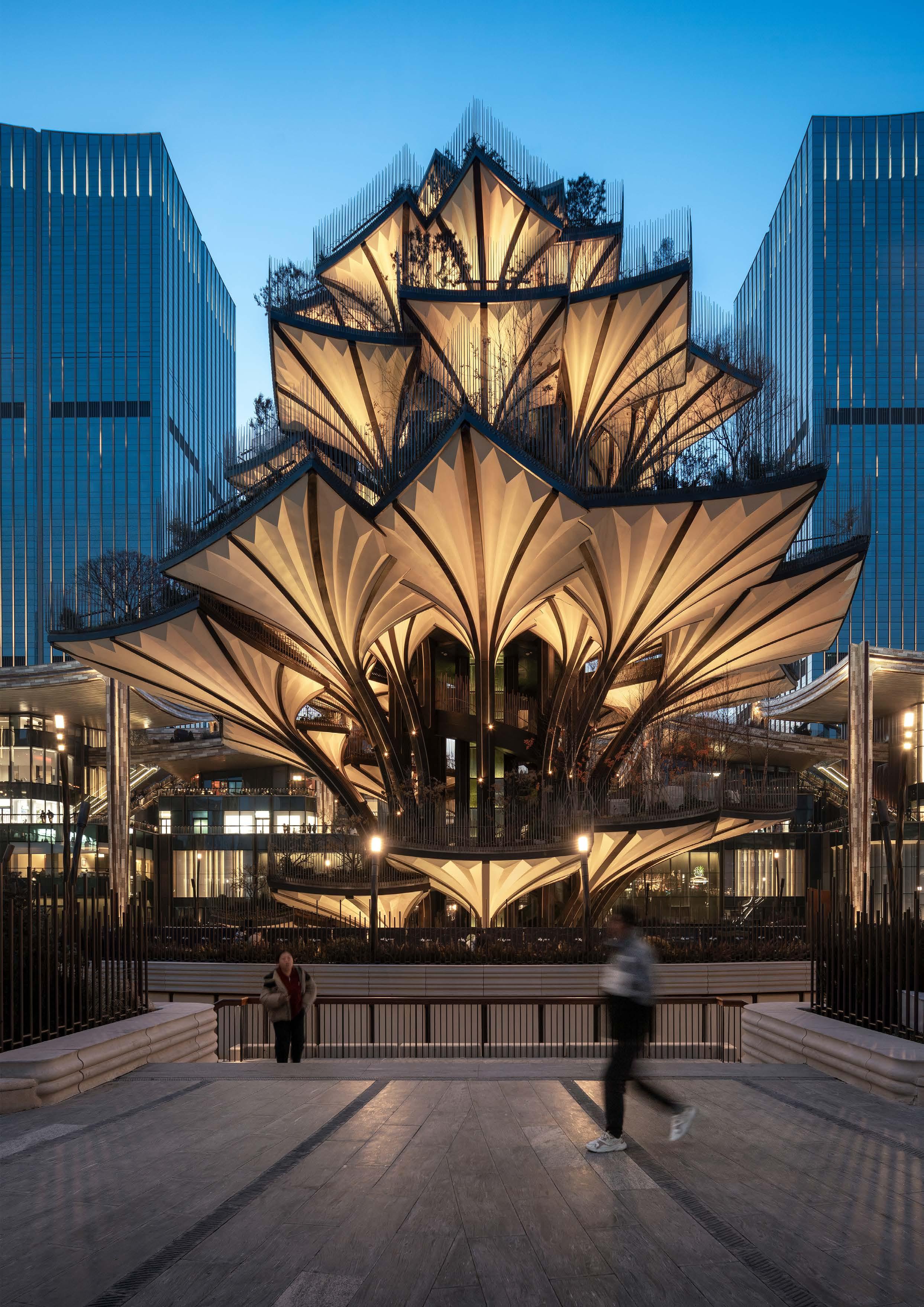
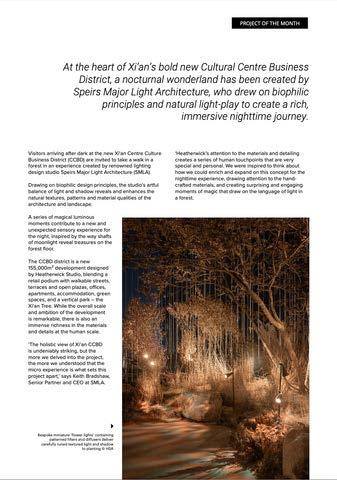
At the heart of the district stands the Xi’an Tree, the central landmark and natural gathering place. Inspired by the ancient ginkgo at Xi’an’s Old Guanyin Temple, it invites visitors to ascend 57 meters through a series of cascading gardens that echo the biomes of the Silk Route, from alpine tundra to dry steppe, before reaching a panoramic city-viewing platform.
‘A development of this scale has the potential to feel overwhelming, especially after dark. It was important to us that it felt welcoming and natural – a place of calm counterpoint to the dense clustering of tower blocks nearby, offering people the space to breathe’
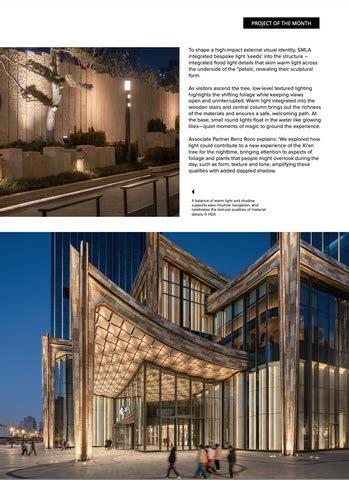
To shape a high-impact external visual identity, SMLA integrated bespoke light 'seeds' into the structure –integrated flood light details that skim warm light across the underside of the "petals', revealing their sculptural form.
As visitors ascend the tree, low-level textured lighting highlights the shifting foliage while keeping views open and uninterrupted. Warm light integrated into the wooden stairs and central column brings out the richness of the materials and ensures a safe, welcoming path. At the base, small round lights float in the water like glowing lilies—quiet moments of magic to ground the experience.
Associate Partner Benz Roos explains: ‘We explored how light could contribute to a new experience of the Xi'an tree for the nighttime, bringing attention to aspects of foliage and plants that people might overlook during the day, such as form, texture and tone, amplifying these qualities with added dappled shadow.
Architecture – Keith Bradshaw, Benz Roos, Bruno Leung, Keerthigan Thavaseelan, Gordon Chan
Executive Lighting Design: HDA
Photography: HDA
‘To deliver the effect we wanted at a miniature scale, we created tiny bespoke 'flower lights’, using patterned filters to bring texture to pathways and planting areas and a specific colour profile tuned to render the vegetation at its best, while blending naturally with the architectural lighting’.
Inside, SMLA’s lighting design continues the focus on emphasising the organic forms and material qualities of the architecture.
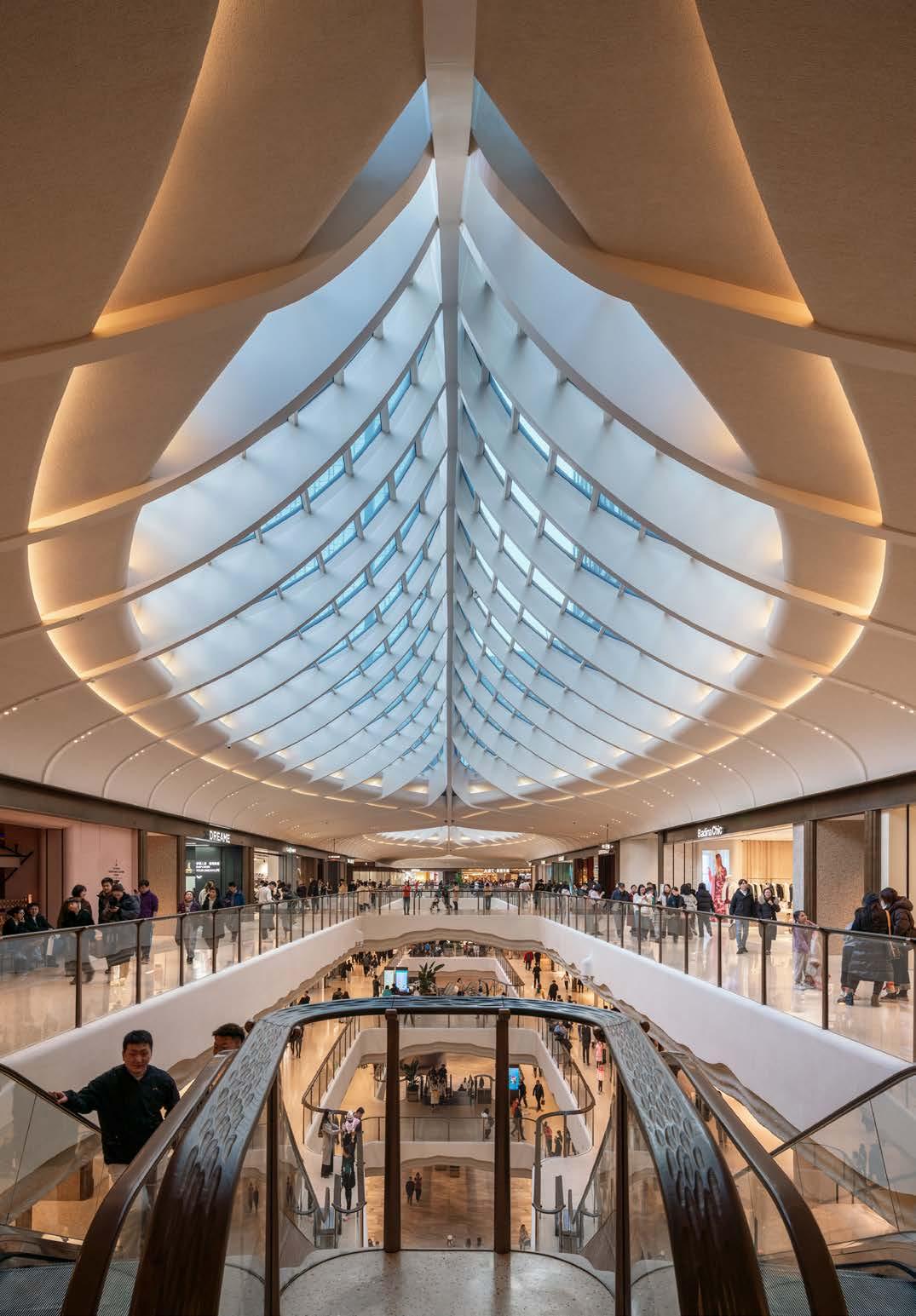
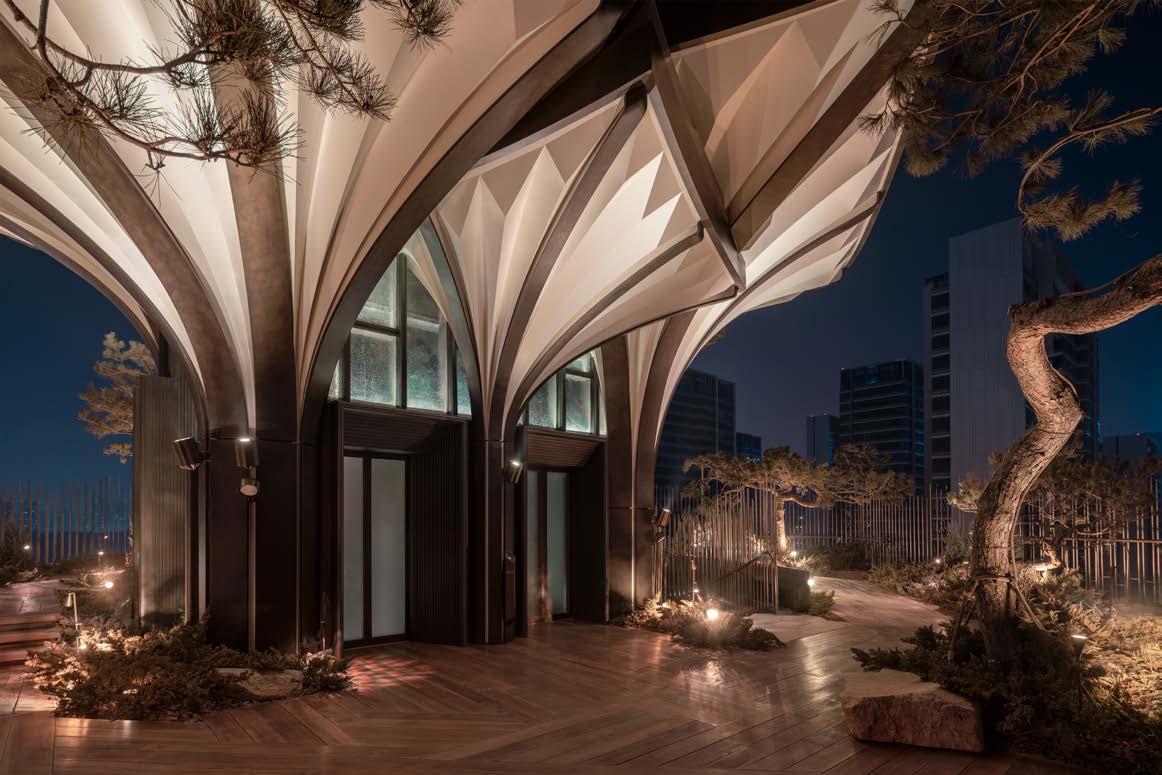
Huge skylights take the form of outsized leaf skeletons, their structural 'veins' appearing in soft silhouette by day. By night, bathed in SMLA's concealed integrated lighting, they glow as if held up to the light of the moon.
Up on the first-floor podium roof gardens, the same structures appear to erupt from the ground, taking the form of stunning pod-shaped curved lanterns.
In the gardens, another delightful lit feature bears closer inspection. Playfully scattered across the landscape, a series of bespoke glowing circular inground luminaires feature a ginkgo leaf motif.
The lift lobbies and bathrooms feature textured panel cladding that evokes rough-hewn stone embedded with plant textures. The lighting for this area is deliberately non-uniform, with downlights placed to create irregular areas of brightness and shade, which boosts visual interest and amplifies the organic qualities.■
‘A more holistic approach to lighting design would improve the lived experience of a city’
— Gary Thornton, Nulty
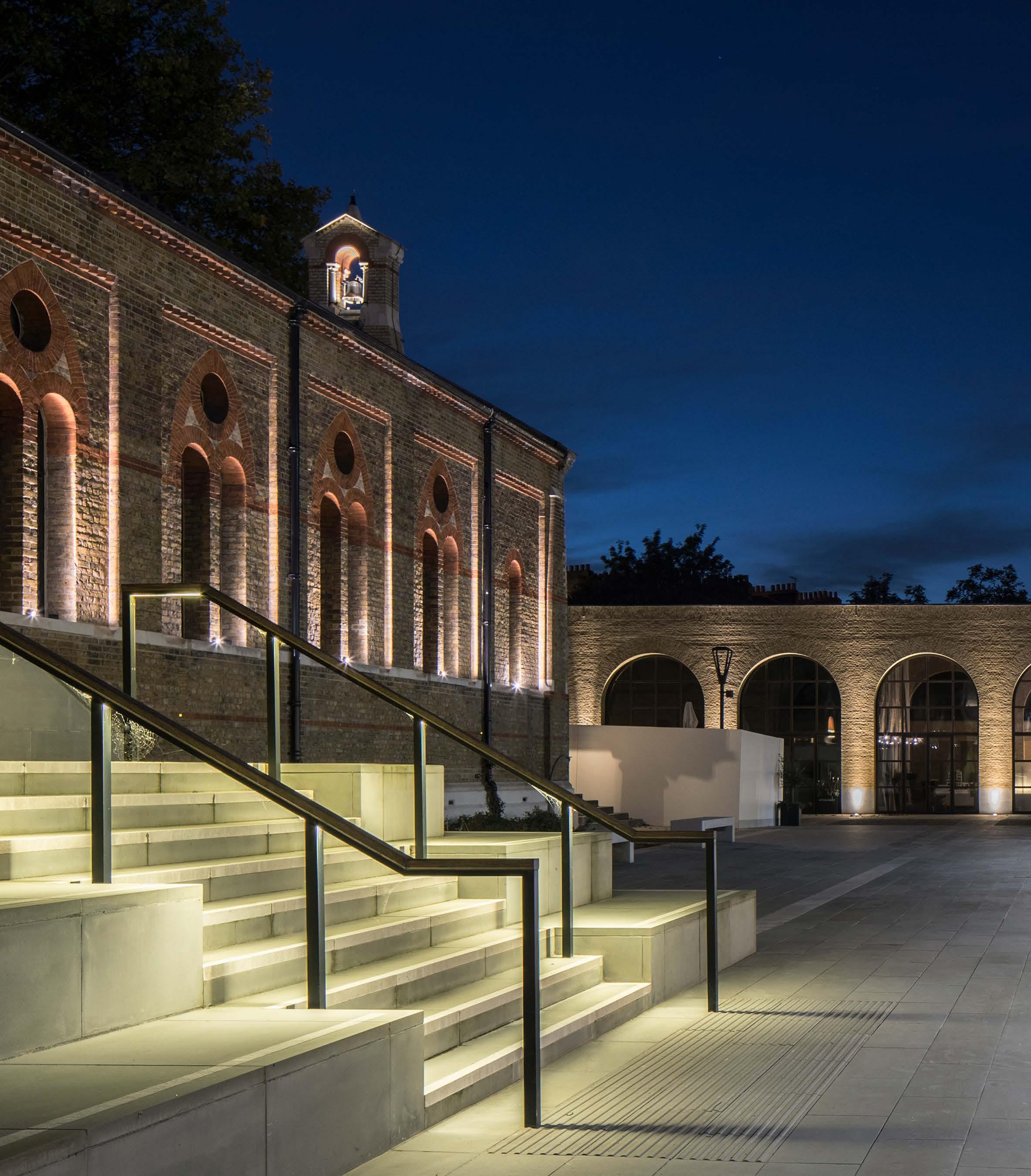
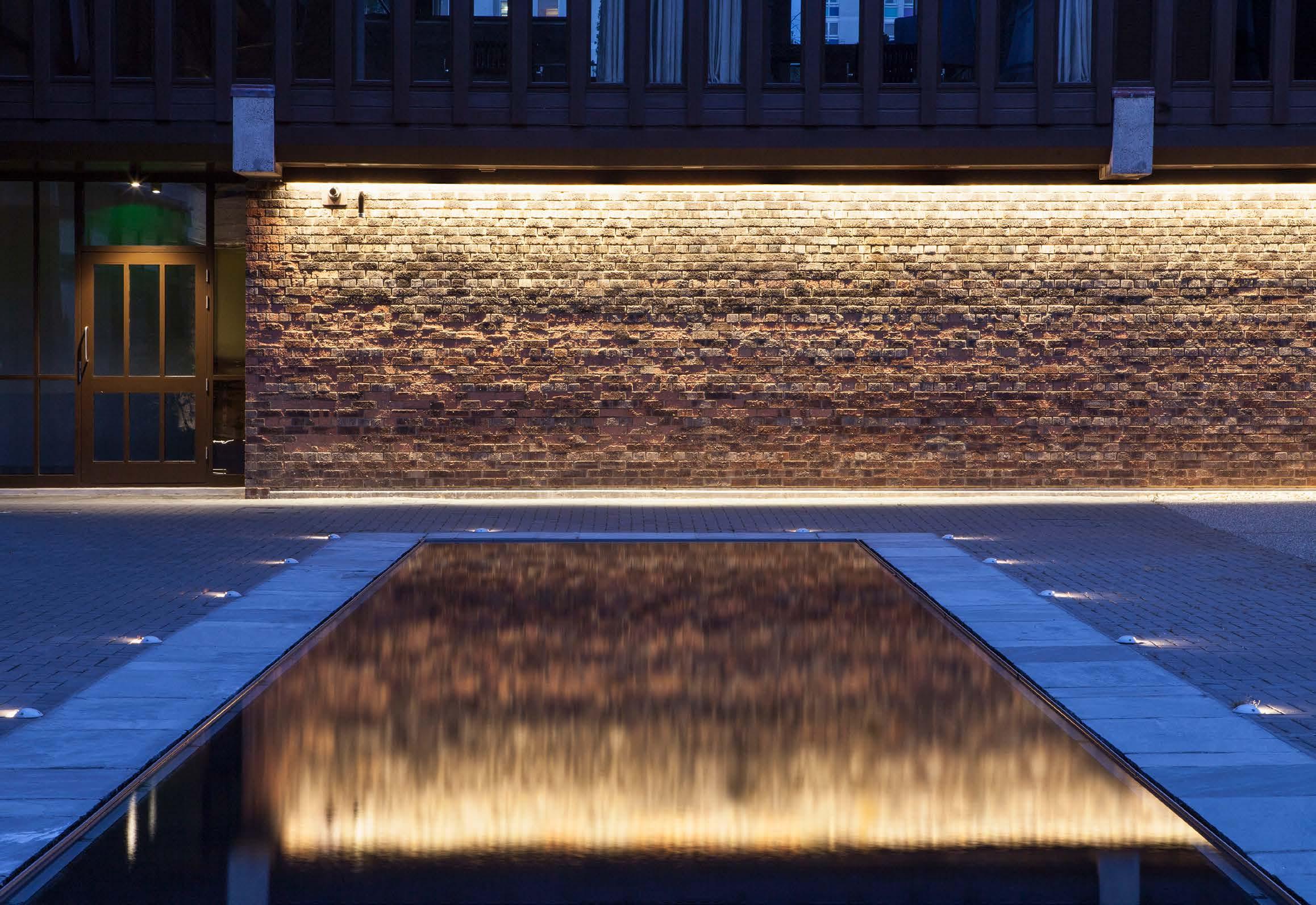
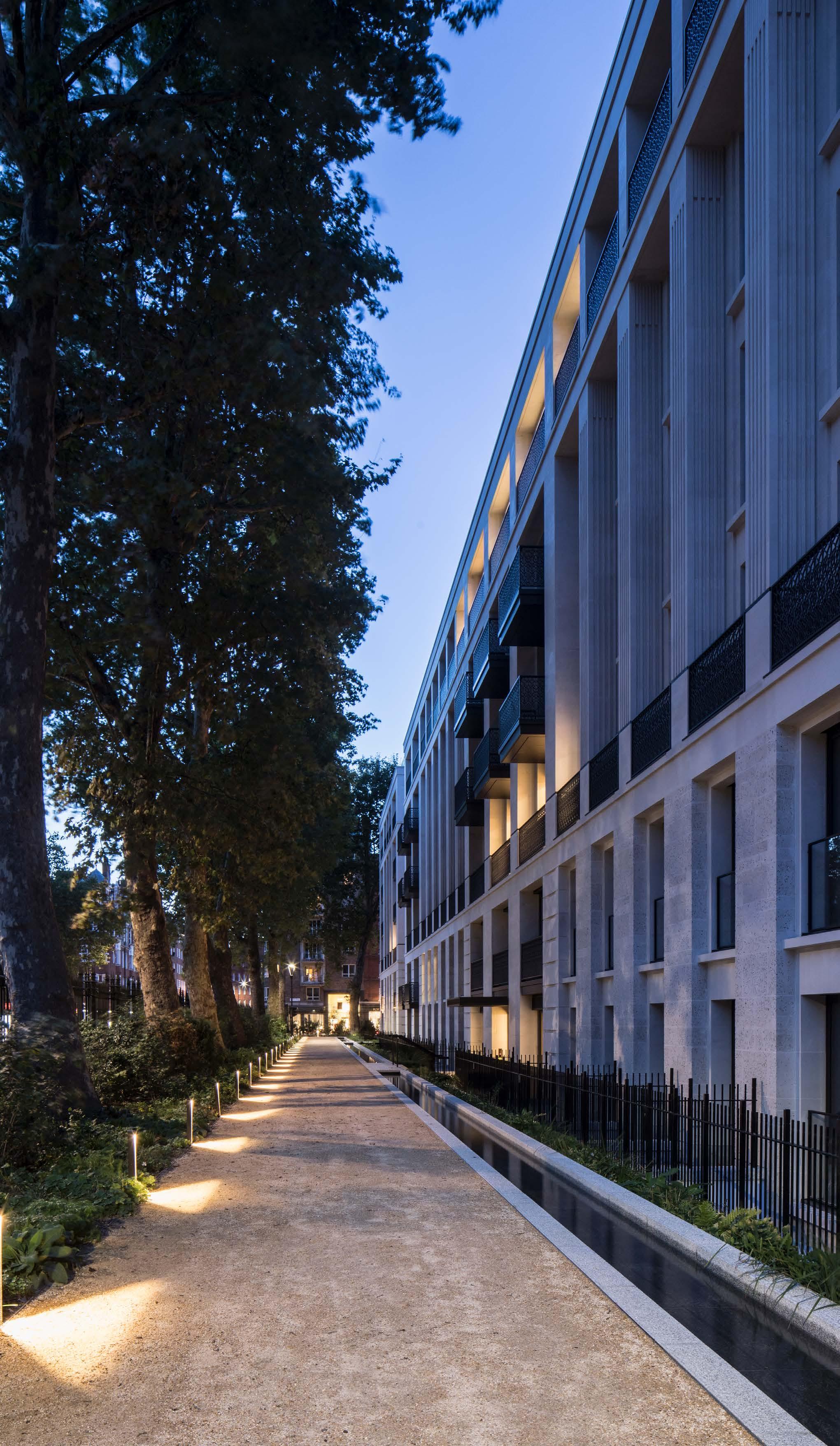
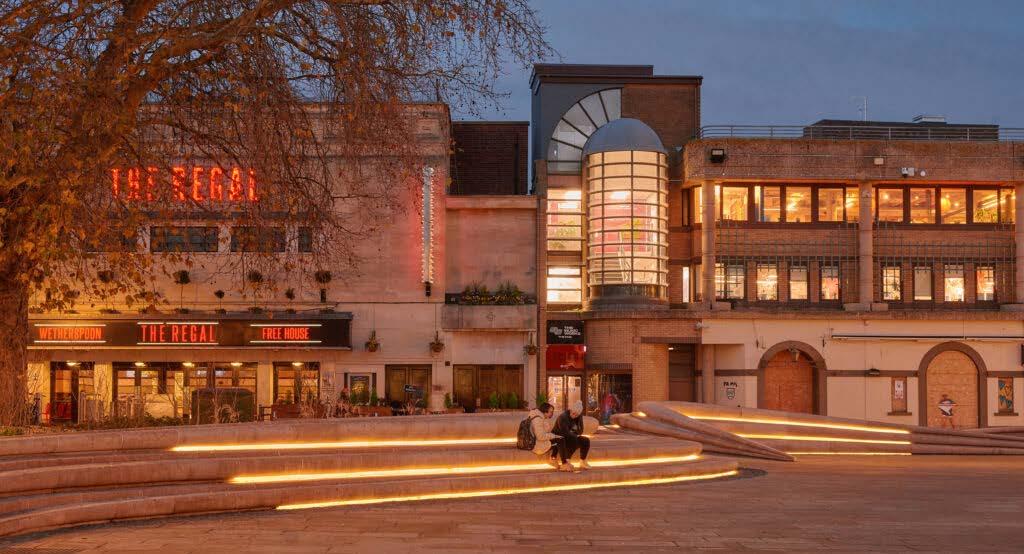
Chelsea Barracks Square, London by Nulty.
Picture: James French
THE ROLE OF LIGHT IN RESTORATIVE CITES
Gary Thornton, director of Nulty, says we need to say no to overly illuminated urban environments that do little for our sense of wellbeing.
Too bright, too dim, too much glare, we have all been exposed to bad lighting in a city –you do not have to be a lighting designer to call it out. Conversely, we have all experienced good lighting, even if we were only faintly aware of it at the time. Why do we naturally gravitate to the old town on our travels? Because people crave visually interesting architecture, with soft, human-scale lighting that works in harmony with the streetscape.
Poorly lit urban environments are a byproduct of the modern age. Somewhere along the way, architecture ceased to be the subject and wrongly
became a canvas to be illuminated. Public realm lighting became a dispassionate and disjointed art form, with lighting designers often brought in as an afterthought.
Where did this lead us? Cities became progressively overly illuminated and over saturated. Buildings began competing with their neighbours to stand out, usually at the expense of quality of light.
With the UN predicting that 68 per cent of the world’s population will live in urban areas by 2050, the role of developers, urban planners, architects, landscape designers and lighting designers as guardians of well-designed cities has come into focus.
As cities have swelled to accommodate more people, quality of life, community and wellbeing have been drastically overlooked. The magnitude of the built environment has superseded the needs of the individual, and cities have been an unhealthy reality for the people that visit and inhabit these spaces.
In recent years, city-wide masterplans with specific lighting strategies have begun to alleviate these issues.
Paris set a strong precedent with its Plan Lumière, developed by Concepto Agency under Roger Narboni. This high-level lighting strategy focused on addressing transitions between different districts and reconnecting the outlying areas with the main city centre after dark.
The overall goal was to give each individual district its own sense of character at night, while achieving a unifying identity for the ‘City of Light’.
Similarly, the City of London has made a concerted effort to overcome a legacy of uncoordinated lighting design. Led by Speirs Major Light Architecture, its lighting strategy aims to create legible public spaces and improve connectivity across the city to promote permeability.
A key focus of the masterplan is to readjust the hierarchy between cars and pedestrians, creating a more humancentric environment and improving the night-time economy.
It is encouraging that the notion of a unified city with an overarching design strategy no longer feels like a luxury – this is especially evident today in the Middle
East, where entirely new cities are emerging from the ground up.
Free from the traditional constraints that come with a city already inhabited by people, buildings and infrastructure, designers are being given the scope to embed cohesive lighting strategies into the fabric of a city.
These pioneering developments demonstrate how light can be an integral part of urban life, helping to enhance culture, wellbeing and connectivity after dark, particularly important in a region where the climate creates a need to socialise and exercise in the evening.
Cities should provide a positive experience for their inhabitants. While progress has been made, we need to look beyond exacerbating the negative effects of poor lighting design. Given the high number of people living and visiting cities, our benchmark for success cannot be to simply ‘do no harm’. We need to go further by actively supporting physical and mental health through our designs.
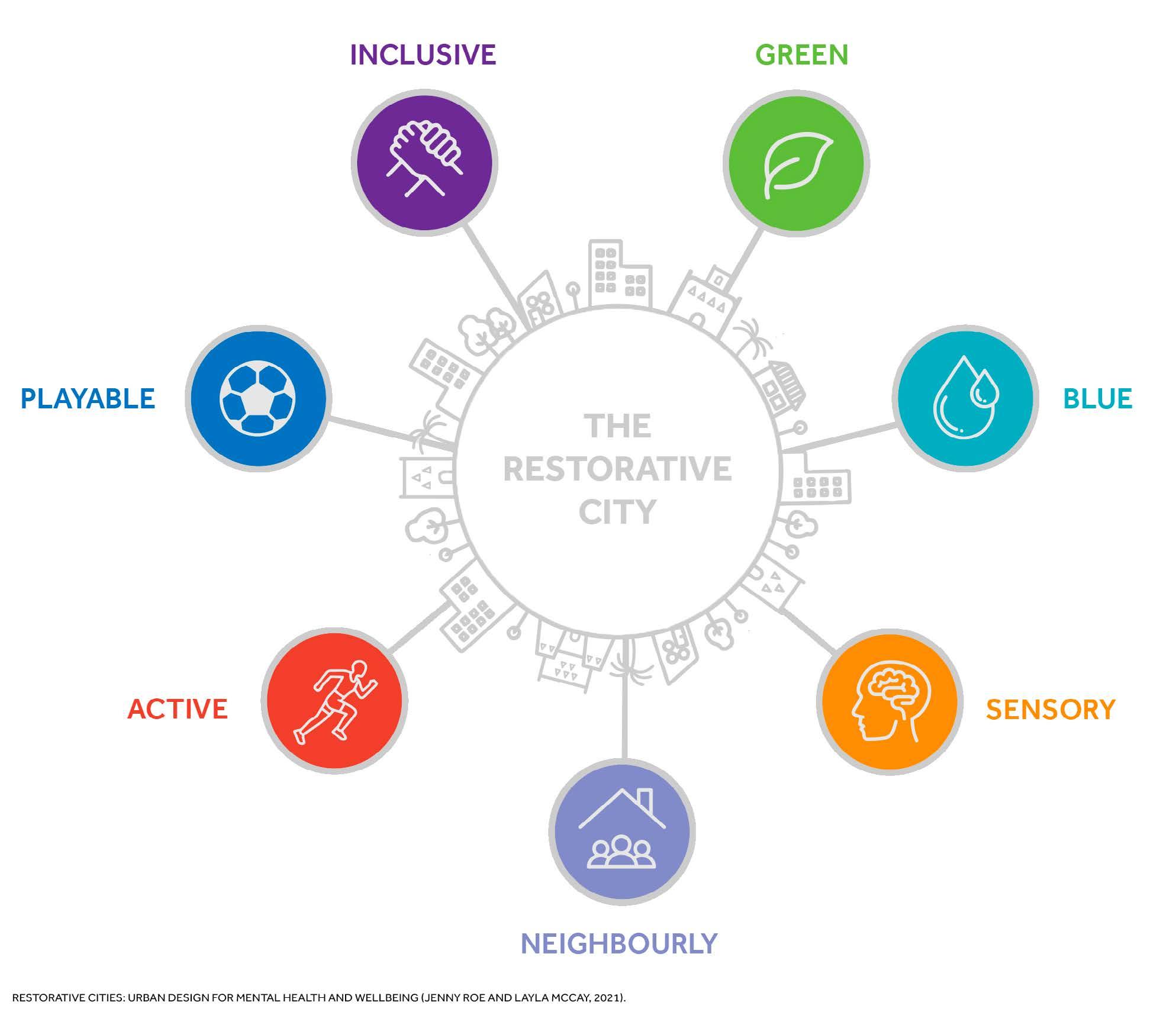
This point leads us nicely onto the concept of a ‘Restorative City’, an idea that I was introduced to courtesy of Restorative Cities: Urban Design for Mental Health and Wellbeing (Jenny Roe and Layla McCay, 2021).
The Baylis Old School Water feature by Nulty.
Picture: James French
Chelsea Barracks Walkway, London by Nulty.
Picture: James French
The book outlines a framework for urban design, centred around the principle of a restorative city, which helps us regulate emotion and mental wellbeing. It is a captivating concept that paves the way for a new paradigm, where designers pledge to move beyond neutral by designing cities that are actively positive for all.
To realise this ambition, we need greater collaboration across disciplines. Light needs to be woven into every pillar of a city where people come together to connect, socialise and play.
While light is not one of these pillars, it can sit across each strand and help bring them together in the spirit of a more cohesive city.
In an urban environment light should operate across many levels, helping to define identity and scale, aid navigation, highlight points of interest, humanise public spaces, and foster connection. Every single intervention should enrich the lives of the people spending time in these spaces – bright and uniform is not the way to do it. ■
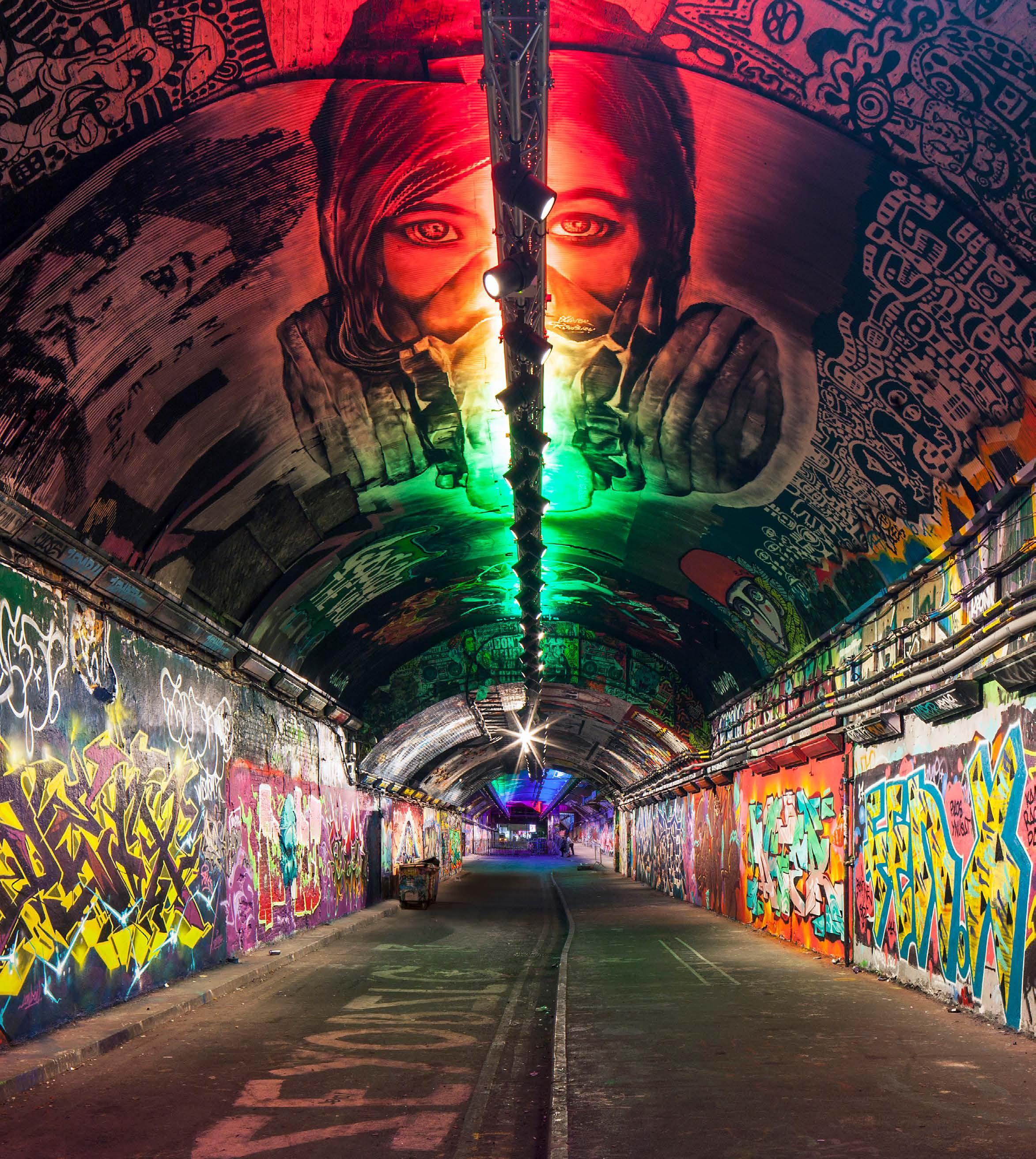
Leake Street Arches, London by Nulty.
Picture: James French
Illuminating the pillars of a connected city
GREEN: Landscape and views of greenery need to be highlighted through the lighting design, encouraging people to explore and enjoy these spaces as part of evening and night-time activities
BLUE: Water features are an integral part of the full multisensory mix and should be accentuated as illumination focal points that draw people in, creating therapeutic points of congregation after dark.
SENSORY: The visual sense influences perception, emotion and wayfinding. Artificial illumination can create visual interest and evoke a positive sensory experience that encourages feelings of familiarity or the desire to explore.
NEIGHBOURLY: As parks should be accessible after hours with a strong sense of safety and community, warm and welcoming light is key. In regions where the climate prevents people from coming together in the
day, great lighting can make a neighbourhood more inviting after dark.
ACTIVE: Making spaces usable after dark is increasingly important in the urban realm, therefore we need lighting that is appropriate in terms of colour, level, and scale for pedestrian-led spaces, cycle zones and transition areas.
PLAYABLE: Designers can leverage the power of light to make a place more magnetic during the evening hours, using techniques such as dynamic or projected light to encourage outdoor play and activities through immersion and interaction with the city.
INCLUSIVE: We need to give everyone the same ability to explore and experience an urban environment. For the partially sighted, this might mean illuminating a vertical surface to make a space more usable, while for a neurodiverse person a space with comfortable, low-level lighting can provide visual relief.
Shedding light on psychiatric patients
A
Norwegian study found that psychiatric patients exposed to blue-blocked lighting in the evening showed clinical improvements and reduced aggression.
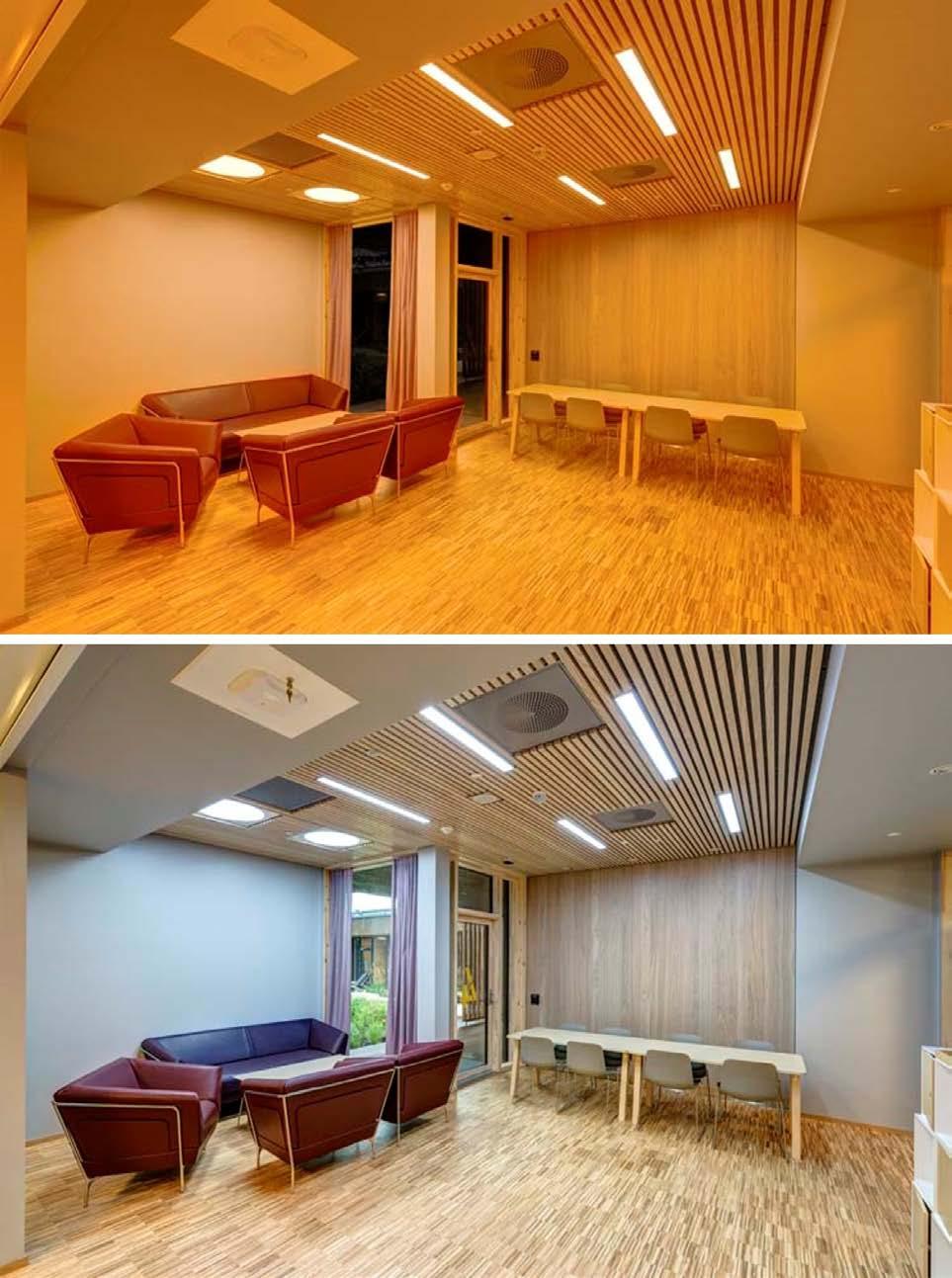
In 2017, St. Olav’s Hospital in Østmarka, east of Trondheim, Norway, opened a new acute psychiatric unit featuring two identical wards. Both wards have the same layout, staffing, and facilities—but differ in evening lighting: one uses standard lighting, while the other uses blue-blocked lighting, which removes blue wavelengths known to impact circadian rhythms.
Lighting supplier Glamox equipped the facility with a range of advanced lighting systems, including connected LED downlights, recessed ceiling fixtures, suspended and wallmounted luminaires, as well as outdoor lighting.
A recently published study in PLOS Medicine followed 476 patients admitted for acute psychiatric care. Each patient was randomly assigned to either the standard-lit ward or the ward with blue-blocked evening light. All received identical care and stayed for a median of four days.
The study offered compelling insights into the potential benefits of tailored lighting for psychiatric care.
'We observed that patients admitted to the blue-blocked light environment showed additional clinical improvement and exhibited less aggressive behaviour during their stay,' the researchers wrote.
Norway’s national broadcaster NRK covered the study on its evening news. When asked whether the lighting adjustments helped make patients healthier, lead
researcher and senior consultant psychologist Dr. Håvard Kallestad from the Norwegian University of Science and Technology confirmed:
'Yes, our findings suggest that.'
While the lighting intervention did not shorten hospital stays, the study found that it offered clinically significant benefits—without increasing side effects, reducing patient satisfaction, or requiring more staff.
To enable this therapeutic lighting approach, Glamox supplied premium, tuneable LED luminaires integrated with an advanced control system. Staff can manage lighting conditions for each patient using a graphical user interface, adjusting settings individually as needed.
The results reinforce growing evidence around the benefits of Human-Centric Lighting (HCL)—lighting systems designed to support human biological rhythms, wellbeing, and performance.
'These benefits, combined with the absence of side effects and the low-intensity nature of the intervention, suggest this strategy is well-suited for broader use—especially in new facilities where lighting systems are being installed from scratch,' the study concluded.
Glamox says it has deep expertise in HCL technology, with lighting solutions designed to align with natural circadian rhythms. While it acknowledges that there’s no one-size-fitsall approach, the company has created lighting systems for hospitals, schools, offices, and industrial sites.
'Our lighting supports everything from improving sleep patterns in hospital patients to enhancing concentration in classrooms,' said Anders Bru, Concept Manager for Human Centric Lighting at Glamox. 'We’ve delivered HCL solutions in over 650 projects—and we’re only beginning to explore what this technology can truly achieve.' ■
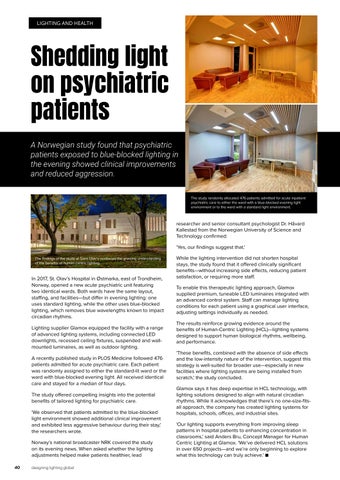
The study randomly allocated 476 patients admitted for acute inpatient psychiatric care to either the ward with a blue-blocked evening light environment or to the ward with a standard light environment.
The findings of the study at Saint Olav’s reinforces the growing understanding of the benefits of human-centric lighting.
A T T E N T I O N LIGHTING DESIGNERS AND SPECIFIERS
designing lighting global (dlg) seeks projects from all categories including office, hospitality, retail, religious, industrial, residential and others Use this user-generated content site to submit your project(s) for consideration.
Please submit your project with 5-10 images along with the following details:
Project name/location (city/country)
Project/building/structure name
Lighting design firm of record (or, architecture firm/landscape architecture firm/engineering firm) + team members names associated with project
Square footage of project
Lighting cost of project, if available
End user name/owner of project
Please include phone number/email address of party submitting project
Send to: publisher@designinglightingglobal.com.
designing lighting global (dlg) will acknowledge receipt of your project and request additional information if needed.
We dive into the bold and explosive universe of South Korean luminaire designer Kwangho Lee whose Bolda is the new and unconventional collection unveiled at Milan Design Week
RAW MATERIALS
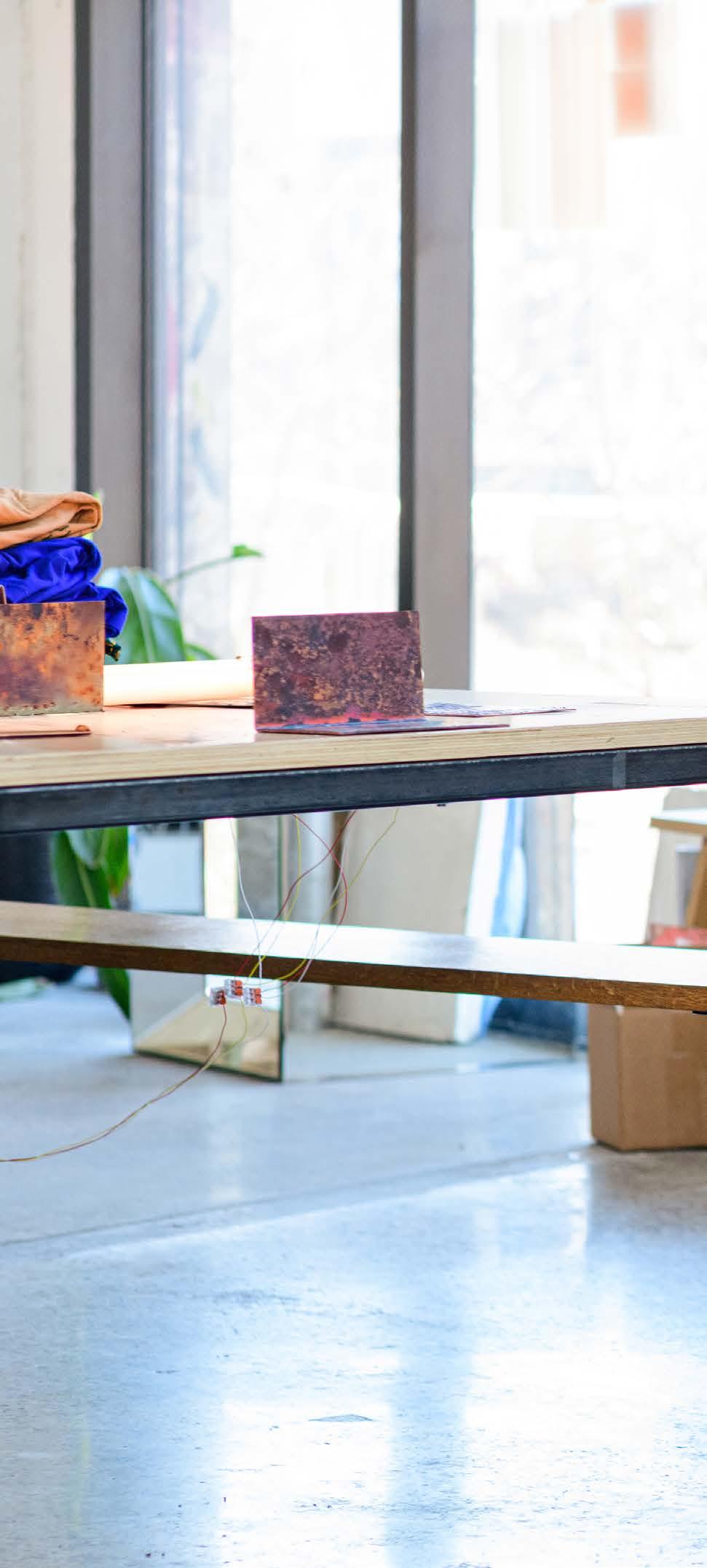
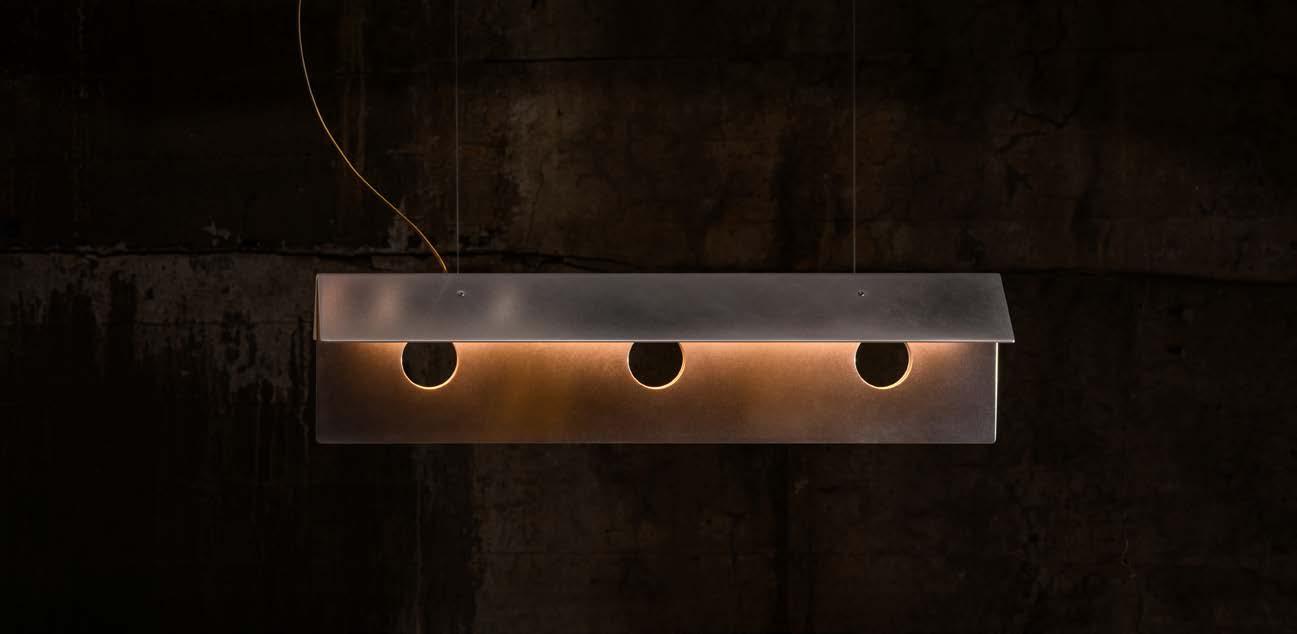
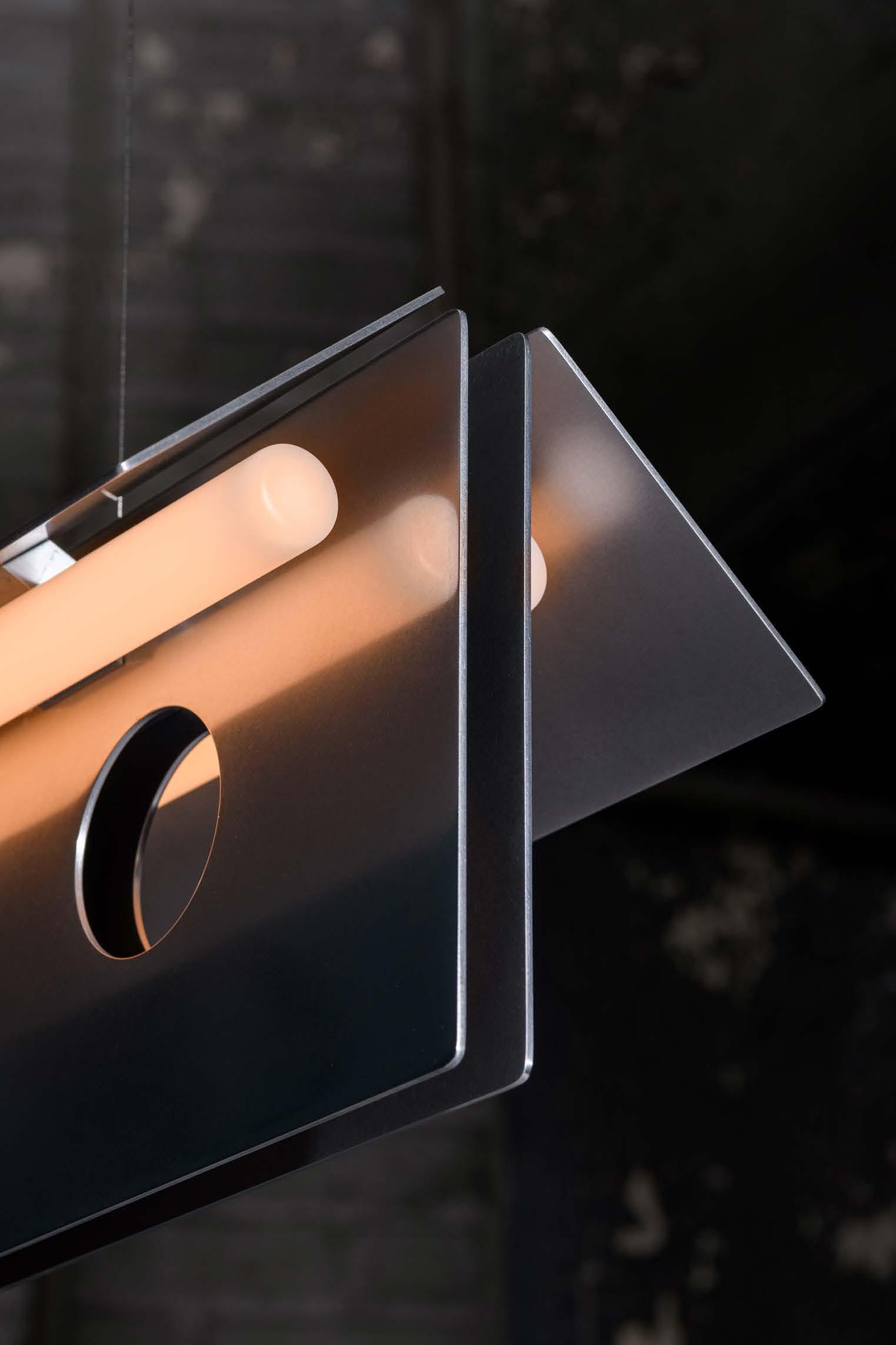
Sheets of polished aluminium, the studio's trademark material, serve as a backdrop for the enamelled copper plates, giving them a sculptural dimension and a unique presence sublimated by a luminous tube.
We’re firmly in the world of South Korean luminaire designer Kwangho Lee whose Bolda light collection was the talk of Milan Design Week.
The light, concealed beneath the cover fold, seeps into all the integrated openings, accentuating the edges and junctions of each piece.
Punctuated by large circular perforations, Bolda's main body is in constant dialogue with the space around it,
shaping its forms according to the observer's point of view and the surrounding colours.
The suspension model and the two wall sconces of the collection are also available in a streamlined version – composed solely of polished aluminium sheets, this version offers a minimalist alternative while preserving the essence of the original design.
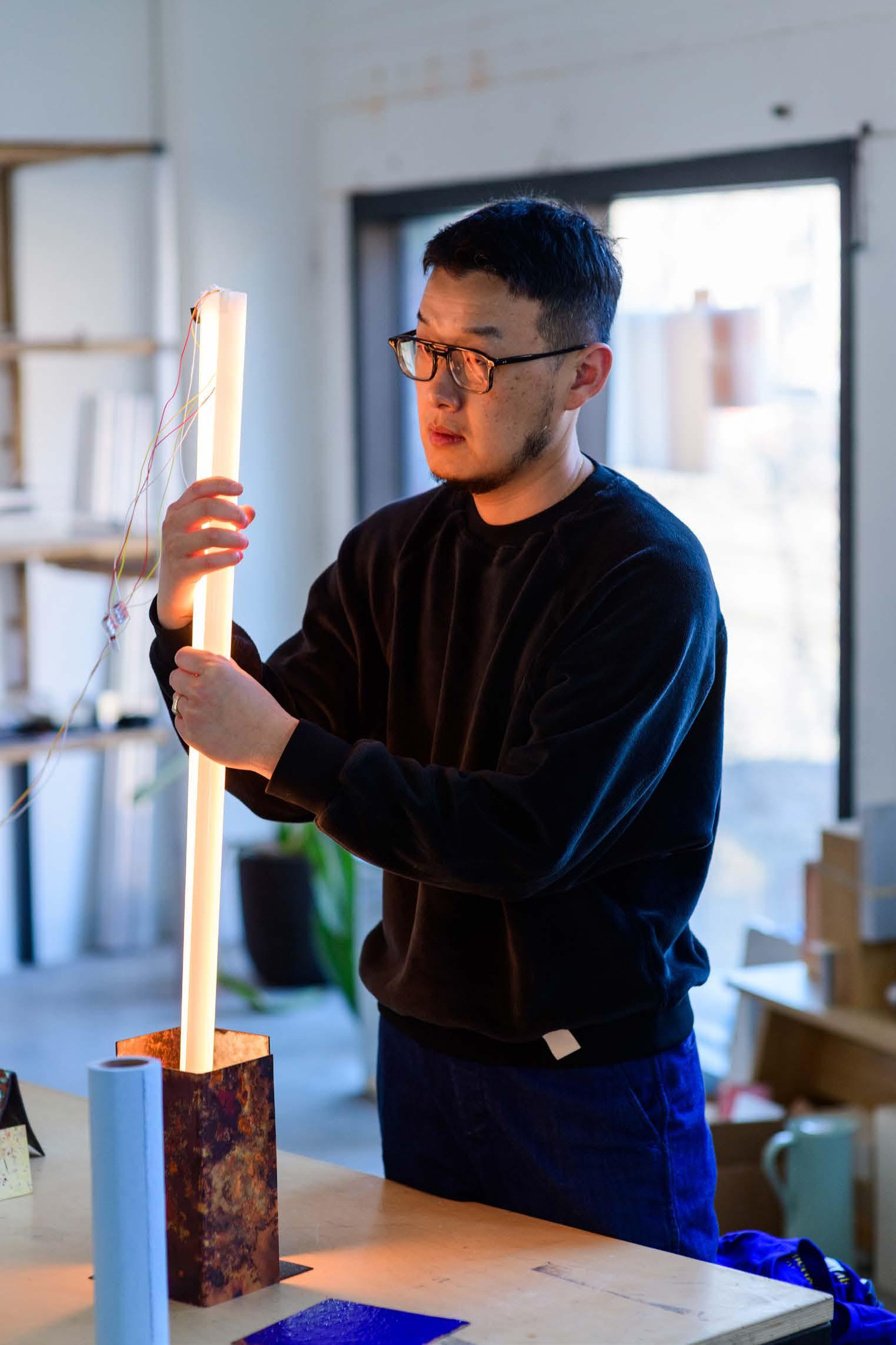
For several years now, Kwangho Lee has been perfecting copper enamelling, inspired by chilbo, a traditional Korean decorative art.
This technique involves applying coloured glass powder to metal, then melting it at a high temperature.
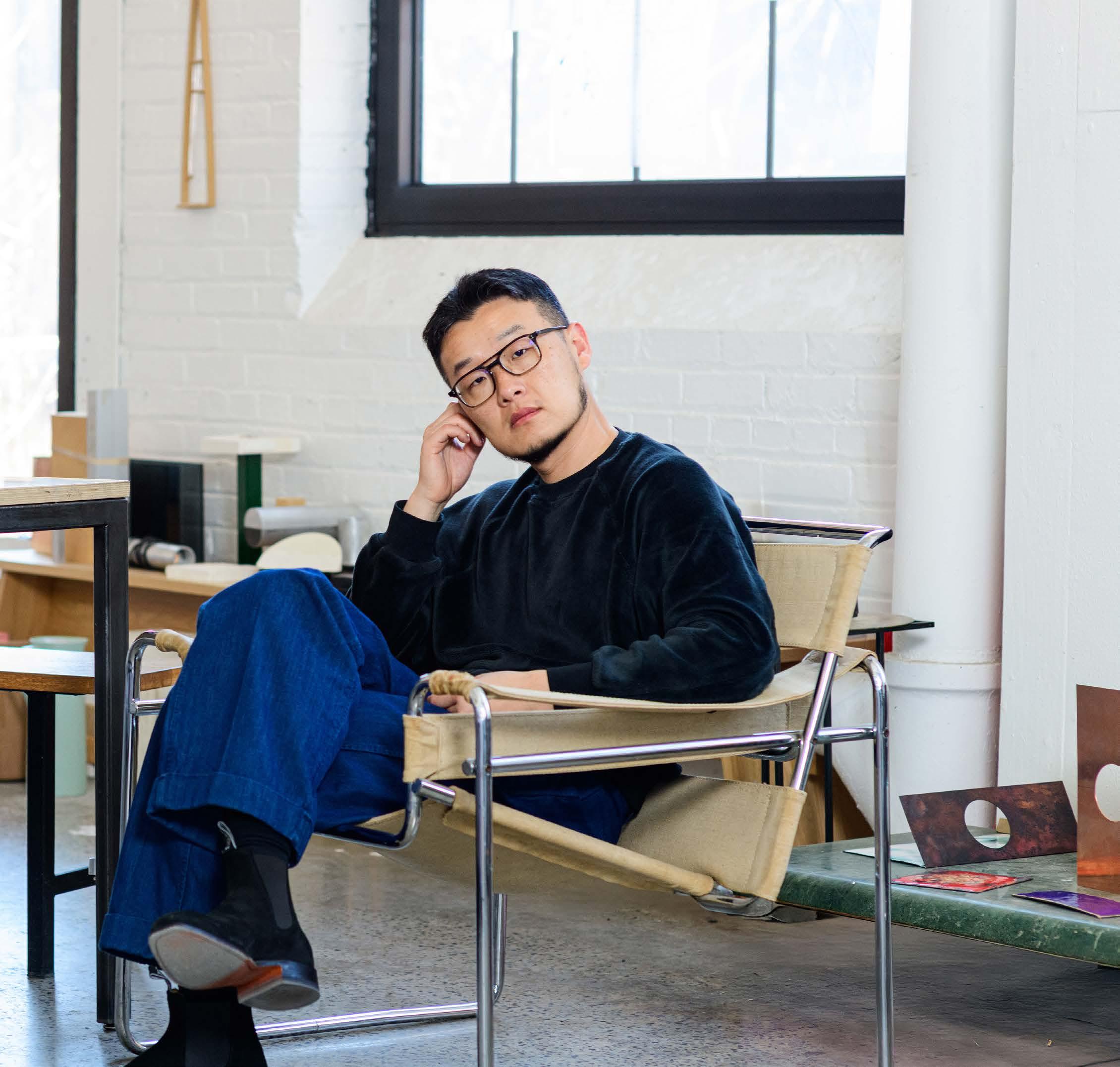
South Korean luminaire designer Kwangho Lee is recognised for his artisanal and experimental approach to the design of luminaires and furniture, and he gives new meaning and new function to the most ordinary.
Chilbo was originally used to decorate small objects, but Lee now adapts it to large-scale furniture pieces. This change of scale gives the enamel a shimmering, irregular effect, which dictated the name of the collection, Bolda – a term evoking tranquil waves and breezes, characteristic of Jeju Island, where Lee lives and finds his inspiration.
Combined with Montreal studio Lambert & Fils' singular expertise, this approach forms the foundation of their collaboration, giving rise to a creative dialogue where tradition and innovation meet.
Taking on new challenges and attempts is like sailing on an open sea. Sometimes we face big waves, and sometimes strong winds blow, and I think our collaboration is the same,’ Kwangho Lee tells Designing Lighting Global. ‘As the name Bolda implies, I think our voyage has finally found new light on calm and quiet waves.’
Pierre Laramée, a prominent figure in Montreal’s design scene and founder of the gallery commissaires, organised Kwangho Lee’s first North American exhibition in 2008.
‘This project was a unique opportunity to push the boundaries of our practice and create a light fixture that reflects the soul of our two creative worlds’
— Samuel Lambert, founder of Lambert & Fils.
Punctuated by large circular perforations, Bolda's main body is in constant dialogue with the space around it.
He played a key role in introducing Lee to Samuel Lambert, firmly believing that their mutual admiration would lead to the creation of a remarkable collection.
After months of remote design work between Seoul and Montreal, the Korean designer finally joined the Montreal studio, fostering collaboration and precision craftsmanship during an inspiring creative residency.
This moment defined Bolda’s identity, allowing Lee to share his expertise in copper enamelling and strengthening the bond and trust at the heart of this partnership.
After several years hosting events at Fuorisalone, Lambert & Fils returned to Salone del Mobile at Euroluce, where they unveiled the Bolda collection to widespread acclaim.
Kwangho Lee has been perfecting copper enamelling, inspired by chilbo, a traditional Korean decorative art. This technique involves applying coloured glass powder to metal, then melting it at a high temperature.
The light, concealed beneath the cover fold, seeps into all the integrated openings, accentuating the edges and junctions of each piece.
Set in a scenography by DWA Design Studio – key partner of the now iconic Caffè Populaire pop-up bars during Milan Design Week – the installation also showcased the complete Ipoli series. This recent collection, exhibiting pivoting heads mounted on a sleek base, blends contemporary energy with the timeless elegance of task lighting.
Born in 1981, Kwangho Lee grew up in a small town near Seoul, South Korea, and graduated from Hongik University, where he studied metal art and design.
Recognised for his artisanal and experimental approach to the design of objects and furniture, he gives new meaning and new function to the most ordinary. His pieces depict the moment when materials meet (or unite).
Lee explores raw materials and traditional techniques to create unique sculptural pieces. His work has been exhibited in international galleries and museums, affirming his influence in contemporary design. ■
INNOVATIONS
New architectural lighting products available for specification
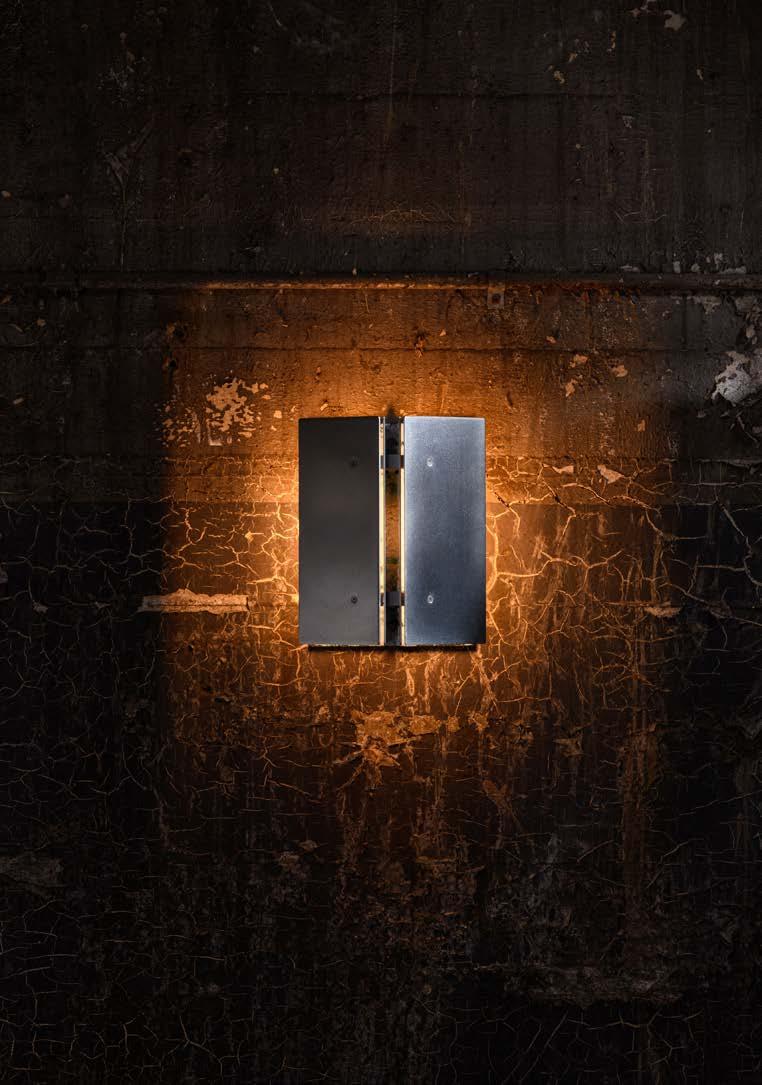
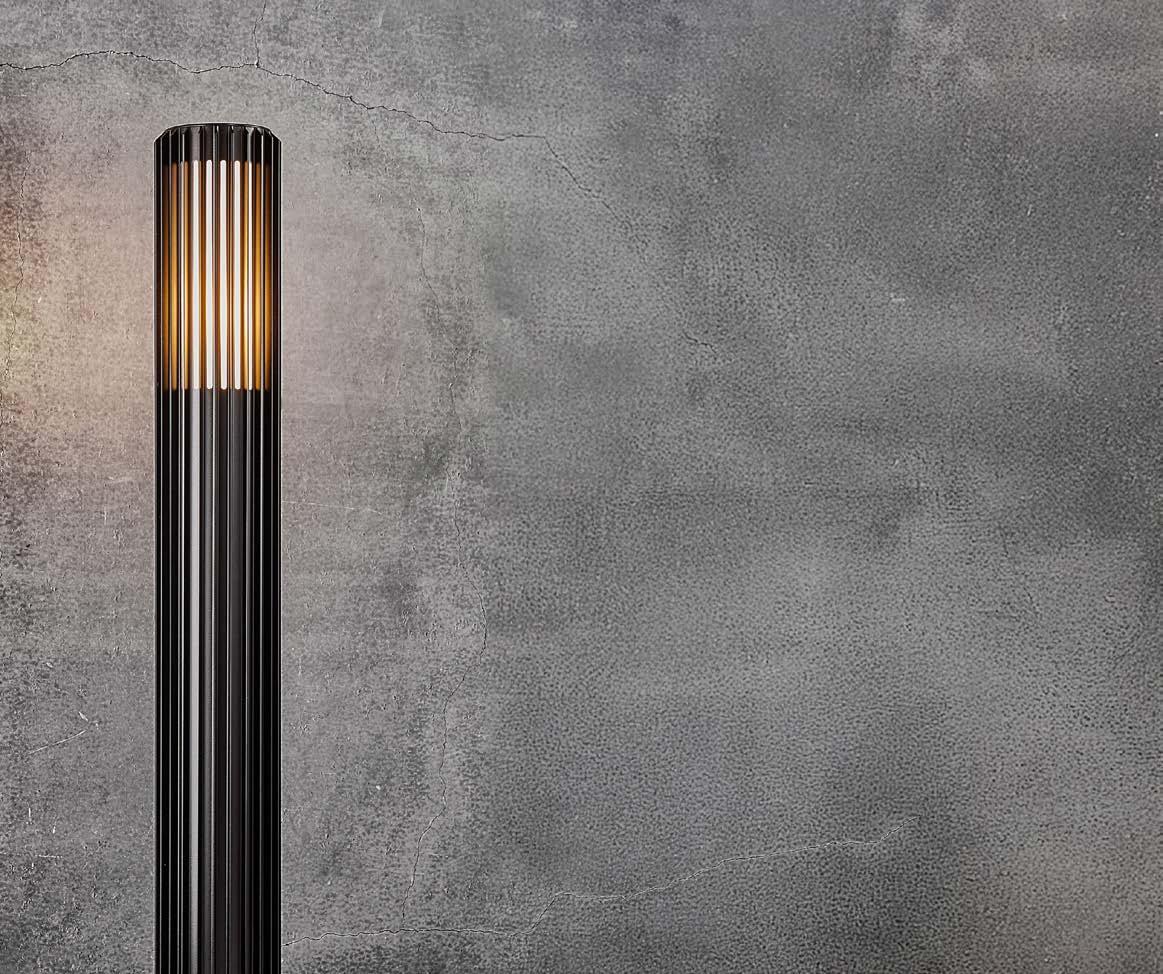
Nordic design studio Jacob Jensen Design has created an outdoor lighting collection for Danish lighting brand Nordlux, which features ribbed surfaces that cast patterns of light and shadow. Named Aludra, the collection includes wall lamps, ceiling lamps and two sizes of garden lights that can be inserted into the ground. The collection includes garden lights, wall lamps and ceiling lamps Each lamp in the collection has a cylindrical shape with a ribbed surface, and is available in black, aluminium and brown metallic finishes. Nordlux designed the lighting to be sculptural and minimalist for a cohesive outdoor lighting scheme.
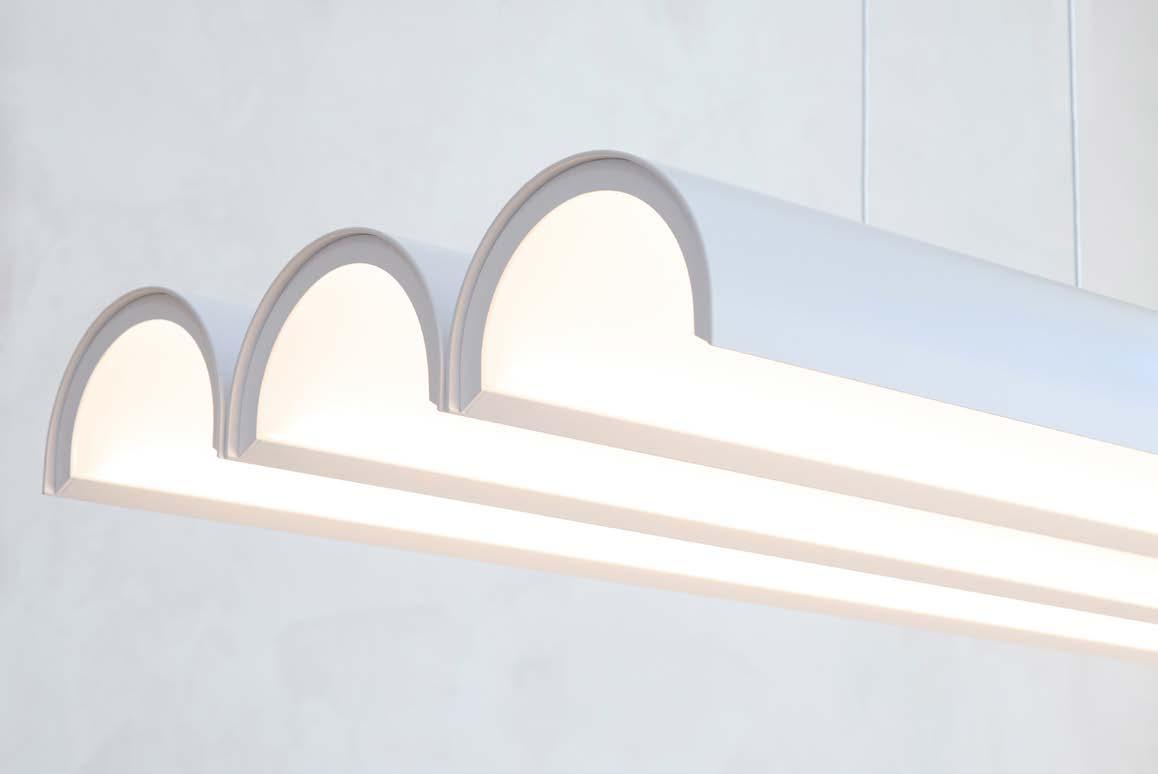
Inspired by tunnels, the design is simple, architectural, and sophisticated. Pola, meaning ‘half’, is equal parts light and heavy, hard and soft. Warm light throws softness on extruded aluminium in a glowing arc. Effortlessly smooth diffusion brings lightness to the frame, while an open structure allows light to flow through and warm its surroundings. The Pola collection consists of a sconce, a floor lamp, a table lamp, a single pendant, and a multipendant. ‘The Pola collection is inspired by long, tunnellike corridors and archways, lit with recessed floor lights,; says Christian Lo, founder of Anony.
Rippl Lighting
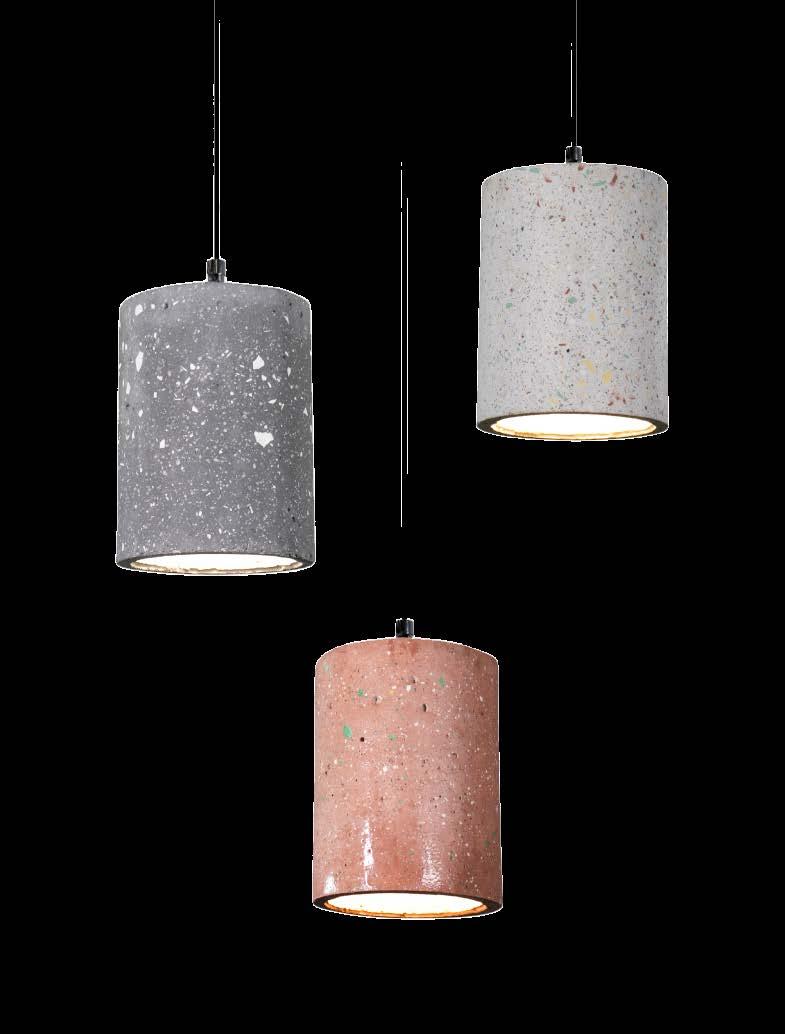
A range of pendant lights made from a blend of paper pulp and cement has been unveiled by Rippl Lighting. The Bengaluru-based firm says the uneven texture of its CretoCraft collection brings a ‘sense of purity’ to interiors. The company makes the pulp from waste carton boxes, mostly generated from its own packing department. These are shredded, and the wet pulp is handformed inside shaped moulds before being dried naturally under the sun — a process that avoids the use of energyintensive machinery. LED technology is then integrated into the dried pendants, allowing the luminaires to offer both functional task lighting and warm ambient illumination.
IKU
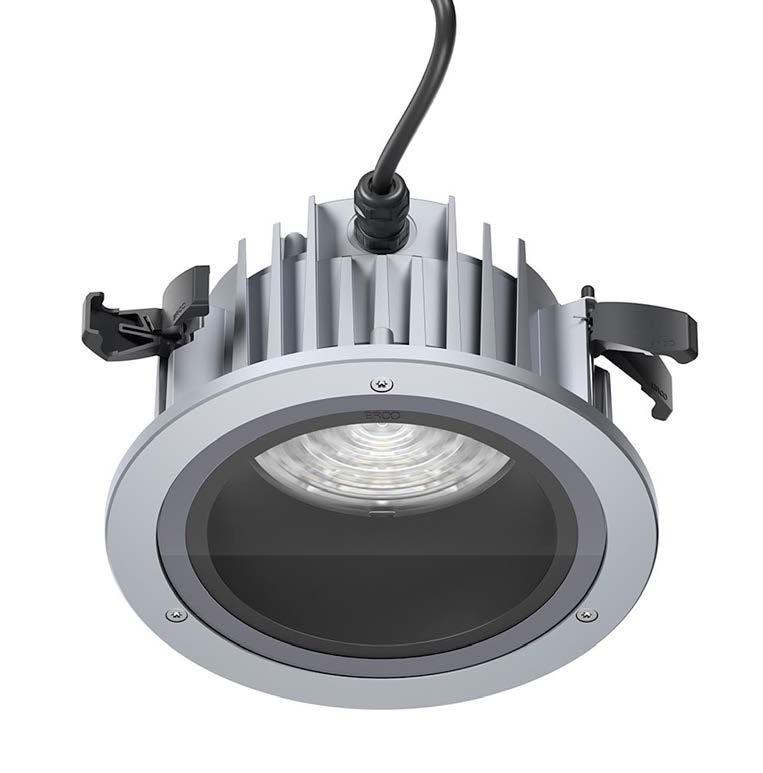
Erco
Erco has expanded the Iku downlight range and is now offering luminaires for indoor and outdoor use, in recessed and surfacemounted versions, as well as track-mounted downlights. Erco says the Iku blends the philosophy of perception-oriented lighting with exceptional energy efficiency. The existing Iku recessed ceiling luminaires and track downlights have been joined by new surface-mounted ceiling luminaires for interiors and recessed and surface-mounted ceiling luminaires for exteriors. This comprehensive system design range offers designers significant benefits: High quality light, uniform light distributions and matching light colours are available across all applications.
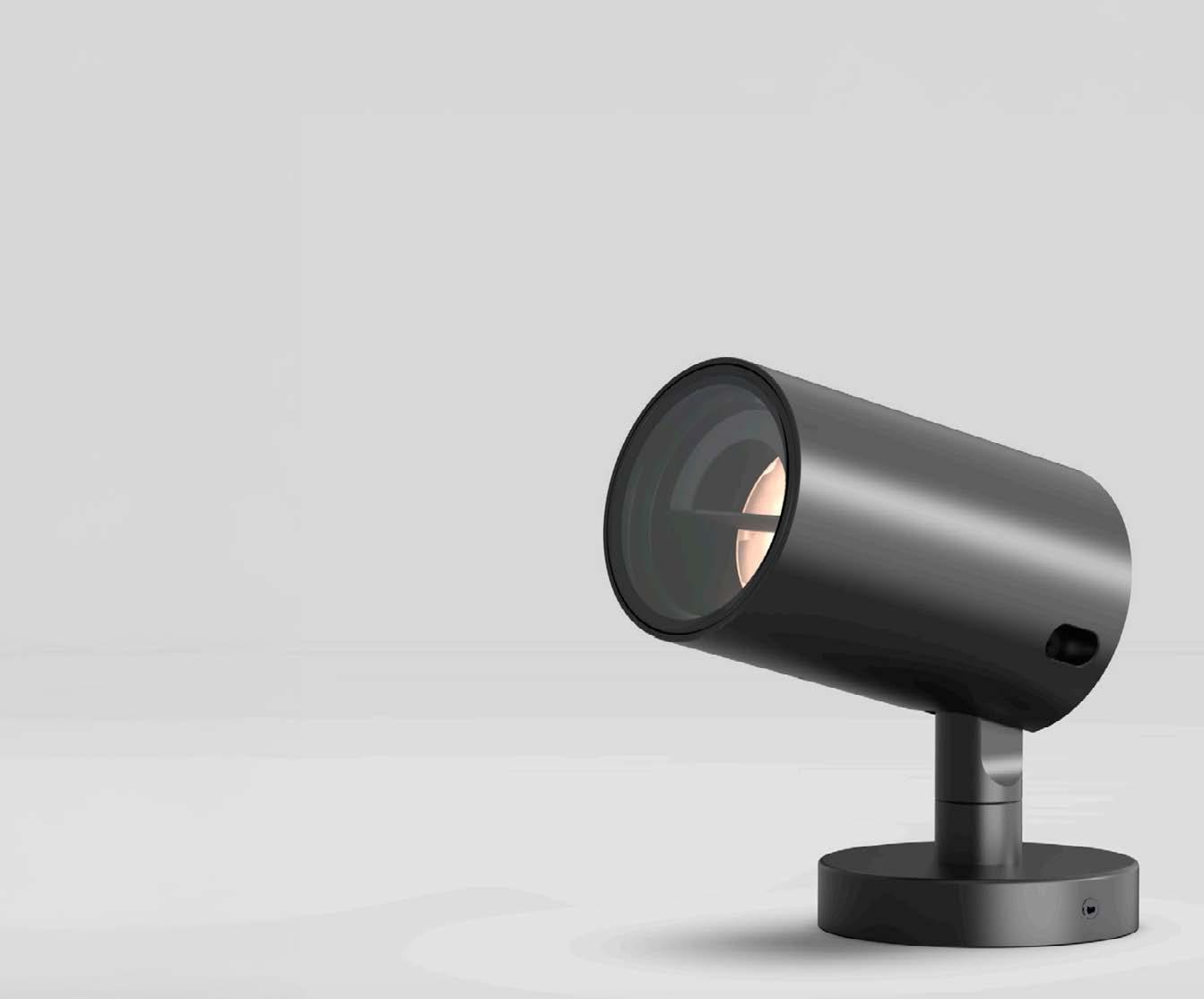
LD238
LightGraphix
The LD238 is a discreet surface mounted spotlight that’s compact in size but offers a powerful output options and a wide range of features. There are two LED engines available. The E3 engine provides the ability to achieve a high output of up to 597lm, whilst the F1 offers a super warm colour temperature of 2200K. Featuring a single optic for superior beam quality, there are a range of beam angles available and a half or full cowl for low glare. With a choice of fixing options, including a ground spike, tree strap and surface mounted base, the versatile LD238 can be used in a range of exterior applications.
ALUDRA Nordlux
POLA Anony
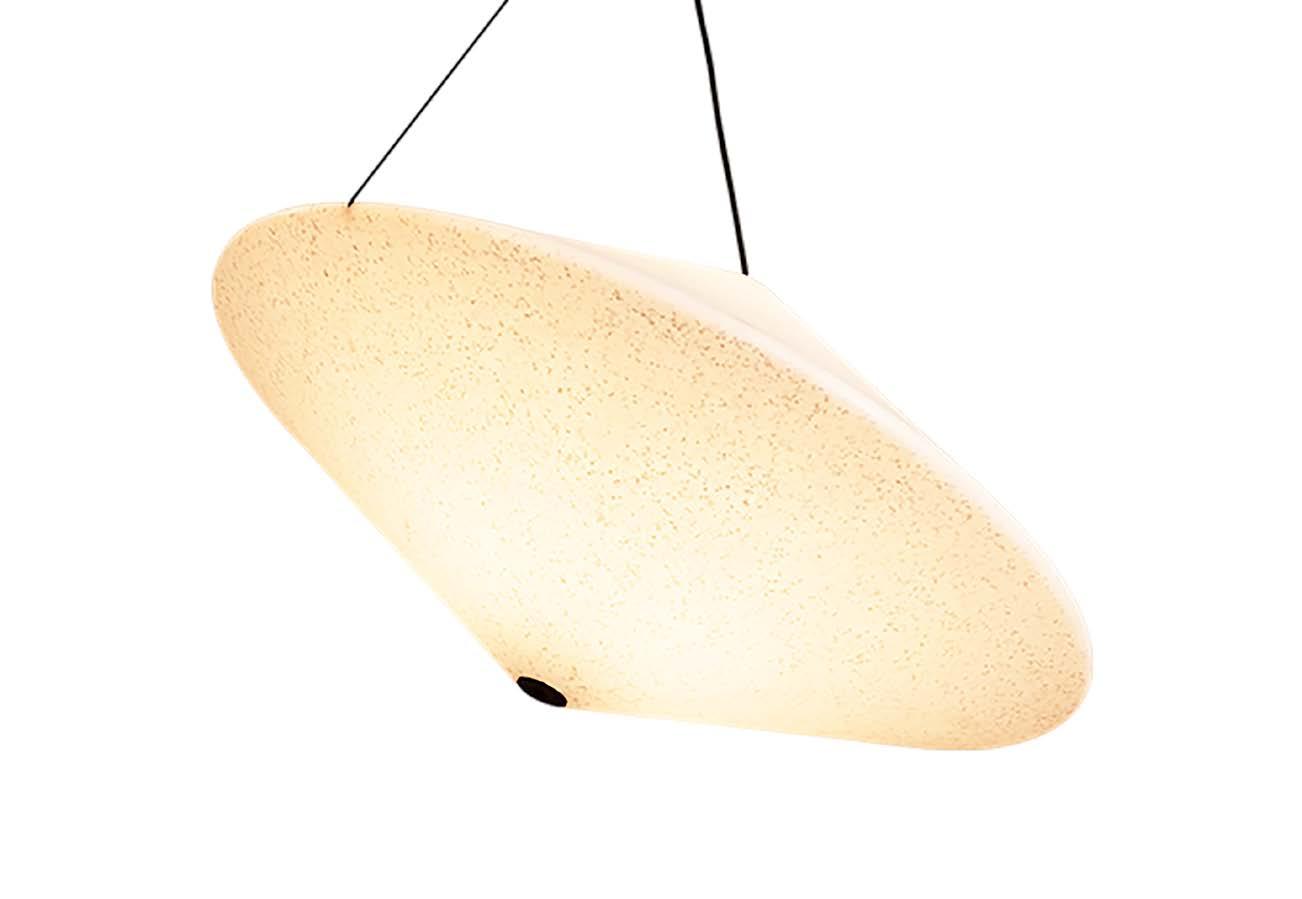
RIFICOLONA Miniforms
Rificolona, designed by Tuscany-based studio e-ggs, is crafted from recycled polyethylene, sourced from industrial or household waste. But it’s not just green: the material is also lightweight and translucent, creating an evocative atmosphere. The material is first sorted by type to ensure purity (mono-polymer), then melted at a low temperature—never burned. This defines a low-impact, sustainable process using a material that can be remelted indefinitely. Rificolona was originally conceived as a ceiling lamp, equipped with a bespoke adjustable system. A small black sphere connects the two support cables: slide the sphere to adjust the lamp’s angle—from horizontal to vertical.
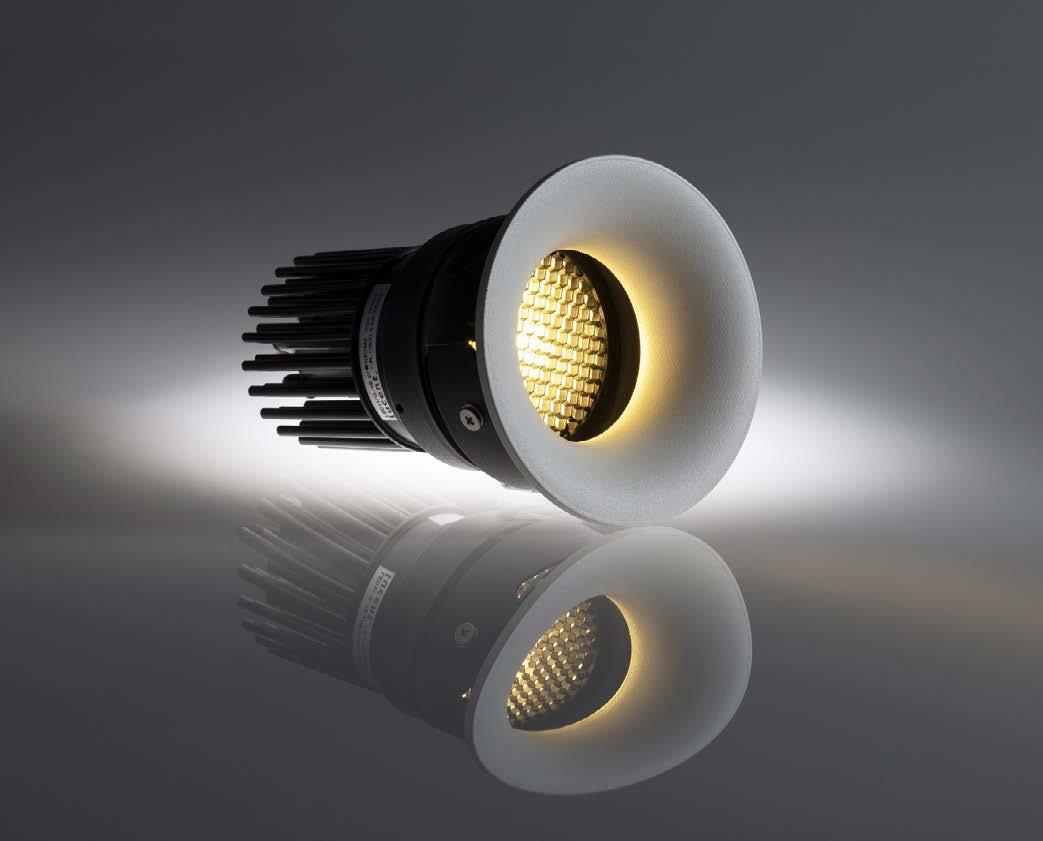
MIX85 Lucent
Erco
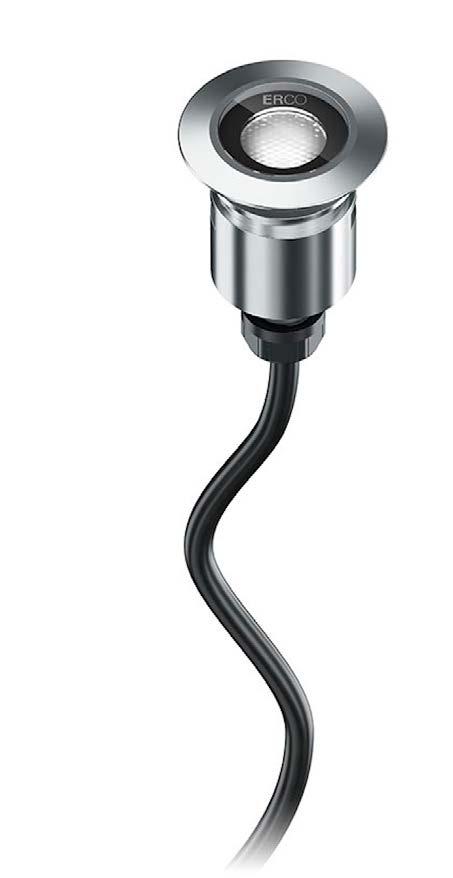
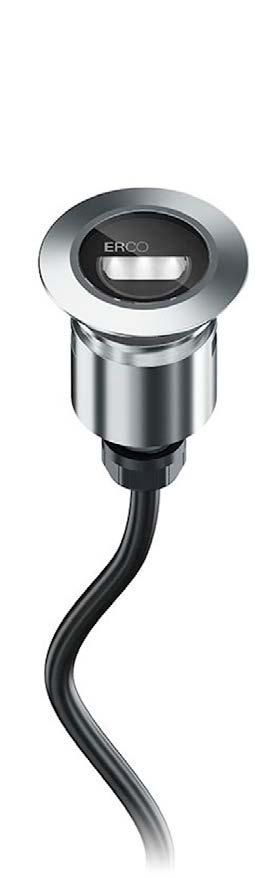
The Tesis generation enables designers to continue using in-ground luminaires responsibly and with all their advantages, says Erco. They blend seamlessly into their surroundings and some models can be integrated into traffic areas where they create a high level of attention due to their unusual direction of light. In-ground wallwashers serve an equally important function outdoors as ceiling-recessed wallwashers do indoors: They provide vertical illuminance, which is essential for spatial perception. When it comes to upgrading existing systems, the Tesis inground luminaires retain the installation dimensions and housing qualities of their predecessors.
Designed with circular economy principles at its core, Mix85 offers lighting performance while minimising environmental impact. It’s made from 86 per cent recycled materials, and an impressive 90 per cent of its components are recyclable, reinforcing Lucent’d pledge toward carbon neutrality. Designed to prioritise longevity and ease of maintenance, Mix85 significantly reduces premature replacements, contributing to a more responsible approach to lighting design. Delivering up to 1775lm of illumination, Mix85 ensures consistent lighting performance while maintaining energy efficiency, meeting and exceeding UK Part L2 compliance with up to 133 lumens per watt delivered.
Zero Lighting
Zero Lighting and Swedish design house Note
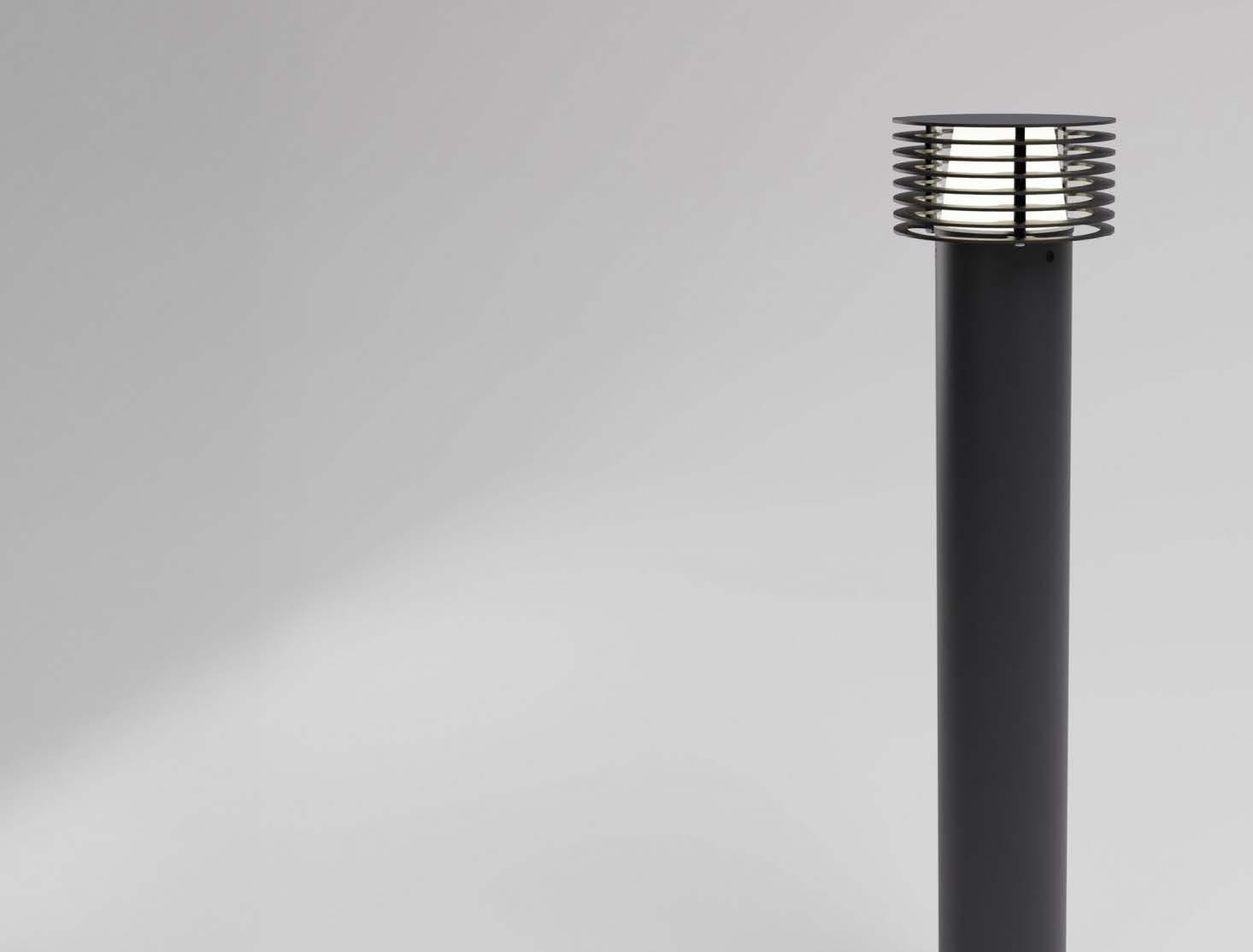
Design Studio have added an outdoor version to the Sprinkle collection. Designed to be used outside, the Sprinkle bollard has a shade mounted on a short sturdy base. All the luminaires in the Sprinkle range share the original pendant lamp's recognisable design, which is characterised by a slatted shade made up of concentric metal rings. Gaps between the discs were designed to allow light to radiate evenly and to create a visual geometric statement. Sprinkle now comes in multiple variations to cater to a range of lighting needs.
PUZZLE Signify
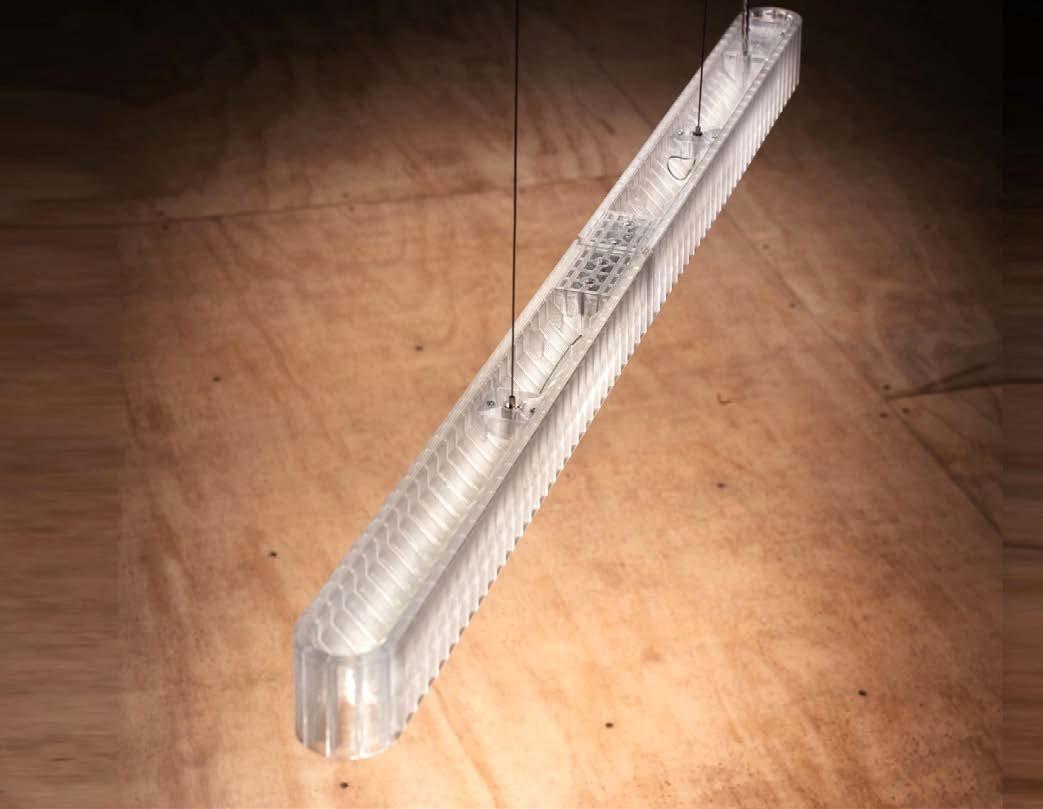
Created by French industrial designer Florent Coirier, Puzzle is a 3D-printed linear luminaire for the workplace made from 75 per cent recycled PET. The latter material comprises post-consumer water bottles, carpets, polyester clothing and spectacles. It’s aimed at task lighting at desks, meeting rooms and other office environments. It’s available in a 4and 5-feet linear pendant size and designed to give a soft seamless glow that helps to improve focus while working. Puzzle integrates with smart systems, such as Signify’s Interact, providing access to energysaving features, including occupancy detection and daylight harvesting. Sensors to be integrated or external. www.signify.com
SPRINKLE
TESIS
A Global Platform for Emerging Talent
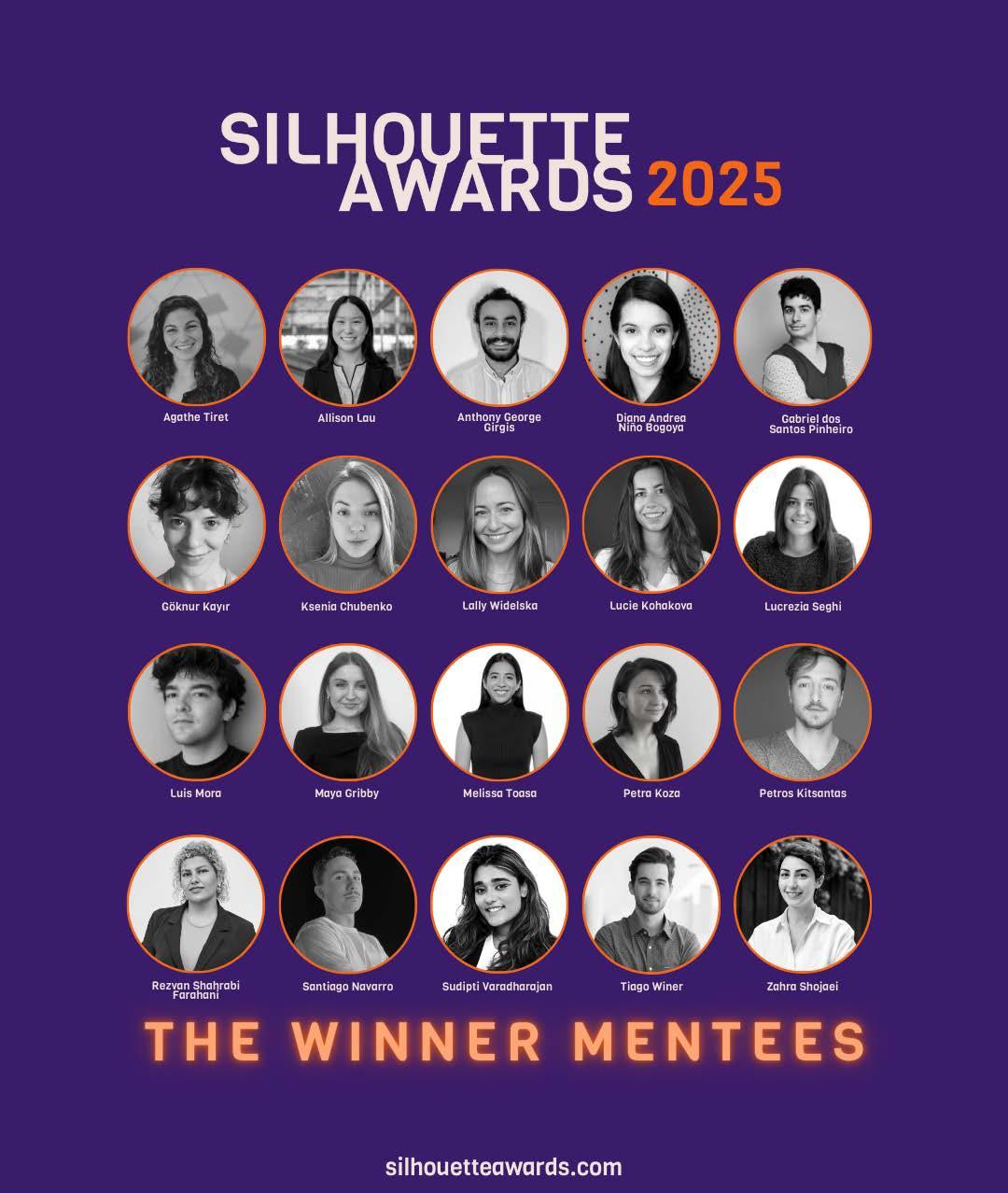
The Silhouette Awards is a global mentorship programme dedicated to identifying, celebrating, and supporting the next generation of talent in the lighting design industry.
Launched in 2021 through a collaboration between Archifos and Parrot PR & Marketing, the initiative has actively brightened the careers of emerging designers. designing lighting (dl) has previously highlighted the programme’s impact and evolution, chronicling its growth and influence within the lighting community.
Now celebrating over 80 successful pairings from across the globe, the Silhouette Awards continues to support rising stars who bring vision, creativity, and leadership to the future of lighting design.
How the Programme Works
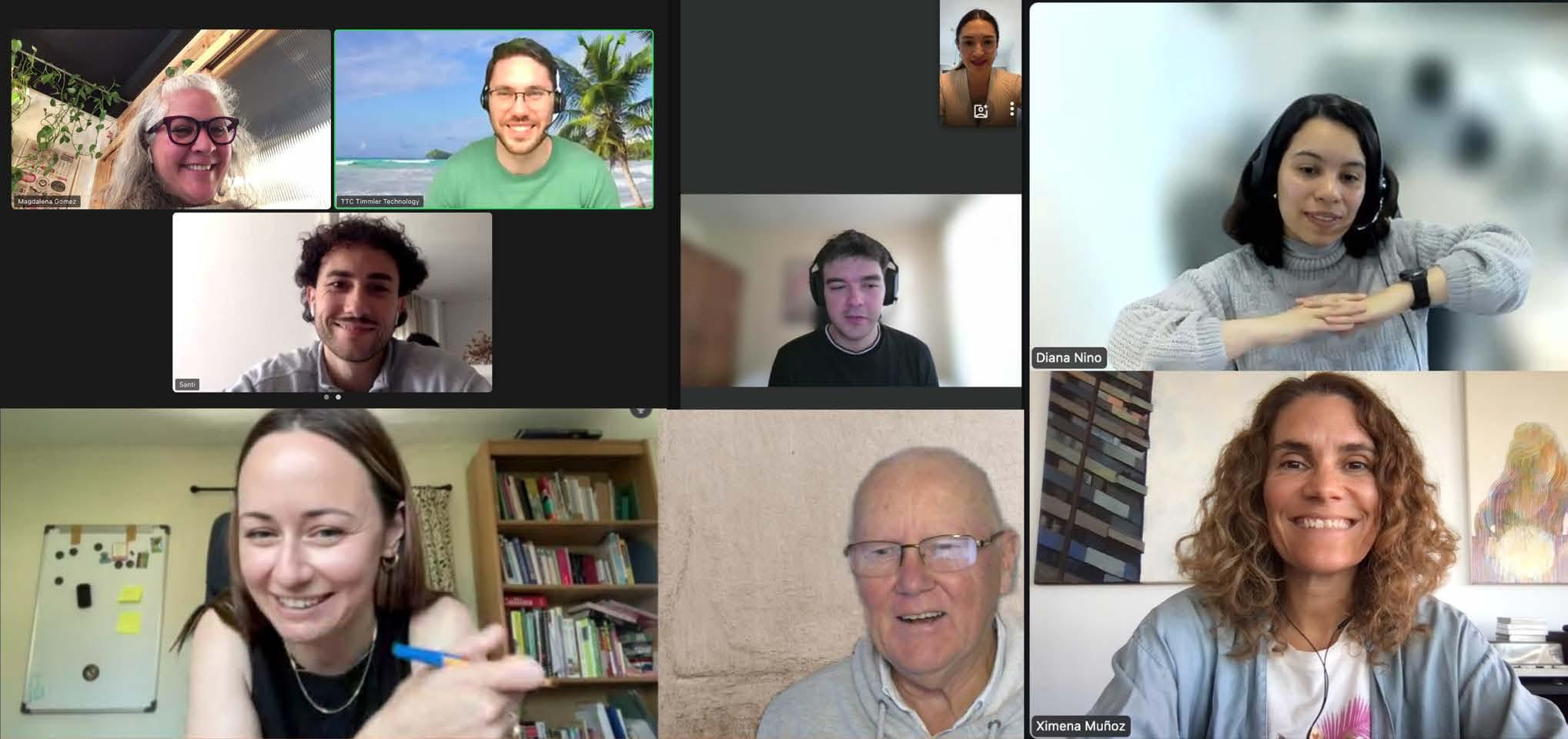
In case you are unfamiliar with the awards, each year the programme ‘shines a spotlight’ on 20 outstanding mentees who are selected from an application process based on their originality, achievements, and potential.
As part of the application process, aspiring participants are invited to submit a three-minute video sharing their
The
Silhouette
story, accomplishments, and aspirations for the mentorship. Designed to be personal, inclusive and accessible, this format allows applicants to communicate their passion directly to the judging panel – the selected mentors.
Each year, the winners are publicly recognised across the global lighting design community and are matched with established professionals for a six-month mentorship. This experience is designed to help mentees develop their skills, build valuable industry connections, and grow both personally and professionally.
Building a Global Mentorship Community
At its core, the Silhouette Awards is about more than individual success. It promotes a global community of mentors, mentees, and supporters, encouraging collaboration, knowledge-sharing, and long-term growth within the industry.
The programme is proudly supported by leading industry organisations and media platforms, including arc magazine, IES, APDI, designing lighting global (dlg), the Society of Light and Lighting (SLL), Women in Lighting, VLDC, and many, many others.
Awards Celebrates
and Elevates the Next Generation of Lighting Professionals
Lighting Design as a Transformative Force
For the lighting community and beyond, light is far more than just illumination - it’s a force that shapes how we experience the world. It defines architecture, enhances well-being, drives productivity, and plays a key role in sustainability. As the Silhouette Awards continues to grow, its mission remains dedicated: to champion emerging talent and ensure the future of lighting design is in inspired, capable hands.
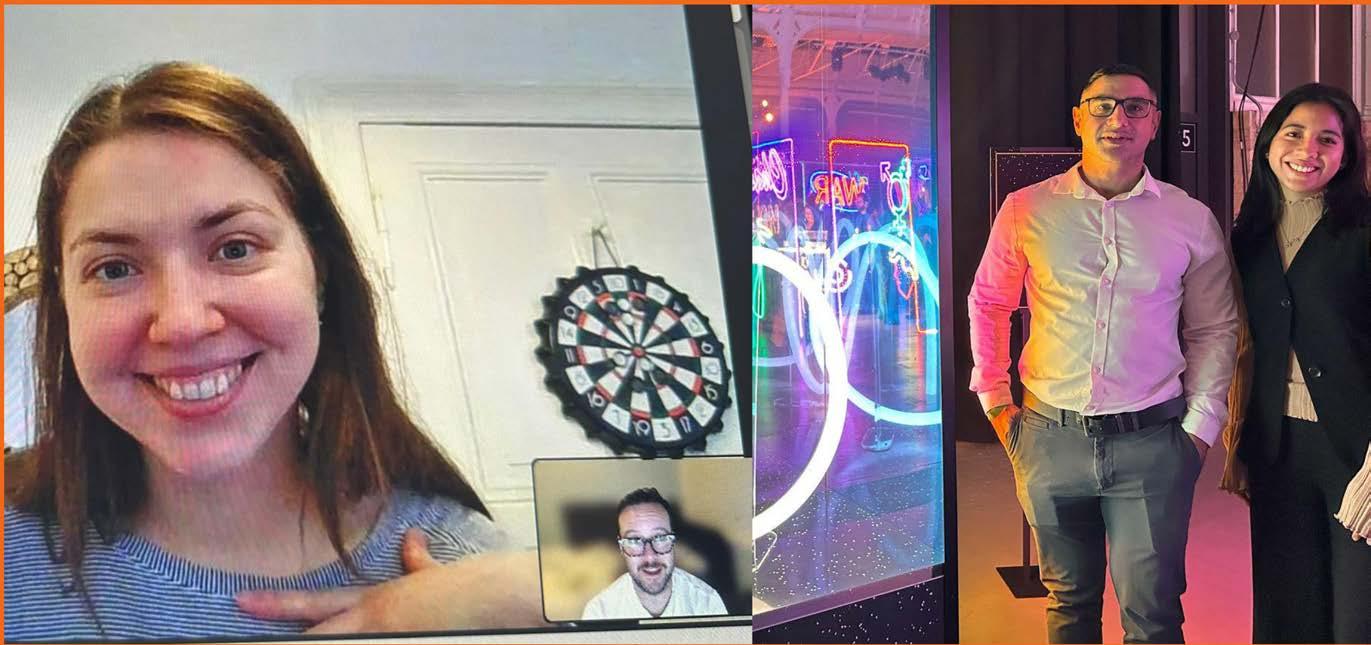
Now in its fourth year, the programme continues to thrive, with dynamic relationships forming among the pairings. The Silhouette Awards not only recognise emerging talent but also celebrate the experienced professionals who dedicate their time and insight to mentoring the next generation. For many, what begins as an opportunity to give back becomes a deeply rewarding experience, one that aids personal growth and inspires fresh perspectives.
Through this unique opportunity, the Silhouette Awards is helping shape not just careers, but the future of the lighting design industry.
Mutual Growth Through Mentorship
Some of this year’s participants have shared their experiences of being part of the Silhouette Awards. From learning new skills to building confidence and making valuable connections, their stories so far highlight the real impact of the programme and what it means to be part of this growing community.
For many, the programme mentorship has been a catalyst for self-reflection and fresh thinking.
Fabiana Nery Pardhanani shared what it is she values from the experience so far with her mentee, Tiago Winer “It has been a good learning curve for both of us. We are learning a lot from each other, finding many things in common and topics to discuss. Tiago is a senior designer with a lot of experience. Therefore, our approach is more about future ideas and how to develop a few areas that are not working well. We are both learning about deeper conversations on lighting topics and getting one another’s opinions on developments. It has been a good journey, and we are enjoying it very much.”
Sometimes, the mentor's journey is not just about support, it's about being transformed by their mentee’s ambition.
Philip Hammond explained, “I was, of course, very excited to start the mentorship with Lally Wildelska. I have encouraged her to step out of that comfort zone and go forward into the unknown. This has been an amazing process for me as an international educator and an illumination engineer with 54 years of experience. I have been challenged to make it my business to ensure that Lally succeeds. It will not only be her success, but it will uplift my spirits to the highest if she succeeds. It means that I have to plan each session for her next step to success.”
While mentorship in the lighting industry supports technical and professional development, it often offers something even more meaningful - a genuine human connection.
Eugenia Cheng expresses this through her partnership with Petra Koza. She said, “This mentorship is a two-way journey for Petra and me. While I give, I also receive - and vice versa. Although we are of similar age, our personal and professional paths are alike yet quite different.
Our journey is about building a trustworthy friendship, dedicating time to help each other hone new skills, and developing empathy as we share our challenges. We strive for honesty and hold each other accountable for our commitments.
I aim to provide options and fresh perspectives, and no matter which path she chooses, I’m here to support her emotionally and mentally. This relationship fosters self-reflection and personal growth for her, while I also evaluate my own experiences and approaches. Every meeting has been uplifting, and I know I will treasure this experience. The more we share, the more I want to help her succeed in whatever endeavours she pursues!”
Creating Lasting Connections
Beyond each annual programme, the Silhouette Awards have created lasting, meaningful relationships that have significantly influenced participants' careers and developed a thriving and connected community. Past mentees have reported increased confidence, expanded professional networks, and new opportunities arising from their involvement in the programme.
One pairing from Year 3 shared their personal experience of the programme and what it has meant to them.
Tiziana Regalado, a mentee from 2024, said, “The Silhouette Awards gave me the confidence and drive to pursue more than I ever expected for myself. I began this journey thinking I would simply gain a mentor to guide me through some daunting upcoming projects.
Instead, I found a friend, a confidant, and a true source of support in Panos. I’m deeply grateful to the Silhouette Awards for this wonderful opportunity and for connecting me with such an amazing, talented, and inspiring community.”
Panos Ferentinos, Tiziana’s Mentor, added, “The Silhouette Awards experience has been truly inspiring, offering mentorship and a deeper understanding of the industry. I had a great connection with my mentee and learned a lot from Tiziana. It has been a journey of growth, happy times and connection and I hope everyone has the opportunity to experience the same.’’
Looking Ahead to Year 5
As the Silhouette Awards look ahead to Year 5, with celebrations planned to mark this exciting milestone, there’s a real sense of anticipation around what the future holds for both the programme and the wider lighting design community. Reaching a fifth year is not only a moment to reflect on the incredible achievements so far, but also an opportunity to look forward to the emerging talent still to be discovered, the mentors yet to share their wisdom, and the continued growth of a truly global network.
To celebrate this landmark year, a number of exclusive sponsorship opportunities and celebratory activities will be introduced. These will offer supporters and partners a unique chance to align with a recognised and highly valued initiative that backs the next generation of lighting designers. From special events and collaborative
campaigns, to enhanced brand visibility across the lighting industry, Year 5 promises to be a standout moment in the Silhouette Awards story - one that welcomes even greater collaboration, recognition, and impact.
Get Involved
The Silhouette Awards 2025 is collaborating with: Power sponsor Huda Lighting, Core sponsors ADO Lights, formalighting, Traxon e:cue and Light sponsors Intra lighting, Ligman, Signify and Vivalyte. To find out more about the Silhouette Awards and how you can get involved as an entrant, mentor, or sponsor, contact info@ silhouetteawards.com. ■
designing lighting global (dlg)
EVERY-ISSUE EDITORIAL
DEPARTMENTS/COLUMNS
PROJECTS
THE BUSINESS OF LIGHTING
DESIGN™
CIRCULARITY
INNOVATIONS
Bad lighting is still bad lighting
The more things change, the more they stay the same. Contractors ruined interiors with Cat 2 luminaires 30 years ago and they’re doing it again with LED panels, says lighting consultant David Tilley
In the UK, the Health & Safety Display Screen Equipment Regulations of 1992 saw the development of Cat 2 louvres. For wholesalers and contractors it was a sales opportunity that was not to be missed.
While the Cat 2 Louvre was developed with the best intensions, it was installed without thought to the space and those working within the space.
The cut-off angle that provided the control of glare, on the display screen, also resulted in flat and dull work spaces. Retrofit schemes gave little or no thought to the location of display screens or the various activities within the space.
Lighting standards were introduced to focus on the space, as a whole, which improved the working environment.
A decade later, has history not repeated itself?
With its lower energy consumption than a T5 or T8 fluorescent luminaire and its simplicity when retrofitting, the LED panel has become a game changer for the commercial lighting sector.
But has the LED panel resulted in more poorly illuminated spaces than the Cat 2 luminaire?
The answer is YES
While the CAT 2 luminaire was generally confined to commercial office spaces, the LED panel has become the contractor’s choice for numerous retrofit projects.
There are very few sectors where you will not find an LED panel installed as a retrofit solution.
The luminaire development plan of manufacturers was to continually improve the lumen output of the LED panel with little or no thought to the retrofit market which represents a significant percentage of LED panel sales.
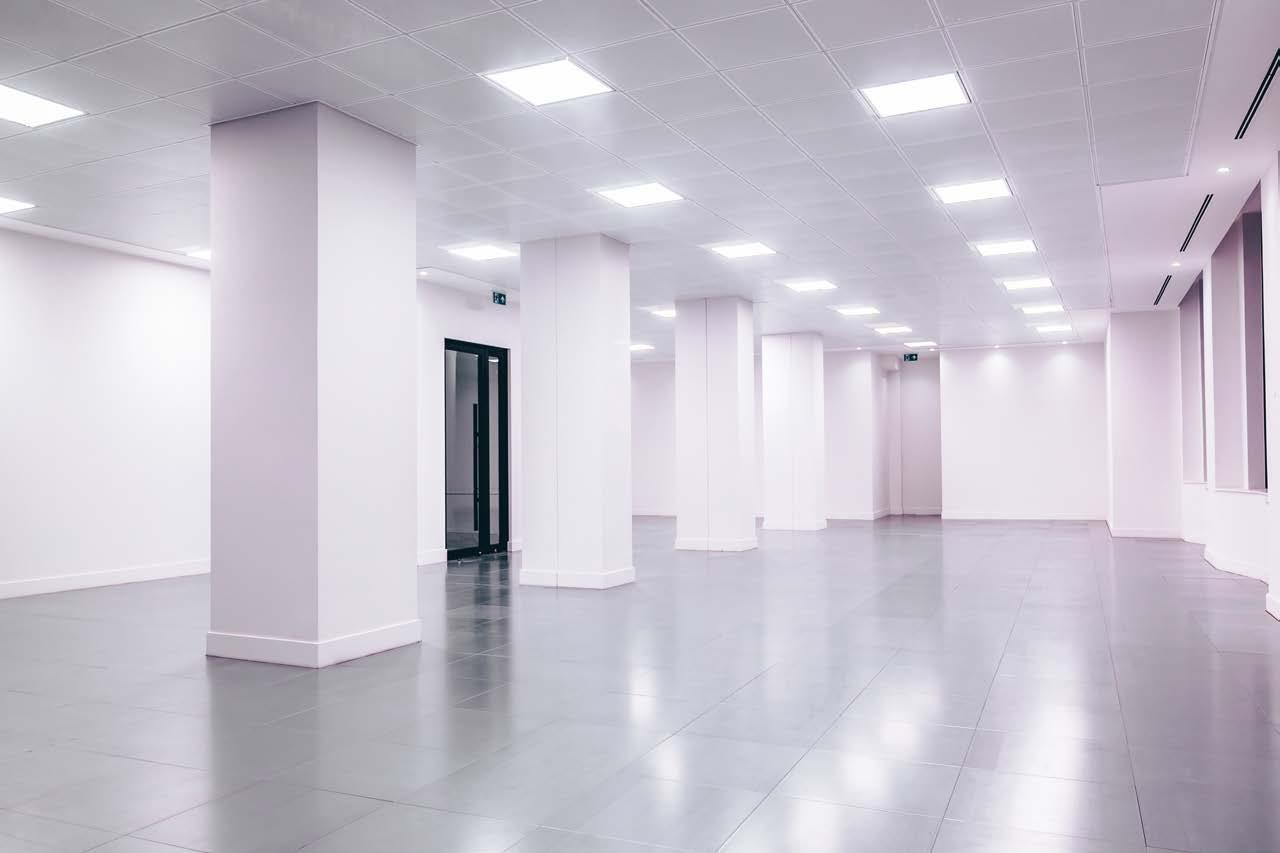
The result of this race to have the best lumen/Watt LED panel is spaces that are over illuminated, have unacceptable glare and deliver poor contrast and ambiance.
Office retrofit projects can have 30 to 50 per cent more LED panels than required to achieve an acceptable lux level. There are a few reasons for this:
• The original schemes were often designed to deliver 500 lux and included maintenance factors
• Display Screen technology was still being developed.
• The Cat 2 luminaire required relatively high numbers to achieve the required lux level.
Without a considered lighting design, clients and contractors simply compared the 72W (4 x 18W) energy consumption of a fluorescent luminaire, without gear losses, to a 30W or 36W LED panel and saw a 50 per cent energy saving. So they moved en masse to the new panels.
But these installations often resulted in the following:
• Over illumination for the application
• Uncontrolled glare
• Higher-than-necessary energy consumption
• Increased potential for failures
• Increased cost of installation
The contractor will of course argue that point-for-point installation is the most cost-effective solution for a retrofit project purely based on not having to undertake a lighting design or a basic lighting review process.
If a retrofit project can be completed with 30 to 50 per cent fewer LED panels the additional energy saving will be significant and often all that is required to complete the project is a few ceiling tiles.
Even worse is the installation of LED panels in retail spaces without any thought to the requirements of the staff and, more importantly, the customers.
Stores look flat and clinical, merchandise isn’t highlighted and customer navigation around the store is impaired.
Clients need to understand that lighting is an integral element of the sales process. Leaving a retrofit project to a contractor with no guidance is a receipt for disaster.
The good news is that lighting manufacturers are providing LED panels with lower lumen outputs and improved glare control.
The bad news? Contractors will still look for the cheapest option. ■
The result of the race to have the best lumen/Watt LED panel is spaces that are over illuminated, have unacceptable glare and deliver poor contrast and ambiance. Pic: Unsplash
ORG NEWS
End Cat A Lighting Waste holds inaugural event
Some 100,000 luminaires are being removed from UK ceilings every week with the majority ending up in the waste stream.
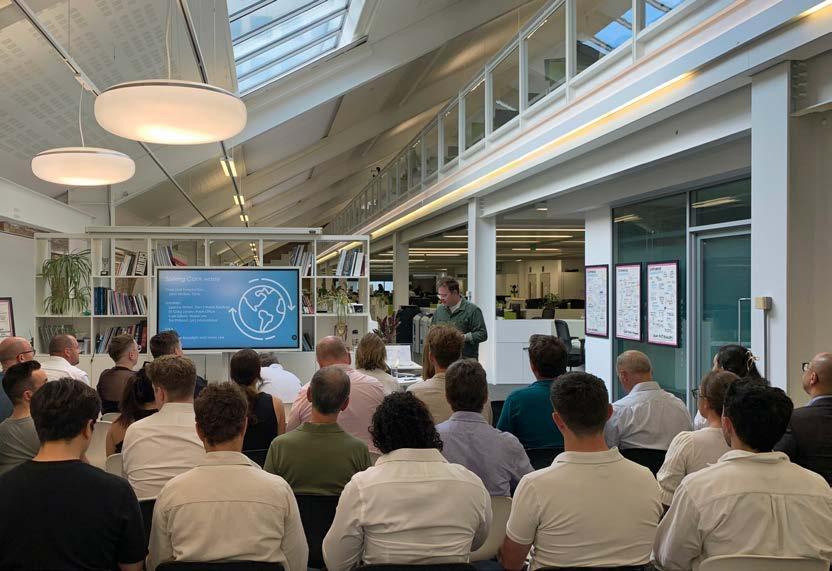
That was the stark assessment of the End Cat A Lighting Waste campaign group which held its augural event in London last night. Architect John McRae of Orms told the gathering that just 7 per cent were recycled appropriately.
McRae said the construction industry needed to ‘change its addiction to the
new and the bespoke’ if it was to be truly sustainable.
The group was set up to highlight and challenge the scandal, as it sees it, of Cat A fit-outs which are typically installed in speculative offices to attract a tenant. These are often ripped out to be replaced by a bespoke ‘Cat B’ installation to the client’s specification, with new lights, ceilings and floors removed.
‘We need to ask ‘what if’, said Kael Gillam, senior associate at Hoare Lea, at whose King’s Cross office the event took place. ‘We need ask how we can do better rather than ‘business as usual’.
She believes designers have a major role in challenging their clients, and designing interiors for flexibility and reuse’
McRae said there was no silver bullet solution to the issue of waste from Cat A installations. Instead, a mixture of measures are needed. These could include the reuse and remanufacturing of luminaires, ceiling tiles and flooring.
Tim Phillpot of SAS ceilings told the
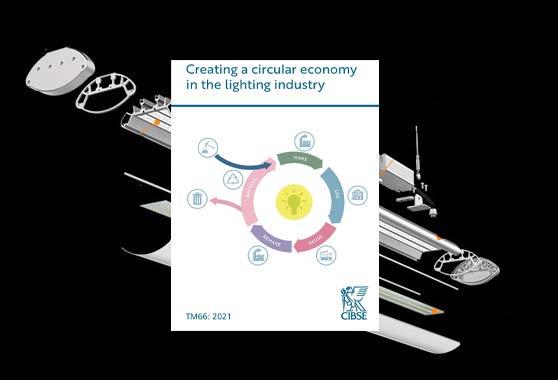
Society of Light & Lighting begin work on version one of TM66
Industry experts are gathering to begin work on version one of the lighting circularity measure TM66.
The technical memorandum, which measures the circular performance of luminaire, has been in a preliminary ‘beta mode’ since its introduction, says its authors, Cibse’s Society of Light and Lighting.
The document won a prestigious Build Back Better Award on its publication on
its publication in 2001 and was quickly adopted by the lighting industry.
Major lighting design practices and organisations are using the metric in their procurement and specification policies, and many manufacturers have rated their luminaires on the TM66 scale, which gives a number between 1 and 4 similar to a vehicle’s NCAP safety rating.
Now the TM66 development team, the founding partners and parallel organisations are set to gather to work the official first version of the standard.
An update will be presented in September at the Circular Lighting Live 2025 event in London on Thursday 25 September.
Sections of the document likely to change include:
• Materiality, the identification and appropriately scoring of those aspects of a luminaire’s design, materials, construction or ecosystem that have the most impact on circularity
• Precision and transparency, especially
audience how the company had set up SAS Recover to take back, remanufacture and resell its ceilings.
However many real estate developers feel a form of Cat A is needed to achieve the desired rents. One said: ‘It’s really tough to take a building all the way through the planning and construction process, and then for it not to get a tenant would be a terrible outcome’.
Hoare Lea described successful projects where just one sample floor of a building had a Cat A fit-out but conceded that this wasn’t possible in all cases.
Other speakers included Leanne Tritton of Don’t Waste Buildings and Greg Lavery of Rype Office.
Creative Cat A will be the subject of a special session at Circular Lighting Live 2025, Recolight’s flagship conference and exhibition, which takes place on Thursday 25 September 2025 at the Minster Building in the City of London. Free to specifiers, Circular Lighting Live 2025 will feature leading experts, specifiers and policy makers who will share their insights into forthcoming standards and legislation, emerging technologies and new business models. More info: www.circularlighting.live
related to language, reporting and evidence
• Greenwashing, the reduction of the possibilities of the metric being used to make misleading or false claims about the environmental benefits of a light fitting.
TM66 has two key tools which the experts will review. These include CEAM-Make, a tool for manufacturers to complete which comprises 66 questions under four tabs – product design, manufacturing, materials and supporting ecosystem.
Each question is rated and then scored between 1-4, where 1 is status quo and 4 is outstanding.
At the end of the assessment a total is generated, and a high score indicates a lighting product with good to outstanding Circular Economy credentials.
Another tool in the document is CEAMDesign, a demand-pull tool which contains 20 questions and is aimed at designers or specifiers to enable them to quickly understand what level of circular performance a not-yet-tested product has. Again, at the end of the assessment a total is generated.
19-20 NOV 2025
8-13 MAR 2026
FRANKFURT AM MAIN
17-19 JUN 2026
APR 2026
6-8 SEP 2026
3-6 MAR 2026
9-12 JUN 2026
15-18 SEP 2026
salutes and thanks its advertisers for their support.
salutes and thanks its advertisers for their support. We applaud the achievements of lighting practitioners and recognize the importance of their work in architecture and design.
We applaud the achievements of lighting practitioners and recognize the importance of their work in architecture and design.
In your next issue of designing lighting global…
PREVIEW: UPCOMING INNOVATIONS IN LANDSCAPE LIGHTING
The landscape lighting industry is on the cusp of a transformative year, with a wave of new technologies and design trends set to redefine outdoor illumination. From smarter control systems to eco-conscious materials, manufacturers and designers alike are pushing boundaries to elevate both aesthetics and efficiency in exterior lighting solutions.
One of the most anticipated developments is the broader integration of smart lighting systems with landscape installations. New products are expected to feature seamless compatibility with voice assistants, mobile apps, and automation hubs, enabling homeowners and property managers to personalize and schedule outdoor lighting with unprecedented ease. Adaptive lighting—systems that adjust brightness and color temperature based on time of day or environmental conditions—is also gaining traction, offering both visual appeal and energy savings.
Sustainability continues to be a key focus. Manufacturers are rolling out fixtures made from recycled or corrosion-resistant materials, while LED technology remains the standard for energy efficiency and longevity. Look for solar-powered and low-voltage options that require minimal infrastructure, ideal for both new builds and retrofit projects.
Design-wise, there’s a growing shift toward minimalist, low-profile fixtures that blend seamlessly into natural environments. Expect more versatile accent lighting, path lighting with architectural styling, and fixture lines that allow for color-tuning and beam shaping.
As these innovations hit the market, landscape lighting professionals will have more creative and technical tools at their disposal than ever before. The year ahead promises a dynamic intersection of design, technology, and sustainability in the outdoor lighting world.
Pictured: King’s Square, Gloucester, UK. Client: Gloucester City Council Design Team: Reef Group, George King Architects, Michael Grubb Studio Photographer: Mike Massaro
CIRCULAR LIGHTING LIVE 25 LONDON REVIEW
We report from the UK’s biggest event dedicated to sustainable lighting.
PAULA LONGATO Up Close with
LIGHTING TEAM LEAD, BURO HAPPOLD, EUROPE/BERLIN
From Brazil to Berlin—A Journey in Light
I didn’t come from a family of architects or designers—far from it. My background is business, thanks to my family in São Paulo. But I knew early on that architecture was what I wanted to pursue. Then, by complete chance, I discovered lighting.
While studying architecture in Brazil, I was looking for an internship. The only ad on the board that day was from a lighting design firm. That’s how it all started—completely by accident. It was a small practice focused on residential projects and restaurants, but it’s where I learned everything on the job. We weren’t just specifying luminaires—we were designing them from scratch, especially for hospitality spaces. Back then, almost everything was halogen.
That hands-on experience was my entry point. Later, I wanted to broaden my understanding of construction, so I worked for a building company, again mostly on residential and restaurant refurbishments. It exposed me to more architectural aspects, but I kept one foot in lighting. Eventually, I felt the pull back to lighting design. This time, I wanted to go deeper. That led me to Germany in 2006 to pursue a master’s in lighting design at Hochschule Wismar.
After graduating, I joined Arup in Berlin and later spent time with them in London. At Arup, I worked on everything from bespoke residential homes to masterplans and airports. What struck me immediately was the design process—it was a revelation. In Brazil, lighting design meant putting dots on a floorplan. At Arup, we built mockups, scale models, ordered samples. I realized then that you can’t rely on renderings or plans alone. You have to see the light. Mockups became fundamental to my process. To this day, I tell my team: ask for the sample. Always. There's no substitute for physically experiencing light in a space.
We even built a small darkroom at the office to test lighting setups. From paper and cardboard models, we are starting to integrate 3D printed
architectural models into our mockups. Architects are already doing this, so why not us? Even when using full-sized fixtures with scaled-down models, it helps us understand how light interacts with form. It’s tactile. It’s necessary.
That hands-on mindset also led us toward sustainability. About six years ago, when I started building our Europe team in Berlin, my team colleagues encouraged us to look critically at our practices. It was clear we needed to change. Over the next two to three years, we developed our Sustainability Lighting Roadmap—a framework guiding how we approach sustainability across every project phase. We’ve collaborated with manufacturers, sustainability experts, and clients to better understand lighting’s environmental role—especially daylight, which still doesn’t get the attention it deserves.
I'm now part of a group of daylight advocates. We’re creating accessible information to help non-specialists— clients, users—better understand the power of daylight. At the same time, I’ve started taking apart luminaires in the office. Literally. When manufacturers send us samples, I ask, “Can I open this?” I want to see how they’re built. How easy would it be for a facility manager to replace a component ten years from now?
At first, manufacturers were baffled. Some didn’t even bring a screwdriver. One even said, “Why open it? Just throw it away—it’s cheap.” That tells you everything. But we began documenting what we found. Which designs are serviceable, which aren't. Which brands understand product lifecycle—and which treat lighting as disposable. The top-tier manufacturers get it. The cheaper ones? Not so much.
We're not trying to save the world overnight, but we are trying to move the industry and the lighting community forward. And it’s working. We’ve seen manufacturers rethink design, embrace modularity, and in some cases, adopt circularity principles. Still, too many luminaires are glued shut, with parts
that can’t be replaced or sourced. I remember a gallery project where, years almost 20 years later, the original Erco spotlights were still working— because the owner retrofitted them with E27 LED lamps and the luminaires were in very good shape. That’s a sustainability win.
We don’t have all the answers yet. But we’re asking better questions: How can lighting remain flexible over a building’s lifespan? Can it adapt to new users or changing needs without full replacement? I believe we must think systemically and rethink our relationship to the objects we specify, how they will be used, by whom and for how long. And not to forget, what happens next?
If I have one piece of advice for those entering this field, it’s this: stay curious. Be relentless in your questioning. Understand how things work—take them apart if you must. Ask why. Ask what’s inside. Ask what happens after 10 years. Today, lighting design isn’t just about creating beautiful atmospheres. It’s about understanding environmental data, navigating circular economies, and adapting to AI, metrics, legislation and the social aspect of lighting and sustainability.
Yes, the learning curve is steep. But if you stay curious, it never stops being rewarding. ■
EdisonReport.tv serves as a hub for all digital content in the lighting industry. A premier source for critical information surrounding lighting, EdisonReport.tv is dedicated to delivering industry news by way of video and serving its audience by spotlighting product launches and up-to-date educational videos, as well as information about upcoming webinars.
Max Robson: Recolight to unveil a LCA and EPD service