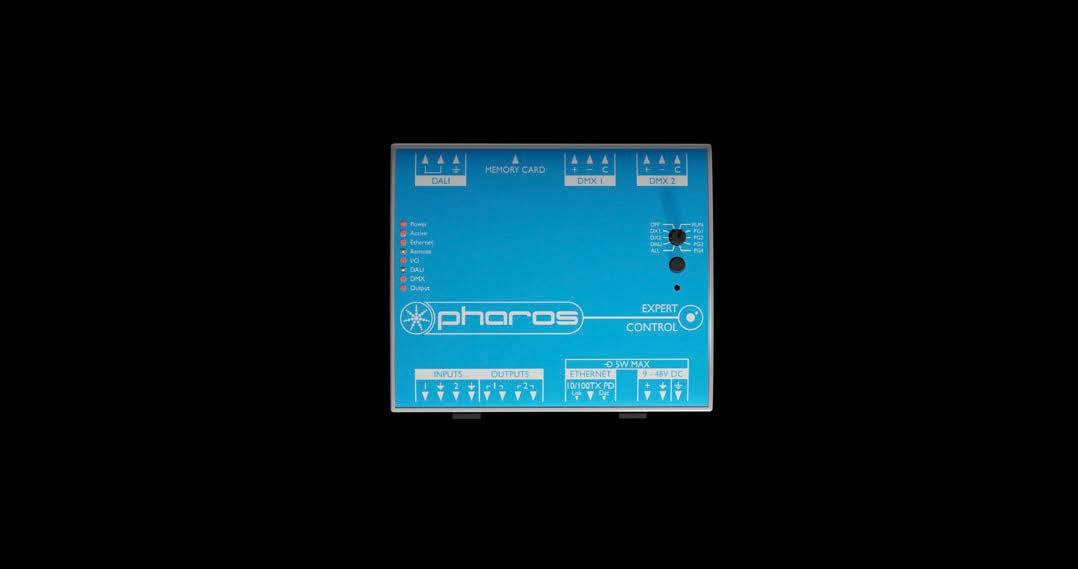
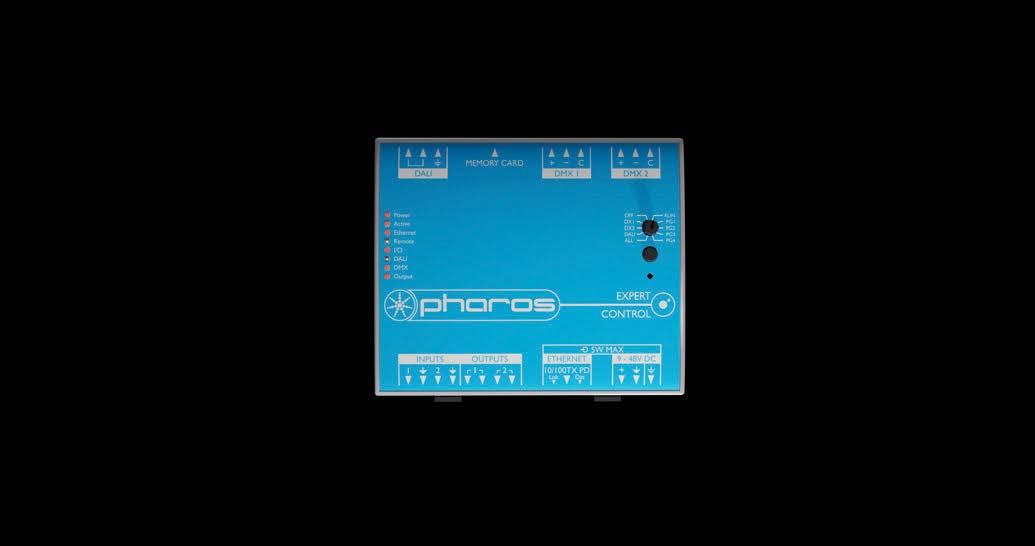
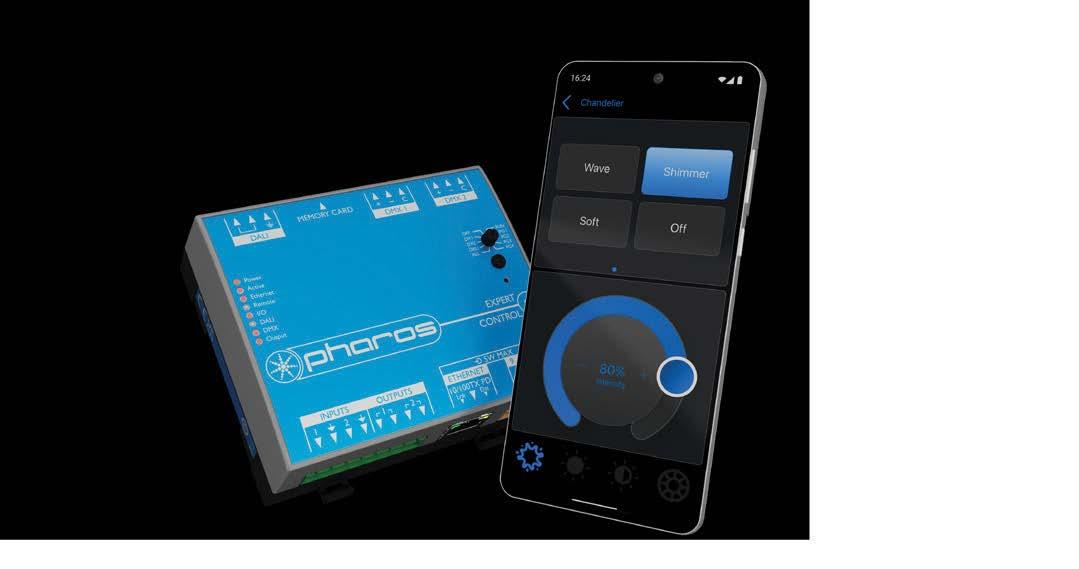
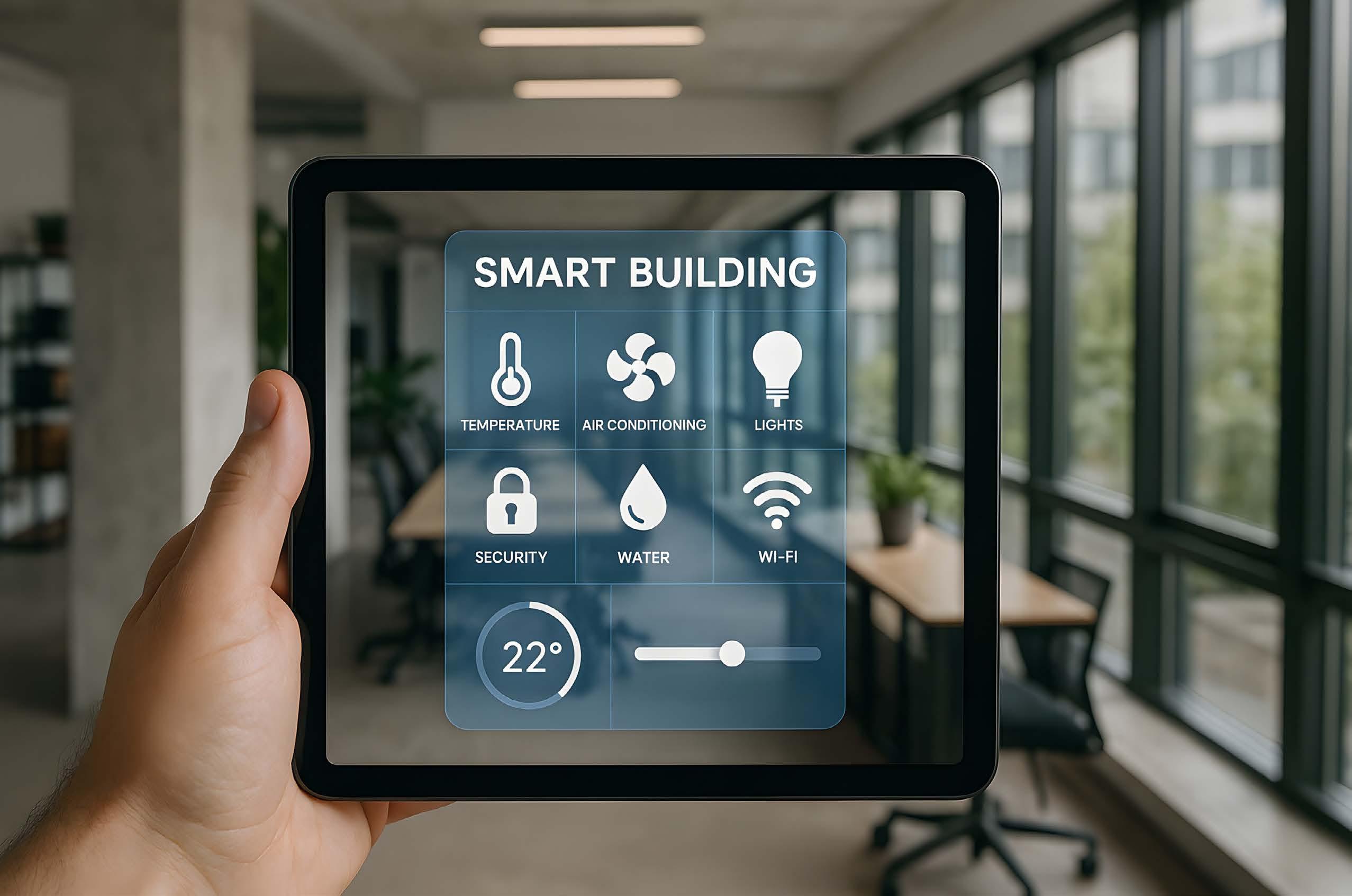
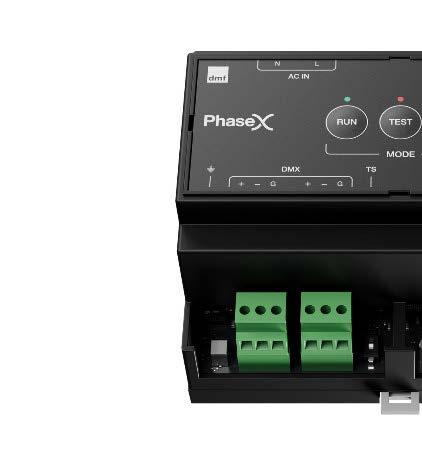
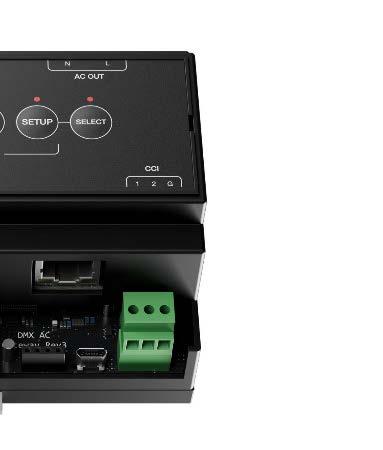
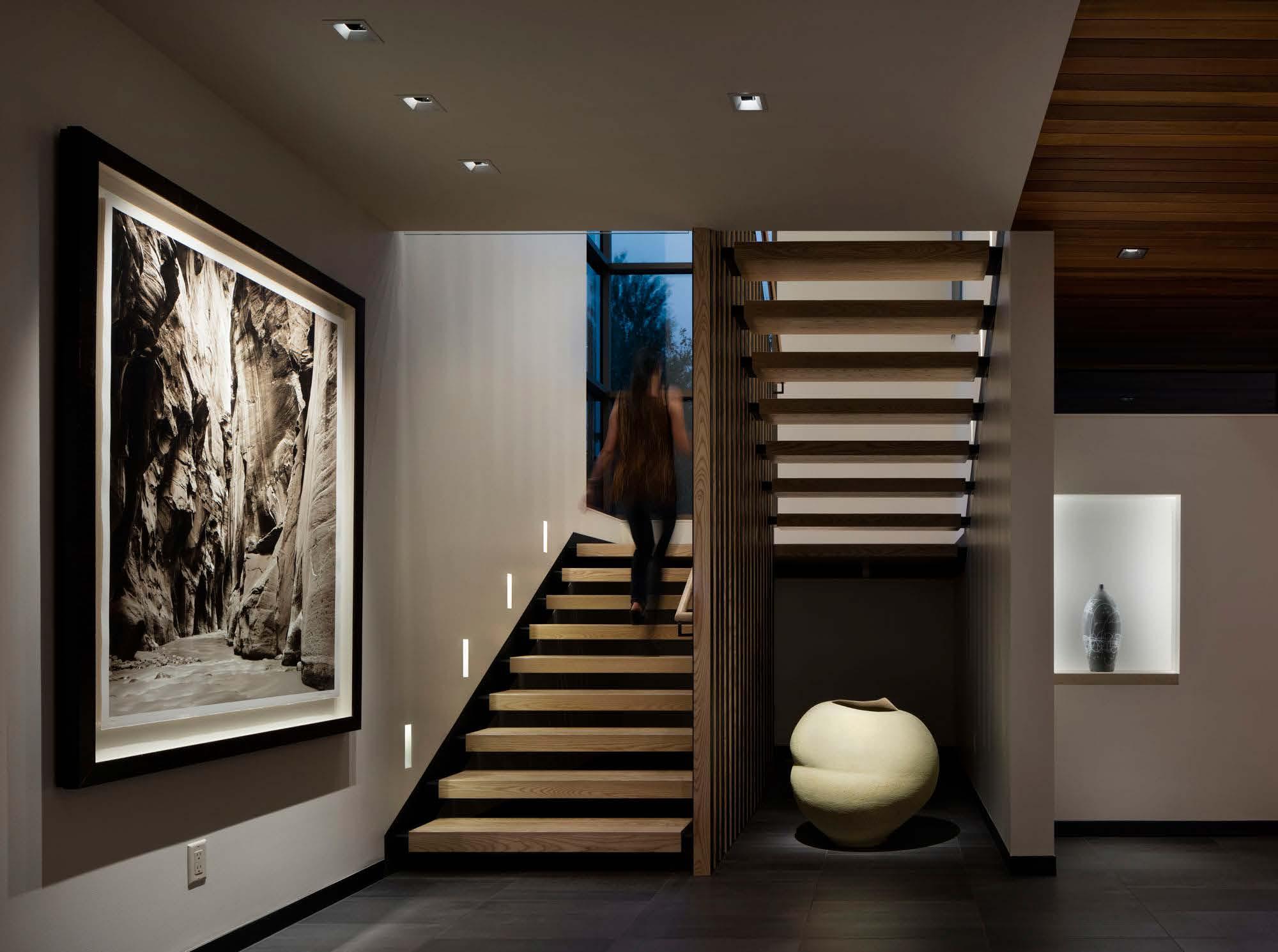
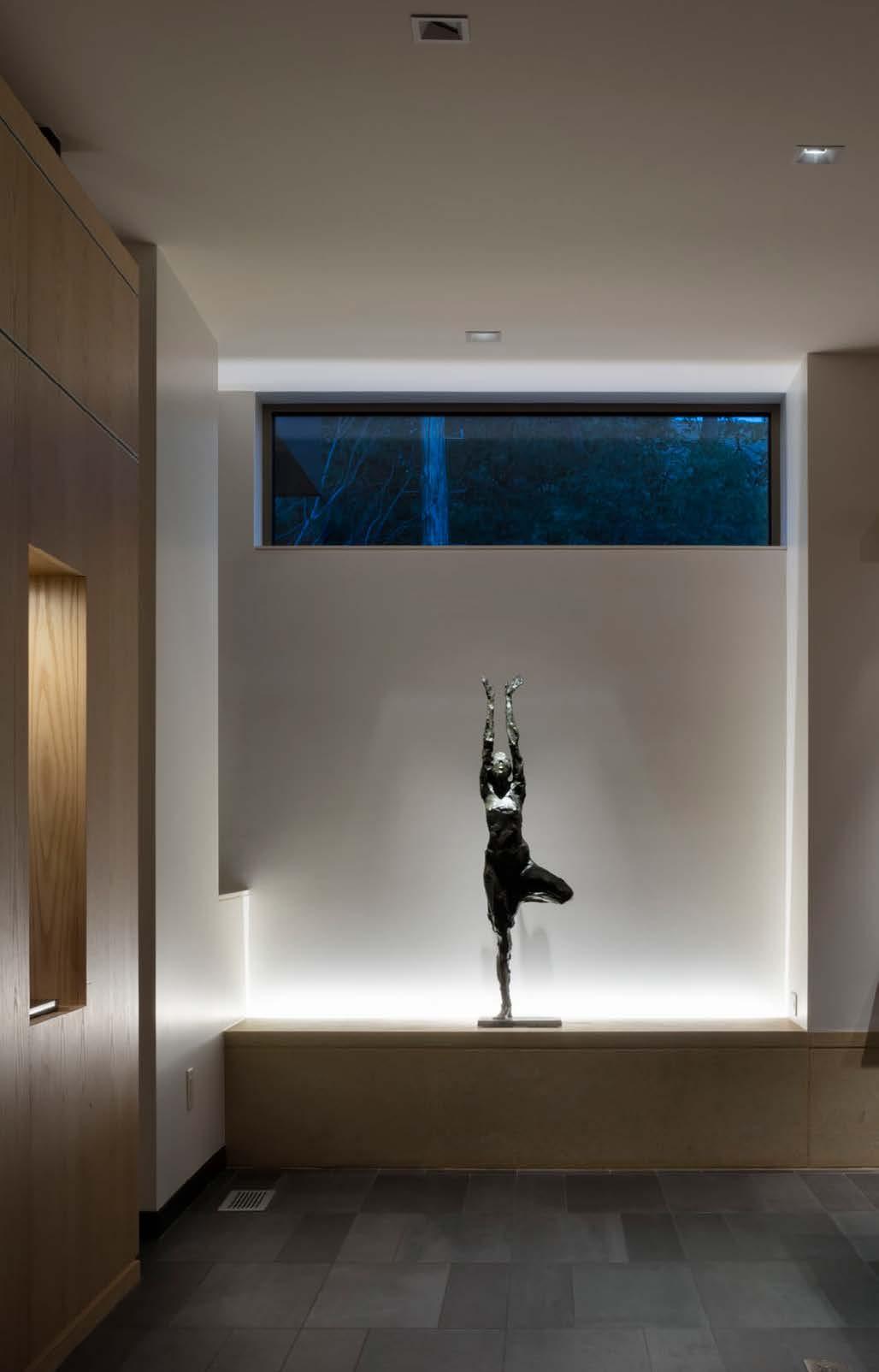
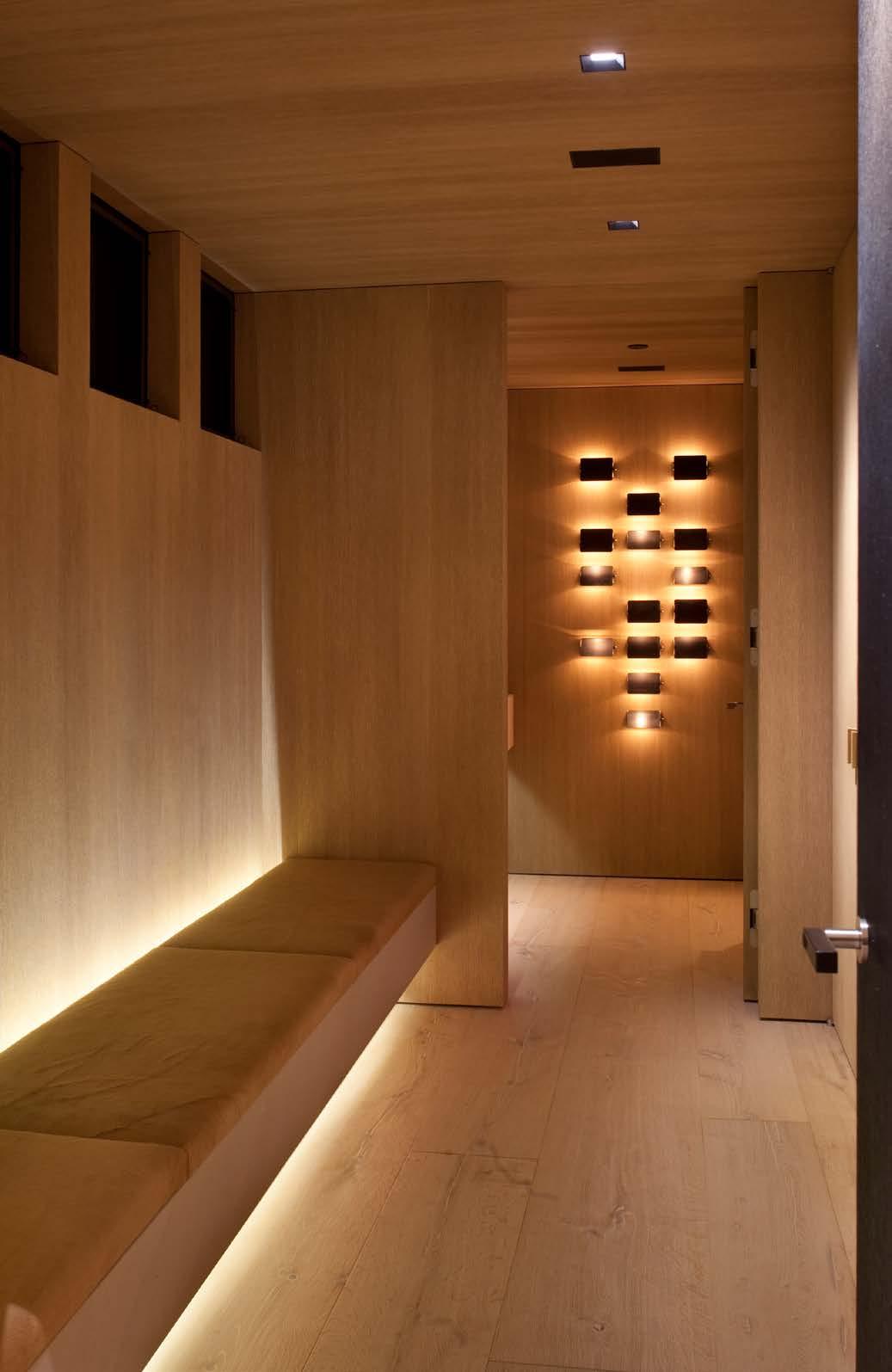
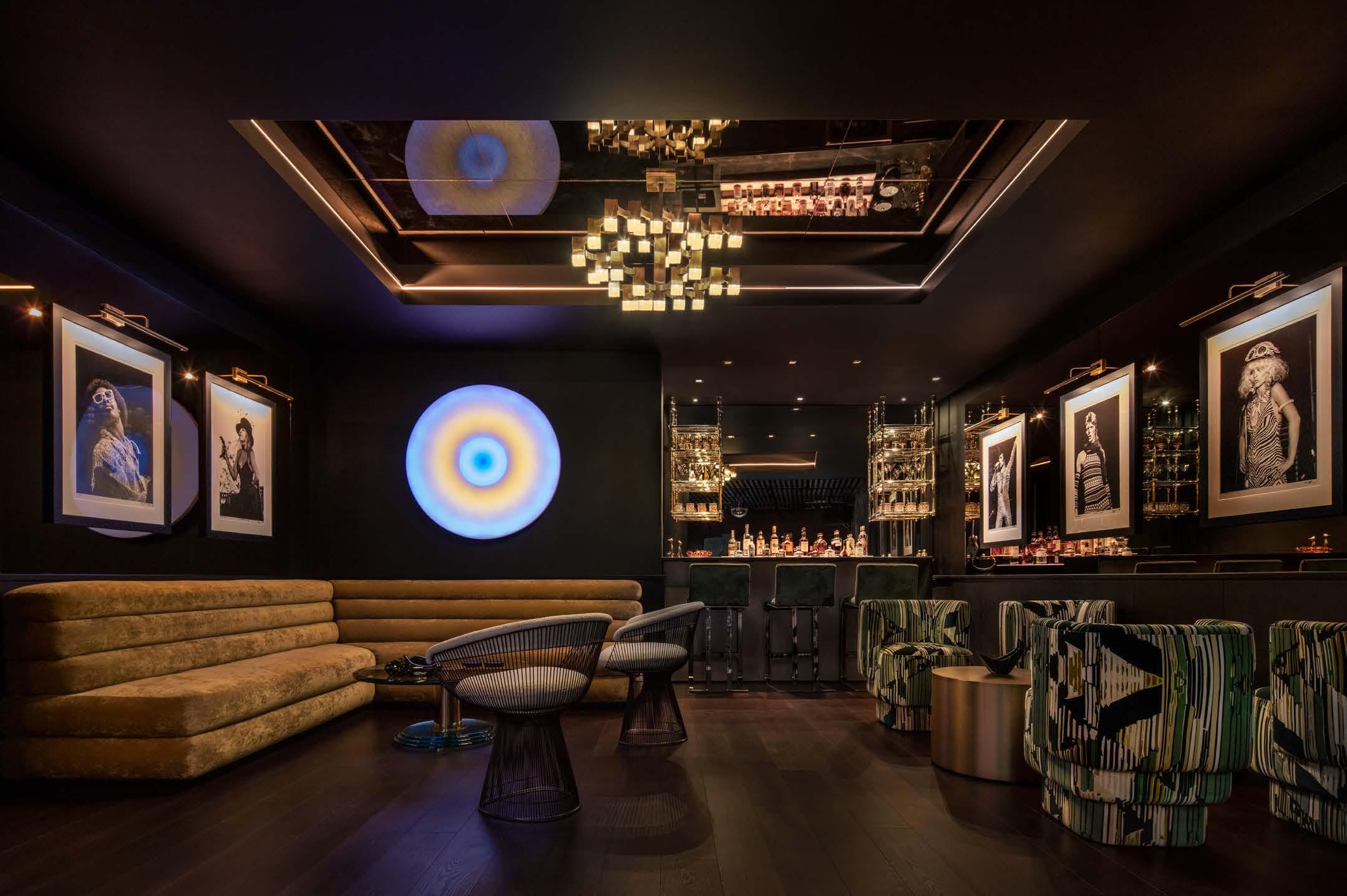
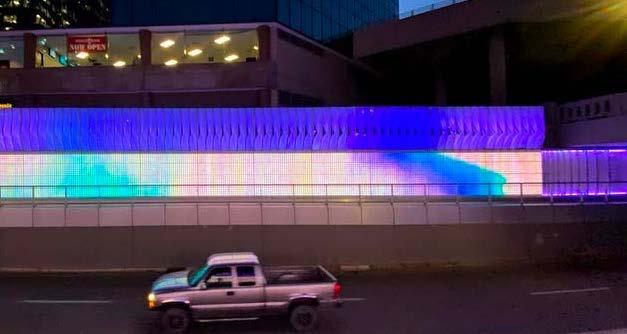
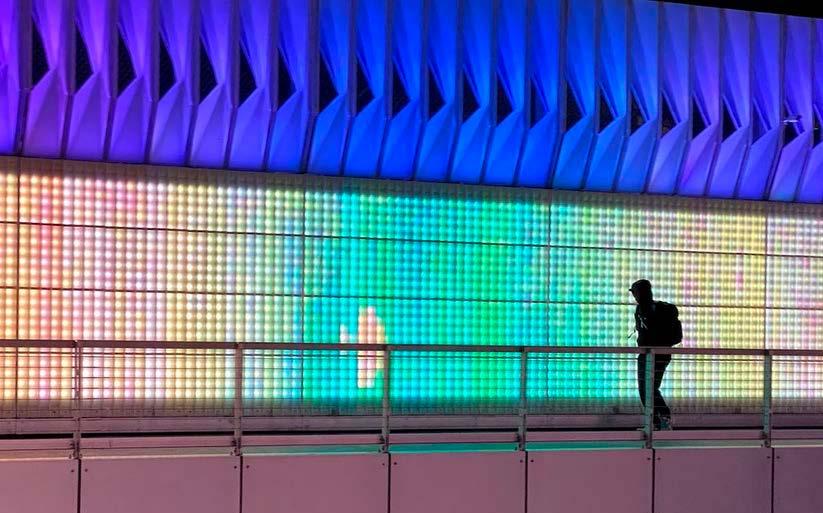
Pharos Expert is a DMX and DALI control system for architectural lighting, suitable for a wide range of
Expert can be used standalone as a set-and-forget solution, cloud connected for remote management, touch controlled using touchscreens or a mobile phone, or integrated into 3rd party systems.
How will you use yours?
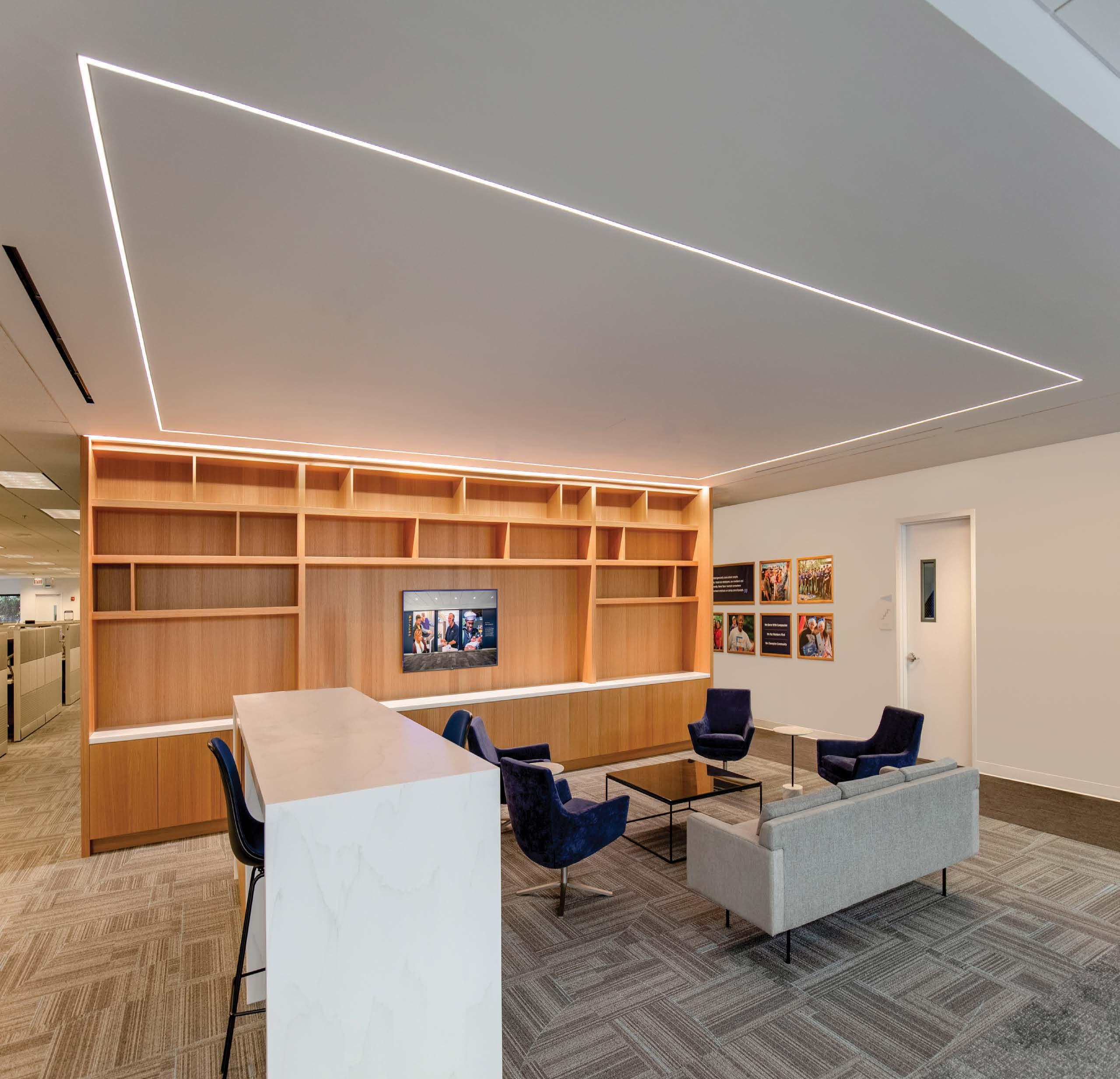
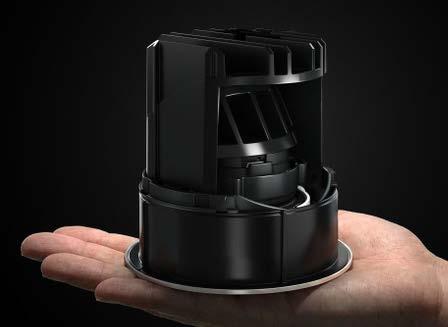
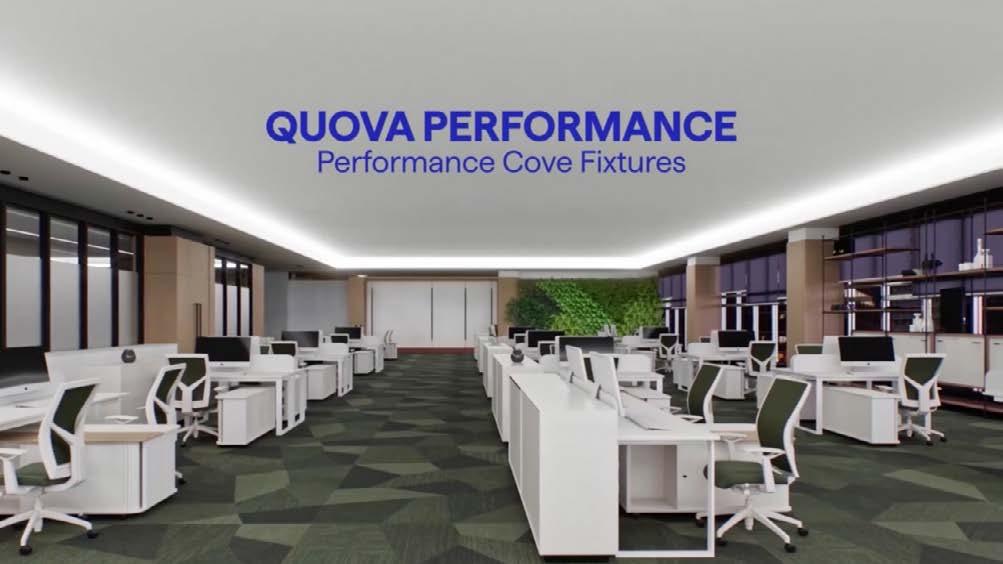
QUOVA PERFORMANCE boasts up to 900 lm/ft of output and 450 cd peak intensity at CRI 98, making it best in class. Its proprietary, asymmetric optic focuses light with high peak intensity, ensuring uniform illumination across ceilings, even from shallow coves.
line of
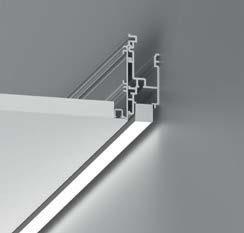
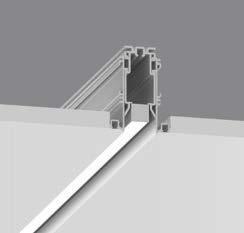
20 Linear Roll Up Lens Seamless lens up to 60' standard with satin opal diffuser
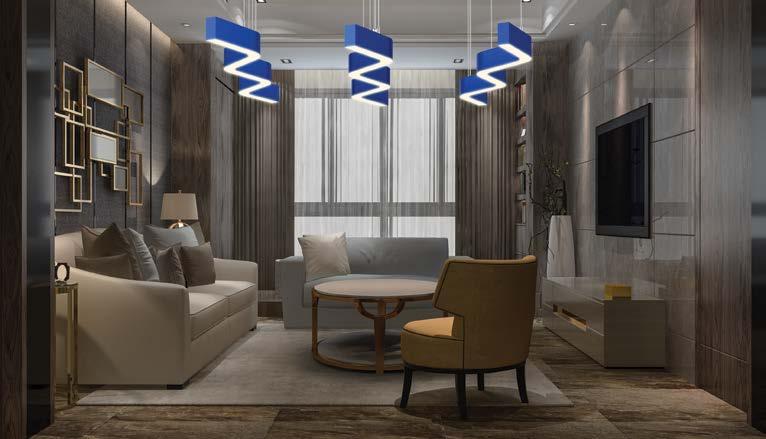
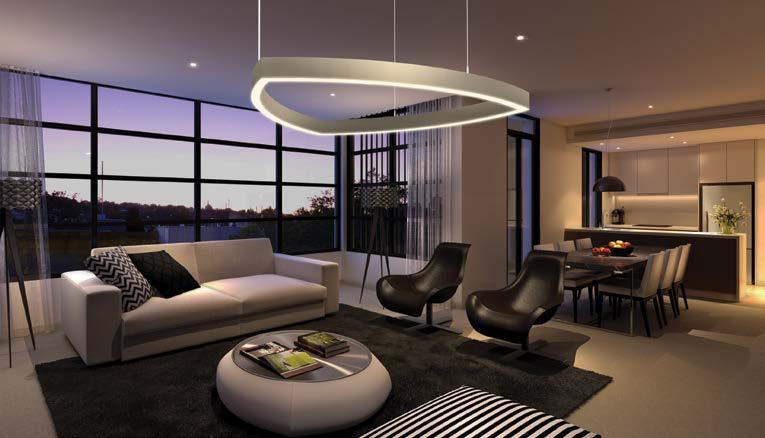
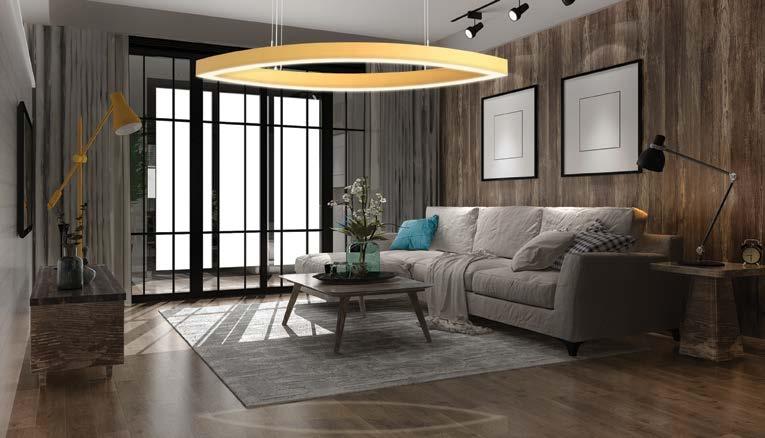
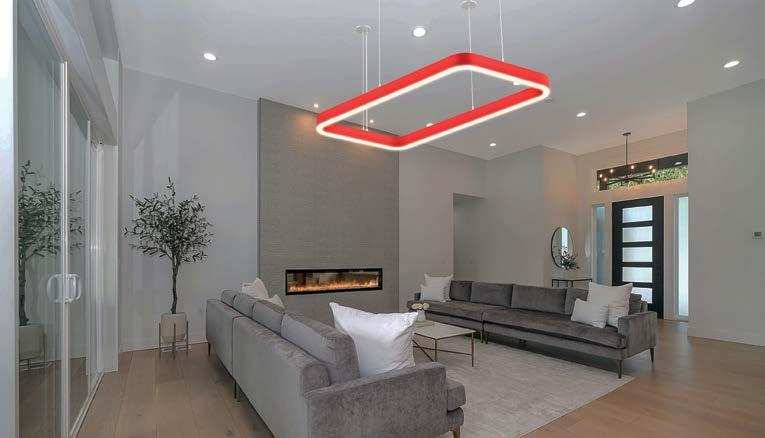
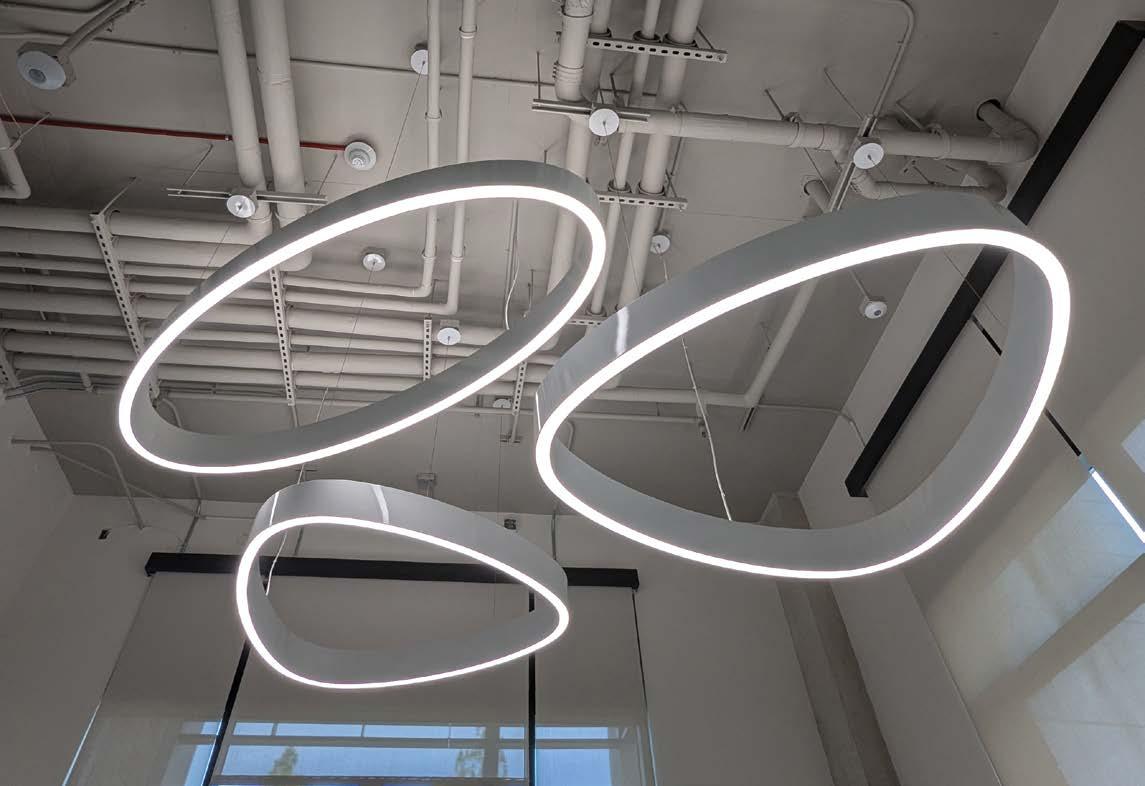
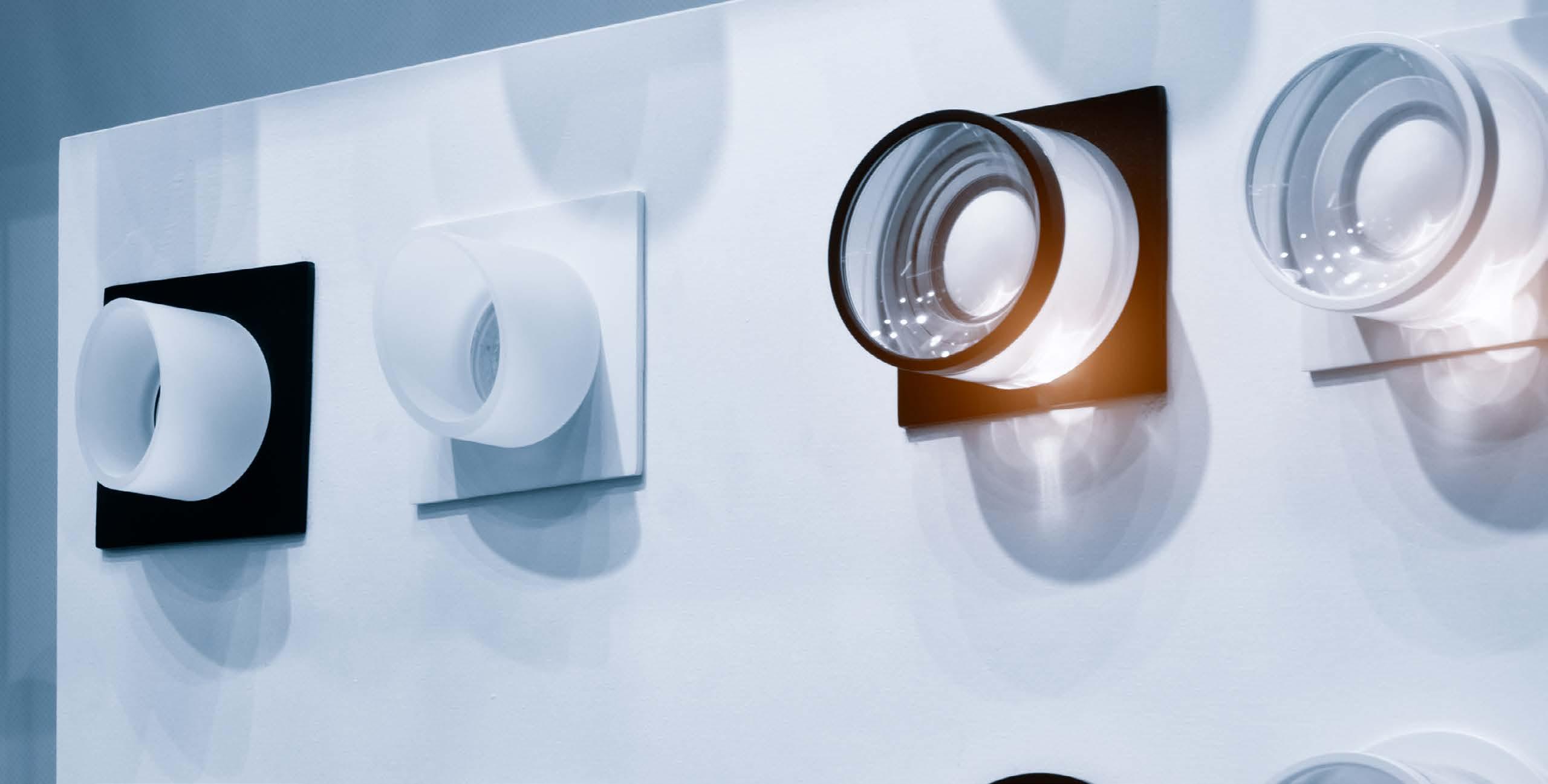
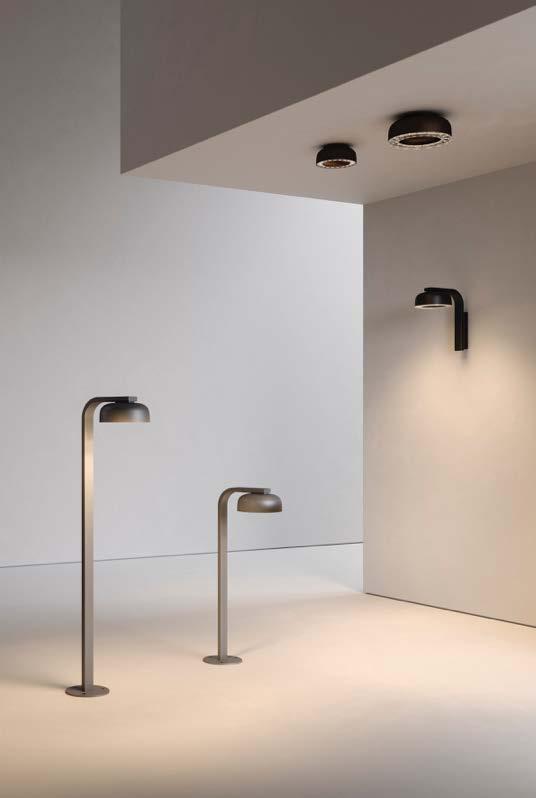
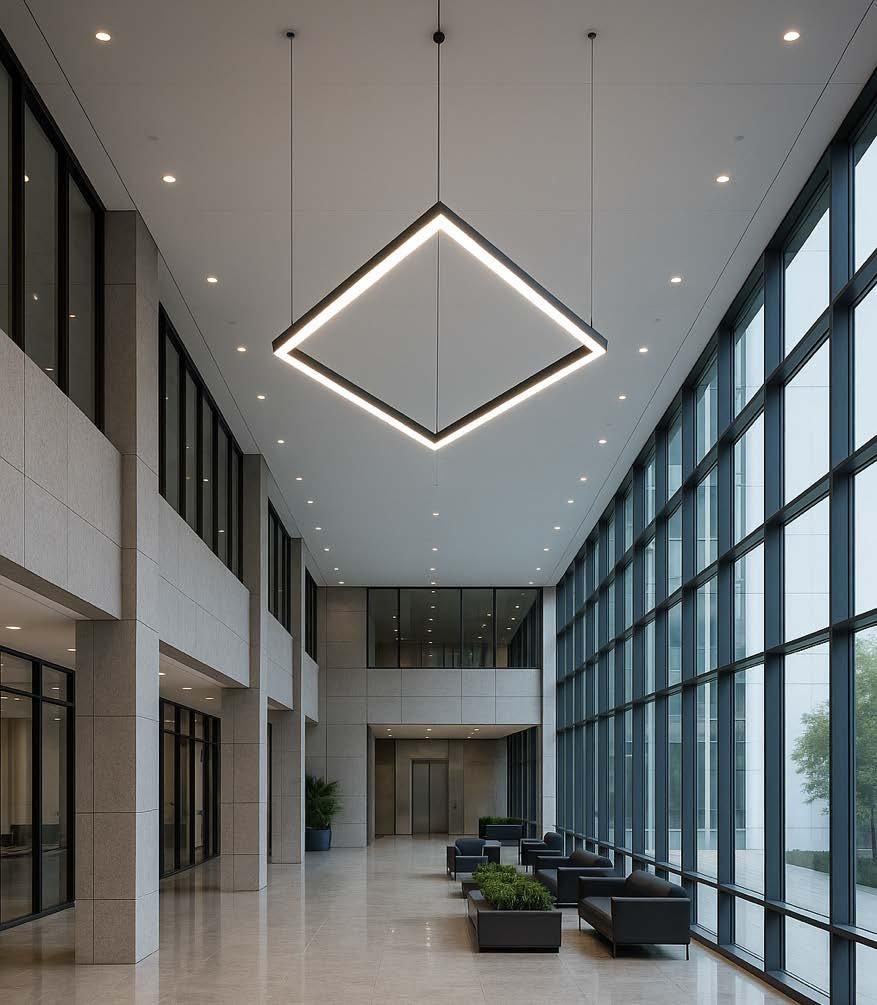
Tangent Shapes from VoksLyte. A new family of exquisite geometric luminaires. Available as a downlight pendant (Tangent Down), uplight/downlight pendants (Tangent UpDown), recessed (mud flange or exposed).
May be finished in any commerically available powder coat colors and real wood veneer (please contact the factory). Illuminated in a variety of options: whites, RGBW, tunable white or dim to warm. Entering our 39th year in business, and made entirely in the US in our Gaithersburg, MD factory.
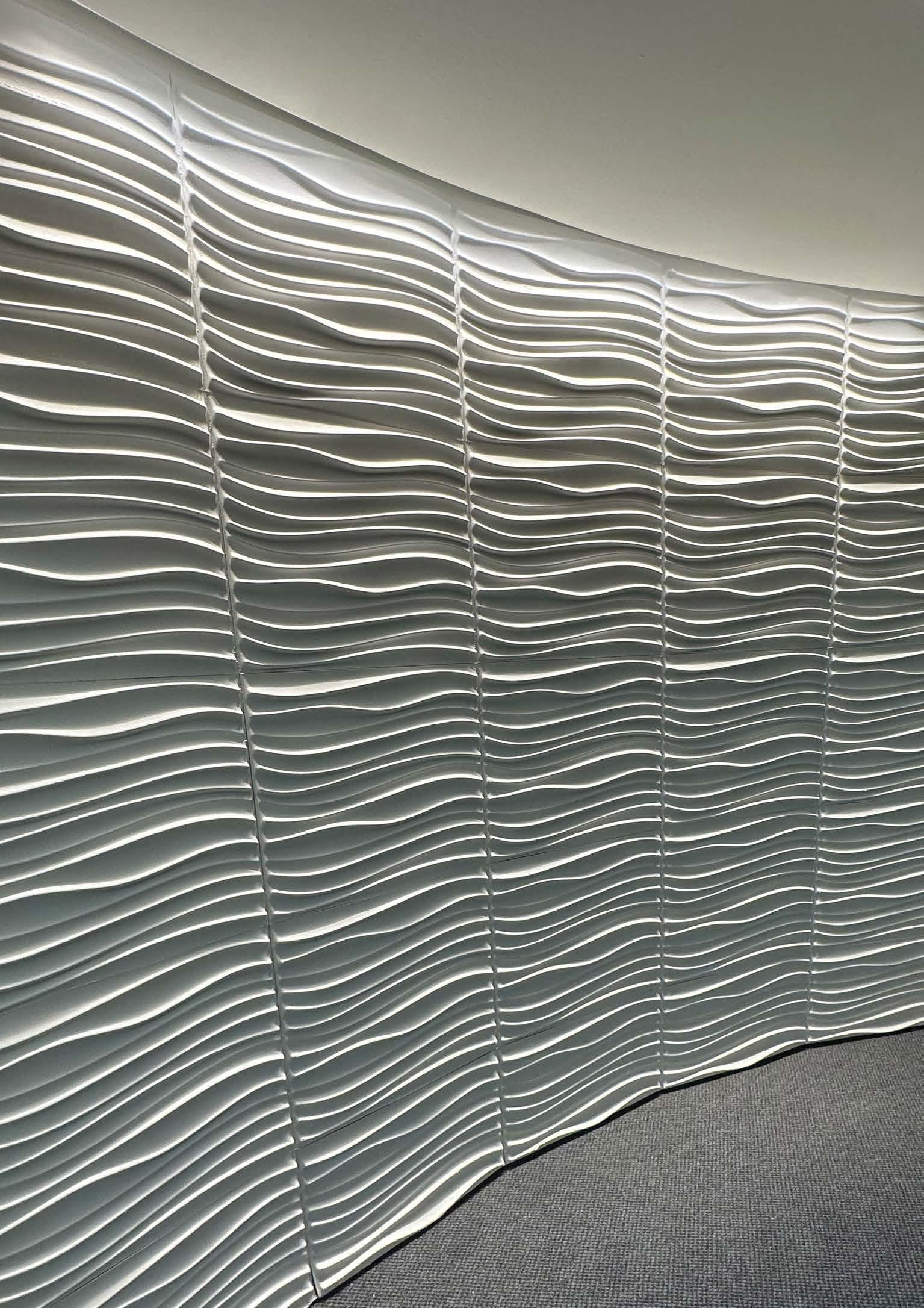
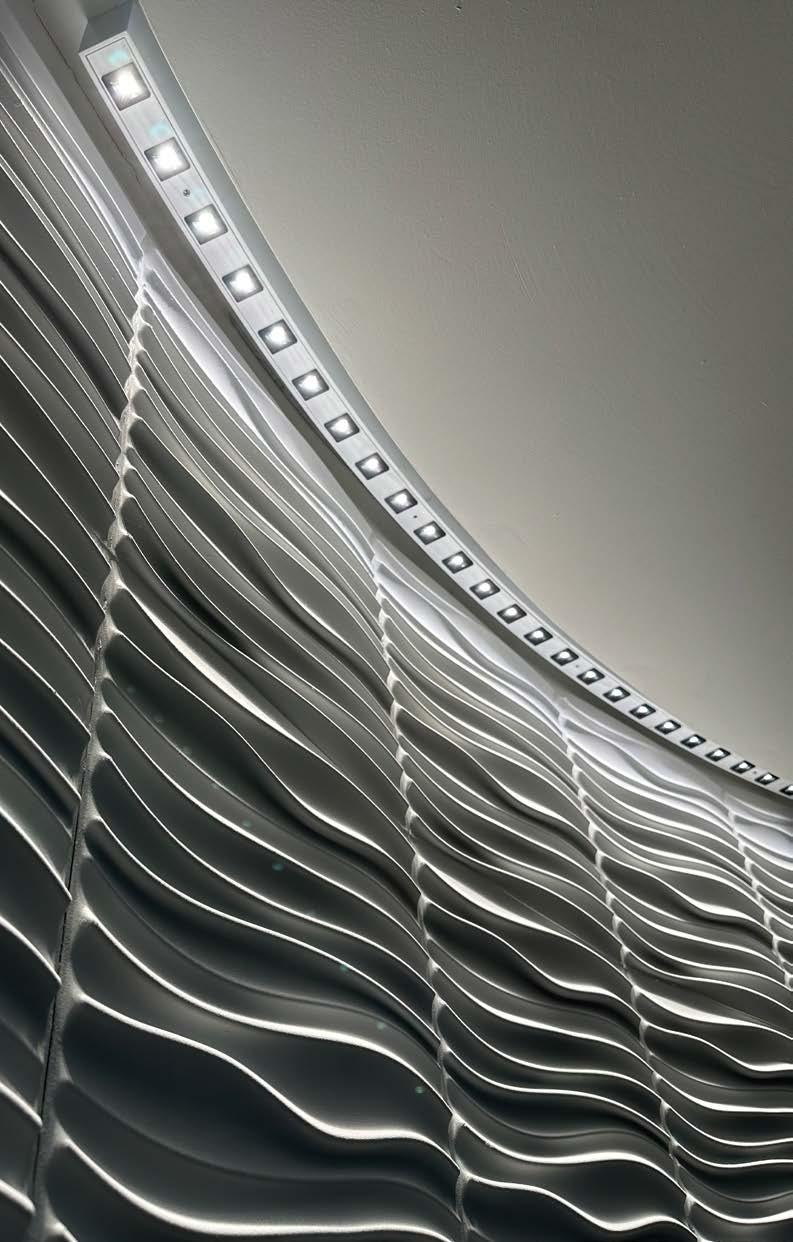
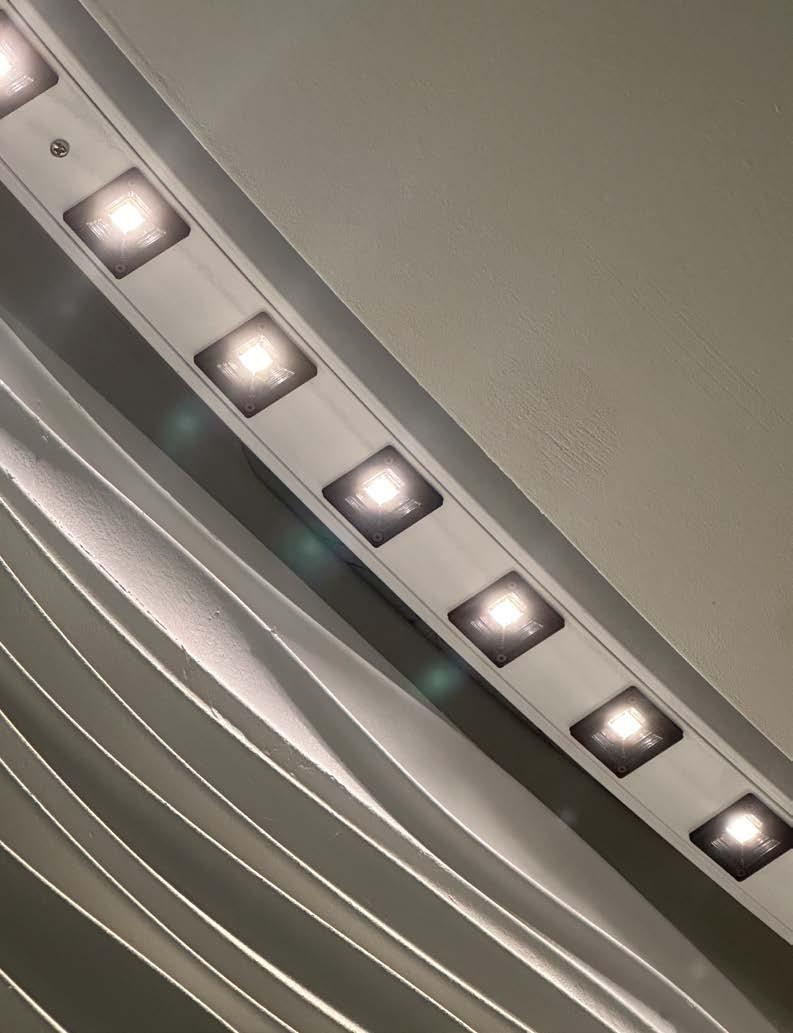
At last, a masterful solution to grazing curved walls. Tangent Grazer is factory-manufactured to any curvature or shape, in static or compound raddii, or any rectilinear or curvilinear application. Made to fit your application perfectly, in both curvature and length. VoksLyte can provide overall lengths to the nearest 1/16” assuring that our curvatures and lengths will match your architectural requirements exactly.
As always, made entirely in the USA in our Gaithersburg, MD factory.
New from VoksLyte!
Editorial Director’s Notepad
Light + Health
Circadian-Effective Lighting and the Integrated Design Process
By Daniel Frering and David Pedler
Can circadian lighting succeed without integrated design, or does it collapse before the first fixture is ever chosen?
The LED Dilemma: Rethinking Maintainability in an Era of Disposable Luminaires
LEDs promised “long life,” so why are whole luminaires getting replaced instead of repaired or upgraded?
Cover Story
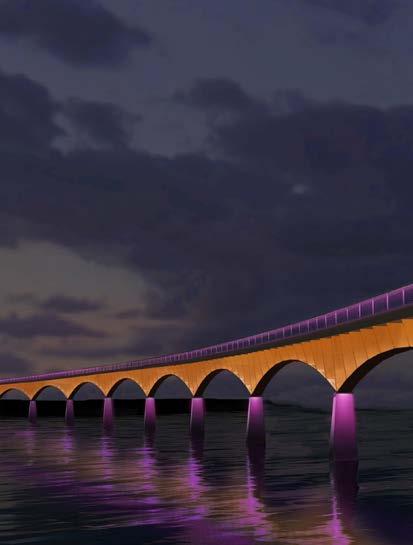
A Bridge Defined by Restraint
By Randy Reid
Four lighting layers, warm-white comfort, and restrained color give this bridge a calm civic presence after dark.
A Decade of Evolution at San Francisco City Hall
It took almost ten years to build, A century later, ten years of upgrades prove control, optics, and calibrated whites can protect a landmark’s nighttime identity.
designing lighting controls (dlc)
Lighting controls are evolving fast. Practical guidance and real-world case studies show how rebates, integration, and connectivity drive savings and better spaces.
Just In
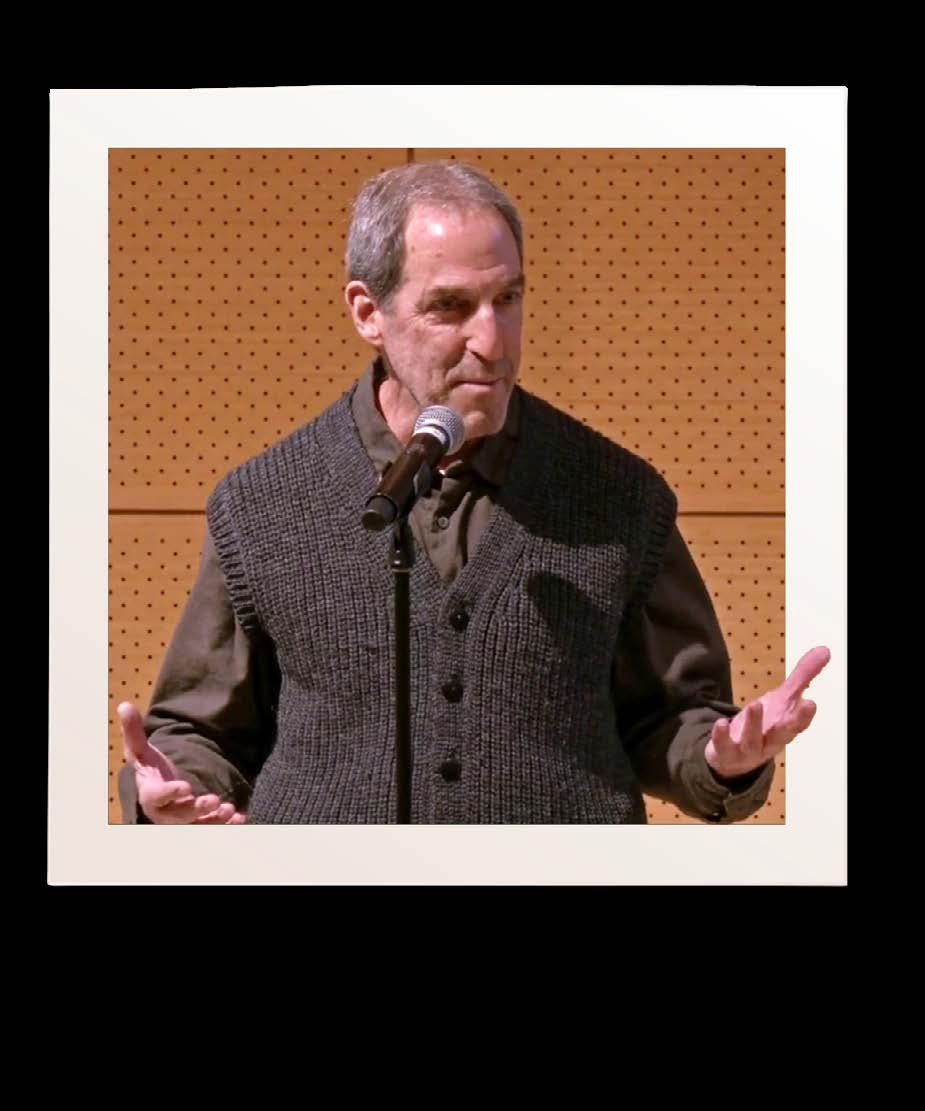
Paul Marantz: A Life in Light, Curiosity, and Craft
By Randy Reid
A tribute to Paul Marantz, whose curiosity and craft shaped projects and people across the lighting world.
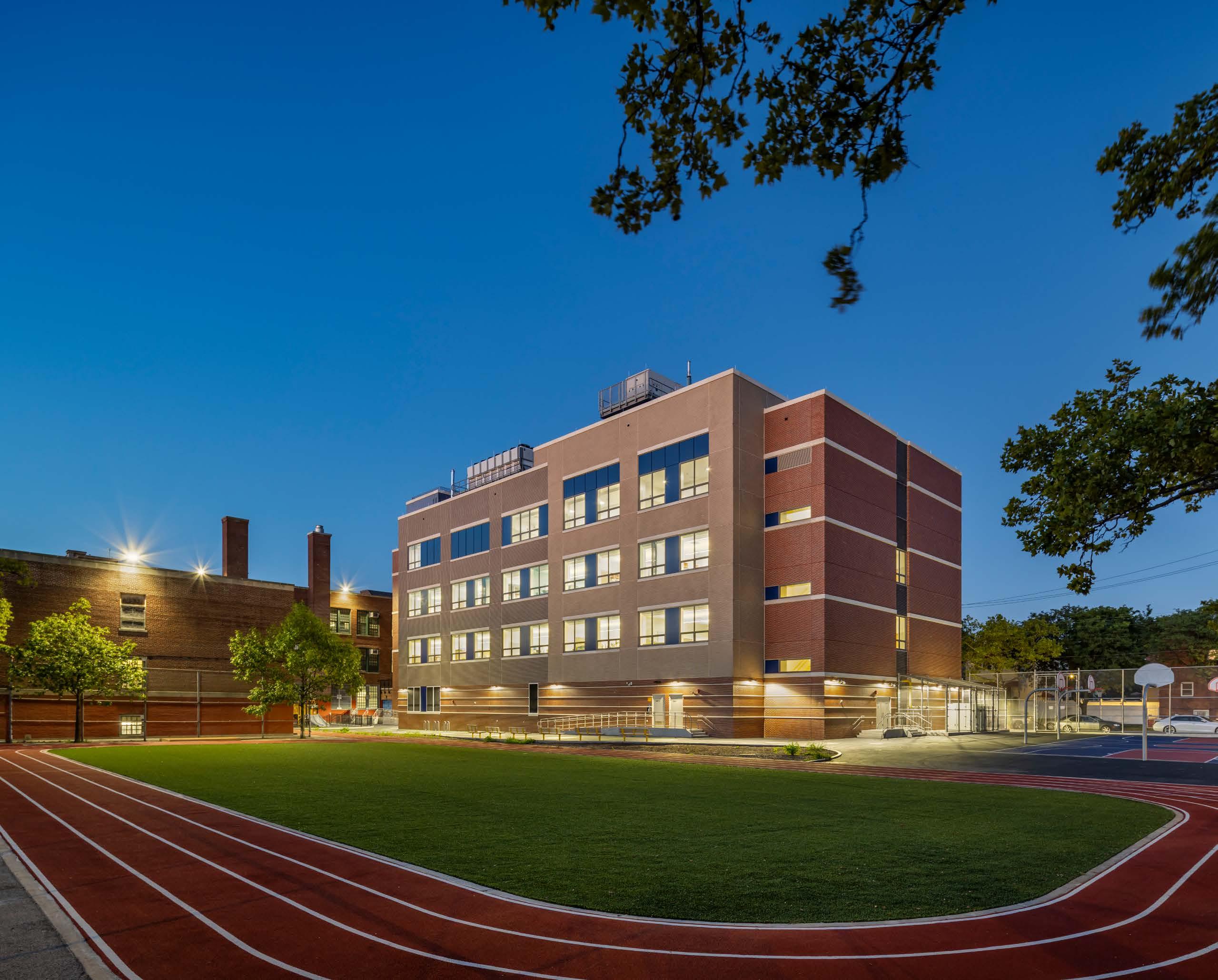
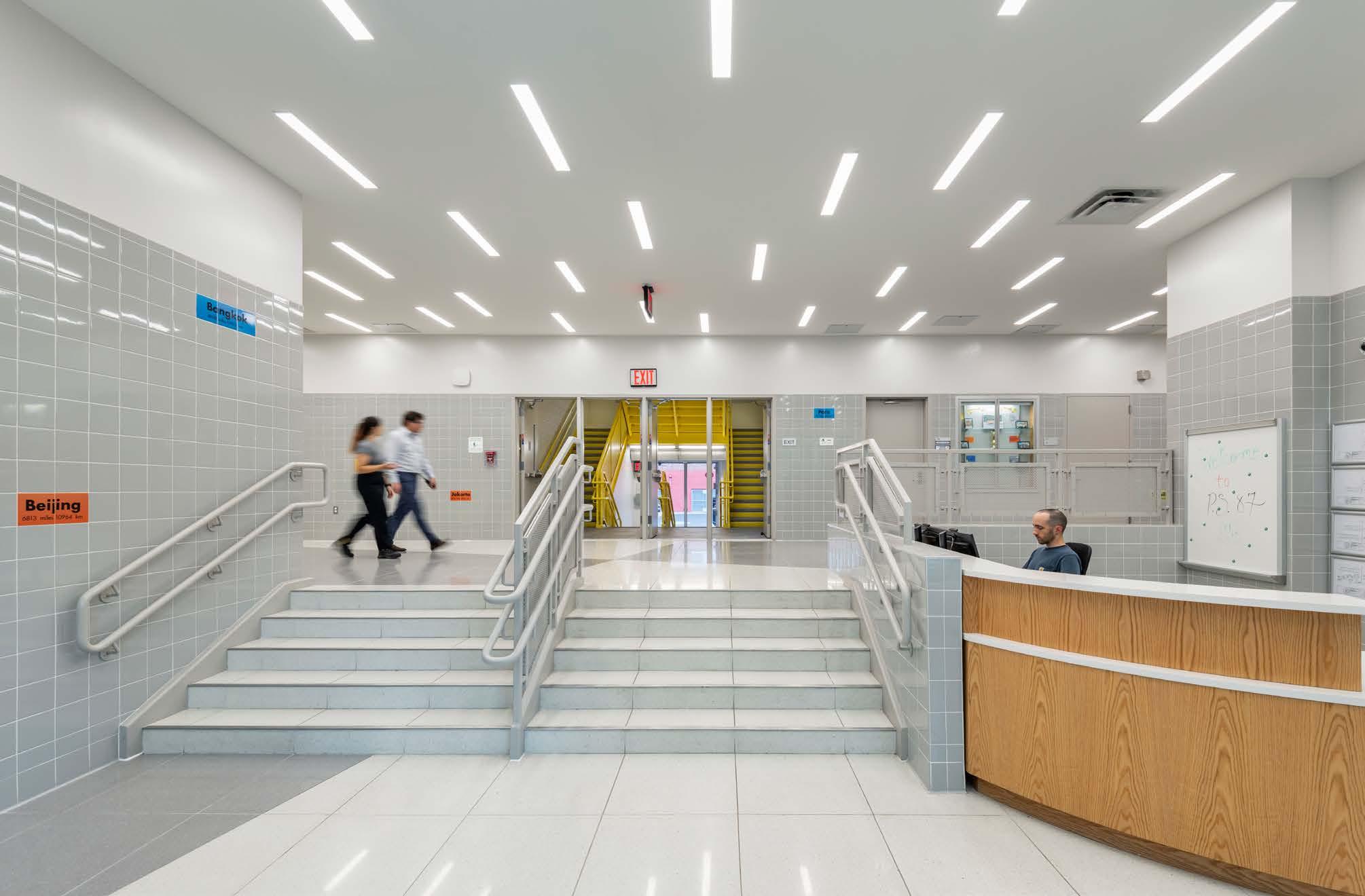
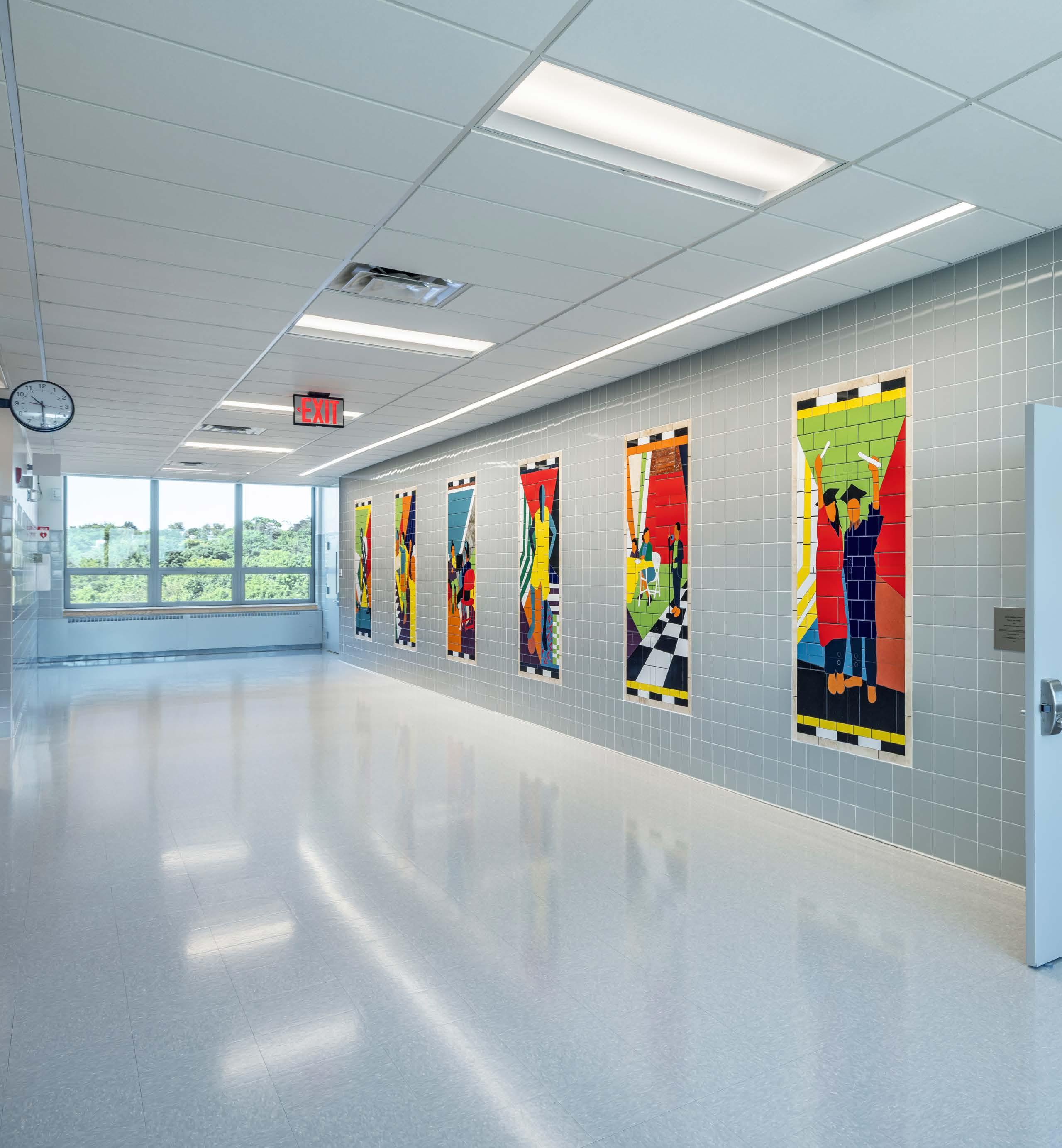
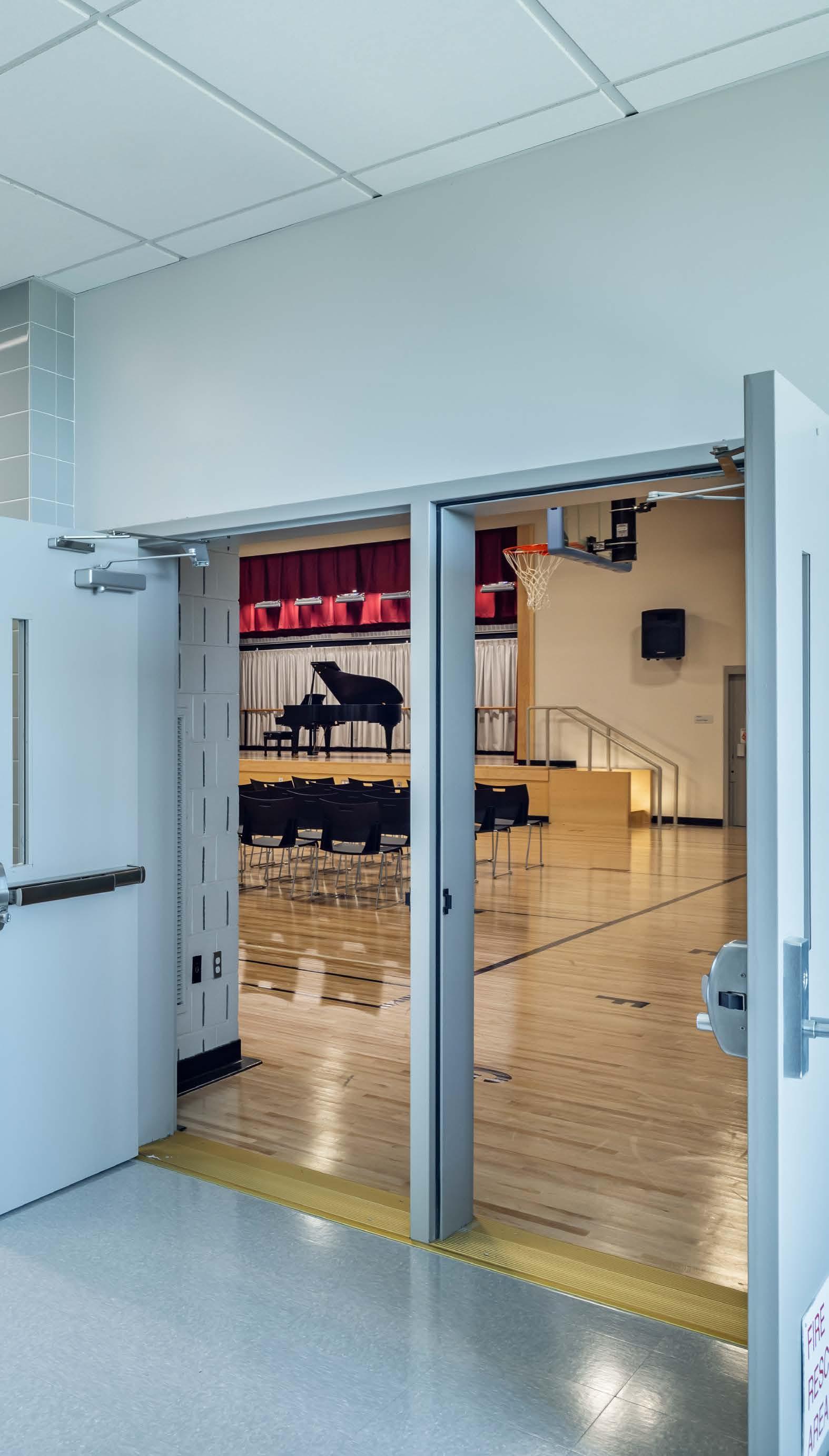
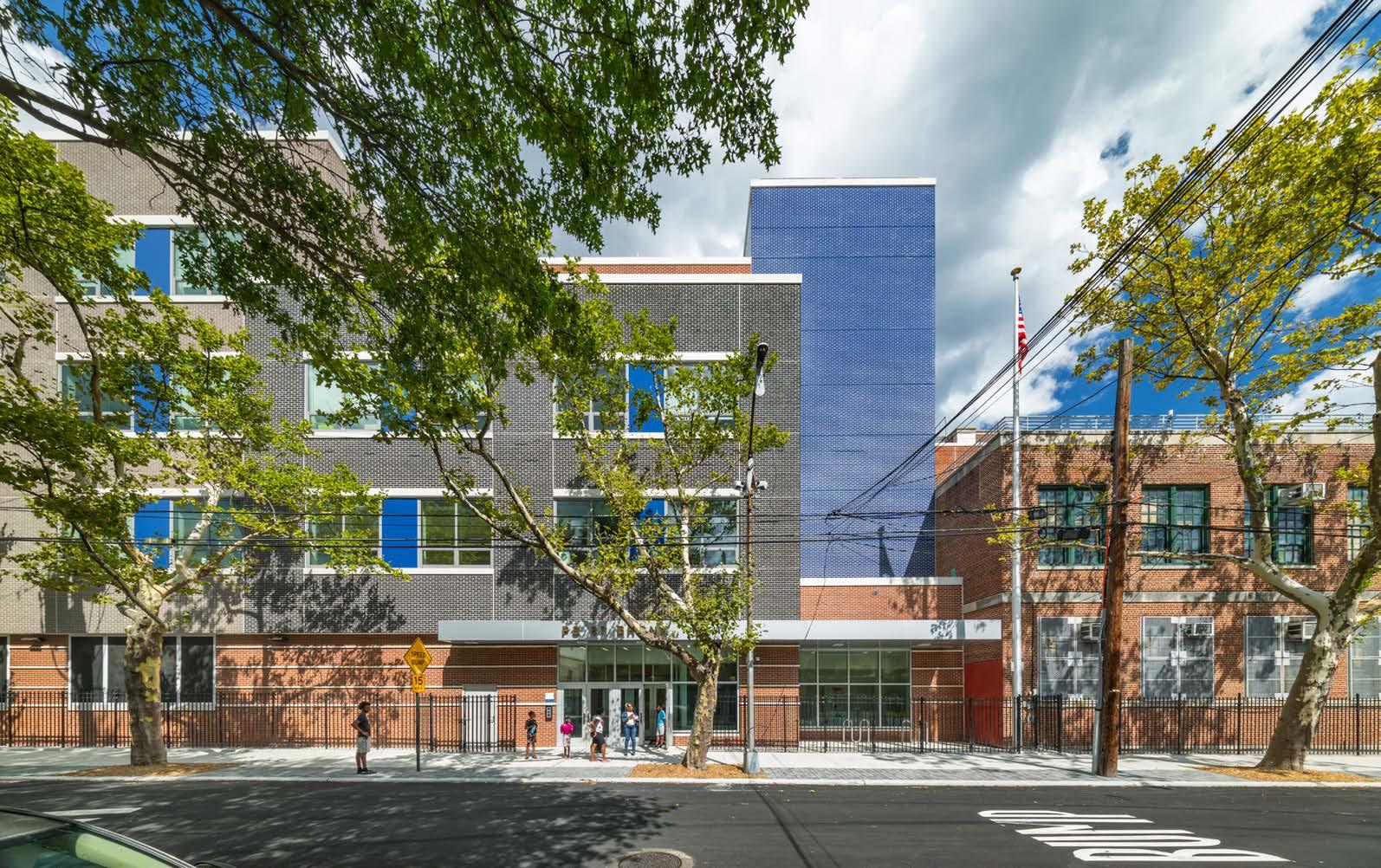
Lighting as Infrastructure at Public School 87
Quiet, high-performing lighting shapes classrooms, corridors, and a gymatorium built for learning, movement, and community.
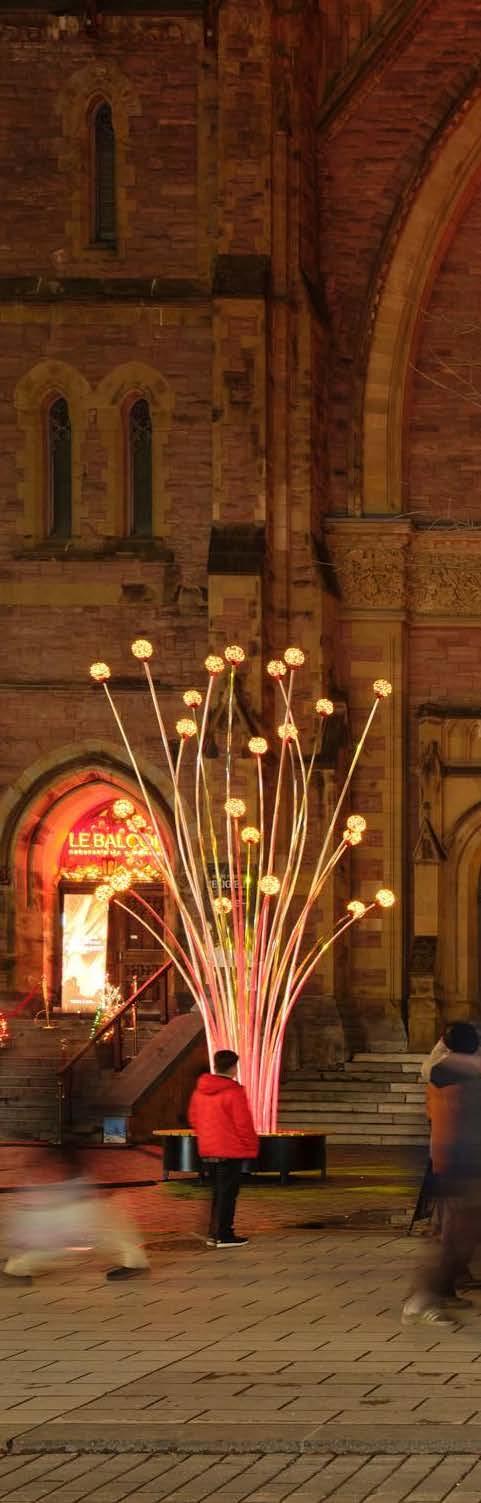
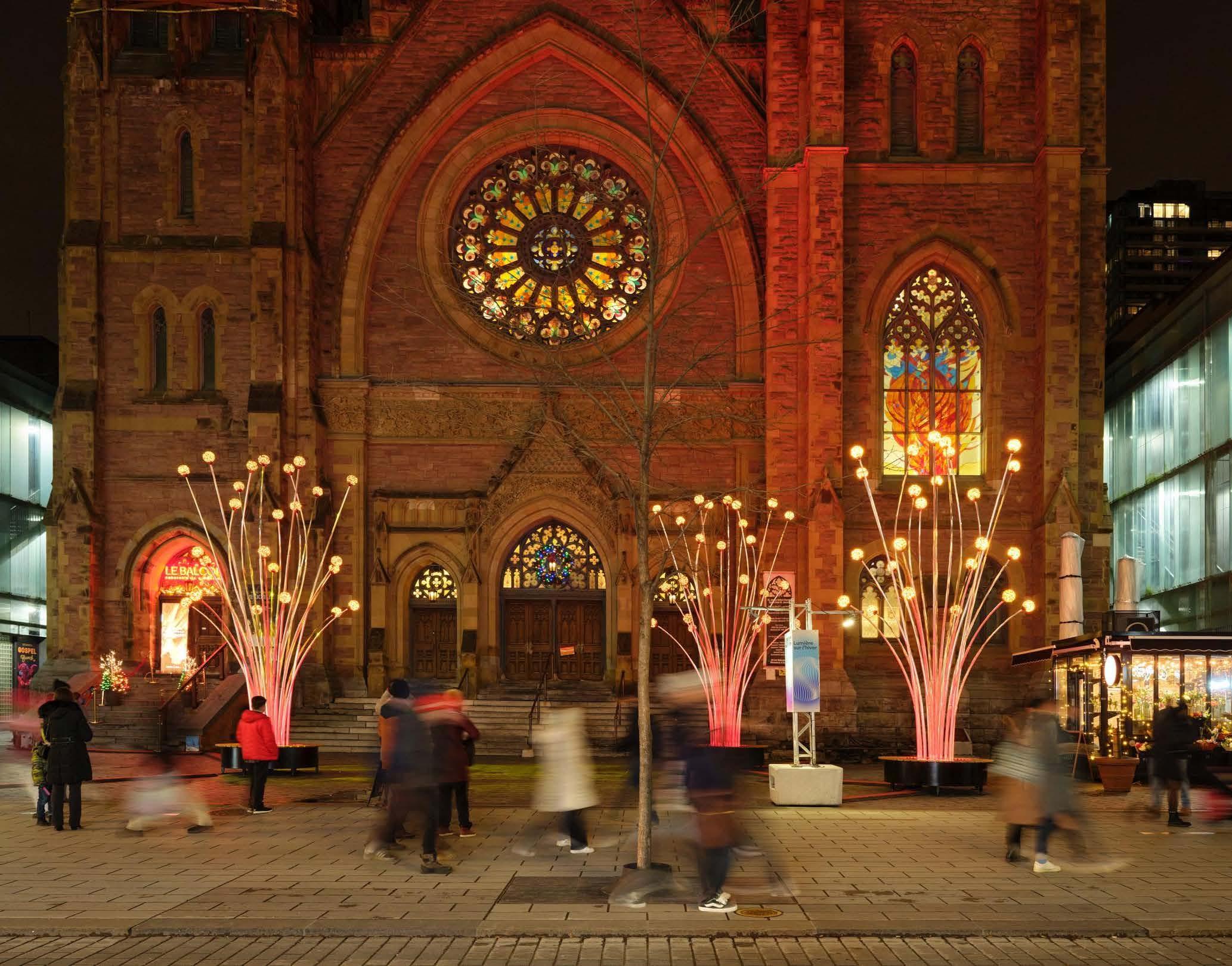
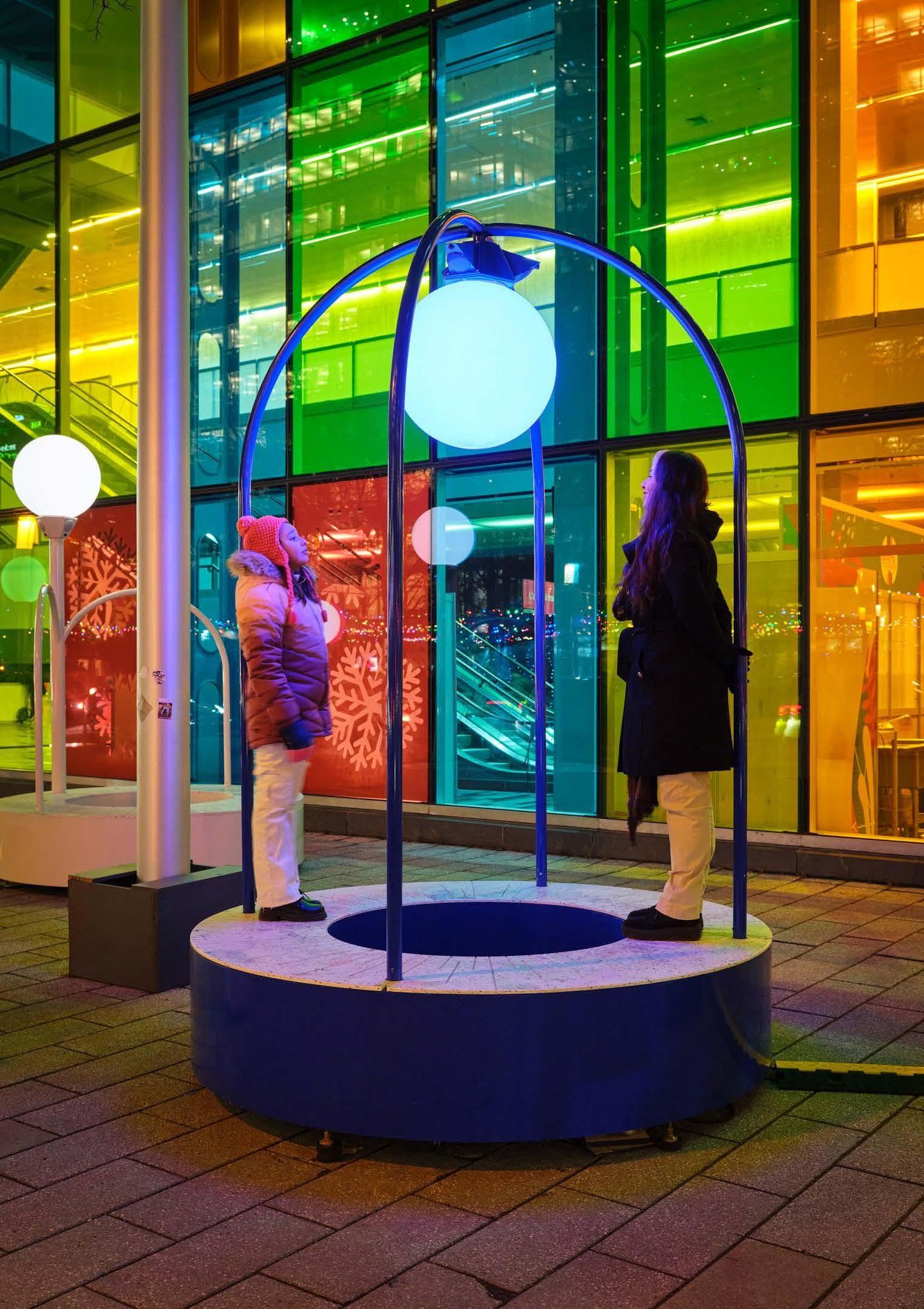
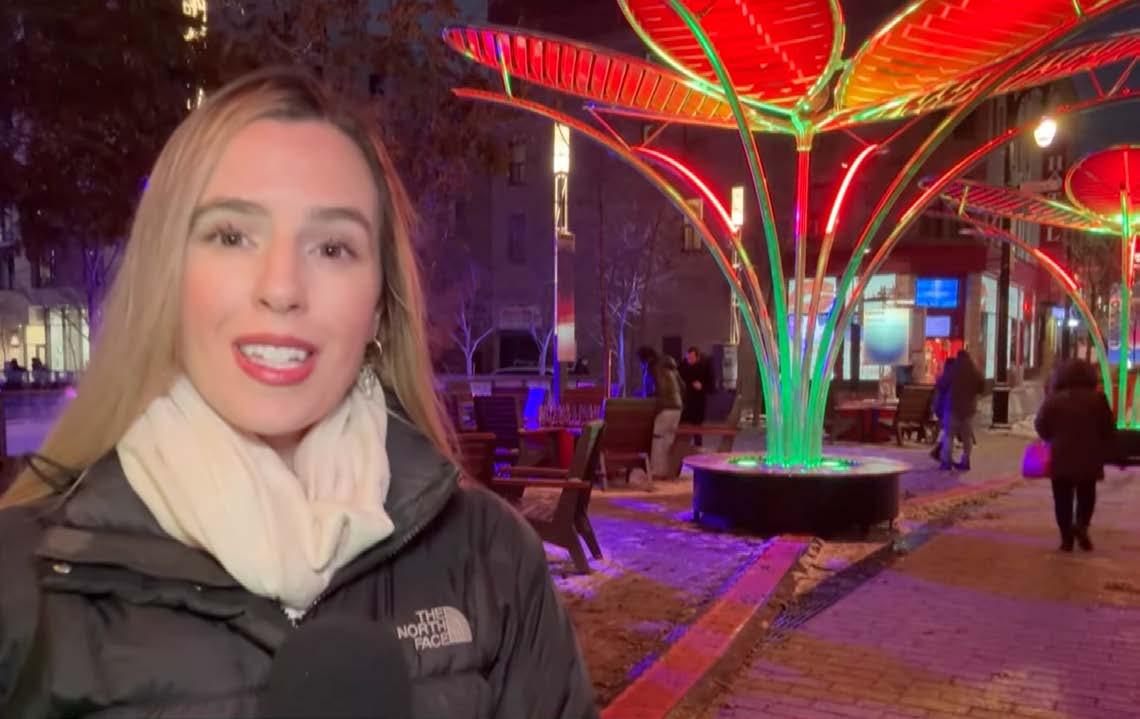
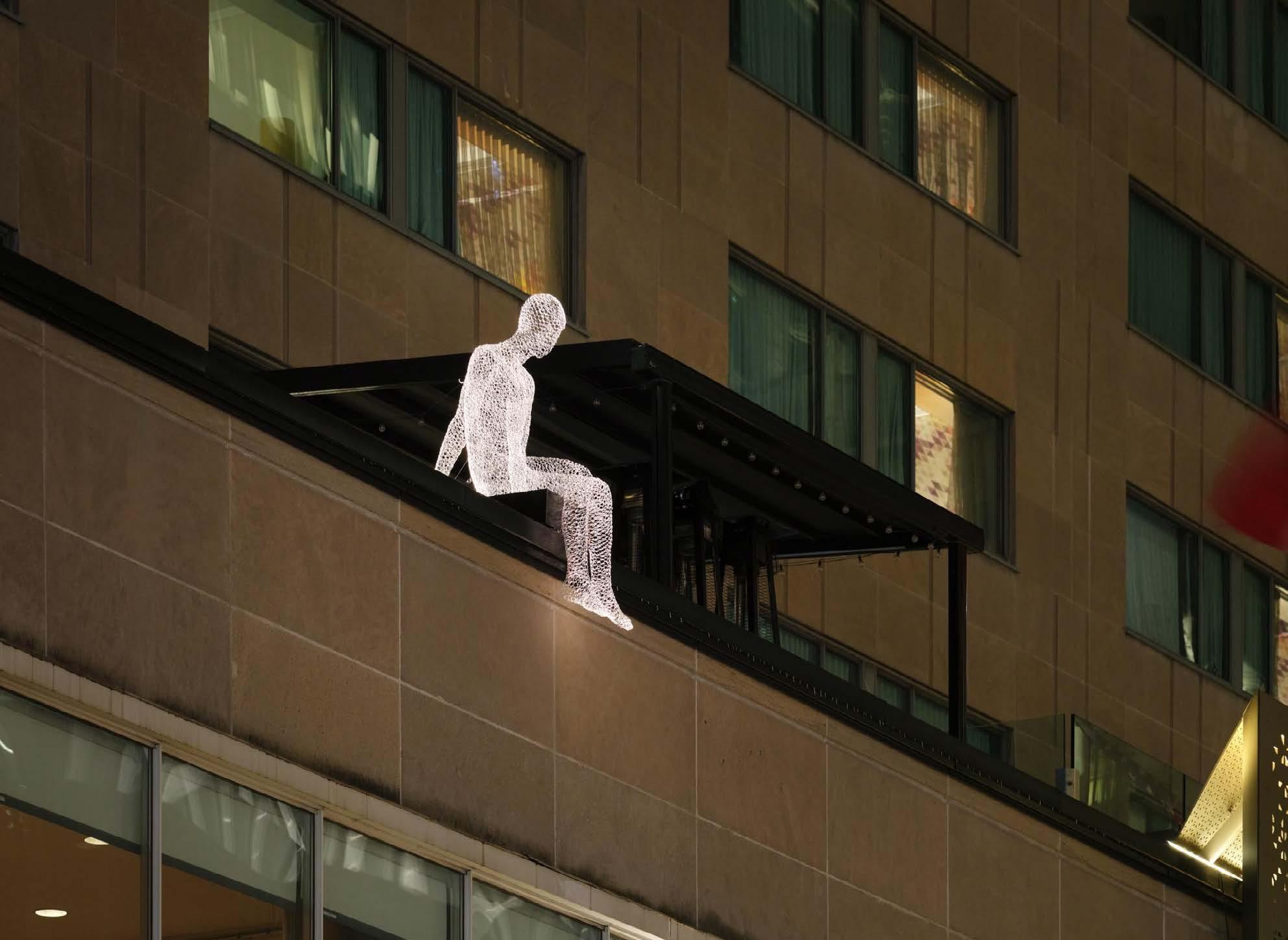
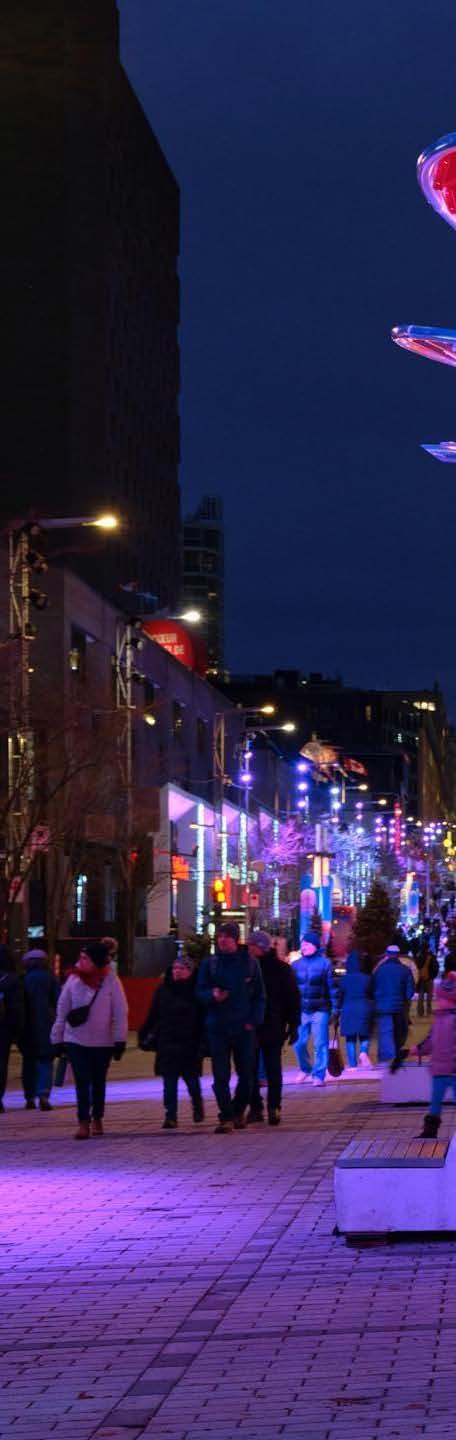
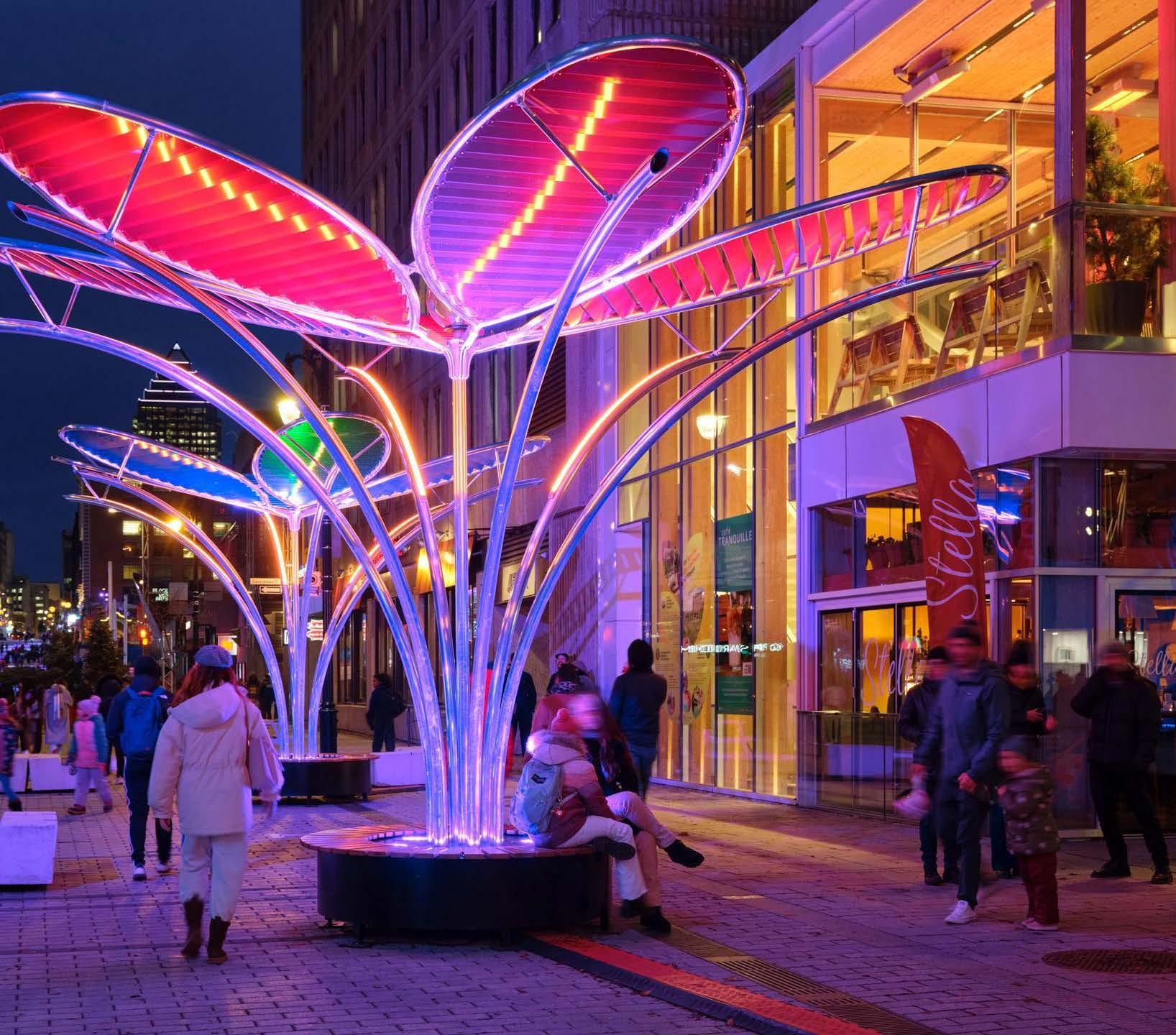
Cold City, Warm Light: LUMINO Transforms Montreal After Dark LUMINO turns winter-dark Montreal into a glowing gallery, one installation at a time. 14 16 20 24 32 41 54 56 62 68
Craig DiLouie, LC, CLCP
Shirley Coyle, LC
Stacie Dinwiddy, CLD, IALD, LC, LEED BD+C
Gary Meshberg
John Lawlor
David Pedler
Daniel Frering
Vilma Barr
Unbeatable Comfort. Uncompromising Performance.
Comfort Vue helps lighting designers confidently justify their professional fees, demonstrating that great design is not only about aesthetics, but also about delivering value-driven results that meet both client and environmental goals.
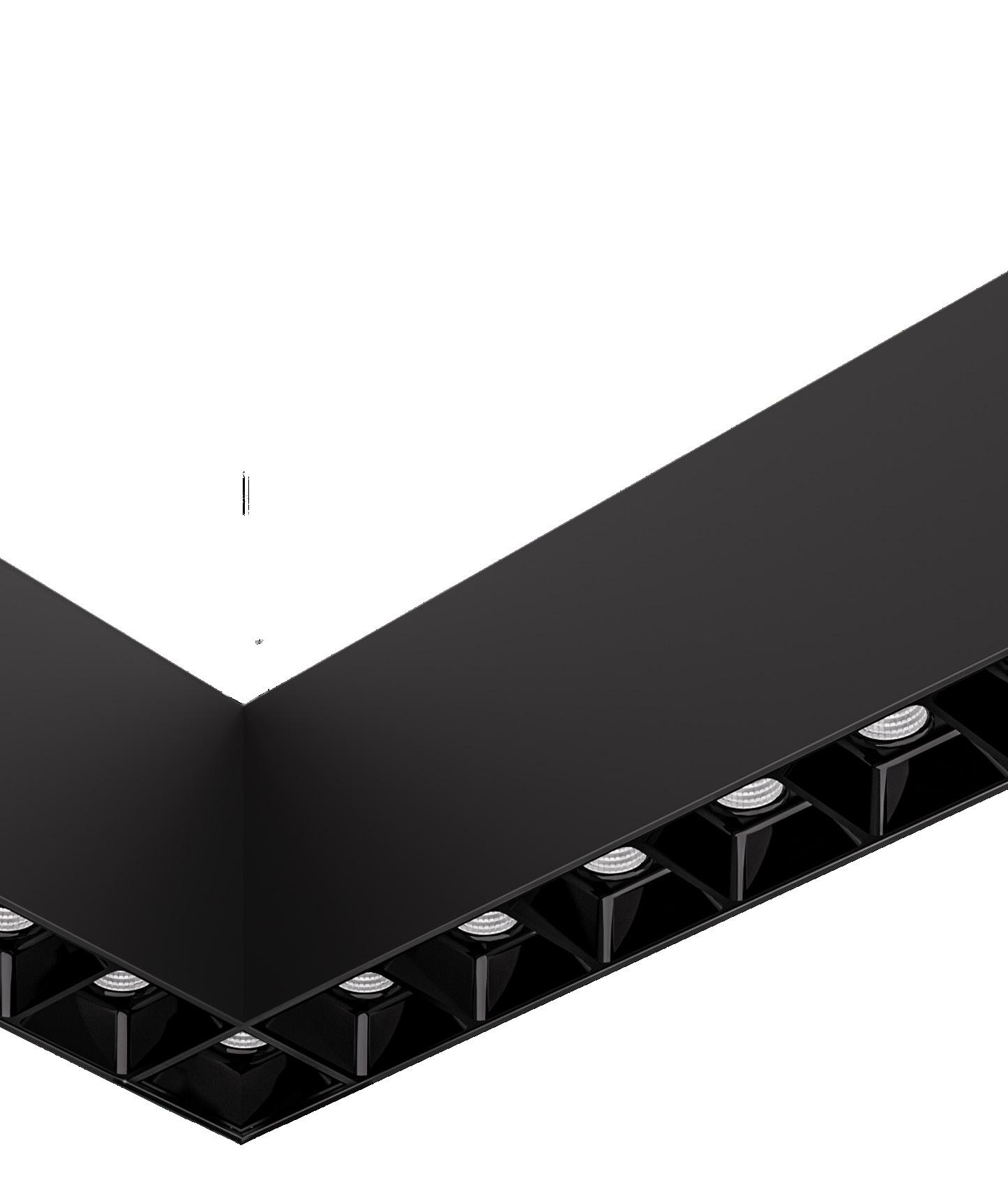
Setting a new standard for linear lighting, delivering industry-best visual comfort without sacrificing performance. By virtually eliminating glare, it creates visually quiet, sophisticated spaces where the architecture and its occupants are the focus not the light source.
With a high shielding angle and a Unified Glare Rating (UGR) of effectively zero.
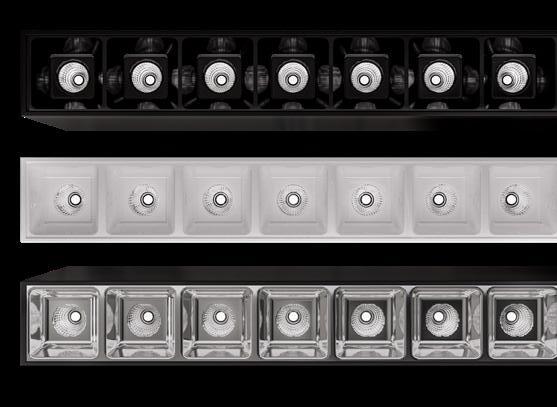
Louver Color Selection
Piano Black
Glossy White
Polished
Chrome
TRADE SHOW AND CONFERENCE YEARS
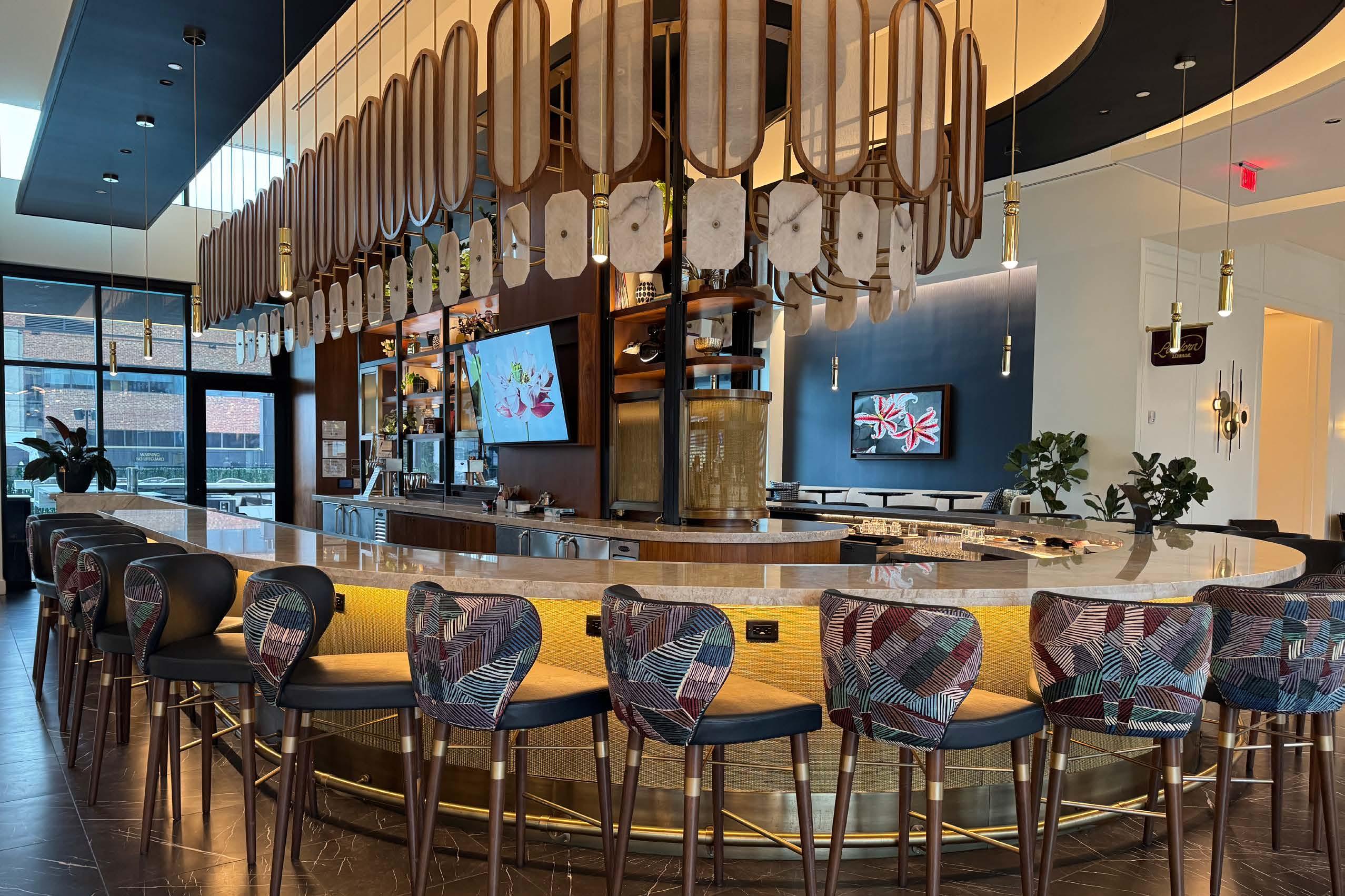
Crafting Atmosphere at Hilton Tempo Nashville Downtown
Inside Hilton Tempo Nashville, layered light sets the rhythm by energizing social spaces while keeping guestrooms calm.
Powered by the Sun, Shaped by the Community
When the original plan collapsed, this community project pivoted to solar, proving resilience can be beautifully illuminated.
An Architect’s Approach to Lighting a Civic Threshold
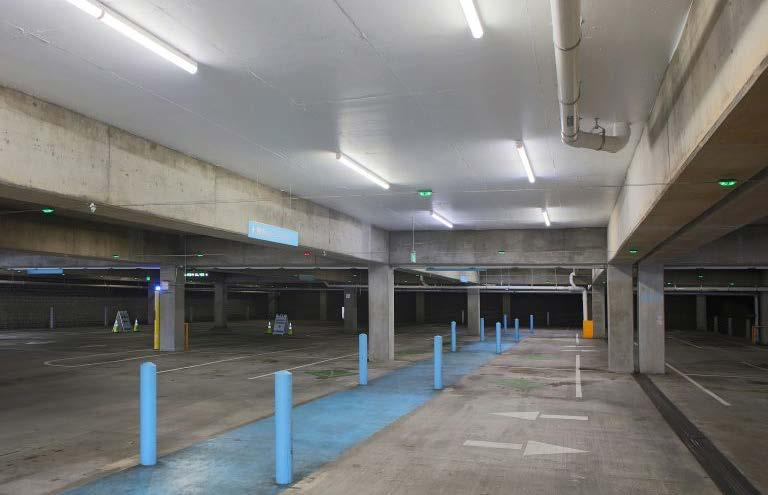
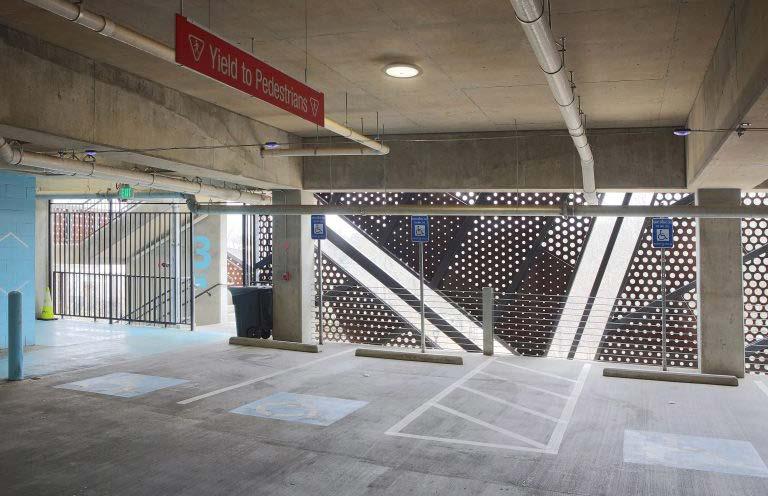
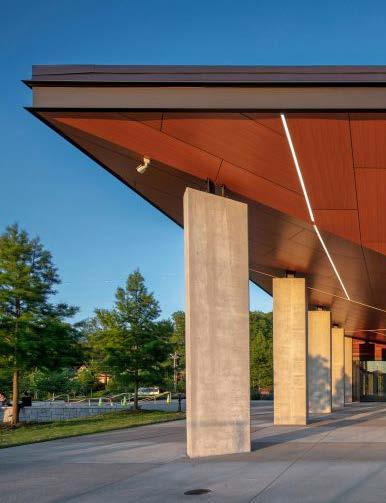
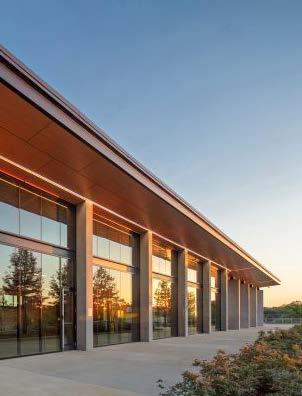
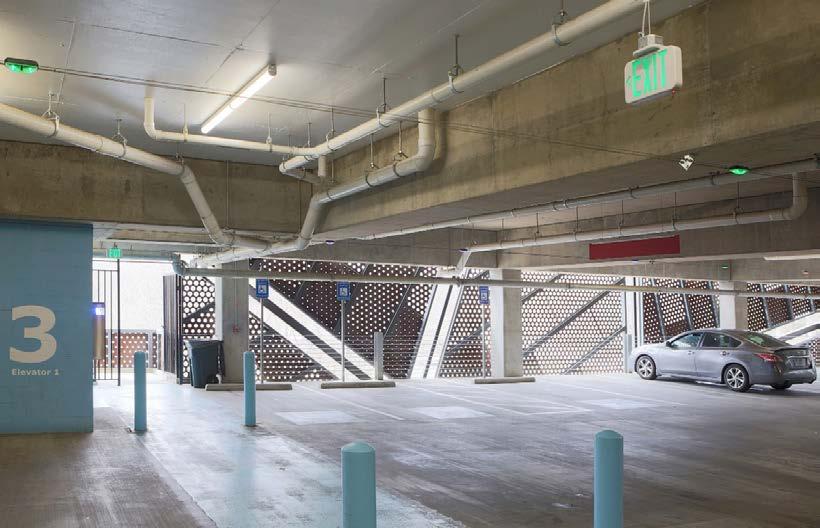
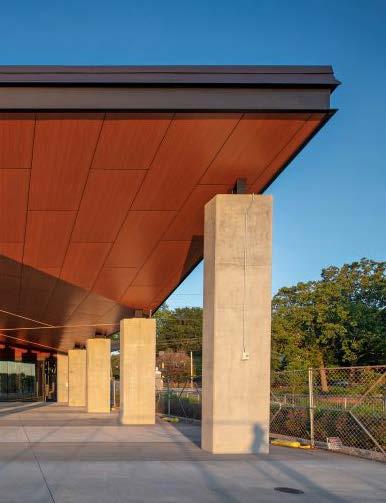
Can lighting turn a parking deck into a civic gateway, safely guiding pedestrians while letting the landscape-led architecture stay in control?
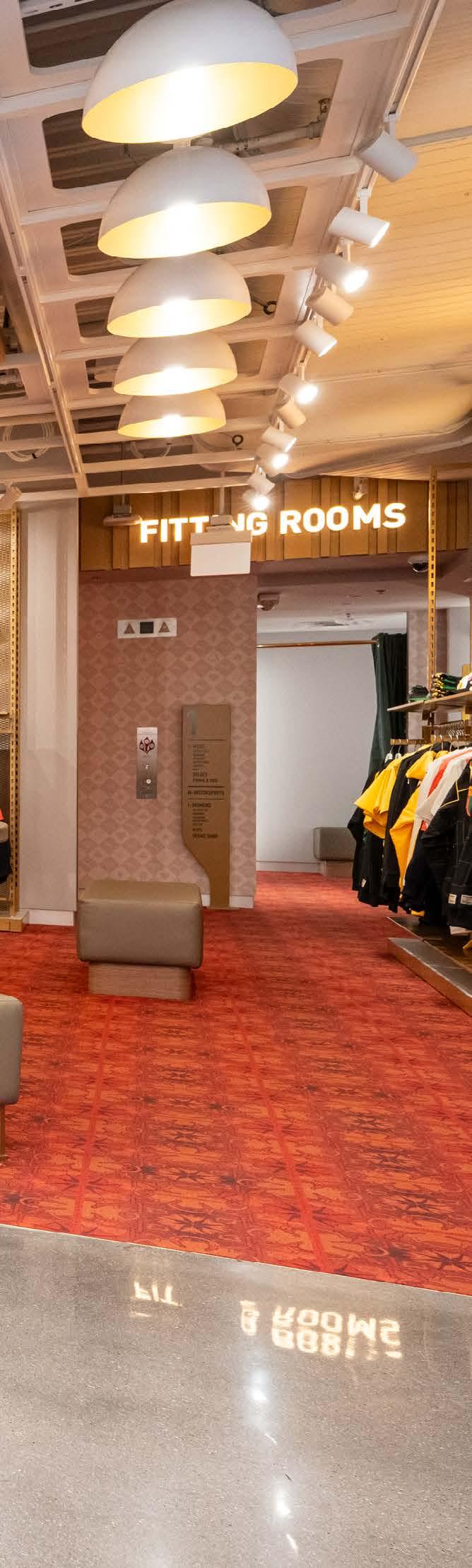
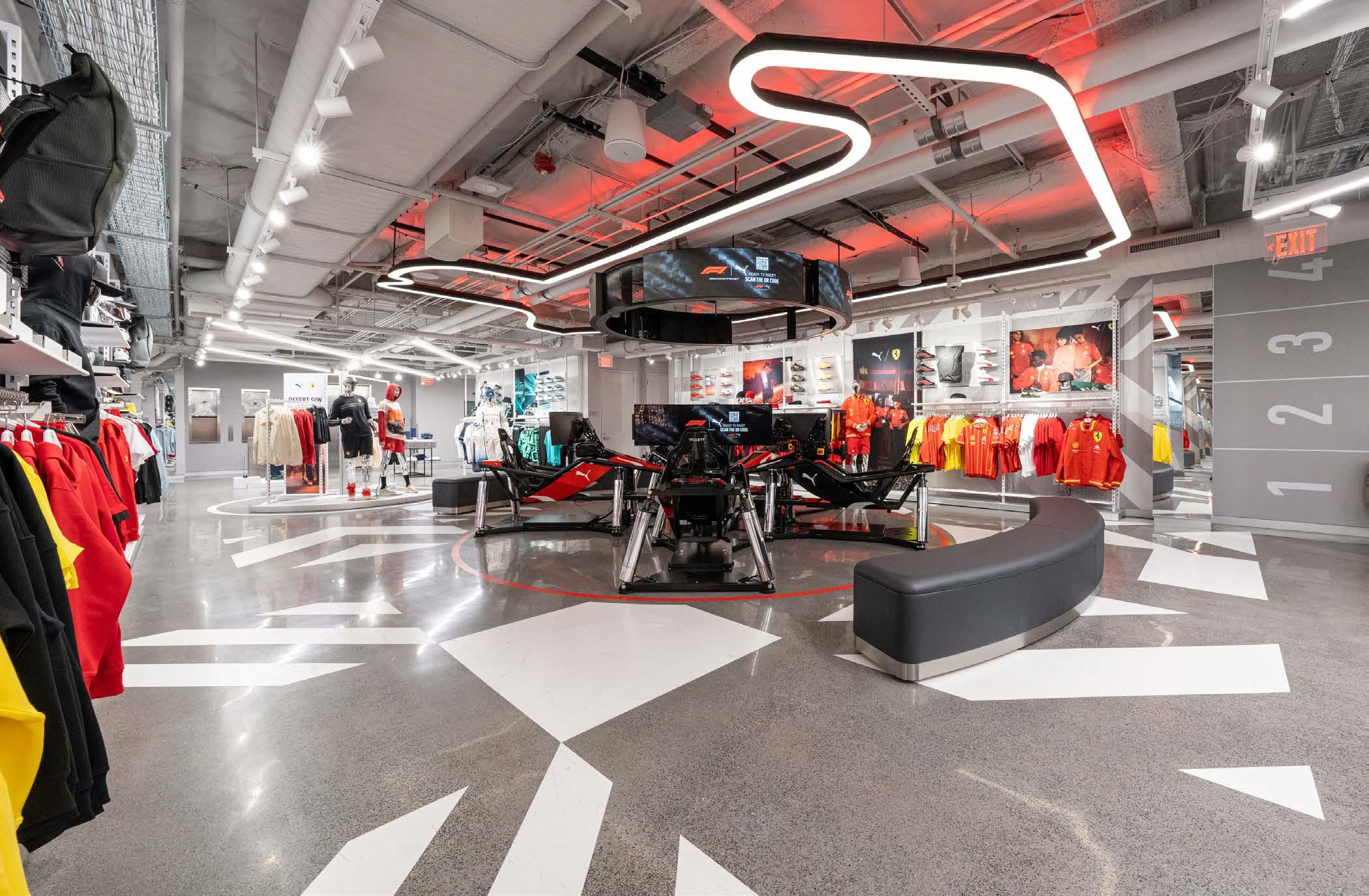
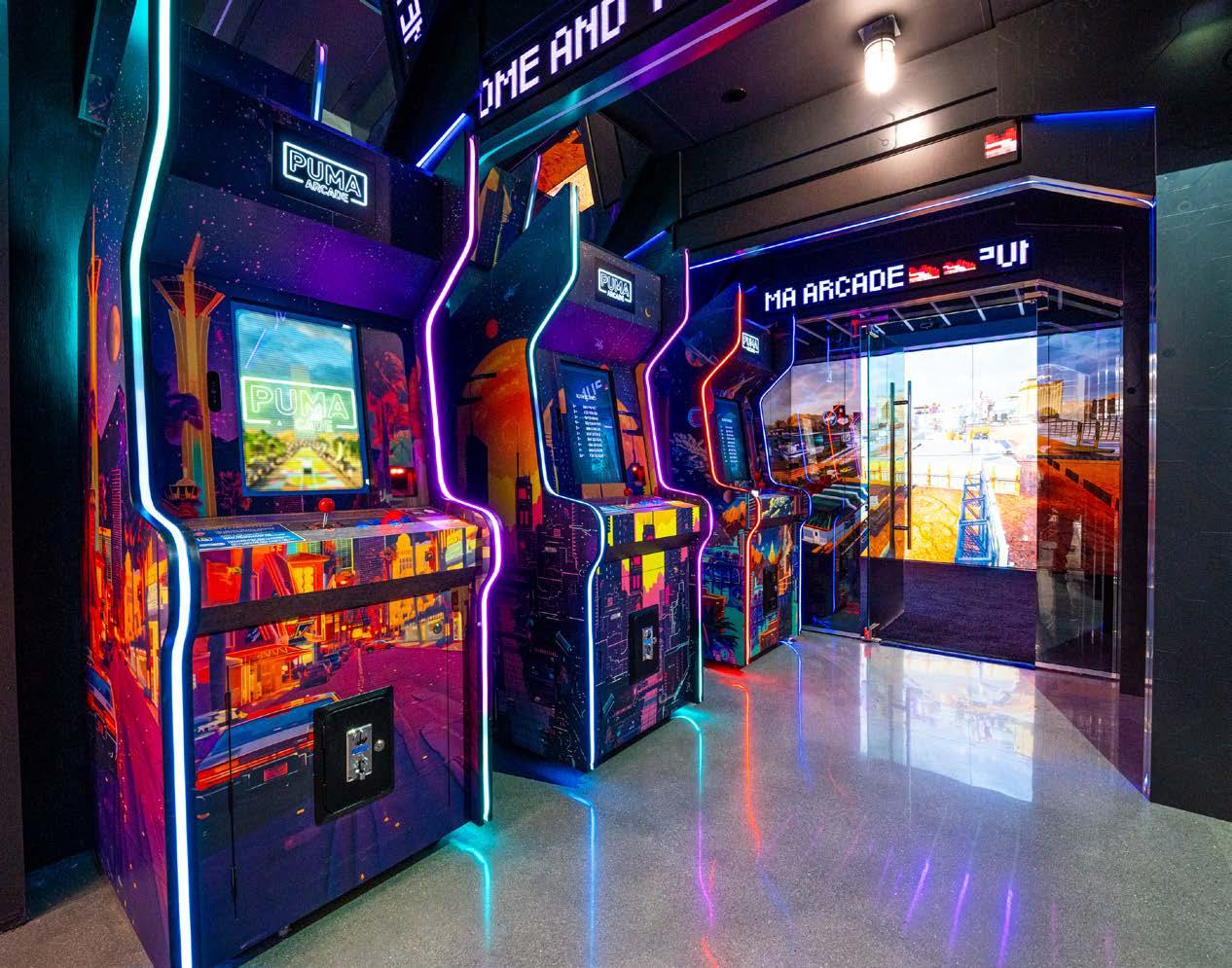
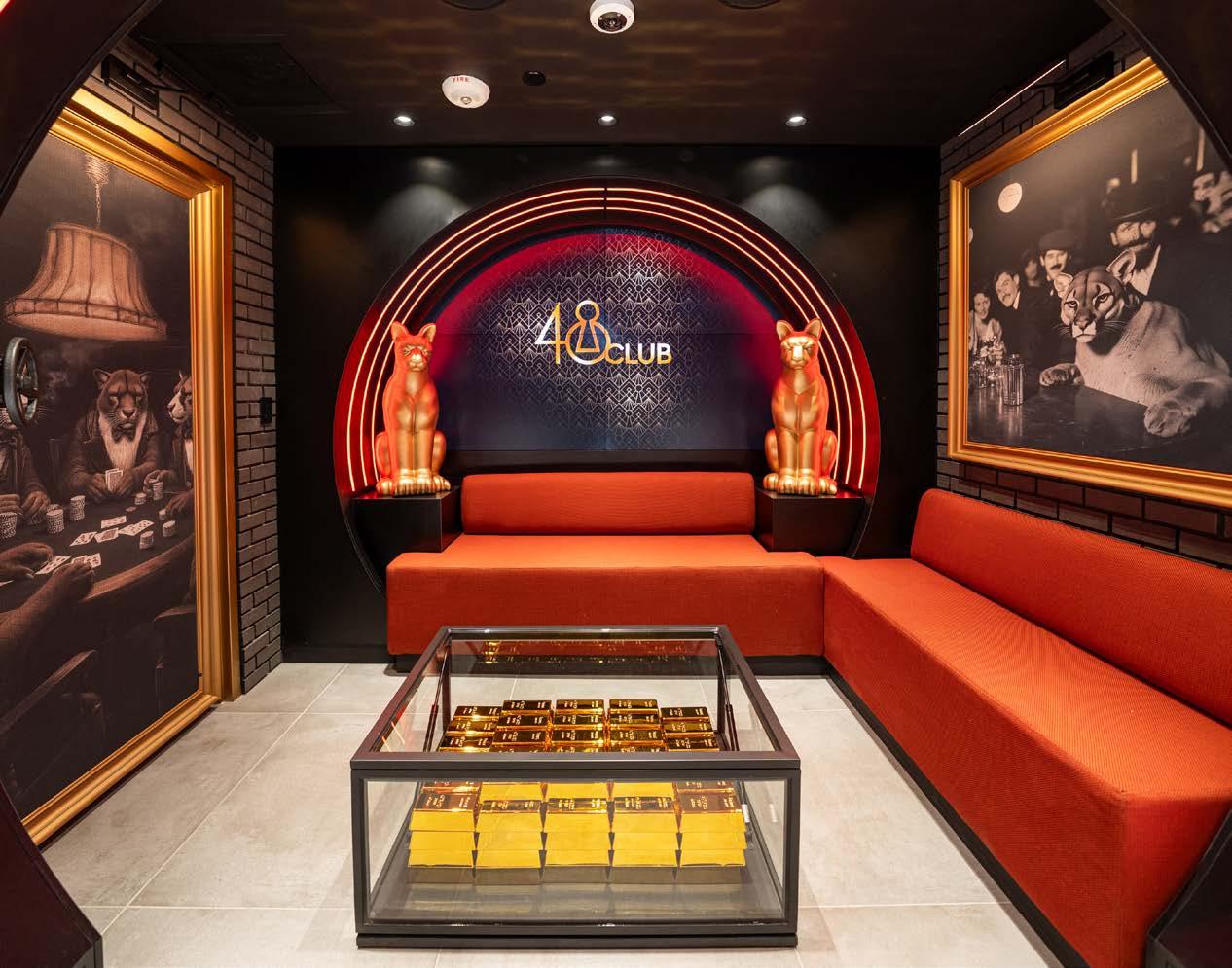
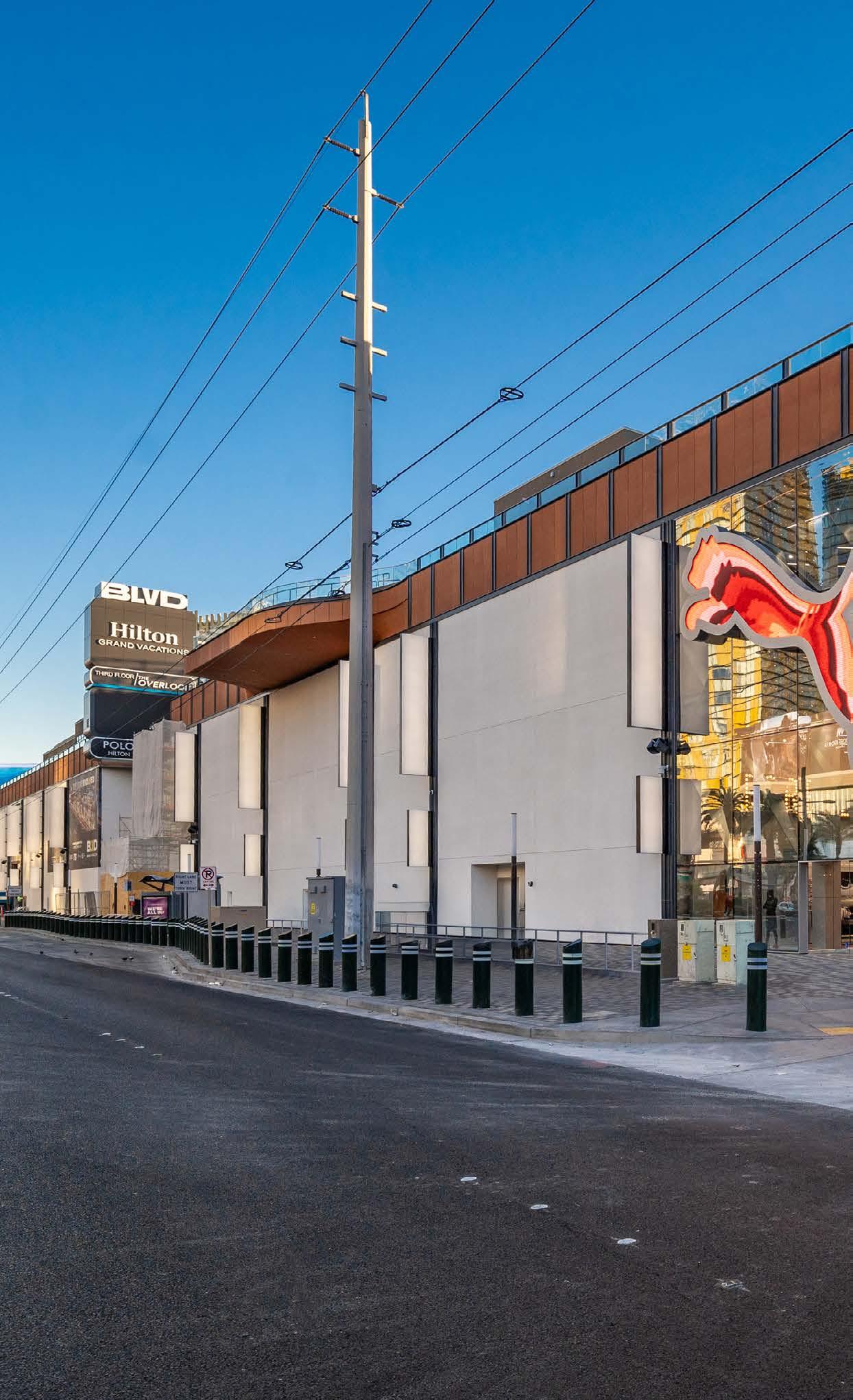
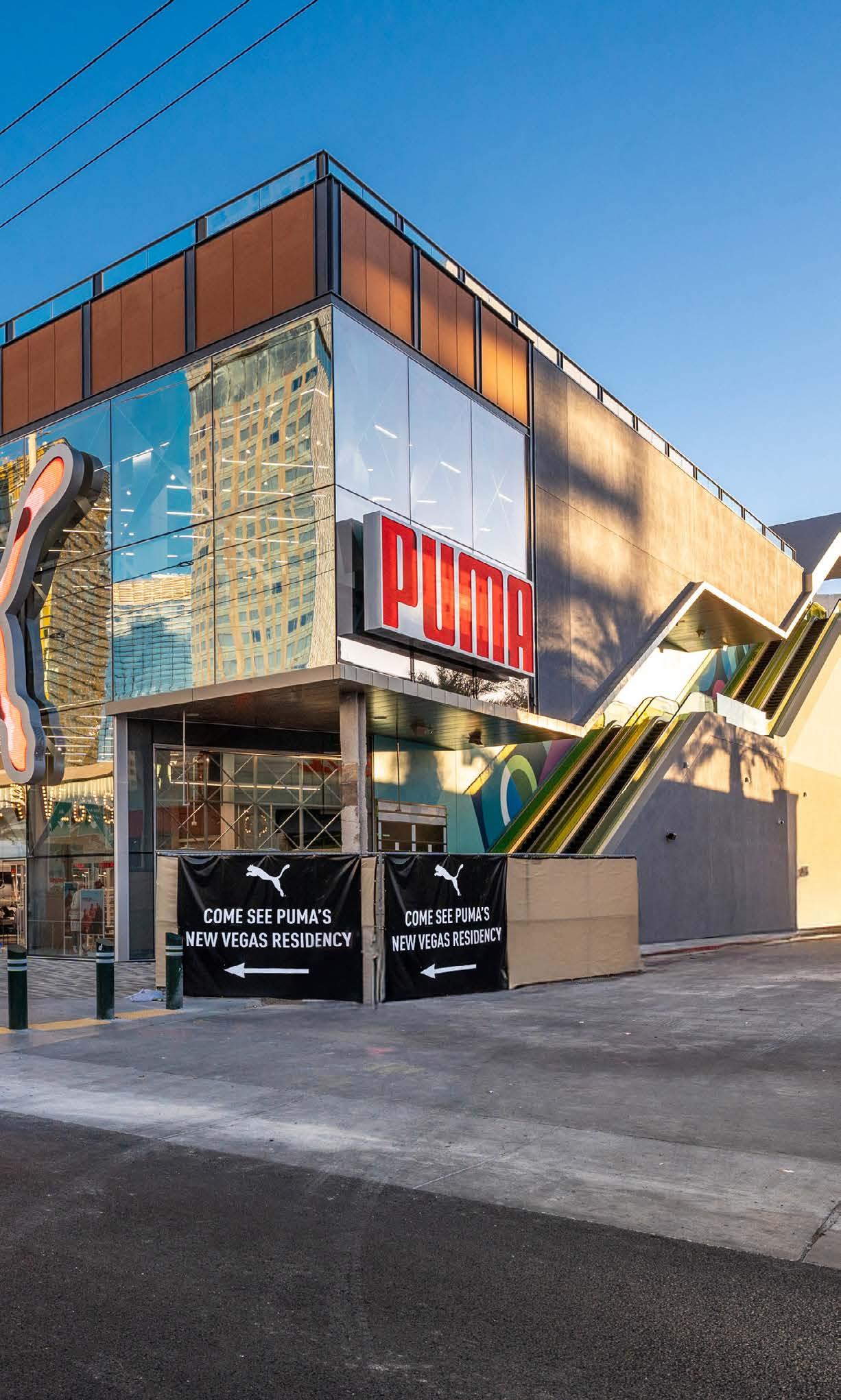
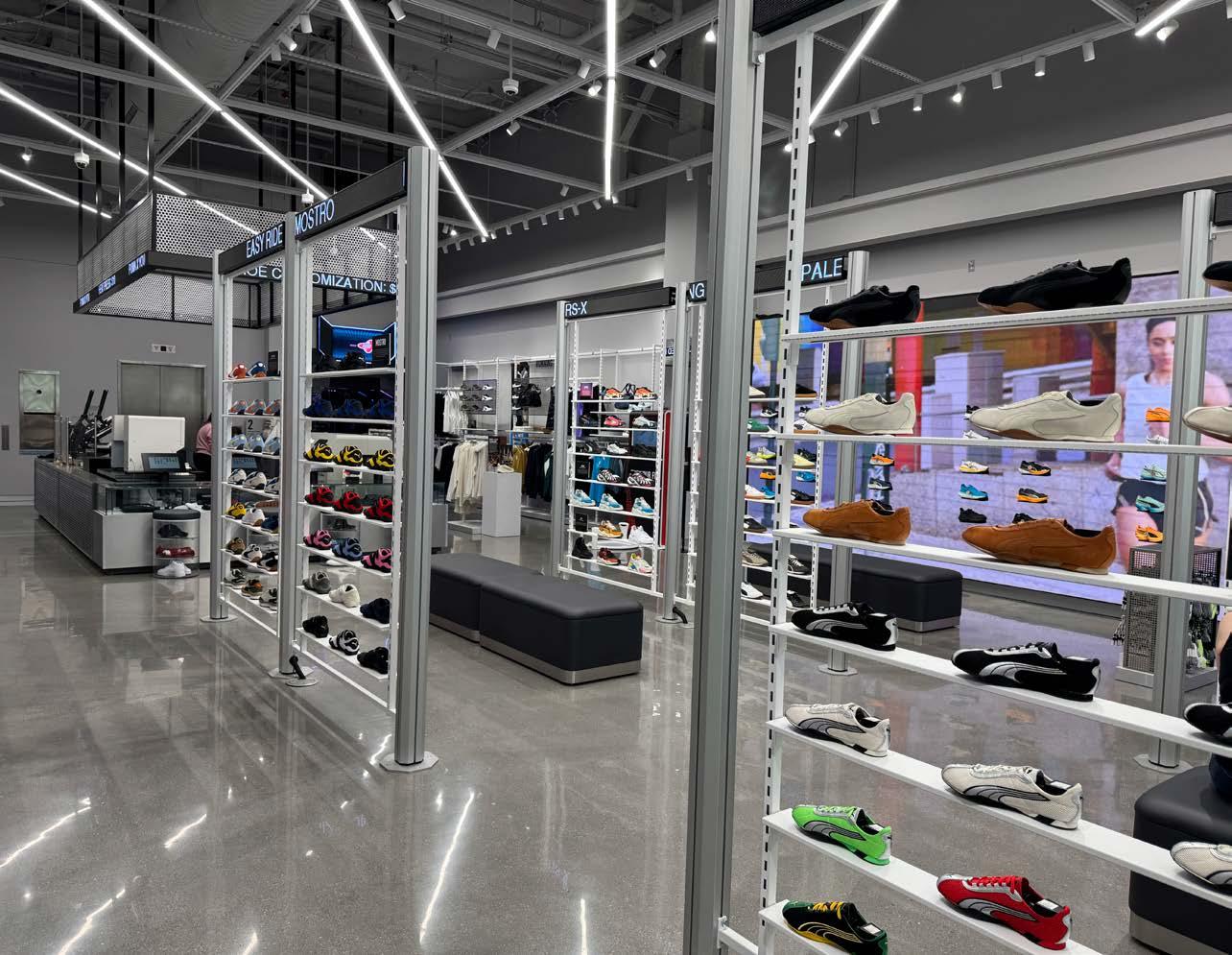
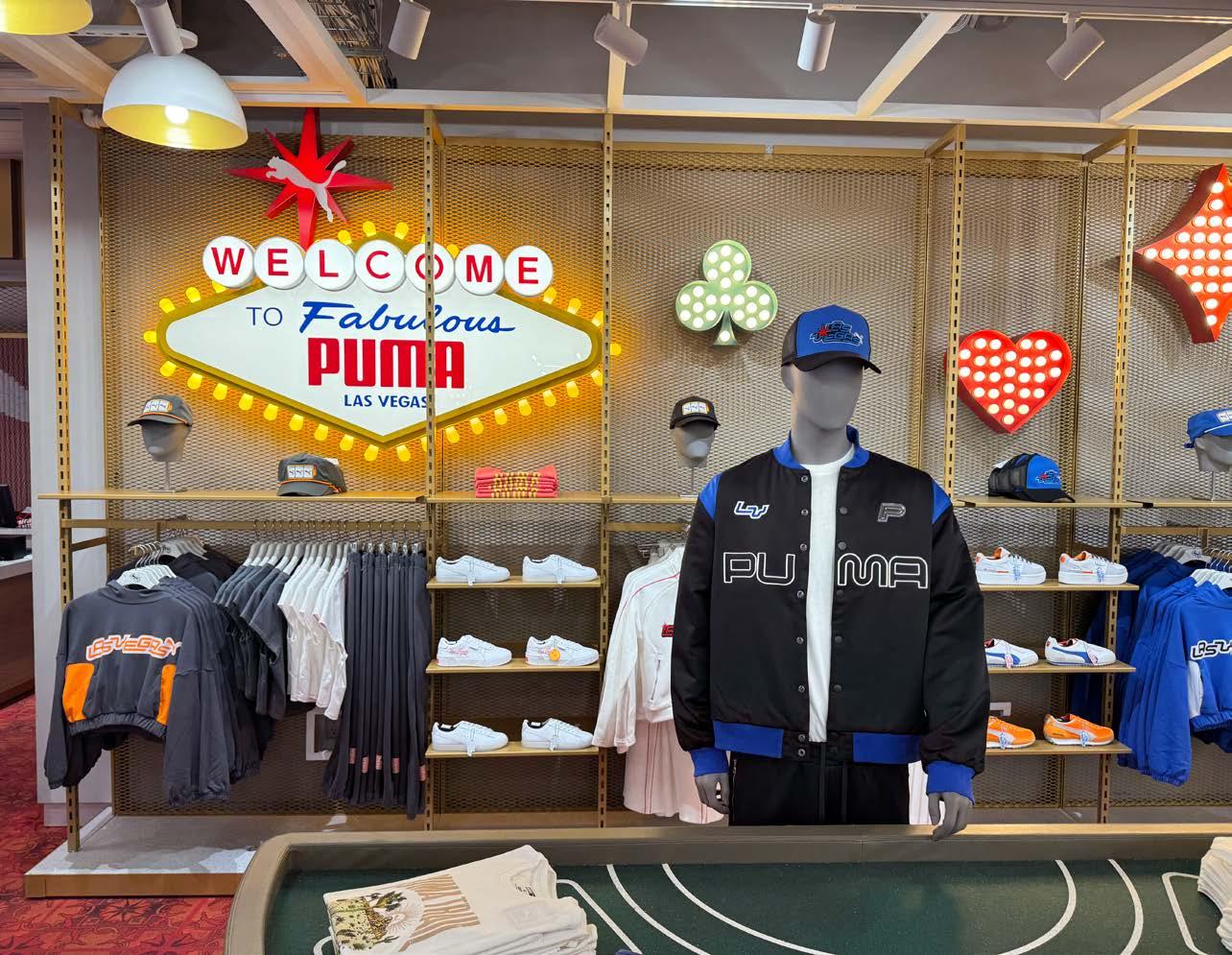
Puma Las Vegas Is a Radiant Winner
By Vilma Barr
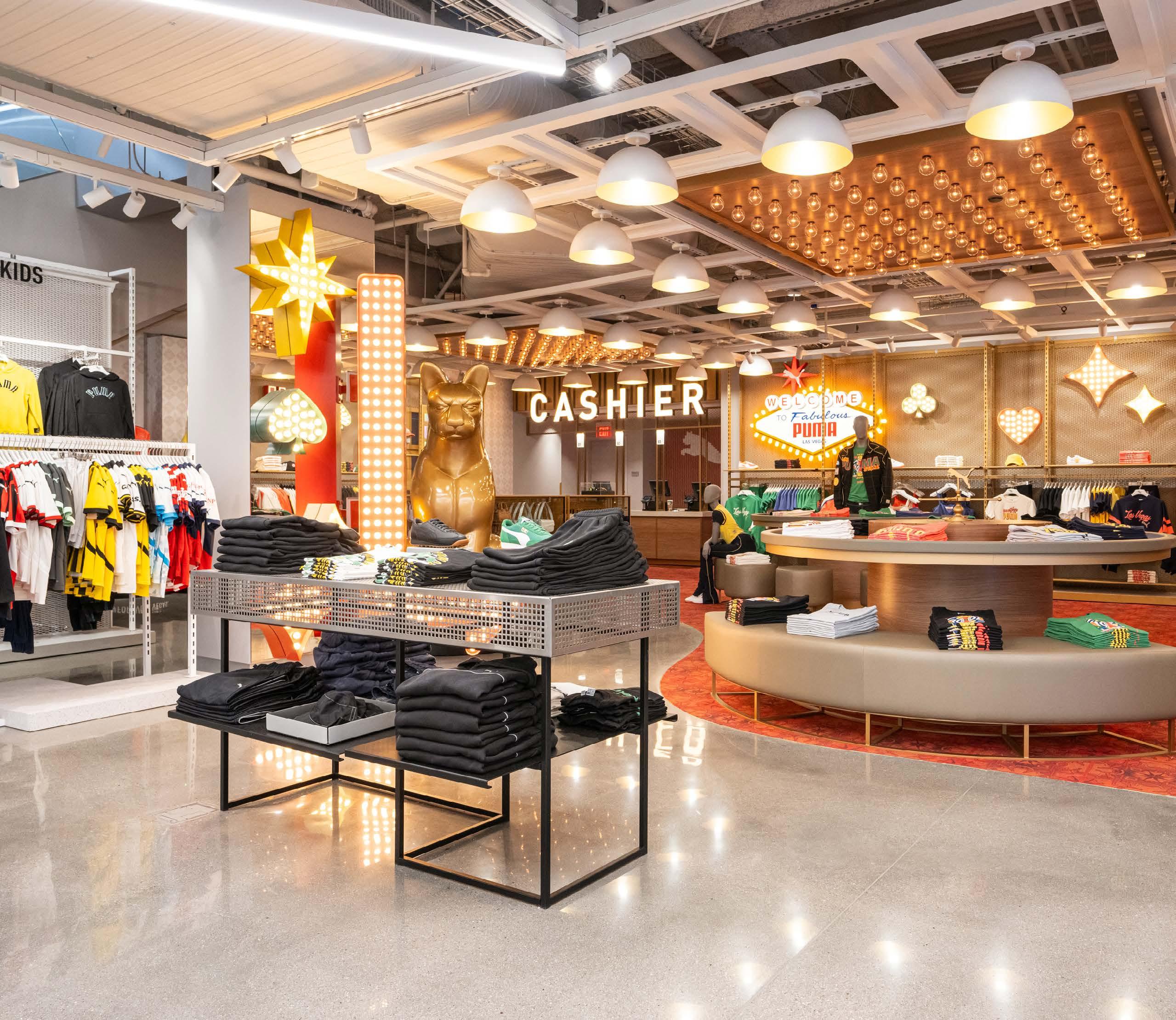
The brand’s new flagship goes bold, with custom LED moments, interactive energy, and retail lighting designed to perform. Residential
The Art of Lighting Art
By Stacie Dinwiddy, CLD, IALD, LC, LEED BD+C
Some private art collections rival those of museums. How do you get museumquality art lighting at home? It starts with preservation, precise aiming, and careful commissioning.
Rep’s Perspective
How Lighting Reps Will Improve the Use of AI in
Lighting
By John Lawlor
As the industry tries to navigate artificial intelligence, reps might be the key to ensuring AI is integrated into the process effectively.
Megan Carroll Joins an Evolving IES
Description Megan Carroll has long been a steady force in lighting education and standards. Now, she joins IES to help set the direction forward.
Advertisers’ Index
When Integration Becomes Design: Why Lighting’s Future Runs Through the Integrator
As lighting merges with shades, audio, and HVAC, are integrators becoming the new guardians of design intent?
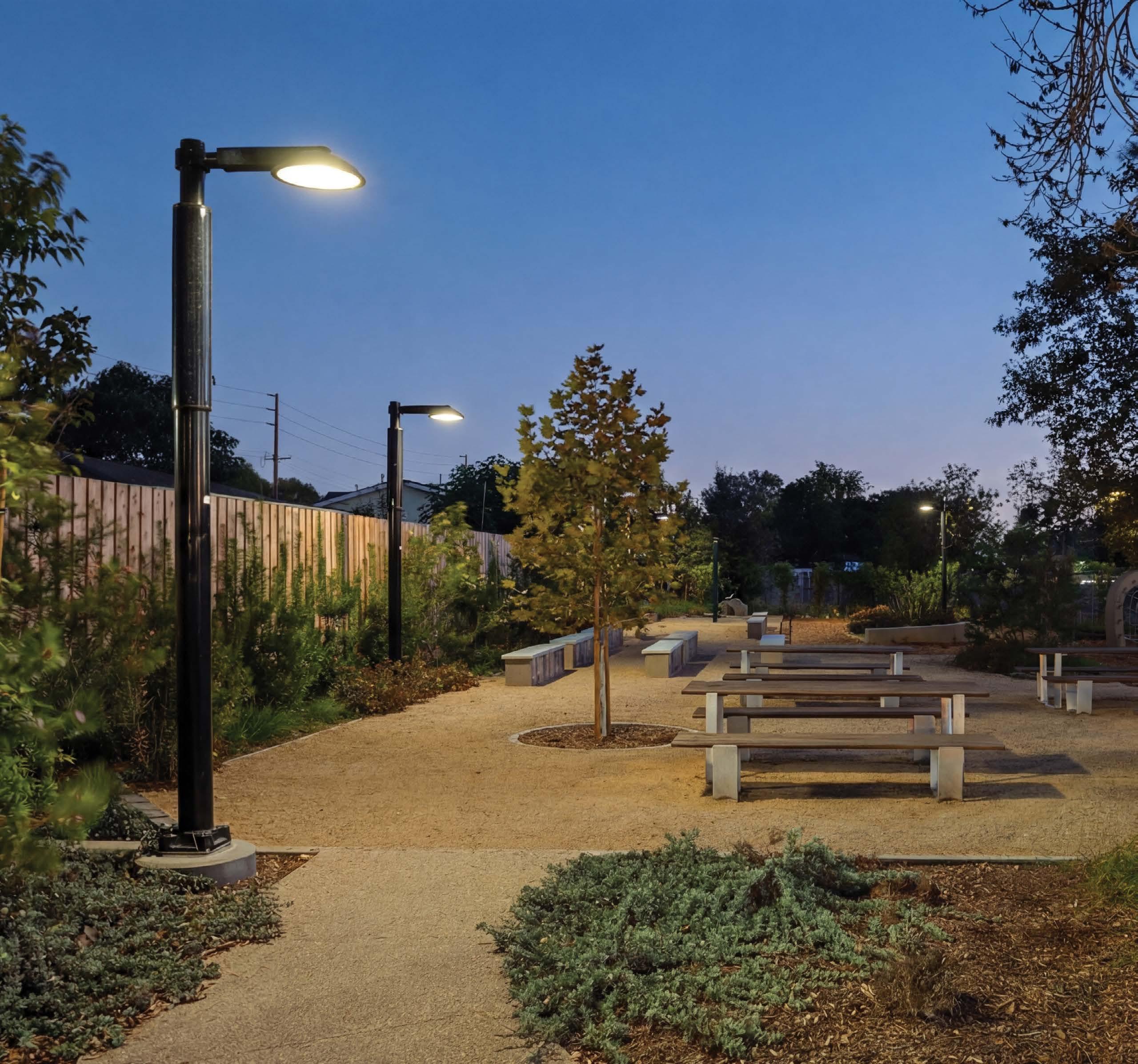
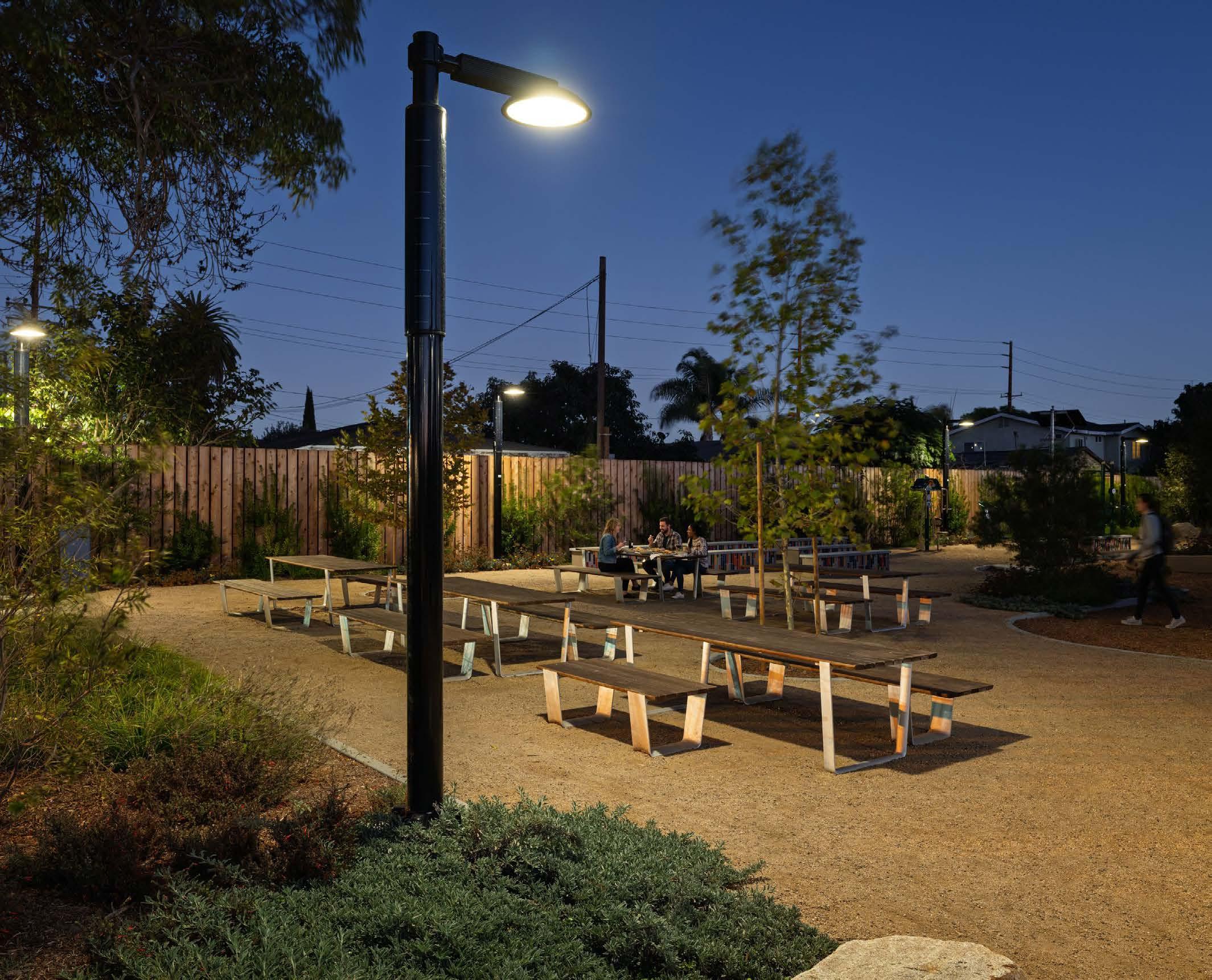
At Alondra Gateway Park, LEO 360 Solar Area Lights illuminate a new community space along Compton Creek, bringing warmth and off-grid lighting. Designed by Studio-MLA, the park transforms a vacant lot into a welcoming hub that shows how light sparks connection and renewal.
Alondra Gateway Park | Compton, CA
LEO 360 Solar Area Lights
Landscape Forms | A Modern Craft Manufacturer
Elvis Has Left the Building
Editorial Director: Randy Reid
Publisher: Cliff Smith
Contributing Writers:
Shirley Coyle
Lead Contributing Editor
President, Cree Lighting Canada
I first met Jim Benya when I was serving as a Regional Director on the IES Board of Directors, sometime in the 1990s. Jim came before the Board to make the case for funding a newly created program, the NCQLP and what would eventually become the Lighting Certification (LC). His argument was simple, direct, and impossible to forget.
Principal, RELEVANT LIGHT Consulting Inc.
Vilma Barr
Contributing Editor
James Benya PE, FIES, FIALD Benya's Art & Science Contributor
Staff Writers: Parker Allen Bridget Leary
Published by EdisonReport
1726C General George Patton Dr. Brentwood, TN 37027
Phone: 615-371-0961
designinglighting.com
designing lighting is focused on the Business of Lighting Design™ and provides business information to the lighting design community. In addition to the website, designing lighting publishes bi-monthly online magazines featuring original content, interviews within the community and highlights successful award winning lighting designs. While designing lighting is based in the U.S., it has contributors from Europe and is developing a global presence. ISSN: 3066-9111.
Statements and opinions expressed in articles and editorials in dl are the expressions of contributors and do not necessarily represent the policies or opinions of the EdisonReport. Advertisements appearing in the publication are the sole responsibility of the advertiser.
Jim pointed out that to cut hair, a person needed a license, yet anyone could call themselves a lighting designer. There was no universal benchmark, no credential that signaled a baseline of knowledge or competence. The LC, he argued, would not define talent or creativity, but it would establish qualifications. It would say something meaningful about commitment to the profession.
The IES was flush with money in those days, and we invested heavily in the LC program. History has proven that to be a consequential decision for the profession—and Jim was at the center of it.
Our December issue of designing lighting (dl) was the first edition that did not include Jim Benya’s long-running Art & Science column. That absence did not go unnoticed. We received a steady stream of emails asking the same question: Where is Jim?
The answer is both simple and significant. Jim has officially retired.
He and Deborah have moved to North Carolina. Jim has spoken about retirement for a long time, and now the moment has arrived. By all accounts, they are doing great—settled, happy, and enjoying a wellearned new chapter.
That reality prompted a larger question on our end: how do you properly honor someone like Jim Benya?
Jim already received an EdisonReport Lifetime Achievement Award in 2021. Still, that felt incomplete. Jim’s influence is not just measured in programs launched, credentials established, or columns written. It lives in careers shaped, confidence built, and standards raised.
So, we landed on what feels like the most meaningful tribute possible— letting Jim hear directly from you.
If Jim Benya has impacted your career in a meaningful way, we invite you to share that story. Written comments are welcome, as are short video tributes. We will collect these throughout the month of March and then present them to Deborah and Jim as a collective thank-you from the community he helped build. Jim can decide if he wants to make any of them public.
If you would like to participate, please send your written comments to editor@designinglighting.com. If you prefer to submit a video, be sure to record it horizontally and send it to the same address.
Jim has given his life to this industry, and the industry is stronger because of it. Your tribute, whether a few sentences or a short video, is a small but meaningful way to say thank you.
Elvis may have left the building, but the music is still playing. ■
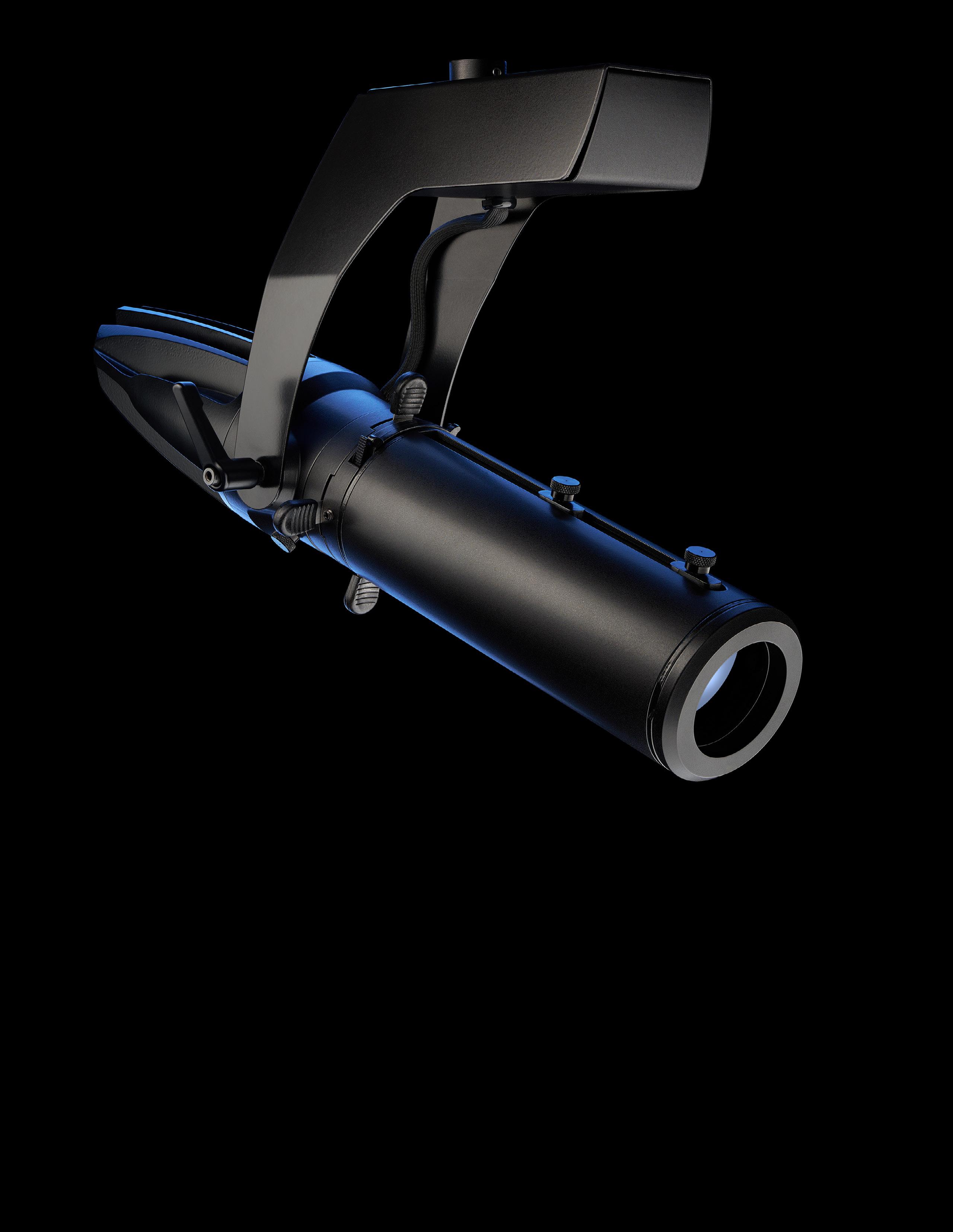
Wide Beam Lens: 30º to 50º 25,000+ CBCP, Up to 3180 Lumens, 38 Watts
The BPH Series sets a new standard as the brightest image projector in its class, delivering uncompromising optical performance in a sleek design. Powered by an advanced high-output LED, the BPH achieves an impressive 25,000+ CBCP at 38 watts.
Discover the full power of the BPH Series—visit our website or scan the QR code below.
Circadian-Effective Lighting and the Integrated Design Process
By
The integrated design process (IDP), variously known by a host of other terms like integrated building design or integrated project delivery, is a collaborative approach to building design and construction that considers the entire building and its systems. The IDP employs a multidisciplinary team that shepherds a building project from beginning to end with the aim of achieving optimal outcomes for the client and, ultimately, for the occupants of the new building. The role of IDP in building design and construction has grown
over the past 25 years, spurred by the increasing interest in green (or sustainable) building design. Actively encouraged in green building projects, the IDP has shown tangible benefits including improved construction quality, lower costs, reduced construction delays, better environmental performance, and overall improved value for the client. 1 A critical linchpin in a successful IDP team has proven to be a skillful leader who can effectively facilitate continuous interaction and communication among team members from inception to completion.
DANIEL FRERING AND DAVID PEDLER Light and Health Research Center at Mount Sinai
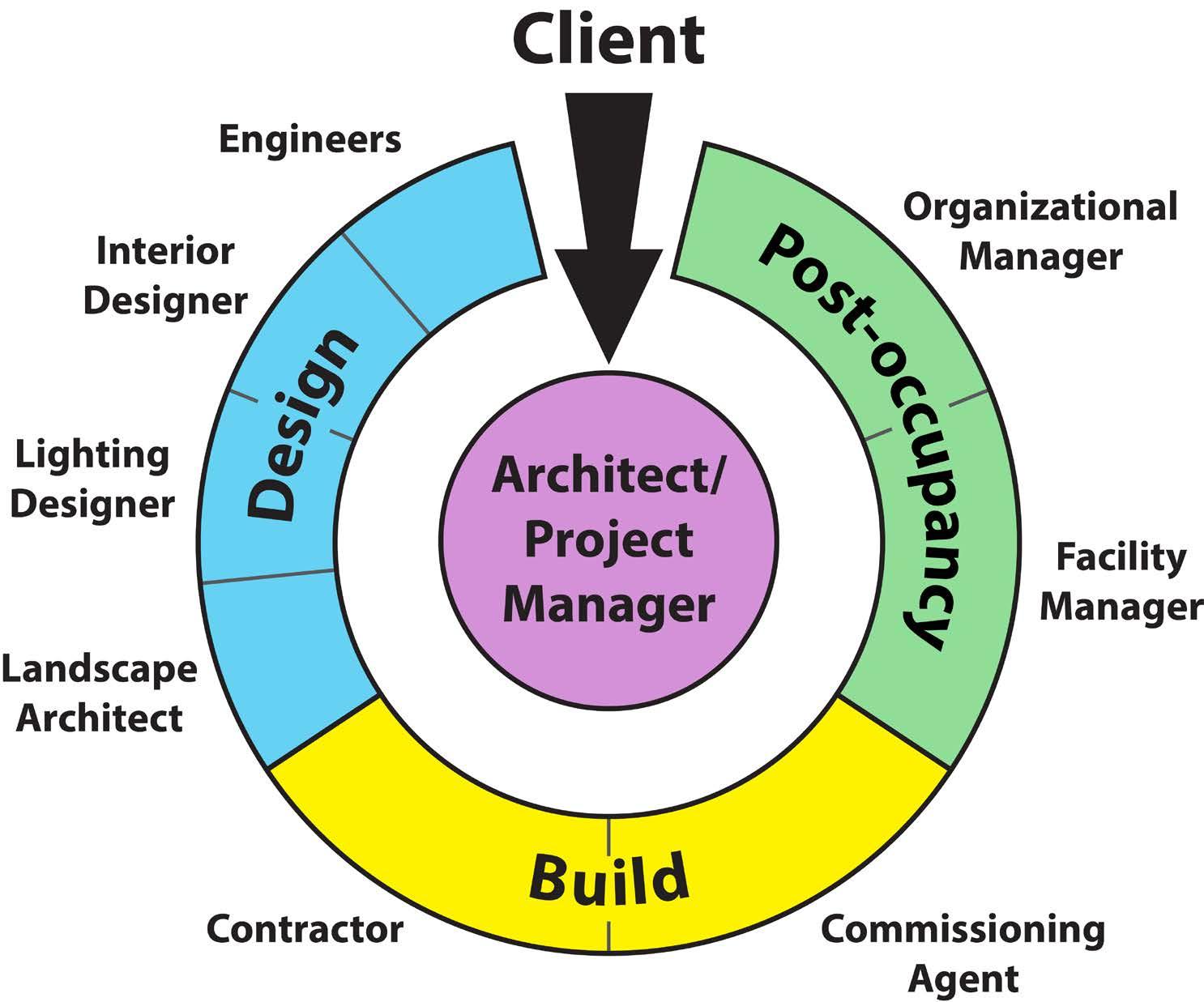
Figure 1. The integrated design process, summarizing the three project phases and team members involved in the design and implementation of circadian-effective lighting.
Closer to the theme of this article, a collaborative IDP can also benefit the development and installation of a circadianeffective lighting design (Figure 1) which, as mentioned in our research team’s December 2025 contribution to designing lighting, lies at the core of the LHRC’s mission. Briefly, our research into light’s effects on the circadian system has shown that receiving a circadian stimulus (or CS, a broadly accepted measure of circadian effectiveness 2,3) of at least 0.3 (or about 400 lx of white light) at the eye for at least 2 hours per day synchronizes our body’s physiological and behavioral functions, leading to positive outcomes for nighttime sleep, daytime alertness, and mood, and perhaps even easing symptoms and lowering the risk of serious illnesses in various populations, including office workers. 4,5
Along with an effective leader, it is also important that every design team member fully understands their role to ensure the completed building is optimized for circadian effectiveness. In other words, they must be conversant in the fundamentals of circadian-effective lighting design and foster an awareness of how their decisions might impact the circadian effectiveness of the final building design. The LHRC’s various other contributions in designing lighting have extensively discussed circadian system fundamentals and lighting design/implementation, and we encourage interested readers to consult those articles. The purpose of this contribution is to briefly discuss the conclusions we have drawn from our extensive field work in the circadianeffective lighted environment, and review how each IDP team member’s decisions affect circadian-effective lighting design outcomes.
Leadership and communication
In a multidisciplinary, integrated design team, it is of utmost importance to identify an effective project manager who will (1) lead and coordinate the team’s work on the project from beginning to end and (2) facilitate effective communication among team members and the client. Sufficient resources must be allotted in the project budget to cover the time required for this level of project coordination. In addition to guiding the efforts of team members, the project manager must convey a solid understanding of circadian-effective lighting and its value for human health to the team members, the client, the building managers, and ultimately the building’s occupants. In most building projects, the project manager is the architect, an associate of the architect, or someone who works directly for the client.
Core team integration for successful circadian-effective lighting
The design and implementation of circadian-effective lighting involves integrating the efforts of every team member (see Figure 1) within and between three project phases.
In the project’s design phase, the core circadian-effective lighting team members include the architect, the lighting designer, and the interior designer. The architect is primarily responsible for daylighting design, which can greatly impact the amount of circadian-effective light available for building occupants by considering factors such as the building’s configuration, siting, and orientation (particularly in the case
of new construction) as well as fenestration and finishes to ensure building occupants are provided with plenty of daylight while minimizing discomfort from excessive heat gain and glare (Figure 2).
The lighting designer, also in this phase, provides the basic blueprint for the circadian-effective lighting system by:
1. Coordinating daylighting, ambient electric lighting, and localized work-station-integrated or portable electrical lighting solutions;
2. Analyzing the lighting needs of occupants in each area of the building;
3. Developing computational models of the lighting in the space for those occupant needs, accounting for daylight, electric lighting contributions, and the spectral characteristics of all available light, as well as related characteristics like surface reflectance values and furniture (fixtures, placement, and finishes) among others;
4. Working with the electrical engineer to coordinate lighting control selection, placement, and configuration; and
5. Remaining involved throughout the project until commissioning.
In this phase, the interior designer is the team member primarily responsible for furniture selection and placement, selection of colors and finishes for each space, and the selection of window covers. Because all these decisions will impact the circadian effectiveness of the final design, it is
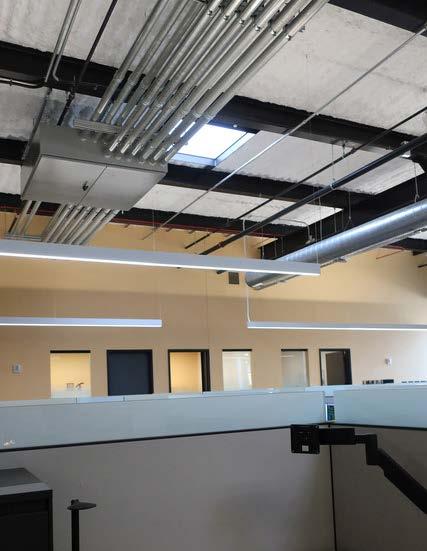
Figure 2. Electrical conduit blocking a skylight in a new office building (upper left quadrant of image). The skylight’s location was determined by the architect, who was unaware of the later addition of the conduit by the electrical engineer.
critical that these decisions be made collaboratively with the lighting designer to ensure a successful outcome.
In the project’s building phase, the builder/contractor is the IDP team member with the greatest impact on the success of the circadian-effective lighting design, ensuring that the core team members’ decisions are implemented as planned. At this point, the builder must communicate with the team leader (e.g., architect or project manager) about any changes that might affect the circadian-effective lighting design, such as lighting, lighting controls, glazing product substitutions, and changes to building configuration or interior finishes (see Figure 2).
The commissioning agent is key to ensuring that all electric lighting and lighting controls are set up and commissioned to provide the amount, duration, and timing of light specified throughout the design phase.
In the building’s post-occupancy phase, it is crucial for those who oversee the operation of the building’s systems, those who manage the employees, and the employees themselves to understand and value the circadian-effective lighting, be proficient in its operation, and be acutely aware of how their decisions and actions impact the lighting’s effectiveness.
Specifically, the Facility Managers must see that lighting and control system settings are maintained as designed. The operational managers should be prepared to explain and reinforce the importance of circadian-effective lighting and how daylighting, ambient electric lighting, lighting controls, and localized lighting work together to provide a circadian-effective lighted environment for all. And finally, the employee occupants must understand how their interactions with window blinds, lighting controls, and other lighting system features will influence the circadian effectiveness of the lighted environment for the benefit of their colleagues and themselves (Figure 3).
Other circadian-effective lighting design decisions
A common misconception is that architectural lighting alone is responsible for the circadian effectiveness of a building’s lighted environment. But other factors relating to light and lighting also have roles to play for ensuring the health, wellbeing, and visual performance of building occupants. Due to its broad spectrum and the sheer amount of available light from well-designed windows and skylights, daylight
is an important contributor to an energy-efficient circadianeffective lighting design.
While the ambient lighting system serves as a base layer of light that contributes significantly to a lighting design’s circadian effectiveness, local electric lighting can be used to mitigate constraints imposed by energy codes (lighting power density) and light distribution limitations that can often make it difficult to deliver circadian-effective light from ceiling-mounted, ambient lighting fixtures alone. It is therefore always important to consider local, portable, or furniture-integrated electric lighting solutions that move the light closer to the eyes of the occupants.
Circadian-effective lighting is not just about the amount of light, but also the time of day that the light is provided and the duration for which it is provided. Lighting controls can ensure that circadian-effective light is delivered at the right time, for the correct duration, and in the correct amount for circadian effectives and energy efficiency.
Finally, the selection and placement of furniture and the colors and finishes of surfaces have an important influence on how much daylight and electric lighting reaches the occupants’ eyes, which again are the primary input of the human circadian system.
Think beyond the ceiling
An often-repeated mantra about circadian-effective lighting design is “think beyond the ceiling.” The only way to do this successfully is through an integrated design approach. All members of the team must buy into the importance of circadian-effective lighting, understand the impacts their individual design decisions have on its realization, and champion its benefits to the health and well-being of building occupants. It is also important that this commitment to circadian-effective lighting be shared by all team members from the project’s inception. It cannot be an afterthought introduced in a later phase. Integrated design is truly the means to a brighter future in building construction, and nowhere does it play a more important role than in circadianeffective lighting design. ■
References
1 Li Z, Tian M, Zhu X, Xie S, He X. A review of integrated design process for building climate responsiveness. Energies. 2022;15(19):7133. doi:10.3390/ en15197133
2 Rea MS, Nagare R, Figueiro MG. Modeling circadian phototransduction: Retinal neurophysiology and neuroanatomy. Frontiers in Neuroscience 2021;14:10.3389/fnins.2020.615305. doi:10.3389/fnins.2020.615305
3 Rea MS, Nagare R, Figueiro MG. Modeling circadian phototransduction: Quantitative predictions of psychophysical data. Frontiers in Neuroscience 2021;15:10.3389/fnins.2021.615322. doi:10.3389/fnins.2021.615322
4 Figueiro MG, Steverson B, Heerwagen J, et al. The impact of daytime light exposures on sleep and mood in office workers. Sleep Health. 2017;3(3):204215. doi:10.1016/j.sleh.2017.03.005
5 Figueiro MG, Kalsher M, Steverson BC, Heerwagen J, Kampschroer K, Rea MS. Circadian-effective light and its impact on alertness in office workers. Lighting Research and Technology. 2019;51(2):171-183. doi:10.1177/1477153517750006
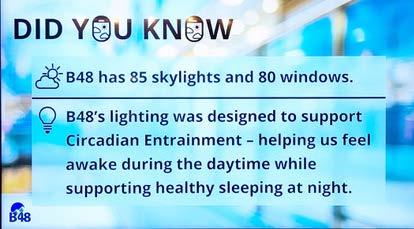
Figure 3. A video display explaining how the office building’s daylight and electric lighting supports circadian entrainment.
Tesis
Change light distributions on site
Benefit from greater planning reliability. Our directional spotlights with interchangeable lenses allow you to change the light distribution on site. This means you can react to unforeseen events at any time.
The LED Dilemma: Rethinking Maintainability in an Era of Disposable Luminaires
The lighting industry’s first generation of LED luminaires promised longevity, efficiency, and reduced maintenance. Many of those fixtures are now failing—and the industry is confronting an uncomfortable truth. Too often, they cannot be repaired, upgraded, or economically maintained. Instead, entire luminaires are replaced, generating waste, inflating lifecycle costs, and undermining sustainability goals.
That tension sat at the center of a timely webinar hosted on 5 February by the Illuminating Engineering Society. Titled The LED Dilemma: Rethinking LED Sustainability, the session brought together two respected voices in architectural lighting to reframe the conversation—away from efficiency alone and toward maintainability as a shared industry responsibility.
The presenters were Rachel Fitzgerald, Senior Principal and Discipline Lead for Lighting at Stantec, and Anne Kustner Haser, President and Design Principal of AKLD Lighting Design. While both have long been advocates for sustainability, the discussion focused on a more pragmatic— and increasingly urgent—question: what happens when LED systems fail?
When Long Life Isn’t Really Long
Rachel opened by addressing a growing disconnect between how LED products are marketed and how they perform over time. Integrated LED luminaires were often sold as long-life systems, yet many lack clear paths for repair.
Owner manuals may list part numbers or include QR codes. In theory, those tools should guide future maintenance. In practice, they often fall short. Tracking down compatible drivers or LED modules five, ten, or fifteen years later can be
parts that work with legacy systems.
That uncertainty places specifiers in a difficult position. Asking manufacturers to maintain inventory for decades requires space, systems, and accountability. It can also run counter to a business model built on selling replacement fixtures. Yet replacing entire luminaires, Rachel argued, is not the right solution—financially or environmentally.
At the same time, technology continues to advance. Drivers shrink. Optics improve. New power strategies emerge. Supporting older platforms can slow innovation. Balancing progress with maintainability, she noted, is one of the industry’s central challenges.
Defining What “Maintainable” Means
Rather than prescribing a single solution, Rachel and Anne framed maintainability as a spectrum. In some products, the light source might be a replaceable LED chip. In others, it could be an LED module integrated with a heat sink. In still others, the light source may include the driver as part of a serviceable assembly.
The key is transparency and choice.
When specifiers compare two downlights—one with a replaceable module and one that requires full replacement— the difference matters. In hospitality or healthcare environments operating around the clock, a five-year replacement cycle can have enormous cost implications. Lifecycle cost analysis, not just first cost, becomes essential.
Rachel pointed out that maintainability can also represent opportunity. Manufacturers willing to support legacy
products create ongoing revenue streams, strengthen client relationships, and build reputations as long-term partners. Increasingly, designers are rewarding that behavior by prioritizing maintainable products in their specifications.
The Return of Attic Stock—and Education
One concept making a quiet comeback is component stock. Once common in conventional lighting, it lost relevance during the early LED era. Now it is returning with purpose.
Specifying spare drivers, LED modules, lenses, and optics at the outset allows owners to respond quickly to failures. Rachel described adding replacement components to a project budget and facing initial pushback—until the rationale was explained. Once clients understood the long-term savings and reduced disruption, the value became clear.
Education emerged as a recurring theme. Owners need to understand that LED systems do not last forever. Rated life does not mean perpetual operation. Replacement modules may cost $50 to $125, but that is far less expensive—and far more sustainable—than replacing an entire fixture.
The industry, Rachel argued, must do a better job helping clients plan and budget for maintenance from day one.
Labor, Logistics, and Real Costs
Anne expanded the conversation by addressing labor realities. Replacement cost is not limited to parts. Electrical labor is expensive and increasingly scarce. One analyst recently estimated the U.S. needs 500,000 additional electricians. In some markets, hourly rates now approach $300.
If maintenance can be handled by facility staff rather than licensed electricians, costs drop significantly. That makes ease of access, modularity, and clear documentation critical.
Anne emphasized the influence specifiers have in this process. Survey data shows manufacturers listen closely to specifiers. Clear expectations around maintainability— especially on high-quantity fixtures—can shift product development priorities.
What the Industry Needs Next
Both presenters were clear: maintainability must be easier to specify.
Today, most cut sheets offer little guidance. Is a fixture repairable? Which parts are replaceable? What is the expected driver life? Without that information, evaluating alternates becomes guesswork.
Anne outlined several practical needs:
• Driver life ratings and options for longer-life drivers
• Higher-quality OEM components
• Best-practice guidance, such as remote drivers or reduced drive currents
• Part numbers listed directly on spec sheets for LEDs, drivers, and optics
QR codes on products could allow maintenance staff to reorder parts instantly. Consistent form factors would also help. A four-inch downlight has existed for decades. Efficiency can improve without arbitrarily changing beam spreads or dimensions.
Looking ahead, Anne suggested the idea of a visible maintainability indicator—perhaps a simple “M” symbol— similar to IP or UL markings. Something that signals, at a glance, that a product was designed with repair in mind.
A Call to Collaborate
The webinar closed not with a prescription, but with a question: If not now, when?
Rachel and Anne made clear they do not have all the answers. That is why they are seeking broader engagement—through organizations like NEMA, UL, and the IES—to explore maintainability standards. Not parts standardization, but transparency standards. Documentation. QR codes. Spec-sheet clarity.
Participants were invited to contribute ideas via a QR code at the end of the session, reinforcing that this is only the beginning of the conversation.
The goal, they stressed, is simple. Lighting systems that can be maintained. Clients who understand what they are buying. And an industry that aligns sustainability with reality— designing products not just to perform on day one, but to endure.
For an industry built on illumination, the message was clear: it is time to shine a brighter light on maintainability.
A big thank you goes out to the IES for hosting such a thought-provoking discussion. ■
A Bridge Defined by Restraint
RANDY REID By Photos credit: Phat Quach, Domingo Gonzalez Associates
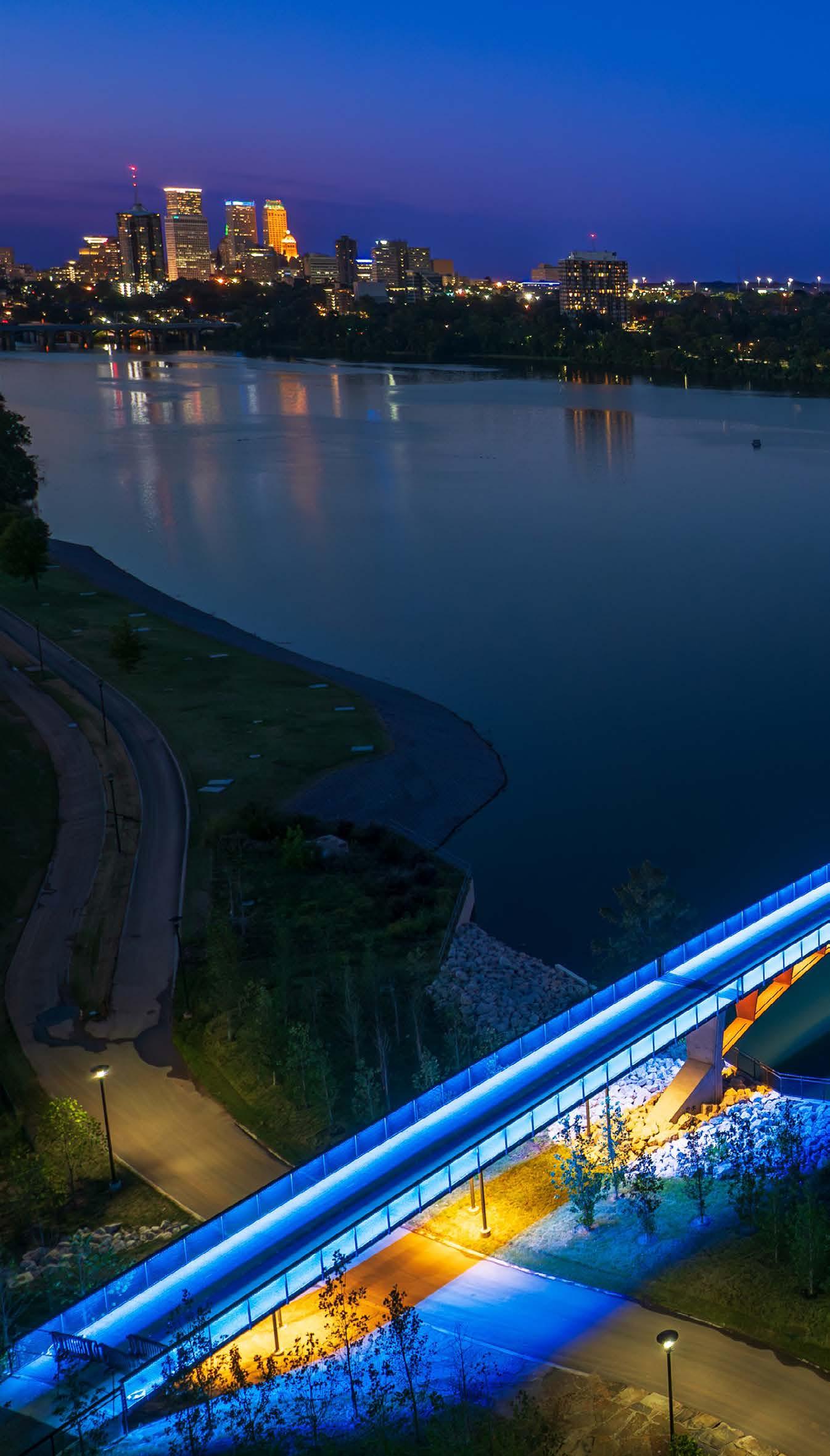
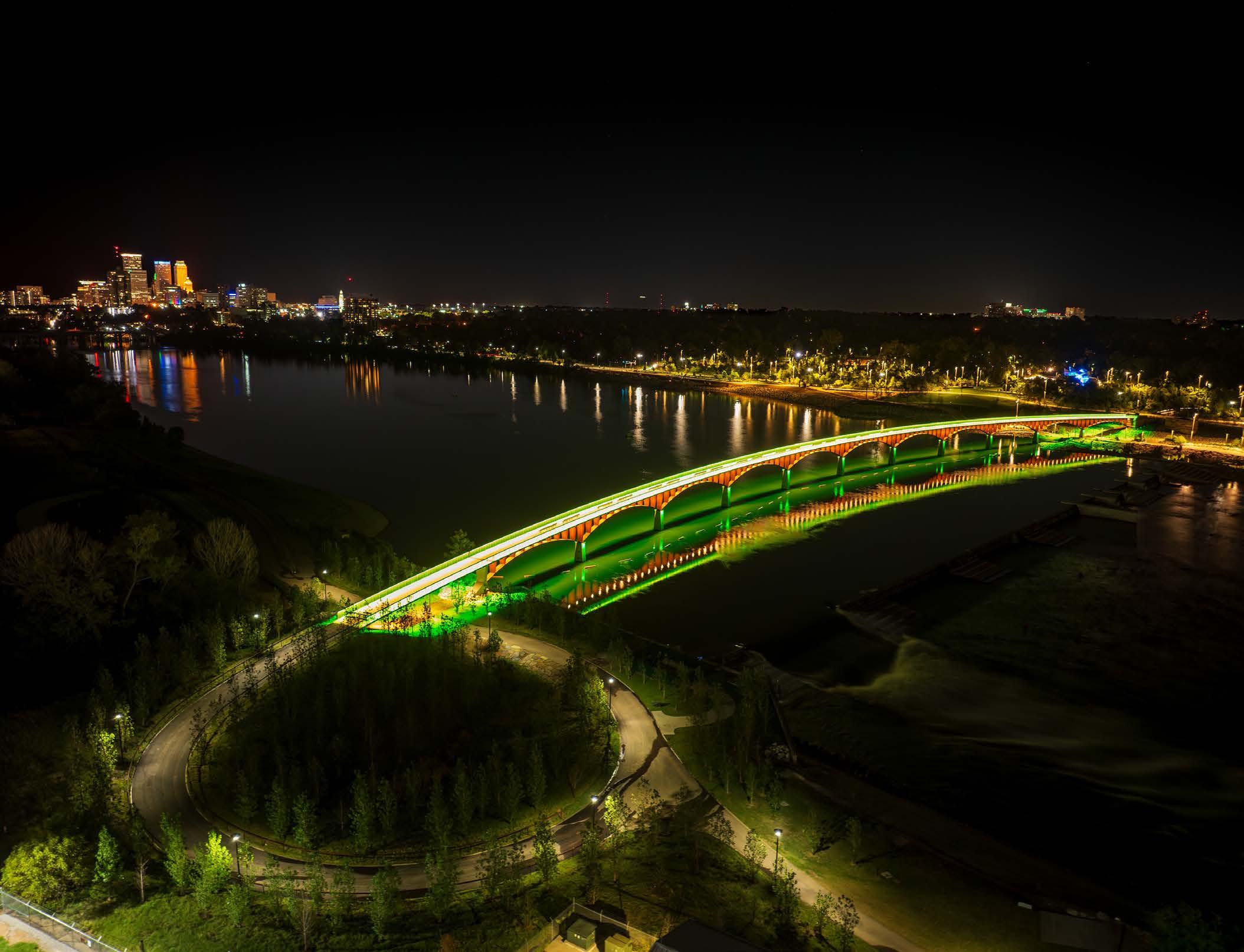
Spanning the Arkansas River with a quiet confidence, the Williams Crossing Pedestrian Bridge is not a spectacle in the conventional sense. It does not rely on scale alone, nor on aggressive illumination. Instead, the bridge asserts itself through restraint, clarity, and a deeply considered lighting strategy that balances civic identity, nighttime comfort, and long-term maintainability.
In speaking with the project’s designers at Domingo Gonzalez Associates, the project unfolded as a study in patience, discipline, and long-term thinking about civic infrastructure. While the detailed lighting design was led by Phat Quach, Director at DGA, the discussion revealed
how the bridge’s nighttime identity grew out of a shared studio culture—one focused on clarity, durability, and respect for how people actually experience space after dark. Stretching across the Arkansas River, the pedestrian and bicycle bridge links Tulsa’s Gathering Place to the riverfront trail system, and at night it reads not as a statement piece, but as a carefully articulated extension of the park itself.
While a Gathering Place officially opened in phases beginning in 2018, the bridge followed a longer arc— initiated in 2018 and reaching completion in 2025— reflecting the reality of large-scale public infrastructure
projects that evolve over years, not seasons. As with the lighting design of the Hudson River Park or Brooklyn Bridge Park (both DGA designed jobs), the timeline was dictated by funding, phasing, coordination, and patience.
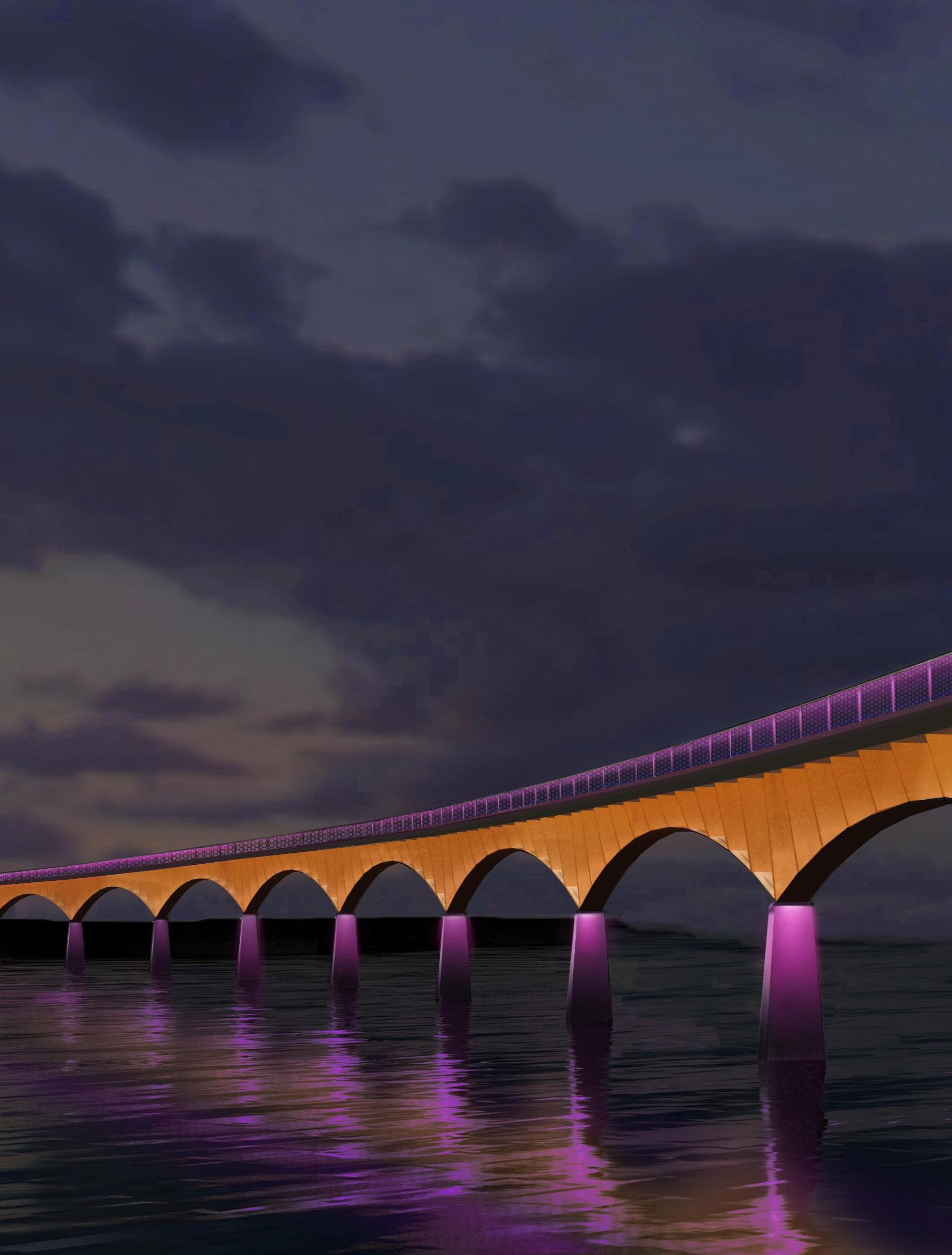
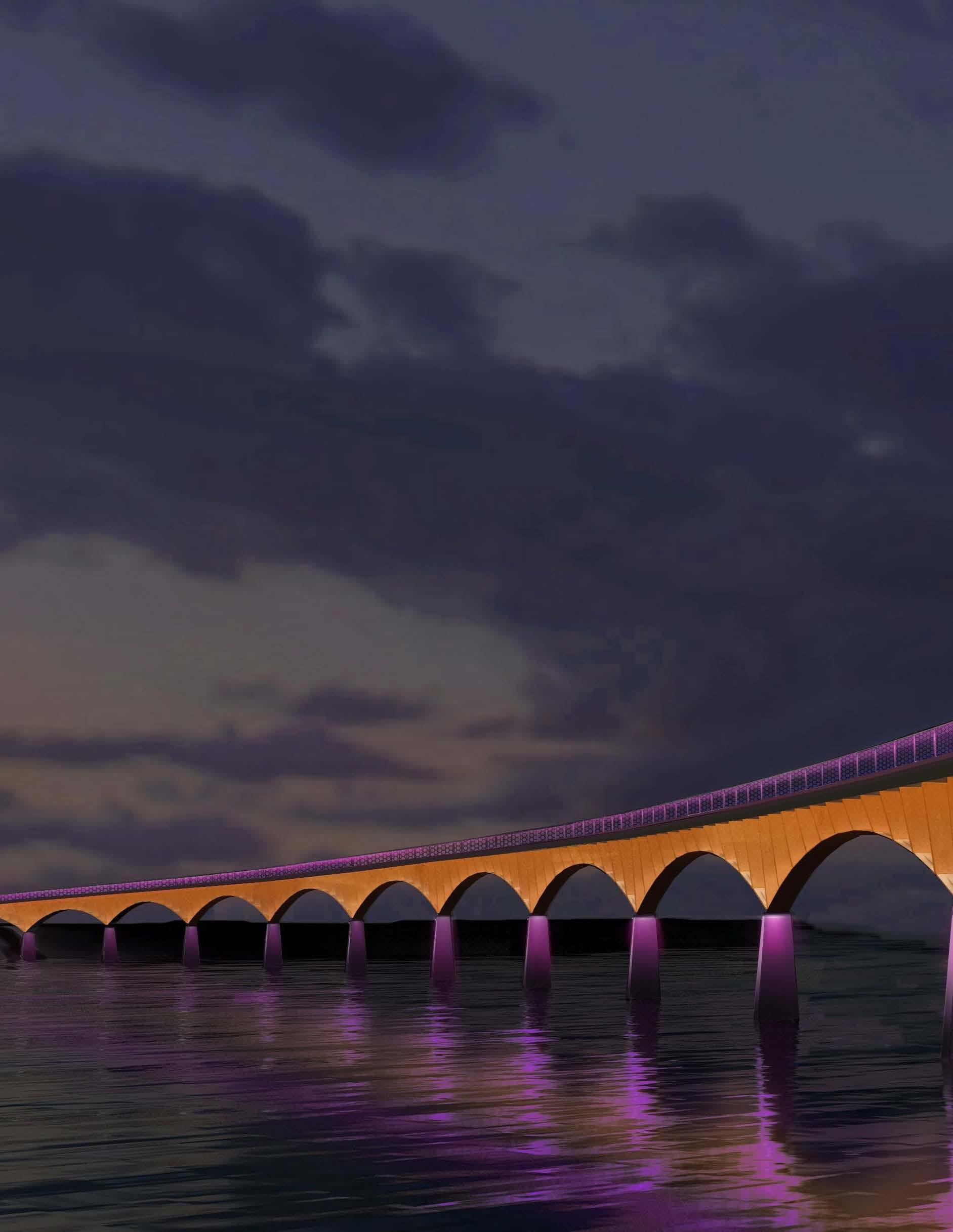
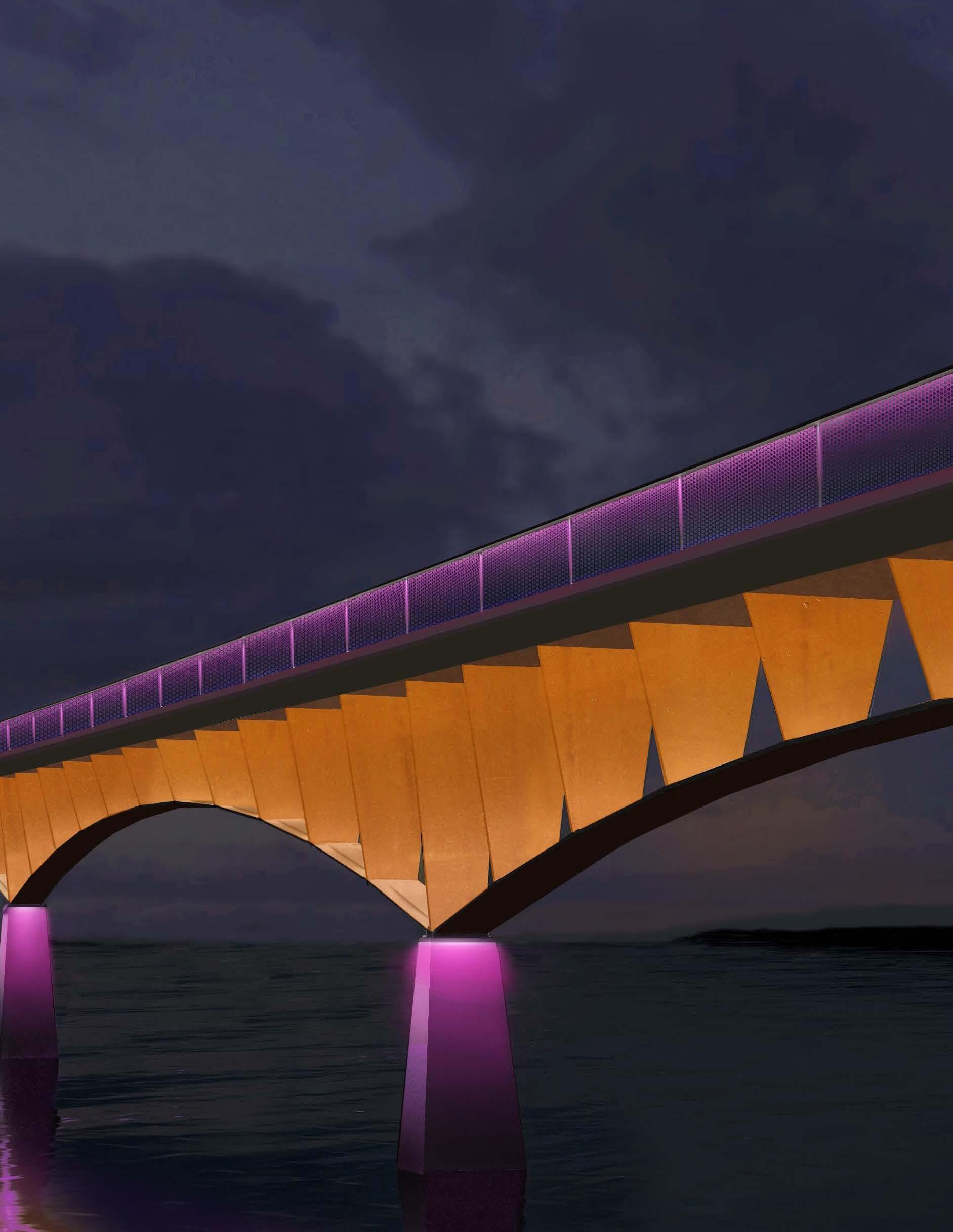
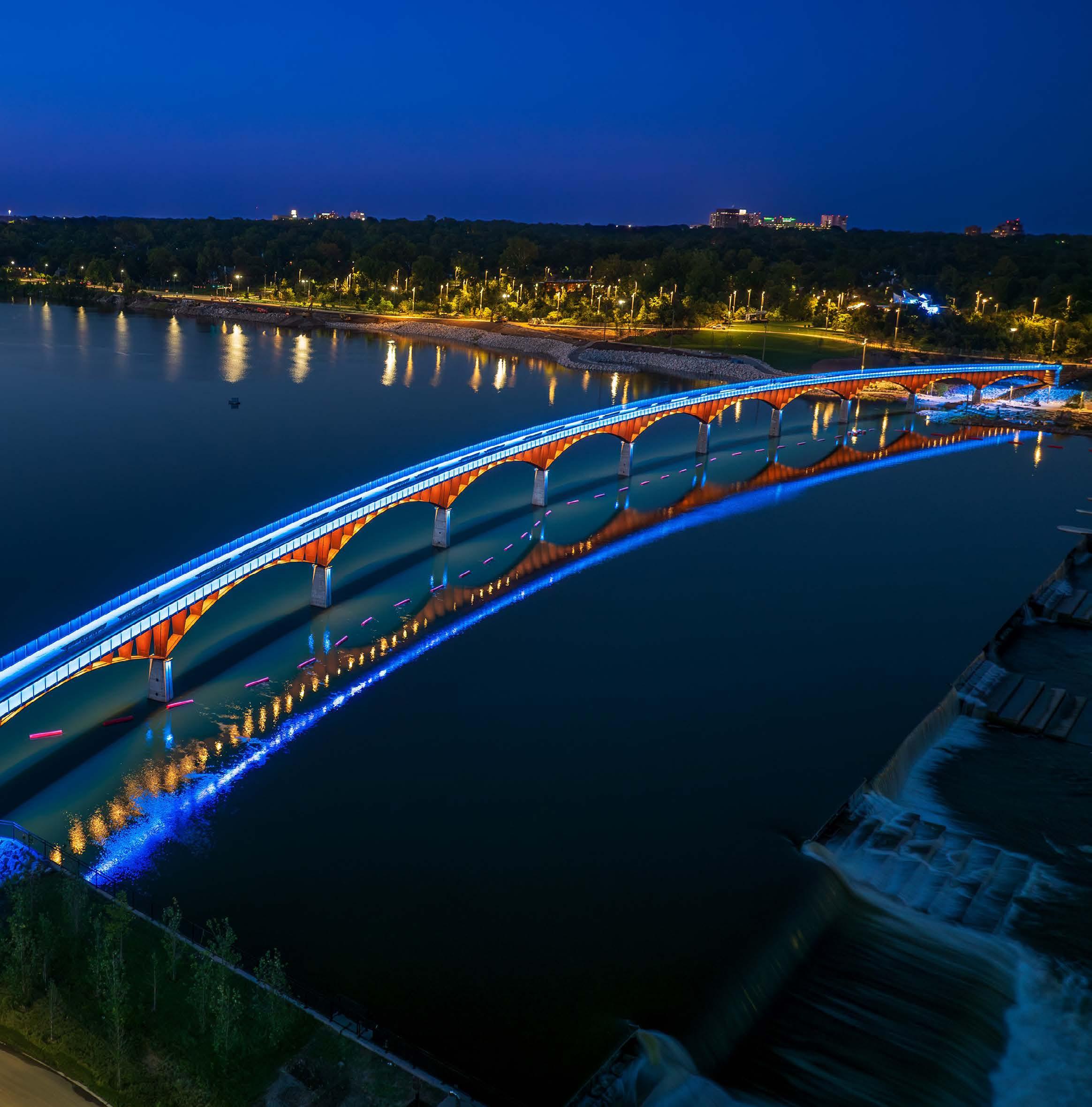
Architecturally, the bridge is notable as the first steel plate arch bridge of its kind in the United States. More than 1,400 feet of weathering steel floats over the river on slender piers, producing a silhouette that is simultaneously industrial and refined. From the outset, the lighting design was tasked with two primary objectives: articulate this graceful structure at night and provide a visually comfortable, welcoming environment for pedestrians and cyclists.
Those goals were achieved not through complexity, but through a disciplined system of four distinct lighting layers, each with a specific role.
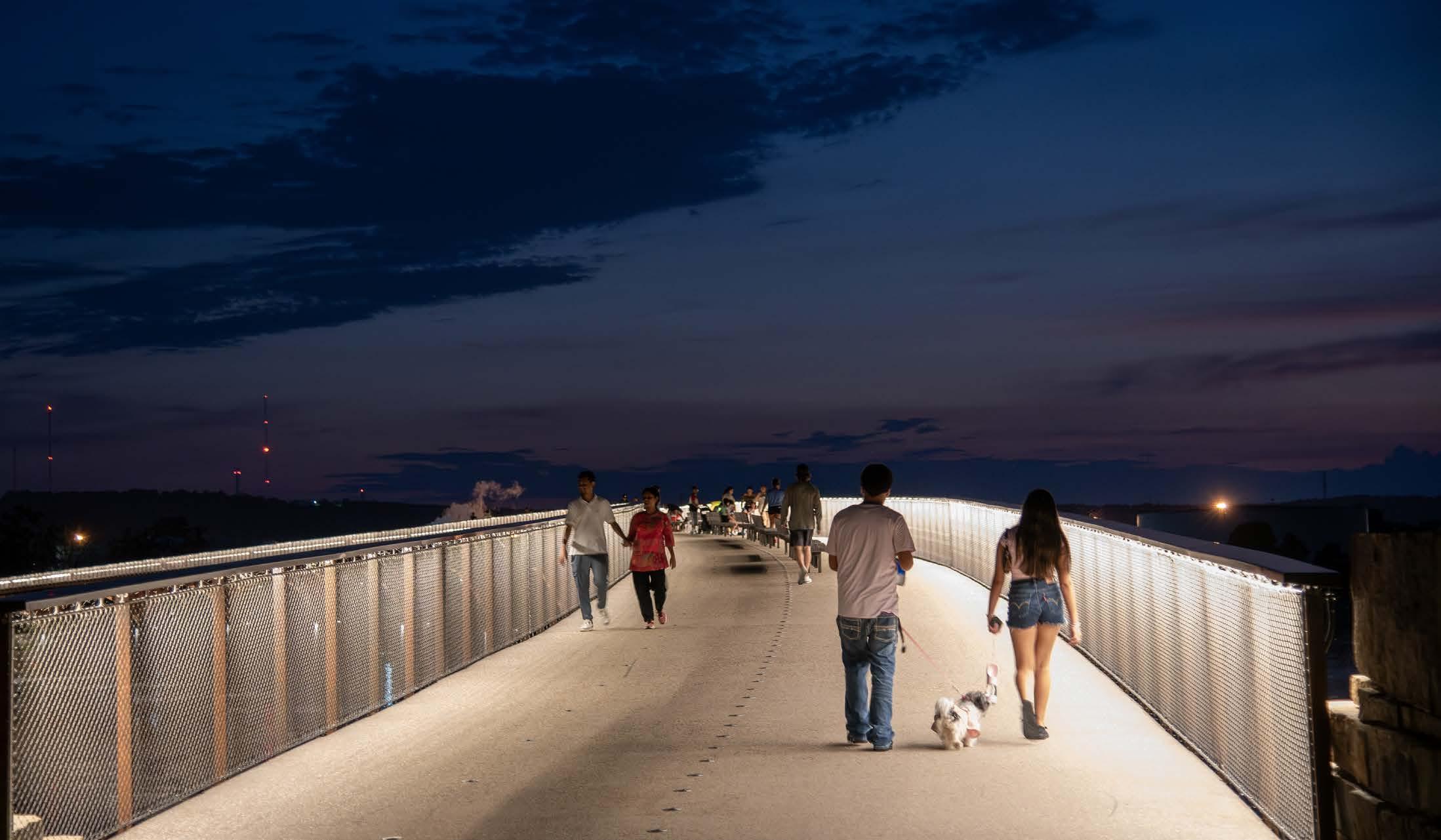
At the core of the strategy is a clear separation between how the bridge is experienced from within and how it is perceived from afar. People crossing the bridge are always in warm white light—never colored—ensuring visual comfort, accurate color rendition, and a sense of safety. Color, when used, is reserved for the bridge’s external expression.
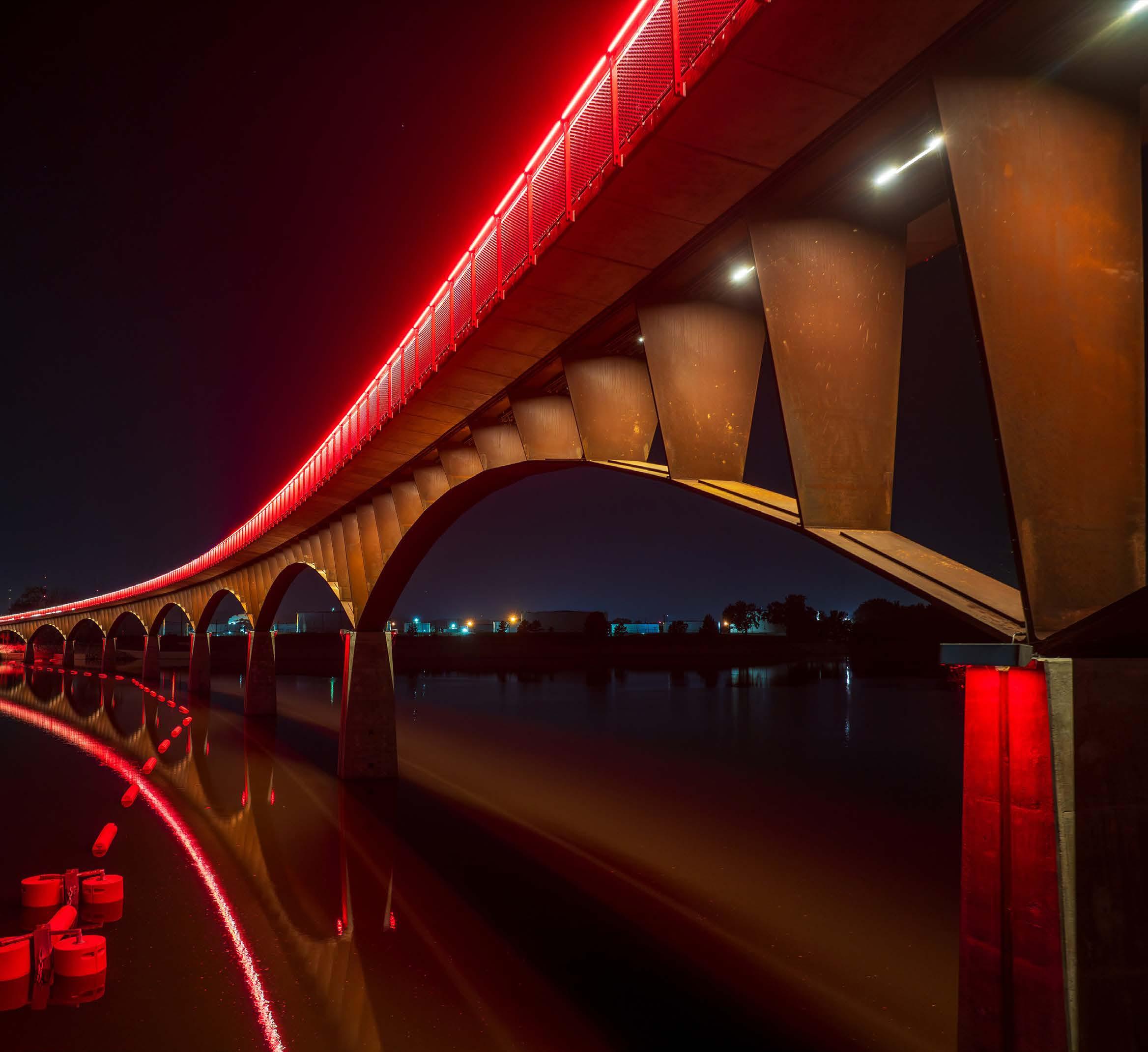
The primary internal layer is handrail-integrated lighting running continuously along both sides of the deck. This system provides uniform horizontal illumination, creating a consistent visual field across the full width of the bridge. The light source is deliberately concealed, maintaining a discreet profile while producing a welcoming vista that avoids hotspots or glare. The handrail lighting establishes the bridge as a place to move through, not merely look at.
At the core of the strategy is a clear separation between how the bridge is experienced from within and how it is perceived from afar.
Running along the sides of the bridge, the wire fabric mesh plays an unexpectedly important role in the lighting composition. By day, the mesh reads as a pragmatic element—light, permeable, and visually recessive. At night, however, it becomes a luminous surface in its own right. Grazed from the exterior with color-changing light, the mesh captures and fractures illumination across its fine geometry, producing a layered shimmer that reinforces the bridge’s linear form without becoming opaque or heavy. From the deck, pedestrians remain in white light, while from the riverbanks the mesh defines the bridge’s silhouette, allowing color to articulate structure without intruding on the user experience. The result is a material that shifts character after dark, transforming from utilitarian infrastructure into a subtle, responsive veil of light.
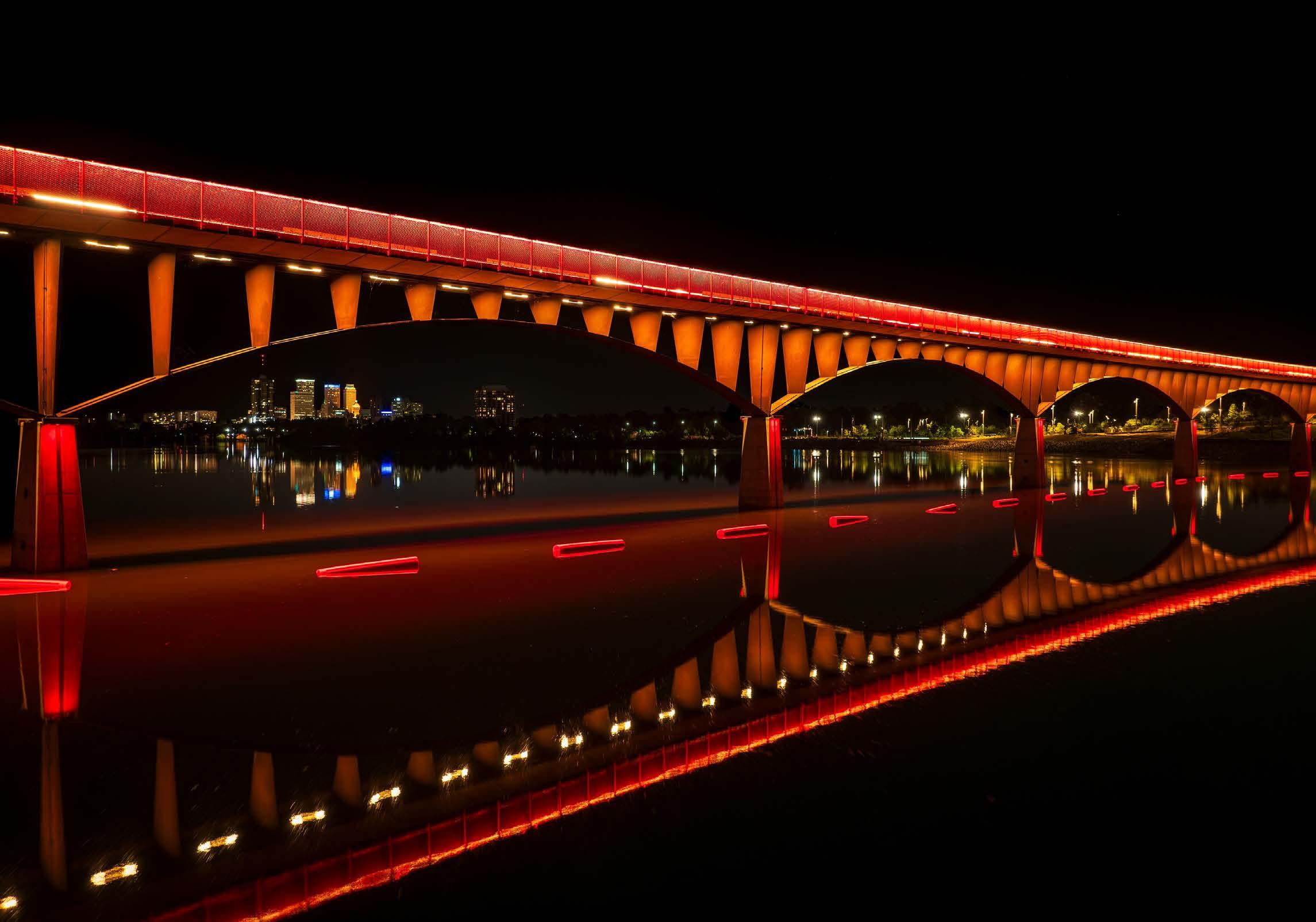
Complementing this is spandrel downlighting between the structural steel elements. Set at 3000K, this warmwhite layer washes the weathering steel surfaces evenly, reinforcing the rhythm of the structure and keeping the material’s rusty patina “honest,” as the designers described it. The choice of warm white was deliberate: cooler tones would have flattened the steel’s depth, while higher outputs would have compromised nighttime visual comfort.
Fixture selection required extensive study. Full-size mockups were constructed in the lighting designers’ own conference room to test lensing, shielding, and distribution. Although many design-phase mock-ups were ultimately canceled due to construction pressures, in-situ mockups during construction proved invaluable, allowing final
confirmation of aiming and shielding. As is often the case, the contractor—initially skeptical—ultimately embraced the process, recognizing the mock-up as a dress rehearsal that clarified installation and reduced downstream issues.
Externally, the bridge’s identity is defined by color-changing grazing and guardrail lighting. RGBW luminaires wash the wire fabric mesh along the bridge edges. In daylight, this mesh can read as utilitarian; at night, it becomes a luminous surface that captures color, texture, and reflection in surprisingly nuanced ways. The grazing light breaks across the mesh, revealing its intricacy and giving the bridge a soft, almost kinetic presence when viewed obliquely.
Crucially, this color-changing system is oriented outward. From the deck, users see only white light. From the city and riverbanks, the bridge reads as a sculptural object,
capable of shifting character for special events, holidays, or civic moments. Most nights, the bridge remains white. Color is deployed sparingly, reinforcing the idea that flexibility does not require constant animation.
Pier lighting forms the fourth layer. RGBW downlights mounted atop the concrete piers articulate the bridge’s vertical supports and anchor it visually to the river below. Originally, all four faces of each pier were intended to be illuminated. Value engineering reduced this to the outward-facing sides, eliminating the faces perpendicular to the bridge deck. While subtle shadows reveal what was removed, the overall effect remains legible and balanced.
All color-changing systems on the bridge are supplied by GVA Lighting, utilizing remote driver configurations located at either end of the bridge. This strategy reflects a longterm maintenance philosophy informed by experience. Rather than distributing individual
Crucially, this color-changing system is oriented outward. From the deck, users see only white light. From the city and riverbanks, the bridge reads as a sculptural object, capable of shifting character for special events, holidays, or civic moments.
drivers throughout the structure—creating the risk of isolated failures that may go unrepaired—the design consolidates potential failure points. If a driver fails, a significant portion of the system goes dark, triggering prompt maintenance. One driver replacement restores a quarter of the bridge, avoiding the “broken tooth” effect so common in large-scale installations.
By contrast, the internal walkway lighting uses linevoltage LED tape, manufactured by Apogee Lighting, with integral micro-drivers. This approach reduced complexity while preserving performance, and was one of the areas where value engineering altered specification without compromising intent.
Control is handled via DMX, integrated with photosensors and astronomical time clocks. The system activates automatically at dusk, dims at curfew, and de-energizes at dawn, ensuring the bridge is a respectful nighttime neighbor while minimizing energy use. The lighting also integrates seamlessly with the broader park lighting strategy, extending the Gathering Place’s nighttime presence and reinforcing continuity across the site.
Reflections play an outsized role in the bridge’s nighttime presence. The Arkansas River is shallow and often still.
The combination of warm white light on weathering steel, restrained color accents, and linear continuity produces reflections that feel intentional rather than incidental—an extension of the design rather than a byproduct.
The bridge’s impact has not gone unnoticed. While it was the Gathering Place itself that drew national attention, the bridge was cited by The New York Times as “stunning” and emblematic of design-forward civic infrastructure. Without the careful balance of articulation and comfort, the structure would not read as it does at night.
Perhaps most telling is the community’s response. Phat admitted he was surprised by the visual punch of the colorchanging guardrail lighting, particularly how clearly it defines the bridge’s form both near and far. More gratifying still has been the public’s embrace of the bridge’s versatility— its ability to remain calm and dignified most nights, yet transform effortlessly for moments of celebration.
In an era when architectural lighting is often expected to entertain, Williams Crossing offers a different lesson. Its success lies in clarity of purpose, disciplined layering, and an unwavering commitment to the user experience. It is lighting that understands its role—not as spectacle, but as structure made celebratory after dark. ■
CELEBRATING 60 YEARS OF INNOVATION & LINEAR LIGHTING LEADERSHIP
Product:
Location: Lucia LA / Fairfax District
Tivoli provides solutions for your projects, from customized vision to large-scope designs that produce the right amount of light where needed. Tivoli has maintained a customer-first approach, with quality products and uncompromising service year after year.
TRACE Horizontal
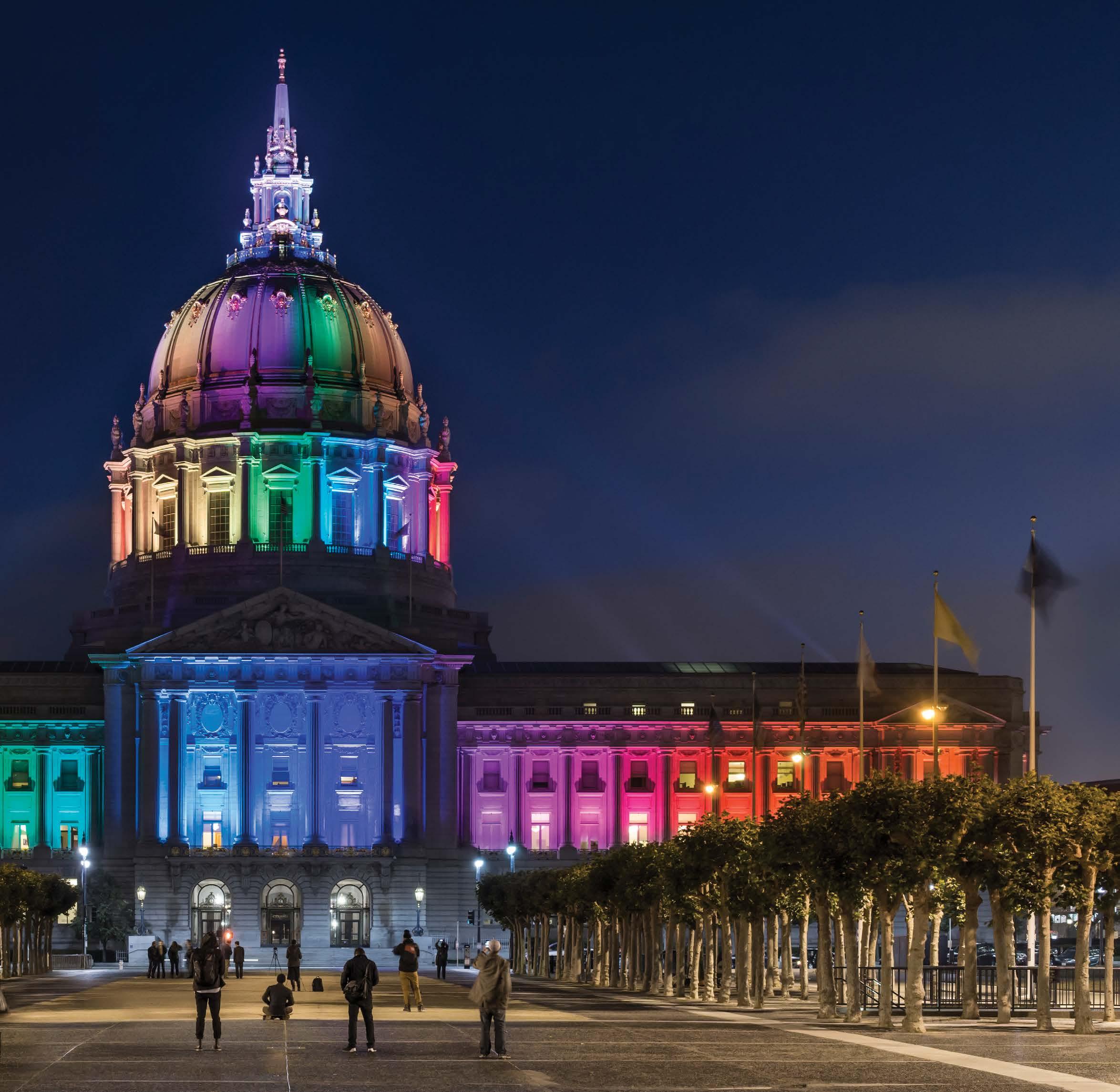
LIGHTING A LANDMARK: A OF EVOLUTION Decade
at San Francisco City Hall
Photo credit: Signify
When Toby Lewis walks the roofline of San Francisco City Hall, she is not looking for drama. She is looking for control.
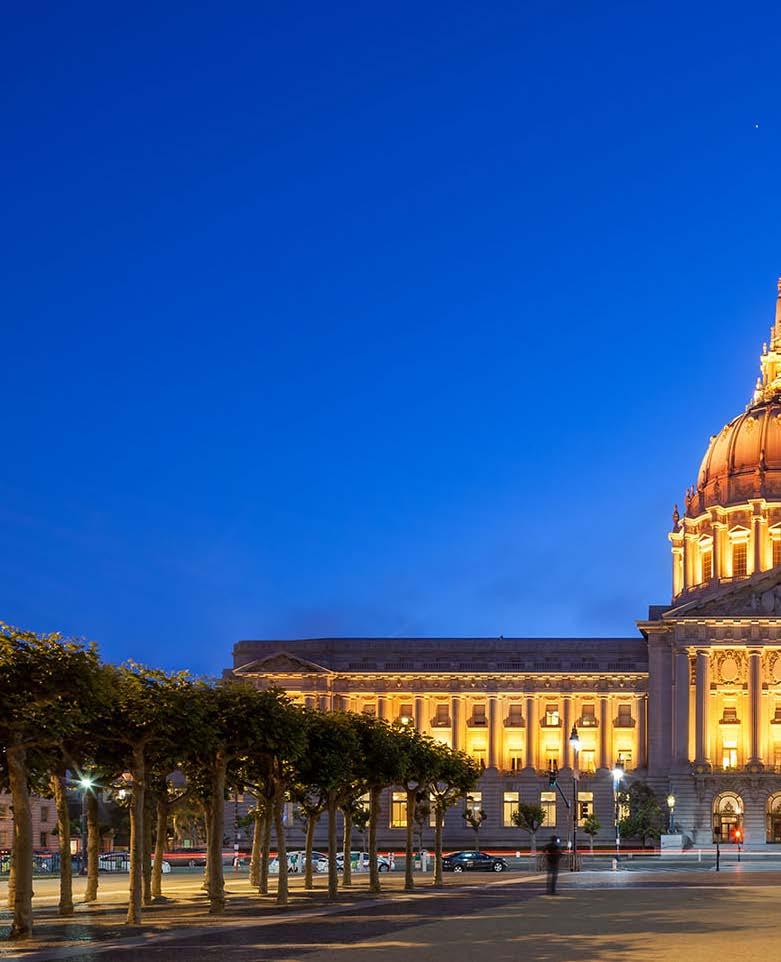
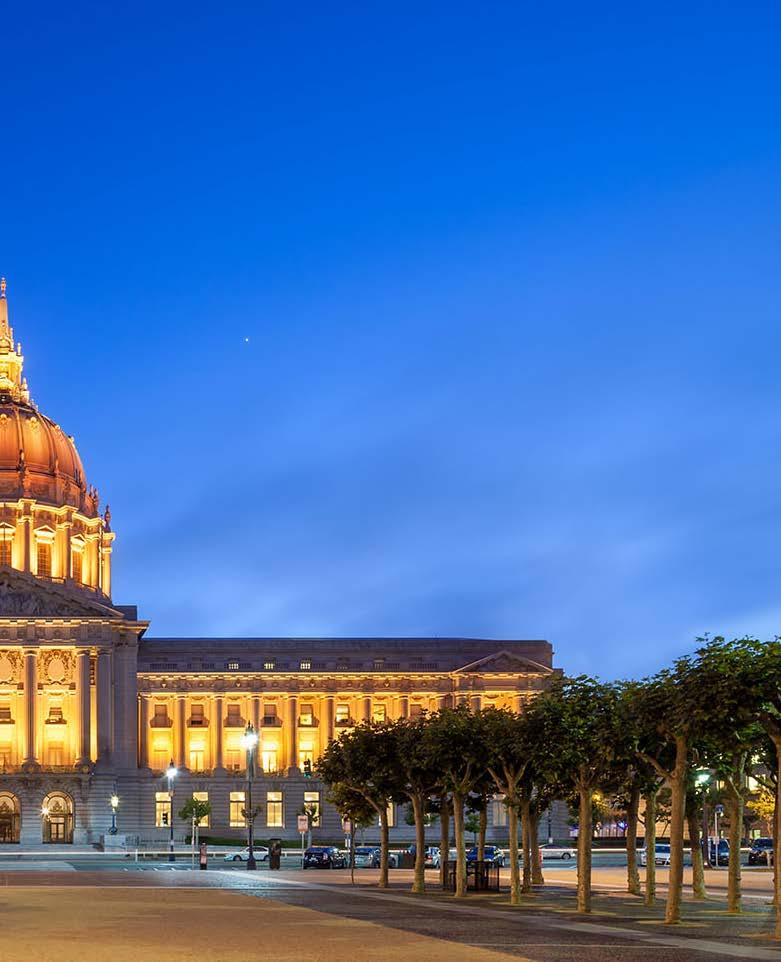
The building—completed in 1915 after the 1906 earthquake—was conceived as a statement of civic permanence. Its Beaux-Arts composition relies on proportion, repetition, and clarity. At night, those qualities can be reinforced—or undermined—by light that is even slightly misdirected. The building façade was first beautified at night by HLB in the late 90’s with technology available at the time.
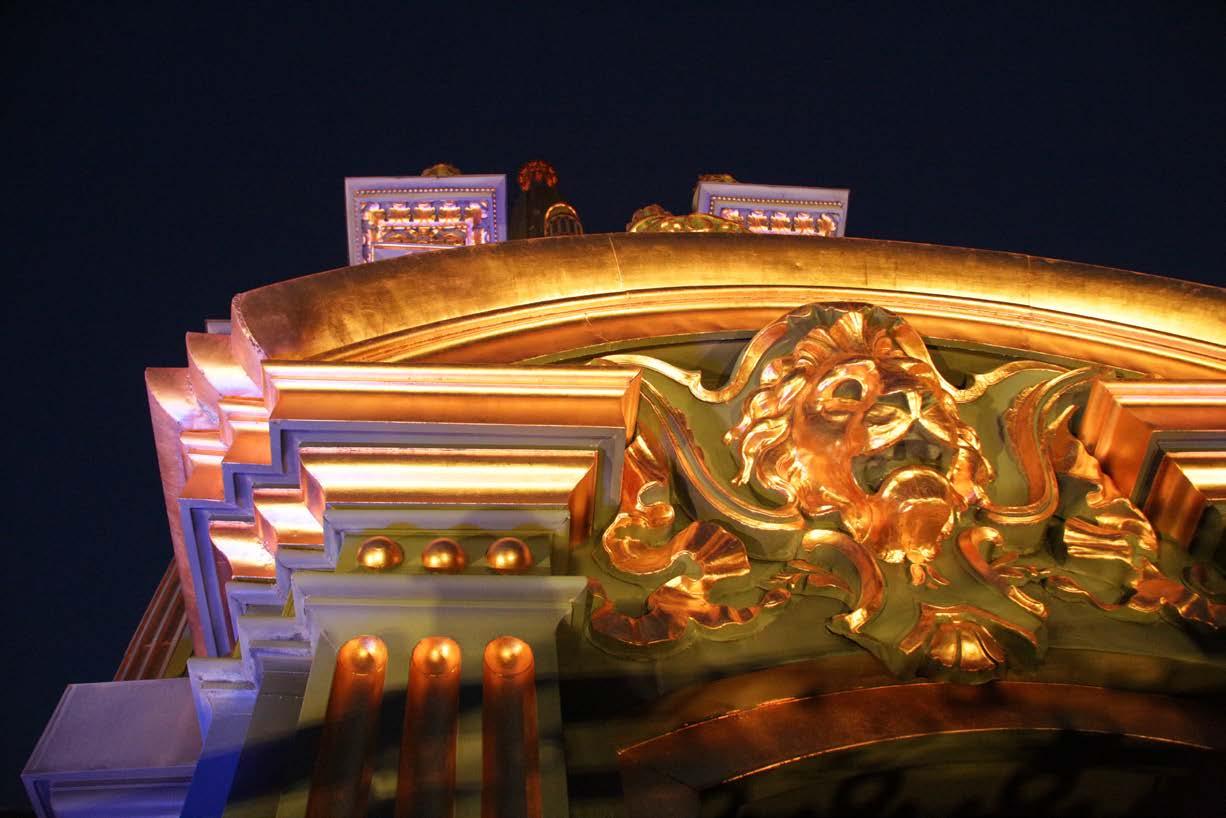
“The façade lighting of SF City Hall is forged by geometric constraints and variations in the detailed craftsman forms,” said Toby. “The patinaed copper dome has faded asymmetrically over time due to the path of the sun. Any appearance of uniformity is achieved through great effort.” What makes the current lighting not just successful but unusually resolved is that it is not the result of a single redesign. It is the product of more than a decade of layered decision-making—an evolution that tracks advances in LED technology while remaining anchored to architectural intent.
A Decade of Evolution
The first LED transformation took place in 2015, when the building’s exterior lighting was upgraded from metal halide to LED, introducing DMX controls and RGBW sources for the first time. Arup led the design effort, with Toby Lewis serving as the project’s lead designer. The work unfolded under significant time pressure, driven by the convergence of two major events: the centennial celebration of San Francisco City Hall and the Conference of Mayors, both hosted in the city that same year. A 5-minute dynamic show was created for the celebration, telling the story of the history of San Francisco in a low-resolution ‘video’ above a crowd dancing to a DJ.
Additionally, the 2015 project was calculated to reduce the connected load to about 75% of the Metal Halide system, but with saturated colors the overall annual energy usage was estimated closer to a 50% reduction.
The schedule forced early commitments. The forconstruction fixture schedule with quantities was issued before full electrical drawings were complete, and bespoke solutions were developed at a moment when high-output exterior RGBW luminaires were still rare. The result was a carefully customized system that established the building’s contemporary nighttime identity while respecting the original lighting positions established decades earlier.
That 2015 phase proved remarkably durable. Many of those fixtures performed reliably for nearly ten years— an outcome that would later influence how subsequent maintenance work was approached.
After founding Left-Hand Lighting in 2021, Toby was brought back as exterior fixtures lighting the dome and lantern—fully exposed to weather—began reaching the end of their expected lifespan. What followed, between 2023 and 2025, was not a wholesale redesign but a targeted maintenance upgrade that benefited from a decade of technological advancement and firsthand knowledge of how the building behaves at night.
Rather than replicate the earlier solution, Toby treated each replacement phase as an opportunity to refine precision, optics, and color control through market research and mockups.
“Every time we upgrade this building, LED products have advanced in a way that enable a sharper nighttime appearance,” she said. “We get a tighter aim. We’re able to smooth out the uniformity more and expand the color range.”
The building has craftsman detailing everywhere. You want to highlight every feature,
History as a Design Constraint
Long before programmable LEDs, City Hall was already a canvas for light. Color was achieved through gels temporarily placed on metal halide fixtures, manually changed by theatrical crews—on average every two weeks—to mark holidays and civic events. The process was labor-intensive, static, and inconsistent, but it established a public expectation: the building would speak through color.
Output, beam control, and color consistency were constrained by available technology. As LED systems matured, the opportunity was not simply to replace lamps, but to rethink how light could reinforce architectural hierarchy.
“The building has craftsman detailing everywhere. You want to highlight every feature,” Toby said. “But then you wouldn’t have visual contrast, and so you have to make choices.”
Those choices—what to emphasize, what to leave in
Photo credit: Toby Lewis
Photo credit: Toby Lewis
shadow, and how light transitions across architectural layers—continue to guide the project today.
Color Temperature as Material Response
One challenge of the LED upgrade was the calibration of the baseline white light scene. “We wanted to target around 3,000K, but get the output we needed and also have some flexibility,” she said. In 2014, she worked with Color Kinetics to customize a single fixture for the second story window columns to include separate RGB and white LED boards (2700K with 4000K chips) – fixtures that have proven durable and are scheduled for replacement in a future phase of the ongoing maintenance project. One of the most consequential decisions in the recent maintenance phase was that rather than defaulting to a neutral architectural white, color temperature was treated as a response to material—specifically, the dome’s oxidized copper surface.
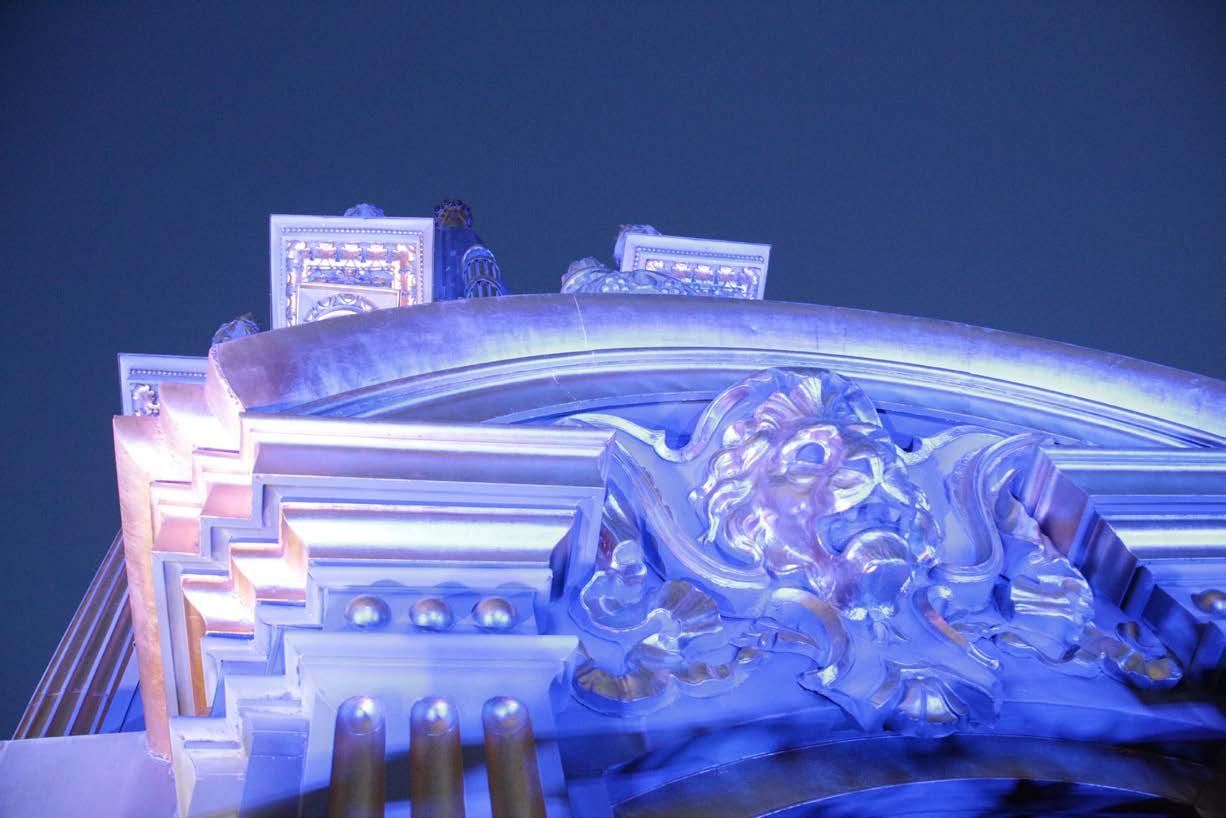
The resulting white scene introduces a restrained bluegreenish undertone that supports the patina rather than competing with it. The effect is understated, but critical to how the dome reads against the night sky.
“If you go too warm, it turns muddy,” Toby noted. “Too cool, and it goes chalky.”
That calibrated white now serves as the building’s default nighttime condition, forming the foundation for all color-changing scenes layered above it.
Optics, Beam Control, and Mock-Ups
The most visible improvements in the current phase are not chromatic, but optical.
Earlier LED solutions required compromise—spill light onto adjacent elements, softened edges, and limited
But then you wouldn’t have visual contrast, and so you have to make choices.
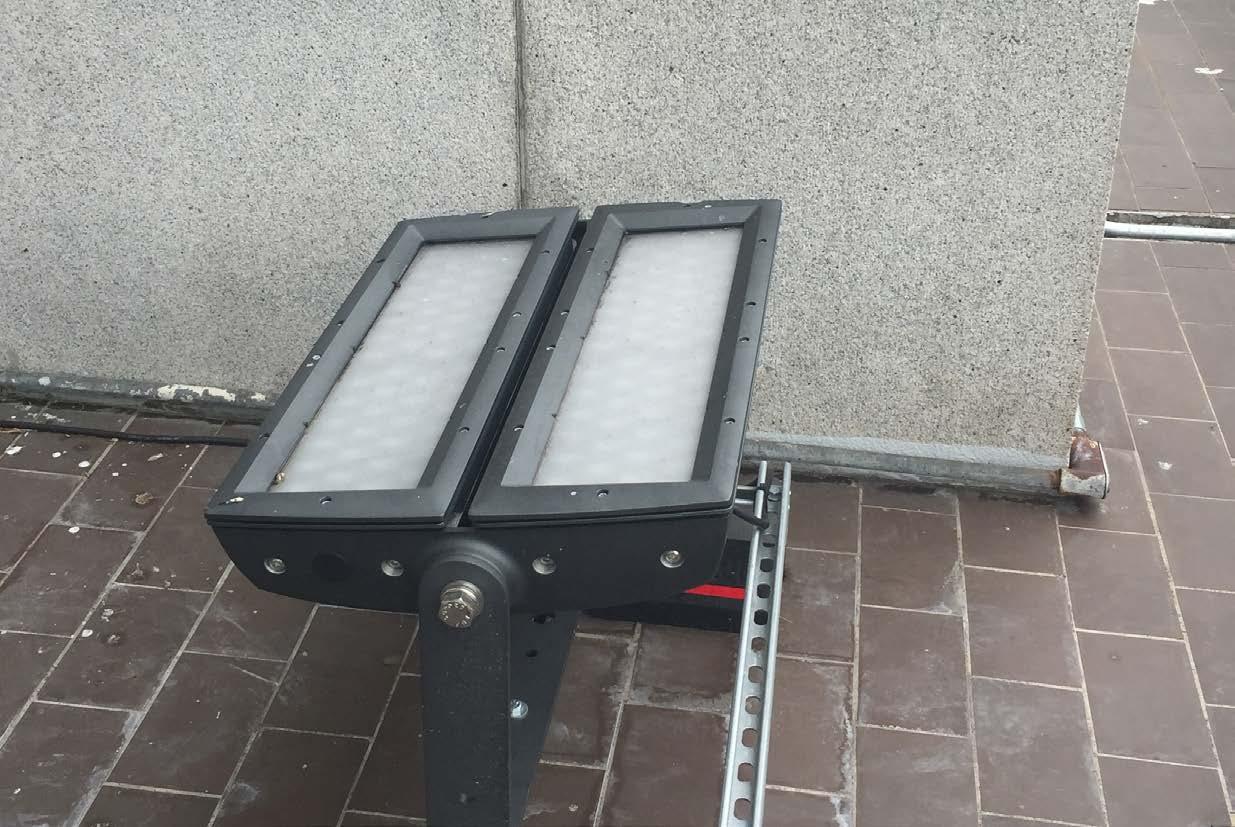
control at scale. Advances in CK exterior luminaires, particularly larger-format fixtures with independently adjustable bars, fundamentally changed what was possible.
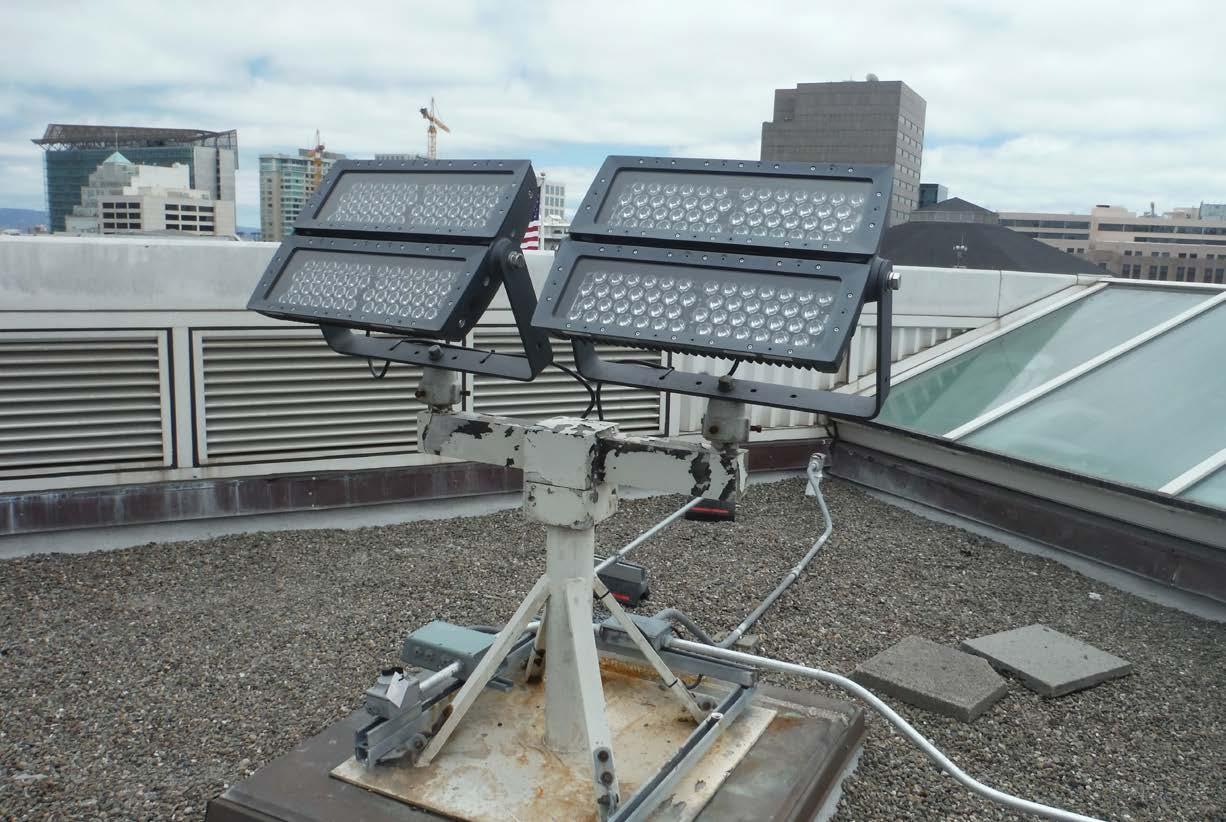
Mock-ups were essential. Rather than relying on photometrics alone, Toby conducted on-site testing, installing fixtures directly on the roof and evaluating them under real conditions.
“I like to start from first principles,” she said. “Not make assumptions about the products or the manufacturer I’m working with.” Of course, durability and product support are also factors for a historic building in a moderate marine environment.
The selected CK fixture lighting the dome allowed each of the three bars to rotate independently, enabling vertical cross-lighting—aiming the lower bar slightly higher and the upper bar slightly lower—to tighten coverage and reduce spill onto urns and ledges already lit from below.
Photo credit: Toby Lewis
Photo credit: Toby Lewis
“It proved to be a huge advantage, especially when working with just a 5-degree beam,” Toby said.
Some shadowing remained, particularly around sculptural elements near the urns. “It adds visual interest,” she said. “I felt okay that some of those shadows we just couldn’t get rid of and chose to embrace the depth the shadows bring.”
A Deliberate Fixture Competition
The refinement visible in the final installation did not come from precedent or brand loyalty. It emerged from a deliberate fixture competition conducted directly on the building.
Rather than assuming earlier solutions would remain appropriate, Toby evaluated multiple manufacturers side by side, testing performance in a full-scale mockup on the dome itself.
“We did a competition, basically, a shootout,” she said. “We brought all of the best names, brands, and reliable manufacturers, and we tested them up on that dome.”
Beam control, color quality, consistency across fixture sizes, and long-term durability in a harsh rooftop environment all factored into the evaluation. Subtle differences in optics became amplified once projected across the dome’s curvature.
While some competing products offered broader color range in specific parts of the spectrum, the CK fixtures ultimately specified provided the balance Toby was seeking with precision optics, independently adjustable elements, and reliable color consistency across architectural layers.
Photo credit: Toby Lewis
At San Francisco City Hall, colorful lighting is no longer a temporary gesture or a technical overlay. It is an evolving design system—one shaped by history, sharpened by technology, and guided by a steady commitment to architectural clarity.
Photo credit: Toby Lewis
Controls as Design Infrastructure
While fixtures shape the light, the control system determines how that light lives over time.
The exterior lighting is driven by a Pharos control system, selected for its ability to manage complex scenes while protecting baseline programming.
A Living Building
Much of the recent work fell under maintenance rather than capital renovation—a designation that underscores Toby’s view of the project as stewardship rather than reinvention.
“It’s really technically like replacing a light bulb,” she said, “but it’s a much more high-stakes light bulb, with significant improvements between product versions.”
The dome fixtures were replaced first, followed by the lantern and colonnade levels. Each phase benefited from lessons learned in the previous one, refining beam control, improving uniformity, and tightening visual hierarchy and contrast. “Every time we upgrade it, the appearance improves,” she said.
At San Francisco City Hall, colorful lighting is no longer a temporary gesture or a technical overlay. It is an evolving design system—one shaped by history, sharpened by technology, and guided by a steady commitment to architectural clarity.
Toby extends special gratitude to the long list of people who supported the façade lighting project over time, especially those who happen to have also been personal mentors to her:
• Janelle Drouet, a friend and mentor who focused the Dome lighting replacement in 2023 for Left Hand Lighting, and who had the idea to ‘patina’ the dome lights
• Emily Duffner, the SF Arup team leader during the 2015 LED project implementation
• Teal Brogden (who mentored Toby’s lighting class at CU Boulder in 2005) and Barbara Horton (who recruited Toby to partner in the More Marathon in 2007), both principals at HLB ■
Photo credit: Toby Lewis
Cylinder One Spectrum
. Selectable CCT (1800K- 8000K)
. Dynamic white (full range)
. Dim to warm (3000K-1880K)
. Any imaginable static color with broad spectrum technology
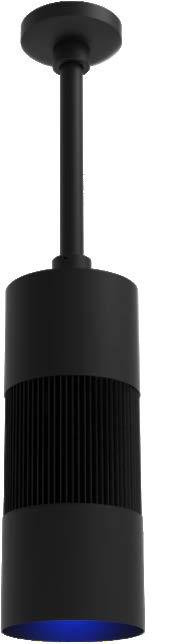
The new evolution of the award-winning Cylinder One HO offering the first 4-in-1 pendant with flicker-free, 0-100% dimming.
designing lighting controls
Everything Is Under Control
Today’s LED lighting systems are highly precise, controllable out of the box, and flexible, offering a menu of capabilities and new benefits that 20 years ago would have been both costly and complex, or even unachievable. The key to unlocking many of these capabilities and benefits is lighting controls.
As a result, lighting controls are currently the most exciting part of our industry. Beyond the familiar energysaving capability and flexibility for creating comfortable and quality lighting, today’s lighting control systems can provide far greater utility. Whether it’s integration, circadian-friendly lighting, minimizing skyglow, generating useful building data, or creating dynamic interiors with dimming and color tuning, lighting controls play a key role in the industry’s most important trends.
ENERGY: The massive buildout of AI data centers currently underway will continue to pressure energy costs, while decarbonization remains a longstanding imperative. As the market for converting traditional light sources to LED matures, major opportunities for deep energy savings include pairing lighting controls with LED lighting in upgrades, LED-to-LED/control upgrades, integration, and networked lighting controls and luminaire-level lighting controls. In these areas, the drive toward standardization, open system architecture, manufacturer compatibility, and innovation will continue to make lighting control more attractive while opening new markets.
As a recent example of such innovation, in 2025 Bluetooth SIG released the HVAC Integration NLC Profile
GARY MESHBERG By Gary Meshberg, LC, CLCP, LEED-AP, IES is Chair of the Lighting Controls Academy and Regional Sales Manager, Central USA for Casambi.
for its wireless Bluetooth NLC standard. This provides an alternative to integrating lighting and HVAC systems via a building automation system—specifically, Bluetooth NLC smart thermostats that can receive occupancy signals directly from Bluetooth NLC sensors. This opens new integration opportunities, notably in existing buildings where Bluetooth NLC sensors are installed, as well as in small- and medium-sized buildings unlikely to have a BAS.
SMARTER BUILDINGS: Networked lighting control systems can play a key role in transforming commercial lighting from a static utility into a source of actionable building data. Because lighting is distributed throughout a building and closely tied to occupancy, networked control systems are uniquely positioned to collect highresolution information about how spaces are actually used.
At the device level, sensors embedded in luminaires and control nodes detect occupancy, vacancy, motion patterns, light levels, and operating status. When these devices are networked, data can be aggregated, time-stamped, and analyzed at the room, floor, or building level. This enables accurate insights into space utilization, including peak usage, dwell time, and underused areas—information that can inform space planning, hybrid work strategies, and real estate decisions.
Energy data is another major application. NLC systems can track lighting power, dimming levels, schedules, and runtime, allowing operators to verify energy code compliance, measure savings, support ESG reporting, and identify opportunities for further optimization. Integration with other building systems extends this value, enabling occupancy data from lighting controls to inform HVAC setbacks, ventilation strategies, and demand response.
Networked controls also support operational intelligence. They enable fault detection and diagnostics, identifying failed drivers, sensors, or communication nodes, which reduces maintenance costs and downtime. Over time, NLC data provides a feedback loop that helps buildings operate as designed, adapt to changing use patterns, and continuously improve performance, making lighting controls a foundational data platform for smart commercial buildings.
TRANSFORMING SPACES: The built-in controllability of LED lighting has made dimming a staple capability and
added a new dimension to lighting control: the ability to adjust color. This offers designers a tool to increase occupant satisfaction, build in flexibility and utility, implement circadian-friendly lighting strategies, and transform spaces with light and color.
An example of how color can create fresh utility in building spaces is schools, where teachers are using tunable-white lighting to cue activity transitions and encourage desired behaviors such as calming, focusing, or directing attention. To highlight this capability, the U.S. Department of Energy published Why Tunable? A Look at Schools in January 2025, examining tunablewhite LED installations in eight school districts. The study found schools adopted these systems primarily to support teaching and learning, particularly in specialneeds classrooms. Teachers responded positively, reporting improved learning environments.
RESPONSIBLE OUTDOOR LIGHTING: Lighting controls have become central to responsible outdoor lighting because they save energy while reducing skyglow, light trespass, and glare.
The IES-IDA “Five Principles of Responsible Outdoor Lighting” emphasize usefulness, targeting, appropriate brightness, control, and warmer light. Building on these ideas, the DesignLights Consortium (DLC) published seven strategies highlighting dimming, controls, optics, and reduced blue-violet emission.
LED technology is well-suited to these goals due to precise optical control, comparable efficacy at lower color temperatures, and easy dimming. Controls are especially impactful: scheduled dimming, occupancy sensing, and high-end trim can proportionally reduce both energy use and light pollution.
EDUCATION IS KEY TO LEADING TRENDS: Today, providing true value to building owners and users with lighting inherently entails having expertise with lighting controls. Expertise, meanwhile, is the junction of education, experience, and keeping up with what’s new.
The Lighting Controls Academy (formerly the Lighting Controls Association), a NEMA coalition, has educated electrical practitioners for 25 years. We provide a website covering everything new in the world of lighting controls, courses that have educated 50,000 practitioners completing nearly a half-million learning modules, sponsor awards and workshops, and offer free tools such as our Design Express sequence of operations templates. Start your education now at LightingControlsAcademy.org. ■
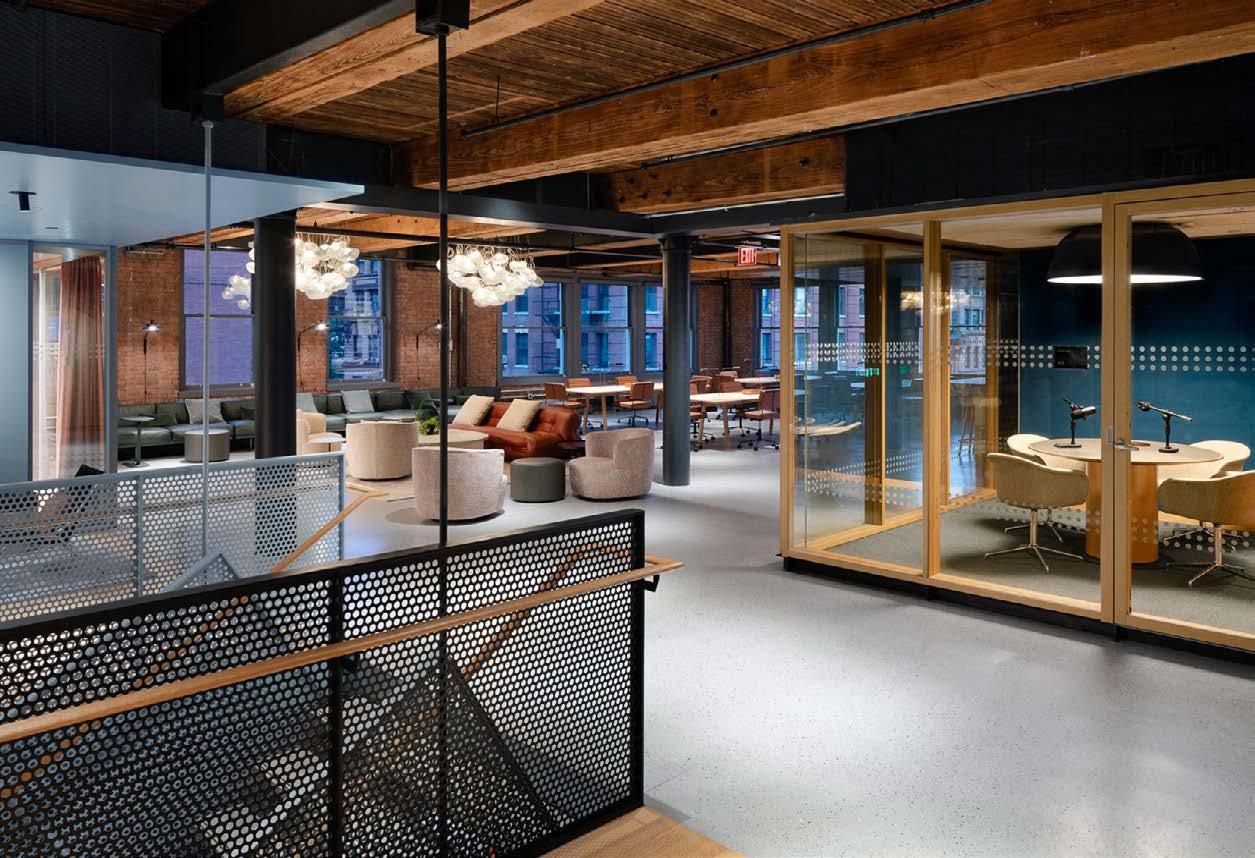
Cover Photo: Soho Workspace
Photography: Amy Barkow | Barkow Photo
2026 COMMERCIAL LIGHTING
CRAIG DILOUIE, LC, CLCP By Craig DiLouie is education director for the Lighting
The commercial lighting rebate outlook is strong for 2026, with rebates available in 75 percent of the United States and covering all popular categories of LED lighting and lighting controls, including networked lighting controls.
Current data provided by BriteSwitch’s RebatePro for Lighting North America database shows three major trends reflecting a state of transition. Overall, growth in AI infrastructure and data centers is pressuring energy costs up, while rebate programs are seeing diminishing energy savings from the traditional stalwart lighting category due to LED market saturation. To reach their energy-savings goals, rebate program administrators must adapt to the changing market.
#1: Rising LED dollar amounts
As LED technology adoption is in the late majority phase, with the remaining legacy lighting market harder to convert, demand for prescriptive lighting rebates has softened.
In 2025, many rebate programs found themselves offering significant bonuses to achieve their energy savings goals. In 2026, 7 percent of programs started the year with a bonus in place.
Many programs are taking a more strategic approach, increasing average rebates for popular product types, particularly those most likely to deliver high energy savings. Other product types, such as LED PAR and TLED lamps— mature categories that produce a lower return—are being sunset by some programs.
In 2026, average rebates for LED products overall saw a 17 percent increase, with major increases—over 30 percent—for products targeting HID luminaires, according to BriteSwitch. Contrast that with an average overall 3 percent increase in 2025 and 2 percent in 2024, which was likely due to project cost inflation.
#2: Evolution for the LED era
Controls
Academy
Besides increasing average dollar amounts, particularly for high-impact LED options, rebate programs are adapting in other ways to maximize energy savings.
In 2025, a small but significant number of prescriptive rebate programs began recognizing LED-to-LED upgrades. In 2026, this number increased by 22 percent, according to BriteSwitch. While still less than 10 percent of rebate programs overall, it’s the start of a trend worth watching.
Meanwhile, 6 percent of programs shifted from basing their incentives on a per-installed-product basis to some other metric such as power or energy reduced. Some 45 percent of lighting rebate programs overall now focus on W, kW, kWh, or some other metric. This combines the innovation and flexibility of custom rebates with the relative simplicity of prescriptive rebates. It encourages high-efficiency solutions and thoughtful design to maximize energy savings.
#3: Stronger focus on lighting controls
Another way in which rebate programs are adapting is to place more emphasis on lighting controls, a reliable source of energy savings. In most of the United States, if a lighting rebate is available, a controls rebate is available as well. Average rebate dollars per installed device or system, already relatively stable and substantial over the years, increased 12-20 percent in 2026, while two product types were reduced, one after a significant increase in 2025.
In 2025, lighting control rebates, typically placed in the back of the rebate catalog, began to be more prominently positioned right alongside LED rebates. Some programs took the stronger step of requiring LED luminaires be controlled in order to qualify for a rebate. In 2026, there wasn’t a significant increase in the number of programs adopting this approach, but it’s another trend to watch.
LIGHTING REBATE OUTLOOK
In 2025, we also began to see integrated control options appearing in midstream (instant prescriptive) rebate programs. In 2026, this is continuing, typically offered in a tiered approach with a standard rebate for a luminaire, a higher rebate for the luminaire with onboard controls, and an even higher rebate for the luminaire paired with advanced luminaire-level or networked controls.
Meanwhile, networked lighting control rebates continue to grow in popularity, with nearly 200 commercial lighting rebate programs currently dedicated to the technology, a 7 percent increase from 2025, according to BriteSwitch. Often, these systems are incentivized via a rebate adder to LED luminaires being installed. If a dedicated prescriptive rebate isn’t available, often networked controls can be built into a project applying for a custom rebate.
Money on the table
By reducing initial cost and increasing return on investment, for decades commercial lighting rebates have offered a strong incentive to adopt energy-efficient lighting and controls in existing construction. While rebates require effort and present a degree of risk, numerous building owners have tapped them to help fund installation of new lighting and controls. And while LED market saturation has impacted demand for lighting upgrades, it hasn’t greatly affected overall availability of rebates, which remain widely available and substantial.
The overall outlook for commercial lighting rebates in the U.S. in 2026 is strong, with good rebates supported by freely available, detailed listings of qualified products. These rebates are particularly attractive for projects involving solutions adding lighting controls, including integrated and networked lighting controls. While capturing lighting upgrade projects may be more challenging as LED adoption increases, rebates can be even more critical to convert this business. ■
Table 1. Popular LED lighting and standard lighting control rebates for 2025-26. Source: BriteSwitch RebatePro for Lighting database, February 2026.
Wired or Wireless?
All lighting control systems depend on communication to distribute control signals between devices. One of the most important design choices is whether this communication will be delivered through physical wiring or wirelessly using radio signals. While both approaches achieve the same fundamental objective (coordinated lighting control expressed via a system), they differ significantly in how they are installed, maintained, and adapted over time.
Meet the contenders
For decades, dedicated low-voltage wiring was considered the gold standard for lighting control communication. Wired systems are valued for reliability, resistance to radio interference, and ability to support large, complex installations. They are highly stable and offer scalability, though changes often require additional cabling and planning. The tradeoff is that wired systems typically involve more installation labor, require defined pathways for control wiring, and can be disruptive when installed in finished or occupied spaces.
Wireless systems take a different approach. By eliminating control wiring, they promise reduced installation materials and labor while providing greater flexibility, particularly in spaces where running new cable would be costly or impractical. Future modifications can be made with minimal disruption. However, wireless systems must contend with environmental challenges such as signal range limitations, physical obstructions, and potential radio interference. Battery-powered devices also require maintenance, and
wireless networks introduce cybersecurity considerations (though these concerns increasingly apply to wired systems as well when they connect to building networks).
And the winner is…
Because each approach has clear strengths and limitations, determining which is “better” depends entirely on the project, as is so often the case with lighting. In many applications, the most effective solution is neither exclusively wired nor wireless. Hybrid systems—where wired and wireless components work together through gateways or interfaces—are increasingly common. This mixed approach allows designers to leverage the reliability of wiring where needed while taking advantage of wireless flexibility elsewhere, creating solutions tailored to specific applications.
A closer look at wireless
Wireless technology is especially effective in two scenarios: renovation/upgrade projects and luminaire-level lighting control (LLLC).
Existing buildings often pose challenges for traditional control upgrades due to finished surfaces, occupied spaces, or limited access to pathways. Wireless systems make it possible to implement advanced control strategies with minimal disruption and without adding new control wiring, transforming what was once impractical into a viable upgrade path.
CRAIG DILOUIE, LC, CLCP By Craig DiLouie is education director for the Lighting Controls Academy.
Luminaire-level lighting control is another area where wireless has proven particularly valuable. By networking individual luminaires that include integrated controllers and sensors, wireless LLLC enables precise control at both the luminaire and group level. This approach improves responsiveness, occupant comfort, space flexibility, and energy performance, while also enabling data collection for system optimization.
Many LLLC solutions rely on controllers that are either factory-installed in luminaires or added in the field. These controllers typically require auxiliary power, often supplied by a compatible LED driver. Since not all drivers include auxiliary outputs, designers must verify driver specifications early or provide separate power supplies when needed. Integrated controllers generally support on/off switching, continuous dimming, wireless communication, and embedded sensors for occupancy and daylight response, supporting energy code compliance. When sensors are included at the luminaire level, the system qualifies as true luminaire-level lighting control.
Finally, wireless systems simplify expansion. Additional luminaires, sensors, or control stations can usually be added without new wiring, as long as they use the same communication method and protocol. Devices are typically discovered and commissioned through software tools such as mobile apps, expediting system growth or reconfiguration.
Designing a wireless lighting control system builds on the same fundamentals as wired systems but adds layers of
complexity related to signal management and network planning. Designers must evaluate how building materials, layout, and distance affect signal propagation and whether repeaters or extenders are needed. Understanding the system’s communication architecture—mesh-based, gateway-centered, or point-to-point—is essential for proper device placement.
Other critical factors include system capacity, future scalability, protocol compatibility, and power strategy. Devices may rely on batteries, line voltage, low voltage, or energy harvesting depending on the application. Designers must also account for gateways, servers, remote access requirements, cybersecurity preferences, and whether cloudbased or local system management is preferred. Installation methods, device mounting locations, and access for programming should be considered early to ensure smooth commissioning.
The future of lighting control
So, is the future of lighting control wired or wireless? The answer is both.
Each approach has a role to play, with hybrid systems providing the strengths of both. Designers who understand and apply both technologies can deliver highly adaptable, efficient, and user-focused solutions. As lighting control becomes increasingly central to energy savings, decarbonization, and occupant satisfaction, flexible and responsive systems, regardless of communication method, will define the future of the industry. ■
TABLE 1. Protocols have a major impact on a wireless system’s capabilities and must be carefully considered based on the project’s needs. Most lighting control systems employ only one protocol within the network, but some may include a secondary protocol for local programming and configuration of specific devices. A wide variety of protocols are in use; the table shows the most common used in wireless lighting control systems today.
Programming and configuration, mobile app control, scalable wireless controls
Programming and configuration, mobile app control, energy-saving retrofits, connecting to Bluetooth mesh network
Casambi transforms how you design lighting systems. Wired or Wireless. Always flexible. Scalable.
Only Casambi can deliver the freedom of choice to use any fixture, control or device you need to bring your design to life.
INTEGRATED (NODE) IN-LINE (MODULE & DRIVER)
discover freedom of choice ▸ casambi.us/lighting-designer-architect
A New Path for Lighting-HVAC Integration
Integrating lighting controls with HVAC systems has emerged as a powerful strategy for reducing building energy use. Studies show that coordinated lighting and HVAC operation can cut HVAC energy consumption by as much as 20-30 percent. As demand for electricity continues to rise, driven in part by expanding data centers and AI infrastructure, this integration represents an increasingly important opportunity for commercial buildings to operate more efficiently.
At its core, the opportunity is straightforward. In many buildings, heating and cooling systems continue to condition spaces even when they’re vacant. Occupancy sensors,
already widely used for lighting control, can provide control signals to HVAC systems, allowing them to reduce or stop conditioning when a space is no longer occupied. The challenge has historically been how to connect these systems in a practical, cost-effective way.
Traditional approaches
Lighting and HVAC integration traditionally relied on a building automation system (BAS) or simple on/off contactclosure interfaces. In a typical setup, occupancy sensors connected to a lighting control system also send signals to
CRAIG DILOUIE, LC, CLCP By Craig DiLouie is education director for the Lighting Controls Academy.
the BAS. When sensors detect that a space is unoccupied, the BAS places the HVAC system into a standby or setback mode. Airflow is reduced, temperature setpoints are stretched, or the system may shut Off entirely.
While this approach can be effective, it introduces complexity. Successful integration often requires careful coordination between lighting designers, mechanical engineers, contractors, and IT teams. It is best suited to larger projects with networked lighting control systems, a BAS, and variable air volume (VAV) HVAC systems, and where lighting zones and HVAC zones are closely aligned. To help project teams navigate this complexity, organizations such as the DesignLights Consortium (DLC) have published guidance and a resource toolkit outlining best practices for networked lighting control and HVAC integration.
Due to what’s required, this model has seen limited adoption. Smaller buildings often lack a BAS entirely, and even in larger facilities, the added cost and coordination effort can be a barrier.
The role of networked lighting controls
Networked lighting control (NLC) systems have played a key role in advancing integration possibilities. These systems can be thought of as architecture layers, beginning at the luminaire and driver layer and extending upward through networks and software platforms. Integration typically occurs at the upper layers, where lighting systems communicate with other building systems or cloud-based applications via wired or wireless connections.
The NLC’s primary contribution to HVAC integration is occupancy data. Lighting controls already rely on sensors for automatic shutoff and dimming, making them a natural source of this information. Once shared with an HVAC system through a BAS, the data enables more precise and responsive control of space conditioning.
Bluetooth NLC changes the landscape
A striking new development promises to simplify lightingHVAC integration. Bluetooth standards, notably the Bluetooth NLC standard, are designed to enable multivendor interoperability across lighting control devices. In 2025, the Bluetooth Special Interest Group released an HVAC Integration Profile, which invited the development of compatible smart thermostats.
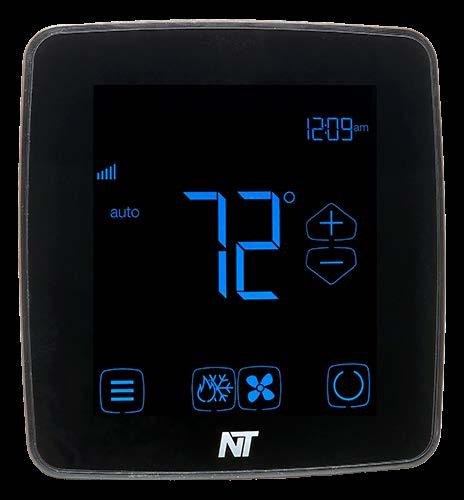
Bluetooth NLC smart thermostats can replace traditional wired thermostats and operate with Bluetooth NLC occupancy sensors. They can combine temperature control, occupancy awareness, analytics, and wireless connectivity into a single platform. Because they are interoperable with Bluetooth NLC sensors, they can receive occupancy signals directly, with no BAS required. This direct communication enables the thermostat to adjust HVAC setpoints in response to current occupancy conditions.
Eliminating the BAS as a requirement expands the pool of buildings that can benefit from lighting-HVAC integration. First, any facility already using Bluetooth NLC sensors becomes a strong candidate for adding smart thermostats and capturing additional energy savings. Second, it opens integration opportunities for small and medium-sized commercial buildings, which often lack the budget or justification for a full BAS. Overall, it increases the value proposition of networked lighting control systems by extending their impact beyond lighting energy savings alone.
Early products and industry momentum
Although HVAC integration based on this approach is still relatively new, products are already entering the market. One early example involves a collaboration between mwConnect, technology partner Silvair, and Network Thermostat. Their Bluetooth NLC-compatible thermostat is available through mwConnect’s TruBlu platform and select wireless ecosystems.
A new path to integration
Lighting-HVAC integration has long promised significant energy savings but has struggled with adoption due to technical and organizational complexity. Bluetooth NLC smart thermostats address one of the biggest barriers by removing the need for a BAS in many applications. As integration grows in importance, simplifying and broadening application can help unlock its full potential. ■
The TruBlu X Series Thermostat by mwConnect, designed in accordance with the Bluetooth NLC specification, is able to communicate with wireless mesh occupancy sensors directly to adjust HVAC setpoints.
As integration grows in importance, simplifying and broadening application can help unlock its full potential.
Transforming a Soho Workspace With Casambi’s LightingOS
Photography: Amy Barkow | Barkow Photo
Every project brings its own challenges, but true success lies in how they’re resolved.
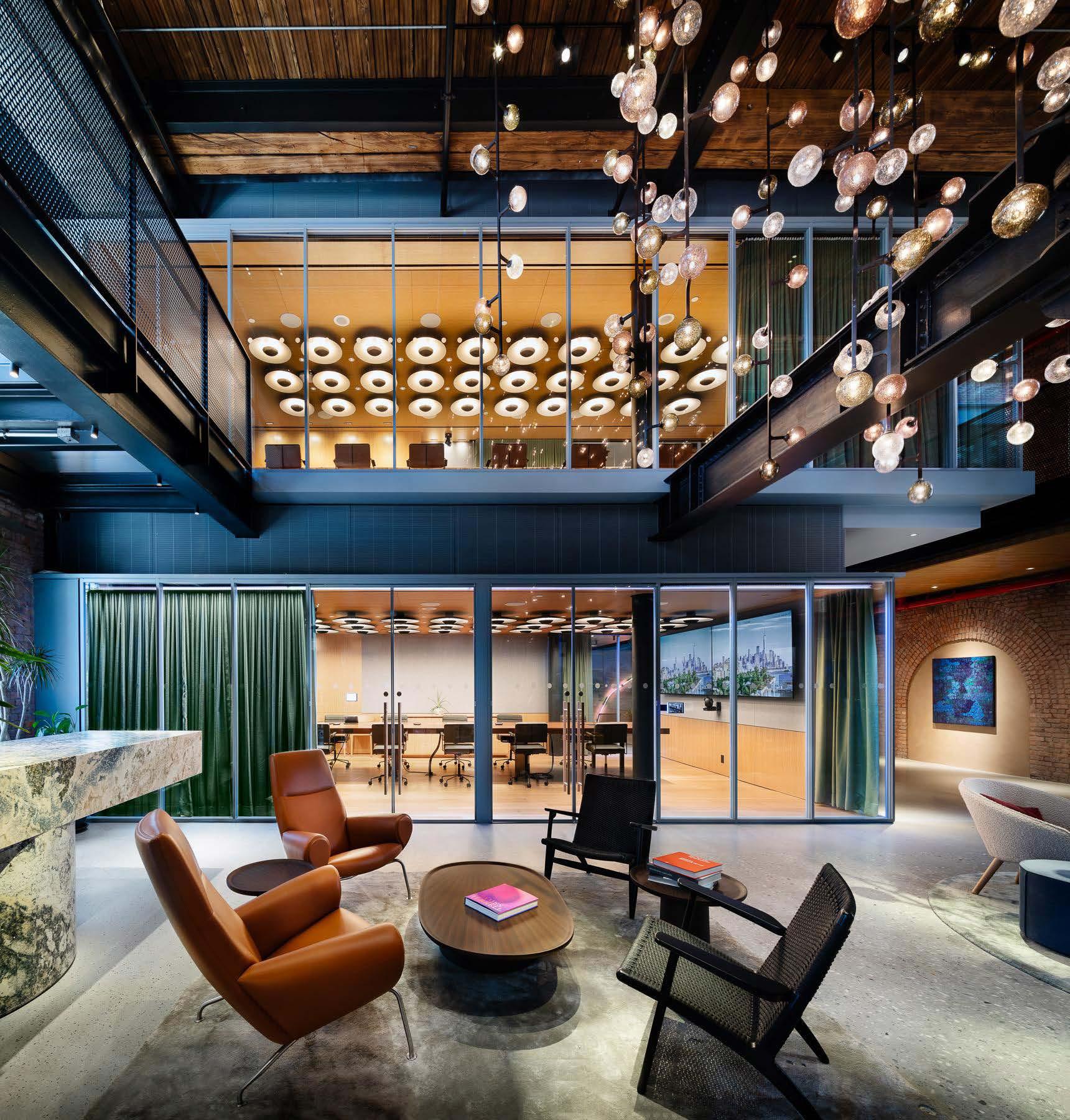
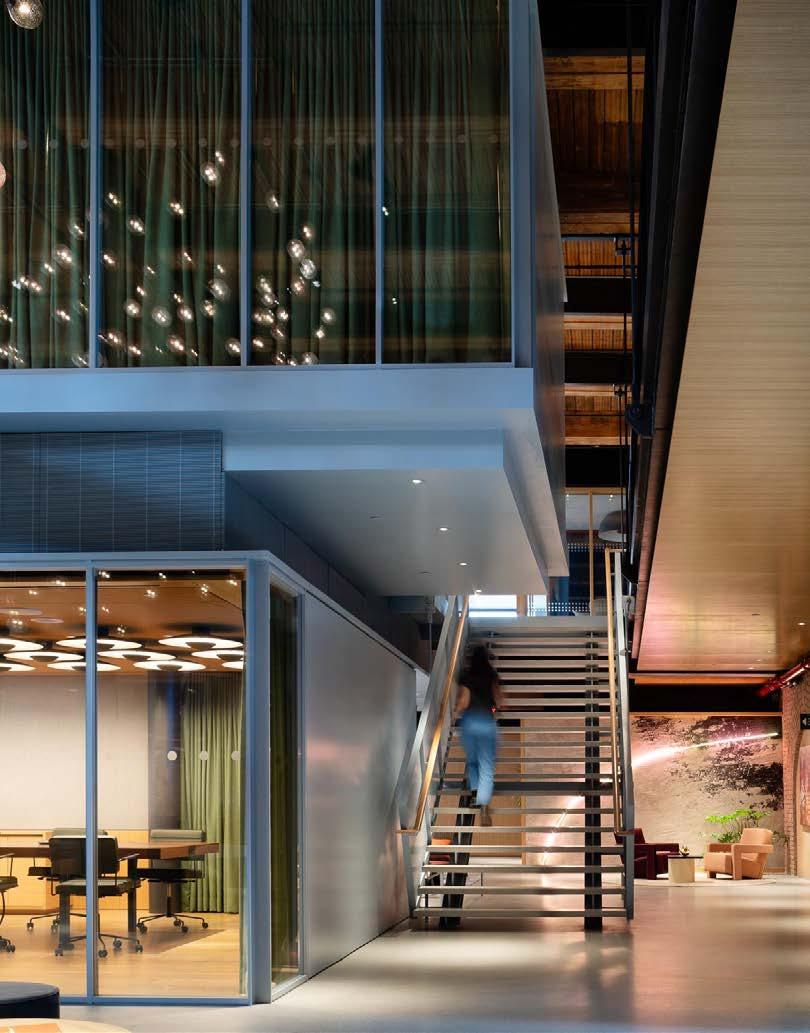
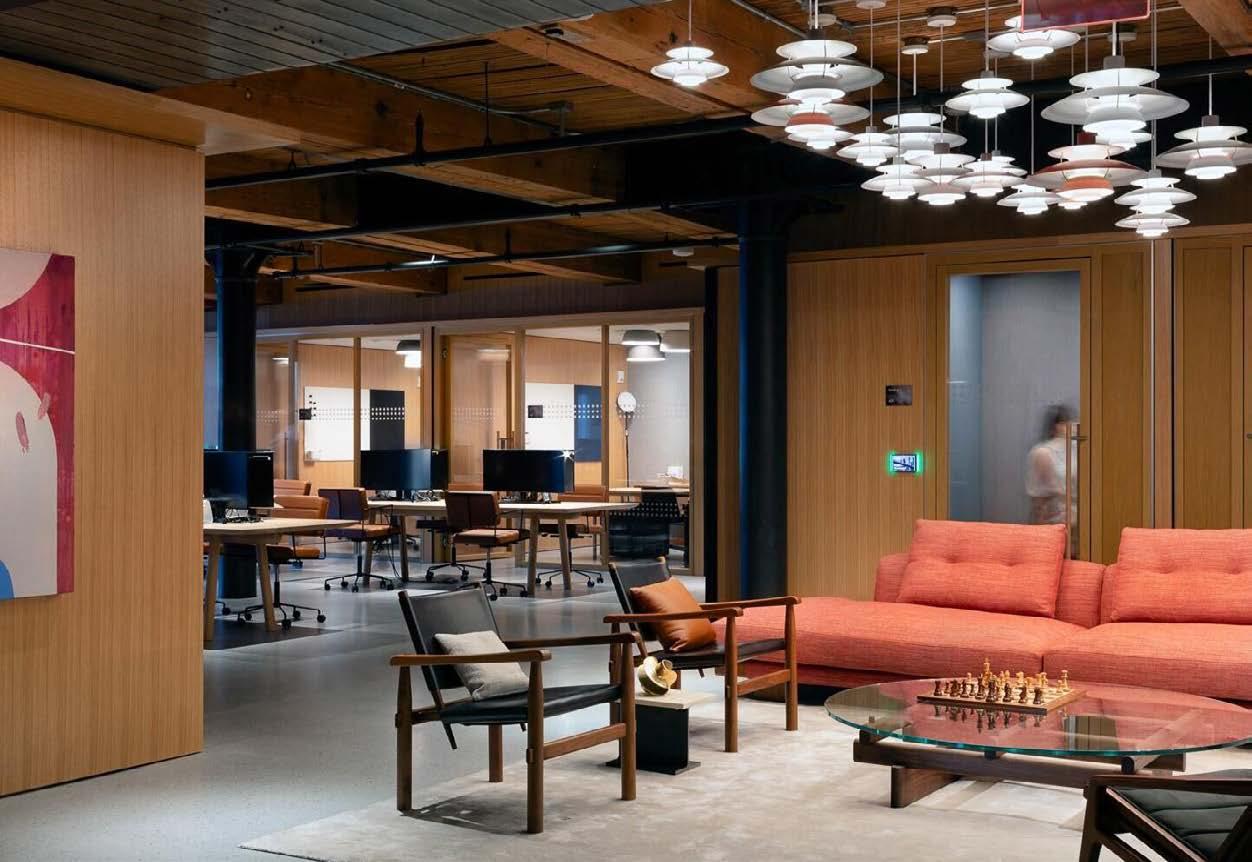
For this high-end, two-story office renovation in a historic Soho building, LYNCH EISINGER DESIGN Architects partnered with WALD Studio (project design by Kelly Roberts) to create a sophisticated lighting and control solution. Casambi’s LightingOS proved integral in realizing the smart, clean, and seamless performance the space demanded.
The Challenge
The project involved transforming an open, two-story office space while preserving its gorgeous wood floors and ceilings. Exposed ceilings meant there was no room for invasive wiring, and the client wanted dynamic, flexible lighting throughout.
Specifically:
• Multiple color scenes for different teams and departments, allowing each group to have its own lighting identity.
• Wireless control across the open floor plan, so spaces could be reconfigured without rewiring.
• Integration of color-changing fixtures while maintaining a minimal footprint, preserving the integrity of the historic building.
• Coordination across multiple drivers, fixtures, and modules, including custom Casambi integrations.
The Reality
Traditional lighting control systems can handle color customization, but they come at a high price. Achieving multiple color scenes across open office spaces typically requires expensive, wired systems with extensive hardware, which can conflict with the architecture of a historic building. Rewiring ceilings or walls risks damaging existing finishes and can compromise the aesthetic of the space. In short, delivering flexible, vibrant lighting often meant choosing between functionality and preserving the building’s character, until LightingOS came into play.
The Solution
Casambi’s LightingOS provided the backbone for a lighting experience that was as seamless as it was versatile:
• Smart: The system handled complex color scene
groupings, enabling the client to instantly switch the ambiance for a department, a meeting, or an event.
• Clean: Wireless controls minimized wiring and preserved the architectural beauty of the space.
• Easy: The intuitive Casambi app empowered users to control lighting directly from their devices, with minimal training.
• Everywhere: From private offices to open seating areas, the system maintained consistent, reliable control across both floors.
Even when installation hiccups arose, including contractor confusion and fixture-driver integration challenges, the Casambi team stepped in. Their hands-on approach ensured proper installation, enough wireless repeaters for reliable coverage, and flawless commissioning.
In Kelly Roberts’ words, “Every project faces challenges, but success often comes down to how your partners respond. When issues arose during construction, the Casambi team showed up. Their hands-on approach and commitment to getting it right made all the difference.”
The Result
The Soho office now boasts:
• Vibrant, configurable color scenes for teams, events, and branding purposes.
• Wireless, intuitive control via the Casambi app throughout the entire two-story workspace.
• A clean, minimal design that respects the historic architecture while delivering modern functionality.
The finished Soho workspace delivers the dynamic experience Roberts envisioned, rich, color-changing light scenes controlled seamlessly through Casambi’s app. Each team can transform the space to reflect their identity or client brand, while the exposed historic architecture remains intact and uncluttered.
“In the end, the system worked beautifully,” Roberts reflects. “Casambi gave us the flexibility and control we needed, and their team’s commitment turned what could have been a stressful process into a win.”
With Casambi’s LightingOS, the office isn’t just lit; it’s alive, responsive, and smart. The system shows that sophisticated control doesn’t have to be complicated, invasive, or overwhelming. It’s lighting that works everywhere it needs to, without getting in the way of the design. ■
JUST IN...
New architectural lighting products available for specification
Designed by David Chipperfield, Ribeira is a compact outdoor family—ceiling, wall, and bollard—that balances a “quiet presence” with precise optics. A recessed central void and miniaturized Opti Diamond optic create a soft, uniform crown of light, with additional Lens options for a continuous “No Dot” ring or asymmetric distributions via Opti Smart Lens. Ribeira is silicone-free, fully disassemblable, and uses recycled/recyclable die-cast aluminum.
Debuting at Lightapalooza 2026, Artafex 1 is DMF’s 1-inch architectural downlight built for whole-home use, delivering up to 1,000 lumens with a patent-pending 3-Stage Optic for strong glare control, plus 35° lockable, gear-driven aiming. PhaseX power adds tunable white, flicker-free dimming to 0.1%, and serviceability from below the ceiling plane.
Cylinder One Spectrum™ is a self-contained, high-performance downlight built for medium-tolong throw applications. A sleek, consistent form factor supports four mounting options to suit varied architectural constraints. Powered by the Spectrum Five light engine, it offers saturated RGBAL mixes, tunable white from 1800K–8000K, and an Ai Dim mode that emulates incandescent-style red-shift dimming.
To support that PhaseX ecosystem, DMF’s new Ethernet-enabled gateway removes the need for separate DMX control boxes, simplifying system architecture while cutting hardware and commissioning costs. Setup runs through DMF software (including over Wi-Fi), with native integration for platforms such as Control4 and Crestron. Availability is expected in early Q2.
Luminii’s new rebuilds the “engine” behind its linear portfolio, introducing five nextgeneration strip families with standardized 10mm architecture for simpler specification and broader fixture compatibility. The upgrade adds expanded outputs and CCTs, tighter cut increments, improved dimming, and higher performance, alongside wider BAA/BABA coverage and a 5-year wet-location warranty.
MOMENTUM is a scalable, modular linear system designed for clean architectural lines, supporting continuous runs and geometric layouts across commercial spaces. Field-selectable wattage, CCT, and distribution streamline specification and on-site adjustments, while magnetic connections deliver strong, consistent alignment for crisp, uninterrupted installs.
USAI’s Small In One™ – Mini is a compact, install-frombelow recessed platform that combines downlight, adjustable, and wall wash performance without sacrificing ceiling aesthetics. It delivers over 2,000 lumens from a 3-inch aperture in a profile under 4 inches tall, fits tight plenums, and offers beam spreads from 10°–65° with up to 40° of lockable tilt.
Paul A Life in Light, Marantz: and Curiosity,Craft
By RANDY REID
All images courtesy of FMS.
The Celebration of Life for Paul Marantz, held on January 29th at The Starr Foundation Room at Parsons, was beautifully conceived and thoughtfully paced. Enough time had passed since Paul’s death that the raw shock had softened, allowing the evening to settle into something more reflective and generous. The room was filled with colleagues, friends, and admirers who came not only to mourn, but to remember, to learn, and to smile. The mood was warm and engaged—at times deeply personal, at times instructive—and there was a quiet sense that the evening itself reflected Paul’s spirit: curious, rigorous, and forward-looking. It was, unmistakably, an uplifting and motivating gathering.
In 2010, the IES commissioned Dan Blitzer to interview several of the great figures in lighting, and those archival
recordings became the emotional backbone of the evening. The program opened with a 3 min slideshow featuring dozens and dozens of Paul’s projects (set against a snappy Donald Byrd soundtrack) a clip of Paul speaking in his own voice, immediately grounding the room in his presence. Seventeen speakers followed, each beginning with another short archival clip of Paul—sometimes reflective, sometimes humorous, always insightful—before offering their own memories and observations. From a standing-room-only crowd, I listened from the back of the room. While the quotes that follow are not word-for-word transcripts, they are faithful to the sentiment, intent, and substance of what was shared, capturing both the wisdom Paul imparted and the lasting impact he had on those who learned from him.
SPEAKER: PAUL MARANTZ
(archival clip)
“Somewhere in the drawer of your brain, you run the risk of thinking that you know the answer to the minute details of the project that walks in the door. I've seen this, you could say, I've seen this before.
And the risk of that is that you then stop; you have interrupted your process of thinking—the basic thoughts of really wiping clean the slate and starting over again.
And it's perfectly human. Well, we've done this, we know how to do this.
Let's not mess around with it. That's what we do. And I hate, personally, the ‘that's what we do,’ because that mentality interferes with your growth. It interferes with the most appropriate solution. And at that moment, you become sort of frozen. You have to fight against all that stuff because it's all too easy.”
Hank Forrest of Fisher Marantz Stone, opened the evening by setting both the tone and the ambition of the program. He described the segment as “Paul Marantz in
the audience a clear sense of why Paul mattered and why his influence endures.
To make the point, Hank referenced the 2004 film Ray, noting that even viewers unfamiliar with Ray Charles could leave the theater understanding what made him extraordinary. Paul’s career, Hank suggested, deserved a similar framing. With limited time, the evening aimed to provide “some inkling of what was special about him and why he influenced so many people,” establishing a lens through which the rest of the program would unfold.
The program then turned to its first speaker, Gary Dulanski of the Dulanski Group. Hank recalled working with Gary when he joined Fisher Marantz in 1987, when Gary served as a controls representative and quickly became the trusted authority on lighting controls and complex electrical systems. Few subjects both intrigued and frustrated Paul more than controls, Hank observed, which made Gary “the perfect place to begin.” With that, he welcomed Gary to the stage.
Gary Dulanski opened by grounding the evening in the idea of storytelling.
Hank Forrest
The room was filled with colleagues, friends, and admirers who came not only to mourn,
but to remember, to learn, and to smile.
Paula Martinez -Nobles
As a longtime manufacturer’s representative, Gary described his years working with Paul Marantz as equal parts collaboration and adventure. Paul, he recalled, was never content with the obvious solution. “He was always trying to bend the rule a little, push the book, and figure something out,” Gary said. That curiosity often led to hands-on experimentation—testing ideas in the field, improvising setups, and learning by doing.
Gary shared stories of Paul’s willingness to get his hands dirty, whether hauling equipment to test lighting concepts at Little Island or drilling into a luminous sphere to create an entirely new fixture solution. Paul, Gary observed, was relentlessly curious, deeply practical, and unafraid to experiment. “He was out of the box—sometimes literally out of the sphere,” Gary said, crediting that mindset for many of the projects that still resonate today.
Charles Stone followed by placing the evening—and his own career—into vivid context. He began by thanking “executive producer” Hank Forrest, and “line producer” Carla Ross Allen. He then traced his connection to Paul back forty-three years, to a Friday Amtrak ride from Washington to New York. At the time, Charles was intent on working for Jules Fisher and Paul, drawn instinctively to what he believed was the most thoughtful and ambitious lighting work anywhere.
After a walk through the studio at 126 Fifth Avenue, and lunch at Pete’s Tavern, Paul offered him a job—an offer Charles later realized was “really an offer
of a career.” Paul became first a boss, then a mentor, and eventually a partner, passing along responsibility with uncommon trust. What defined the studio, Charles said, was stability and mutual respect, paired with Paul’s uncanny ability to identify what mattered most. “You always had to bring your A-game.”
Paul had an uncanny ability to quickly identify the thing of greatest importance on any project. He would ask, “Stone, what do you think?” If Charles replied with a good sketch—or perhaps a clever comment—they would talk. But if he hesitated, two seconds later Paul would walk away.
From projects like Little Island to major cultural and corporate commissions around the world, Paul’s approach was consistent: a quick sketch, a clear idea, and just enough light—and negative space—to let the story emerge.
Looking back on more than 5,000 projects on six continents, Charles called it a great ride. “The ride continues,” he said. “We’ll keep sketching, tinkering, creating—and we’ll remember Paul for his smile and his steady, reliable genius.”
Paula Martinez-Nobles, former intern and now President of Fisher Marantz Stone, reflected on Paul Marantz as a restless experimenter—someone endlessly drawn to the potential of small objects. Paul, she recalled, delighted in “toys”: lenses, connectors, films—anything that could be repurposed and reimagined. These objects acted like magnets. If you wanted Paul’s attention, Paula joked, you simply placed something intriguing on your desk and waited.
He would wander over, pick it up, turn it in his hands, talk through the idea out loud, then disappear—often taking the object with him. Days later, it might reappear elsewhere, accompanied by a quick sketch and a plan to make something ordinary better. Paul had an instinct for discovering new uses for familiar tools. In doing so, he quietly fostered a culture of curiosity, generosity, and collaboration across the studio and the broader industry. “He was a pollinator,” she said—and many of his ideas are still in bloom.
Dan Blitzer noted that when he first walked into Paul Marantz’s office in 1975, he had little experience—and even less standing. Thirty-five years later, in 2010, Dan found himself in a very different position. When Addison Kelly and Bill Maynard assembled the interview program on behalf of IES, he was invited to conduct the on-camera conversations with Paul Marantz and Jules Fisher.
While the footage may appear calm, Dan emphasized that the reality was anything but static. The ideas moved quickly, bouncing back and forth in real time. Dan complimented Hank for editing more than two hours of material into concise excerpts that captured that energy, offering a rare glimpse into how Paul thought, challenged, and created.
SPEAKER: PAUL (archival clip)
“The methodology of getting a day job was I opened a New York classified telephone directory under lighting design and I think there were only a few entries. One must have been Richard Kelly and the other was Marvin Gelman's company.
He would design things, he would rent things, he would make things. It was survival time for Lighting Services. So I called them and he said come down for an interview in a basement office on Park Avenue and after a half hour he says well, I'd like to offer you a job, you can be the chief engineer. And I said, I'm not an engineer. He said, that doesn't matter. It sounds better than apprentice.
So I became the chief engineer, having no engineering background whatsoever, and went on to do a whole lot of architectural lighting design because customers were coming and their specialty was retail store windows. We did all the windows of Saks, and Tiffany's, and Bergdorf, and all the Fifth Avenue stores.
So that was kind of a nexus between theater lighting and architectural lighting. We'd design the installation, and then we'd go in and light the windows.”
Following the archival footage, Daniel Gelman—CEO of Lighting Services Inc and the son of its founder— shared a personal and affectionate perspective on Paul Marantz’s earliest years in the profession. He recalled being struck by the story of Paul’s first job offer as chief engineer at Lighting Services, a role that sounded glamorous on paper but required descending a back alley and metal stairs to reach the modest office at 77 Park Avenue. Paul, Daniel noted, was unfazed. He took the job and stayed for seven formative years.
As a child, Daniel often accompanied his father to the office and gravitated toward Paul, who always had something to tinker with. “Paul was a tinkerer,” he said, remembering magnets, propellers, and improvised tools scattered across Paul’s desk. Reflecting on a later interview, Daniel quoted Paul describing his time at Lighting Services as “the equivalent of three advanced degrees,” calling it an opportunity that shaped everything that followed.
SPEAKER: PAUL (archival clip)
“A young person my age, exactly my age, walked in and said that he was doing off-Broadway lighting to the plays and would like to find a cheaper way to do it than the equipment that he was able to rent in the regular retail chain. That young person was Jules Fisher. And as luck would have it, Jules started getting offers to do architectural projects and he was busy doing shows so he would call me and say, do you want to do this?
SPEAKER: JULES FISHER (archival clip)
“When I was, as Paul says, looking for less expensive means to light shows, I always wanted to get the most for the dollar. I wanted the most amount of lighting I could put on the stage to do this play, or what was required of the material. But there was always a budget, like today. And off-Broadway, the budgets were much smaller than Broadway. And I kept having grander and grander ideas of how to make lighting look interesting. So I was looking for any source, and I probably went to the phone book and found Lighting Services Inc and I remember going to Park Avenue in a little staircase into the
Daniel Gelman
Paul Marantz at David Geffen Hall
basement, and I met you and said do you have lights to rent?
And I was happy to use those, and you were willing to make things for me. So if I wanted a certain light with a certain barn door, a certain shape fitting on it, you were able to manufacture it.”
SPEAKER: PAUL MARANTZ (archival clip)
“I went to Century and was there for three years. I had the opportunity to work with some of the lighting consultants in the field at that that time. And so I was learning more about architectural lighting on a larger scale. Century was purchased by Strand, a British firm, and they decided to move the headquarters to California. And I didn't want to move to California, I had a family here. And Jules and I had informally talked about setting up something, and that was the sort of the engine that caused us to start a firm.”
SPEAKER: PAUL MARANTZ (archival clip)
“When we started, the idea that there would be a lighting designer on a project was unusual and special, and
now the idea that there would NOT be a lighting designer on a project is unusual and special.”
Francesca Bettridge reflected on Paul Marantz from the perspective of a peer and longtime observer of the profession’s evolution. While she never worked with Paul directly, his words and example resonated deeply with her own experience as both a participant in—and witness to—the growth of architectural lighting design. She recalled the early years of the field, when convincing architects and owners of the value of a lighting designer was itself a challenge, before that role became an expectation rather than an exception.
For several years, Francesca and Paul met regularly for lunch. Those conversations, she said, were more than pleasant—they were grounding. Paul was “a fellow traveler” in a small professional world, generous with his time, relaxed in manner, and quietly funny. Even as a colleague at a competing firm, he remained open and supportive, embodying a generosity that helped define the profession itself.
SPEAKER: PAUL MARANTZ (archival clip)
“Job of the architectural lighting designer is to inhabit the mind of the architect….you have to understand what the vision is of the building and find a way to support that”.
Architect Tyler Donaldson commented that Paul always figured out how to get it done, Architects loved working with Paul because he made their buildings better”.
Teal Brogden of HLB Lighting Design reflected on how deeply personal—and often quietly humorous—Paul Marantz’s influence could be. She noted that while Paul’s brilliance shaped countless lives, what stood out to her was his humility and mischievous intelligence. Early in her career, while managing a project for a Barcelona hotel, Teal witnessed Paul’s ability to read people as deftly as he read architecture.
The client meetings were intense: a husband-and-wife team, equally passionate, frequently argued—sometimes throwing things—over competing priorities. As tensions rose over whether to have a ceiling cove or ductwork, Paul remained calm. He opened his sketchbook, pulled out his pencil, and drew a waiter carrying a silver tray. “We’ll just have a thousand waiters bring in cool air,” he suggested, sketching as he spoke. The room broke into laughter, and the conflict dissolved.
Paul, Teal said, understood that good design required seeing everything—light, space, and people. “He saw the client,” she observed, “and because of that, he brought projects to life.”
SPEAKER: PAUL MARANTZ (archival clip)
“The only project that I ever had a hand in that is likely to endure at least in memory has nothing to do with architecture at all. It was the Tribute in Light which was supposed to have been a temporary thing that happened until a permanent memorial could be built. But no one seems to be able to leave it behind. Somehow it has embedded itself in the consciousness of New York.”
Rob Schoenbohm described the extraordinary technical challenge behind the first iteration of the Tribute in Light, created in March 2002—just six months after the attacks. Rob recalled that the idea of projecting two vertical beams into the night sky raised immediate questions. “There was no IES guidance for lighting thin air,” he said.
Sent to Las Vegas to test large Xenon searchlights in the desert, Rob evaluated the beams from miles away before returning to New York. When Paul asked whether the lights would work, Rob answered yes—followed, he admitted, by
“five of the most anxious months” of his life. The final installation relied on 88 lights powered by generators, focused by hand in freezing winds (It was March 11th). Achieving the illusion required obsessive precision: fractions of a degree in tilt mattered, often forcing fixtures to be physically reoriented just to gain another quarter degree. Through it all, Rob said, Paul had the vision—and the courage—“to leap into space” and make it work.
There were other key quotes from Paul throughout the night. A few follow:
“The first question is what do I have to see and where do I have to see it from.”
“Seeing is more than just reading a book or writing a sentence, it is also how do I see and feel about the environment I’m doing this in, what does the environment supposed to do for/with me.”
“What is the problem, what are we trying to do, what is the simplest way we can possibly do this…. usually the simplest way is the best way.”
“(In lighting) theater people have a great advantage because they do work very rapidly and can learn from their mistakes.”
There were many other speakers each offering their own perspective on Paul’s life and work. The collective message was unmistakable. Through stories large and small, technical and personal, the evening made clear that Paul Marantz’s legacy is not confined to projects or portfolios, but lives on through the people he taught, challenged, encouraged, and inspired—and through the way they continue to see, question, and shape light. ■
SCHOLARSHIP
Constantly experimenting with light and shadow, Paul was a thoughtful, curious and endlessly creative designer of light and luminaires throughout his long career. His mastery of the power of light has inspired generations of colleagues and clients.
To join in honoring Paul’s legacy and for information on how to donate through the Nuckolls Fund for Lighting Education, please scan.
On a weekday morning in the Wakefield section of the Bronx, students move through the new addition at Public School 87 with a sense of ease that feels intentional. Light is present everywhere, but rarely noticed. Classrooms feel evenly illuminated without glare. Corridors guide movement without calling attention to themselves. Even the gymatorium shifts effortlessly from physical education to performance mode. This quiet consistency is no accident—it is the result of a lighting strategy conceived as infrastructure rather than embellishment.
Designed by RKTB Architects in partnership with the New York City School Construction Authority as both client and construction manager, the 58,000-square-foot expansion and modernization of P.S. 87 added 17 general classrooms, eight special education classrooms, dedicated art and music studios, administrative offices, and a stateof-the-art gymatorium. From the earliest design phases, according to RKTB principal and K-12 studio lead Albert Aronov, AIA, lighting was treated as a core building system—fully coordinated with HVAC, acoustics, and life-safety requirements rather than layered on after the fact.
Coordinating Light and Air
The introduction of full central air conditioning and heating fundamentally shaped the lighting design. With mechanical systems now standard for SCA schools, ceilings became the primary site of integration. Lighting had to coexist seamlessly with air distribution, fire protection, and acoustic treatments while remaining flexible for future adaptation.
Throughout the building, low-profile luminaires are carefully aligned within ceiling systems that prioritize clarity and restraint. The visual result is calm and orderly; operationally, the approach minimizes maintenance and allows lighting and mechanical systems to evolve over time without disruptive reconfiguration. Lighting does not assert itself architecturally—it supports the architecture by staying disciplined and unobtrusive.
Classrooms Tuned for Learning
With a wide range of instructional environments, lighting strategies were calibrated to support different learning needs. In general education classrooms, direct/indirect LED luminaires provide balanced ambient illumination, reducing glare and shadowing while maintaining consistent light levels throughout the day. This supports reading, writing, and screen-based instruction without visual fatigue.
Special education classrooms build on this approach with an increased emphasis on visual consistency and comfort. Light levels and fixture placement were refined to minimize contrast and overstimulation, supporting students with diverse sensory sensitivities. Here, lighting plays a stabilizing role—present, reliable, and intentionally understated.
Dedicated art and music studios required more specialized solutions. In art rooms, high color rendering and enhanced vertical illumination allow students and teachers to perceive colors, textures, and materials accurately. Music rooms, by contrast, are evenly lit with careful glare control, supporting
both instruction and performance without visual distraction. Across all learning spaces, the guiding principle remained consistent: lighting should support the activity without becoming the focus.
A Gymnasium That Performs
The combined gymatorium represents one of the most technically demanding spaces in the project. Designed to function equally well for daily physical education, assemblies, and performances, its lighting system needed to be both durable and adaptable.
High-bay luminaires deliver uniform, high-output illumination for athletic use and are specified to withstand impact while maintaining visual clarity. For performances and assemblies, theatrical lighting integrated at the stage introduces dimming and zoning capabilities, allowing the space to transition seamlessly between functions. This layered strategy preserves a cohesive architectural character while enabling flexibility—a hallmark of the project’s lighting approach.
Illuminating Art and Circulation
Lighting also plays a critical role in supporting public art integrated into the building. A large-scale installation titled Friends and Family by artist Dennis RedMoon Darkeem is located along the second-floor gymatorium hallway. Composed of seven-foot-high panels of ceramic tile, marble, granite, travertine, and stone, the artwork required a lighting response tailored to its material richness and scale.
RKTB worked closely with SCA Public Art for Public Schools, engineers, and the artist to study color rendering, glare control, and sightlines. The resulting lighting enhances the artwork’s presence while respecting the corridor’s everyday function as a circulation space. Light, art, and architecture operate together, creating a distinct moment without disrupting daily movement.
On the first floor, the main corridor serves as both circulation spine and civic space. Slot-type linear fixtures
reinforce spatial order and continuity, guiding students and visitors while maintaining a clean, consistent visual language.
Quiet Performance, Long-Term Value
Following NYC SCA standards, lighting choices prioritize durability, energy efficiency, and ease of use. High-efficiency LED fixtures with long service lives reduce maintenance demands, while straightforward control strategies align with daily school operations rather than relying on complex user interaction.
Accessibility informed lighting decisions throughout the project, supporting clear wayfinding and visual comfort for students and staff of all abilities. Ultimately, the lighting at P.S. 87 is designed to be quietly effective— integrated with building systems, resilient in a demanding environment, and flexible enough to support the school’s
FIXTURE SCHEDULE
FIXTURE MFG
ALTMAN
ACUITY BRANDS / ACUITY MARK
ALTRU
CANLET
EATON
FINELITE
HOLOPHANE
Clamp-on theatrical spotlight (Q25 style)
Clamp-on PAR-style theatrical fixture
Acuity Mark architectural linear slot luminaire
Acuity Mark recessed architectural lighting slot (various configurations)
Universal self-powered LED exit sign with emergency battery pack
Black non-metallic fluorescent wall-mounted fixture
Wall pack with glare control and forward throw optics
evolving needs over time.
At Public School 87, lighting does not announce itself. Instead, it creates the conditions for learning, movement, and community to unfold naturally—an essential, invisible framework for a modern public school. ■
FIXTURE MFG DESCRIPTION
LITHONIA LIGHTING
METALUX
PARAMOUNT
PEERLESS LIGHTING
RAB LIGHTING
SIGNIFY / PHILIPS (GENLYTE FAMILY)
ULITRON
Area of refuge fixture (LED)
Metalux 2FT linear LED luminaire (surface/recessed)
Architectural studio luminaire (custom aluminum construction)
Fully gasketed canopy luminaire with stainless steel hardware
Recessed emergency lighting fixture
Surface-mounted colored steel housing fixture
Dual Hub | 107
One Hub. Three Profiles. Limitless Light.
Experience design flexibility with the 107 style’s new Dual Hub mounting option — now available across the Box, Race, and Wing families.
This innovative option seamlessly combines two rail types into a single, streamlined fixture, empowering you to create new lighting solutions tailored to the most complex applications with unparalleled style and performance while reducing component and installation costs.
Features & Benefits
Dual Rail Integration
Complex lighting designs are simplified by combining 107 rail types into one minimal fixture.
Versatility
The Dual Hub enables creative combinations by allowing you to mix and match fixtures.
Rotational Control
Each fixture can rotate up to 360 degrees, allowing precise beam control.
Familiar Fixtures
Utilize any of the 107 fixtures to suit any application.
Cold City, Warm Light.
LUMINO TRANSFORMS MONTREAL
After Dark
Winter is often treated as something to endure in Montreal. With LUMINO, it becomes something to inhabit.
Now in its 16th edition, LUMINO has grown into one of the most ambitious winter light events in the world—an urban-scale laboratory where light, sound, interaction, and climate converge across the Quartier des Spectacles and the broader downtown core. Running through 8 March 2026, the free experience unfolds across more than 15 indoor and outdoor sites, weaving luminous installations, video projections, and participatory works into the everyday rhythms of the city.
Last winter, LUMINO drew more than 1.5 million visitors. That number is not accidental. Over the years, the festival has evolved from a seasonal attraction into a civic instrument—one that reframes winter not as an obstacle, but as a canvas.
This year’s program includes 35 works, 19 of which are original creations debuting in Montreal, alongside 23 installations by Quebec-based artists. The festival unfolds in three distinct phases: a holiday-season launch in November and December, the unveiling of major new works in January, and special programming during March break. The result is a living exhibition that changes with the season, encouraging repeat visits and prolonged engagement.
“For more than 15 years, LUMINO has been an exceptional platform for creators of all stripes to present unique participatory experiences,” said Monique Simard, chair of the boards of directors
“The works transform citizens’ and visitors’ view of winter and the urban environment.”
― Monique Simard
Celestia, Kleis. Photo credit: Ulysse Lemerise / OSA
of the Quartier des Spectacles and Quartier des Spectacles International. “The works transform citizens’ and visitors’ view of winter and the urban environment.”
That transformation is especially evident in Les Voyageurs (Travellers) by Cédric Le Borgne. Floating above five downtown hotels—including Hôtel HoneyRose Montréal, Fairmont The Queen Elizabeth, and Montréal Marriott Château Champlain— the luminous figures appear suspended between sleep and wakefulness. Seen from the street, they prompt passersby to look upward, stitching a quiet, poetic dialogue between architecture, sky, and public space. The project was realized in collaboration with Tourisme Montréal and the Association hôtelière du Grand Montréal, extending LUMINO’s reach beyond traditional cultural sites.
Elsewhere downtown, light becomes both object and invitation. On Sainte-Catherine Street West, France’s TILT Studio presents Anemonia and Shadow, biomorphic sculptures inspired by marine and terrestrial
plant life. Nearby, Unicode Haïku Extension by Fred Sapey-Triomphe pairs generative light with poetic rhythm, while Sagesse de foule by Ottomata turns bodily warmth and reflexes into playful participation.
Video projection—long a signature of LUMINO—returns as a central medium. New works by Iana Brezeky, Marie-Ève Drolet, and Teo Leroo animate four of the Quartier’s projection surfaces with palettes drawn directly from winter’s chromatic language. At Esplanade Tranquille, Le coffre à jouets dégivré by Ottomata and Doki transforms the skating rink into an interactive field of motion and light beginning mid-January.
At Place des Arts, the work becomes more immersive. Michel Lemieux’s Vulnérable responds directly to human movement, generating evolving avatars that feel at once fragile and alive. Nearby, Stargate by Chalk River Labs wraps a sculptural structure in video mapping, inviting visitors to step inside the work itself—both participant and subject.
Les voyageurs, Cedric Le Borgne, Fairmont Le Reine Elizabeth
Photo credit: Ulysse Lemerise / OSA
Throughout the program, LUMINO demonstrates a consistent curatorial belief: that light is not decoration, but experience.
January introduces a new layer of scale and ambition. ChronoHarp by Australian duo Amigo & Amigo transforms the Promenade des Artistes into a playable luminous instrument, while Horizon by Olivier Landreville creates a field of glowing cocoons at Place Ville Marie’s Esplanade PVM. In the Quartier Latin, Mirari’s Climat intérieur debuts as a world premiere, and Studio Vertigo’s End over End reimagines a childhood Slinky at monumental scale on the Glissades Gamelin.
Throughout the program, LUMINO demonstrates a consistent curatorial belief: that light is not decoration, but experience. It shapes movement, alters perception, and reframes the relationship between people and the city—especially in winter, when darkness and cold heighten every sensory response.
In Montreal, winter does not recede for light. It collaborates with it. ■
Photo credit: Ulysse Lemerise / OSA
Lighting
a New Tempo: Crafting Atmosphere at Hilton Tempo Nashville Downtown
In the center of downtown Nashville, where honky-tonks, high-rises, and hospitality collide, the Tempo by Hilton Nashville Downtown sets out to do something deceptively difficult: feel energetic without becoming chaotic. The hotel’s interiors lean into eclectic materials, curated artifacts, and moments of luxury, but it is the lighting that ultimately holds the experience together—guiding movement, shaping atmosphere, and giving clarity to an otherwise richly layered environment.
That responsibility fell to Gwen Grossman, Principal of Gwen Grossman Lighting Design and her Senior Lighting Designer, Alexandria Quella. Their approach to the project emphasizes hierarchy, concealment, and precision over visual noise. Completed in 2024, the hotel was designed by ESa with interiors by Wimberly Interiors.
From the moment guests enter the lobby, it becomes clear that this is not a space lit by fixtures alone, but by strategy.
Arrival and the Language of Glow
The lobby experience begins at the reception desks—twin sculptural elements that act as both wayfinding and visual anchor. Each desk features layered, curved integrated lighting concealed within the millwork, creating a soft, luminous presence rather than a bright focal point. The glow establishes importance without glare, guiding guests intuitively while reinforcing the hotel’s refined tone.
Alex describes these desks as critical moments where lighting needed to balance functionality and elegance. Rather than relying on overhead illumination, the design emphasizes integrated sources that wrap and define form, ensuring faces are well lit while surfaces remain visually calm.
Above, cove lighting introduces movement across the ceiling plane. Each cove is treated individually, responding to the material and geometry it contains. Most striking is the cove above reception, where real gold leaf transforms reflected light into a shimmering surface that changes subtly as guests move through the space. The lighting here does not compete with the finish; it activates it.
Vertical Surfaces and Visual Comfort
Throughout the lobby and public spaces, vertical illumination plays an outsized role. Walls, curtains, and art surfaces are carefully grazed and accented, creating depth while reducing reliance on uniform downlighting. This strategy allows the space to feel expansive and layered, even as ceiling heights fluctuate.
Curtain grazers were particularly important near reception, where soft textiles act as both backdrop and acoustic buffer. Lighting these elements vertically adds warmth and visual softness, helping to ease transitions between circulation zones and gathering areas.
Art throughout the hotel is treated with
adjustable accent lighting, allowing each piece to be highlighted without overpowering adjacent elements. Alex notes that flexibility was essential, as artwork placement evolved during construction. The lighting system accommodates these changes without compromising intent.
The Bar: Precision Meets Atmosphere
Behind the bar, lighting shifts from ceremonial to tactile. Integrated shelf lighting is concealed within custom millwork, highlighting liquor bottles with a deliberately warm, flattering glow. The shelves are illuminated at 2400K, a conscious choice to enrich amber tones and bring depth to whiskey and spirits, allowing glass and liquid to read with warmth and saturation. Throughout the remainder of the space, architectural lighting is set at 2700K, creating a subtle but perceptible contrast. That slight temperature shift gives the bar display visual priority without breaking cohesion, lending richness to the bottles while maintaining overall color harmony across the room.
Narrow-beam recessed downlights provide focused illumination on the marble bar countertop, ensuring functionality without flattening the space. Decorative pendants contribute visual interest, but they are never asked to perform alone. Architectural lighting quietly does the work, allowing decorative elements to remain expressive rather than utilitarian.
This layered approach ensures that the bar reads as inviting during the day and intimate at night, adapting seamlessly to changes in daylight and occupancy.
Exterior Identity and Continuity
The lighting narrative extends beyond the interior. The building’s exterior is articulated with individual fin lighting along the roofline, reinforcing the hotel’s vertical rhythm against Nashville’s skyline. Along the lower façade, custommodified linear fixtures are integrated into metal panel ceiling chases, maintaining a clean architectural expression while providing functional illumination.
Rather than treating the exterior as a billboard, the lighting emphasizes structure and material, allowing the building to participate in the cityscape without overpowering it.
Pool Deck and Nighttime Social Life
At the pool deck, lighting shifts again—this time toward warmth and sociability. Integrated lighting along railing walls provides low-level guidance while maintaining open views. Overhead, a suspended catenary system casts a golden glow across the exterior event space, creating an atmosphere that feels festive without spectacle.
The catenary lighting introduces a sense of intimacy, lowering the perceived scale of the space and encouraging guests
to linger. Its warm tone contrasts with cooler ambient city light, subtly separating the hotel’s environment from its surroundings.
Concealment, Control, and Longevity
A defining characteristic of the project is how little of the lighting is visible. Fixtures are tucked into millwork, coves, ceiling slots, and architectural details, allowing materials to take center stage. This concealment supports both visual comfort and long-term durability—an essential consideration in a high-traffic hospitality environment.
Control strategies reinforce flexibility without sacrificing consistency. Preset scenes guide the space through natural shifts from day to night, while still allowing staff to respond to occupancy and use in real time—an approach that supports the hotel’s changing rhythms rather than locking it into a single lighting condition.
Gwen explained, “Everything is controlled with Lutron. The bar area has local control with five preset scenes. The bar is also connected to the exterior, so whoever is working there can balance interior and exterior lighting together as the space transitions from day to night.”
A Cohesive Experience
At Hilton Tempo Nashville, lighting does not announce itself. Instead, it clarifies, supports, and elevates. By prioritizing
layered illumination, vertical surfaces, and concealed sources, Alex and Gwen created an environment that feels energetic yet composed—one that reflects Nashville’s vibrancy without mimicking its noise.
In a hotel designed to draw guests out of their rooms and into shared spaces, the lighting succeeds not by dazzling, but by understanding how people move, gather, and linger. It is lighting that sets the tempo—steady, confident, and unmistakably intentional. ■
Powered by the Sun, Shaped by the Community
Alondra Gateway Park sits quietly along Compton Creek, transforming a once-vacant half-acre into a place of belonging.
It is the first built project from a larger master plan for the creek corridor, and while modest in scale, it carries an outsized sense of intention. The park reflects the everyday life of its neighborhood—cyclists and walkers passing through, families gathering, horses tied up while riders linger nearby— all stitched together by a lighting strategy that is as pragmatic as it is thoughtful.
“This was really about giving something back to the
community,” says landscape architect Mike Hee, Technical Director at Studio-MLA. “It went through a lot of community meetings. People wanted a place that felt like it belonged to them, not just another park dropped in.”
The site itself is tucked between Compton Creek, lined with equestrian and pedestrian paths on one side and houses on the other. Parking serves both the park and the adjacent burrito shop, reinforcing the idea that this is a lived-in space rather than a destination. Design cues throughout reference the area’s agricultural and equestrian history: horseshoeshaped benches, horseshoe-inspired play elements, and
“It went through a lot of community meetings. People wanted a place that felt like it belonged to them, not just another park dropped in.” ― Mike Hee
tie-ups that allow riders to dismount and participate in the park.
Lighting became a defining part of the project, not because the team set out to make a statement, but because circumstances demanded a rethink. Despite visible utility poles nearby, coordinating a permanent electrical connection proved unworkable within the project’s accelerated construction schedule.
“The connection itself is easy,” Mike explained. “But the coordination and getting everything to line up with the utility company just wasn’t happening. The construction schedule was moving too fast.”
The solution was to pivot to solar lighting, specifically Landscape Forms’ twelve-foot LEO 360 Solar Area Light. What initially appeared to be a workaround quickly revealed itself as an advantage.
“One of the big benefits was cost,” Mike says. “By not having to trench conduit, not having to run wire, all of that labor and material we didn’t need—it ended up saving money.”
When asked directly whether the labor savings offset the additional cost of the solar fixtures, Mike was unequivocal, “It actually saved the client money; it was less expensive.”
At 3500K, the LEO 360 Solar Area Light integrates the photovoltaic array vertically into the pole, avoiding the visual clutter commonly associated with solar fixtures. The result is a clean, composed element that fits comfortably within the landscape. Finished in black and scaled at approximately twelve feet, the poles provide even illumination without overpowering the intimate site.
The lighting strategy is intentionally simple. There is no dimming system or layered control scheme. “The lights are either on or off,” Mike noted. “That’s it.” The approach aligns with the park’s character—straightforward, reliable, and welcoming rather than performative.
LANDSCAPE FORMS ELEMENTS:
• LEO 360 Solar Area Lights, MultipliCITY Tables and
• Benches, Bola Bike Racks,
• Select Recycling Systems
DESIGN PARTNERS:
• Studio-MLA
While this was Mike’s first experience specifying solar lighting, the process itself felt familiar. “It was no different than any other job,” he said. “Very seamless. Having the rep on board and being able to lean on their experience made it easy.”
The light itself lands on the warmer side, contributing to a sense of comfort and safety after dark. “It’s a very nice color of light,” Mike added, a small but telling endorsement from a designer more focused on experience than spectacle.
Throughout the park, Landscape Forms furnishings— benches, picnic tables, bike racks, and waste receptacles— reinforce a cohesive visual language. Native California plantings, low-water irrigation strategies, and permeable paving support environmental performance while remaining largely invisible to users.
The park’s opening celebration revealed just how deeply the project resonated. A local high school marching band and drumline performed, equestrian groups arrived on horseback, and community members took part in a site blessing. Temporary markings created for the event lingered briefly — not as graffiti, but as a visible sign of ownership.
“You love that kind of community support,” Mike says. “Especially in a park.”
Alondra Gateway Park demonstrates how lighting, when integrated with community process and pragmatic decisionmaking, can quietly elevate a project. The LEO 360 Solar Area Light doesn’t call attention to itself—and that is precisely the point.
Here, light extends the life of the park into the evening hours, supporting memory, gathering, and return. In this small space along Compton Creek, powered by sun rather than wire, lighting becomes not a feature, but a facilitator of place. ■
TEAM MEMBERS:
• City of Compton, San Gabriel & Lower Los Angeles Rivers and Mountains Conservancy (RMC),
• Skanska Integrated Solutions
• (SIS), KASA, CWE
PHOTOGRAPHY:
• Hunter Kerhart
GRANT PARK GATEWAY
At first glance, the Grant Park Gateway parking deck reads more as landscape than infrastructure. Located at the edge of Zoo Atlanta, the project avoids the visual heaviness typically associated with large parking structures.
Instead, it integrates parking, circulation, and public space into a layered civic gesture that relies on lighting as an organizing tool rather than a decorative afterthought.
The project emerged from a moment of pressure. In the early stages of COVID, Zoo Atlanta experienced a surge in visitors that quickly overwhelmed its existing parking. What had been a surface lot, approximately 7.5 acres accommodating about 500 vehicles, strained circulation and fractured pedestrian movement. The ambitious response was to replace the surface lot with a multi-level parking deck, cap it with a sustainable public landscape, and reconnect the site to the surrounding park fabric.
Smith Dalia served as architect of record, with HGOR leading the landscape design. The resulting structure adds roughly 1,000 parking spaces while presenting itself as green space rather than garage. From many angles, the deck appears almost subterranean, until a walk around the
perimeter reveals its stepped levels and open construction.
Lighting was integral to maintaining that perception.
What distinguishes the Grant Park Gateway lighting approach is that it was led by a trained architect. At the time of design, the lighting effort was spearheaded by Pam Banister, a Georgia Tech–educated, licensed architect working in specification sales. Her architectural background shaped the lighting strategy in ways that are evident throughout the project.
Rather than treating the garage as a uniformly bright volume, the lighting establishes a clear hierarchy. Pedestrian circulation zones are consistently illuminated, while vehicular areas respond dynamically to occupancy. This approach supports safety while reinforcing sustainability goals, allowing large portions of the deck to remain unlit when not in use.
At the upper levels and along circulation paths, linear slot luminaires define movement without dominating the architecture. The project uses Neo-Ray Define linear slot fixtures integrated cleanly into ceilings and soffits. These fixtures provide continuous visual guidance while maintaining a restrained
Images Courtesy of Cooper Lighting Solutions
An Architect’s Approach to Lighting a Civic Threshold
presence during daylight hours.
Within the parking levels, the strategy shifts from architectural expression to performance. Pedestrian walkways are illuminated using Metalux SNLED linear strip fixtures, providing uniform, low-profile illumination where people move through the structure. In the main parking bays, approximately 400 McGraw-Edison Top Tier luminaires are deployed across the deck.
The Top Tier fixtures use WaveStream optical technology, directing light efficiently onto the horizontal plane while minimizing glare. This optical control is critical in an open parking structure, where visual comfort and perceived safety depend as much on glare reduction as on light levels themselves.
Each Top Tier luminaire is equipped with occupancy sensors, allowing lighting to respond directly to use. In photographs, this can appear as uneven illumination, but on site it reflects a deliberate strategy to light only the areas in use while maintaining continuous illumination along pedestrian routes. The result is a space that feels calm, legible, and efficient rather than overlit.
Sustainability goals guided decisions well beyond fixture selection, noted Winfield Littleton, director of sales for Ardd + Winter, the project’s lighting representative firm. The deck was designed without elevators, relying instead on accessible ramping to reduce both energy consumption and long-term maintenance. Lighting followed that same logic, prioritizing controlled optics, fewer fixtures, and performance over redundancy.
Exterior site lighting continues this approach. Along key pedestrian paths, Lumiere 303 bollards provide lowlevel illumination using precise optical distributions rather than diffuse glow. This allows wider spacing between
fixtures while maintaining uniformity and reducing overall fixture count. Elsewhere on the site, McGrawEdison Galleon site luminaires provide architectural area lighting, reinforcing the landscape design without competing with it.
All luminaires on the project were supplied by Cooper Lighting Solutions, whose portfolio allowed the team to maintain consistency across architectural, garage, and site applications while tailoring performance to each condition.
Throughout the structure, perforated metal façade panels filter daylight deep into the deck, creating subtle reflections and changing tonal conditions as the sun moves. At dusk, electric light takes over seamlessly, reinforcing spatial cues established during the day rather than erasing them.
What ultimately sets Grant Park Gateway apart is not a single fixture or gesture, but the coherence of the lighting approach. Decisions were made with architectural intent, circulation logic, and human experience in mind. That sensibility is difficult to achieve when lighting is treated as a late-stage technical layer.
Here, it was embedded from the beginning—with support from Cooper Lighting Solutions and a design mindset rooted firmly in architecture.
In an era when parking structures are often reduced to code compliance and efficiency metrics, Grant Park Gateway demonstrates what can happen when lighting is used as a spatial tool. The project doesn’t announce itself loudly. Instead, it works quietly, guiding movement, conserving energy, and allowing the public landscape above to take center stage.
For infrastructure designed to handle thousands of cars, that restraint may be its most meaningful achievement. ■
is a PUMA LAS VEGAS RADIANT WINNER
By VILMA BARR
The Puma flagship store in Las Vegas features an immersive, tech-driven lighting design that creates a high-energy environment for customers. Custom LED lighting is a key element of the visual experience, highlighting products and interactive features across the three-level, 25,000-sq-ft store at BLVD Las Vegas, a new retail and entertainment development in the heart of The Strip.
All major design decisions, including the lighting, were made by a group formed by designers, the contractor, Puma retail
management representatives, and specialized product suppliers. Jacob Mathews, Director of Store Development Design for Puma, assembled the team when planning began in April 2023. The opening was planned for November 2024, an 18-month timetable.
“Opening our second North American flagship store in Las Vegas is a big step for Puma’s growth in North America, especially the F1 race,” Bob Philion, President of Puma North America, said in a company statement following the store’s
Puma Las Vegas is an immersive, interactive shopping experience merging sports performance, fashion trends,
Photos courtesy of Puma
The Flagship Store Presents an Interactive Sports World
opening. “Las Vegas is a booming sports city and a center for entertainment and fashion that attracts millions of visitors each year.”1
“I believe that our new Las Vegas Flagship is essential for conveying the true character of our PUMA Brand and for creating an immersive, interactive shopping experience as it will redefine in-person shopping by seamlessly merging sports performance, latest fashion trends, and technology,” said Puma CEO Arne Freundt in the announcement.i
Transforming a Black Box
Lighting was layered in the various sections of the store to produce architectural interest in a raw space that Mathews described as having been “... dull and drab. A blank, black box. Our concept was classic Las Vegas, like
the original Golden Nugget.”
“We made every one of the store’s 25,000 square feet count. We had global guidelines for our layout and the lighting from Puma headquarters in Germany that we followed to resolve our own design language. Everyone had a voice in the final floor map, and each member participated in discussions on subjects like scheduling and pricing,” Mathews related.
Schimenti Construction worked with Puma to develop a curtain wall featuring a 40-foot LED screen with the leaping Puma. Starting with this signature LED facade, the free-standing structure is wrapped in a dynamic LED display behind a glass curtain wall, reflecting the surrounding Las Vegas cityscape, said Del Zotto.
Inside, the store blends merchandise with interactive zones, and the lighting shifts accordingly from bold architectural statements to tight, adjustable accents that emphasize key product stories.
The space offers attractions such as a professional F1 racing simulator, an interactive arcade, and a customization studio where customers can personalize apparel and footwear. It features Puma collections across basketball, motorsport, golf, running, training, soccer, and children’s categories, along with merchandise tied to special Las Vegas events.
Combining Art with Brand Identity
Mathews directed specialty contractors who designed and installed a Puma logo out of more than 32,000 poker chips, and a sneaker display where the bottom of the shoe lights up when lifted by a customer, a technique applied by U.K.-based Recourse. EWI furnished specialty product displays including interpretations of blackjack tables and roulette wheels.
An elegant feature of the store is the 48 Club, which commemorates the year the business was founded in 1948. “It has an undertone of a speakeasy. Appointments are suggested for those who want to visit, which they can do by submitting a QR code to enter,” Mathews noted.
Here, red fabric-covered banquettes invite seating. A feature wall is identified by illuminated arches with Puma statues on each side. Large period-style drawings are outlined with lighting inset into their frames. The entry corridor walls have similar light-framed drawings and hidden glowing blue stripe lighting at the ceiling and floor. In the VIP lounge, guests can sip champagne and kick their feet up on a transparent cocktail table with a base composed of gold-tone bars.
An Immersive, Tech-Driven Lighting Design
Corey Del Zotto, whose creative vision set the design themes for the various spaces, said, “We agreed on a low-key casino-based environment that connects with the
The interactive Puma Arcade features outlined activity stations for running, golf, and soccer experiences.
The free-standing Puma store is wrapped in an LED display behind a glass curtain wall, reflecting the surrounding Las Vegas cityscape. It is the largest standalone retail and entertainment destination on The Strip.
In the 48 Club’s VIP lounge, guests can sip champagne and kick their feet up on a table composed of gold-tone bars.
customer but does not detract from the brand’s message.”
Del Zotto carried renderings to Puma’s headquarters in Germany to get comments from the company’s management team, including Andreas Loenig, Director of Puma’s Retail Store Design Program. “They agreed that Las Vegas would receive a distinctive image to appeal to a specialized high traffic market. Their evaluation supported our team’s objective,” said Del Zotto.
Custom LED lighting is a defining key element of the visual experience. Inside, the exposed industrial-style ceiling is a backdrop for track fixtures and adjustable accent lighting for key product displays and mannequins. The store integrates lighting into its interactive, techpowered features to establish a bright and energetic mood
throughout, Del Zotto affirmed.
A central Puma Brand Wall is a light-infused, multi-story surface that highlights Puma's history and the athletes who endorse its products. Interactive lighting effects support gameplay for sports challenges and virtual golf.
“Puma is a quality brand, and the architecture and product presentation in the Las Vegas store gives it a competitive edge in the market,” Del Zotto pointed out. “Customers can come away from a visit with their own customized products no one else has.”
Puma Las Vegas received First Place in-Store Apparel Presentation in the 2025 International Visual Competition Awards. ■
The ceiling is busy giving an overall sense of energy to the merchandising.
Photo credit: Randy Reid
The welcome sign glows and industrial rack which adds to the contrast and diversity in the store. Photo credit: Randy Reid
THE ART OF LIGHTING ART
Photo credit: Astula Raul J. Garcia
By STACIE DINWIDDY, CLD, IALD, LC, LEED BD+C
Associate Director, HLB Lighting Design, New York
In luxury residential work, fine art is rarely an afterthought. More often, it is the starting point and the anchor around which the architecture and interiors are shaped. I regularly work with private collections that rival museum holdings in both scale and significance, and that reality fundamentally changes how we approach lighting.
Lighting art in a home is not about dramatic accents or visual flair. It is about restraint, precision, and respect for the artwork, for the artist’s intent, and for the fact that this is a lived-in environment.
When it is done well, the lighting disappears, and what remains is a quiet, effortless experience of the work itself.
Light Sources and Preservation
One of the first conversations I have with clients is about preservation. Natural daylight may feel desirable, but it is also the most damaging light source we contend with. Heat gain and ultraviolet exposure can cause irreversible fading, discoloration, warping, and material breakdown over time. I am equally cautious about fluctuating heat sources such as fireplaces, radiators, and even appliances when artwork is nearby.
For this reason, LEDs have become the clear choice for residential art lighting. Their low heat output and minimal ultraviolet and infrared emissions make them well suited for long-term display. In museum environments, we often work in the 3500K to 4100K range. In homes, I tend to favor slightly warmer sources, typically 3000K to 3500K, to strike the right balance between inviting ambiance and accurate color representation.
Color rendering is equally critical. A Color Rendering Index (CRI) of 90+ ensures that pigments, materials, and tonal subtleties are revealed accurately. When tunable white or color-lock technologies are available, they can be incredibly useful, particularly when calibrating light to a specific piece. Whenever possible, I let the artist’s intent guide those decisions. When that insight is not available, careful calibration during commissioning becomes essential.
That said, tunable systems still come with limitations in residential settings. Inconsistent color, limited form factors, or control incompatibilities can undermine an otherwise cohesive lighting strategy. These systems need to be applied selectively and thoughtfully.
Aiming, Optics, and Placement
Luminaire manufacturers often provide offset and aiming recommendations intended to promote uniformity and minimize scalloping across adjacent surfaces. Lighting designers frequently apply the established 30degree rule for accent lighting, positioning luminaires so the center beam strikes the center of the artwork at a 30degree angle. This approach minimizes glare and reflected lamp images, particularly on glazed or high-gloss pieces, while
Photo credit: Astula Raul J. Garcia
Photo credit: Brent Moss Photography
revealing texture, brushwork, and depth.
In high-end residential projects, artwork dimensions are frequently unknown until late in the process. To manage that uncertainty, it’s best to evaluate ceiling heights and luminaire adjustability early, typically allowing for 30 to 40 degrees of maximum aiming. That flexibility helps avoid field compromises when structure or mechanical systems constrain placement.
Final beam angles and optics are always refined during commissioning. I like to have multiple lens options on hand so we can fine-tune the presentation in real time. As a general benchmark, if the light level at the top of a piece is no more than three times that at the bottom, the eye will perceive the illumination as even.
Controls and the Viewing Experience
Lighting controls play a central role in effective art illumination. Just as artists manipulate light within their work, the way artwork is illuminated influences how it is perceived and experienced. Maintaining a consistent light level should not be mistaken for a static lighting
approach – interactions between ambient daylight and controlled illumination can create a dynamic impression that enhances depth and presence.
In residential settings, light levels are calibrated for enjoyment rather than sales presentation. Smart systems allow clients to engage with their collection in different ways through time-of-day presets, event-based scenes, or quiet evening modes that encourage a more intimate experience.
Thoughtful control programming can bring out different qualities in a piece while supporting how a home is lived in and how collections evolve over time.
Understanding the Artwork
Every lighting decision should begin with the artwork itself. Is it two-dimensional or sculptural? What materials were used? How does the surface interact with light?
Most pieces benefit from a downlighting approach, but there are moments when uplighting reinforces the artist’s intent, particularly when shadows or perceived light
Photo credit: James Florio
sources are integral to the composition. Whether the goal is a soft wash or a more sculptural effect, I am always thinking about what the light reveals and what it leaves in shadow.
Medium matters. Layered paint, mixed media, pencil, pastel, and textured substrates all respond differently to light. Understanding how illumination interacts with the canvas itself is fundamental to successful presentation.
Luminaires and Architectural Context
Specialized art luminaires offer exceptional beam control and shaping, but they often require early coordination due to their size and mounting requirements. Precision matters both in placement and in how these fixtures integrate with the architecture.
Standard architectural luminaires may offer a cleaner aesthetic and reduced visual presence but often struggle to deliver even illumination across larger works without spill or shadowing. Limitations in optic selection and glare control can also disrupt visual comfort and the ceiling plane.
Track and recessed accent systems are often a strong fit for minimalist interiors and collectors with rotating collections. Picture lights can also be successful when proportioned correctly, though they require careful consideration of ceiling height, frame depth, and adjustability. When poorly placed, they can introduce reflected lamps or uneven gradients that detract from the work.
Honoring the Artist’s Intent
The most meaningful art lighting starts with a few simple questions. How did the artist intend this work to be seen? Did they work in daylight or electric light? Warm or cool conditions? Ambient or directional illumination?
Collaborating with art consultants is invaluable in this process. They often provide insight into an artist’s philosophy and working conditions, context that can fundamentally shape lighting decisions. Without that understanding, a piece may be beautifully lit but emotionally misaligned.
For some artists, light is fundamental to the work itself. Dan Flavin’s sitespecific fluorescent installations rely on scale, placement, and variability, with posthumous exhibitions governed by strict foundation guidelines. James Turrell’s work reframes perception, using light as a material that transforms space and challenges the act of seeing.
Dale Chihuly’s glass installations emerge from a deep exploration of color, form, and light, with precise aiming and color temperature enhancing dimensionality and vibrancy.
As residential collections continue to grow in scale and cultural relevance, the role of the lighting designer expands accordingly. By applying museum-level rigor, thoughtfully adapted to the intimacy of the home, we allow art to be not just displayed, but genuinely experienced. ■
Photo credit: Raul J. Garcia Photography
Photo credit: Dallas @ Harris Photography
How Lighting Reps Will Improve the Use of AI in Lighting
By JOHN LAWLOR
Our agency recently did a lighting mock-up to highlight a feature on the facade of a 35-story tower. The end user had been underwhelmed and hesitant after reviewing the lighting study and rendering from the lighting designer. Once our demo was set up, we shot a beam of light all the way up the tower! Judging by the look on their faces, we knew they were impressed.
This mockup turned into a question: Had the rendering produced from the lighting software helped or hindered the goal of the lighting designer?
Knowing that AI can be a brilliant tool helping designers, engineers, doctors and dreamers with writing proposals, I started to reflect more on the role of the lighting agency or factory rep. I recalled an interview from last year where a lighting designer was ‘training’ AI on how to assist with simple repetitive layouts: His goal in working with AI was to assist in daylighting and the complexities of those calculations.
The multitude of applications with widely ranging lighting requirements is mind boggling—from office spaces, parks, parking lots, schools, to factories. Not all these environments need demos, but what we learn from small mockups is important information that AI needs to learn to meet the human requirements for illumination of a space or task.
We communicated the results of our demo back to the fixture designers at the factory with pictures and the previous rendering. The manufacturer’s engineers study the feedback—not just the lighting performance of the fixture, but also how best to service and even install faster for future projects.
The big win was receiving positive feedback. Now, the lighting designer had confidence in the product.
The consistent message is that AI is always searching, growing and storing information. The catch is, “Where does AI get the information and how is the data verified?” Pre-AI, the lighting industry relied, since the early 1900s, on the integrating sphere for collecting data on fixtures.
We should be watching how the global building system firms are adopting AI. Siemens and ABB are two who have made it known that they are active in AI and working on developing a solid base of information. The mega projects these firms work on will influence many of their partners as they integrate AI with lighting technologies for optimal environments, including Human Centric Lighting-based spaces.
Most architectural lighting manufacturers meeting with designers at industry tradeshows will express how vital their local lighting reps are in sharing the data on their lighting products with lighting designers to integrate into AI platforms.
The younger generation coming up in the lighting industry, either as designers or reps, will be faster to adopt and make best use of AI. They are the future now. And we, the old school lighting reps, can be a sounding board for the younger generation. No doubt there will be some hard lessons if they do not learn about the checks and balances. We have all been blamed at one time or another for a light not performing as promised.
If they are not already doing so, lighting
reps should be looking into AI platforms and reading articles on AI. Research into AI will help the agency rep make a stronger case for our role in maintaining the flow of information to our lighting designers. Advocate to your clients that your rep agency team members are a direct line to help with a solution. Be ready to assist the designer in verifying the design parameters. Be inquisitive about what your design community is working towards in the adoption of AI.
While it’s not yet clear how long it will take to have AI involved reliably in architectural lighting design, the role of the lighting rep working with lighting designers and manufacturers, will be vital in getting the use of AI right. ■
MEGAN CARROLL Joins an EVOLVING IES
and leaner, IES is rethinking how to best serve its members and the entire industry, reshaped by the pandemic years.
competing for limited bandwidth.
Megan accepted the opportunity to help rebuild and rebrand for expansion. She took it because, early in her own career, the Illuminating Engineering Society was core to her success. It taught her how the industry worked and introduced her to mentors she did not yet know she had. It proved that lighting was not just a profession, but a community with standards, structure, responsibility—and friendship.
IES today operates with a staff of just twelve, a reality that has brought clarity and focused priorities. Megan’s role sits at the intersection of growth and communication, helping the Society articulate what it already does well, and ensuring the right audiences hear it.
The Society Expanded
Megan stepped into the role previously held by Graham Kirk, enabling Graham
For lighting, that meant Megan could concentrate exclusively on IES, its members, its programs, and its longterm position as the authority in the field.
That clarity matters at a time when IES is reasserting its value proposition in an increasingly fragmented ecosystem of education providers, advocacy groups, and special-interest organizations.
Education and Standards
IES has long been known for advancing the art and science of lighting. But Megan believes the Society has not always been explicit enough about what that actually means in practice, or who it is for.
“There’s so much we offer that we can more clearly define and better communicate,” she said. “Manufacturers, designers, sales representatives—they don’t always realize how it applies to them, or the
of services and products: what exists, who it serves, and why it matters. That includes standards development, technical guidance, and the Society’s role in accreditation—often invisible to the broader industry, but foundational, nonetheless.
“If not us, who sets the standards?” Megan asked. “Who writes the RPs and LPs? We need to communicate this better.”
The Local Question
One of the ongoing priorities for IES has been strengthening the connection between headquarters and its local sections. Megan remains deeply involved at IESNYC because of her commitment to grassroots engagement.
“Grassroots involvement is where you gather knowledge and build relationships,” she said. “You understand what people actually
need, their pain points, their accomplishments.”
With deep roots in IESNYC, Megan has served the section in multiple leadership roles, including President. As one of the Society’s most dynamic and consistently successful sections, IESNYC provides meaningful lessons for the broader organization. Hiring this particular former section president speaks to IES CEO and Executive Director Colleen Harper’s long-view strategy for strengthening the Society.
While her immediate focus is on the national organization, Megan sees section engagement as a critical lever for rebuilding membership and relevance. IES is already moving in that direction, reemphasizing leadership forums and regional programming at IES26, The Lighting Conference, creating opportunities for sections to learn from one another and share best practices.
“There’s a lot of value in helping volunteers do their jobs better,” she noted. “And bringing more people into the conference creates more opportunities to make it more meaningful for all attendees.”
Emerging Professionals and the Pipeline Problem
Few issues concern Megan more than the shrinking pipeline of young professionals entering lighting. The industry, she acknowledged, is aging out—and every design office feels it.
“Emerging professionals are our future,” she said. “That’s our pipeline for sustainability.”
IES has responded by sharpening its focus on tools, programming, and mentorship for early-career professionals, recognizing that community-building now matters as much as credentialing. Megan does not see this as a departure from IES’s mission, but an expansion of how that mission is delivered.
Organizations like Women in Lighting + Design (WILD), which she was instrumental in developing, have shown how meaningful in-person
connection can be, especially for younger designers finding their footing in the profession. Megan believes IES can learn from those models without losing its core identity.
“Our focus is education, lighting science, and standards,” she said. “But we can build warmth around that— through events, shared experiences, and real-time connection.”
Membership, Revisited
Rebuilding membership now means rebuilding community—intentionally. That includes better communication, more human touchpoints, and a renewed emphasis on what members gain that cannot be replicated online: leadership skills, professional networks, and shared purpose.
“You don’t get that over Zoom,” Megan said. “You get it in person. At the Lighting Conference and at local section events.”
Why She Said Yes
When asked why she took the role, Megan returned to the beginning, to what IES meant to her when she was just starting out.
“It was essential,” she said. “It gave me a professional community I didn’t have. It helped me learn. It motivated me to get involved, to volunteer, to *do* something.”
She remembers watching industry leaders—learning from them before mentorship was formalized, before career paths were clearly marked. Today, she sees her role as helping the next generation find that same sense of direction, structure, and belonging.
IES may be smaller than it once was, but under Megan’s stewardship, it is becoming more focused, more explicit, and more intentional about the role it plays. Not everywhere. Not for everyone. But at the center, where standards, education, and professional responsibility still converge.
For Megan, that center is worth rebuilding. ■
IES Leadership and Honors
IESNYC
• Programs
• Lumen Committee
• Lumen Chairwoman (2 terms)
• Board Member
• Past President
• NYControlled Chairwoman
• Marketing Communications
IES Society
• IIDA Regional Chair (now IA Awards)
• DSA Committee
• Medals Committee
• EP Committee
• IA Committee
• IA Chairwoman
• Annual Conference Chairwoman
Leadership
• Co-chaired the first launch of LIRC with Lee Waldron
Awards & Honors
• IESNYC Section Merit Award
• IES Distinguished Service Award
• IESNYC Brilliance Award
salutes and thanks its advertisers for their support. We applaud the achievements of lighting practitioners and recognize the importance of their work in architecture and design.
When Integration Becomes Design: Why Lighting’s Future Runs Through the Integrator
On a busy stretch of Franklin Pike, just south of Nashville, construction crews move steadily through a cavernous interior that feels more like a film set than a showroom. Walls are finished. Ceilings are tuned. Lighting scenes shift subtly from warm hospitality to focused task, from theatrical drama to residential calm. This is not a lighting showroom in the traditional sense, nor is it simply an audio-video space. It is something newer—and increasingly essential.
“This isn’t about showing products,” says Ed Simonton, General Manager of Audio Advice’s new Nashville experience center. “It’s about showing how everything works together.”
That distinction—between product and system, between fixture and experience—sits at the heart of a larger shift underway in lighting design. As buildings grow more connected and clients demand seamless control across lighting, shades, audio, HVAC, and security, integrators are moving from the periphery of projects to the center of design conversations. In many cases, they are becoming the connective tissue that makes good lighting design actually function as intended.
From Music Row to Networked Homes
Ed’s path mirrors the industry’s evolution. After arriving in Nashville in 1990 with a degree in audio engineering, he
spent nearly two decades on Music Row, working in recording studios at a time when the industry was still largely analog. As digital technology crept in—and then flooded the market—it didn’t stop at the studio door.
“What started in professional audio moved into homes very quickly,” Ed explains. “Once everything became digital, once everything moved onto the network, the house itself became a system.”
By the early 2000s, Ed had transitioned into custom integration, joining Imagine Audio Video and later serving as General Manager after the firm became part of a national integrator platform. Lighting control, once a niche conversation, began to dominate residential discussions after the 2008 housing recovery, as homeowners reinvested in technology-driven upgrades.
“At first it was intercoms and AV,” Ed says. “Then it was thermostats, then lighting, then shades. Eventually, nothing stood alone.”
Lighting Is No Longer an Island
For decades, lighting designers have fought against fragmented systems—lighting specified one way, controls installed another, commissioning handled by someone else
entirely. The result, too often, is compromised intent: scenes that don’t dim properly, spaces that can’t adapt, circuits grouped by convenience rather than design logic.
This is where integrators are changing the equation.
At Audio Advice, lighting from manufacturers such as Lutron, DMF Lighting, WAC Lighting, and Proluxe is presented not as isolated product, but as part of a unified automation environment driven by Control4.
“The value isn’t the fixture by itself,” Ed says. “It’s what happens when lighting, shades, audio, and climate all respond together.”
That integration mindset reframes lighting design from a specification exercise into a behavioral one. How does the space transition from day to night? What happens when the homeowner leaves town? How does a kitchen scene differ when it’s used for cooking, entertaining, or late-night cleanup?
“These are design questions,” Ed adds. “They just happen to be answered through integration.”
The Experience Center as Design Tool
Audio Advice’s Nashville space—6,500 square feet with two theaters, dedicated listening rooms, and a fully realized residential environment—functions less like a store and more like a three-dimensional mockup. Designers, architects, builders, and homeowners are invited to experience lighting as it behaves in real time.
“You can talk about layered lighting all day,” Ed says. “But when someone stands in a room and sees ambient, task, and safety lighting working together—when they feel the difference—that’s when it clicks.”
The lighting design for portions of the experience center was led by David Warfel, of Light Can Help You, with his team translating architectural intent into scenes that demonstrate both restraint and flexibility. The result is a space that
communicates not just what lighting looks like, but how it performs when integrated properly.
This is where integrators are quietly becoming educators— bridging the gap between design intent and operational reality.
Beyond Residential: The Rise of ‘Resimercial’
While Audio Advice’s roots are residential, Ed is quick to note that integration’s influence doesn’t stop at the front door. Conference rooms, amenity spaces, clubhouses, private offices, and boutique hospitality projects increasingly demand the same level of control and cohesion as high-end homes.
“We call it Resimercial,” he explains. “It’s not a high-rise office tower, but it’s also not just a house.”
In these spaces, lighting failures are often systemic rather than aesthetic: zones tied to the wrong circuits, dimming curves mismatched, scenes that can’t adapt to time-of-day use. Integrators, working alongside lighting designers, are often the ones who can resolve those problems holistically.
“If lighting is tied into a larger control platform, suddenly those issues become solvable,” Ed says. “You’re no longer fighting the infrastructure.”
A Shift Designers Can’t Ignore
For lighting designers—particularly those working at the intersection of residential, hospitality, and small-scale commercial projects—the rise of the integrator is less a threat than an opportunity. When engaged early, integrators can protect design intent, ensure proper commissioning, and create systems that actually live up to the drawings.
The risk, as always, lies in late involvement.
“If integration is an afterthought, everyone loses,” Ed says. “But when it’s part of the design conversation from the beginning, the results are dramatically better.”
That reality is reshaping project teams. Increasingly, lighting designers, integrators, and controls specialists are no longer working in sequence, but in parallel—collaborating to deliver spaces that are not just beautiful, but responsive.
Standing in the Nashville experience center, as scenes glide effortlessly from one mood to another, it becomes clear that the future of lighting design may not hinge on brighter sources or slimmer profiles, but on who ensures everything works together.
And more often than not, that person is the integrator. ■
“If integration is an afterthought, everyone loses, but when it’s part of the design conversation from the beginning, the results are dramatically better.”
― Ed Simonton
Light Middle East Awards 2026
The winners were announced at Light Middle East on 14 January. See the winners here
Lighting Design 40 Under 40
The winners of this program, now under the leadership of Filix Lighting and Light Collective, were announced in January. See the full list of winners here.
Women in Lighting Leadership Award
Nominations due by 1 April 2026.
LIT Lighting Design Awards 2026
10% EARLY BIRD DEADLINE
30 April 2026
ANNOUNCEMENT DATE
November 2026
NLB Lighting Transformation Awards
FINAL SUBMITTAL DATE
24 JULY 2026
AWARDS PRESENTATION
NALMCO Annual Convention and Trade Show, 11-14 October 2026
Glendale, AZ
The IALD International Lighting Design Awards 2026
FINAL SUBMITTAL DATE
Closed
AWARDS PRESENTATION
10 March 2026
Light + Building, Frankfurt, Germany
NLB Tesla AwardsTM 2026
FINAL SUBMITTAL DATE
Closed
AWARDS PRESENTATION
14 April 2026
LEDucation, NYC
IESNYC Lumen Awards 2026
FINAL SUBMITTAL DATE
Closed
ANNOUNCEMENT DATE
18 June 2026
Lumen Gala, Pier 60, NYC
IES Illumination Awards 2026
FINAL SUBMITTAL DATE
Closed
AWARDS PRESENTATION
14 August 2026
IES 26: The Lighting Conference, Denver, CO
Thanks for their suppor t as Presenting Sponsor of
Please join us prior to the f irst day of LEDucation in celebrating the achievements of six outstanding lighting industr y leaders April 13, 2026 , 5 pm, Parsons, The New School; Starr Foundation Hall, 63 Fifth Ave, NYC
Elizabeth McGuoirk started a new position as Lighting Designer and Sales Consultant
Cody Starkey was promoted to Senior Lighting Designer
THE LIGHTING PRACTICE
Gabrielle Strong was promoted to Senior Designer
Erin Gilbert was promoted to Senior Lighting Designer
Design Assistant
ON THE
Brian Wiley was promoted to Associate|Director of Chicago
Alexander Fabozzi was promoted to Associate Principal
Associate
DAVIDE GROPPI
DARK LIGHT DESIGN
William Kirkham was promoted to Associate
Nadia Rua was promoted to
Julian Brown started a new position as
Marta Casarin was promoted to Senior Lighting Manager
Carmen Iris Ruiz Cruz started a new position as Associate Lighting Designer
Sebastien Payannet was promoted to Senior Associate
Renata Gallo started a new position as Associate Lighting Designer I Project Manager
Amy Leder was promoted to Senior Associate
Chao-Wei Su was promoted to Senior Associate
Shelly (Wan-Chien) Lin was promoted to Senior Lighting Designer
Alexander Rossini was promoted to Associate
Leslie Crapster-Pregont was promoted to Associate
Gillian Wright started a new position as Lighting Designer
Deanna Valcour was promoted to Associate
Jessica Kennedy was promoted to Associate
Shawn Good started a new position as Lighting Studio Director
Benjamin Basom started a new position as Senior Lighting Designer
Dave Rosenberger started a new position as Senior Lighting Designer
WINDWARD ENGINEERS & CONSULTANTS
Taleen Streeter started a new position as Senior Lighting Designer, Senior Associate
Juan José Acosta was promoted to Partner
UP CLOSE WITH
JIM BANEY
COYLE, LC By
It was a high school elective class in architectural drafting that set Jim Baney on the path to lighting design. Growing up in Pittsburgh, Jim had always been “pretty good in math and sciences, with a love for design.” He recognized that The Penn State University’s Architectural Engineering program was a good spot for him.
Finding the “visually driven” work was what inspired him, Jim thrived in his architecture projects, spending a lot of time on group projects working on physical models. He recalled, “I learned the impact that light has on rendering and reinforcing architecture ... the training helped me a lot as I moved into the working world.”
Post graduation, Jim got a great start with CUH2A in Princeton, later HDR. A downturn in the economy led to having to find a new job. “It was a big blow, but in the lighting industry there are always relationships. Within a couple of days, I was working again, and it gave me a chance to do more of a search. I ended up going to New York, joining Fisher Marantz Stone (FMS).”
He continued, “I believe every experience in life is not by mistake—that God ordains those things in our lives to refine us, sometime uncomfortably, moving us on to the next thing.”
In 1994, he heard about an opening at Schuler Shook in Chicago, a city that Jim loved for its great architectural heritage and reputation. He interviewed and joined the firm in 1994.
Over thirty years later, now a Partner at Schuler Shook, Jim reflected on his success, saying, “Success is making good decisions over a long period of time and learning from your decisions along the way. Part of that is being a good listener. If we listen to our owner client, to our architect client, then we understand the
overall vision of a project.”
“From the vision, we understand the requirements, then we can go off and come up with the answers … Beyond projects, it’s fun to do really great work. It comes down to the people you’re working with—many of our team members have been with us for a long time, and it’s rewarding to be part of their growth and development.”
Explaining their design process, Jim noted, “There’s no shortcut to good design. We always fight for the process to include research, experimentation and collaboration, which take time. If you short circuit these things, the project suffers.”
“There’s a tendency toward projects being driven so quickly that design takes a back seat, with design meetings replaced by coordination meetings. It was exacerbated by Covid, when everybody set up a weekly meeting on every project just to stay in touch. We’ve pushed ourselves back into in-person lighting design studio meetings, where we’ll bring a project in front of our whole group and brainstorm about it, putting out our best ideas.”
Specification integrity is also critical, he explained. “As independent lighting designers, we’re paid to research and select the best products for a given application. We have a process to test products in our light lab, resulting in a spreadsheet of fixtures as the basis for our specification.”
He added, “It’s another thing that has been swept aside in the digital age—the idea of getting our hands on physical fixtures and equipment, testing dimming products and doing that work ourselves. There’s no substitute for getting a fixture in our hands, aiming it at a wall, seeing the uniformity, color temperature, the way it’s built.”
On the wide interest in AI, Jim
commented, “AI is obviously a very powerful tool, if used judiciously. It’s only as good as the prompts we’re able to feed it. We’re doing a lot of research into AI. For certain tasks, it’s been very helpful.”
“I learned early in my career to write about a lighting concept before ever trying to draw it or present it. That’s kind of a lost art now. If you can get that picture in your mind by writing about the lighting concept, then you can make it happen using whatever tools you choose. And if you go to AI, you have to prompt it. You have to write about the lighting concept; then it gives you a picture.”
Jim’s advice to those coming into the lighting community is to “get involved and do small things, wherever you start. Do it with excellence and that will lead to other opportunities. I get the sense sometimes that people want to rush through the process of their career, but I don’t think careers are forged that way.”
He offered, “Join a committee with IALD or IES; attend industry events. Meet and learn from others. There’s such a wealth of knowledge and so many people that are generous and sharing, but you have to make yourself available.”
What keeps Jim busy outside of Schuler Shook? He continues to return to Penn State, usually once a year, for Project Candle, a partnership between Penn State U and lighting professionals to nurture design in lighting education.
When he’s not deep in his lighting design work, he tries to stay active, which for him “means running after one of my three girls (ages nine, seven and five) and our puppy Sparky. I enjoy running, hiking, in-line skating.”
Jim Baney has built a rewarding career on a commitment to the design process, spec integrity and mentoring the next generation—along with a happy, hectic family life. ■
SHIRLEY
EdisonReport.tv serves as a hub for all digital content in the lighting industry. A premier source for critical information surrounding lighting, EdisonReport.tv is dedicated to delivering industry news by way of video and serving its audience by spotlighting product launches and up-to-date educational videos, as well as information about upcoming webinars.