LESSONS FROM AI WORKSHOPS TRIA LANDSCAPE LIGHTING SYSTEM TIMELESS SIMPLICITY AT LAX METRO TERMINAL LIGHT AND HEALTH
1
designing lighting VOLUME VI • ISSUE 3
THE SPHERE’S OTHER Skin YOUR FEE IS ONLY HOW MUCH? HOTEL ANDAZ: LIGHT, WATER, AND THE AQEUOUS THRESHOLD
designing lighting
DECEMBER 2025 designing lighting
1
272 Gunnersbury Avenue London, W4 5QB United Kingdom
Scan to learn more 2
designing lighting
+44 (0)20 7471 9449
sales@pharoscontrols.com pharoscontrols.com @pharoscontrols
QUOVA PERFORMANCE boasts up to 900 lm/ft of output and 450 cd peak intensity at CRI 98, making it best in class. Its proprietary, asymmetric optic focuses light with high peak intensity, ensuring uniform illumination across ceilings, even from shallow coves.
QTL.lighting designing lighting
3
THE 7TH ANNUAL
www.NLB.org
AWARDS
20 2
ABOUT THE AWARDS
The 7th annual Tesla Awards program recognizes excellence in lighting projects that through the creative use of lighting systems and controls, illustrate the value of lighting including: improved visual performance, promotion of health and wellness, environmental impact including reduced light pollution/preservation of nighttime lighting quality, enhanced safety and security, and increased overall occupant satisfaction.
WHO CAN SUBMIT
Anyone may enter a lighting design project for the Tesla Awards. Projects to submit should have been completed within the 2023, 2024, or 2025 calendar years. Submissions should be entered via the designated online submittal process found below.
AWARD DETAILS Winning projects will be announced at the 2026 LEDucation trade show. Location: New York Hilton Midtown Dates: April 14-15, 2026
Spe ial Citation or Innovative Lighting Controls Sponsored by
Final Submission Deadline:
February 2, 202
|
ntry ee: $100
Early Bird Deadline:
January 19, 202 entry ee: $50 |
SUBMIT TODAY
WWW.NLB.ORG 4
designing lighting
New for 2026 Special Citation for Exemplary Residential Lighting Sponsored by the
20 Linear Smallest scale, largest range of luminaires designed to wash, graze and generally illuminate walls, ceilings and floors with even, glare-free light.
New Catalog Specifications Design Details
tools for lighting
BAA/BABA
inter-lux.com/20L designing lighting
5
Merging the art of metal and the science of light
Wave
Reuleaux Triangle
Ocular
Rhombus
Plectrum
Ellipse
Racetrack
Rounded Square Tangent Shapes from VoksLyte. A new family of exquisite geometric luminaires. Available as a downlight pendant (Tangent Down), uplight/downlight pendants (Tangent UpDown), recessed (mud flange or exposed). May be finished in any commerically available powder coat colors and real wood veneer (please contact the factory). Illuminated in a variety of options: whites, RGBW, tunable white or dim to warm. Entering our 39th year in business, and made entirely in the US in our Gaithersburg, MD factory.
Tangent Shapes: Plectrum UpDown (Direct/Indirect) & Ellipse UpDown (Direct/Indirect) UC Riverside Campus • Riverside, CA Designer: Solomon Cornwell Buentz 8020 Queenair Drive, Suite D • Gaithersburg, MD 20879 USA • phone: 301 921 4120 6 designing lighting email: Sales@VoksLyte.com • website: www.VoksLyte.com
Merging the art of metal and the science of light
TANGENT Grazer
TM
Custom-Curved Wall Grazer
New from VoksLyte! At last, a masterful solution to grazing curved walls. Tangent Grazer is factory-manufactured to any curvature or shape, in static or compound raddii, or any rectilinear or curvilinear application. Made to fit your application perfectly, in both curvature and length. VoksLyte can provide overall lengths to the nearest 1/16” assuring that our curvatures and lengths will match your architectural requirements exactly.
As always, made entirely in the USA in our Gaithersburg, MD factory.
designing lighting
7
table of
CONTENTS 14 Editorial Director’s Notepad 16 Emerging Designer of the Year 18 Rep of the Year 20 Are Codes and Standards Obstacles to Circadian-Effective
CONTRIBUTORS
Jennifer Brons
Light + Health
Lighting Design?
By Jennifer Brons and David Pedler Lighting codes and recommendations focus on the visual system, not the circadian system. How do we remedy the situation?
Shirley Coyle, LC
24 Your Fee Is Only HOW MUCH? The Business of Lighting Design™
By Randy Reid Fees aren’t just a number. They should reflect the true value that design experts offer.
28
What 2025 AI Workshops Have Taught About the Future of Lighting Design
David Pedler, BA
By Randy Reid AI is no longer theoretical. It is here. It is messy. And it will reshape everything we do.
in Practice 30 AI By Erik Stroemberg
HLB’s BIM Manager offers practical insights and recommendations for creating an effective AI policy.
Dean Skira
32 The Sphere’s Other Skin Cover Story
By Randy Reid Sphere offered designers a chance to bring together everything they care about— interiors, lighting, storytelling, experiential design. And ICRAVE delivered.
Erik Stroemberg
Water, and the Aqueous Threshold 40 Light, By Randy Reid
The Andaz Miami Beach succeeds because it remembers that light isn’t just something you see, it’s something you feel.
44 Just In 8
designing lighting
Sima Tawakoli
designing lighting
9
With a high shielding angle and a Unified Glare Rating (UGR) of effectively zero.
Learn More
www.amerlux.com 10
designing lighting
Unbeatable Comfort. Uncompromising Performance. Comfort Vue helps lighting designers confidently justify their professional fees, demonstrating that great design is not only about aesthetics, but also about delivering value-driven results that meet both client and environmental goals. Setting a new standard for linear lighting, delivering industry-best visual comfort without sacrificing performance. By virtually eliminating glare, it creates visually quiet, sophisticated spaces where the architecture and its occupants are the focus not the light source.
Louver Color Selection Piano Black Glossy White Polished Chrome
designing lighting
11
the Gateway as LA Welcomes the World 46 Lighting By Randy Reid
The design team for the LAX Metro Terminal achieved what every civic project hopes for: timeless simplicity.
Michener’s Arrows to Crestron Keypads 50 From By Randy Reid
Light, control, and intention are perfectly layered onto a brand-new custom home in Centennial, Colorado.
in Warm-Dim Residential Magic 56 ABy Masterclass Randy Reid
Light, both natural and electric, turns this house into a lantern in the woods— transparent by day, warm and welcoming by night.
Landscape Lighting System 60 TRIA By Dean Skira
The new TRIA offers something for all—a system for designers, a relief for contractors, and a rational investment for clients.
64 Illuminating Intent Rep’s Perspective
By Sima Tawakoli Good reps sell products. Great reps bridge vision and reality, bringing designs to life.
Washington and Adams 66 Reawakening By Randy Reid
In the Harvard Club of Boston, new lighting has restored the vibrancy to two American Icons
Tradition: Reimagining the Westlink Library 68 ABy Family Randy Reid
Grand Egyptian Museum Photo credit: Robin Jerstad, © Grand Egyptian Museum Lighting Services Inc was the track and accent lighting manufacturer for this cover project and was omitted in error from the fixture schedule accompanying the article.
Light traces the building’s original geometry while carving out new spaces for gathering, learning, and wonder.
72 People on the Move 76
Events
77
Award Competitions
LESSONS FROM AI WORKSHOPS TRIA LANDSCAPE LIGHTING SYSTEM TIMELESS SIMPLICITY AT LAX METRO TERMINAL LIGHT AND HEALTH
75
Advertisers’ Index
1
12
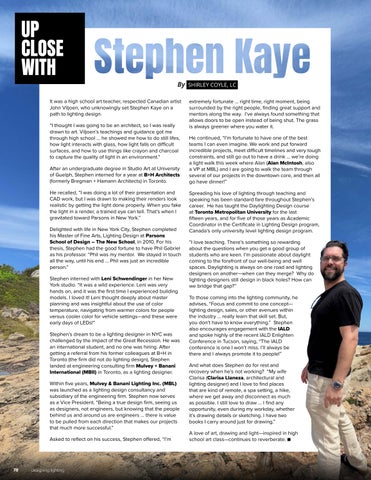
Up Close with Stephen Kaye By Shirley Coyle, LC
designing lighting
VOLUME VI • ISSUE 3
THE SPHERE’S OTHER Skin YOUR FEE IS ONLY HOW MUCH? HOTEL ANDAZ: LIGHT, WATER, AND THE AQEUOUS THRESHOLD
designing lighting ISSUE NO. 3
CAN LIGHTING SAVE RETAIL? BENYA’S ART & SCIENCE IALD MEASURES IMPACT OF COVID-19
78
designing lighting
DECEMBER 2020
ON THE COVER LIGHTING
T he Eisenhower Memorial
OFFICE IN THE CLOUDS THE NEW WORLD OFFICE UP CLOSE WITH BARBARA HORTON
The Sphere Las Vegas, Nevada, USA Cover Image: Randy Reid
DECEMBER 2025
designing lighting
13
EDITORIAL DIRECTOR’S NOTEPAD
As I try to slow down at this stage of my career, the opposite seems to happen. Things keep getting busier and busier. You may feel the same way. Editorial Director: Randy Reid Publisher: Cliff Smith
Contributing Writers: James Benya PE, FIES, FIALD Benya's Art & Science Contributor Principal at Design Services, Inc. and The Benya Burnett Consultancy Shirley Coyle Up Close Contributor President, Cree Lighting Canada Principal, RELEVANT LIGHT Consulting Inc.
Staff Writers: Parker Allen Bridget Leary Published by EdisonReport 1726C General George Patton Dr. Brentwood, TN 37027 Phone: 615-371-0961 designinglighting.com designing lighting is focused on the Business of Lighting Design™ and provides business information to the lighting design community. In addition to the website, designing lighting publishes bi-monthly online magazines featuring original content, interviews within the community and highlights successful award winning lighting designs. While designing lighting is based in the U.S., it has contributors from Europe and is developing a global presence. ISSN: 3066-9111. Statements and opinions expressed in articles and editorials in dl are the expressions of contributors and do not necessarily represent the policies or opinions of the EdisonReport. Advertisements appearing in the publication are the sole responsibility of the advertiser.
14
designing lighting
For this issue, I had the privilege of visiting two projects and each one was fascinating in its own way. The first stop was Miami, where I visited the Andaz Miami Beach Hotel to experience the lighting design by David Ghatan of CM Kling Lighting Design. The concept alone—using pools as skylights—felt almost inconceivable until I saw it in person. Watching light filter through the water and into the restaurant below, then observing how that light transforms dramatically from day to night, was nothing short of astounding. Next, I traveled to Las Vegas, where my wife and I attended—or rather, participated in—the Wizard of Oz experience at Sphere. “Attended” doesn’t quite capture it. If you have the opportunity to see anything at Sphere, go. I hope my article conveys even a fraction of the awe I felt experiencing it firsthand. This issue also includes two articles focused on artificial intelligence. AI is the nine-hundred-pound gorilla, not just in our industry, but across every industry and everyday life. Frankly, we could have filled four articles on the subject alone. You’ll also find an article highlighting the good work of our friends at the Business of Light, titled “Your Fee Is Only HOW MUCH?” Once again, I didn’t just read about it. I attended and actively participated in the session in person. We also have our Rep of the Year as well as our Emerging Designer of the Year. Two fascinating stories from two generations and two geographies. It has been an incredible and successful year for designing lighting (dl) magazine. On behalf of our entire team, we wish you and your colleagues a wonderful holiday season and a happy, healthy, and prosperous 2026.
Education: March 15 - 18, 2027 Exhibition: March 16 - 18, 2027 Las Vegas, NV
Where LIGHT Meets BUILDING LEARN MORE
designing lighting
15
AJIN Emerging Lighting
CHO Designer of the Year:
By RANDY REID
A Self-Made Journey on Borrowed Time
In a world that blends art, science, and sheer determination, few stories capture the human spirit quite like that of Ajin Cho. This year, we’re proud to name Ajin our Emerging Lighting Designer of the Year— not just for her technical talent and fresh perspective, but for the extraordinary selfmade path she’s carved from South Korea to New York City. At 34, Ajin embodies the grit of someone who saved every won, crossed oceans, and built a career from scratch in one of the world’s toughest cities. Yet, as her visa clock ticks down, her story also serves as a poignant reminder of the fragile threads holding international talent in our industry. Ajin’s journey began in Seoul, where she grew up with a passion for spaces that tell stories. After earning her degree in architecture, she landed a role as a visual merchandising designer for UNIQLO, the global Japanese clothing brand. For four and a half years, she designed seasonal displays for over 150 stores across Korea, focusing on flagship locations. It was handson work, and “lighting was the critical part,” she recalled. “It drew me in because it elevates everything around it.” But Korea’s lighting design market was limited, and Ajin dreamed bigger. New York City called—the epicenter of lighting design, home to firms pushing boundaries in architecture and illumination. There was just one hurdle: the cost. Parsons School of Design, renowned for its Master of Fine Arts in Lighting Design, wasn’t cheap, and neither was living in Manhattan. She scrimped and saved her paychecks from UNIQLO, building a nest egg that would fund her leap across the Pacific. In 2021, at age 30, Ajin packed her bags and arrived in New York, a city that can break even the toughest spirits. “I researched schools from Korea, and Parsons stood out as the most influential,” she said. To make ends meet, she hunted 16
designing lighting
scholarships relentlessly. The International Association of Lighting Designers (IALD) awarded her one, a lifeline that affirmed her potential. She also worked as a research assistant for Parsons professors Glen Shrum and Derek Porter, trading hours for tuition relief. “I applied everywhere,” she explained. “Every little bit helped.” No safety net—just her savings, scholarships, and sheer will. Her education at Parsons was transformative, blending theory with realworld application. She sought internships to gain experience and offset costs. Her breakthrough came with a three-month summer internship at L’Observatoire International, her top choice. “It was my first time as a lighting designer,” she said. “I learned so much about collaboration and detail.” Another internship at One Lux Studio followed, deepening her practical skills in project workflows. After graduating in 2022, Ajin joined Domingo Gonzalez Associates as a junior lighting designer, where she’s thrived on high-profile projects like urban installations and architectural integrations. Her portfolio shines with a mix of architectural precision and artistic flair, drawing from her merchandising roots. She’s active in Women in Lighting + Design (WILD), Equity in Lighting, the AIA, and the IESNYC. “Networking has been key,” she noted. “It’s how I build connections in this industry.” Yet, beneath this success lies a ticking clock. As an F-1 visa holder on STEM Optional Practical Training (STEM OPT), Ajin has just three years post-graduation to work in the U.S. She’s already used two and a half, leaving mere months before expiration. Without an H-1B or O-1 visa— options complicated by recent policy shifts and lotteries—she faces deportation back to Korea. “I have limited time,” she admits. “If I don’t secure a visa, I must return.” What a tragedy that would be.
Glenn Shrum, Associate Professor of Lighting Design at Parsons, explained that Ajin’s situation is actually quite common for international students. After completing an advanced degree in the U.S., they become eligible for Optional Practical Training (OPT), which provides temporary work authorization in a field related to their studies. While OPT is typically limited to one year, Parsons now offers a significant advantage. “I led the effort about ten years ago to have the Parsons MFA Lighting Design program classified as a STEM degree,” Glenn said. “Because of that designation, our graduates are eligible for up to three years of OPT instead of just one. It’s made a real difference for international students who want to begin their professional careers here.” Ajin isn’t just another designer; she’s a bridge between cultures, infusing American projects with a global sensibility honed in Asia’s bustling retail scenes. Her self-made ethos mirrors the immigrant stories that have fueled U.S. innovation for generations. To lose her now, when she’s blooming at Domingo Gonzalez Associates, would dim our industry’s diversity. Korea’s market, while growing, lacks the scale of New York’s, potentially stunting her career just as it’s accelerating. Ajin’s story isn’t unique in lighting, where international talent often navigates visa mazes. But it’s a call to action. Firms, sponsor these rising stars. Organizations, advocate for policy changes. “I’m doing this for my career and to stay,” she sayid. As she eyes O-1 eligibility— reserved for “extraordinary ability”—her determination shines brightest. In naming Ajin our Emerging Lighting Designer of the Year, we celebrate not just her designs, but her resilience. From Seoul savings to New York spotlights, she’s lit her own path. Let’s hope her light stays here, illuminating our field for years to come. ■
designing lighting
17
2025 REP OF THE YEAR: SESCO LIGHTING
John Palk's Journey from Knoxville Startup to Multi-Regional Powerhouse By RANDY REID
Every year, we select a manufacturer's representative agency that exemplifies excellence in our industry—not just in sales numbers, but in culture, innovation, and the kind of steady, principled growth that builds lasting legacies. For 2025, that honor goes to SESCO Lighting, the Maitland, Florida-based juggernaut that's transformed from a regional player into a U.S. force with 33 offices and over 600 employees. At the helm is John Palk, President and CEO, whose story is as much about spotting potential in people as it is about spotting market opportunities. I recently caught up with John—from his car, no less, after a breakfast with old contractor friends in Knoxville—and his reflections paint a picture of an agency that's employee-owned in every sense of the word. SESCO's roots run deep in the Southeast, but its evolution under John's watch has been nothing short of remarkable. Founded in 1967, the company established an Employee Stock Ownership Plan (ESOP) in 1995, a move that set the tone for its people-first philosophy.
A Turning Point in Knoxville By the time John joined in 2007, SESCO had offices in Florida and Georgia, but expansion was on the horizon. "I was born and raised in Tennessee," John recalled, "and I got the chance to open our Knoxville 18
designing lighting
office in October, which joined the recent addition of Chattanooga in March 2007." John's ascent at SESCO highlights the power of mentorship and opportunity in the industry. "I was still relatively young in the business," John admitted, "but Marshall Graham, who was CEO at the time, I believe saw something in me." Marshall asked John to help lead the ESOP Committee, and that role immersed him in the intricacies of employee ownership. "It was a turning point," he reflected. "Helping lead that committee gave me an understanding how our structure aligns everyone's interests— when the company wins, we all win." In 2017, opportunity knocked again: promotion to VP of Sales and Marketing, requiring a family uproot to Central Florida. Under his guidance, SESCO ramped up internal processes, emphasizing training and cross-regional collaboration.
Navigating the Pandemic Years Being one of just a few people in the office in 2020 and officially stepping into CEO at the beginning of 2021 John recalled it as a "baptism by fire." With lockdowns ongoing, survival mode kicked in. Fiscally conservative like Marshall, John viewed the crisis as a reset. "All agencies had the opportunity to say, ‘If we were starting over ... what would we do differently? What does the future look like?’ This mindset accelerated long-term planning during this time, turning uncertainty into a catalyst for
SESCO's explosive growth. When John became CEO, SESCO had around 250 employees and 13 offices. Today? Over 600 team members across 33 locations, spanning Florida, Georgia, Alabama, Tennessee, North and South Carolina, Texas, Oklahoma, and beyond. This explosion owes much to strategic acquisitions, a hallmark of John's tenure.
Acquisitions Reshape the Map In May, SESCO snapped up ERT Lighting, expanding into Central and South Texas markets like San Antonio and Austin. In July 2025, SESCO closed on its acquisition of NexGen Lighting Solutions in Dallas. The acquisition bolstered its North Texas presence and added expertise in controls and smart lighting. It also marked a milestone as the first ESOP-to-ESOP deal for the company. "It was special from that sense," John reflected, given both firms' employee-owned structures.
The Unanimous Vote What made it unique—and nerve-wracking— was the requirement for a unanimous vote from NexGen's 35 employees. "If we had one person who said, 'This doesn't work for us,' we would not have had a deal," he explained. The process unfolded dramatically, with
attorneys revealing the vote requirement just weeks before closing. To win them over, SESCO had to "sell" itself. They presented for about an hour, sharing their passion for the company and culture, then stepped out for the vote. Remarkably, it was approved at 35-0. The resounding yes turbocharged SESCO's North Texas trajectory. John explained, "That sort of unanimous answer really propelled us forward at a speed that we had not seen. Their team and leadership taking that step forward just gave us more confidence of the incredible journey we were about to start."
Expanding the Footprint into Oklahoma The momentum continued. In September, SESCO announced the acquisition of Smith Lighting Sales in Oklahoma City, linking the company’s Texas operations along the I-35 corridor. Expanding into Oklahoma wasn't an original focus before 2025, but as they solidified their presence in Arkansas and Louisiana, Oklahoma naturally kept surfacing as a vital piece of the puzzle. John explained, “I initiated contact with Eric Stewart and Mike Demario of Smith Lighting, and that led to an incredible fullcircle discovery. I learned that our founder, Mike Segal, and Bob Smith, founder of Smith Lighting, had known each other exceptionally well, connecting through NEMRA councils for more than 25 years.” The synchronicity became even clearer when he later came across a document from a NEMRA meeting in Carmel, Indiana. It listed both Bob Smith and Mike Segal as original founders of NEMRA Lighting in the late 1970s. “That moment was powerful,” John said. “Considering the long-standing bond, the great people at Smith Lighting, market shifts in Oklahoma, and the enthusiastic endorsement from our partners, everything came together perfectly for this opportunity.” The deal will be finalized on 1 January 2026. These moves are about synergy more than size. John emphasizes due diligence on culture: "We look for agencies where the teams align with our 'people first, process second, product third' mantra."
Culture First, Always That mantra isn't lip service. As an ESOP, SESCO's employee-owners have skin in the game, fostering accountability and innovation. This shows in retention rates and internal promotions. Training is a priority, too; SESCO invests in certifications, product knowledge sessions, and even wellness programs.
John made it clear that SESCO’s embracement of AI is important to their growth, but that it is still a people business based on relationships. John's leadership style draws from mentors like Marshall Graham, whom he credits with teaching humility and long-term vision. "Marshall always said, 'Take care of your people, and the business takes care of itself,'" John recalled.
do get concerned about for the industry." He emphasized measured growth: "If we're not disciplined and we're not aligned with our partners, there is the opportunity ... to take that regionalization too far too fast and not professionally." Ultimately, John believes success lies in balance. "The local relationship makes all the difference in the world ... If it's done right, then it can be successful.”
SESCO's line card reflects this strength, representing premium brands in LED fixtures, controls, and sustainable solutions. The agency specializes in commercial, industrial, and architectural projects, with a growing emphasis on energy efficiency and smart buildings. Recent wins include major infrastructure jobs in Texas and hospitality upgrades in Florida, where SESCO's expertise in tunable lighting and IoT integration shines.
Industry Leadership
View on Genlyte/Signify
John highlighted Scotty's focus on growth and advancing the professionalism of lighting and controls, noting that his role at IES provides a powerful platform. As for SESCO's backing, John was clear, "Scotty has a commitment from myself and the company—if there is time that he needs or if there are ideas, if it's down to a meeting location, if he needs a sounding board, we really want to help.”
I asked John about his relationship with Genlyte and his impressions of As Templeman, Signify's new CEO. John praised the current team, saying, “I do believe that the strongest leadership team that Genlyte has had in the US is currently assembled. I personally have zero doubts about that.” He called As "a breath of fresh air,” noting, "He is a fantastic listener ... He intentionally listens to understand and not to answer." This approach, John explained, showed Templeman wasn't making assumptions but genuinely seeking insights on the U.S. market. Overall, John is "very bullish" on Templeman, anticipating more U.S. autonomy and investment in growth, though he added wisely, "Proof will be in the pudding."
The Debate Around National Reps I asked John for his take on the emerging trend of national reps, given SESCO's expansions and similar moves by agencies like Bell & McCoy. He's somewhat torn, viewing SESCO's growth as more responsive than aggressive: "If you look at the track record of SESCO ... We were in Florida for 25 years, and then asked by a partner to move into Georgia. And that kind of started sort of a regionalization movement." He noted expansions into Chattanooga and Knoxville in 2007, and Nashville in 2009, were partner-driven, often by Day-Brite. John cautioned against unchecked speed, explaining, "We have the ability ... to expand probably a lot faster than most people are comfortable with. And that is a trend that I
One area where SESCO's commitment to industry leadership shines is through its support of key figures like Scotty Hutto, the company's Georgia-based expert and IES president-elect. "What an ambassador," John said. "If you know Scotty, he does things the right way and is intentional about his words, about his actions to ensure that things are done correctly."
This kind of support underscores why SESCO isn't just growing its business—it's elevating the entire field. Looking ahead, John sees more growth— both organic and acquisitive. But, challenges loom: supply chain disruptions, talent shortages, and economic headwinds. "The industry's consolidating," he observed. "As agents, we all must adapt to change or risk getting left behind." SESCO's edge? Its culture and ESOP model, which John says attracts top talent by offering ownership stakes. "In a competitive job market, that's a differentiator." As our 2025 Rep of the Year, SESCO earns a certificate, but the real accolade is the impact. Under John Palk, the agency hasn't just grown—it's thrived by prioritizing people. "We're grateful," John sayid humbly. "This recognition is for our entire team who are here and came before us. It’s the team that brings it every day and who has bought into the philosophy and strategy.” In an industry of bright lights, SESCO shines as a beacon of what smart, heartfelt leadership can achieve. As we wrapped up my conversation, John shared a line from Isaac Newton: “If I have seen further, it is by standing on the shoulders of giants.” He believes the quote captures the essence of SESCO’s journey. ■ designing lighting
19
LIGHT AND HEALTH
ARE CODES AND STANDARDS
OBSTACLES TO
Circadian-Effective Lighting Design?
By JENNIFER BRONS AND DAVID PEDLER Light and Health Research Center at Mount Sinai
Humans are a day-active species. Regardless of where we live on Earth, most of us wake up in the morning, eat and work through the brightness of the day, return home to dial things down a notch in the evening, and sleep through the dark night. This cycle is governed by circadian rhythms that are generated and regulated by the central brain’s master biological clock, which uses the pattern of light received by the retina to synchronize the body’s various functions to do the right things at the right time. People who habitually disrupt this pattern by exposure to only dim light during the day or bright light at night are at risk for a host of health conditions 20
designing lighting
like cancer, metabolic and cardiovascular diseases, and mental health disturbances like anxiety and depression. LHRC researchers have long explored and measured the relationship between light and the human circadian system for promoting health and well-being (see the August 2025 issue). To that end, we developed an empirical model1-3 that quantifies how light at the retina is converted into neural signals for the master clock. The model employs a metric called circadian stimulus (CS) that accounts for factors such as a light exposure’s duration, level, and spectrum as well as the timing and history of
LIGHT AND HEALTH previous light exposures. Our research has shown that receiving a CS ≥ 0.3 (or about 400 lx of white light) at the eye for at least 2 hours per day synchronizes the circadian system and has positive effects on nighttime sleep, daytime alertness, and mood, and may even ease symptoms and lower the risk of serious illnesses. (Specifiers are invited to use the free online CS Calculator to see how their designs measure up.)
Design Guidelines
The simple scheme of bright days and dark nights for the health of the circadian system has been codified into a series of guidelines by various agencies and organizations. The two that most closely mirror the LHRC’s past and ongoing research are UL Design Guideline 244804 (UL24480) and the recently rescinded (February 2025) GSA Facilities Standards for Public Building Service P1005 developed by the U.S. General Services Administration (GSA). What follows is a summary of some barriers and possible workarounds specifiers might expect when implementing these circadian-effective lighting standards in the face of various other codes, recommended practices, and design considerations.
Energy Code Power Limitations
Lighting power limitations are perhaps the greatest obstacle to implementing circadian-effective lighting designs. Though energy code requirements in the U.S. vary by state, many of them refer to model energy codes (i.e., IECC,6 ASHRAE7) that set lighting power density limits for a system’s total connected electric load. This can make achieving CS targets challenging for specifiers. Our extensive field experience with GSA properties has revealed that using localized lighting, which could be considered “task” lighting, is an excellent strategy for minimizing power demand while achieving the goal of providing additional light at the eye.
Figure 1. Local task lamps employing saturated blue light (i.e., with a peak wavelength around 470 nm) can efficiently deliver CS using only a fraction of the power that would be required for white light.
Furniture-mounted supplemental task lighting is exempted or granted an additional allowance if it (1) is equipped with an occupancy sensor, (2) has dimming capability over a minimum of 2 minutes, (3) can control downlight separately from uplight sources, and (4) allows for individual adjustments of light level. Importantly, circadian-effective task lighting is inherently of greater efficiency due to its position closer (< 3 feet) to occupants’ eyes, particularly when it reaches the target CS level for at least 2 hours in the morning. Our research8 has also shown that local task lighting employing saturated blue light (Figure 1) can efficiently deliver CS using only a fraction of the power that would be required for white light.
Daylight Sensing
Energy codes require automated photosensor controls that dim or turn off electric lighting in daylit spaces. While useful for minimizing energy use, this may result in inadequate light levels for circadian effectiveness given variations in available daylight. Supplemental electric lighting is therefore almost always needed to reach circadian targets (see the October 2024 issue). Here, solutions are admittedly difficult to find unless code exceptions can be carved to accommodate circadianeffective light levels for the crucial 2-hour morning period or photosensor controls could be configured with time-of-day features. This situation presents an excellent opportunity for collaboration with lighting controls manufacturers to furnish photosensor controls with time-of-day features.
Motion Sensing
Code requirements for motion sensing controls can also present obstacles to implementing circadian-effective lighting designs. In private offices, overhead lighting controlled by wall switch sensors must be manually reenergized upon re-entry (“manual-on”) or limit the luminaires’ electric power to no more than 50% upon re-entry (“partial-on”).
Figure 2. Circadian-effective desktop task lighting can provide the necessary CS while limiting energy-intensive overhead lighting.
designing lighting
21
Occupants then must manually operate the switch to achieve 100% power when circadian stimulation is needed. To limit excess energy use with overhead lighting while ensuring continuity of circadian-effective morning light exposure, it is advisable provide circadian-effective desktop task lighting (Figure 2).
High-end trim
High-end trim, while particularly effective at minimizing lighting energy, is typically applied continuously, without regard to time of day and circadian system needs. As a workaround, if designers cannot specify a higher setpoint during the morning, it may be more practical to exclude circadian-effective lighting from circuits controlled by highend trim functions.
Discussion
The obstacles to circadian-effective lighting that we have touched upon here exist because energy codes and industry recommendations focus on lighting requirements for the visual system, not the requirements for the circadian system.
For example, the IES recommendation that office lighting should average only 75–82.5 lx on the vertical plane is over four times lower than what UL 24480 advises for circadianeffective lighting, leaving design teams to sort out which guidelines they should follow. Such conflicts can be further complicated when other parties enter the fray, such as facility managers and commissioning agents, who might not be on the same page about exactly what is required and how a circadian-effective lighting design should be implemented. To advance the understanding and adoption of circadianeffective lighting, we suggest that advocates for circadian lighting use their community connections to encourage codeand standard-writing committees to broaden their mission to include building occupants’ circadian needs. It would also be worthwhile exploring collaborations with controls and lighting manufacturers to develop products and technologies that promote circadian health. Finally, returning to the question we began with, our answer is yes and no. As we have attempted to explain here, codes and regulations can pose obstacles to circadian-effective lighting design, but those obstacles can be surmounted. For the sake of our health, it is essential that we do so. ■
References
22
1
Rea MS, Figueiro MG, Bullough JD, et al. A model of phototransduction by the human circadian system. Brain Research Reviews 2005; 50: 213-228. https://doi.org/10.1016/j. brainresrev.2005.07.002
2
Rea MS, Nagare R and Figueiro MG. Modeling circadian phototransduction: Retinal neurophysiology and neuroanatomy. Frontiers in Neuroscience 2021; 14: 10.3389 fnins.2020.615305. 05 February 2021. https://doi.org/10.3389/fnins.2020.615305
3
Rea MS, Nagare R and Figueiro MG. Modeling circadian phototransduction: Quantitative predictions of psychophysical data. Frontiers in Neuroscience 2021; 15: 10.3389 fnins.2021.615322. 05 February 2021. https://doi.org/10.3389/fnins.2021.615322
4
UL Standards & Engagement. Design Guideline for Promoting Circadian Entrainment with Light for Day-Active People, Design Guideline 24480, Edition 1. Northbrook, IL: Underwriters Laboratories, 2019.
5
U.S. General Services Administration. P100 Facilities Standards for the Public Building Service, https://www.gsa.gov/system/files/P100%202021%20v1.pdf (2021, accessed 15 September 2024).
6
International Code Council. 2024 International Energy Conservation Code, https://codes.iccsafe.org/content/IECC2024P1 (2025, accessed 11 November 2025).
7
American Society of Heating, Refrigerating and Air-Conditioning Engineers (ASHRAE), . Energy Standard for Sites and Buildings Except Low-Rise Residential Buildings (ANSI Approved; IES Co-sponsored). ASHRAE 90.1-2022 (SI). Peachtree Corners, GA, USA: American Society of Heating, Refrigerating and Air-Conditioning Engineers, 2022.
8
Figueiro MG, Bullough JD, Thayer A, et al. Supporting visual and non-visual lighting design without increasing discomfort glare or lighting power density. Lighting Research & Technology 2025; 57: 5-27. https://doi.org/10.1177/14771535231212683
designing lighting
designing lighting
23
THE BUSINESS OF LIGHTING DESIGN™
Your Fee Is Only
HOW MUCH? By RANDY REID
Note from the editor: This article first appeared on designinglighting.com.
On a crisp afternoon in mid-November, a select group of lighting designers and consultants gathered at the Lutron Global Experience Center in Manhattan. For five hours, they immersed themselves in the latest Business of Lighting (BOL) workshop, titled “Your Fee is Only HOW MUCH?” Facilitated by Justin Smith of Zweig Group, the session unfolded like a master class in value-driven fee setting, a precise blend of strategy, psychology, and bold confidence. While most attendees were independent practitioners, one designer from a leading New York firm added subtle depth to the dialogue.
24
designing lighting
In past BOL recaps, I’ve simply observed and reported. This time, however, Justin—whom I’ve come to know well—put me to work. Paired with the sharp-minded Sara Schonour, I dove into sticky notes and lively debate. What follows is merely a taste of the day’s insights; the full power of valuedriven fee setting truly requires in-person participation. No article can fully capture its spark.
Crafting a Go/No-Go Checklist: Filtering for True Value A central exercise focused on building a screening tool to assess opportunities with rigor. Justin led us in pinpointing
THE BUSINESS OF LIGHTING DESIGN™
key questions that reveal “value alignment” in potential projects. The approach begins with a clear “Go/No-Go” framework, rating each factor from low value (1–5) to high value (6–10). Together, we outlined ideal and warning traits across five categories: •
Lead Source. The best leads come from trusted, repeat clients who favor your proposals. Red flags? Unsolicited RFPs copied to multiple competitors. As one participant noted, “If your rivals are CC’ed on the RFP, it likely deserves a low score.”
•
Project Fit. Does the work match your skills, market, and location? High-value fits feel seamless; low-value ones often involve vague goals or strong competition.
•
Effort Analysis. Think about team strain. Green signals include familiar, enjoyable, sole-source projects with fair timelines and strong pay. Red alerts flash for drawn-out pursuits, heavy bidding wars, or distant jobs needing extra certifications.
•
Risks. Clear scopes, reliable schedules, and solid relationships mean low risk. High risks include
Sara Schonour opened the BOL session, “Your Fee is Only How Much.”
scope creep, late-paying clients, or architects stretching beyond their expertise. •
Value Fit. Hourly rate × hours is the bare minimum—not the target. True value-driven fee setting seeks premiums for expertise, future referrals, awards, or growth, where the client’s view of your worth far outpaces the effort required. Justin repeatedly warned against settling for hourly pay alone.
Most projects, he explained, land in the gray middle. Yet this exercise fostered brutal honesty: If the fit feels off, walk away. In one group activity, we reviewed lost bids and realized many could have been avoided with sharper early questions.
Proving Expertise Through Outcomes: The Heart of Value-Driven Fee Setting Next, the conversation turned to why clients—architects, engineers, or interior designers—hire lighting specialists. Expertise leads the list, but Justin pushed further, “Expertise is expected—how do you prove it? You show it.” Clients care less about flawless lighting design and more
designing lighting
25
THE BUSINESS OF LIGHTING DESIGN™
about results like higher retail sales, better workplace focus, or award-winning spaces that elevate their own brand. Five core principles of value-driven fee setting emerged: 1.
A disciplined Go/No-Go process
2.
Structured discovery to uncover value early
3.
Anchoring projects to the client’s desired outcomes
4.
A guided walk-through of your offer
5.
Rehearsed responses to objections
A lively debate arose over the client-owner divide. Legally, the architect signs the contract; strategically, the owner holds the vision. Justin was firm: Refuse work without owner access. “How can we create value if we’re guessing?” he asked. Many nodded in agreement, sharing frustrations with gatekeepers who hinder direct contact and derail alignment. To connect the dots, Justin introduced the Outcome to Value Map, linking client goals to your actions, risk safeguards, and scope. For instance: •
Outcome: Repeat retail traffic through adaptable lighting.
•
Proof Actions: Design a DALI system for easy changes; include field-tunable fixtures.
•
Risks Mitigated: Check art materials for fading; calculate gains like 3% higher conversions on 100,000 visitors at $25 each ($75,000 uplift) or 1% productivity rise for 50 employees at $60/ hour ($62,400 yearly impact).
Quantifying value sparked passionate discussion. Justin highlighted examples: 20% lower cost per square foot compared to electrical engineers, or reduced maintenance from fewer fixture replacements. Challenges like shifting costs and limited data were acknowledged, but the message was clear—translate your work into client gains. A $15,000 fee should feel like a smart investment when compared to real returns.
Handling Objections with Poise: The Final Layer of Value-Driven Fee Setting Even strong proposals can stumble. So, Justin equipped us with “get out of jail free” phrases: 1.
“The price is what it is because you said X matters most—and we’ve built it to deliver.”
2.
“That line item protects against the risk you mentioned.”
3.
“Removing it exposes Y—are you okay with that?”
4.
“Which outcome matters most: A, B, or C?”
Through role-play, we practiced the shift: When price concerns surface, ask what to remove—not lower the fee. Experience objections often hide trust issues; probe gently, reframe, and resolve. Justin also outlined a smooth negotiation rhythm across calls: •
Call 1: 15-minute value screen
•
Call 2: 20-minute scope discussion
•
Call 3: 10-minute close
Above all, skip the jargon. Speak at the decision-maker’s level—many don’t know lighting terms.
Key Takeaways: A Spark, Not the Full Flame By focusing on value over hours, screening carefully, and measuring impact, lighting designers can demand higher fees and dodge low-return work. As Justin put it, “If someone else can deliver these results for less, they’re better. Go with them.” In a field blending art, science, and business, events like this remind us: Your fee isn’t just a number. It reflects real value. This article wasn’t a complete playbook for holding fees, but rather a brief look into the workshop. The report shares only fragments of value-driven fee setting. Its true magic happens live, amid ideas, laughter, and sudden clarity. For the full experience, join the next BOL online workshop on 10 December. Your practice, and your bottom line, will thank you.
Interludes and Insights During breaks, designers shared a common frustration: Architects often wait until the last moment to hire lighting experts, then expect instant results. Later, over drinks, an informal chat revealed a growing trend: Large firms are managing workloads by outsourcing select projects to independent lighting designers—a smart, evolving partnership I’m seeing more often. Thanks to Lutron for the stunning venue, BOL for meaningful programming, and Justin for a transformative day. ■
In a field blending art, science, and business, events like this remind us: Your fee isn’t just a number. It reflects real value. 26
designing lighting
EVERY PROJECT STARTS WITH INTENTION. we bring ideas to light. Each environment presents a unique challenge. We provide lighting with the purpose and precision that each project demands. Work with us!
SCAN TO VIEW OUR PROJECTS.
TSLIGHT.COM designing lighting
27
WHAT 2025 AI WORKSHOPS HAVE TAUGHT ABOUT THE
Future of Lighting Design By RANDY REID
Emad Hasan (IALD, moderator), Matt Alleman (IALD), Ketryna Fares (IALD), and Brandon Thrasher (IALD, CLD) at the 2025 IALD Enlighten Americas Conference
Over the past year, I’ve become a repeat customer at AI sessions. I’ve sat in packed rooms at Boston Lights, IALD Enlighten Americas, ArchLIGHT Summit, and the NALMCO Convention, laptop in hand, trying to make sense of what this technology really means for our industry. At Boston Lights I attended a workshop called “Lighting the Way With AI” that aimed to give designers and manufacturers a practical starting point. At IALD Enlighten Americas, the panel “AI and Lighting Design: Creators, Challenges, and Protecting the Craft” dug into ethics, education, and data. In Dallas, ArchLIGHT Summit hosted “Intelligence by Design: How AI is Shaping Lighting, Architecture, and Everyday Workflows,” where a cross-disciplinary panel showed how quickly AI is moving from novelty to daily tool. And at NALMCO’s 72nd convention I listened to “AI Surge,” a session for maintenance contractors and distributors who care less about prompts and more about truck rolls and margins. Different audiences, different pressures—but the same undercurrent: AI is no longer theoretical. It is here, it is messy, and it will reshape how we design, sell, and maintain lighting.
AI as a Fast, Opinionated Collaborator
The first consistent theme is speed. At ArchLIGHT’s 28
designing lighting
“Intelligence by Design” session, Joshua Miller, Manager at Acuity, described how generative tools are changing visualization. A quick sketch and a few lines of text can now turn into near-photographic imagery in minutes. Joshua’s team uses AI to “up-res” concept renderings at the end of the process, making everyday visuals look like polished marketing pieces. He also noted something I’ve seen in multiple studios: when AI is in the mix, more people participate. The quiet team member who would never touch a pencil will happily type a prompt and share an idea. That broader participation is healthy, as long as someone still curates the results. In the Boston Lights discussion “Lighting the Way With AI,” AI was framed as a pushy junior collaborator. It throws out options at reckless speed. Some are brilliant, many are unusable, and all of them need a senior designer’s judgment. Used well, AI becomes an extra set of hands, one that never gets tired of iterating the fourth option for a lobby cove or rewriting the sixth version of a concept statement.
Keeping Concepts Honest When Images Look Too Real The dark side of that speed is realism. AI images are so convincing that they can quietly reset expectations.
At ArchLIGHT, Lisa Reed, Principal at Reed Burkett Lighting Design, warned that clients often arrive with AI fantasies in
hand. “I saw this thing, I want this,” even though “this thing” does not exist. She urged designers to stay away from hyperreal AI images in early phases, favoring sketchy, watercolorlike outputs that still read as ideas rather than promises. The IALD Enlighten Americas panel took a similar line. In “AI and Lighting Design: Creators, Challenges, and Protecting the Craft,” moderator Emad Hasan, IALD, together with designers Matt Alleman, IALD, Ketryna Fares, IALD, and Brandon Thrasher, IALD, CLD, emphasized that AI should not replace human concept development. Matt’s firm, for example, bans AI from the earliest design sketches specifically to preserve authorship and client trust. If we present AI imagery as concept art, we must clearly frame it as such. Otherwise, we spend the rest of the project trying to build a mirage.
3. Teaching Young Designers in an AI-First Era
Every panel, regardless of audience, circled back to the next generation. How do young people and interns learn if AI does the tedious work we all cut our teeth on? At Enlighten Americas, Matt worried that over-reliance on AI could blunt critical thinking, much like students who skipped foundational math and now rely only on calculators. Brandon pushed the point further: If AI lays out your luminaires and calculates your loads, how will a junior designer ever learn when to choose a 1,000-lumen downlight over a 10,000-lumen one? Ketryna suggested flipping the script—using AI as a tutor rather than an answer machine. Ask the model to explain why it placed fixtures where it did. Ask it to cite standards or show alternative solutions. That line of questioning trains younger staff to interrogate results, not just accept them. Across the aisle, contractors at NALMCO’s “AI Surge” session raised a similar concern: If AI drafts proposals and work orders, will newer employees understand the systems they’re selling and servicing? We agreed the only sustainable model is “AI plus apprenticeship,” not AI instead of apprenticeship.
Data, Liability, and Who Owns the Output
The most animated discussions came whenever we hit data and liability. In the Enlighten Americas panel, the group talked about portfolios, project photos, and BIM models quietly feeding large AI systems. Matt advised firms to read the fine print
before uploading anything proprietary; some tools reserve the right to train on user content. Brandon pointed out that photographers often own image rights, meaning a wellmeaning intern could inadvertently violate a contract by dropping a hero shot into a public model. At ArchLIGHT, Carla Bukalski, Principal of Strategy & Operations at Reed Burkett Lighting Design, took a hard line on trust. AI, she said, “Speaks with authority even when it’s wrong,” which is dangerous in an industry where errors can affect life safety, glare, and compliance. She treats AI recommendations like those from an overeager intern. They can be helpful, but ought to always be checked against codes, manufacturer data, and real-world experience.
Business Models, Energy Use, and the Ethics Question
One of the most uncomfortable threads is money. If AI lets designers work faster, do fees go down? At Enlighten Americas, the panel pushed back. Time saved on writing narratives or cleaning spreadsheets should be re-invested in extra options, more mock-ups, and better coordination, not surrendered as pure efficiency. The challenge is explaining that value to clients: instead of saying, “This takes fewer hours,” we should say, “This lets us explore three concepts instead of one.” Energy use is the other elephant in the server room. Emad shared numbers on data-center growth and the carbon footprint of large models—figures that made the room noticeably quieter. Ketryna argued that if AI consumes this much power and water, designers should use it sparingly and demand transparency from vendors. That argument resonated strongly with a community already wrestling with embodied carbon, dark skies, and turtle-safe coastlines. At ArchLIGHT, Carla framed it bluntly: The only ethical justification for AI’s resource use is if we harness it to solve the very environmental problems it helps create. That could mean optimizing controls sequences, reducing waste in manufacturing, or using simulations to cut down on trips and mock-ups. The biggest lesson, though, came from Chip Israel, founder of Lighting Design Alliance, who stood up during the Enlighten Americas session and asked whether our industry should push back against big software and AI companies quietly harvesting our work. It was less a question than a call to action: If we don’t shape how AI enters lighting, someone else will. After a year of AI workshops, I’m convinced of two things. First, AI will absolutely become embedded in every tool we use, from calculation engines to CRM software. Second, the firms that thrive will be the ones that treat AI not as magic, but as infrastructure: powerful, fallible, and ultimately in service to human designers, contractors, and clients.
At ArchLIGHT Summit, Lisa Reed addressed a common pitfall: clients confusing AI imagery with reality.
The technology is racing ahead. Our job, as a community, is to make sure the craft of lighting doesn’t get left behind. ■ designing lighting
29
AI in Practice By ERIK STROEMBERG
Associate Director & BIM Manager at HLB Lighting
Note from the Editor: A version of this article first appeared on the Zweig Group website in October 2025. When we first explored artificial intelligence at HLB, like many in the architecture, engineering, and construction industry, we approached it with excitement and caution. Implementing AI offered incredible potential, but the risks quickly became evident. If your firm does not yet have an AI policy, learn from our experience and establish one as soon as possible. Here are practical insights and recommendations to guide you through creating, communicating, and maintaining an effective AI policy.
Planning
In the wake of ChatGPT 3.5’s release in November 2022, when the world saw just how transformative AI could be, we moved quickly. By February 2023 we had assembled a dedicated AI team that blended HLB’s strategic vision with deep technical and educational expertise. Within weeks, this small group began researching trends, evaluating tools, and translating insights into clear, actionable guidance. Having one point of contact within our AI team helped us to drive consistency and kept our strategy aligned and accessible, accelerating the understanding and potential for this technology within HLB. 30
designing lighting
Next, the team generated and deployed our AI policy with a focus on speed over perfection. We knew it was more important to get a solid baseline in place, something clear but not overly granular, than to wait for every detail to be perfect. Policy creation was not limited to leadership or IT. Open, cross-disciplinary conversations, together with advice from our legal team, brought forward diverse perspectives on risks, opportunities, and practical needs. Through broad engagement and insights gathered, we shaped a policy that anticipated how teams might work while leaving room to refine and expand as new tools emerged. We also ensured that the scope of the policy applied not only to chatbot interactions but also to AI image generation and AI meeting note takers, covering internal and external communications. Finally, before diving into specific tools or technologies, we made sure our AI team understood the current capabilities of AI and its rapid trajectory. We then organized collaborative workshops and pilot programs, carefully selecting participants who were quick learners and natural cheerleaders for the initiative. These sessions combined workflow mapping with the development and testing of well-thought-through prompts, helping us outline a solid strategy. We ensured that valuable data was
Insights and Recommendations for Creating, Communicating, and Maintaining an Effective AI Policy
collected throughout these pilots, measuring time taken, effort level, and quality compared to baseline methodologies.
intellectual property, protected just like code, specifications, and client deliverables.
Through this hands-on exploration we identified where AI could boost speed and innovation and where we needed to keep human expertise firmly at the core of decision-making and quality control. These exercises gave us more context and insights into future revisions to the policy.
Underlying all of this remains one core principle: Human judgment remains essential. Our policy makes it clear that AI is a support tool, not a replacement for expertise. Every AI-assisted output must be reviewed for accuracy, bias, and alignment with our values, ensuring the work we deliver remains thoughtful, ethical, and high quality.
Implementation
We quickly discovered that an instructional PDF document doesn’t drive change. Real implementation came only when we committed to onboarding, ongoing education, demonstrating approved use cases, and creating space for discussion. That integration of policy into everyday practice made a meaningful difference. It wasn’t about getting signatures on policy documents; it was about building a shared understanding of the reasoning behind each of the provisions. When it came to AI-generated content, we communicated a clear analogy: Treat outputs like junior staff work. Even when something looked polished, it could contain hidden inaccuracies, hallucinations, bias, or missing context. To protect quality and maintain trust, we implemented independent review processes for AI-assisted work regardless of the user’s experience level. One important decision during the development of our AI policy was aligning the consequences of misuse with our existing IT and HR policies. The policy also complements these documents; for example, it states that “AI should not be the primary decision-maker for any employmentrelated judgments.” By keeping the disciplinary structure consistent, we eliminated ambiguity and reinforced that AI use is held to the same professional standards as other core responsibilities. We also learned that hard-coding specific tools into the policy didn’t work. The pace of AI software evolution made that approach impossible to maintain. We replaced it with a dynamic list of approved tools that live outside the main document and are revised regularly. This gave us flexibility while maintaining oversight and consistency.
Follow Through
A rigid policy can stifle creativity, while a vague one invites risk. We invest time in finding language that sets clear expectations and still encourages thoughtful exploration. Teams are invited to evaluate new workflows within safe boundaries, so innovation flourishes without compromising data-security, oversight, or quality. We hope these insights help you as you develop your own policy. We are still refining our own as a work-in-progress document—identifying gaps, rolling out additional training to ensure alignment across offices, and preparing to revise our guidelines as both market tools and our in-house solutions evolve. If you are debating whether to start, do not wait. You do not need perfection on day one. Give your team a structure for responsible AI use, gather feedback, and iterate. As technology matures, your plainlanguage instructions will evolve into automated workflows that drive geometry, populate schedules, and produce clientready deliverables. Decide early where AI adds speed and insight, and where human intuition remains non-negotiable. Teach emerging staff the reasoning behind these choices so they build the judgment that senior reviewers rely on during QAQC. The richer the context you supply, the more accurate, personal, and valuable the AI’s response becomes, keeping you firmly in control while extending your reach throughout every project phase. ■
Data privacy was a foundational pillar. We clearly defined what information could never be shared with AI systems depending on whether it is a public LLM or a secure internal environment, while also distinguishing the difference between the two. We cautioned teams that while public AI tools are easy to access, they often harvest your inputs to improve their models, so using unauthorized chatbots can expose sensitive company data. Prompts themselves were treated as designing lighting
31
THE SPHERE’S
In Sphere’s atrium, towering columns and carefully angled cove lines wash the space with saturated color, part of a system designed to shift mood and even calm the brain between spectacles. Photo credit: Rich Fury
32
designing lighting
A World Written in Light By RANDY REID
COVER STORY The Las Vegas Sphere may be the most photographed building on earth, yet almost none of those images show what lighting designers care about most—what happens inside. ICRAVE, a studio within global design and innovation agency Journey and led by Lionel Ohayon, Journey's Chief Creative Officer, created the architectural and theatrical lighting for Sphere’s interior—every public space, every atrium, every preshow zone, and every suite. The exterior screen may capture the headlines, but the interior is where lighting and architecture truly merge. Lionel worked closely with Brian Smith, Journey’s Director of Lighting, whose leadership and technical expertise were central to shaping the project’s lighting strategy. The Sphere project began as an international competition between his firm and another contender. His team approached it through an intensive design sprint, during which they generated a wide range of concepts for what Sphere could become. Although much of that early work remains confidential, Lionel noted that the ownership made one point clear: The venue could not be “an concrete block arena with signs.” It needed a true vision, an experience. His team, which also included Lighting Design Director Renée Joosten, understood that the bowl itself would be a technological breakthrough in live and projected entertainment, yet the surrounding 400,000 square feet were equally vital. Those spaces, he emphasized,
would shape the visitor’s journey and could host events, performances, conventions, and countless other uses. The competition captured this broader experiential ambition, and ultimately, his firm was awarded the commission. They wanted an experience. Lionel and his team won the job by proposing a single integrated lighting system capable of functioning as both theatrical and architectural lighting. Eliminating the typical dual-system approach protected the design vision and reduced complexity during construction. With the project running on union labor, time-and-material contracts, and exceptionally high construction costs, this unified approach became a crucial breakthrough. It streamlined the build, cut waste, and set the stage for the three core lighting elements that would ultimately define the space. From the beginning, lighting drove the architecture. Lionel describes the interior as being defined by three elements: the lighting, the floor, and the vast surfaces that receive light. The floor is a jet-black terrazzo, spanning tens of thousands of square feet, chosen specifically to disappear when illuminated. It reflects the architectural forms above, turning the atrium into a limitless mirrored void. As visitors move through the space, reflections pull them forward, creating portals of light that echo the perfect geometry of the Sphere itself. The effect is sensory disorientation—intentional and controlled. Fixtures mounted on towering columns, some eight stories high, wash the space without revealing their source. Every optic was customized. Every downlight is individually addressable. Cove lines are angled so that no matter where a visitor stands—even 90 feet below—the LED source remains invisible. In the words of Lionel, the architectural surfaces are treated as “receivers of light,” not as objects to illuminate. In the midst of a design this massive, Journey still created moments of intimacy. Some walls feature transparent, reflective patterns—mathematical equations used in the engineering of the Sphere itself. These markings remain
OTHER SKIN designing lighting
33
COVER STORY hidden until the light strikes them at the right angle. As guests walk by, the codes appear like a mirage. Light reveals the story; architecture holds the secret. The word “limitless” comes to mind, especially with those dark floors that seem to dissolve into the architecture. Because the lighting system was fully adjustable and adaptable, requirement codes could be met with only a portion of the fixtures operating at any given time. Nothing in the space ever ran at full output, which allowed the design to function both theatrically and architecturally. The black floor supports the dynamic atmosphere Lionel envisioned while still delivering the required functional light levels. The USAI downlights vary in scale, from roughly four inches at the smallest to about six inches in diameter at the top. The larger fixture size was a matter of both proportion and performance. “We customized many of these lights to very specific lumen outputs, color ranges, and optics,” Lionel said. “We wanted absolute precision in where the light landed—and where it didn’t.” Avoiding scalloping on the vertical “ribbons” that animate the space was crucial, he added, because those surfaces play a key performative role in the overall experience.
A glowing portal of light frames Sphere’s food-and-beverage zone, where continuous linear illumination turns the ceiling and counters into a mirrored, cinematic corridor. Photo credit: Rich Fury
Controls were equally ambitious. The team used ETC Mosaic and Paradigm, giving them pixel-level control of every fixture. Brian spent months on commissioning. Pre-show scenes create excitement; intermission scenes calm the space. At one point, Brian and Lionel developed a programmed “call to action”—a wave of light that moves from the floor upward, guiding the crowd toward the performance bowl. Tivoli products appear in several lighting applications throughout Sphere. The Flexile LG System defines the Radius Bar with its 360° uniform illumination, creating uninterrupted lines that accentuate the ceiling’s curves and contours and help shape the bar’s visual identity. Lighting manages emotion as much as visibility. Sphere immerses 18,000 people in media that can overwhelm the senses. If someone needs a break, they step into the atrium, where the lighting shifts to a soft bluish tone designed to calm the brain.
Crisscrossing escalators and concealed coves paint the “receivers of light” in saturated reds and violets, reflecting off the jet-black terrazzo floor. Photo credit: Rich Fury
Not everything inside is permanent. Sphere was intentionally designed to host rotating art installations, live performances, and brand activations. The space can hold enormous objects—Lionel joked that “Saturn rockets could fit.” 34
designing lighting
The project also presented challenges in discipline. Budgets fluctuated, and the team faced intense value-engineering pressure. Lionel and Brian protected the essentials: the black floors, the reflective surfaces, and the integrated lighting system. The final design looks effortless, which means it wasn’t.
COVER STORY Sphere interior includes bars, retail zones, and food venues, each one unique in color, lighting, and material. Yet everything remains part of a visual family. The shapes, arches, reflections, and portals connect the entire interior into one experience. The lighting never competes with the architecture; the lighting is the architecture. On a future visit, I will see the lighting design during a live event—The Wizard of Oz. Lionel explained that Sphere adjusts the interior lighting based on the performance: different colors, different moods, different storytelling. I asked Lionel what the “call to action” will be for that show—the moment Sphere signals the audience to enter the bowl. He smiled. Sphere now has its own lighting team, and even he doesn’t know what they will program. “I can’t wait to go find out,” he said. At one point during our conversation, Lionel reflected on what the project meant for Journey. Sphere allowed the studio to bring together everything they care about— interiors, lighting, storytelling, experiential design—and treat them as one discipline. Brian added that the project represents everything Journey stands for: emotion, precision, and narrative delivered through light. When I asked if Sphere was the most important project they have ever done, Lionel paused. “It gave us a canvas big enough to use every tool we have.” Sphere doesn’t use lighting to reveal architecture. The lighting is the architecture, proving that lighting can shape space, shape emotion, and shape a building’s identity. Light defines Sphere. ■
A glowing portal of light frames Sphere’s food-and-beverage zone, where continuous linear illumination turns the ceiling and counters into a mirrored, cinematic corridor. Photo credit: Rich Fury
FIXTURE SCHEDULE Application/Location
Manufacturer
Product
Notes / Specifications
Recessed Downlights (throughout)
USAI
Bevel 5.0, Bevel 2.2, Mini Downlights
Custom RGBW, custom optics and outputs
Backlit Portals
Acolyte
LED Flexible Backlyte Panels
RGBW
Curving & Straight Linear LED Slots (Entries & Upper Floors)
Coronet
LS Curve (Custom RGBW)
Curved linear slot system
Coronet
PG4 (Custom RGBW)
Straight linear slot
Atrium Coves
Color Kinetics
Powercore IntelliHue Wall Grazers
RGBW
VIP Vomitories
iGuzzini
Trick
RGB
Linear LED Striplights (throughout)
Acolyte / QTL / Tivoli
Various Models
Flexible and rigid linear LED products
Trackheads (throughout)
Clarte
Custom RGBW Trackheads
Custom configuration
Controls
ETC
—
System-wide control
designing lighting
35
The Sphere Held Its Breath By RANDY REID
Concealed cove lines and individually addressable fixtures— run with pixel-level control—wash the performance bowl’s ribbed arches in amber, making the architecture itself the light show. Photo credit: Randy Reid
When my wife and I stepped into the Sphere, the first thing that hit us was how warm and muted everything looked—like the whole place was lit at around 1800K with a very nice and relaxing glow. I’d walked in fully expecting to be blasted with wild, swirling emerald greens—that electric Wicked Witch of the West energy. I know what this lighting system can do, and it was disappointing to see that it was not being used to its fullest extent. The kind word is … calm. The honest word is boring. It was only after the show that I realized the brilliance of the lighting.
36
designing lighting
Going up the escalator, The Wizard of Oz logo was projected onto a screen consisting of small fans, which gives the picture a 3D effect. Tivoli products appear in several lighting applications throughout Sphere. We were early, so on our way to the seats, we visited the Radius Bar featuring Tivoli’s Flexile LG System with its 360° uniform illumination, creating uninterrupted lines that accentuate the ceiling’s curves and contours and help shape the bar’s visual identity. Finally, some exciting lighting! We got to our seats around 7:30 for the 8 p.m. show. Walking
1800K amber glow we’d seen in the hallways outside. Cozy, sure … but still underwhelming. A few rows ahead, either Gary Busey or the world’s most convincing Busey impersonator plopped down. We’d heard Nick Saban was in town for the College Football Hall of Fame event, so Mrs. Reid kept scanning for Miss Terry. No luck. Busey gets up and wanders off. We are still hunting for the Sabans. Still bored. The pre-show music is a clever mash-up: Snippets of Wizard of Oz songs played like a live orchestra is warming up in the pit—trumpets running one riff here, strings sawing away at another tune over there, all overlapping. The longer I sat there, the clearer it became: This wasn’t the mind-bending 360-degree immersion I’d imagined. Instead, I was about to watch (probably for the last time) the movie I’ve seen more than any other, projected on the world’s largest flat screen, with two smaller panels for close-ups and the occasional flying monkey tossed onto the dome as an afterthought. Low-tech as hell for a place called the Sphere. Only one glass of wine in me and a whole show to go. This is going be a long night. 7:02 – Busey slides back into his seat. 7:03 – Curtain rises, the MGM lion (actually, his cowardly counterpart) roars; opening credits roll on the monster screen. The two side screens stay black. All that glorious real estate … wasted. Sigh. The warm lighting fades to dark. BOOM! into Section 205, the first thing you see is the massive main screen flanked by two smaller ones on each side—basically a giant concert-style setup. The night before, Lea Tranakos and her husband Peter had attended a Zac Brown concert and for a split second, I thought we had the wrong date. Next, I noticed the huge PA speakers dangling right in front of the screen, eating up a chunk of the picture. Rookie design mistake, I thought. All along the sweeping curved walls and ceiling that wrap around the screen, there’s tons of acoustic material—smart for sound, obviously. And once again, the lighting was that same sleepy
In an instant we are transported to Kansas. It happened in less than a second, and I was in a state of shock unable to grasp what had transpired. The entire bowl (every inch of the 360° dome except our seats) had become the screen. My feeble brain could not process the transformation that occurred. Quickly, I looked for the giant speakers that were so poorly located. Gone! The two mini screens—gone. The giant screen that held the credits just a few seconds earlier, completely vaporized. The entire bowl, save the seating area, became one huge, curved screen.
designing lighting
37
We are in the center of the movie and it is happening all around us. The clouds are moving.
The close ups were very close. Apparently, there were a lot of bad teeth back in the day.
Within a few seconds, the audience laughed and clapped loudly. There was nothing funny, it was as if there was a collective relief from the audience that this was going to be a hell of a show!
Clouds churned overhead. Camera movements were so aggressive that I occasionally had to look away to avoid motion sickness. I became concerned about Mrs. Reid, who suffers from frequent vertigo episodes. She did grab my hand a few times, and I thought we might have to visit the VIP vomitory.
We weren’t watching the movie anymore. We were inside it. Dorothy and Toto sprinted toward the farm; we sprinted with them. The sky tore past above our heads. Miss Gulch pedaled her bicycle straight at us, so close I could see the veins in her scowl, and for a moment we were riding right beside her.
I won’t do a play-by-play of every scene; you’d think I was making it up. But I’ve now lived through a tornado from the inside: dust blasted the rows in front of us; actual leaves fluttered down into our laps. When the wind picked up on the screen, it picked up in our seats proportionally. When the house finally crashed back to earth it landed directly on top of us. We jumped about a foot. The seats bucked and rumbled every time the Witch appeared (which was often, and terrifying). AI quietly worked overtime: while Dorothy talked to the Tin Man, my eyes drifted left, and there were giant ants marching across tree bark the size of buses. Two rats scurried along the Yellow Brick Road when no one was looking. In the rafters of the farmhouse, you could see every knot in the wood. Butterflies in Emerald City flitted so close I lifted my hand to try to touch one. Remember when Dorothy picked that apple? The apple tree came alive and slapped Dorothy’s hand away, flinging fruit in protest. At the precise moment a single apple (perfectly chilled, faintly fuzzy) dropped from above and landed in our lap. It now has a ribbon tied around the stem and a permanent place on our Christmas tree. Upon exiting the show, now I saw the green columns and green light pulsing and vibrating. There was green everywhere. Static and moving and pulsing. The 1800K amber lighting had been retired. A realization dawned on me about the preshow lighting. No need to stir the audience before the show. This was the brilliance— use lighting to keep the audience calm and unexpecting before dropping the hammer. It appeared the designers of this building and this show had left no stone unturned. Even down to the hidden, but effective, lighting on the handrails to the seats, this sphere is a masterpiece! While Alabama National Championship games are still my favorite event, The Wizard of Oz at the Sphere is a close second. Roll Tide! ■
38
designing lighting
designing lighting
39
Hotel Andaz Miami Beach: Light, Water, and the Aqueous Threshold By RANDY REID The first thing I noticed, standing on the upper terrace of the new Hotel Andaz Miami Beach, was the movement of light. Not electric light—at least not at first—but daylight tumbling through circular water-filled skylights overhead. The sun rippled through the fountains, flickering onto the stone floor of the restaurant below as if the entire building were breathing through the water. It was a transformation that could only be deliberate, and it set the tone for this article. That choreography belongs to David Ghatan of CM Kling Lighting Design. David and his team spent nearly two years stitching together an integrated, aquatic-themed lighting narrative for this full-property renovation, working handin-glove with architect Malcolm Berg of EOA Architects and ownership group Sunstone. The result is a resort that feels cohesive, fluid, and in constant conversation with its beachfront setting. I interviewed David before my Miami getaway, and while his insights were invaluable but even his detailed explanations couldn’t prepare me for the experience of seeing the lighting come alive once I arrived on site. I made two visits: an earlymorning walk-through and a return late in the afternoon. That second visit carried me into dusk, long enough to watch the space dissolve from blue-washed daylight into a soft, saturated red as evening arrived. “You’re always right at the line where land and ocean meet,” David told me. “The architecture carries that idea, and the lighting needed to reinforce it—subtly, quietly, and always with movement.”
A Lobby That Breathes The moment you climb the grand staircase to the secondfloor lobby, you sense the project’s central idea: light as water, and water as light. The ceiling is carved into massive concentric coves, their soft curves bending like surface ripples. Each cove carries a hidden band of bendable tape light from Inter-lux’s Linea Light brand—warm 2700K, dimmable to fine degrees, never dramatic, always atmospheric. “These aren’t rectangular coves,” David said. “They’re organic forms, undulating, creating a real ambiance.” The decision not to use dim-to-warm here was intentional. Instead, he kept the coves at a consistent 2700K while 40
designing lighting
iWorks sconces cast moving shadows across curved millwork and high white surfaces, tying daylight, architecture, and ambient light together. Photo Credit: Randy Reid
allowing downlights—primarily from Lucifer—to warm as they dim. That subtle shift helps anchor the bar and seating areas during evening service without overpowering the architecture. During the day, the light is buoyant. The lobby is washed in soft daylight bouncing off white columns, pale terrazzo, and sculptural forms. “The daylight is strong and very reflective,” David explained. “So instead of fighting it, we embraced it. We wanted the warmth to arrive at night, not during the day.” It works. On my second visit, I sat in the lobby long enough to watch the space move from airy brightness to a layered,
welcoming glow. By early evening, the coves become the primary visual cue, guiding guests through the bar and lounge run by the José Andrés Group. Shadows move across the walls—ripples cast by sculptural sconces made by iWorks, shimmering against curving millwork and high white surfaces.
Wildlife Conservation Commission. The Andaz sits within a turtle protection zone, which meant David and his team had to eliminate nearly all uplight and tree-mounted fixtures and limit outdoor illumination strictly to amber or red wavelengths above 560 nanometers.
Lighting the Landscape from Within
“I think most people know about amber,” David said. “But red also qualifies, and in some cases it’s even more effective.”
One of the project’s most inspired details is nearly invisible until you look for it: the lighting tucked directly into the planters. “Yes, there’s a whole strategy inside those planters,” David said, laughing. “Cord management became a real topic.” The uplights—Delta Light’s Kix series—sit inside the planters, aimed upward through layers of tropical foliage. The hotel uses large custom pots with smaller interior liners, which hide wiring and drivers while allowing the fixtures to be serviced. The result is a beautifully ephemeral effect: branches and oversized leaves project soft, watery shadows onto the ceiling. In several of the photographs, you can see how those shadows animate the ceiling’s curves, blending natural movement with architectural form. “Those shadows are as much part of the experience as the fixtures themselves,” David said. “You’re always aware of the plants, the breeze, the climate. It ties the inside to the outside.”
That explains the deep red glow that carries through parts of the landscape at night—intentional, controlled, and compliant. Inter-lux’s red-spectrum exterior tape light appears throughout the pool deck and walkways, installed with durability in mind to withstand salt air and harsh coastal conditions. The result is subtle. Light levels are intentionally low, supplemented by rechargeable portable fixtures the hotel positions seasonally. Step lights, ultra-shielded downlights, and low-profile bollards from Neri provide safe circulation without disturbing wildlife. “We were always asking: how do we do this while coexisting with the environment?” David said. Chiara Carucci, who pioneered research on turtle-friendly design would be proud!
The Water-Filled Oculi But the most memorable feature at Andaz Miami Beach is the set of circular fountains on the pool deck—fountains that are also skylights. Architect Malcolm Berg envisioned them as “oculi,” portals of water casting light downward into the outdoor restaurant below. During the day, the skylights collect and refract sunlight, sending rippling blue patterns onto the stone patio and tabletops. At night, hidden red LED light sources (again from Inter-lux) take over, sending a warm red glow down into the dining space. The effect is dramatic but deeply soothing. The space feels submerged—almost as if you’re sitting in the belly of a reef. I experienced this shift firsthand. When I visited the restaurant once midday, the skylights acted like lenses for the Miami sky. After dark, each oculus became a glowing red halo. The water amplified the light, turning the ripples into a fluid, living feature. It is rare to see daylighting and electric lighting so intertwined—and rarer still to see it executed with such restraint. “That interplay was the architect’s big idea,” David said. “Our job was to make it believable—to make the movement of light meaningful, not theatrical.”
Exterior Lighting and Turtle-Safe Compliance The exterior lighting required an entirely different kind of discipline, shaped by Florida’s Fish &
Turtle-safe red and amber LED tape washes pathways and landscape features, providing safety and ambiance while protecting wildlife. Photo Credit: Randy Reid
designing lighting
41
Photo Credit: Bronwyn Knight
Guest Rooms and Controls
“Like the ocean. Like the sky. Like the place itself.”
Inside the guest rooms, the lighting remains consistent with the overall narrative. Tape lights hidden behind headboards provide ambient illumination, and suites include additional coves in seating areas. The guest rooms use Lutron’s Caseta system, while the public areas are all Athena
The Andaz Miami Beach succeeds because it remembers that light isn't just something you see—it’s something you feel. ■
CM Kling’s controls specialist, Ben Sullivan, spent multiple nights fine-tuning scenes, working onsite with Lutron, Hyatt’s engineering team, and the hotel’s management. “Our goal is always to make the transitions invisible,” David said. “Fade times of five minutes, ten minutes, even thirty minutes—so nothing feels abrupt.” Nothing about this property feels abrupt. Not the architecture. Not the guestrooms. Not the lobby bar. And certainly not the restaurant beneath the glowing red oculi.
A Boutique Experience Rooted in Light The Andaz brand aims for lifestyle luxury—something personal, immersive, and local. This project accomplishes that through lighting that supports the architecture while deepening the guest experience. It feels like Miami Beach, but not the over-lit, high-energy Miami Beach many visitors expect. Instead, it is a place where light moves like water: reflective, calming, and warm. After two visits—one in broad daylight, one deep into evening—I found myself drawn to the same places again and again: the planters with their painterly shadows, the lobby’s sculpted coves, and the dining terrace where water and red light mingle overhead. These effects aren’t loud. They simply feel right. “We wanted it to be fluid,” David said as we ended our call. 42
designing lighting
Fixture Schedule GENERAL INTERIOR LIGHTING Inter-lux / Linea Light – Bendable Linear LED Tape (2700K) • Primary cove lighting used throughout lobby, lounge, spa, and suites • High dimming resolution for long fade transitions • Exterior versions used in red/amber turtle-friendly wavelengths • Notes: Selected for bendable format to match organic architecture and salt-air durability DOWNLIGHTING Lucifer Lighting – Recessed Downlights • Standard downlight throughout lobby, bars, circulation areas • Some dim-to-warm versions used strategically • Notes: Chosen for beam quality and compatibility with Athena control system PLANTER UPLIGHTING Delta Light – Kix Series Micro Uplights • Hidden inside planter pots to uplight foliage • Creates signature shadow patterns on sculpted ceilings • Notes: Cord-management coordinated with architect; located near columns with concealed power
(Based on interview with David Ghatan and site observations)
DECORATIVE LIGHTING
EXTERIOR & LANDSCAPE
Preciosa – Custom Decorative Pendants (Lobby) • Backlit resin/acrylic “floating discs” suspended from ceiling • Designed with EOA Architects; tuned for 2700K ambience • Notes: Resemble drifting water-polished stones
Inter-lux / Linea Light – Red/Amber Exterior LED Tape
COLUMNS & INTEGRATED FEATURES
Neri – Concrete Bollards and Marker Lights
Interlux Linea Light Rubber series • Custom Millwork Lighting (Integrated at Tulip Columns) • LED tape concealed in recesses formed into column petals • Highlights sculptural geometry • Notes: Continuous curves required custom bending and mockups GUESTROOM LIGHTING Tape Light Behind Headboards • Soft ambient glow for general illumination • 2700K • Notes: Some suites include additional perimeter coves
•
Turtle-safe wavelengths above 560 nm
•
Installed in and around water-filled skylight oculi
•
Notes: Provides red underwater glow visible in restaurant below
•
Low-level, fully shielded site lighting for pool decks
•
Notes: Chosen to comply with Florida Fish & Wildlife standards (no uplight, no tree mounting)
CONTROLS Lutron – Athena System (Full Property), Caseta (Guest Rooms) •
Integrated with legacy Lutron panels retained from earlier renovation
•
Remote access for tuning and troubleshooting
•
Notes: Scenes programmed with long fade times (5–30 minutes) designing lighting
43
JUST IN... New architectural lighting products available for specification
Tivoli Lighting has introduced Trace Mini COB, a mini-profile linear LED family designed for precise, durable architectural and outdoor applications. The lineup includes static white (2700K–6500K), dynamic white tunable options, and RGB/RGBW versions with DMX control. Trace Mini COB delivers up to 76 lm/W, uses a rugged silicone housing, and is IP67 rated for wet locations.
Sabin has introduced LINEAR, a modular acoustic lighting system that combines sound control with clean linear illumination. The family includes STANDARD thin-baffle profiles and STADIA versions with a bullnosed diffuse lens, offered in multiple depths and corner options. Designers can build long continuous runs with flexible connectors and mounting choices, plus options for sensors, speakers, and controls.
Gotham has expanded its IVO™ family with IVO Adjustable Downlights, delivering precision aiming, visual comfort, and a quiet ceiling aesthetic. Featuring 365° rotation and 40° tilt, the fixtures help create depth and contrast while minimizing glare and trim flash. Perfect Color technology supports consistent color performance, with beam options from 10° to 60°.
Visa Lighting has expanded its Harmony recessed ceiling family with eleven new models for general purpose, overbed, and behavioral health/high-abuse spaces. Building on the award-winning Harmony 2x4 Overbed, the line keeps its signature cove-like lens for a soft, indirect-light effect and adds new light source options including tunable white. Behavioral health versions are ligature-resistant with IK10+ impact resistance and grid or hard-ceiling installation kits.
44
designing lighting
The Nova Linear™ is a super high-output linear graze/wash fixture for long-throw architectural applications. It supports multiple color options—static white, dynamic white, RGBA, and RGBL with selectable white—powered by ColorDrive technology for vivid color and smooth 0–100% dimming. A hidden-cable design enables clean, continuous runs up to 50–100 feet, with DMX/RDM control and IP66 durability.
Alloy LED’s VariTune RazorLine 6.1 is an ultra-narrow tunable-white tape light built for millwork, shallow channels, drawers, and other tight installs. It spans 2700K–6500K with 90+ CRI and strong R9/R13 for accurate whites and delivers smooth dimmable transitions with tunable-white control systems. The flexible tape is UL 2108 field-cuttable every 1.4 inches, with runs up to 10 feet.
American Lighting’s NAVI Dim and NAVI CCT are all-in-one inwall driver/dimmer systems that fit standard single-gang boxes, supplying 24VDC power with smooth 0.3–100% dimming and no minimum load. NAVI Dim supports fixed-white tape and fixtures; NAVI CCT adds tunable CCT control. Both offer memory recall, single-pole/3-way operation, and dry/damp ratings.
A suspension lamp created in collaboration with Needs Studio, Tidal features a fluid, oval shape that captures the essence of the movement of celestial bodies, waves, and tides. projects light downwards and upwards simultaneously, and its intensity can be adjusted via a dimmer controlled by the wall switch. The fixture comes in four unique finishes and is also available as a ceiling lamp. designing lighting
45
Lighting th as LA
The sweeping station canopy features a continuous ribbon of light that emphasizes the architecture and creates a welcoming presence. Photo Credit: © Jason O’Rear
46
When the Los Angeles County Metropolitan Transportation Authority (Metro) set out to link its growing rail network directly to the airport, the project required a design that could do more than guide commuters. It needed to rise to the moment—especially with major events such as the 2026 FIFA World Cup and 2028 Olympic and Paralympic Games bringing unprecedented global attention to the city.
For Joyce Hahn, Senior Lighting Designer at Arup, light became one of the defining mediums for that welcome. “The architecture already had a grand and sweeping energy,” she said. “We wanted the lighting to amplify that while simultaneously being clean, timeless, and unmistakably LA.”
The LAX/Metro Transit Center Station project, a collaboration between Metro, Grimshaw, Gruen Associates, and Arup, is not just a transportation hub. It’s a civic statement: Los Angeles welcoming the world.
At the heart of the design is a floating canopy that curves along the station’s full length. The architecture naturally invited a continuous lighting gesture. The design team conceptualized what they called the ‘tech bar’—a structural
designing lighting
A Continuous Ribbon of Light
he Gateway Welcomes the World
Recessed linear fixtures provide uniform illumination along pathways, staircases, and escalator entries, guiding passengers safely. Photo Credit: Arup
By RANDY REID
Pole-mounted fixtures and Lumenpulse ceiling lights supplement ambient light while minimizing glare and uplight in public areas. Photo Credit: Arup
The perforated panels above act as reflectors and diffusers, creating a signature lantern effect along the station’s full length. Photo Credit: Arup
edge that would integrate lighting, power, and signage in one seamless line. The bar became both the architectural spine and the lighting backbone of the project. Linear uplights mounted along its inner edge graze the perforated aluminum panels and roof soffits above, producing a subtle, floating glow visible from the surrounding streets. Joyce explained, “We wanted a volume of light that feels calm and even—something that looks like it belongs to the architecture.”
Achieving that quiet, architectural glow required far more than simply aiming uplights. The design demanded fixtures that could deliver smooth, overlapping illumination across long exterior surfaces, without producing glare, hotspots, or visible hardware. Outdoor lighting was needed beneath walkway canopies, along pedestrian paths, and train platforms, all while maintaining an understated presence. The team selected custom asymmetric linear uplights from elliptipar®, mounted on concealed brackets within the bar’s frame. This approach kept all hardware hidden while still allowing full maintenance access. With its durability and designing lighting
47
Each recessed run was field-measured during construction, and the lengths were fabricated to fit into the architecture. The result was a continuous, even glow that defines the station’s spine and guides passenger circulation.
Vertical Rhythm
Between each section of the canopy, vertical columns support the roof structure. These were treated not as an opportunity to reinforce visual wayfinding. Cylindrical sconces by Gotham Lighting are surfacemounted directly to the columns, echoing their vertical rhythm. Each sconce delivers 4000K light with a narrow vertical beam spread, creating soft halos that emphasize depth without overwhelming the space. “At night, when people are coming off of the long flight and arriving at a busy metro station, there needs to be a feeling of safety and a feeling of clarity and way finding,” Joyce explained.
The Human Layer
At ground level, light becomes more tactile and personal. Every stair, escalator, and ramp features integrated handrail lighting—a slim LED strip housed within stainless-steel rails. The system provides both code-compliant egress lighting and subtle visual comfort, guiding travelers without glare. Custom “tech bar” integrates lighting, power, and signage into one seamless line, forming the architectural spine of the station. Photo Credit: Arup
IK08/IP66 ratings, the elliptipar S175 fit the requirements for reliable performance across exposed exterior conditions. elliptipar engineered several custom modifications specifically for this installation: low-profile mounting feet that allowed two fixtures to sit back-to-back within the tech bar; a custom cross-baffle system that minimized glare and preserved clean sightlines throughout the terminal; and water-tight connectors that supported long, continuous through-wired runs. Together, these adaptations allowed the team to create the calm and even “volume of light” Arup envisioned. It’s an exterior illumination strategy that feels fully integrated with the architecture rather than applied to it. The perforated metal panels above serve as both reflector and diffuser, giving the canopy its signature “lantern effect.”
Layers of Guidance
Below the floating light ribbon, recessed linear fixtures by OCL continue the visual rhythm. These fixtures provide uniform horizontal illumination for pedestrian circulation, staircases, and escalator entries. Their continuous lines align precisely with the architectural curves of the tech bar and undulating canopy panels. “Lighting is the connective tissue,” Joyce said. “We coordinated every fixture run with the ceiling geometry so that each segment merged together to create one cohesive composition.”
48
designing lighting
In open pedestrian areas, pole-mounted lights offer illumination with precise cutoff to reduce uplight and meet California’s Title 24 and BUG rating requirements. Throughout the plaza and concourse, Lumenpulse ceilingmounted area lights supplement the ambient glow. Each luminaire uses a wide optic with internal baffles to reduce the brightness of the light source for the comfort of travelers.
Timing the City’s Pulse
The entire site operates on a centralized nLight controls system. The programming is elegantly simple: The lighting layers activate approximately one hour before sunset, gradually ramping up as daylight fades. The controls also include an astronomical time clock with seasonal adjustments, ensuring consistent illumination levels throughout the year. Energy metering, motion sensors, and emergency overrides are all integrated into a single dashboard accessible to Metro’s maintenance team.
A Beacon for Los Angeles
Now complete, the station glows like a soft lantern against the night sky—an unmistakable marker of arrival. From a distance, the continuous line of light reads as motion; up close, it reveals detail, craft, and precision. The design team achieved what every civic project hopes for: timeless simplicity. There is no gimmick, no colorchanging spectacle, just light doing what it does best, revealing form and guiding people home. Joyce reflected. “This project is about people. It’s about making sure everyone who arrives feels welcome.” ■
Carefully measured recessed runs align with the architecture, creating a cohesive, uninterrupted line of light along the station spine. Photo Credit: © Jason O’Rear
The station glows like a soft lantern, providing a calm, clear, and welcoming environment for travelers. Photo Credit: © Jason O’Rear
designing lighting
49
Custom task lighting and shelving illumination allow for reading and display while preserving architectural form.
Warm-dim coves and bedside accents create a serene environment, perfect for relaxing or preparing for rest.
Back in the mid-1970s, when I barely knew what a light bulb was, I picked up a copy of James A. Michener’s Centennial. The book followed the land itself—eastern Colorado, from prehistoric times through the 1970s— and how layer upon layer of human ambition, ingenuity, and plain old stubbornness shaped a place. Fifty years later, I found myself on a Zoom call with two gentlemen who are layering light, control, and intention onto a brand-new custom home just southeast of Denver in, you guessed it, Centennial, Colorado. The same ground Michener wrote about, but now the story is being written in photons instead of cattle trails. The house is roughly 7,500–8,000 square feet of Rocky Mountain contemporary, and the lighting story is a textbook example of why the role of the integrator has become indispensable. Not just in high-end residential, but in every architectural lighting conversation I’m having these days. The integrator is no longer the “AV guy who also does lights.” Increasingly, the integrator is the only one who can deliver a complete, cohesive lighting experience because they own controls, project management, and execution from day one. Tyson Rabani, founder and CEO of Quality Audio Video (GoQAV) in Centennial, Colorado, led the technology integration. He
50
designing lighting
Proluxe linear coves and warm-dim DMF downlights create a layered, ambient glow in the main living area.
FROM MICHENER’S ARROWS TO CRESTRON KEYPADS
Soft, indirect lighting washes the space in warmth, highlighting materials while creating a peaceful, spa-like retreat.
Lighting the Next Centennial By RANDY REID
Photos Courtesy of DMF Lighting
designing lighting
51
partnered with Light Can Help You (LCHY), the lighting design firm that has quietly become the go-to specifier for the CEDIA channel. Together they turned what would have been a permit-driven, contractor-grade lighting plan into something that actually supports the way the owners live.
The numbers tell part of the story. By adding proper lighting design and premium fixtures, Tyson roughly doubled the lighting portion of the job compared with the original utility-grade spec. The client happily paid for it because they could see the difference in LCHY’s 3D digital sketches before a single hole was cut. Those sketches are worth dwelling on for a moment. Most homeowners never get to see their future home rendered in light. They get 2D plans with circles and a quantity question (“Is 47 downlights enough?”). LCHY’s sketches let them experience layers—task, accent, architectural reveal, cove, toe-kick, shelf light— long before drywall goes up. Clients go from “That looks like a lot” to “I finally understand what I’ve been missing.”
Custom-tuned scenes allow the living and entertaining areas to shift seamlessly from daylight brightness to a relaxed, intimate glow at night.
Warm, indirect lighting enhances the sauna’s intimate ambiance, creating a serene and relaxing escape.
52
designing lighting
Tunable warm-white downlights provide precise lighting for countertops and cooking surfaces without harsh shadows.
Layered recessed lighting and mirror illumination enhance functionality while maintaining a soft, luxurious feel.
Task lighting above the pool table ensures precise play while integrated ambient lighting preserves the room’s cozy character.
Fixtures were predominantly DMF Lighting (with support from the local CEDIA rep firm Momentum). Roughly 200 DMF M-Series downlights (mostly 4-inch, some 2-inch) with warm-dim or tunablewhite engines, plus Proluxe linear from American Lighting for coves, beams, and dramatic grazes. Control is pure Crestron—Tyson is unapologetically brandloyal because Crestron offers enterprise-grade reliability and a lifetime warranty on residential lighting controls. That’s the kind of bulletproof performance clients expect when they’re spending seven figures on a house. Scenes are simple but perfectly tuned to lifestyle: Welcome, Relax, Entertain, Goodnight, and the client favorite—Energize. Walk into the gym at 6 a.m. and the square downlights and tunable coves ramp to a crisp, invigorating level. Hit “Goodnight” and the whole property eases into a warm 1800 K glow while pathway lights drop to 1% so a midnight trip to the fridge doesn’t feel like an interrogation. What struck me most was the collaboration model. LCHY does not sell product; they sell pure design. That independence keeps the fixture count honest and the recommendations client-focused. Tyson handles procurement, Crestron programming, and all on-site execution. The electrical contractor gets a fixture schedule and
designing lighting
53
Integrated linear and accent lighting emphasize the dining table while maintaining a comfortable, evening-friendly ambiance.
Linear cove lighting and recessed downlights illuminate the bar island, highlighting textures while maintaining a welcoming evening atmosphere.
integration with shade systems, and scenes that actually get used, the integrator is increasingly the one who can deliver. The owners told Tyson, “I had no idea lighting could make this much of a difference. It’s like I moved into the Ritz.” That’s the new benchmark.
Crestron keypad allows seamless scene selection for every mood, from Relax to Entertain to Goodnight.
details from LCHY that are, as Tyson puts it, “about ten times better than anything they normally see.” The result? No change orders, no “we’ll fix the dimming later” punch-list items, and Tyson is completely out of the house at closing. Zero post-occupancy chaos. Tyson has refined his early-engagement mantra into three non-negotiable rules. First, bring the integrator in early. Second, hire the integrator early. And third, pay the integrator early (design deposits) so real engineering can begin before the foundation is poured. Skip any one of those steps, and the opportunity for great lighting slips away. I’m seeing this integrator-led model migrate into some commercial and architectural projects now—retail, boutique hospitality, even small-office tenant improvement. When the client wants tunable human-centric lighting, seamless 54
designing lighting
Michener closed Centennial with a reflection on how the land itself endures long after the people and their dramas have faded into history. Studying the photos, the LCHY sketches, and the night shots from this project, I couldn’t help thinking the light has now become part of that same enduring story. Long after the current owners move on, someone else will tap a Crestron keypad, select “Entertain,” and those DMF modules will still be there—quietly, reliably—turning a very good house into something that feels, well, monumental. Same Colorado dirt Michener loved. A new chapter, written in light. ■
FIXTURE SCHEDULE •
DMF Lighting – M-Series Downlihgts
•
American Lighting – Proluxe linear
•
Crestron – Lighting Control Systems
COMING IN FEBRUARY
Project Focus: Urban & Outdoor Trends: The Evolving Role of Integrators Published in digital and print format, this issue delivers bonus distribution in hard copy at Light + Building in Frankfurt. Contact: Randy Reid at editor@designinglighting.com for editorial content Cliff Smith at csmith@designinglighting.com for advertising
Ad close: February 11 Ad materials due: February 12 designing lighting
55
M A G I C R E S I D E N T I A L Q U I E T L Y : G L O W I N G
A
M A S T E R C L A S S
I N
W A R M - D I M
M A G I C R E S I D E N T I A L W A R M - D I M Q U I E T L Y : G L O W I N G
A
M A S T E R C L A S S
I N
R E S I D E N T I A L Q U I E T L Y : G L O W I N G
A
M A S T E R C L A S S
I N
W A R M - D I M
M A G I C
RESIDENTIAL COLUMN
56
Nancy Mah’s home perched on a Pawling hillside glows warmly at night, appearing as a lantern among the trees while maintaining its serene transparency by day.
designing lighting
Mono-point accents highlight artwork and the fireplace without shining directly on occupants, maintaining a comfortable, immersive atmosphere.
WARM-DIM GLOWING QUIETLY: A MASTERCLASS IN
Residential Magic By RANDY REID
The first time I saw images of designer Nancy Mah’s home, I understood why she calls it her sanctuary. Perched on a rugged hillside outside Pawling, New York, the house is all glass, cedar, concrete, and trees—a quiet composition of honest materials and long views. But as striking as the architecture is, what makes the project unforgettable is the way light—both natural and electric—has been shaped. From the beginning, Nancy knew lighting would be a core design element, not an accessory. She had grown up in architect-designed homes, had built a career with firms like Rockwell Group, and had watched hospitality projects come alive. So when it came time to build her own retreat, she brought in Focus Lighting, with Principal Christine Heller leading the team, to shape the lighting for what is arguably the most personal project of her career. “My dream was a lantern in the woods,” Nancy told me. Transparent by day, warm and welcoming by night.
Lantern, not light show Christine normally lives in the world of restaurants and hotels, but the timing was uncanny. In the pandemic slowdown, hospitality work softened and residential requests surged. Nancy’s house landed on Christine’s desk as a rare opportunity: bring hospitality-level thought to a deeply personal residence.
Photo Credit: Ryan Fischer
“It’s just like old incandescent,” Christine explained. There’s no separate CCT channel to program; the shift is built into the driver. As Nancy dims the house for the night, the color warms automatically. The backbone is Lutron RadioRA 2. Instead of a centralized panel, the system uses roughly 95 wallbox dimmers, many hidden in closets and ceilings, wirelessly linked to small scene keypads and an app. In quiet rooms like guest bedrooms, the dimmers are visible and simple. In the main living spaces, they disappear, and Nancy interacts mostly with clean keypads labeled for scenes and pathways.
Living room: Beams as light engines The main living/dining space is where the architecture and lighting lock together. Concrete floors run throughout, ground and polished to reveal aggregate and pick up every gradient of light. A sloped wood ceiling floats above, supported visually by a pair of slender beams that traverse the room. Those beams are more than structure; they are the primary light engines.
Rather than filling ceilings with downlights, Christine started with a simple idea: surfaces should glow, not fixtures. She and her team focused on walls, ceilings, art, and foliage, using just enough hardware to make the house read as a soft lantern in the landscape—visible from the woods, but never harsh.
Christine used them to hide the lighting. Warm-dim LED tape sits in extrusions along the tops and edges of the beams, turning them into linear coves that wash the sloped ceiling and upper walls. Different profiles throw light straight up, out at 45 degrees, or along the edge, blending into a single, continuous glow overhead. From most vantage points, you never see the source—only wood quietly illuminated.
Color temperature was the first big decision. Exterior fixtures are a fixed 2700 K, warm enough to feel like candlelight in the trees. Inside, linear coves, accents, and recessed fixtures follow a dim-to-warm curve from 3000K down to 2200K. As the lights dim, cooler chips fade out and amber chips come up, so the house naturally slides from crisp evening light to a deep, incandescent warmth.
Mono-point accents by MP Lighting, also warm-dim, pick out art and focal points. Two of them sit high on the main ceiling aimed at the fireplace; others hide along the beams and at the room perimeter, carefully tipped to graze paintings and objects. Specialty Lighting adjustable accents in the entry hall do double duty—lighting art and putting a soft sheen on the concrete floor. designing lighting
57
M A G I C R E S I D E N T I A L W A R M - D I M I N M A S T E R C L A S S Q U I E T L Y : G L O W I N G
A
M A G I C R E S I D E N T I A L W A R M - D I M I N M A S T E R C L A S S Q U I E T L Y : G L O W I N G
A
Q U I E T L Y : G L O W I N G
A
M A S T E R C L A S S
I N
W A R M - D I M
R E S I D E N T I A L
M A G I C
RESIDENTIAL COLUMN
58
Hidden linear and accent fixtures wash the patio and surrounding plantings in soft, warm light, extending the lantern-like glow of the home into the outdoor living space.
designing lighting
Linear coves and bullet-style accents reflect off wood walls, producing a golden, enveloping light perfect for work or relaxation.
The result is an evening scene with almost no direct light on people’s faces. You move through a lit envelope— glowing ceiling, bright art, softly lit piano—without feeling that anything is shining on you. “That was intentional,” Christine said. “We wanted you to feel like you’re in the light, not under it.”
Studio: Plywood, pixels, and a golden wrap The studio building, just across a small breezeway from the main house, is both workspace and guest retreat. Here, Nancy wrapped the entire interior in wood. That single material choice gave Christine an extraordinary reflector. A continuous linear cove runs around the perimeter at the base of the joists, resting on a small notch that the contractor cut into the structure. When the cove comes up, the wood walls and ceiling go molten—golden light everywhere, no visible strip. Bullet-style surface accents provide task light over the desks, and a simple pendant anchors the middle of the room. “There’s something about that wood,” Nancy said. “Even at full brightness it feels warm; dimmed, it turns into this amber cocoon.” The combination of indirect cove light and carefully aimed bullets keeps the room flexible enough for video calls, drawing, and late-night work without ever feeling clinical. Up in a small loft, a circular “porthole” window looks back toward the main house. At night, that little opening glows with reflected light from the studio, a tiny punctuation mark on the façade that Christine loves. It’s a reminder that in this house, light is always playing on more than one surface.
Outside, the lighting strategy completes the lantern effect. At the arrival courtyard, the garage wall is built of open cedar slats, stained to match the siding. A small linear grazer along the top washes down, revealing texture and depth, while up/down sconces light translucent panels and the fern beds below. Step lights in the pool deck define levels. Hidden accents in planters and just beyond the edges of the deck reach up into tree canopies, making the landscape feel like part of the luminous volume of the house. Christine even tucked small accent fixtures under the pool deck edge, aimed up into trees that grow from far down the slope. You’d have to lie on your stomach and reach under the deck to see the source, but their effect is obvious: a soft, vertical frame of trunks and leaves, as if the house itself were emitting light into the forest.
Pathways, shadows, and living with the system Not everything is about drama. In the entry hall, small “footlights” in the lower walls guide guests at night from living room to kitchen to greenhouse to bedrooms. Nancy leaves them on when she has visitors; they function as a quiet wayfinding system and a gentle safety layer. One of her favorite effects isn’t electric at all. At the pool-side pergola, narrow slats throw thousands of small shadows across the seating area as the morning sun climbs. Later, interior fixtures take over, casting their own shadows from plants, beams, and objects. Uniformity was never the goal; richness was.
On the opposite side of the U-shaped plan, a fully glazed greenhouse acts as a second living room, plant lab, and the only TV space in the house. Here, lighting had to disappear even more.
Behind the scenes, Nancy laughs about the 95 dimmers hidden in ceilings and closets. “If they were all on the walls, you’d see nothing but switches,” she said. Instead, she lives with a handful of small keypads and an app. Once Focus Lighting finished commissioning and labeling, the system settled into everyday life: scenes for arrival, cooking, evenings, and movies; quiet fades that feel more like changing sky than technology.
Working with the greenhouse fabricator, Christine integrated low-voltage track into the slender mullions. Onto these she clipped Eklipse Pixis—tiny magnetic heads barely an inch in diameter. They’re not warm-dim, but their scale and placement let them light plants, table, and fireplace with minimal visual clutter. The glass walls, open louvers, and roaring fire do the rest.
For Nancy, the house is a lifelong dream realized. For Christine, it’s proof that hospitality-grade thinking belongs in residential work. And for anyone who cares about light, it is a case study in how a home can glow like a lantern in the woods—never shouting, always breathing—with every beam, tree, and concrete slab playing its part in the story of night. ■
Greenhouse and courtyard: Dissolving the boundary
“My dream was a lantern in the woods. Transparent by day, warm and welcoming by night." ― Nancy Mah
designing lighting
59
TRIA — a Landscape Lighting System for Living Environments 60
designing lighting
By DEAN SKIRA, guest columnist
Landscapes are alive. They grow, shift, and seasonally reinvent themselves. TRIA was created for this reality—not as a single luminaire, but as a modular system that lets designers compose light with precision today and re-compose it just as easily tomorrow. Designed by Dean Skira and manufactured
by FILIX, TRIA condenses years of field experience into a clean, contemporary pole-based platform that is as elegant as it is practical. Last night in New York, TRIA was honored with a Beacon Award for design—a note of encouragement that this approach resonates with the profession. designing lighting
61
Traditional landscape lighting scatters small fittings across the ground. It works—until plants mature, layouts change, or maintenance teams chase buried drivers and broken connectors. TRIA flips that logic. It creates fewer, smarter positions from which you can mount, aim, and re-aim multiple luminaires at variable heights without opening a single electrical connection. At the core is a triangular vertical pole that functions as an outdoor track: three mounting faces, continuous along the height, accepting brackets for projectors and linear elements. The result is a controlled, future-proof backbone that reduces site complexity while multiplying design options. With TRIA you adjust without rewiring: you raise or lower each luminaire to the exact height required, with no disconnecting, no new junctions, and no excavation. As canopies thicken or sightlines shift, your lighting follows effortlessly. The same system serves parks and pathways, trees and sculptures, edges and textures, even street-level lighting distributions; one pole can host up to nine projectors, or combine projectors with linear light—including patterned grazing effects—to articulate borders, materials, and wayfinding. Because there are fewer physical positions, there is less cabling and fewer foundations, and the base of each pole doubles as an
62
designing lighting
installation manhole, giving clean access to terminations, drivers, or auxiliary gear either on the pole or distributed nearby. Built for change, TRIA lets you add, remove, or swap luminaires over time, refocus after planting, and move from seasonal highlights to permanent scenes while treating the site as a living canvas. The platform is open and compatible, accepting existing outdoor fittings with minimal adaptations, so you can keep photometries you trust and gain vertical flexibility within a unified aesthetic. TRIA is also more than light; it is a multi-purpose urban utility spine. The pole can carry video surveillance for safety, Wi-Fi access points for connectivity, speakers for ambient sound or public address, and wayfinding signage or micro-beacons. This convergence keeps the ground uncluttered, coordinates details, and aligns budgets to a single, adaptable infrastructure. The outcomes matter. Visual results improve as height and setback control reduce glare and spill, enhancing task visibility and night comfort while honoring dark-sky intentions. Design and specification become simpler, because one system yields many outcomes and designers can spend less time stitching together mixed hardware and more time fine-tuning light. Installation is faster thanks to fewer positions and a pole-integrated manhole that makes
electrical work straightforward; contractors appreciate the clarity, and investors appreciate the savings. Over the life of the project, costs are lower because when the landscape changes, you adjust rather than rebuild, maintenance simplifies, inventory is rationalized, and the overall investment remains considerably smaller not only on day one but at year five and ten. Across heritage parks and gardens, TRIA positions discreet projectors at staggered heights to sculpt trees and understory without ground clutter. On waterfronts and promenades, it pairs linear grazers for parapets with projectors for features while integrating polemounted signage and Wi-Fi for visitors. On campuses and resort paths, it provides pathway distributions at midheight, accents for planting, and speakers for ambient soundscapes. In public plazas, it mixes optics for façades, art pieces, and circulation while integrating cameras where required. For designers, TRIA is a system—not a single product— offering effectively infinite compositions within one coherent language, quick focusing and easy re-focusing as planting grows, flexible photometry that combines projectors and linear patterns on one pole, and simpler specifications with cleaner details and a unified look. For
contractors, there are fewer poles, fewer trenches, and less cabling; the base acts as a serviceable manhole; height adjustments happen without touching wiring; and expansions or swaps are straightforward. For investors and cities, capital expenditure drops through position and cable reduction, operating costs fall thanks to simpler maintenance and adaptability, the mast consolidates lighting with connectivity, safety, and signage, and the durable, coherent aesthetic ages gracefully with the site. TRIA’s form is intentionally minimal and contemporary. Every bracket, seal, and junction is resolved so the technology recedes and the night scene remains the protagonist. The triangular section creates three clean mounting faces that keep fixtures aligned and cabling concealed, yielding a technical object with architectural manners. Landscapes don’t stand still. Neither should the lighting. With TRIA, you compose light with precision and stay in control as nature and program evolve. It is a practical poem: fewer positions, clearer wiring, faster work, and the freedom to keep the night exactly as you intend. TRIA by Dean Skira—manufactured by FILIX. A system for designers, a relief for contractors, and a rational investment for clients. ■
designing lighting
63
Illuminating Intent REP'S PERSPECTIVE
By SIMA TAWAKOLI
sixteen5hundred
How Lighting Reps Bridge Vision and Reality Lighting design is an art of intention—not repetition. It is an art of precision, a form of empathy, and a discipline that shapes experience of spaces. Behind every successful, and sometimes unsuccessful, lighting design is a less visible support system and collaboration. In the vast network of individuals and teams making a design project possible, the rep agency is one of the important partnerships. As a lighting designer, application engineer, architect, and an educator working in California, I have found that this partnership between designers and lighting reps can either illuminate or obscure a project’s intent.
Project: Benchmark Capital, San Francisco, CA | Agent: sixteen5hundred Specifier: Lundberg Design / Banks Landl Lighting Design | Brands: Eureka | Photographer: Thomas Kuoh
Today’s lighting reps are more than sales professionals. They bring a practical vision to the table that supports the designer’s vision. The rep’s vision is built on the reality of budget, technical feasibility, and design aspiration. Reps have a deep knowledge of technical specifications and an understanding of current regulations and codes to help align the project’s creative goals and performance standard. The early-stage design conversations start with quality, creativity, aesthetic, and form, the way that the lighting will shape the application. The designer taps one of their most important resources— their lighting rep.
Project: Ireland House, San Francisco, CA | Agent: sixteen5hundred | Specifier: William Duff Architects, Inc. Brands: Eureka | Building Certification: LEED Gold | Photographer: David Wakely Photography
64
designing lighting
As the project evolves, so does the role of the rep. Conversations expand to exploring ideas, availability, technology, energy
REP'S PERSPECTIVE
codes, photometric studies, sustainability certificate goals, and construction phases. At this stage, the rep’s value becomes tangible.
Concepts and Compliance In California, Title 24 energy compliance impacts nearly every lighting design project. For architects and lighting designers focused on creative outcomes, the regulation process can feel restrictive and challenging. A knowledgeable rep can remedy the situation, leaning on their close relationship with manufacturers from whom they can request a customized solution to the application.
Project: Seaplane Lagoon Ferry Terminal, Alameda, CA | Specifier: Marcy Wong Donn Logan Architects / HLB Lighting | Photographer: Billy Hustace Photography
For example, on a public street lighting project in San Francisco, the designers envisioned a luminaire that would have several dimming stages and different color temperature options on a tilted head. Two criteria needed to be met before the final specification of this luminaire. First, wattage consumption was above the energy allowance. Second, the tilted luminaire head was an issue for limiting trespassing light onto private properties in the neighborhood. As the rep’s design team, I ran a photometric study on the required lumen output, then collaborated with the factory to customize the wattage and driver solution to meet the IES-advised lighting level for public streets and the Title 24 requirements. The manufacturer designed a louver for the luminaire to minimize light trespass. The result satisfied the designer, the rep, and the manufacturer.
Design Partner: Technology Lighting’s toolkit has transformed radically in recent decades. LED technology, tunable white, color changing systems, and advanced control systems play an important role in enriching the designer’s creative process. But, they add complexity. Reps provide answers for lighting designers who want to know what a fixture is capable of and how it behaves within a system; how color changes and fades, how the dimming shifts, how the luminaire’s light beam renders horizontal and vertical surfaces, and how illuminated fixtures can impact human circadian rhythm and well-being. Many rep agencies invest a good amount of their time into educating their employees to be able to answer questions on all products from all manufacturers. Reps constantly visit factories, attend training and conferences. Reps learn a lot from their clients, too. Lighting challenges all parties involved in lighting to think beyond lumens and watts, and to consider feelings, memories, and meanings.
Collaboration Becomes the Language of Trust Trust is earned, not given, and is the foundation of any successful collaboration. Trust grows between lighting designer and rep when the rep’s approach is as an ally
rather than a product advocate. A good rep proactively listens before suggesting, educates themselves before recommending, and tests before making any promises that would impact the design integrity. The same concepts apply when the reps work across disciplines. Lighting projects often require a layered coordination between architects, lighting designers, engineers, contractors, and manufacturers. The rep plays a key role in keeping all involved parties aligned technically, logistically, and financially so that the designer’s vision survives.
The Future of Lighting Representation The lighting industry is at a fascinating crossroads: AI, emerging LED technologies, and the growing possibility of laser-based illumination are reshaping how we imagine and deliver light. In this rapid evolution and unpredictable global economy, the role of the lighting rep is neither fading nor fixed. It is expanding, adapting, and being redefined in ways unimagined just a few decades ago. What was once primarily a sales-oriented profession has evolved to include creative alliance and technical partnership. Reps today are not only product experts but also active collaborators. They are allies who help projects move forward more smoothly and achieve greater financial success. Many rep agencies have strengthened their in-house design departments to better serve lighting designers, architects, and contractors, providing faster, more precise support. Looking ahead, the next generation of lighting reps will be hybrid thinkers, fluent in aesthetics, data, and sustainability. With remote collaboration now the norm, reps will act as local connectors and global collaborators, bridging creative imagination with evolving technology. The future rep will deliver samples and insights, interpret specifications, and contribute to research, education, and post-occupancy evaluations. The rep’s role merges technical expertise with human understanding, creating a holistic model of partnership that is agile, intelligent, and deeply attuned to the designer’s intent. ■ designing lighting
65
Viewed from below the grand staircase, the portraits appear naturally lit, free from glare or spill light, preserving both comfort and historical integrity.
THE BUSINESS OF LIGHTING DESIGN™
Reawakening Washington and Adams In the grand staircase of the Harvard Club of Boston, two portraits, one of George Washington and one of John Adams, had watched over generations of alumni in dim silence. Visitors would often gather beneath the ornate chandelier to snap photos for social media, unaware that the artwork, shrouded in shadow and glare, had lost much of its original vibrancy. When Lana Nathe, principal of Light Insight Design Studio, was brought in to “just light the paintings,” she immediately saw the potential to transform not only the portraits but the entire experience of the space. What began as a small lighting improvement evolved into a twoyear collaboration that bridged conservation, technology, and design.
A Fragile Canvas
The project came with unusual challenges. The Harvard Club’s walls were made of horsehair plaster, part of the building’s original construction. They couldn’t be touched or drilled into without risking damage. The ceiling, positioned over a sweeping
staircase, was equally off-limits. “The challenge,” Lana explained, “was how to create museumquality art lighting without a single anchor point.” The existing fixtures—small LED picture lights at 4000K— produced hotspots and washed-out color. “They were the wrong temperature, too cold,” Lana said. “Everything looked flat and lifeless. The first step was finding a way to deliver warmer, more even illumination.”
A New Fixture for a New Need
After searching worldwide, Lana found no fixture that met her requirements for size, precision, and color rendering. “I turned to elliptipar, an American company I trusted for wall washing.” elliptipar had an LED wall washer with potential, but nothing designed for fine art. Working with the company’s engineers, Lana helped adapt their technology into a new format. The result became known as the artZi—a compact, high-CRI linear luminaire built specifically for large portrait illumination.
How Light Returned Their Voices 66
designing lighting
By RANDY REID Photo Credit: Emily O' Brien Photography; Boston
"You can’t separate design from preservation. Every lumen has to earn its place.” “We had to refashion it completely,” Lana said. “The body, the optics, even the driver location. It created a new avenue for elliptipar—a totally different market for them.” Each fixture delivers 95 CRI at 3000K, with custom lenses that evenly distribute light across the six-foot-wide, nine-foot-tall canvases. The luminaires mount directly behind each frame using existing outlet boxes, with wiring concealed and no contact with the fragile wall surface. Allie Schieffelin, CEO of elliptipar, worked closely with Lana on the project. She stated, “We used the highest-performance chips from Cree LED. They deliver excellent fidelity and superior R9 values, with true 3-step binning, not a mixed assortment. Pricing is higher and minimum orders apply, but the quality is exceptional.”
Controlling the Light
Each portrait has its own dedicated circuit and switch on the stair landing. Originally, staff could only turn the lights on or off, but that risked uneven or excessive light levels. The design called for replacing the standard switches with a Casambi wireless control system, allowing fine-tuning during the commissioning of preset scenes.
Each artZi fixture was set at 45% light output. Lana explained, “That was the perfect balance. Bright enough to reveal every brushstroke but low enough to protect the paint surface. You can see the texture now, the depth of color that was lost before.” The precision of the new system also revealed something unexpected. “Once we relit John Adams, it became clear the painting needed restoration,” Lana said. “The light showed how much of the pigment had faded over time.”
Mockups, Measurements, and Meticulous Testing
The design and testing process lasted nearly eight months, involving full-scale mockups and color temperature studies. “We brought a fixture in, mounted it, and ran trials,” Lana said. “We tested color temperatures and beam angles until we achieved even luminance from top to bottom.” Her team also evaluated glare and spill light, ensuring that the portraits appeared naturally lit even when viewed from the staircase below. “Most people don’t realize how easily you can overlight art,” she said. “It’s not just about visibility—it’s about an essence of connection to the art piece.”
Revealing the Masters
The results are striking. Washington’s portrait now glows with subtle dimensionality, while Adams’ face, though faded, has regained visual depth. The difference is immediate even to the untrained eye. “You can finally see the brushwork, the shadows in the folds of their topcoats,” Lana said. “Lighting doesn’t just make things brighter. It restores presence.” Both works are attributed to James K. Frothingham, a noted portraitist from Charlestown, Massachusetts, whose pieces were often modeled after Gilbert Stuart’s original paintings. The Adams portrait was donated by the Adams family, adding historical resonance to the space.
More Than a Fixture Lana described the partnership as a “wonderful collaboration” that produced a fixture both technically innovative with flexibility to be applied to artwork in prominent art galleries or private collectors’ homes. A picture-light revolution.
The Business of Preservation
Lana’s approach exemplifies the business of lighting design— where creativity, engineering, and client service intersect. “The Harvard Club is a living piece of history,” she said. “You can’t separate design from preservation. Every lumen has to earn its place.” Phase two of the renovation, which will illuminate the secondfloor art collection, is expected to follow once building renovations conclude. In the meantime, the portraits of Washington and Adams stand renewed, not just as artwork but as icons of how light can honor legacy. ■
FIXTURE SCHEDULE • elliptipar – artZi custom linear portrait luminaires – highCRI (95), 3000K, custom lenses for even illumination of large portraits • Casambi – Wireless control system Subtle, even illumination reveals brushwork, fabric folds, and dimensional depth in George Washington’s portrait without overexposing the fragile canvas.
designing lighting
67
A Family Tradition: Reimagining the Westlink Library By RANDY REID Photo Credit: Martin Haney Randomized linear “pick-up sticks” lighting from Lumination adds visual depth while maintaining uniform illumination across the book stacks.
On a quiet morning in Wichita, architect Martin Hanney stood beneath the familiar concrete façade of the Westlink Library—a building he had known since college. About five decades earlier, his father, William Hanney, and partner Thomas Sanders of the firm Hanney-Sanders designed the original 10,000-square-foot structure, using the same exposed concrete, stone, and angled geometries found next door in the St. Francis church. The commission to renovate and expand it to 20,000 square feet wasn’t just another project. For Martin, it was a chance to continue a family story—one written in concrete, daylight, and, this time, light itself.
A Brutalist Shell, Reawakened
The original design faced north, leaving its primary street frontage in permanent shadow. “The entrance always felt lackluster,” Martin said, recalling how the façade never quite invited visitors in. The challenge was to brighten the building without altering its historic materials. The existing rustication joints—deep horizontal and diagonal grooves in the concrete—became the perfect opportunity.
68
designing lighting
Martin searched for a thin LED profile that could nest seamlessly within the joints. He ultimately selected Neoflux Pro-L by Prizm, an exterior-rated linear product with six-inch addressable RGBW segments controlled through an NX Lighting Controls CX panel by Current. The strips follow the building’s distinctive 15-degree angles, subtly guiding visitors toward the entrance. At night, the light reflects in the glass, creating a doubled pattern—architecture multiplied through illumination. Originally envisioned as static white segments, the dynamic capabilities of the chosen fixture opened new possibilities. Color, dimming, animation—even if Martin preferred keeping the building’s expression understated, the system provided flexibility for future programming. “It gave the opportunity to do a lot of things,” he said.
Circles Under a Square Sky
Inside, light becomes the primary tool for redefining space. At the central reading area, a square skylight left a geometric imprint on the ceiling. Martin responded by introducing
circular luminaires—soft, glowing rings suspended beneath the rigid square opening. These fixtures, Sketch Pendants by Axis Lighting, offered a clean, contemporary counterpoint to the building’s original geometry. The interplay of shapes brings fresh energy: the legacy of the original square remains, but the new circular forms give the space a modern lift. The circular accent lights also addressed a functional challenge. The library had previously used directional lights that were blocked by bookcases, leaving lower shelves in shadow. The diffuse quality of the Sketch Pendants solved the issue while adding a sculptural rhythm overhead. Martin explained that the library uses 4000K, providing crisp visibility while maintaining a comfortable, neutral tone across the stacks and reading areas.
The Children’s Area: Light That Plays
Nowhere is the transformation more evident than in the new children’s wing. Westlink is the second-highest-visited branch in Wichita, and its expanded children’s area needed both identity and delight. Martin introduced what he calls “lily pads”—large, overlapping circular ceiling forms. Each is rimmed with RGBW COB tape light from American Lighting that gently shifts in color throughout the day, creating a layered, immersive ceiling that feels alive. Above the lily pads, the ceiling is painted white so the
Suspended circular luminaires soften the rigid square skylight, introducing diffuse light and a contemporary counterpoint to the building’s original geometry.
colored light becomes the surface itself. Below them, the team used DMF Lighting M Series RMRS 4-inch recessed downlights. In the open spaces between the lily pads and in the maker space, they paired them with DMF Lighting M Series Cylinder 4-inch pendants, aligning apertures across fixture types for consistency.
Linear RGBW lighting embedded in the concrete rustication joints traces the library’s original geometry
designing lighting
69
The lighting also supports an interactive projector installation, where children can walk through moving scenes—prairie landscapes, animals, shifting seasons—and watch their shadows become part of the story. In the Teen Pod, the ceiling and lighting were a collaborative effort between Martin and his son and partner, Chris Hanney, with Chris leading the initial concept. A separate control zone managed through the NX panel allows this area to shift atmosphere for teens without impacting the rest of the floor. Outside the library, a series of sculptural rain-catching “lily pads”—three metal disks on stems—echo the interior ceiling forms, completing the narrative between architecture and landscape.
Light as a Unifying Language
Throughout the expanded library, Martin used linear slot lighting in randomized patterns to create visual depth while maintaining uniform illumination across book stacks. These “pick-up-sticks” lines of light are part of the Allusion Series by Lumination, which appears elsewhere in the project, including the square fixtures in the conference room— geometric forms that subtly reinforce the library’s original concept plan. Along the perimeter of the main book stack area, a continuous cove uplifts the ceiling plane. This zone uses additional linear LED products similar to the RGBW system above the lily pads but specified here as static white. In the suspended-ceiling zone beyond the stacks, Martin incorporated A-Line Edge luminaires by Liteline Corporation, using their thin profile to emphasize the architectural shift between renovated and newly built spaces.
typical architectural phases—schematic design, design development, construction documents, bid negotiations, and construction—over about six months of lighting and ceiling development. The city contracted the design team on a fixed fee, with monthly billing during construction.
A Family Legacy, Illuminated
For Martin, the significance of the commission goes deeper than design excellence. His father’s original model for the library—once displayed proudly for the city—has long since disappeared, but its spirit lives on in every angle, every joint, every decision. Now, with Chris contributing to the new lighting and ceiling design, three generations of Hanneys have shaped Westlink. “To return to a building my father designed and then work on it with my son—it means more than I can say,” Martin said. “Touching it again, together, makes the whole project incredibly special.” The renovated Westlink Library is now brighter, clearer, and more inviting than ever. Children discovering their future walk beneath a ceiling that glows softly with color. Light traces the building’s original geometry while carving out new spaces for gathering, learning, and wonder. In the end, Martin’s most enduring contribution may be the one visitors feel but never see: the way light unlocks the architecture’s potential, honors its history, and illuminates the next chapter in a family’s story. ■
The result is a building where lighting becomes both wayfinding and storytelling. It defines each zone—the reading tables, the soft seating, the stacks, the children’s discovery areas— while stitching them into a cohesive whole.
The Architect as Lighting Designer
Martin is the first to acknowledge that lighting design is evolving rapidly and that dedicated lighting designers bring fresh possibilities. But in this case, the integration of architecture and lighting from the outset allowed him and Chris to shape the building holistically. “We try to integrate lighting to make the space interesting—not just give you a school-room level of lighting,” he said. In Westlink, light becomes a partner in defining circulation, activating surfaces, and clarifying the building’s form. The project moved through the five
70
designing lighting
Square Allusion Series luminaires subtly echo the library’s original concept plan, reinforcing geometry through light.
PROJECT DETAILS Project
Westlink Branch, Wichita Public Library
Architect Firm & Specifier
Hanney & Associates
Manufacturer’s Rep Firm
Convergence
Design Firm
Margaret Sullivan Studios - New York
Fixture Schedule
Overlapping “lily pad” ceiling forms rimmed with RGBW tape light create an immersive, playful environment that shifts color throughout the day.
AXIS LIGHTING Sketch Pendant Circular pendant used beneath the skylight; provides soft, diffuse illumination and geometric contrast. DMF LIGHTING M Series Cylinder – 4" Pendant Used between children’s lily pads and within the maker space; matches recessed aperture. M Series RMRS – 4" Recessed Downlight Installed within the lily pad ceiling forms. LITELINE CORPORATION A-Line “Edge” Thin-profile outline luminaires installed in the suspended ceiling transition zone. LUMINATION Allusion Series – Square Fixtures Square luminaires used in conference room; shape reflects original concept plan. Allusion Series – Linear “Pick-Up Sticks” Randomized linear strip fixtures used throughout the main stacks and open floor areas. Additional Lumination Luminaires Used broadly throughout the project per shop drawings. CURRENT NX LIGHTING CONTROLS CX Lighting Control Panel Main control backbone for RGBW exterior lighting and several interior zones; iPhone-capable programming. PRIZM LIGHTING Neoflux Pro-L RGBW linear product embedded in the exterior rustication joints; 6" addressable segments.
Throughout the renovated library, light acts as both wayfinding and storytelling— honoring the original architecture while shaping new spaces for learning and discovery.
designing lighting
71
LAM PARTNERS
CASAMBI TECHNOLOGIES
Gary Meshberg started a new position as Regional Sales Manager
FLUX STUDIO LTD.
ON THE
Jack Risser was promoted to Senior Associate
Maggie Golden was promoted to Senior Associate
Jess Krometis started a new position as Senior Designer
Molly Bowman was promoted to Lighting Designer
LIGHTING BY MOOD Kai Mosvold started a new position as Lighting Designer & Co-Founder 72
designing lighting
MELANIE FREUNDLICH LIGHTING DESIGN
Riddhi Doshi started a new position as Lighting Designer in the New York Office
TIRSCHWELL & CO., INC. ARCHITECTURAL LIGHTING DESIGN
OCULUS LIGHT STUDIO
Lindsay Stefans started a new position as Senior Designer
Jesse Prince was promoted to Associate Principal
HLB LIGHTING DESIGN
Carla Wille started a new position as Associate Joel Weston was promoted to Associate Principal
Lisa Wong started a new position as Senior Associate at the Boston office.
designing lighting
73
THE LIGHTING PRACTICE POWER DESIGN, INC. Nick Irwin was promoted to Lighting Consultant
Paige Rivero was promoted to Lighting Consultant
Hyesoo Chun started a new position as Lighting Designer I in the New York office
ON THE
Camryn Andre started a new position as Lighting Designer in the Dallas office
MULVEY & BANANI LIGHTING
LUX COLLABORATIVE Anne Rainbow Savag started a new position as Project Designer at the New York office.
74
designing lighting
Shaghayegh Riazi was promoted to Senior Associate
salutes and thanks its advertisers for their support. We applaud the achievements of lighting practitioners and recognize the importance of their work in architecture and design. PAGE 23
PAGE 10-11
PAGE 15
PAGE 39
PAGE 2
PAGE 9
PAGE 6-7
PAGE 5
PAGE 3
PAGE 27
PAGE 13
PAGE 4
PAGE 45
PAGE 17
PAGE 81
designing lighting
75
EVENTS
76
10-13 JAN 2026
12-14 JAN 2026
16-19 FEB 2026
DALLAS
DUBAI
AUSTIN
8-13 MAR 2026
14-15 APR 2026
17-19 JUN 2026
FRANKFURT
NEW YORK CITY
PARIS
13-15 AUG 2026
15-16 SEP 2026
15-17 OCT 2026
DENVER
DALLAS
AUSTIN
designing lighting
*dl is a proud media sponsor and participant of these events.
IESNYC Lumen Awards 2026 FINAL SUBMITTAL DATE 9 January 2026 AWARDS PRESENTATION 18 June 2026 Lumen Gala, Pier 60, NYC
NLB Tesla AwardsTM 2026 FINAL SUBMITTAL DATE 20 January 2026 AWARDS PRESENTATION 14 April 2026 LEDucation, NYC
IES Illumination Awards 2026 FINAL SUBMITTAL DATE 12 February 2026 AWARDS PRESENTATION 14 August 2026 IES 26: The Lighting Conference, Denver, CO
LIT Lighting Design Awards 2026 10% EARLY BIRD DEADLINE 30 April 2026 ANNOUNCEMENT DATE November 2026
Light Middle East Awards 2026 FINAL SUBMITTAL DATE Closed ANNOUNCEMENT DATE 14 January 2026 Dubai World Trade Centre
The IALD International Lighting Design Awards 2026 FINAL SUBMITTAL DATE Closed AWARDS PRESENTATION 10 March 2026 Light + Building, Frankfurt, Germany
Casambi Awards 2025 The winners were announced at LiGHT25 in November. See the winners here.
DLFNY Beacon Awards 2025 The Beacon Awards ceremony was held on 29 October 2025. See the winners here.
designing designing lighting lighting
77 77
UP CLOSE WITH
By SHIRLEY COYLE, LC
It was a high school art teacher, respected Canadian artist John Viljoen, who unknowingly set Stephen Kaye on a path to lighting design. “I thought I was going to be an architect, so I was really drawn to art. Viljoen’s teachings and guidance got me through high school ... he showed me how to do still lifes, how light interacts with glass, how light falls on difficult surfaces, and how to use things like crayon and charcoal to capture the quality of light in an environment.” After an undergraduate degree in Studio Art at University of Guelph, Stephen interned for a year at B+H Architects (formerly Bregman + Hamann Architects) in Toronto. He recalled, “I was doing a lot of their presentation and CAD work, but I was drawn to making their renders look realistic by getting the light done properly. When you fake the light in a render, a trained eye can tell. That’s when I gravitated toward Parsons in New York.” Delighted with life in New York City, Stephen completed his Master of Fine Arts, Lighting Design at Parsons School of Design – The New School, in 2010. For his thesis, Stephen had the good fortune to have Phil Gabriel as his professor. “Phil was my mentor. We stayed in touch all the way, until his end ... Phil was just an incredible person.” Stephen interned with Leni Schwendinger in her New York studio. “It was a wild experience. Leni was very hands on, and it was the first time I experienced building models. I loved it! Leni thought deeply about master planning and was insightful about the use of color temperature, navigating from warmer colors for people versus cooler color for vehicle settings—and these were early days of LEDs!” Stephen’s dream to be a lighting designer in NYC was challenged by the impact of the Great Recession. He was an international student, and no one was hiring. After getting a referral from his former colleagues at B+H in Toronto (the firm did not do lighting design), Stephen landed at engineering consulting firm Mulvey + Banani International (MBII) in Toronto, as a lighting designer. Within five years, Mulvey & Banani Lighting Inc. (MBL) was launched as a lighting design consultancy and subsidiary of the engineering firm. Stephen now serves as a Vice President. “Being a true design firm, seeing us as designers, not engineers, but knowing that the people behind us and around us are engineers ... there is value to be pulled from each direction that makes our projects that much more successful.” Asked to reflect on his success, Stephen offered, “I’m
78
designing lighting
extremely fortunate ... right time, right moment, being surrounded by the right people, finding great support and mentors along the way. I’ve always found something that allows doors to be open instead of being shut. The grass is always greener where you water it. He continued, “I’m fortunate to have one of the best teams I can even imagine. We work and put forward incredible projects, meet difficult timelines and very tough constraints, and still go out to have a drink ... we’re doing a light walk this week where Alan (Alan McIntosh, also a VP at MBL) and I are going to walk the team through several of our projects in the downtown core, and then all go have dinner!” Spreading his love of lighting through teaching and speaking has been standard fare throughout Stephen’s career. He has taught the Daylighting Design course at Toronto Metropolitan University for the last fifteen years, and for five of those years as Academic Coordinator in the Certificate in Lighting Design program, Canada’s only university level lighting design program. “I love teaching. There’s something so rewarding about the questions when you get a good group of students who are keen. I’m passionate about daylight coming to the forefront of our well-being and well spaces. Daylighting is always on one road and lighting designers on another—when can they merge? Why do lighting designers still design in black holes? How can we bridge that gap?” To those coming into the lighting community, he advises, “Focus and commit to one concept— lighting design, sales, or other avenues within the industry ... really learn that skill set. But, you don’t have to know everything.” Stephen also encourages engagement with the IALD and spoke highly of the recent IALD Enlighten Conference in Tucson, saying, “The IALD conference is one I won’t miss. I’ll always be there and I always promote it to people!” And what does Stephen do for rest and recovery when he’s not working? “My wife Clarisa (Clarisa Llaneza, architectural and lighting designer) and I love to find places that are kind of remote, a spa setting, a hike, where we get away and disconnect as much as possible. I still love to draw ... I find any opportunity, even during my workday, whether it’s drawing details or sketching. I have two books I carry around just for drawing.” A love of art, drawing and light—inspired in high school art class—continues to reverberate. ■
designing lighting
79
EdisonReport.tv serves as a hub for all digital content in the lighting industry. A premier source for critical information surrounding lighting, EdisonReport.tv is dedicated to delivering industry news by way of video and serving its audience by spotlighting product launches and up-to-date educational videos, as well as information about upcoming webinars.
80
Inter-lux | Orma
MaxLite | c-Max Lighting Controls
Tivoli | ADAPT 2.0 PET Globe
PureEdge Lighting | Linea
Lumenwerx | Introducing Curvia Seal
QTL | QUOVA PERFORMANCE Overview
designing lighting