The Green Card Roadmap: A Guide for Lighting Firms By BRIDGET LEARY
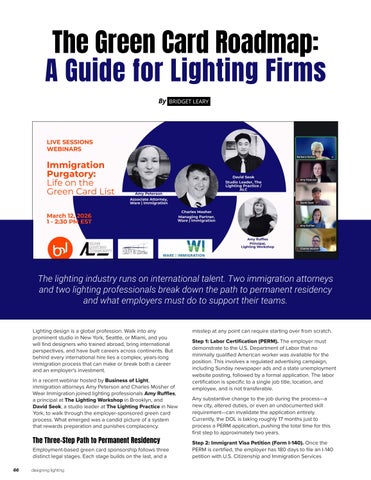
The lighting industry runs on international talent. Two immigration attorneys and two lighting professionals break down the path to permanent residency and what employers must do to support their teams. Lighting design is a global profession. Walk into any prominent studio in New York, Seattle, or Miami, and you will find designers who trained abroad, bring international perspectives, and have built careers across continents. But behind every international hire lies a complex, years-long immigration process that can make or break both a career and an employer's investment. In a recent webinar hosted by Business of Light, immigration attorneys Amy Peterson and Charles Mosher of Wear Immigration joined lighting professionals Amy Ruffles, a principal at The Lighting Workshop in Brooklyn, and David Seok, a studio leader at The Lighting Practice in New York, to walk through the employer-sponsored green card process. What emerged was a candid picture of a system that rewards preparation and punishes complacency.
The Three-Step Path to Permanent Residency Employment-based green card sponsorship follows three distinct legal stages. Each stage builds on the last, and a 66
designing lighting
misstep at any point can require starting over from scratch. Step 1: Labor Certification (PERM). The employer must demonstrate to the U.S. Department of Labor that no minimally qualified American worker was available for the position. This involves a regulated advertising campaign, including Sunday newspaper ads and a state unemployment website posting, followed by a formal application. The labor certification is specific to a single job title, location, and employee, and is not transferable. Any substantive change to the job during the process—a new city, altered duties, or even an undocumented skill requirement—can invalidate the application entirely. Currently, the DOL is taking roughly 17 months just to process a PERM application, pushing the total time for this first step to approximately two years. Step 2: Immigrant Visa Petition (Form I-140). Once the PERM is certified, the employer has 180 days to file an I-140 petition with U.S. Citizenship and Immigration Services