


Inline’s light modules rotate 355 degrees individually for controlled illumination and one-of-a-kind lighting flexibility. This unique feature allows for precise directional aiming of the light beam, to highlight and capture landscape details.


Pay a tribute by sketching a meaningful picture or jotting down a heartfelt note on a cocktail napkin.


n High efficiency is defined by using high-performance LEDs and drivers, along with a controlled distribution that delivers the maximum amount of light to the object being illuminated with minimal wasted light and energy.
n Absolute brightness control eliminates glare and ensures that the wall is the brightest feature in the space.
n Designed to bring the source of illumination as close as possible to the surfaces being illuminated with minimal wasted light and energy.
n With minimal scale comes minimal visual impact to the space, supporting the philosophy of seamless integration.
n By allowing the finished wall to extend past the ceiling plane, the entire wall is illuminated from top to bottom.

James R. Benya,
By David Pedler, Mark S. Rea, PhD, and Mariana G. Figueiro, PhD







It’s not about what we do. It’s about what you need, what you’re imagining, what you’re designing next.
You are the engine of our creativity.
At Amerlux, our newest architectural lighting solutions do more than illuminate. They integrate and elevate, blending into your beautifully designed spaces.
With thoughtful engineering, unsurpassed spec-grade quality and human-centric design, we empower your creativity and take it to new heights—the ones set by you.
Soar high with our new Finch and Stadia at LightFair 2023.
Visit Booth 2051 to capture your creative visions.


The elusive Finch is a rare, designer-friendly find. Amerlux’s latest design collaborative, delivers glare-free illumination using controlled beams of light, allowing for cleaner
Stadia A softer touch
Offering a soft, rounded-edge square design, Stadia provides a modern aesthetic that integrates fluidly into any design. With its uniform lighting, this distinctively styled downlight brings a sense of tranquility and subtle elegance.


By Stef Schwalb
Craig DiLouie, LC, CLCP
David Warfel
David Hakimi and Martin Knop


Forms That Inspire, Experiences T hat Captivate
We believe that great design should stand the test of time, be sustainably crafted, and be proudly American made.
Typology Collection : Striking industrial design by day, enchanting and ethereal pieces of luminescent art by night
Designed by Designworks, a BMW Group Company
Visit us at Lightfair in booth 2546. landscapeforms.com


Editorial Director: Randy Reid
Publisher: Cliff Smith
Director of Audience Development: Angie Hullfish
Contributing Writers:
James Benya PE, FIES, FIALD Benya's Art & Science Contributor Principal at Design Services, Inc. and The Benya Burnett Consultancy
Shirley Coyle
Up Close Contributor Principal at RELEVANT LIGHT Consulting Inc.
Craig Dilouie
Get Control Contributor Principal at ZING Communications
Stefanie Schwalb
Hospitality Lighting Contributor Interim Managing Editor at Boston Magazine
David Warfel
Residential Lighting Contributor Founding Designer Light Can Help You
Staff Writers: Parker Allen Katie Smith
Published by EdisonReport 1726C General George Patton Dr. Brentwood, TN 37027
Phone: 615-371-0961 designinglighting.com

designing lighting is focused on the Business of Lighting Design™ and provides business information to the lighting design community. In addition to the website, designing lighting publishes bi-monthly online magazines featuring original content, interviews within the community and highlights successful award winning lighting designs. While designing lighting is based in the U.S., it has contributors from Europe and is developing a global presence.
(ISSN 2693-9223)
Statements and opinions expressed in articles and editorials in dl are the expressions of contributors and do not necessarily represent the policies or opinions of the EdisonReport. Advertisements appearing in the publication are the sole responsibility of the advertiser.
As editor of designing lighting (dl) and publisher of designing lighting global (dlg) magazines, it is important for me to continue learning everything possible about our profession and industry.
At Euroluce in Milan, I attended the panel discussion, "Building Awareness and Equal Opportunities for Education and Careers in Lighting", hosted by the IALD LIRC Steering Committee and moderated by Martina Frattura and Chiara Carucci. The panel featured experts such as Andrea Hartranft from the US, Dean Skira from Croatia, Paul Ehlert from Switzerland, and Surbhi Jindal from India. The conversation was thought-provoking and highlighted the need for more discussions like this from lighting designers worldwide.
In January, I attended Light Middle East (LME) in Dubai and was impressed by the show's success and many education sessions for lighting designers. During LME, Muntasar Pocha, sales manager for Zumtobel in the UAE & Kuwait, presented the Monza Method which focuses on the relationship between color and human perception. A friend suggested I interview the Method's discoverers, Francesco Iannone and Serena Tellini of Consuline Milan. They kindly participated in an in-depth 60-minute interview at Euroluce.
My experience at Light Middle East reminded me that many US lighting designers work globally - and underscores the significance of world-wide collaboration. So many industry trends and techniques overseas are equally important to American specifiers, and vice versa.
Through both magazines, we will continue bringing new ideas to our audience.
Please visit our LightFair Studio, booth 3148. We are honoring Howard Brandston's life at the EdisonReport Lifetime Achievement Awards on May 22nd where guests are welcome to share their designs on cocktail napkins or leave heartfelt comments. These contributions will be displayed on our tribute board at our booth, and everyone is invited to participate.
Lighting specifiers, please share your best practices and project wins. Our team looks forward to hearing from you!


4º Fixed Beam Angle COB SUPERSpot Series
LP230: 13 Watts, 70,000 CBCP
LP260: 4 Watts, 26,000 CBCP
Integrating Control Simplicity LSI’s most iconic design equipped with state-of-the-art LED technology are the latest additions to the SUPERSpot family of fixtures. The LP230 and LP260 are integrated with powerful 4 degree COB spotlights to produce clean, unsurpassed optical performance up to 70,000 CBCP. Changing the beam from 4 degrees to wider distributions is as simple as adding a spread gel, making these Spotlights the most flexible tools in your arsenal.
Lighting Services Inc The premier specialty lighting manufacturer
Lighting Services Inc
800 999- 9574 www.LightingServicesInc.com


Modern Forms offers effortless, uncomplicated lighting and smart fan designs created from the finest upscale materials and innovative technology. Our designer collections refresh and redefine luxe spaces.


The late Howard Brandston, a generous mentor and teacher to many in the lighting design community. Photo courtesy of Melanie Brandston.
The Nuckolls Fund was named after the late James Nuckolls who was a pioneer in introducing lighting programs and curriculum in academic settings.

The system of mentoring in lighting design is without doubt the reason for the rapid success and development of our profession, and making sure that it is part of your daily life is the secret to success in the field of lighting.
The history of lighting design has been very, very brief. It has only been about 125 years since electric lighting started to become commonplace, and it made lighting design for buildings a relatively brand-new specialty profession.
At first, lighting was predictably utilitarian, even when light bulbs were used in chandeliers that once held candles. Industrial luminaires followed using high wattage lamps and reflecting shades. Lighting specialists were hardly considered “designers,” as illuminating engineering was in the forefront of lighting in all facets of human existence with emphasis on industry, commerce and safety. Lighting choices fell onto the shoulders of electrical engineers, electricians, architects and interior designers. Lighting design, if considered at all, was relegated mostly to the style of the luminaire, especially chandeliers and lamps. Modernism made it worse; lighting design became “laying out” recessed cans and boxes into flat white ceilings. Decorative lighting mostly disappeared, save for ornate chandeliers and a few modern art luminaires. A huge percentage of what was considered lighting design was due to the efforts of lighting sales representatives and design showrooms who always have and still provide considerable and beneficial input to many architects’ and engineers’ lighting designs.
Theatrical lighting designers were among the first to use the effects of lighting in an artful manner in buildings. The late Howard Brandston, one of the founders of International Association of Lighting Designers (IALD)1, often cited A Method for Lighting the Stage by Stanley McCandless2 as essential in learning lighting design. He, like other founders and early members of IALD, believed that the artistic principles of theater lighting could be directly interpreted into rooms and buildings, and from this they created and built a lighting design industry in New York in the dawn of lighting design for the built environment.
Most professions begin with higher education for which we turn to colleges and universities. For lighting design in buildings, there weren’t any until the late 1960s and early 1970s, when two professors – the late John Flynn at Michigan and later, Penn State, and Ron Helms at Colorado and later, Kansas – set out to provide a classic academic foundation for a new profession. A new generation of their students offer expanded academic options in lighting design for which the IALD Education Trust
provides funding and support around the world (https://iald. org/trust). But, relative to the size of the lighting industry, the number of higher education programs remains miniscule.
To make up for this, a lot of lighting designers (myself included) have taught lighting classes at schools of architecture and design. Additionally, manufacturers filled the void by teaching lighting to students and professionals alike through sales agents and in lighting training centers like Cooper Lighting’s “SOURCE.” But perhaps the biggest difference was made by a new generation of accomplished lighting designers, like the late James Nuckolls, who stepped into a college design programs to teach lighting design as adjunct faculty members. This was accompanied by a surge in professional development and education in lighting through conferences and trade shows like LightFair. Many successful lighting designers joined the part time teaching ranks. At Parsons in New York, an exemplary degree program in lighting design began, started by Nuckolls and still running strong. The new profession of lighting design for architecture and the built environment became legitimate and influential worldwide in less than 50 years, a sure sign that something was done right. But, it was only partly due to academics.
In my opinion, that “something” behind the rapid emergence and growth of professional lighting design was and is the widespread use of mentoring. It is reminiscent of a classic master/protégé concept, but unlike traditional arrangements, the roles can often reverse. Perhaps it is especially successful in lighting design because the best designs realize a harmony of the vision of the architect, landscape architect or interior designer with the skills of a lighting designer. After all, the breadth of knowledge affecting lighting design today is vast, multidisciplinary, technical and contextual, and it is darned easy for two persons to see a design problem differently. Together, they find a result that is best for the project and client. Their different backgrounds often allow for that unique synergy from which the best lighting designs are created.
I will admit that for quite a while, theater lighting designers had a distinct advantage…and may still. Steven Rosen, president and founder of Available Light, recently told me that he has always preferred and hired theatre lighting people. On the other hand, my main mentor, Stephen Squillace, was an engineer who loved lighting, and as Chief Electrical Engineer
for the Smith Group, he founded its Lighting Group in 1975. At first, almost all Group members were students of Flynn or Helms from Penn State or Colorado, but over time, members of the group included theatrically trained lighting designers, electrical engineers, architects and interior designers, all who caught the lighting “bug.” It was because of Squillace that I chose electrical engineering in the construction industry, and it had a lot to do with being able to design lighting because, as with Steve, lighting was my true passion. But, I am a better lighting designer because of the cross-mentoring within the Group. Imagine being able to seek the advice of Jan Moyer and David DiLaura without leaving my office!
When it came time for me to build my own practice in San Francisco, I ensured that we had that diversity, and I learned to encourage the cross-mentoring among us. Always remember that age or position doesn’t matter – I have sought and was mentored by partners and staff who were younger than me. I strongly believe that from diversity comes considerable improvement in the quality of the work. I occasionally relive moments sharing a design challenge with Naomi Miller, Michael Souter or the late Ross De Alessi.
You can pursue other mentors with whom you are not employed, too. Some of them will be brief but will impart something important; some will become life-long friends and mentors forever. For example, there was a period during
which I could spend time with Howard Brandston, and as his partners and staff will happily confirm, he was generous and willing to teach and share. At the time, I was beginning to play a larger role in the IES, and he offered me welcome personal advice on how to successfully participate. I relied on him as an occasional mentor until his passing, and from the ongoing success of the practice you can bet that his successors received many more mentoring benefits even after he (supposedly) retired.
As I look upon lighting design in the world today, I see this method of developing a lighting design practice helping the industry blossom everywhere. Formal lighting design education remains limited, so the creation of new lighting design firms and the expansion of successful firms into other cities could only be possible if done this way. I also see a glimmer of it among the many lighting experts employed in manufacturing, sales and academia. The system of mentoring in lighting design is without doubt the reason for the rapid success and development of our profession, and making sure that it is part of your daily life is the secret to success in the field of lighting. As long as you can find and/or be a mentor, take advantage of it.
Inspired by the passing of Howard Brandston. “Light is everything. Light is life. It is art, it is science, it is whatever you wish to make it.” – Howard Brandston, 1935 – 2023 ■
1 IALD was founded in 1969 by 13 lighting designers in New York who practiced lighting design for buildings. IALD now has over 1600 members in 30 countries.
2 McCandless, Stanley, A Method for Lighting the Stage, Theater Arts Books, 1927. Fourth Edition 1958.
cross-mentoring IN , AGE OR POSITION DOESN'T MATTER. DIVERSITY PROVIDES CONSIDERABLE IMPROVEMENT IN THE QUALITY OF THE WORK.


Green walls contribute to the greater well-being and better indoor climate. With their positive effect on the indoor climate and quality of stay, they are seen as a building block towards user-oriented sustainable interior design.
Through our New Parscan, you can discover optimum lighting needed for lighting green walls. With 6 sizes, 12 interchangeable distributions, tunable white and RGBW, the new generation offers even more. No matter the room height, the new Parscan always offers the right wattage for your project.



Stay on top of your industry and your game!
Today in Lighting (TiL) is the daily broadcast of EdisonReport and designing lighting (dl)
Hosted by Randy Reid, TiL is presented in audio and video formats weekday mornings at 8 AM Eastern.
Tune in for the latest industry news including
All in less than two minutes! Available via Spotify or anywhere you listen to podcasts, the EdisonReport YouTube channel or LinkedIn
TiL is also available for corporate sponsorship
Please contact Cliff Smith for information: csmith@designinglighting com or 917 705 3439 new product launches project updates mergers and acquisitions staffing announcements industry stock news


For two decades, the Monza Method has been a game-changer in lighting design. While Monza is famous worldwide for Formula 1 racing, lighting designers know the city for the Method's discovery.
During Salone del Mobile.Milano’s Euroluce in Milan last month, I had the pleasure of interviewing the Method's discoverers, Francesco Iannone and Serena Tellini of Consuline Milan. They explained how it all began…as an accident.
The Monza Method was born when Francesco and Serena were commissioned to design the lighting for the Museum and Treasure of the Cathedral of Monza.
Both were working there in 2003 for the lighting restoration with Osram, focusing on the chapels dedicated to Queen Theodolinda. Initially, they specified a certain luminaire for this work. However, when their assistants arrived, they found themselves with completely different luminaires from those imagined. They were a mixture of wattages, beam angles, and spectral distributions. Despite the mistake, something incredible happened.
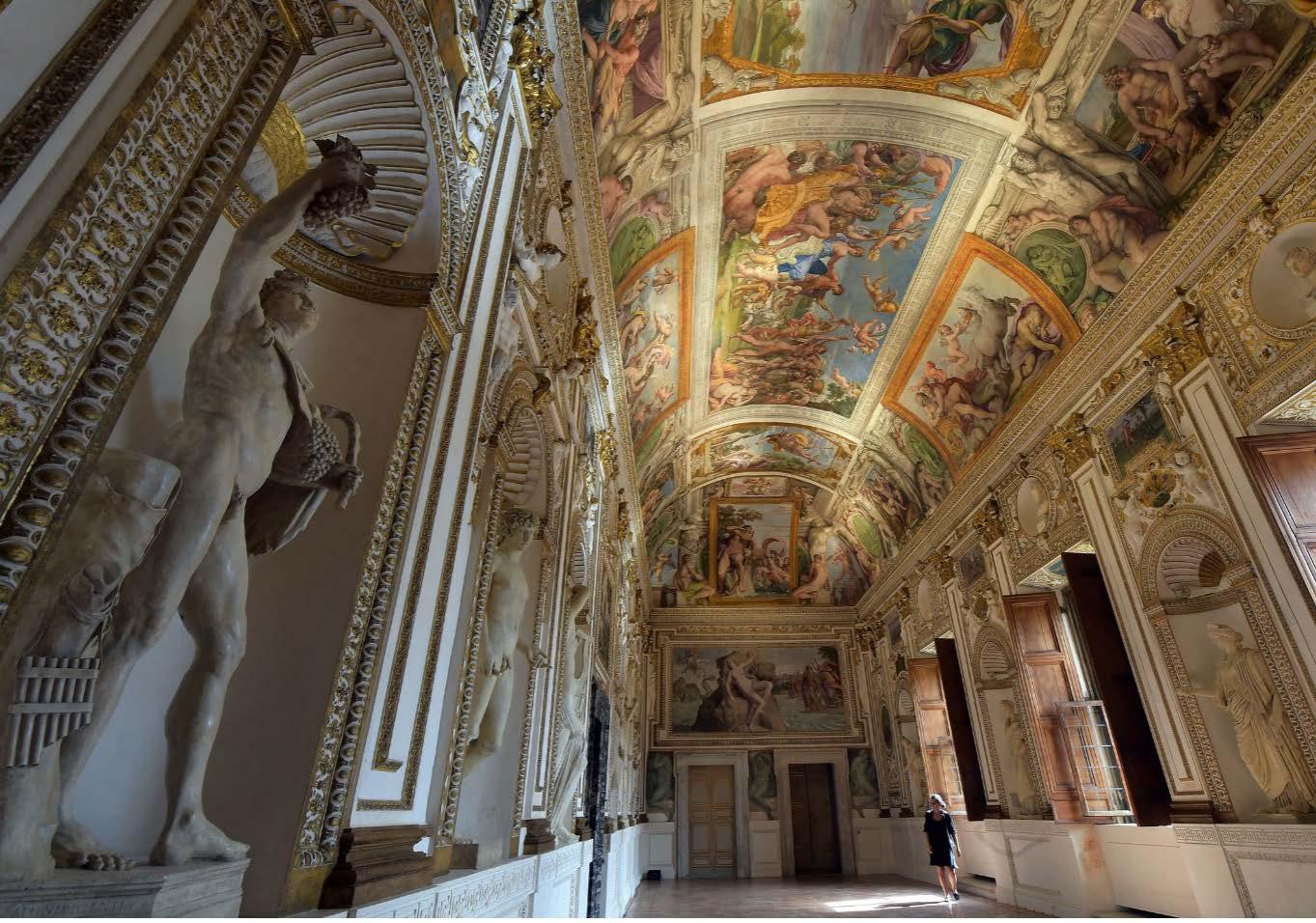
Francesco explained that they noticed something that wasn't visible previously when they turned on the fixtures. They could not believe what they were seeing; they switched the power on and off but still had the same result. The mistake, Serena added, highlighted details in the painting that became much more evident than expected. The addition of the "light mixture" greatly enhanced the features of the painting.
Both Serena and Francesco knew they were dealing with an unknown phenomenon which they discussed with university scholars in Malaysia, Singapore and Nanyang. Francesco was reminded that the brain expects light to be firm, fixed, single, and uniform.
When light is produced with incorrect color temperature and intensity, it can cause distortion to the brain's perception. This can lead to the human eye increasing its focus automatically.
"At this moment, the brain almost panics for a few seconds as it does not comprehend, because the vision is not perfect. Then the brain adjusts, adapts, and in this case, rebuilds the painting and recognizes what you have in front of you. Once the brain
has rebuilt the image, serotonin is released, and the brain is quite proud of itself," said Francesco.
“The Monza Method,” Serena added, “is focused on the relationship between color and human perception. By mixing light sources with different spectral curves at different angles and intensity, the perception of certain pigments is emphasized.”
After the discovery, Serena and Francesco began speaking at conferences such as ELDA and PLDC. They then began organizing seminars worldwide, including two large exhibitions on Giovanni Bellini and Lorenzo Lotto in Scuderie del Quirinale in Rome.
One project in Rome, recently completed, is the frescoes painted by Annibale Carracci in Palazzo Farnese.
The third exhibition showcased Tiziano and included a room at the end that compared the Monza Method to traditional lighting. The results were conclusive, and the public preferred


the Monza Method. Within three months, there were about 300,000 visitors to the exhibition; approximately 25,680 participated in the 20-minute test.
The results were presented at 2013 Copenhagen PLDC conference. When observing the bell tower, 72% reported better detail clarity when using LEDs compared to halogen. For the background, 44% perceived as farther away when using LED while 41% held the same perception using halogen. A larger percentage – 56% – noticed a wider range of colors with LED, whereas only 34% reported the same with halogen. For the painting's overall appeal, 48% found it more captivating under halogen, compared to 42% under LED.
In 2017, the Art History Museum in Vienna hosted a practical lighting workshop, “Immersive Art”, on the Monza Method. Lighting designers from around the world attended. Zumtobel donated the luminaires for the event.
1. One spotlight (Zumtobel SUPERSYSTEM II midi, 34° beam angle, 3000K) focused on the bottom left.
2. One spotlight (Zumtobel SUPERSYSTEM II midi, 20° beam angle, 4000K) focused on the top right.
3. A combination of situations 1 and 2.
4. The situation in 4 with an additional blue filter on the 4000K spotlight. Concept developed by Nelson Jiang and Dario Maccheroni.


Consuline implemented the Monza Method most recently in November 2022 to enhance the exhibition titled "The
Monza Method's discovery was a happy accident that changed the profession. Francesco and Serena's persistence in sharing their discovery at events worldwide helped establish the Method's popularity. Two decades on, it continues to inspire and influence lighting designers worldwide. ■


DAVID PEDLER, MARK S. REA, AND MARIANA G. FIGUEIRO By
Light isn’t just for vision anymore. Lighting researchers and professionals across multiple disciplines agree that an abundance of circadian-effective light in architectural spaces promotes good health, good mood, general well-being, and a good night’s sleep.
The consensus breaks down, however, when competing systems are advanced to quantify light’s circadian effectiveness or otherwise explain how light confers these benefits.
The not-so-good news? If the Dec 2022 issue of designing lighting is any indication, consensus on a metric for quantifying light’s circadian effectiveness doesn’t look like it will be reached anytime soon, neither among the research community nor the lighting industry at large. The great news? For the application at hand, it doesn’t really matter which metric is used to quantify circadian effectiveness. Though we obviously stand behind the circadian stimulus (CS) metric, all the presently available metrics will produce broadly similar results among real people in real spaces. Melanopic EDI (mEDI)? Equivalent melanopic lux (EML)? Which is the better choice? We say, “SOWatt!” (Standard Observer Watt).
Rigorous laboratory and field work, peer review, questioning and revision, publication and debate are part and parcel of the scientific process, to which we maintain a vital, lifelong commitment. But at some point, in practical terms, it all comes down to providing circadian-effective lighting for people in buildings. To date, however, lighting designers and engineers have lacked a salient tool for identifying luminaires that can best meet that relatively simple end, free of competing claims over circadian efficiency functions and metrics.
That is why we have proposed a methodology for evaluating and ranking luminaires in terms of their relative potential for delivering circadian-effective light to the eyes of a
standard observer. Our approach emulates the United States Environmental Protection Agency’s (USEPA) automobile fuel efficiency standard methodology that led to the iconic new-car window stickers and transformed the new-car marketplace in response to the 1973 oil crisis and 1975 passage of Energy Policy and Conservation Act.
Today, we face a no less urgent but largely silent crisis — sleeplessness, which the Centers for Disease Control (CDC) has declared a public health epidemic. This epidemic puts tens of millions of Americans at risk for car crashes, medical errors, industrial accidents, and a well-known host of disorders contributing to serious medical problems (e.g., cancer, metabolic diseases, depression) that are associated with disordered sleep. Given that the CDC’s declaration was made almost 10 years ago, the time for a redoubled effort to provide circadian-effective lighting in buildings has long passed.
Every new-car buyer has at least once studied a USEPA fueleconomy sticker, which follows a procedure that measures exhaust emissions from test vehicles on simulated city and highway drives to calculate fuel efficiency. The resulting prosaic window sticker displays the vehicle’s data and position in the range of vehicles in the same vehicle “line” (i.e., compact, sedan, sport utility vehicle, light-duty truck, etc.). We believe our luminaire standard methodology can do for the lighting industry what the USEPA did for the automobile industry.
Simplicity is the key, given the daunting array of factors that can affect the amount and distribution of circadian-effective light reaching a person’s eyes, including the characteristics (e.g., configuration, relative spectral power distribution [SPD], spatial distribution) of the luminaire itself, the reflectance values of the space’s surfaces (i.e., walls, ceilings, floors, desk/ table tops), workstation partition heights, window locations, occupants’ direction(s) of view, and so on. But choosing among


The proposed Circadian-effective Lighting Estimates tag showing the SOWatt value for a sample luminaire. Like the USEPA sticker, the tag shows the luminaire’s position with respect to the range of values calculated for luminaires in the Ceiling Mounted – Direct Batwing Distribution "line”.
candidate luminaires is governed by a single common denominator—their capacity to deliver circadian-effective light during the day to an occupant’s eyes. There are of course collateral issues that must be considered in any lighting design, like glare and energy, but these are easily managed by experienced designers. What is new and sorely needed for current lighting design is an objective way to measure the circadian effectiveness of different luminaire types.
Our proposed standard observer method differentiates spectral from optical factors to facilitate comparisons between the electric power (Watts) needed by luminaires to deliver a criterion circadian stimulus value (SOWatt), whether it be specified in terms of EDI, EML, CS or even photopic illuminance at the eyes.
Whatever measurement criterion is used, the lowest resulting SOWatt value within a given luminaire “line” indicates which is more or less efficient for delivering circadianeffective light to a standard observer. Importantly, as is the case with the USEPA sticker, the actual performance of a given luminaire will depend on when (timing), for how long (duration), and under what conditions (partitions, reflectance values of wall, floor, furniture, and ceiling) it is installed and operated. A distinct advantage of this method is that SOWatt values can be calculated virtually using photometric prediction software or through actual photometric testing.
As electric utilities become increasingly interested in the nonenergy benefits of lighting, the SOWatt metric provides a convenient, intuitive, and meaningful scale for supporting and promoting energyefficient circadian-effective lighting.
And nobody can reasonably say, “So what?” to that. ■
Light isn’t just for vision anymore.


Design Architect Gehry Partners
Executive Architect Gehry Partners
Interior Designer Rockwell
Lighting Designer KGM

By

The size and openness of the valet area presented a unique challenge when selecting the lighting.

KGM was chosen for the lighting design of The Grand LA by Gehry Partners, due to their long alliance with Related California and Gehry Partners, particularly in California.
The project had been in the works for 10+ years and began construction in 2019. Gehry Partners was the design architect and executive architect for the entire project.
Dan Weinreber, IALD, LC and Partner at KGM, sat down with designing lighting (dl) to overview the project.
The Grand LA consists of retail on the first five levels, which includes shopping, food and beverage, and the hotel above. KGM was responsible for lighting in the residential areas and all public and outward facing exterior design, including the valet area.
The hotel interiors were handled by Isometrix in London, with Tara Bernerd as the lead hotel interior designer. The two firms coordinated closely on the exterior areas, such as the pool deck and outdoor dining spaces.
The valet is the only entry for both retail and hotel and has varying ceiling heights of 10 to 50 feet. Due to this variation, Dan required a downlight that could accommodate different outputs, beam spreads, and other features while keeping a consistent aperture.
KGM used a 4-inch DMF downlight. “As you can see in our approach,” commented Dan, “We organized the lights intentionally and placed them behind columns to prevent aiming towards drivers' eyes. This lighting technique is similar

to how racetracks are illuminated, where poles light up the track surface without affecting the drivers' visibility.” In some areas, they grouped luminaires together in twos, threes, or fours to serve different purposes.
There are beams of light across the ground, often called marker lights. These serve as a signifier for the drop-off zone where vehicles arrive and valet staff assist passengers. They are semi in-grade fixtures that emit a beam across the ground. These are similar to runway lights found on aircraft runways/taxiways and are used instead of signage.
Smaller DMF downlights arranged in constellation patterns are used in areas where visitors/guests gather to access vertical transportation points, such as elevators. These are in three locations and serve as a signifier for the elevators.
With a pinhole of approximately 3 inches, these downlights create a pattern that directionally leads into the interior. These also serve as a guide, reducing sign clutter.
Located one level above Grand Avenue, the bridge is open to the sky and connects the two outdoor retail areas. It leads to the Disney concert hall and other areas.
The space is a hybrid of indoor and outdoor, with an open roof and full glass walls creating an indoor space impression despite its connection to the sky.
KGM intended to create a continuous experience, blurring the lines between indoors and out, and the effect is heightened by the residential lobby with its 24-foot windows and a generous spill of light, which generates a unified atmosphere. For

consistency, a color temperature of 3000 Kelvin was used throughout the project.
The monumental stair, which is open to the public and connects the residential courtyard to the Grand Avenue level, features lighting that is located underneath the metal cladding and illuminates the stair treads from about 9 inches above them. It is a continuous curving light that follows the complex, curving shape of the stair.
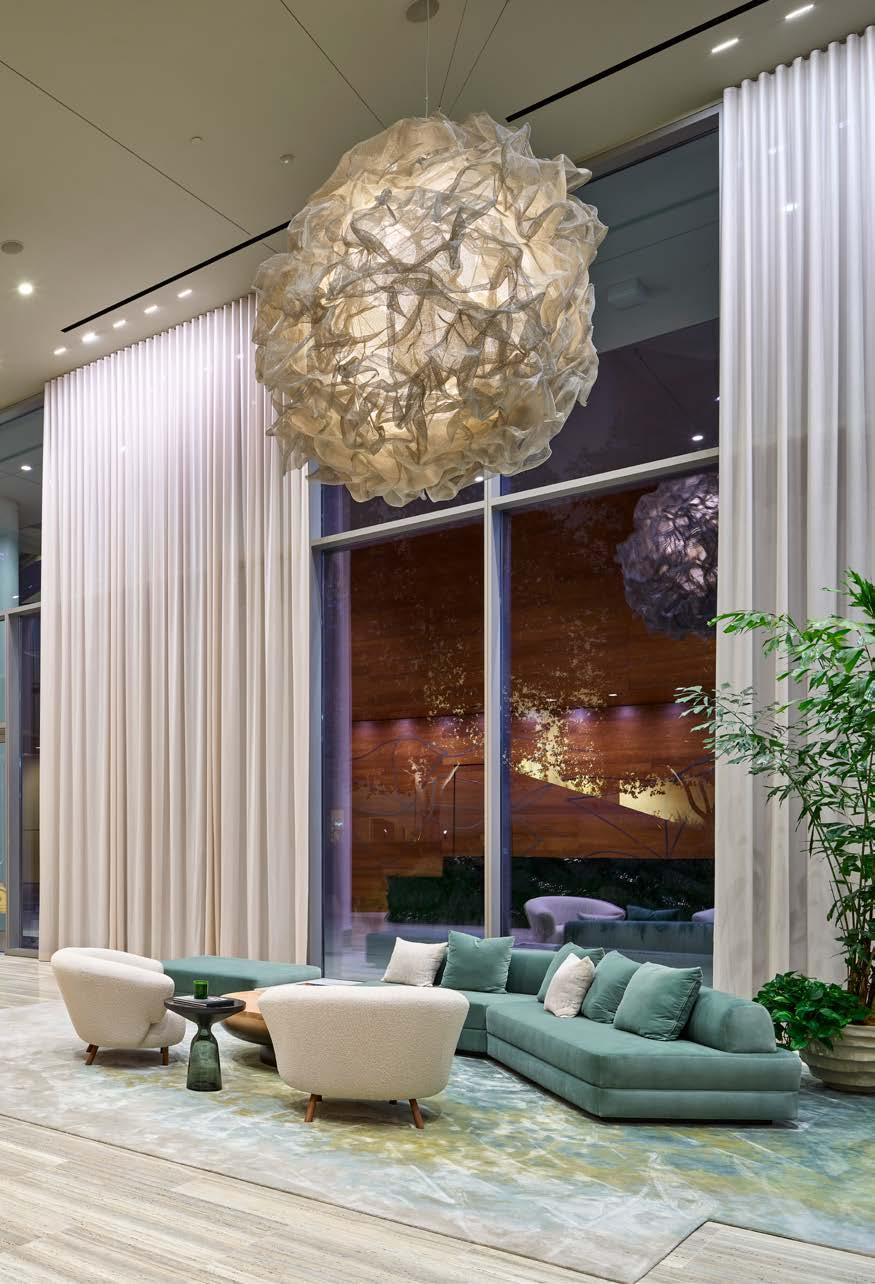
In the residential lobby, ceilings are close to 25 feet. Fixed drapery sheers are washed by linear multi-cell Lumenwerx wall wash luminaires. The lobby downlights are DMF, while the decorative fixtures are custom-designed by Frank Gehry, who often works with an artist fabricator to create unique pieces. Similar decorative fixtures can be found in other rooms.
The lobby features wood panels with DMF downlights and smaller Lumenwerx multicell wall wash fixtures. Lumenwerx was selected to provide a different aperture scale and size, with a smaller housing footprint and remote driver. Because the panels are basically two large blocks of wood overlapping at an angle, the goal was a continuance of light for the ever-decreasing angle toward the corner: they needed the smallest luminaires possible.
Installation of the rail lights posed a significant challenge as an aircraft cable had to pass through the light fixture. The fixtures, which are located 42 inches above the deck, demanded a bespoke design by Cole Lighting to ensure optimal functionality and aesthetic appeal. Inserting the high tension cable through the fixture required a coordinated effort between Cole Lighting

and multiple trades for a custom solution. Fixtures are watertight via a sleeve insulating the cable.
The residential pool area is illuminated exclusively by these rail lights from Cole, which are positioned around the perimeter of the deck. The light source is underneath the top rail, with no visible poles, allowing the low perimeter lighting to complement the minimalist architecture. This design ensures that the lighting does not undermine the architecture or create glare, resulting in a wonderful mood at night.
The control system used throughout the entire hotel, including the public spaces, retail area and exterior spaces, is ETC. Most fixtures are 0 to 10 volt, with a handful of phase dimming fixtures. The control system has the capability of working on a time clock, which was the original intent. This required unpacking and revisiting previous decisions, which added to the challenges already presented by Covid.
Another surprise was the need for a planter with living plants, which went through several designs, including a sculpture garden and green wall before settling on a planter. The challenge was to provide enough light for the plants to survive, as the area received no direct sunlight.
Over 100 footcandles of light were required, but the goal was to avoid blasting the entire space with glare. Providing ample light for growing plants solely with artificial sources was a completely different design challenge. To avoid detracting from the architecture, conventional fixtures could not be used. The result was a design that delivered light for the plants without compromising aesthetics of the space.
Los Angeles is considered a “package town,” and PLP SoCal was the manufacturer’s rep. According to Dan, they did not experience any significant lighting supply chain issues.
The completion of The Grand LA marks another successful project for KGM Lighting. The team's ability to overcome unexpected challenges and their commitment to creating intentional and cohesive design continues to make them a trusted partner for architectural firms and developers. ■


wednesday - may 24th @ 2 pm
join WILD's PRG+ Panel for a great discussion lead by Brittany Lynch from Clanton & Associates and Lisa Reed, fromReed Burkett Design on "What Companies Do to Retain Parents" .
wednesday - may 24th @ 4 pm
all are welcome to our LightFair networking event! Join us May 24th for yummy food, libations, and good times! We look forward to socializing with all our friends and allies from all corners of the industry!
We're still short of our 2023 goal! Silver and Bronze sponsorships are still available! Please join us in supporting the women of the lighting industry! Check out our website for more information and reach out via email with any questions.












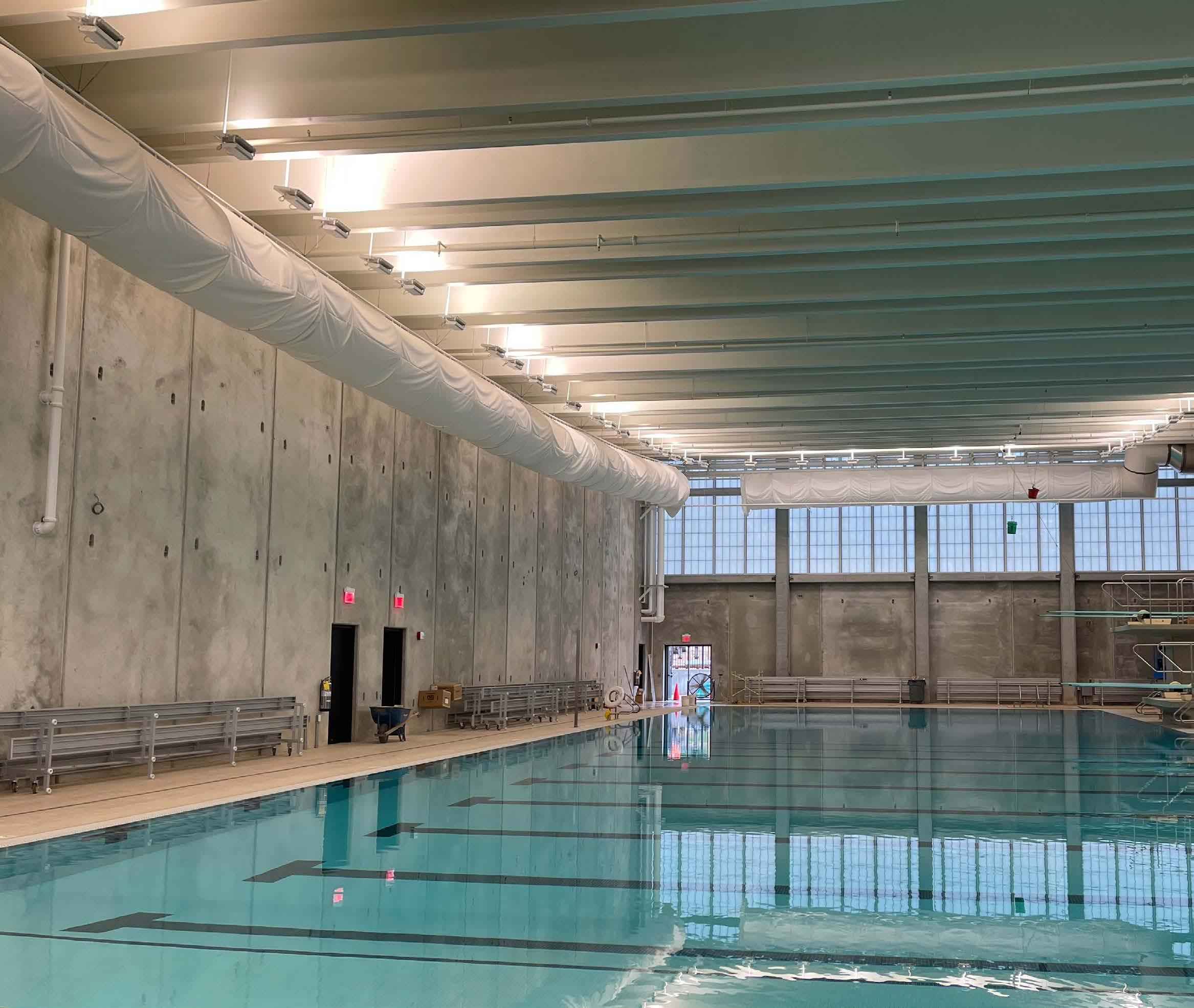


Kalamazoo College hosts some of the most prestigious swimmers in the state of Michigan. When their natatorium was no longer meeting standards and had to be completely rebuilt, they hired MillerDavis and TowerPinskter to design the building.
I sat down with Tony Reiner and Scott Garberick to learn more about TowerPinskter’s involvement in the new lighting for the natatorium. After a couple of years of discussion, the old natatorium was officially torn down and completely redesigned to better elevate the college campus, while meeting all required NCAA standards. With the design for the facility completed in 2020, the process of designing the lighting began. TowerPinskter designed the lighting for the entire building, not just the natatorium.
From the outside looking in, you can see large windows revealing beautiful lighting in a lobby area, known as the “Hall of Excellence,” showcasing awards and achievements compiled by the school’s swimming and diving team over the years. The customlength continuous linear fixtures are a focal point. Lit at 3,500K, the lobby offers a warmer tone. With a space for students to study, concessions, and private and public locker rooms, the building boasts 35,000 square feet. The historic campus is full of beautiful buildings, so the new design implements brick to match. Tony stated, "A form influenced by the dynamic movement of swimming and diving, clad with campus brick, elevates the core of the athletic campus." He went on to say that it’s a way to blend into the campus while pushing form and illuminating it in a way that isn’t overly offensive. Throughout the building there is brick mixed with concrete, and the lighting strategy is thoughtful and subtle. While the lobby is an impressive feat in its
own right, the Lithonia Cylinder light fixtures stretching across the side corridor of the building are a beautiful and somewhat industrial touch to the mixed concrete and brick hallways.
Scott explained, “The design philosophy is to always do light from the sides of the pool, where maintenance can easily be performed when necessary.” They designed the lighting to go around the edges of the pool and solely above walkways, and indirectly so it will never be in the athlete's eyes as they swim.
Through the process of talking to different lighting representatives, Scott and Tony sought to find indirect luminaires. Importantly, the fixtures needed to be chemically resistant to survive the natatorium atmosphere. They went with the high-performance Bolt series by Meteor Lighting. The lights are set at 4,000K and are complete with an Acuity nLight basic room controller, allowing 0-10 volt dimming and 100% to 10% dimming capability. A simple switch control allows for the coach to come in and turn the lights on at 75% for day-to-day use, and to 100% for swim meets. The lighting control system in the pool and surrounding space, like the corridor and lobby, are tied to a central lighting relay control panel provided by Acuity nLight. It is also tied to the building management system so the staff can control the time schedule. The building has a generator and emergency transfer devices to handle egress lighting as part of that system.
With no supply chain issues, the largest issue the team seemed to run into was the material of the ceiling itself and the design change. Originally planned to be two separate pools, one for laps and one for diving, it was then altered into one large “L” shaped pool. Scott shared that this caused the number of fixtures to increase and, because of the concrete “T” shaped beams in the ceiling, there were issues

with just how many fixtures were needed to get to the light level they wanted. The solution? Scott convinced them to paint the ceiling white.
Painting the ceiling white reduced light loss within the dark T’s. Keeping in mind NCAA standards and the possibility of film crews filming meets, they created a way for the lights to be bright enough to properly illuminate the pool and room as a whole. The lights now reflect off the white ceiling, providing a much brighter space.
The light fixtures were originally intended to sit at a tilt over the bleacher area where the spectators sit. Installed instead with no tilt, Scott sat and manually adjusted, but recognized it created an undeniable glare. While this wasn’t an intended
Lighting Design: TowerPinskter
Construction Manager: Miller-Davis
Electrical Contractor: Hi-Tech electric
Pool Area: Meteor Lighting Bolt Series
Linear Lights in Lobby: Focal Point
Cylinders in Lobby: Lithonia
Pool, Lobby, Corridor Controls: Acuity nLight
situation, it actually prevented an unnecessary glare on the water from the lights. A surprise in disguise!
Balanced with the natural light of north and west-facing windows, the pool is always washed with daylight that is complimented extremely well by the lighting design from Scott and Tony.
In a competitive, college-level natatorium, there is no more beautiful way to subtly display light fixtures around the concrete wall to emphasize the brightness of the room and the competitors while being equally cost-efficient and effective at bringing bright energy to the room. In a project that first began in 2018 and came to completion in 2021, this was an incredibly impressive job well done by TowerPinskter. ■


Annual check-ups with healthcare providers often evoke images of dull waiting rooms and sterile examination rooms. However, Modern Age, a wellness studio in NYC, is changing the game by creating a multi-sensory experience. The studio's founder, Melissa Eamer, wanted to take control of the way people age, and part of that was impacted by how people feel during their healthcare experiences. To accomplish this goal, Eamer brought on Madelynn Ringo, Head of Studio Design and Founder of Ringo Studio, and Kirsten Harris, Senior Manager of Construction of Modern Age, to disrupt the status quo of the typical doctor's visit.
Ringo wanted to focus on the customer experience from a sensory approach, considering sound, color, lighting, and smell. The lighting was a crucial element in defining the brand atmosphere. Ringo brought on Eileen Pierce from Pierce Lighting Studio, located in Chelsea, New York City, who has extensive experience as an architectural lighting designer for immersive spaces, to explore design possibilities.
Pierce has years of collaboration with Ringo on experiential retail environments. Eileen has a reputation for supporting unique designs through extensive research, tailoring the needs of the project to and honing the design criteria for innovative lighting solutions.
Inspired by the legendary artist James Turrell, Pierce's approach for the treatment suite deep regress ceiling cove takes advantage of the Flagship’s high ceilings. She stated, "We created volumes of light with different color spectrums and highlight architectural textures to reinforce the visual experience."
Turrell is known for his work with light, and his installations often create immersive and transformative experiences for viewers. Pierce's design is similarly ambitious, and it promises to create a unique and memorable space for visitors.
The multi-layer lighting design employs LED light sources throughout, including ceiling and wall coves, recessed and pendant downlights, wall sconces for circulation and

tasks, and integrated millwork for retail display. The varying light distributions support the serene spatial composition.
Arancia Lighting, a Canadian company, was specified for the lounge and circulation omnidirectional pendant fixtures echoing the curving shapes of the entryway. The fixtures are 3000K, which is a warm, inviting color temperature. The pendants create a new ceiling datum, avoiding drawing attention to the unfinished ceilings above. The brightness of the fixtures creates a sense of passage and delight with the shimmering tiled columns.
When the client arrives, the photo booth serves as the initial assessment. Pierce’s design calls for a 36” diameter RGBW Lumenwerx fixture in the booth to enhance facial features. The client is then taken to the treatment suite, where lighting has different scenes. The Welcome scene is warm and inviting, with moderate light levels. The Examination scene is brighter, with 100 footcandles of vertical light. The Meditation scene, with color tuning features, is designed to be relaxing.
For the 3-inch adjustable downlights within the treatment suites, Pierce Lighting Studio specified 3G Lighting, another
Photobooth: Lumenwerx
Downlights: 3G Lighting
Pendant Mount: Arancia Lighting
Wall Sconces: Sonneman
Wall Coves: Lumenwerx
Suite Task light: RBW
Controls: Casambi
Canadian company. These fixtures, also 3000K, have a high CRI and lumen output.
For controls, Pierce Lighting Studio specified Casambi, a fully wireless lighting control system, for its costeffectiveness and maximum flexibility.
Casambi's BLE mesh network offered customization, allowing design for scenes that would adjust and dim as required by operations. Color control is a native feature of Casambi's control software, eliminating the need for bulky DMX lighting systems. The Casambi app made programming the system simple, enabling hypercustomized experiences at a scalable level. Harris, the construction manager of the Flagship location familiar with the setup, was able to begin commissioning on the second Upper East Side location before the official programming was scheduled.
The design team fine-tuned the hierarchy and presets of how the lights would adjust, dim, and change colors, from the studio lounge to the treatment and consultation suites. The lighting control system was programmed and easy to manage for varying light intensities, while supporting Modern Age operations. With Casambi's builtin astronomical clock, preset scenes could be executed manually or automatically, conserving energy. Casambi's technology supported the design team’s objective to streamline the controls across all studio locations.
The collaboration between Modern Age and Pierce Lighting Studio, with support of the lighting and controls manufacturers, is a true testament to the power of lighting design’s positive influence for a unique wellness transformative experience. ■


May 21, 2023 • 9:00 am – 4:00 pm • L23W04
Lighting Projects Properly Exposed
(Eligible for IES, AIA, NCQLP, BOMI CEU credits) by Gavriil Papadiotis, n/a, GavriiLux
May 22, 2023 • 9:00 am – 12:00 pm • L23W12
Light Activism - Every light is political, so let's illuminate together!
(Eligible for IES, AIA, NCQLP, BOMI CEU credits) by Martin Flugelman, Architect / MA Light Design student, Studio Barthelmes
May 23, 2023 • 11:00 am – 12:00 pm • L23S01
A Brighter Tomorrow: Lighting for the Workplace of the Future
(Eligible for IES, AIA, NCQLP, BOMI CEU credits) by Alison Fiedler, WELL AP, Associate IALD, Stantec and Jessica Smith, LC, Jr. Associate IALD, WELL AP, Stantec
May 23, 2023 • 2:00 pm – 3:00 pm • L23S08
Artistic Illumination of Clothing, Costumes, and Accessories
(Eligible for IES, AIA, NCQLP, BOMI CEU credits) by Janet Hansen, n/a, Enlighted Designs, Inc.
May 23, 2023 • 3:00 pm – 4:00 pm • L23S16
Before the electric light, a story painted in pictures
(Eligible for IES, AIA, NCQLP, BOMI CEU credits) by Roberto Corradini, n/a, Lighting Design Workshop
May 23, 2023 • 4:00 pm – 5:30 pm • L23S24
The Magic of Light
(Eligible for IES, AIA, NCQLP, BOMI CEU credits) by Jon Armstrong, n/a, Jon M Armstrong Design
May 24, 2023 • 9:00 am – 10:00 am • L23S32
Blurring Boundaries between Light & Art
(Eligible for IES, AIA, NCQLP, BOMI CEU credits) by vibhor sogani, Installation Artist & Industrial Designer, Office of Design and Development
May 24, 2023 • 10:00 am – 11:00 am • L23S40 Light in Film - Deciphering Lighting Technique from the Screen's Perspective
(Eligible for IES, AIA, NCQLP, BOMI CEU credits) by Robert White, IALD, IES, LC, CFL, Illuminart
May 24, 2023 • 11:00 am – 12:00 pm • L23S48
Lessons Learnt from Lighting Art
(Eligible for IES, AIA, NCQLP, BOMI CEU credits) by Linus Lopez, BE MA IALD, Lirio Lopez Lighting Design Consultants
May 24, 2023 • 2:00 pm – 3:00 pm • L23S56
Exploring Human Perception Through Art and Design
(Eligible for IES, AIA, NCQLP, BOMI CEU credits) by Derek Porter, IALD, MIES, Derek Porter Studio
May 24, 2023 • 3:00 pm – 4:00 pm • L23S64
Lighting for Anxiety and Depression- A Designers Approach (Eligible for IES, AIA, NCQLP, BOMI, AIA-HSW, IDCECHSW CEU credits) by Lindsay Stefans, WELL AP, LEED AP, LC, Vode Lighting LLC
May 24, 2023 • 4:00 pm – 5:00 pm • L23S72
Lighting Takes the Scene: An Exploration of Light Through the Big Screen
(Eligible for IES, AIA, NCQLP, BOMI CEU credits) by Victor Quezada, MFA, MIES, AES Engineering
May 25, 2023 • 9:00 am – 10:00 am • L23S80
Reveal the Spirit of Place with Light – the Integration of Art and Lighting Technology in Cultural and Religious Architecture
(Eligible for IES, AIA, NCQLP, BOMI CEU credits) by Richard Wang, Senior Member - CIES, Shanghai ATL Lighting Design Company and Rodger Lu, Member of IES/IALD, ATL International Lighting Design Inc.
May 21, 2023 • 9:00 am – 12:00 pm • L23W06 Empowering More Equitable and Accessible Cities, the Smart and Sustainable Way.
(Eligible for IES, AIA, NCQLP, BOMI CEU credits) by Heidi Adams, BASEstud.io and Olantunji Oboi Reed, Equiticity and Nick Albert, and Ric Moore
May 21, 2023 • 9:00 am – 4:00 pm • L23W03
LC Study Group
(Eligible for IES, AIA, NCQLP, BOMI CEU credits) by Craig Bernecker, Ph.D., FIES, LC, Parsons School of Design, The New School/The Lighting Education Institute
May 22, 2023 • 9:00 am – 12:00 pm • L23W08
Designing with Luminance and Exitance
(Eligible for IES, AIA, NCQLP, BOMI CEU credits) by Craig Bernecker, Ph.D., FIES, LC, Parsons School of Design, The New School/The Lighting Education Institute
May 22, 2023 • 9:00 am – 12:00 pm • L23W10
LIGHTING HOPE AT HOME: Rethink
residential lighting to find middle ground between lackluster layouts and out-ofreach designs
(Eligible for IES, AIA, NCQLP, BOMI CEU credits) by David Warfel, n/a, Light Can Help You
May 22, 2023 • 2:00 pm – 5:00 pm • L23W15
Next Level Contract Review, Revision, Negotiation, and In-Project Communication
(Eligible for IES, AIA, NCQLP, BOMI CEU credits) by Eliot Wagonheim, Attorney, Associated Builders & Contractors
May 23, 2023 • 11:00 am – 12:00 pm • L23S02
Monthly Retainer: Exploring Alternate Business Structures
(Eligible for IES, AIA, NCQLP, BOMI CEU credits) by Derek Porter, IALD, MIES, Derek Porter Studio
May 23, 2023 • 4:00 pm – 5:30 pm • L23S25
Amplifying Your DEI Strategies & Humanizing the Experience
(Eligible for IES, AIA, NCQLP, BOMI CEU credits) by Desmond Davis, Davis Inspired Solutions LLC
May 24, 2023 • 9:00 am – 10:00 am • L23S33 Harnessing Passion to Drive Your Profession
(Eligible for IES, AIA, NCQLP, BOMI CEU credits) by Linus Lopez, BE MA IALD, Lirio Lopez Lighting Design Consultants
May 24, 2023 • 10:00 am – 11:00 am • L23S41
Shaping Information for How We’re Wired
(Eligible for IES, AIA, NCQLP, BOMI CEU credits) by Britain Willcock, Masters in Information Design and Strategy, MGM Resorts International
May 24, 2023 • 11:00 am – 12:00 pm • L23S09
Branding, Promotion, And Thought-Leadership For Small & Mid-Sized Lighting Businesses
(Eligible for IES, AIA, NCQLP, BOMI CEU credits) by David Shiller, MIES ALA, Lighting Solution Development
May 24, 2023 • 2:00 pm – 3:00 pm • L23S57
The Company Scorecard: What Companies Do to Retain Parents
(Eligible for IES, AIA, NCQLP, BOMI CEU credits) by Brittany Lynch, LC, Assoc IALD, Clanton & Associates and Lisa Reed, PE, IALD, MIES, LEED AP BD+C, Reed Burkett Lighting Design
May 25, 2023 • 10:00 am – 11:00 am • L23S88
Visual Storytelling in Effective Presentations
(Eligible for IES, AIA, NCQLP, BOMI CEU credits) by Britain Willcock, Masters in Information Design and Strategy, MGM Resorts International
May 21, 2023 • 9:00 am – 4:00 pm • L23W05
Maximize BIM efficiency; Modeling parametric lighting families
(Eligible for IES, AIA, NCQLP, BOMI CEU credits) by Gabi Korac, IES, Assoc. AIA, Essential Light Design Studio and Jacob Gerber, IALD, CLD, Essential Light Design Studio
May 21, 2023 • 9:00 am – 4:00 pm • L23W01 Basic Lighting
(Eligible for IES, AIA, NCQLP, BOMI CEU credits) by Kevin Houser, PhD, PE (NE), FIES, LC, LEED AP, Oregon State University
May 21, 2023 • 9:00 am – 4:00 pm • L23W02
Creating Control Intent Narratives and Sequence of Operations
(Eligible for IES, AIA, NCQLP, BOMI CEU credits) by Lyn Gomes, PE, LC, CCP, CLCATT, LEED AP, DPR Construction and Rick Miller, PE, LC, LEED AP, RNM Engineering
May 22, 2023 • 9:00 am – 12:00 pm • L23W09
Modeling a New Approach to the Design of Lighting Controls
(Eligible for IES, AIA, NCQLP, BOMI CEU credits) by Daniel Blitzer, BA, Economics, FIES, LC, The Practical Lighting Workshop and Jessica Collier, B.Arch, MFA Lighting Design, LC, Pacific Northwest National Laboratory and Ruth Taylor, BS, Environmental Design, Pacific Northwest National Laboratory
May 22, 2023 • 2:00 pm – 5:00 pm • L23W14
Design Thinking: A Creative and Analytical Working Process Adapted to Lighting Design
(Eligible for IES, AIA, NCQLP, BOMI CEU credits) by Derek Porter, IALD, MIES, Derek Porter Studio
May 22, 2023 • 2:00 pm – 5:00 pm • L23W13 IES TM-30 Color Rendering Workshop -- let's work through your current challenges!
(Eligible for IES, AIA, NCQLP, BOMI CEU credits) by Tony Esposito, PhD, MIES, Lighting Research Solutions
May 23, 2023 • 11:00 am – 12:00 pm • L23S03
2023 National Electrical Code - Changes That Effect Lighting Design
(Eligible for IES, AIA, NCQLP, BOMI CEU credits) by Christopher DeWaal, PE, LEED AP, CPH, Inc.
May 23, 2023 • 11:00 am – 12:00 pm • L23S04
Media Lighting Design Considerations
(Eligible for IES, AIA, NCQLP, BOMI CEU credits) by Cy Eaton, IES, Affiliiate IALD, Traxon Technologies and Doug MacDonald, n/a, Traxon Technologies and Florian Licht, n/a, LichtundSoende
May 23, 2023 • 11:00 am – 12:00 pm • L23S12
Why sustainable lighting design matters — and principles in praxis
(Eligible for IES, AIA, NCQLP, BOMI CEU credits) by Mihkel Pajuste, n/a, Aalborg University Copenhagen
May 23, 2023 • 2:00 pm – 3:00 pm • L23S10
A New Approach to the Design of Lighting Controls
(Eligible for IES, AIA, NCQLP, BOMI CEU credits) by Daniel Blitzer, BA, Economics, FIES, LC, The Practical Lighting Workshop and Ruth Taylor, BS, Environmental Design, Pacific Northwest National Laboratory
May 23, 2023 • 2:00 pm – 3:00 pm • L23S11
Lighting Design Is Not Just About Calculation Numbers
(Eligible for IES, AIA, NCQLP, BOMI CEU credits) by Meko Huang, CLD, LC, WELL AP, IALD, MIES, Arcadis IBI Group
May 23, 2023 • 2:00 pm – 3:00 pm • L23S13
Bringing emerging lighting technologies to the mass market: What are the drivers and how can you be involved?
(Eligible for IES, AIA, NCQLP, BOMI CEU credits) by Chris Wolgamott, CEM, CDSM, Northwest Energy Efficiency Alliance and Yao-Jung Wen, and Axel Pearson
May 23, 2023 • 3:00 pm – 4:00 pm • L23S18
Adapting The Past To An LED Future
(Eligible for IES, AIA, NCQLP, BOMI CEU credits) by Patrick Hunt, n/a, New Grand Light, LLC and Ryan Stockman, B.S.B.A., New Grand Light, LLC
May 23, 2023 • 3:00 pm – 4:00 pm • L23S19
From the End of Design to the Punch List - Getting Your Design through the Construction Process
(Eligible for IES, AIA, NCQLP, BOMI CEU credits) by Archit Jain, IALD, LEED AP, ISLE, Oculus Light Studio and Mariel Acevedo, LC, Solus and Jeff Woodrum, and Kurt Hamilton
May 23, 2023 • 4:00 pm – 5:30 pm • L23S27 THE BUYING PROCESS: WHO ARE THE PLAYERS & HOW DO WE NEED TO COMMUNICATE? or CAN'T WE ALL JUST GET ALONG?
(Eligible for IES, AIA, NCQLP, BOMI CEU credits) by CHARLES THOMPSON, FAIA, IALD, CLD, IES, LEED AP, AIA, IALD, IES
May 24, 2023 • 9:00 am – 10:00 am • L23S34 Case Studies: Lighting Controls Integrations
(Eligible for IES, AIA, NCQLP, BOMI CEU credits) by C. Webster Marsh, CLCP, IES and Ron Kuszmar, ETCP, Port Lighting
May 24, 2023 • 9:00 am – 10:00 am • L23S35 Light + Justice Indoors
(Eligible for IES, AIA, NCQLP, BOMI CEU credits) by Edward Bartholomew, IALD, IES, Light Justice and Lya Osborn, IES, IALD, Light Justice and Mark Loeffler, IALD, IES, Light Justice
May 24, 2023 • 10:00 am – 11:00 am • L23S42 Confessions of an Old School Lighting Auditor
(Eligible for IES, AIA, NCQLP, BOMI CEU credits) by Frank Agraz, LC, IES, Eco Engineering
May 24, 2023 • 11:00 am – 12:00 pm • L23S50
Living Light: Developing a Living Building
(Eligible for IES, AIA, NCQLP, BOMI CEU credits) by Molly Stowe, none listed, LUMA Lighting Design and Shea Sterner, none listed, LUMA Lighting Design and Zachary Suchara, AIA, MIES, LC, LEED AP, LUMA Lighting Design
May 24, 2023 • 11:00 am – 12:00 pm • L23S50 Living Light: Developing a Living Building
(Eligible for IES, AIA, NCQLP, BOMI CEU credits) by Molly Stowe, none listed, LUMA Lighting Design and Shea Sterner, none listed, LUMA Lighting Design and Zachary Suchara, AIA, MIES, LC, LEED AP, LUMA Lighting Design
May 24, 2023 • 11:00 am – 12:00 pm • L23S55
Using Light to Create Natural Environments and Powerful Human Experiences: A Case Study of Three Aquarium Projects
(Eligible for IES, AIA, NCQLP, BOMI CEU credits) by Leslie Crapster-Pregont, Junior Associate IALD, Oculus Light Studio and Scott Hatton, MIES, LEED AP, Oculus Light Studio
May 24, 2023 • 2:00 pm – 3:00 pm • L23S58
Everyone Wins: Measuring Impacts on Landlords and Tenants from Common Space Lighting Upgrades in Multifamily Buildings
(Eligible for IES, AIA, NCQLP, BOMI CEU credits) by Sofia Jurema, n/a, CMC Energy
May 24, 2023 • 2:00 pm – 3:00 pm • L23S59
What can lighting designers learn from Hollywood?
(Eligible for IES, AIA, NCQLP, BOMI CEU credits) by Jeff Thompson, n/a, HDR and Riley Johnson, PE, HDR
May 24, 2023 • 3:00 pm – 4:00 pm • L23S65
Bringing Life to Urban Night: Methodologies and Strategies
(Eligible for IES, AIA, NCQLP, BOMI CEU credits) by Elif Ayalp, n/a, Arup and Sarah Xiaoying Wang, Associate IALD, LEED GA, Oculus Light Studio
May 24, 2023 • 3:00 pm – 4:00 pm • L23S71
Collaborative Design for Storytelling with Light: Creating Spaces for Human Experiences
(Eligible for IES, AIA, NCQLP, BOMI CEU credits) by Lauren MacLeod, IALD, IES, LEED AP, Stantec and Rachel Fitzgerald, CLD, LC, IES, IALD, LEED AP BD+C, Stantec and Shannon Glover, IALD, LEED AP, Stantec
May 24, 2023 • 3:00 pm – 4:00 pm • L23S66
The balancing act – A case study in designing for light and health
(Eligible for IES, AIA, NCQLP, BOMI, AIA-HSW, IDCEC-HSW CEU credits)
by John Jacobsen, Assoc. IALD, IES, LC, Schuler Shook and Sarah Safranek, n/a, Pacific Northwest National Laboratory
May 24, 2023 • 4:00 pm – 5:00 pm • L23S79
Connecting the Dots:Digital Technologies and Immersive Visual Storytelling
(Eligible for IES, AIA, NCQLP, BOMI CEU credits) by Anthony Cortez, n/a, Arup
May 24, 2023 • 4:00 pm – 5:00 pm • L23S73
The Illuminated Little Island That Could
(Eligible for IES, AIA, NCQLP, BOMI CEU credits) by Enrique Garcia-Carrera, n/a, Fisher Marantz Stone
May 24, 2023 • 4:00 pm – 5:00 pm • L23S102
DarkSky Design Principles: Where Quality Light and Quality Night Coexist
(Eligible for IES, AIA, NCQLP, BOMI CEU credits) by Nancy Clanton, PE, FIALD, FIES, LEED Fellow, Clanton & Associates, Inc. and Ruskin Hartley, n/a, International Dark-Sky Association
May 25, 2023 • 9:00 am – 10:00 am • L23S82
Writing Sequences of Operation and Control Intent Narratives for Lighting Control Systems
(Eligible for IES, AIA, NCQLP, BOMI CEU credits) by Lyn Gomes, PE, LC, CCP, CLCATT, LEED AP, DPR Construction
May 25, 2023 • 11:00 am – 12:30 pm • L23S97
Blinded by the Light: Using UGR Effectively
(Eligible for IES, AIA, NCQLP, BOMI CEU credits) by Carol Jones, IES, Beyond Light Consulting and Harold Jepsen, P.E., WELL-AP, IES, AEE, NFPA, ASHRAE, ICC and Matt Hartley, IES, Matt Hartley Lighting LLC and Nancy Clanton, PE, FIALD, FIES, LEED Fellow, Clanton & Associates, Inc. and Nathan Stodola, and Jim Gaines
May 25, 2023 • 11:00 am – 12:30 pm • L23S96
Revitalizing the Smithsonian's National Air and Space Museum: Artifact Protection in Daylit Spaces
(Eligible for IES, AIA, NCQLP, BOMI CEU credits) by Gary Woodall, IES, IALD, LC, LEED BD+C, Gary Steffy Lighting Design Inc and Leora Mirvish, AIA, LEED BD+C, Quinn Evans and Mike Henry, P.E., Smithsonian Institution, Facilities
May 25, 2023 • 12:00 pm – 1:00 pm • L23S104
Senior living/senior care – Simple ways to use LIGHT and DARK for health
(Eligible for IES, AIA, NCQLP, BOMI, AIA-HSW, IDCEC-HSW CEU credits) by NAOMI MILLER, IALD, IES, LC, Pacific Northwest National Laboratory and Joan roberts, PH.D, Fordham University
May 21, 2023 • 2:00 pm – 5:00 pm • L23W07
Beautiful and Responsible Outdoor Lighting for All!
(Eligible for IES, AIA, NCQLP, BOMI CEU credits) by Charles Stone, FIALD IES LC LEED AP BD+C, Fisher Marantz Stone and Nancy Clanton, PE, FIALD, FIES, LEED Fellow, Clanton & Associates, Inc. and NAOMI MILLER, IALD, IES, LC, Pacific Northwest National Laboratory and Randy Burkett, FIALD, FIES, RBLD (Reed Burkett Lighting Design) and Rick Utting
May 22, 2023 • 9:00 am – 12:00 pm • L23W11
Dynamic Daylighting for Occupant's Health and Well-being: Theory, Research, and Design Applications for Practitioners
(Eligible for IES, AIA, NCQLP, BOMI, AIA-HSW, IDCECHSW CEU credits)
by Ahoo Malekafzali, Ph.D., Saint-Gobain North America and Ihab Elzeyadi, Ph.D., LEED, IESNA, University of Oregon and Stanley Gatland, PE, Saint-Gobain North America and Soumya Haridas
May 23, 2023 • 11:00 am – 12:00 pm • L23S05
Applying knowledge from the lab to the real world: from basic genetics to healing patients using light
(Eligible for IES, AIA, NCQLP, BOMI, AIA-HSW, IDCECHSW CEU credits) by Sofia Axelrod, Ph.D., Rockefeller University, Solaria Systems Inc.
May 23, 2023 • 3:00 pm – 4:00 pm • L23S20
Exploring lighting design as a wellnessenhancing proactive salutogenic approach towards optimal health
(Eligible for IES, AIA, NCQLP, BOMI, AIA-HSW, IDCECHSW CEU credits) by Amardeep Dugar, PhD, IALD, IES, FSLL, Lighting Research Design
May 23, 2023 • 4:00 pm – 5:30 pm • L23S28
The Effects of LED Roadway Lighting on Health and Alertness
(Eligible for IES, AIA, NCQLP, BOMI CEU credits) by George Brainard, n/a, Thomas Jefferson University and John Hanifin, n/a, Thomas Jefferson University and Rajaram Bhagavathula, n/a, Virginia Tech Transportation Institute and Ronald Gibbons, n/a, Virginia Tech
May 24, 2023 • 9:00 am – 10:00 am • L23S36
Wellness Lighting and Energy
Efficiency Converge
(Eligible for IES, AIA, NCQLP, BOMI, AIA-HSW, IDCECHSW CEU credits) by Robert Soler, n/a, NA
May 24, 2023 • 10:00 am – 11:00 am • L23S43
Further Thinking of Underpass Areas
(Eligible for IES, AIA, NCQLP, BOMI CEU credits) by Meko Huang, CLD, LC, WELL AP, IALD, MIES, Arcadis IBI Group
May 24, 2023 • 2:00 pm – 3:00 pm • L23S63
Lighting Alphabet Soup
(Eligible for IES, AIA, NCQLP, BOMI CEU credits) by Deborah Steimel-Clair, PE, LC, Illinois Institute of Technology
May 24, 2023 • 2:00 pm – 3:00 pm • L23S60
Physiological Responses and Quality
Attributes of Microgreens, Leafy Vegetables, and Tomatoes in Response to Specific LED Lighting in Controlled Environment Agriculture (CEA)
(Eligible for IES, AIA, NCQLP, BOMI CEU credits) by Ki-Ho Son, Prof., Gyeongsang National University
May 24, 2023 • 2:00 pm – 3:00 pm • L23S61
The Color of Night
(Eligible for IES, AIA, NCQLP, BOMI CEU credits) by Dawn Hollingsworth, CLD, Darkhorse Lightworks
May 24, 2023 • 3:00 pm – 4:00 pm • L23S68
The Sun: What you see is less than half of what you get
(Eligible for IES, AIA, NCQLP, BOMI CEU credits) by Jay Goodman, n/a, Apres Illumination, LLC
May 24, 2023 • 4:00 pm – 5:00 pm • L23S74
Biologically Aware Circadian Lighting: Moving From Concept to Reality and Beyond
(Eligible for IES, AIA, NCQLP, BOMI, AIA-HSW, IDCECHSW CEU credits)
by Grant Kightlinger, MIES, Assoc. IALD, Pivotal Lighting Design and James Greenberg, MD, Science of Life Center/Cincinnati Children's Hospital Medical Center and Marty Brennan, AIA, WELL AP, ZGF Architects
May 24, 2023 • 4:00 pm – 5:00 pm • L23S75
The Effectiveness of Integrating Germicidal UV with Architectural Lighting in Real Spaces
(Eligible for IES, AIA, NCQLP, BOMI, AIA-HSW, IDCECHSW CEU credits)
by Craig Bernecker, Ph.D., FIES, LC, Parsons School of Design, The New School/The Lighting Education Institute and Dave Pfund, The Lighting Quotient
May 24, 2023 • 4:00 pm – 5:00 pm • L23S76
Well-being and work-life balance in the design industry
(Eligible for IES, AIA, NCQLP, BOMI CEU credits) by Grisell Herrera-Fernández, Architect. Lighting Designer., Light In Me and Magali Mendez, Architect. Lighting Designer with certificactions , Light In Me
May 25, 2023 • 9:00 am – 10:00 am • L23S81
Blinded by the light (pollution): How to select non-white outdoor lighting to minimize sky glow
(Eligible for IES, AIA, NCQLP, BOMI CEU credits) by Leora Radetsky, MS, MIES, LC, DesignLights Consortium and Tony Esposito, PhD, MIES, Lighting Research Solutions
May 25, 2023 • 9:00 am – 10:00 am • L23S83
New Retail lighting: lighting strategies and their impact on health
(Eligible for IES, AIA, NCQLP, BOMI, AIA-HSW, IDCEC-HSW CEU credits)
by Nubi Leon-Martinez, Arquitect & Lighting designer, Arquifabrica
May 25, 2023 • 10:00 am – 11:00 am • L23S90 How Germicidal UV Light Can Be Applied to Reduce the Risk of Airborne Disease Transmission
(Eligible for IES, AIA, NCQLP, BOMI CEU credits) by David Sliney, PhD, John Hopkins School of Public Health and David Welch, PhD, Columbia University and Paul Jensen, PhD, PE, CIH, Final Approach Inc. and Richard Vincent, n/a, Icahn School of Medicine at Mount Sinai
May 25, 2023 • 10:00 am – 11:00 am • L23S91 [Lighting] Sustainability Through History
(Eligible for IES, AIA, NCQLP, BOMI CEU credits) by Sima Tawakoli, Master of Science, Canada College
May 22, 2023 • 2:00 pm – 5:00 pm • L23W17 Integration Roadmap
(Eligible for IES, AIA, NCQLP, BOMI CEU credits) by C. Webster Marsh, CLCP, IES and Gary Meshberg, LC, LEED-AP, Legrand
May 23, 2023 • 11:00 am – 12:00 pm • L23S07
Can Lighting be a Catalyst that Drives Smart Buildings?
(Eligible for IES, AIA, NCQLP, BOMI CEU credits) by Rick Huijbregts, Ph.D, Stantec and Seth Ely, MIES, Stantec
May 22, 2023 • 11:00 am – 12:00 pm • L23S06
Create Resilient Exterior Lighting with PV-integrated Luminaires
(Eligible for IES, AIA, NCQLP, BOMI CEU credits) by Christopher Pickering, n/a, Light Efficient Design
May 23, 2023 • 2:00 pm – 3:00 pm • L23S10
A New Approach to the Design of Lighting Controls
(Eligible for IES, AIA, NCQLP, BOMI CEU credits) by Daniel Blitzer, BA, Economics, FIES, LC, The Practical Lighting Workshop and Ruth Taylor, BS, Environmental Design, Pacific Northwest National Laboratory
May 23, 2023 • 2:00 pm – 3:00 pm • L23S100
DALI-2 D4i: Standardizing Lighting Control (Eligible for IES, AIA, NCQLP, BOMI CEU credits) by Landon Miles, n/a, Inventronics
May 23, 2023 • 2:00 pm – 3:00 pm • L23S14
Data Ethics in Machine Learning & AI (Eligible for IES, AIA, NCQLP, BOMI CEU credits) by Mary Willcock, n/a, GMR Marketing
May 23, 2023 • 2:00 pm – 3:00 pm • L23S101
Dermaphotology: the Color of Light (Eligible for IES, AIA, NCQLP, BOMI, AIA-HSW, IDCEC-HSW CEU credits) by Maria Thompson, PhD, Photic and Nathalie Rozot, n/a, PhoScope
May 23, 2023 • 2:00 pm – 3:00 pm • L23S15 Electrification Impacts On The Lighting Industry
(Eligible for IES, AIA, NCQLP, BOMI CEU credits) by Chris Brown, IES, Ultra Yield Solutions and David Shiller, MIES ALA, Lighting Solution Development and Peter Brown, LC, Lighting Transitions
May 23, 2023 • 3:00 pm – 4:00 pm • L23S22
AI based Video Analytics and its applications in Lighting
(Eligible for IES, AIA, NCQLP, BOMI CEU credits) by Dennis Kwan, n/a, WiSilica Inc and Vivek Pramod, n/a, WiSilica Inc
May 23, 2023 • 3:00 pm – 4:00 pm • L23S21 Brighter, Smaller, Further, Faster –> how LaserLight is changing the lighting industry
(Eligible for IES, AIA, NCQLP, BOMI CEU credits) by James Highgate, BSEELCATC, Kyocera SLD Laser and Paul Rudy, doctoral degree in physics, MBA, Kyocera SLD Laser
May 23, 2023 • 3:00 pm – 4:00 pm • L23S23
D4i Advances Lighting Designs with Smarter Lighting
(Eligible for IES, AIA, NCQLP, BOMI CEU credits) by Michael Davidson, BS, Electrical Engineering, Georgia Institute of T, Synapse Wireless
May 23, 2023 • 4:00 pm – 5:30 pm • L23S29
Frontiers of Sustainable Lighting
(Eligible for IES, AIA, NCQLP, BOMI CEU credits) by Alessa Aguayo, LC, WELL AP WIL+D and NLB Board Member, Coronet LED and David Bergman, RA, LEED AP, CPHD, Assoc AIA, New York School of Interior Design and Leela Shanker, MIES, Green Light Alliance & Flint Collective NYC and Shaun Fillion, LC Educator IALD MIES, RAB Lighting | New York School of Interior Design
May 23, 2023 • 4:00 pm – 5:30 pm • L23S26
Importance of LED Lighting Standards and Regulations
(Eligible for IES, AIA, NCQLP, BOMI CEU credits) by Jianzhong Jiao, n/a, JZJ Consulting, Inc.
May 23, 2023 • 4:00 pm – 5:30 pm • L23S31
Smart Lighting and Controls: The Key to Electric Vehicle Adoption?
(Eligible for IES, AIA, NCQLP, BOMI CEU credits) by C. Webster Marsh, CLCP, IES and Gary Meshberg, LC, LEED-AP, Legrand and Peter Brown, LC, Lighting Transitions
May 24, 2023 • 9:00 am – 10:00 am • L23S39
Color tuning and its “50 shades of gray”: Design and deliver an insightful space using color tuning in 5 steps.
(Eligible for IES, AIA, NCQLP, BOMI CEU credits) by Martin Mercier, P. Eng, Cooper Lighting Solutions and NAOMI MILLER, IALD, IES, LC, Pacific Northwest National Laboratory
May 24, 2023 • 9:00 am – 10:00 am • L23S38
Connected Emergency Lighting
(Eligible for IES, AIA, NCQLP, BOMI CEU credits) by Khasim Rizvi, BSEE, Bodine Emergency Lighting and Tom Stoll, PE, LC and CFSE (TUV), Bodine Emergency Lighting
May 24, 2023 • 9:00 am – 10:00 am • L23S37
Specifying Sustainable Luminaires
(Eligible for IES, AIA, NCQLP, BOMI CEU credits) by Scott Roos, Member IES Sustainability Committee, BFA Industria, Acuity Brands
May 24, 2023 • 10:00 am – 11:00 am • L23S45 Laser lighting - a new way to generate light with new lighting design opportunities
(Eligible for IES, AIA, NCQLP, BOMI CEU credits) by Erik Wellen, n/a, Solis Laser Lighting B.V.
May 24, 2023 • 10:00 am – 11:00 am • L23S44
Lighting Measurement with a 360° Panoramic Camera
(Eligible for IES, AIA, NCQLP, BOMI CEU credits) by Hongyi Cai, PhD, LC, University of Kansas
May 24, 2023 • 10:00 am – 11:00 am • L23S46
Show Me the Money!
(Eligible for IES, AIA, NCQLP, BOMI CEU credits) by Deborah Steimel-Clair, PE, LC, Illinois Institute of Technology
May 24, 2023 • 10:00 am – 11:00 am • L23S47 Zhaga Platform for Smart City Sensors
(Eligible for IES, AIA, NCQLP, BOMI CEU credits) by Mark Duffy, PhD, MD35 Consulting, LLC
May 24, 2023 • 11:00 am – 12:30 pm • L23S52 Keeping Up With Change
(Eligible for IES, AIA, NCQLP, BOMI CEU credits) by Mark Lien, LC, HBDP, CLMC, CLEP, LEED AP, Augmented Illumination and Paula Ziegenbein, n/a, Hartranft Lighting Design and TBD TBD, n/a, n/a
May 24, 2023 • 11:00 am – 12:00 pm • L23S53
Retrofitting a building to include a lighting control system starts with a well-planned strategy
(Eligible for IES, AIA, NCQLP, BOMI CEU credits) by Lynnette Schaeffer, LC, MBA, EiKO Global, LLC
May 24, 2023 • 11:00 am – 12:00 pm • L23S54
WELL Buildings Std v2: Be in the know on how lighting contributes to it, and beyond lighting!
(Eligible for IES, AIA, NCQLP, BOMI CEU credits) by Martin Mercier, P. Eng, Cooper Lighting Solutions and Jon Parrish, and Nathan Stodola
May 24, 2023 • 2:00 pm – 3:00 pm • L23S62
Unraveling Networked Lighting Controls
(Eligible for IES, AIA, NCQLP, BOMI CEU credits) by Lynnette Schaeffer, LC, MBA, EiKO Global, LLC
May 24, 2023 • 3:00 pm – 4:00 pm • L23S70
Five Paradigm Shifts in Lighting Controls
(Eligible for IES, AIA, NCQLP, BOMI CEU credits) by C. Webster Marsh, CLCP, IES and Gary Meshberg, LC, LEED-AP, Legrand
May 24, 2023 • 3:00 pm – 4:00 pm • L23S69
How to Advance High Tech Light Management with MLA Solutions
(Eligible for IES, AIA, NCQLP, BOMI CEU credits) by Kevin Green
May 24, 2023 • 4:00 pm – 5:00 pm • L23S77 ECONOMICS of Solar Lighting Solutions
Post Inflation Reduction Act – for USA Installations: CAP X or NO Cap X = REDUCED OP X – IS THIS REALLY POSSIBLE – YES IT IS
(Eligible for IES, AIA, NCQLP, BOMI CEU credits) by Brian Steinkamp, J.D., HSI Solar and David Beatty, n/a, Sonoran Energy & Lighting and Neal Verfuerth, n/a, Energybank, INC
May 25, 2023 • 9:00 am – 10:00 am • L23S84
Germicidal Ultraviolet Systems for Healthier and More Energy Efficient Buildings
(Eligible for IES, AIA, NCQLP, BOMI, AIA-HSW, IDCEC-HSW CEU credits)
by Gabe Arnold, P.E., L.C., Pacific Northwest National Laboratory and Jason Tuenge, LC, Pacific Northwest National Laboratory
May 25, 2023 • 9:00 am – 10:00 am • L23S85
Lighting the path to Smart & Healthy Buildings
(Eligible for IES, AIA, NCQLP, BOMI CEU credits)
by Angela Pilant, LC, Evergreen Consulting Group and Doug White, CEM, CALCTP, LEED AP, Trane Technologies and Eric Fournier, MBA, LEED, Avi-On Labs, Inc
May 25, 2023 • 9:00 am – 10:00 am • L23S86
The Lighting Singularity is Near: Accelerating Toward a Brighter Future
(Eligible for IES, AIA, NCQLP, BOMI CEU credits) by Katheryn Czub, IALD, IES, LEED BD+C, Fisher Marantz Stone
May 25, 2023 • 9:00 am – 10:00 am • L23S87
Flicker: What does it LOOK like and HOW to evaluate products to avoid it
(Eligible for IES, AIA, NCQLP, BOMI, AIA-HSW, IDCEC-HSW CEU credits)
by NAOMI MILLER, IALD, IES, LC, Pacific Northwest National Laboratory
May 25, 2023 • 10:00 am – 11:00 am • L23S92
Opportunities for DALI-2 in dynamic lighting projects
(Eligible for IES, AIA, NCQLP, BOMI CEU credits) by Bas Hoksbergen, BEng, Pharos Architectural Controls and Simon Hicks, MA MEng (Cantab), Pharos Architectural Controls
May 25, 2023 • 10:00 am – 11:00 am • L23S94
What Does the Future Hold? Artificial Intelligence and Lighting Control
(Eligible for IES, AIA, NCQLP, BOMI CEU credits) by Landon Miles, n/a, Inventronics
May 25, 2023 • 10:00 am – 11:00 am • L23S95
Designing adaptive lighting systems with digital light sources
(Eligible for IES, AIA, NCQLP, BOMI CEU credits) by Timothy Logan, n/a, HKS and Wouter Soer, n/a, Lumileds
May 25, 2023 • 11:00 am – 12:30 pm • L23S98
Life-cycle liberty and justice for all: exploring social equity and justice from a life cycle perspective; activities and approaches to build a more sustainable world for everyone
(Eligible for IES, AIA, NCQLP, BOMI CEU credits) by Kate Hickcox, LC, MS, PNNL and Tyler Harris, PhD, Pacific Northwest National Laboratory and Kasey Johnston
May 25, 2023 • 11:00 am – 12:30 pm • L23S99
Links in the (Supply) Chain – Manufacturing a More Sustainable Future
(Eligible for IES, AIA, NCQLP, BOMI CEU credits) by Jon Penndorf, FAIA, LEED AP, Perkins&Will and Melissa Mattes, LC, Living Future Ambassador, Sladen Feinstein
May 25, 2023 • 11:00 am – 12:00 pm • L23S105
LED Lamps and Luminaires at End of Life
(Eligible for IES, AIA, NCQLP, BOMI CEU credits) by Jeffrey Schwartz, LC, MEIES, JDS1 Consulting


Division Chief, Natural Sounds and Night Skies Division
U.S. National Park Service
Ms. Treviño will discuss her experiences, successes, and challenges in transforming a small, lesser-known program into a national success. Additionally, she will explore the impact of outdoor lighting on national park resources and values.


Aculux's AX series architectural recessed downlights have been improved with enhanced WarmDim® and Tunable White technology. WarmDim® provides the feeling of halogen lighting with the energy savings of LED, while Tunable White lets users adjust the color temperature in real-time. The AX3 series delivers 800 to 1500 lumens with a 12° lighting distribution, and the AX4 series offers 800 to 2000 lumens with beam distributions from 10°. Ideal for various applications, including healthcare, hospitality, and retail.

Saber Suspension by PureEdge Lighting provides designers with a unique solution for outdoor lighting projects. Its flexible 0.8" rounded lens delivers soft and glare-free illumination without any visible pixelation, spanning up to 40ft with multiple color temperature options. Saber also features RGBTW, offering 16+ million colors and 85,000 tunable white tones. With rugged, watertight construction, Saber exhibits outstanding R9 and CRI color rendering.


The Bruni Collection is a modern lighting set that includes circular lamps with adjustable rings and ample lighting. These lamps are available in two sophisticated finishes, painted or powder-coated aluminum and steel, and feature a clear acrylic ribbed texture. They are equipped with high-quality LED lights that have a 90 CRI and a warm 3000K color temperature, providing warm and diffused lighting that is perfect for sloped ceilings

The REV Flex is a versatile lighting solution with 359° rotation and 30° tilt, suitable for any installation. It has a regressed 40-degree cut-off trim for fixed applications, field-replaceable optics, flangeless and wall wash options. The VX Driver eliminates invisible LED flicker with CCR and PWM technology, meeting IEEE 1789 standard practices. The REV Flex light engine produces 690-4,640 lumens using 10W-60W of energy with a long-lasting LED luminaire and TM21 L70 lifetime of 100,000 hours.


Introducing the Tangram-Cut lighting fixture, featuring strong geometric lines suspended at angles of your choice, and connected seamlessly with straps. This fixture boasts a solid UV resistant and crystal-grade glass piece available in clear or frosted finish. With a single 90 CRI COB light engine, it delivers up to 2500 lumens of powerful illumination, and is also available in tunable white. Installation is easy with high-quality UV resistant nylon straps housing an imperceptible flat power cable. The fixture is available in 5 colors and allows for adjustable strap angles, positioned inside or outside as desired


Kvisten is a sustainable workplace luminaire, consisting of 77% recycled or renewable material, including a wooden frame, recycled reflectors, and reduced plastic components. It delivers optimal lighting experience with a delta-micro prism louvre optic in acrylic for direct or direct/indirect light distribution. The luminaire provides CLO and DALI/phase pulse control for dimming and features Organic Response PIR with presence and daylight-responsive control. It is pendant-mounted with height adjustment of the wire and a 5-pin snap-in terminal block connection. Accessories are available separately, and customization options are available in Fagerhult's configurator for CRI, color temperature, optics, luminous flux, controls, and more.


DMF Lighting introduces the X Series: modular 2-inch downlights and 3-inch cylinders with tool-less, fieldchangeable trims, modules, and optics. The Precision Lock Collar simplifies installation, and the modules have Fixed and Adjustable options with outputs from 750 to 1500 lumens. The X Series offers color temperatures ranging from 2700K to 4000K, and the X Series Cylinders provide pendant, surface-mount, and wall-mount solutions. The downlighting system is compliant with Title-24 JA8, ENERGY STAR®, and Declare Listed.
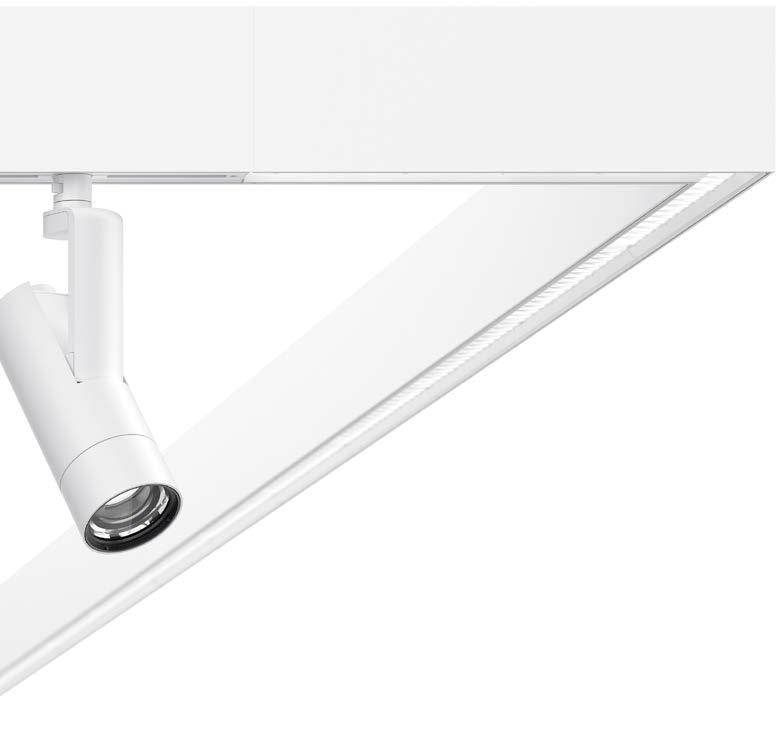


Introducing the Invia 48V lighting system - the perfect solution for museums and galleries looking for outstanding wallwashing and accent lighting for highquality art. With its unique wallwashing capabilities, this system can even uniformly illuminate corners, ensuring that art is displayed with high contrast. The Invia 48V system also offers the option of using 48V spotlights for added impact. With tunable white light, this system is versatile and can be adjusted to follow the application and architecture. The continuous line design adds a dynamic element to the space and highlights spatial dimensions.


WAC Landscape Lighting offers a range of bollards for outdoor spaces. The GATE LED Bollard provides even illumination and blends seamlessly into pathways with a sleek linear design. The SCOOP Bollard is ideal for lighting and accenting landscaping, walkways, buildings, and parking areas, improving visibility and security. These IP66rated LED landscape luminaires are factory-sealed and protected against high-pressure water jets, with a constant output for 9-15 volt input. They can operate with 12-volt, 120-volt, and 277-volt systems, making them versatile for various applications. Bollards are perfect for lighting gardens when other fixtures aren't practical.

Introducing the Pivotaire Nano Linear fixture with a unique zig-zag configuration - perfect for adding clean, modern lines of high-impact linear light to 90° corners in modern architecture. This fixture boasts patented features, including a mounting system that allows for 360° of freedom, enabling it to be mounted at any angle, including horizontal, vertical, and any other angle you can imagine. The Pivotaire Nano Linear fixture also features a patented lens design that ensures even illumination across the entire surface, eliminating any dark edges. UL Listed and patented, this fixture guarantees impeccable performance.


The Pavo 2" wall sconce now comes with an IP66-rating for outdoor use, while still retaining its stylish and functional design. Its linearly-lit sconce provides even illumination, without any visible shadowing, and up to 750 lumens per foot. Its minimalist bracketry and hardware ensure a clean look, and it can be mounted vertically or horizontally on walls or ceilings. Additionally, it complies with the Americans with Disabilities Act (ADA) requirements and is handcrafted in the USA. By pairing it with other elements of the Pavo family, it creates continuity between interior and exterior designs.


Visa Lighting's healthcare sconces are both aesthetically appealing and ADA compliant, featuring formed aluminum construction that is durable and easy to clean. All sconces are damp location rated, easy to clean, and available in 21 paint colors with an antimicrobial top coat option. The Bliss Round emits a circle of comfortable light from its shallow cylindrical form, while the Bliss Square produces a simple square of illumination from its boxed shape with a frosted acrylic lens.


The library at University of California San Diego (UCSD), known as the Geisel Library, was renamed in honor of Theodor Seuss Geisel, also known as Dr. Seuss, and his wife Audrey, who made significant donations to the facility. This iconic building, alongside the renowned Hotel del Coronado, is one of the most famous structures in San Diego and within the entire UC system. The library was originally designed by William Pereira, a wellknown architect whose signature style is recognizable in other famous structures such as the Transamerica Building in San Francisco and the floating restaurant at LAX.
Recently, I had the opportunity to meet with Kevin deFreitas of Kevin deFreitas Architects, the architect and mastermind behind the redesign of the Geisel Library's lobby, and Diane Borys, Founding Principal of Noctiluca Lighting, who was responsible for the new lighting design. They walked me through the newly renovated building, highlighting the changes in the lighting design. I couldn't help but wonder if I would have fared better in my academic pursuits if libraries were as inviting and inspiring as this when I was a student.
The Geisel Library, designed by Pereira in 1968, opened in 1970. While the entrance is iconic from the outside, the inside was originally small, with a low ceiling and basic carpeting. Fluorescent lights were installed, creating an unremarkable interior.
The new light art in the entrance was crafted by the renowned Californian artist John Baldessari, who previously taught at the university. The piece reads, "Read, write, think, dream.” Additionally, Roy McMakin, another faculty member, contributed to the artwork by designing the accompanying benches. With the redesign, the light art in the entrance has now become one of the most Instagrammed places on campus.
Local manufacturer A-Light Architectural Lighting provided custom-sized fixtures for the new entrance lighting. Diane pointed out that the curve of the fixtures is an essential aspect of the design concept, evident throughout the building's lights, carpeting, and details, matching the exterior's concrete curve. Kevin explained, “This curve increases the strength of the building's concrete, and we brought the geometry of the curve into the interior design.” Although it was challenging to find pendant lights with curved corners during the 2020 design, it is now a popular trend.
The luminaires have a color temperature of 3500K and are fully dimmable, while the square 2-inch downlights in the main lobby are sourced from CSL and are visually appealing, especially in contrast to the previous 8 inch incandescents.
The design of the library prioritized openness and accessibility in line with the ideals of open and democratic societies that share information. To achieve this, the carpet was removed and replaced with reflective flooring to create a brighter and more spacious environment. Walls were also removed to make the library as open and bright as possible. The redesign involved a timeless neutral pallet to let the colorful window art, rainbow wall mural and students themselves provide the color in the space.
The transformation of libraries accelerated during the pandemic, and more collections are going digital. Consequently, the top floor's book stacks were removed and replaced with ultra-quiet study spaces. As you move down the floors, the study spaces become progressively louder, and the library's focus shifts towards meeting and collaboration spaces with facilities such as a GIS room and 3D printer room. The lighting design reinforces this programming and highlights the architecture.
Moving on from the entrance, there are different sections off the lobby, including Geisel West and Geisel East, each with a distinct color at the entrance traced with a thin line of light creating a portal. Kevin humorously refers to these as “Tron lights,” which are used to draw people through the space by using color and light.
One of the rooms off through one of these portals was like a time machine, transporting me back to the 1980s with its outdated design. The 1 x 4 fluorescent fixtures had multi-colored
louvers, and it was hard to tell if the louvers had changed color or if the fluorescent lamps were different color temperatures. Maybe both. The room had a dark and artificial feel, and one fixture appeared to be hanging precariously from the ceiling, which only added to the oppressive atmosphere. It was a stark contrast to Diane’s bright and welcoming design.
The former transaction counter has been relocated, and the Integrated Services space now serves as an open lounge. “The original fixture that we had specified for the Integrated Services space was discontinued during COVID,” Diane explained. “During construction we had to find a new luminaire that was within the budget. This is where Coronet came in. Their Y-shaped luminaire complements the linear forms of the building while not competing with the irregular ceiling shape.” Kevin added that “the Y-shape also represents the library idea of challenging knowledge and asking “Why?””
The lighting design also employs layers and accents to help create a sense of movement and visually guide visitors through the space without signage. The library is in a constant state of transformation, with exhibits showcasing archives from Geisel. The archives are periodically updated every quarter, with new exhibits being displayed in the gallery.
The library's ceiling is mainly exposed concrete, which may seem impractical for sound absorption. Kevin explained that the goal was to expose the historic structure and the building's original back-of-house aesthetic. As part of the redesign, the drop ceiling at 9 feet was removed, and the ceiling height was increased to around 15 feet. Due to the ceiling's irregular shape, sound absorption is not a problem. The irregularity dramatically reduces sound reflection, as opposed to a symmetrical space where sound can bounce off surfaces.
In the distance, various study rooms are visible, featuring different shades of blue, from dark to medium to light. Wall washers are used to create a sky theme, with metal columns backlit to highlight cloud perforations.
In contrast to traditional library rules, Geisel features a café where students can eat, drink, and socialize. Diane noted that the goal is to make people comfortable, in line with the library's emphasis on accessibility and openness.
We visited an active learning classroom where students take the mandatory How Do You Use the Library course. The library is one of the few academic buildings open all day, five days a week, and soon it will be open 24/7, due to the growing campus population. The library serves as a central hub, providing essential services for students and is often referred to as the living room of the campus.
In the active learning classrooms, the linear indirect/direct luminaire housings are asymmetric to help reduce glare and are strategically placed and routed to highlight the space and ceiling. The combination of finished wood and concealed CSL cylinders with raw concrete complements the space.
Kevin showed us the Nest, a reading area that felt like the most comfortable and welcoming area in the library. Kevin shared that his parents, both school teachers, passed away during the library's design phase. In their honor, Kevin and his family contributed to the budget, and the University added a plaque in remembrance of his parents, which was a touching moment during our visit.
Diane's lighting design incorporated layers of light, including Louis Poulsen pendants in the front library area, which featured books by local authors. The pendants added to the theme of openness and warmth and gave the area an oldfashioned feel, which was further emphasized by the use of wooden slats in the entry and the curved area of the active learning classroom.
The design and construction of the library took place during the COVID-19 pandemic, with the first site walk taking place on March 16th, 2020, the very day that the library was closed due to the pandemic. The design team hoped this would speed construction. It ultimately proved an added challenge for the project since the university also had financial concerns, as the library does not belong to a particular department and therefore there was no designated champion for funding. Kevin explained that the library belongs to everyone and no one as it serves all eight colleges at UCSD, each with its own provost competing for funding.
Kevin showed me a concrete column and pointed out a whimsical design that seemed embedded in the concrete. Upon closer inspection, it appeared to be a grey fresco. He then explained that over the decades, hundreds of signs had been glued to that one column, making it look like a billboard. This was a common practice among student organizations, who would plaster printouts on every available surface. The column was left with glue residue and holes from mounting screws. Kevin and his team wanted to restore the column to its original state. He said, “Now the library uses light and color to guide people, not signs.”
The Geisel Library at UC San Diego is a remarkable building that underwent a transformative redesign that prioritized openness and accessibility. The lighting design played a significant role in the library's overall transformation, with custom-made fixtures and the use of light art guiding visitors through the space. The library is a central hub for students, and the redesign made it more inviting and welcoming. Kevin deFreitas and Diane Borys masterfully incorporated layers of light and unique design elements that emphasized the library's iconic architecture and openness. Their work is a testament to the power of lighting design to transform a space and make it more inviting to all. ■


At UCSD, Geisel Library reigns supreme, A famous structure, it's a dreamy scene, With Pereira's design, iconic from afar, And Seuss' donations, it's a shining star.
Kevin deFreitas, an architect of fame, Led the redesign, with lighting a game, Diane Borys, a lighting designer bright, Crafted the lights, oh what a sight!
The entrance now greets with light art so grand, Baldessari's words, with benches at hand, A-light fixtures curve, matching the exterior, And WAC tracks, light up the interior.
The lobby now has a gallery's touch, With Cornet's "Y" luminaire, it's not too much, Tron lights guide, with colors of delight, Through Geisel West, East, South, and North’s light.
No more drop ceiling, no more carpeted floor, Reflective flooring, the space does adore, Open and bright, quite a sight, With study spaces, for all, day or night.
• Curved-edge open rectangle pendants: A-Light
• Lobby track at art: WAC (Strut track)
• Square outline 2x2 at elevators: Coronet
• Cylinders at wood ceilings: CSL
• "Y" Pendants: Coronet
• Asymmetric linear pendants: Coronet
• Service hub cove uplight: Interlux channel with Kelvix Tape
• Meet Spot book area pendants: Louis Poulsen
• Backlit column tape: Kelvix
Asymmetric luminaires reduce glare, Wood and concrete, a unique design pair, Louis Poulsen's pendants add warmth and glow, Old-fashioned feel, with a vintage throw.
Layers of light, guide visitors through, Making them comfortable, nothing new, The Nest, a reading area so serene, With Kevin's tribute, to his parents seen.
COVID-19 made the project not so fast, But funding was a concern that could not last, The library belongs to all, they say, So light and color guide, without any fray.
The concrete column with a whimsical touch, Was once a billboard with signs too much, Now, light and color, are all they need, To guide people, and let their mind feed.
Geisel Library's redesign is now complete, Open, accessible, and very neat, With lighting design, that's sure to please, A welcoming space, for all to seize.
OWNER: University of California San Diego (UCSD)
PROJECT: Geisel Library - Lobby Renovation
COMPLETE: September 2022
• Architect/mastermind: Kevin deFreitas, FAIA (Kevin deFreitas Architects)
• Lighting Designer: Diane Borys, LC, CID, WELL AP, LEED AP, EIT, CEPE (Noctiluca Lighting)
• MEP: Syska Hennessy
• Graphics: Emily Desai (Bowyer)


PERI, the smallest integral driver perimeter fixture, delivers 1000+ lm/ft at 90+ CRI and multiple optic options. Ideal for shallow plenum spaces, it’s compatible with multiple ceiling types, and its modular assembly allows for easy installation.


Designed with the modern traveler in mind, citizenM hotels can be found in Europe, Asia, and all across the United States. From New York and Los Angeles to London and Kuala Lumpur, guests who stay at these properties appreciate the value and luxury they provide on a daily basis. The design-forward Dutch company opened its first location in Amsterdam in 2008 and shows no signs of slowing down. In fact, citizenM aims to have 40 operational hotels in its portfolio by 2024 as it continues to cater to mobile citizens across the globe who travel to the
key gateway cities they are located in, one of which is its latest property to open stateside—citizenM Miami Worldcenter.
As the brand’s second hotel in the Magic City, citizenM Miami Worldcenter is situated in the heart of its business and financial center, which also includes a range of entertainment, hospitality, and retail spaces. The vibrantly designed hotel has 351 rooms, four society meeting rooms, a gym, and a rooftop pool and bar. We connected with Claudia Abt, citizenM’s Chief Design Officer, for details on how the project’s lighting and fixtures form a key part of the brand’s vibe and appeal and how the general design aesthetic—as well as the property’s location—impacted its design and corresponding choices.
“This hotel is located within Miami’s newest shopping, dining, and entertainment destination at the Miami Worldcenter development in downtown. It’s an exciting part of the city. Our aim for the property was to embrace Miami’s vibrant culture, which is a perfect fit for citizenM’s distinct style and commitment to design, art, and technology,” Abt explains. “Our design for the hotel creates bright, light-filled spaces for work and play that also nod to the Miami setting—for instance, with built-in seating that uses patterns reminiscent of classic beach chairs and is illuminated with pendants that offer a coastal feel. In general, the lighting choices are about creating a luxurious mood that allows guests to feel comfortable whether they’re in an all-day meeting, spending time with friends in the living room, or relaxing in bed.”

“Our design for the hotel creates bright, lightfilled spaces for work and play that also nod to the Miami setting."
− Claudia Abt
To achieve that mood, the role of lighting was a two-prong approach, which is standard practice at every citizenM hotel where a mix of iconic fixtures and custom lighting solutions is seamlessly applied. “Our clustered installations of George Nelson pendant lights have become a brand signature, for example, and these designs always resonate with our guests,” Abt says. “At Miami Worldcenter, we also specified pendant fixtures by Artek, Ebolight, Hatco, Moooi, Angle Poise, &tradition, Flos, Delta Light, Marset, Linea Light, and Roll & Hill.” For custom solutions, which are equally important, she cited several examples. “In the living room and societyM workspaces, we specified extensive runs of linear LEDS, which in some instances create a visual impact on the ceiling, and in others are used to accentuate the millwork, but in every case offer a warm glow that makes our guests feel at home. We use LED toe-kick runs in certain seating areas and around our canteenM space for the same reason.”
Of course, as with all hospitality projects, how lighting and the choice of fixtures are determined remain integral parts of overall strategy and process. “Lighting plays an important role in our design approach at citizenM, and it’s a meaningful part of how we express our brand ethos. Our guests know and appreciate us for being a designforward brand, so it’s crucial that we use lighting effectively as part of a cohesive design vision for every space in every hotel,” Abt reveals. “Sometimes light fixtures themselves form a focal point that helps to define a space—with a cluster of beautiful pendant lights or a large-scale floor lamp in a vibrant color near a seating area. In other instances, the fixtures fill a specific supporting role, such as drawing attention to the curated collection of art and objects that we display on custom shelving units or the commissioned works on our walls.”
Visitors also appreciate citizenM for providing a seamless experience throughout their stay, Abt adds, and the team uses smart lighting to help reduce any points of friction. “Through their citizenM app, guests can control nearly every aspect of their individual rooms, including the
level of illumination and its color.” In a similar vein, citizenM takes ESG and sustainability very seriously, and smart lighting design and specification helps in that regard, too. “All of our hotels across our global portfolio use only LED lights, from the bedrooms to the kitchens, and every discrete zone within each hotel has individual lighting controls that are also integrated with our operations software,” she reveals. “This means that once a guest checks out, for example, the lights in their room switch off automatically. The time and effort our team invests in making thoughtful decisions around lighting and controls really pays off in terms of energy savings.”
For Abt and the team at citizenM, inspiration for design and lighting is an ongoing process, and it’s one they enjoy immersing themselves in depending on where each property is located and what innovations are impacting the industry. “As a brand, citizenM is known for offering the best of lifestyle, art, and design, and we’re always on the lookout for exciting new ideas. For our new hotels, we’ll often take inspiration from the surrounding city itself—its culture and arts scene, its architectural styles, and its overall attitude,” Abt concludes. “And of course, we’re always tracking the latest innovations in architecture and design, from modular construction to ultraefficient new fixtures and 5G integration.” ■


By PureEdge Lighting
Saber and Saber Mini, our patent-pending suspended lighting systems, take outdoor architectural lighting to the next level by creating one-of-a-kind, dimensional, ‘laser beam’ illumination. LED rounded strips of light create soft, glare-free ambient illumination with no visible pixelation. Saber features a profile of 0.8” while Saber Mini features a smaller profile of 0.6” and bends up and down giving it the unique ability to traverse open spaces wall to wall, wall to ceiling, or floor to ceiling. Available in RGB and RGBW, Warm Dim, and Tunable White (2000K – 6500K) for design flexibility.

By
The American Society of Heating, Refrigerating, and AirConditioning Engineers (ASHRAE) and the Illuminating Engineering Society (IES) recently published ANSI/ASHRAE/IES Standard 90.1-2022, Energy Efficiency Standard for Buildings Except Low-Rise Residential Buildings.
This edition includes an expanded scope for building sites, a minimum prescriptive requirement for onsite renewable energy, and other major additions appearing for the first time in a U.S. model energy standard or code. For lighting, the new version adjusts power allowances, adjusts the definition of alterations, adds horticultural lighting, and updates several control requirements.
Commercial building energy codes regulate the designed energy efficiency of nonresidential buildings. A majority of states rely on model energy codes such as ASHRAE/ANSI/ IES 90.1 and the International Energy Conservation Code (IECC). While a majority of codes are based on the IECC, 90.1 is recognized by the U.S. Department of Energy as the national reference code (currently the 2019 version, with all states required to adopt a code at least stringent as this version by July 2023); it is also the basis for building rating systems such as LEED. Further, the IECC recognizes 90.1 as an alternative compliance standard. Both model codes are updated every three years.
For lighting, typically, energy codes impose a mix of prescriptive and mandatory requirements, with mandatory requirements focused on lighting controls. Since 1999, the overall trend is toward lower power allowances and more detailed control requirements to maximize energy savings. The 2022 version of 90.1 is no exception, with changes focused on tightening interior power allowances—based almost entirely on LED technology—while tweaking requirements for lighting controls.
Let’s take a look at what’s new, focusing on salient changes while noting this information is provided for educational purposes only and does not constitute a definitive interpretation, which is up to the authority having jurisdiction.

For more information and interpretations, consult the code or the applicable AHJ.
ANSI/ASHRAE/IES 90.1-2022 clarifies the scope of 90.1 to include the site, not just the building.
Before this change, the standard covered only systems fed by building power. As a result, exterior and parking lot lighting, if not provided through the building’s main electrical panel, were previously not within the scope of 90.1. Now it is.
Including sites also confirms that onsite renewables can count as credits toward energy usage across the building even if not part of the building footprint.
As 90.1 evolved, lighting retrofits have increasingly become recognized as within the standard’s scope. In the new 2022 version, all alterations are lumped together, including retrofits in which the original lamps and driver/ballasts are replaced with lamps and drivers/ballasts that were not components of the original luminaire. These alterations are then broken out and assigned separate requirements depending on whether the lighting is interior or exterior.
Interior: If the lighting system in the interior building spaces adds up to more than 2000W of load, the alteration must comply with the standard’s lighting power allowance and mandatory control requirements that are applicable to each altered space. If the connected lighting load is 2000W or smaller, the alteration must comply with the standard’s lighting power allowance requirements (or result in new wattage at least 50 percent below the original wattage of each altered lighting system) and then comply with only the standard’s manual local and automatic shutoff mandatory lighting control requirements.
Exterior: For an exterior building area, if the total number of new or retrofitted luminaires is greater than 10, or where the

combined length of new and retrofitted linear luminaires is greater than 20 linear feet, the alteration must comply with the standard’s lighting power allowance and mandatory control requirements. If the alteration is smaller, it must comply with lighting power allowance requirements (or result in new wattage at least 50 percent below the original wattage of the system) and then be controlled by at least an Off switch.
The 90.1 standard limits maximum lighting power density. Unless opting to use complex building modeling, designers can choose one of two compliance paths, either the Building Area Method (single maximum power allowance in W/sq.ft. for entire building) or Space-by-Space Method (maximum power allowance for each type of space within building). The standard also caps exterior lighting power using a system of base allowances and tradable surfaces.
Exterior lighting power allowances are significantly reduced compared to previous versions of the standard. For interior lighting power, allowances were generally reduced or stayed the same. Also generally, when power allowances were reduced, they were not reduced as significantly as in previous versions, suggesting maturing acceptance of LED by 90.1.
Here are some examples:
This new section of 90.1’s lighting section addresses the distinct characteristics of horticultural lighting. Certain horticultural luminaires must achieve a minimum photosynthetic photo efficacy (PPE) and be controlled by a device that automatically turns them Off at specific times. PPE is a new metric developed in ANSI/ASABE S640.
The 2022 version of 90.1 added power used only for a germicidal function in lamps or luminaires to the list of lighting exempted from being subject to interior power allowances.
When calculating the wattage of line-voltage track lighting and plug-in busway designed to allow the addition and/ or relocation or lighting without system wiring alteration, the 2019 version of 90.1 offered one option – the specified wattage of the system’s lighting with a minimum of 30W/linear foot. The 2022 version reduced the 30W/linear foot to 10W/ linear foot in recognition of higher-efficiency LED technology being predominant.
When using the Space-by-Space Method to comply with maximum allowed lighting power, an increase is allowed for specific purposes such as decoration (decorative lighting or to highlight art or exhibits that are not exempted by the standard) and supporting retail sales. The 2022 version of 90.1 decreased the additional interior lighting power allowance for decorative lighting from 0.75W/sq.ft. to 0.70W/sq.ft. while also reducing the retail sales area additional power allowances. Additionally, 90.1-2022 created a new additional power allowance of 0.50W/sq.ft. for interior lighting used for videoconferencing.
ASHRAE/ANSI/IES 90.1-2022 updated the lighting control requirements with several significant tweaks and additions.
Occupancy sensing in open offices: Occupancy sensors are required as the automatic shutoff strategy in various spaces, typically smaller, enclosed spaces such as offices smaller than 300 sq.ft.. Now larger offices are included, aligning 90.1 with IECC 2021 and the latest Title 24, Part 6 energy code in California.
If the office is 300 sq.ft. or larger, such as open offices, occupancy sensors are required to provide automatic shutoff within 20 minutes of the area being unoccupied. The control zone for each sensor is limited to 600 sq.ft.

While the 90.1-2022 standard allows up to 50% of the general lighting power to automatically turn On, here all lighting in occupied zones is allowed to turn On to full power. If only some of the control zones in the office are occupied, the general lighting in the unoccupied zones is allowed to automatically turn On to up to 20% of full power. This ensures that if, say, a single zone
is occupied, it is surrounded by dim but not dark zones.
New threshold for daylight-response controls: Standard 90.1 requires that general lighting in daylight areas feature daylightresponsive controls that independently control the lighting, with exceptions. IECC defines the dimensions of these daylight areas based on whether they are sidelit (adjacent to vertical fenestration such as windows) or toplit (under fenestration such as skylights), with sidelit areas divided into primary (directly adjacent to fenestration) and secondary (directly adjacent to primary) areas.
The standard indicates a wattage threshold at which automatic daylight-responsive lighting controls are needed to control general lighting in daylight areas. In the 2022 version, if the total wattage of general lighting either entirely or partially in the primary sidelit area is 75W or greater, daylight-responsive control is required. This threshold was reduced from 150W in the previous version of 90.1.
Additionally, if the total wattage of general lighting either entirely or partially in the primary and secondary sidelit areas is 150W or greater, daylight-responsive control is required in both areas, with each area being independently controlled. This was reduced from 300W in the previous version of 90.1.
For toplit areas, if the total wattage of all general lighting either entirely or partially in a daylight area under skylights and roof monitors is 75W or greater, daylight-responsive control is required for the area. This was reduced from 150W in the previous version of 90.1.
In all of the above cases, the daylight-responsive control will reduce lighting power in response to daylight by using continuous dimming to 20 percent (or less) plus Off. Note that general lighting in overlapping sidelit and toplit daylight areas must be controlled together.
Exterior lighting controls: Standard 90.1-2022 now requires that all exterior lighting be furnished with an Off control. All exterior lighting must be capable of being reduced by at least 50 percent of full power in response to both a schedule and occupancy sensing. In the case of occupancy sensing, light reduction must occur within 15 minutes of vacancy and a single control zone may include no more than 1500W of controlled lighting.
Guestroom lighting controls: Both the 2019 and 2022 versions of 90.1 require automatic shutoff control of lighting and all switched power receptacles in guestrooms and suites in hotels, motels, boarding houses, and similar buildings. Specifically, lighting and switched receptacles in each enclosed space must be turned Off within 20 minutes after it becomes unoccupied. For bathrooms, shutoff must occur within 30 minutes, with up to 5W of night lighting being exempt.
In the 2019 and other previous versions of 90.1, rooms where lighting and switched receptacles were to be controlled using a captive card key system were exempt. The 2022 version eliminated this exemption, recognizing card key control as often bypassed and being otherwise largely obsolete.
Dwelling unit controls: For dwelling units such as living spaces in 4+ story multifamily buildings (not including hotel/motel guestrooms), the 2019 version of 90.1 required that at least 75 percent of permanently installed luminaires feature a light source efficacy of at least 55 lumens/W or a total luminaire efficacy of at least 45 lumens/W. A significant exemption is for lighting controlled by dimmers or automatically turned Off via occupancy sensing.
The 2022 version of 90.1 increased minimum source efficacy to 75 lumens/W and luminaire efficacy to 50 lumens/W while making the previous controls exemption a requirement. In dwelling units, at least 50 percent of permanently installed luminaires must be controlled by dimmers or automatically turn Off within 20 minutes of vacancy.
Additionally, permanently installed exterior luminaires dedicated to a dwelling unit must be provided with manual control while also automatically shutting Off based on schedule, occupancy (within 15 minutes), or daylight. An exemption is when the total rated luminaire wattage of these luminaires is no greater than 8W.
Overall, ASHRAE/ANSI/IES 90.1-2022 is modestly progressive on interior lighting power allowances and control requirements, though with several significant tweaks and additions adapting 90.1 to current technology and conditions. While it may be some time before this version of the standard sees adoption, it may be useful to begin familiarizing oneself with its changes now.
For more information, consult ASHRAE/ANSI/IES 90.1-2022, available at the ASHRAE bookstore here. ■


The 61st edition of the Salone del Mobile.Milano notched 307,418 attendees, up 15% compared with 2022.
After visiting the Euroluce exhibits for three days, two key trends were clear. First, sustainability emerged as a critical factor in the design world. Second, there was a noticeable trend of repurposing and updating popular designs from years past.
Maria Porro, the President of Salone del Mobile.Milano, emphasized the importance of sustainability in the show. She revealed that they are currently undergoing a third-party audit to ensure that their sustainability goals are being met. Auditors were present at the exhibition, evaluating every aspect to ensure that Salone and its exhibitors were adhering to their sustainability commitments.
Many of the exhibits highlighted the designer responsible for the products, whether it was an individual or a company. Many designers were present at the show, providing firsthand explanations of their designs. This personal touch added an extra layer of insight and appreciation for the designs on display.
RANDY REID By
LZF, a Spanish company renowned for their wooden luminaires, recently introduced Estela, a lighting fixture that seamlessly blends glass and wood. This design features a cylinder-shaped wood veneer diffuser enveloped in hand-blown borosilicate glass. A dimmable LED light source is housed within, providing soft illumination that is further softened by the glass.
The natural imperfections in the wood, coupled with the handblown glass, enhance the warmth and elegance of this fixture. Adding to its unique character, each lamp is signed by Eduardo Garuti, the artisan responsible for crafting it. Overall, Estela exemplifies LZF’s dedication to creating beautiful, high-quality lighting products that combine artistry and technology.
Artemide recently launched the Stellar Nebula suspension lamp family, featuring a unique combination of artisanal blown glass and innovative finishing techniques. According to Guillaume Bastien, the Country Manager for France, the roles of industrial and artisanal production are harmoniously blended in this collection, offering both mass production and distinctiveness.


Bastien elaborated that the master glassmaker’s role extends beyond simply blowing the glass; they also apply their expertise in techniques that softly alter the regular shape, emphasizing the uniqueness of each handmade piece. I was particularly struck by the innovative dichroic finishing process, which creates the illusion of different color temperatures when viewed from different angles, even though the fixtures are identical up close.
Furthermore, Bastien explained that the Stellar Nebula luminaires use only about 5% solvents on the clear coating, compared to similar-sized fixtures that typically use around 75%, reflecting Artemide’s commitment to sustainability. Developed in partnership with Bjarke Ingles Group (BIG), the Stellar Nebula suspension lamps are truly stunning, showcasing Artemide’s dedication to innovative design and production techniques.
I wasn’t familiar with Slamp Lighting, but they collaborated with the Zaha Hadid Design to create a new modular version of their Aria luminaire originally launched in 2013. The design incorporates polycarbonate layers, resulting in what they call “visionary fluidity.” This unique feature provides innovative light diffusion properties, showcasing the company’s creative approach to lighting design.

Upon seeing the Modular Wine Rack, L182 from MP Lighting, I was immediately captivated by its striking design and lighting features, exclaiming to Mrs. Reid, “Oh my gosh, I want that in my house!” Kerry Kitteringham then explained to us that each wine bottle resting on the wooden shelf is illuminated by a ¼ watt LED. It’s worth noting that this luminaire is suitable for both commercial and residential settings, highlighting its versatility and functionality.
The Moodmoon from Ingo Maurer was designed by Sebastian Hepting and is indeed a beautiful modern design that combines LED technology and Japanese paper to create a unique and mesmerizing lighting experience. Its name, Moodmoon, is fitting as it can evoke different moods and set the ambiance of a room. The ability to choose from 14 different lighting moods through an app is a thoughtful feature that allows users to customize according to their own sensibilities and preferences. Sebastian developed the Moodmoon during the 2020 COVID lockdown with a focus on individual wellbeing. It’s wonderful to see how art and design can contribute to improving people’s lives during challenging times. The flexibility of the Moodmoon to be set on an easel, hung like a picture, or set on a table makes it a versatile and adaptable piece that can fit into various spaces.
I’ve encountered Ambientec, a Japanese-based company, at multiple shows and had the opportunity at Euroluce to learn


more about their innovative products. Atsuro Ijichi informed me that their restaurant table lamps now boast a full 5-hour lifespan at maximum light output. One of their notable products is the TURN CRAFT, which employs a steel dyeing process to ensure the richness of its glossy black color. Additionally, a portion of the lamp’s stem is adorned with handstitched fine black Tuscan Liscio leather, adding a touch of artisanal craftsmanship to the design.


Numerous companies have found success in modernizing classic 20th-century designs, and FontanaArte is no exception. One of their most iconic lamps, the NASKA desk lamp, originally designed in 1933, has received a contemporary update. The lamp’s spring-balanced arm and timeless aesthetic have made it an archetypal work lamp. Now, FontanaArte has introduced a supersized version of the NASKA, designed for outdoor use and featuring an IP-20 rating. This updated lamp allows customers to enjoy the classic design in a new context, while also taking advantage of modern technology and durability.
During my visit to the off-site location at the Circolo Filologico, I had the opportunity to see LUCE TU’s innovative lighting design. CEO Nicole Brioschu showcased a two-piece fixture that caught my attention, as the bottom piece also doubled as a shelf. This clever design not only provided illumination but also a functional storage solution, making it a practical addition to any space.

During the demonstration, Foscarini presented the FREGIO, a stunning ceramic fixture that caught my eye. What makes it unique is its “dual identity” as both a source of light and a decorative piece, providing aesthetic appeal even when not in use. The design features a beautiful floral glaze that was created in collaboration with the Gatti workshop of Faenza, renowned for their historic ceramic creations. According to the press kit, the bas relief panels used in the design were once common in residential interiors and palace exteriors, but disappeared with the rise of modernity. However, the bas relief’s ability to play with light makes it a fascinating addition to any lighting design, as its volume disappears without illumination. As such, the FREGIO represents a fortuitous merging of material and thought, a playful reflection on the interplay between form and function.
Euroluce at Salone del Mobile.Milano showcased a variety of innovative and sustainable lighting designs that highlighted the importance of craftsmanship and technology. The event demonstrated a growing trend towards repurposing and updating classic designs, while also emphasizing regional design preferences. Many of the exhibits incorporated personal touches, with designers present to explain their creations. From LZF’s Estela to Foscarini’s FREGIO, each design showcased unique features that blended functionality, artistry, and sustainability. The event reinforced the importance of thoughtful design in improving individual wellbeing and providing environmental ambience. ■


Sunlight2® LED Dim to Warm light bulbs were designed and engineered specifically for high-end residential, retail, art galleries, and hospitality lighting applications. Sunlight2® products offer a perfect full-spectrum light with built-in-human-centric features, including our Dim to Warm technology, which many Architects and interior designers have come to demand on their projects. Sunlight2® LED provides high-quality light output with the best color-over angle. CRI up to 98, R9 90+ with a perfect 100 TM30!


• Architectural Grade
• CRI 94+ R9 90+
• Full Spectrum TM˜100
• Dim to Warm 3000K dims to 1800K CCT
• UL Listed, Title 24/JA8 compliant
• Custom finishes available
• MR16, GU10, PAR20, PAR30, PAR38
DAVID K WARFEL By
The proper spacing for recessed downlights in a home depends on who you want to make happy: your light meter or your clients.

Light Meter Choices. Precision calibrated meters and questionable smart phone apps matter less than a homeowner’s eyes.

We face a silent but growing crisis in lighting at home. The technology revolution of the last twenty years has brought us exciting new tools for delivering light, and concurrent scientific discoveries have dramatically deepened our understanding of light and its power over human biology. We can now have amazing lighting at home that looks better than ever and supports human wellness more than at any other point in the history of artificial light.
But, lighting at home is getting worse instead of better. We need new fixture designs, new control paradigms, and even new ways of delivering power, all of which I explored in previous articles. We may also need to rethink lighting calculations, which may be getting in the way of delivering better lighting at home.
Before I dig into my desire to ditch my light meter, allow me to calm the fears of those of you who rely on lighting calculations for your daily work. I have no bone to pick with lighting calculations in general – they can be quite critical and helpful in the lighting design process. I personally enjoyed my days of running lighting calculations, as there is something soothing about getting closer and closer to the right ceiling uniformity ratio or target illumination, and it feels quite rewarding and reassuring when that moment finally arrives. Beyond mere enjoyment, lighting calculations help us save energy by dialing in the lighting and help us ensure the job turns out right for the occupants.
But, I continue to discover as I write this series on residential lighting that the rules change when we leave work and return home for the evening. Lighting calculations – and light meters – are getting in the way of helping others with light. Why? Because lighting numbers can be misleading, can miss the point altogether, and contribute to the prohibitive cost of good lighting at home.
I was recently asked, “Can you do photometric printouts for clients to see?” The question came from someone new to the lighting profession who had seen photometric reports provided by a manufacturer and was suitably wowed. A good photometric report, a selection of drawings with point-bypoint calculations and false-color “heat maps,” makes for an
impressive deliverable that practically screams, “Trust me, I’ve got this.”
The problem with providing these reports to clients is twofold. One is that virtually no homeowner really has any idea what the readouts mean, or how it will affect their home. Showing photometrics to the client is just a way of building trust, like a tax accountant showing us a stack of forms. We believe our accountant because we do not want to dig into the numbers, but they could be bilking us for thousands.

Even a handful of calculations will not tell us what our homeowner sees.
The second reason that photometric reports can be problematic is that they may be entirely misleading, creating a sense of professionalism and “rightness” while ensuring a lackluster lighting layout in the home. I took a look at the report my friend mentioned and found exactly what I expected: a home with rows and rows of recessed downlights pointing at the floor. The home was going to be flat, ugly, and cave-like… but the floor was going to be well-lit. The report convinced the client to buy the lighting, but it wasn’t going to be very good –just bright, like an overlit gas station canopy.
There is another reason that light meters are less useful at home than at work, and it has to do with occupancy. At work,
lighting calculations help us find an average that we hope will work for a great number of people over the course of a few years. Illuminance targets help us guess what will be needed without having to complete exhaustive interviews of the six thousand employees that will occupy the building.

Light meters and calculations are good methods of finding an average, but at home there are only four light meters that matter: the left and right eyes of the primary occupants. There is no guesswork needed; simply ask the homeowner if it feels right. As Peter Ngai likes to say, we all have a psychological appetite for brightness, and when we enter a space we will either be satisfied or unsatisfied.
An unsatisfied employee among hundreds or thousands is easy to gloss over. An unsatisfied homeowner is not. If the home “feels” dark to an occupant, it does not matter if we have four hundred lux or four thousand. Either way, we got it wrong.
These four light meters owned by a home’s occupants – their eyes – also take continuous readings, all day long, everywhere they go. Walk into a room and one reading will be taken upon entry. Take a step towards the counter and look at the cookies… how many more readings are being taken? Cook a meal, share

The lighting industry makes better lighting possible, but also puts up barriers to getting great lighting at home.
it with friends, and it would take thousands of calculations and readings to accurately predict the experience, and it still would not tell us whether the homeowner is satisfied or not.
But my biggest problem with lighting calculations is that they take time to craft, and our time to complete them must be billable. Would it be good to run lighting calculations of every room in a home? Absolutely. And our fees would show it. While this may not be a problem for the ultra-wealthy that are most likely to employ lighting designers, we have to give them up if we are to help more of our friends and neighbors.
The average home in North America has an architectural lighting budget of less than one thousand dollars. Total. It will cost that or more to run basic calculations, and the home will be dark because we spent all the money on a fee. If we are serious about helping more people get better light, we need to streamline the process.
We can move beyond lighting calculations in a number of ways. We could give every new designer a lighting package for their home; once installed, they would know how much light is needed and where without doing any calculations. We could run full calculations on a typical home and then amortize the cost out over twenty or thirty homes. We could over-design, adding in extra layers to make sure we have enough and then hope we can dim it down as needed.
Or we can train people to use the light meters they already have. We can help people see light.
I am increasingly convinced that we will only truly help a meaningful number of people get better light in their homes when we figure out how to deliver the results without any interaction whatsoever. People need to be able to do it themselves. And it must be more than just smart bulbs that change color temperature with a time clock; that is a lovely feature but a bit like saying all you need for good shoes is quality laces. Important, perhaps, but far from a complete picture.
How do we help people see light and imagine a better possibility at home? It will not be with lighting calculations that scare them into trusting us, but rather through reimagining how we talk about light, how we share what we do, and finding new ways of getting the message out beyond our beloved lighting software packages.
We have to develop an easy, foolproof way for homeowners to ensure they get better lighting at home. Then we have to share it in ways that cost the consumer absolutely nothing. Perhaps it is providing free design and fixtures to showcase homes – and providing a handout for every person that walks through on five ways to get great light at home. Perhaps it is shooting videos of our finished projects and sharing them on social media – and avoiding technical terms when we do. Perhaps it is pooling our resources and paying influencers to share better lighting with their followers – but in ways that truly serve the public and not just move product.
We can help people live better lives with light; this we know. Sadly, lighting at home is getting worse instead of better with an over-reliance on disc lights and glare-inducing decorative fixtures. Better lighting for our friends and neighbors may begin with setting aside the beloved tools we use at work. We must pay more attention to the only light meters that truly matter: the eyes of those living in the home. ■


SPONSORS


PAUL RUDALAVAGE By Synergy Electrical Sales

If you have worked in the lighting industry over the past ten years, you have likely experienced the dizzying influx of “more.” More lumens per watt, higher CRI, more color temperatures, more part numbers, more spec sheet pages, more lead times. Lighting controls have also faced the flood of more features. More energy codes, more load types, more money, more coordination meetings, more IT discussions, more zoning
schedules, and often more frustration. We keep adding more features – but how can we make sure that those features are benefitting the end user rather than frustrating them?
This March, Market Research Future projected that smart indoor lighting technology will grow 21.4% between now and 2030, noting significant benefits over conventional lighting such as
"long life span and easy customization" as key growth drivers.1 However, factors such as "high installation costs and lack of skilled experts" are cited as major barriers to the growth of smart lighting controls, despite other benefits.
When asked about the focus of lighting design, Shoshanna Segal of Hartranft Lighting Design said, “It’s centered where it always has been – on the human experience.”2 The obvious answer to “why more?” is that these new technologies improve the human experience, including enhanced control and flexibility for lighting systems that allow designers to create more innovative, dynamic, and human-centric environments.
The most advanced systems can also offer seamless integration with building automation systems, creating more efficient and cost-effective lighting solutions. Another advantage of “more” is that it opens the door for new people to work in this historically intimate industry.
At Synergy, we collaborate with design and construction professionals on many levels – from initial design concepts, to programming, to post-occupancy support. We know firsthand that more features and technology can often lead to an end user feeling frustrated instead of delighted. Segal commented on this, saying, “I think any new technology, if thoughtfully implemented, can augment rather than detract from user intuition, but the converse is also true; no matter how spiffy the tech, if it's not thought through, it won't help the end user.”2
There will always be resistance to new things and new technologies, especially if users’ experiences are negatively impacted by the technology in question. Despite these challenges, new lighting control technologies offer tremendous potential for the lighting industry. By providing greater control and flexibility, these technologies can help lighting designers create innovative and dynamic lighting solutions that enhance the overall aesthetic of a space. "I want to embrace new and exciting technologies for my applications and clients, but I proceed with caution because user intuition must prevail for the project," says David Seok, a senior lighting designer for The Lighting Practice.3 At Synergy, we strive to thoughtfully implement new control technologies without overcomplicating the end user experience. Our efforts are strengthened by our network of manufacturers and partners who are equally invested in human-centric technology.
As technology continues to evolve, it’s more important than ever to prioritize the human experience and ensure that new technologies are accessible and intuitive for everyone. The Interaction Design Foundation says, “When a user is able to understand and use a design immediately—that is, without
consciously thinking about how to do it—we describe the design as ‘intuitive.’” 4 Certain manufacturers are taking significant steps to make their commercial controls interfaces as intuitive as possible for their intended user. For example, Lutron worked closely with lighting designers to build the Designer app and end-user touchscreen for their commercial controls system, Athena. They interviewed members of the design community to establish a usable interface for tweaking scenes and optimizing lighting on-site during construction administration (CA). As elements of hospitality design continue to influence corporate environments, the growing significance of CA has become clear. David Seok notes that corporate work has increasingly focused on flexibility in recent years. Personal control of features like intensity and color is one way that advancements in lighting control are helping provide end users with more flexibility3 – and systems like Athena are making that flexibility and ease of use possible for the designer and the end-user.
Manufacturers like Lutron who design residential and commercial control systems have the unique advantage of learning from their customers (for whom user experience and an intuitive interface is a top priority). By applying lessonslearned, a clever manufacturer can use residential customer feedback to refine the user experience and transform commercial systems. This translates to more accessible tools and software that users and designers can more easily utilize to personalize their spaces. They no longer have to entirely rely on factory technicians and programmers for commissioning and refining a system.
New controls technology has created a need for professionals to implement and maintain these systems. For example, the technology can add value to designers’ services, increasing scope which translates to income. It’s also an opportunity for an entrepreneurial mind to create a new service and new job openings, which ultimately drives economic growth and innovation. Finally, programming a basic lighting control system (which only takes a few days to learn) offers a unique opportunity for new people to enter the industry and have an immediate and positive effect on the construction of a new building. This paves new inroads to the design and construction industries.
New intelligent lighting technology offers tremendous potential for the lighting industry, but only if implemented thoughtfully with the end user in mind. Lighting controls have historically been a challenging product category to navigate, but recent advancements in software have made them more user-friendly than ever before. With improved interfaces and simpler installation processes, designers and contractors can now easily incorporate lighting control software into their projects. This user-friendly approach not only streamlines the process but can also lead to more innovative and efficient lighting solutions, as well as more job opportunities within the construction industry. ■
1 Market Research Future. 2022. “Smart Indoor Lighting Market To Grow USD 38,976.2 Million at a CAGR of 21.7% by 2030 - Report by Market Research Future (MRFR).” Yahoo Finance, March 14, 2023. https://finance.yahoo.com/news/smart-indoor-lighting-market-grow-072400955.html?
2 Shoshanna Segal (lighting designer) in discussion with Matthew Dacey, March 2023.
3 David Seok (lighting designer) in discussion with Hagen Denton, March 2023.
4 “What Is Intuitive Design?” The Interaction Design Foundation, accessed March 23, 2023, https://www.interaction-design.org/literature/topics/intuitive-design.
Charles Darwin is believed to have said, “It is not the strongest of the species that survives, nor the most intelligent that survives. It is the one that is the most adaptable to change.” Humans are the sole species that give thought to what the future holds. We can be incredibly adaptable to change, if we anticipate and plan accordingly.
What does the future hold for the lighting industry?
Let’s look at where we are. The advent of LEDs constituted a paradigm shift in lighting, similar to the paradigm shift in biology brought about by Darwin’s theory of evolution by natural selection.
LEDS have taken over, and they are here to stay. They have dramatically dropped in price and increased in efficiency and are expected to continue that trendaccording to a recent report on solid-state lighting by the U.S. Department of Energy’s Office of Energy Efficiency & Renewable Energy. This incredibly thorough 175-page document has a lot to say.1
According to the same report, in 2020 LEDs had a market penetration of 35%, bolstered by a high adoption rate in outdoor/commercial settings. Residential and industrial settings trailed slightly, but by 2035 estimated adoption rates will be above 80% in all markets. So, in the coming decades, the story of lighting will continue to be the story of the LED.
As LED technology continues to evolve, we can expect more compact and flexible designs that can be integrated into a wide range of products and applications. Integration with other building systems will become more prevalent. A focus on sustainability will shape our manufacturing and design decisions. Lighting will continue to converge with other technologies and be shaped by advances in augmented reality and artificial intelligence. Let’s look at some of the technologies and trends that will shape our future.
Micro-LEDs, OLEDs, and quantum dots are all solidstate technologies with unique advantages and challenges. Micro-LEDs use very small light-emitting diodes to create high-resolution displays with high brightness, contrast, and power efficiency. However,

Price for high-power and mid-power warm-white and cool-white LED packages over time. The prices have come down rapidly over the past decade with new technology innovation and a more robust supply chain. Note: Cool-white LEDs assume CCT=5700 K and CRI=70; warm-white LEDs assume CCT=3000 K and CRI=80.1
Source: DOE BTO Solid-State Lighting Program, “2022 DOE SSL R&D Opportunities”

Summary of current LED package price and future performance projections. The LED performance projections are…for LED packages at 35 A/cm2. The price projections… represent the lowest prices available with mid-power LEDs.1
Source: DOE BTO Solid-State Lighting Program, “2022 DOE SSL R&D Opportunities”
their manufacture and mass production require improvements to achieve consistency in performance.
OLEDs use organic compounds as the emissive substrate, and they
Low cost Mature
Largest market share
High brightness Wider application areas
Excellent stability Possibility of sensor integration
Higher pixel density Fast fresh rates
Higher luminous efficiency
Cost down capability
Lower power consumption
Semi-transparency
Flexibility/ Foldability/ Rollability
Simple packaging
Supply chain reshuffle
Wide color gamut
Self-emissive
Perfect black
Wide viewing angle
High contrast
Solution-processable
Simplified structure
Potential in both photoluminescence and electroluminescence
Comparison of performance benefits of display technologies. LCDs are the incumbent and have the dominant market share in 2023 but are unable to provide other benefits available with emissive display technology like micro-LEDs and OLEDs.1
Source: X. He, "Micro-LED Displays for 2021 Onwards," in IDTechEx, 2021, as cited in DOE BTO Solid-State Lighting Program, “2022 DOE SSL R&D Opportunities.”
can produce incredibly vibrant and accurate colors, as well as deep blacks. They are also very thin and flexible, making them ideal for use in devices that require a curved or flexible display. However, OLEDs can suffer from "burn-in" or "image retention," and they tend to be more expensive than traditional LCD displays.
Quantum dots are tiny semiconductor crystals with sizedependent electronic and optical properties that make them ideal for use in a wide range of applications, including display technologies and quantum computing. However, their production and use can pose environmental and health risks due to their toxic materials. Alternative materials and manufacturing methods are being explored to reduce their potential impact.
The chart above outlines the advantages of these new solidstate sources compared to traditional LCD displays. The flexibility of these sources, combined with their increase in efficiency and performance, make them an important focus for research and development.
"Scientists at Rensselaer’s Lighting Research Center (LRC) envision the future of architectural lighting practice involving onsite, on-demand printing of cost-effective, custom light fixtures."
Dr. Nadarajah Narendran and Jennifer Taylor, 3D Printing: Can It Work for Lighting?2
As Narendran and Taylor explain, 3D printing fixtures can reduce cost without sacrificing quality. 3D printing could upend the industry by changing the current production model. Local manufacturing could reduce the need to transport products across the globe as well as the need to keep extensive inventories. As an additive, rather than subtractive, manufacturing method, 3D-printed fixtures consume less
starting material, lowering embodied carbon.
Narendran and Taylor note that the Lighting Research Center (LRC) at Rensselaer Polytechnic Institute has been “been investigating the feasibility of currently available 3D printing materials, technologies and processes at supporting the thermomechanical, electrical and optical needs of lighting fixtures.”2 To that end, the LRC launched the 3D Printing for Lighting Program in 2019. To increase awareness and spur research in this area, the LRC is hosting the 3D Printing for Lighting Conference in August of this year as part of SPIE Optics + Photonics 2023. As they are on the front lines of the 3D printing revolution, LRC is a great resource for latest developments in this technology.
“Developing a sustainable supply chain that feeds into the circular economy is an opportunity for lighting industry to model the transformation needed for a sustainable future. Manufacturers need to design differently by using more sustainable materials and to deconstruct differently by creating intentional designs for disassembly and recycling of luminaire materials.”
DOE BTO Solid-State Lighting Program, “2022 DOE SSL R&D Opportunities”1
In a recent Gartner survey of CEOs, environmental sustainability was listed as a top 10 business priority – for the first time in the survey’s history. It came in as the 8th most important business priority, up 12 spots from the same survey 7 years ago.3
The recent popularity of the Declare label, as discussed in February designing lighting (dl) magazine, is a good illustration of the industry’s push for sustainability. As Mark Lien stated in a recent IES presentation, “Declare forces the decarbonization
shift with a focus on embodied carbon. Our industry is struggling to clarify the embodied carbon in our products.” 4
The industry may be still in the early stages of understanding its environmental impact, but an effort is underway. The Lighting Industry Life Cycle Assessment Incubator, begun early last year, is a collaborative effort between the GreenLight Alliance and IALD’s Lighting Industry Resource Council (LIRC) to better understand the embodied carbon contributions of our most common products and provide that data to designers and end-users.
“LED lighting has led to significant energy savings in buildings, though more energy savings is possible with well-designed integration strategies with other building systems. While further energy benefits (and non-energy benefits) can be realized when these lighting systems are integrated with other building systems, the challenge of complexity in building system design and operation are often experienced.”
DOE BTO Solid-State Lighting Program, “2022
DOE SSL R&D Opportunities”1
The era of interconnectedness has arrived. It brings both challenges, from installation to operation, and promises, from energy efficiency to better space utilization and indoor air quality monitoring. The DOE report states that the interoperability of lighting systems is crucial for unlocking advantages such as enhanced connectivity with other building systems. LED lighting technology provides greater adaptability and possibilities, but the utilization of lighting control systems remains sluggish because of the difficulty in actualizing their promised benefits.
Will the lighting industry overcome these challenges and finally deliver on the promise of controls?
Much has been made of the need to understand how light affects our circadian rhythm and then create spaces that support the healthy regulation of it. As discussed in the December issue, there are still kinks in the science to be worked out, but we have a basic understanding of what is needed –plenty of light at the eye in the daytime, low light in the evening hours before sleep, and a sleep environment that is as dark as possible.1
The Light and Health Research Center has studied the effect
of circadian-effective lighting on health outcomes of hospital patients with extended stays, but we have enough of an understanding of circadian lighting to use in designing all of our spaces. There is no need to wait for the science to be completely settled to start making necessary changes to our designs now.
The integration of augmented reality (AR) into lighting could transform the industry by allowing users to interact with lighting in new and innovative ways. For example, AR could be used to create interactive light shows or to simulate different lighting scenarios before they are installed, highlighting potential problem areas and saving revision costs before the project even starts. We are at an inflection point with augmented and virtual reality – the technology is poised for takeoff, and unknown benefits may well be realized as the use of AR/VR becomes mainstream.
“The SSL revolution was our rehearsal. The lighting industry won with a fast market conversion and impressive energy reductions. There is now a stillness in our industry just before the next challenge tests us again. This is the time to prepare.”
Mark Lien, The Calm Before the Storm: Prepping for the next revolution 5
Over the last two decades, we have lived through the LED revolution. Those late to the game paid a price for not being prepared. Now, we eagerly await the next age of lighting. The technologies and trends mentioned here will be key to research and progress. And, Lien predicts we will begin seeing increasing convergence with other technologies, something already in progress. Given how quickly technology is advancing these days, it will come quickly. Best be ready.
This article is not meant to be an authoritative analysis of the future of our industry, but rather a primer on the subject. It was inspired by a talk given by Mark Lien for the IES: “ Ignoring Change is How We Become Irrelevant .” His presentation, along with the 2022 Solid-State Lighting R&D Opportunities report, provide a comprehensive look at the future of our industry. ■
1 Pattison, M., Hansen, M., Bardsley, N., Thomson, G. D., Gordon, K., Wilkerson, A., Lee, K., Nubbe, V., Donnelly, S. (2022). 2022 Solid-State Lighting R&D Opportunities (DOE/EE-2542). Building Technologies Office, Office of Energy Efficiency & Renewable Energy, U.S. Department of Energy. https://www.energy.gov/sites/default/files/2022-02/2022-ssl-rd-opportunities.pdf
2 Narendran, N., Taylor, J. (2020, April 13). 3D Printing: Can It Work for Lighting? Illuminating Engineering Society. https://www.ies.org/lda-magazine/featured-content/3d-printing-can-it-work-for-lighting/
3 Gartner Survey Reveals Significant Shifts in CEO Thinking on Sustainability, Workforce Issues and Inflation in 2022. (2022, May 18). Gartner. https://www.gartner.com/en/newsroom/press-releases/2022-05-18-gartner-survey-reveals-significant-shifts-in-ceo-thinking-on-sustainability-workforce-issues-andinflation-in-2022
4 Lien, M. (2023, January 26). Ignoring Change is How We Become Irrelevant. Illuminating Engineering Society. https://elearning.ies.org/products/ignoring-change-is-how-we-become-irrelevant#tab-product_tab_overview
5 Lien, M. (2023, January 9). The Calm Before the Storm: Prepping for the next revolution. Illuminating Engineering Society. https://www.ies.org/lda-magazine/featured-content/the-calm-before-the-storm/

is pleased to salute
on their 65th anniversary
Founded in 1958 by Marvin Gelman, Lighting Services Inc has been part of an extraordinary revolution in architectural lighting - not just in the technical aspects of the industry, but also in the expectations of people all over the world who experience the positive effects that exceptional lighting delivers
LSI’s commitment for the future is to support the lighting community with the development of new technologies and sustainable manufacturing processes The announcement of a 24,000 sq ft expansion to accommodate continued growth will execute the vision for the next 25 years
Congratulations, LSI, on this milestone of excellence in the lighting industry – from all your friends at dl and dlg!

Russian artist and designer El Lissitzky works on a set design at the Meyerhold Theater for the 1926 post-revolutionary play “I Want a Baby” by Sergei Tretyakov.
Licht-Raum-modulator, or Light Space Modulator, created by Hungarian artist László Moholy-Nagy in 1930

By DAVID HAKIMI
President and Co-Founder, Alcon Lighting
MARTIN KNOP
Artist/Printmaker, Media Arts

Creating art can be transformative and healing, allowing for expression in ways sometimes words can’t or fall short. Experiencing art can be equally cathartic.
Light plays a role in the creation and experience of art. Humans are phototrophic by nature, meaning we grow toward light. Art can use light to create depth, detail and atmosphere and to convey an emotion or to make a statement.
Artists have always used light to emphasize certain aspects of their works of art. How light bathes a basket of fruit, for example, or shines on a pearl earring, can accentuate an artwork’s attributes. The contrast of darkness with light can be alluring. Chiaroscuro, for example, is a technique using a stark contrast between light and dark to create dramatic compositions, most famously used by artists such as Caravaggio, Rembrandt and Goya. In modern and contemporary art, only the medium has changed.
In the 20th century, artists began to use light itself as art. Light art, as it’s come to be known, can take multiple media forms, including sculpture, installation and performance. Installation light artists use light color, intensity, filters, angles and shadows to create their works. You may have seen more light art than you realize; neon signs, holographic images projected on a building, abstract light fixtures or light sculptures are all examples. Today, light art is highly sought after in museums as well as commercial and residential spaces, making it a prominent and accessible art form.
The light bulb was invented in 1879. Yet, it’s believed that an artist named El Lissitzky is the first to have used electrical light in his work—60 years later. One of the first object-based light sculptures was made by László Moholy-Nagy in the 1920s.
Light art originated in the 1960s as kinetic, or Lumino kinetic, art. In later forms, some artists used light to create psychedelic experiences. From that movement came minimalism, with artists such as the late Dan Flavin, who worked with fluorescent light
tubes, playing with light as it relates to sculpture, movement and various spaces.
Neon came onto the light art scene in the 1980s. Artists began using neon in interior design and sculpture in an effort to push boundaries.
The newest light art trend is projection mapping, which projects video onto an object or wall. When shown against threedimensional objects, a projected video employs color, light and movement to give the appearance of transforming a static object into something almost lifelike.
Many artists have gained notoriety using light as an artistic medium. From public space exhibitions to museum showcases, light art uses everyday encounters to express an experience, a thought or an emotion.
Among artists using light, here are five of the most notable:
Following the kinetic movement of the 1960s came the minimalism movement. Dan Flavin pioneered the use of fluorescent lighting tubes in his sculptural and installation light art. Flavin's first professional installation using the fluorescent tube light was in 1963. The work was named Diagonal of Personal Ecstasy, and it featured a yellow fluorescent placed on a wall at a 45-degree angle from the floor.
Peruvian-born Grimanesa Amorós lives and works in New York City as an interdisciplinary artist known for large-scale installations of light sculpture. Amorós first researches the locations, histories and communities of her sites and incorporates various elements from video, lighting and technology to create site-specific installations to engage architecture and create community.


Dan Flavin, “Untitled (for Frederika and Ian) 3,” 1987. Pink, yellow, and blue fluorescent light, 183 cm long on the diagonal. Credit: David Zwirner
“Ocupante” (2016) was featured at the Ludwig Museum in Berlin, Germany. Amoros explains, “The work seeks to create a space where the viewer becomes the occupant of the museum space. Additionally, “Ocupante” dreams of a world of connection.”
Keith Sonnier is a Postminimalist video and light artist. In 1968, Sonnier created his first artwork using neon. A neon tube is a sealed glass tube with a metal electrode at each end, filled with one of a number of gases at low pressure.
He has been one of the most successful with this technique. Over the years, Sonnier has used incandescent, fluorescent, as well as LED lighting. Sonnier’s pieces tend to include light tubes, aluminum and other objects to create electric light sculptures.
The installation “Keith Sonnier: Until Today” featured more than 30 works from over three decades of Sonnier’s career.

Romanian-born artist Adela Andea uses LED light and space, magnifying lenses and flexible neon tubes to immerse viewers in a sensory experience.
“A.57” by Adela Andea blends LED, CFL and neon lights supported on a plastic and steel wire frame at the Anya Tish Gallery in Houston, Texas.

Among James Turrell’s pieces is this installation at the Guggenheim Museum in New York, where Turrell used shape and light to immerse the visitor in purple. Turrell demonstrated here that light doesn’t have to be static or displayed on a wall—he shows that light can merely be part of an experience.
“Ondo Pink” is a “Turrell Projection” that focuses light at the corner of a room from the opposite corner, creating a threedimensional effect with the light.

Contemporary artists have leveraged this relatively new technology to play on an age-old fascination humans have
with art and light. By experimenting with color and shape and intertwining its existence with outside materials, our public spaces and our museums, light art challenges the way we perceive the things around us. ■

COMING IN JUNE
Project Focus: Retail Trends: Light and Health

Even though offices are opening up again, people are continuing to work from home and may continue to do so for the foreseeable future. For designers’ own purposes, or for clients who wish to ramp up their electronic images across the internet spectrum, advice from a professional lighting expert will enhance both the visage and the surroundings, at home or a traditional business setting.

“We try to eliminate all of the distractions in the way of face-to-face conversing, improving the lighting and the space around the speakers,” says Josh Gillick, creative director at Webex, an electronic conferencing service agency. Gillick suggests that a few pieces of well-placed accessories can help establish some personality and interest. In his own home office, the background includes photography and small pieces of artwork.
Professional filmmakers say that the best place to sit is facing a window so that the whole face is lit, with a simple back with depth behind. If there isn’t a window close by, or not of a size to emit sufficient light, there are techniques available to re-create this scenario. If the space has natural light, they should have curtains or other window covering to control the amount of light being emitted.
• Fixtures that are free standing, attached to tripods, or that clip onto the frame of a computer screen are available with incandescent, fluorescent, or LED output. Installing high CRI LED lights comparable to a 60W into a desk lamp and pointing the lamp to a wall in front of the speaker produce an even coverage.
Studio Softbox. The EMART photography softbox lighting kit, #4331906965, takes a 45W dimmable LED with 2700K and 5500K settings. Reflector comes with diffuser.
• Ring lights, clip-ons or with table-top or floor-mount stands, are an affordable option. Professional studio prediction coordinators typically favor a brand with a 96 CRI that is dimmable. To prevent reflection in the eyes and glasses, the light can be angled slightly to one side, above the speaker’s face, or moved further away. Ring lights help to dispel shadows from overhead lights found in many office buildings.
• A camcorder light that is small enough to light off-site meetings and other events for those whose responsibilities keep them on-the-go. The Pocket LED RGB video light from Boling features a built-in 360˚ mount and is battery operated and has adjustable color temperature settings.
• Softbox Lighting Kit. The EMart Photography Softbox Lighting Kit adapts sophisticated lighting equipment that is standard for studio professionals but here designed to be adaptable for personal set-up users as needed. “Soft boxes help smooth out the image, getting us the ‘pro’ look we’re going for,” observes Cy Eaton, Global Development Director for Traxon e:cue. This version consists of a 29.7 x 8.5 x 9.4 inches nylon shade mounted on an adjustable tripod. Illumination is supplied by two 45W dimmable LEDs. A diffuser is supplied for model #4331906965.
• Microphone Kit. If the zoom conference requires any of the participants to move from their desk or conference table chair during the meeting to cite a graphic or product, Eaton prefers the audio quality supplied by a Lavalier lapel microphone kit. He rates built-in microphones as “O.K, but may pick up an echo or background noise. A wired lapel mic drastically improves quality and clarity of the audio feed.”
• LED panel lights. Led panel lights can add another light source to a space, in lieu of or in addition to a desk lamp. From the numerous options on the market, Webex’s Gillick has preference for a model with adjustable color and brightness. “For maximum flexibility, pick a style that can connect to Wi-Fi so that it can be controlled from the computer or smartphone,” he points out. “Consider the size of the space for the installation of a panel light,” he notes, such as a high-quality, smaller option like the PanelMini from Lume Cube.
• Webcam. “The default camera that is built into a laptop may not cut it,” is a critique voiced by sources in the lighting and communications industries. Getting the lighting right in a space where business or other professional activity is being carried out, they believe, is part of the battle. A poor-quality camera may not project the image that the user wants to achieve. They advise investigating into an investment of a high-quality external webcam that support excellent video and Zoom transmittal in various lighting conditions. An example from Webex is the Desk Camera 4K.

A ring light with desk clamp is a fast and easy way to set up a lighting workstation. They accept LED lamps. Model shown is by Bower, #BB-CL3. LED ring light, 6W, is adjustable for color temperature.


LED pocket-size panel light. Boling BL-P1 RGB LED full color camera can also travel for out-of-office sites for video and zoom. By bouncing the light off a blank wall, a flattering soft light is produced.
Whether working from home or the office – or both – good lighting means good communication, making the most of opportunities to connect with colleagues, customers, and clients. This integration of a well-lit space into an operating communications platform has become an accepted contribution to a firm’s success. ■

FINAL SUBMITTAL DATE 17 February 2023
ANNOUNCEMENT DATE 6 June 2023
FINAL SUBMITTAL DATE EST February 2023
ANNOUNCEMENT DATE EST June 2023
AWARD NIGHT 15 June 2023 LIT Design Awards
FINAL SUBMITTAL DATE 22 October 2023
ANNOUNCEMENT DATE EST November 2023
FINAL SUBMITTAL DATE
Est November 2023
ANNOUNCEMENT DATE Est January 2024
Tesla Awards ™
FINAL SUBMITTAL DATE 4 April 2023
ANNOUNCEMENT DATE 23 May 2023, Booth 3049 at LightFair

FINAL SUBMITTAL DATE 21 August 2023
ANNOUNCEMENT DATE Est October 2023
FINAL SUBMITTAL DATE 15 February 2023
ANNOUNCEMENT DATE EST June 2023
FINAL SUBMITTAL DATE 31 January 2023
ANNOUNCEMENT DATE 23 April 2023
AWARD PRESENTATION Lightovation, 21 June 2023 40 Under 40
FINAL SUBMITTAL DATE 23 December 2022
ANNOUNCEMENT DATE January 2023


Brock Soderberg was recently promoted to Associate Principal at LUMA.

Jess Baker has been promoted to Senior Lighting Designer at EXP.

Paul Daniel started a new position position as Deputy Lighting Section Manager at HDR.

Grace Rote started a new lighting design firm, Light+Form Studio.

Clara Samudio and Min Young Kim were recently promoted to Associates at Cline Bettridge Bernstein Lighting Design.

Kevin Greene has been promoted to Project Theatre Consultant, Lauren Gallup has been promoted to Theatre Consultant, Patrick Knee joined Schuler Shook as Theatre Consultant, Sten Severson and Leann Fuqua joined Schuler Shook as Audio Video Consultants, Benjamin Grohs joined Schuler Shook as Theatre Specialist, Benjamin Grohs and Kelly Murphey joined Schuler Shook as Theatre Specialists.

salutes and thanks its advertisers for their support. We applaud the achievements of lighting practitioners and recognize the importance of their work in architecture and design.
salutes and thanks its advertisers for their support. We applaud the achievements of lighting practitioners and recognize the importance of their


SHIRLEY COYLE, LC By

By the time Naomi Miller opened her own lighting design practice in upstate New York in 1999, she had already travelled an amazing path of lighting adventures, taking her from Detroit to San Jose and then San Francisco. One might question setting up shop in Troy, NY with the Big Apple just a few hours away, but Naomi smartly saw, within a 3-hour driving radius of Troy, access to clients in New York, Pennsylvania, Vermont, New Hampshire, northern New Jersey, and parts of Canada – especially those clients not quite ready for a fancy city lighting designer. ”And I was as far from fancy as you could get,” laughs Naomi.
Naomi has worked with some of the most well-known lighting designers, educators and researchers in the lighting community – starting with her initial hiring by Smith, Hinchman & Grylls (now SmithGroup) in Detroit. Naomi was looking for a job fresh out of MIT (BS, Architecture), and noted lighting designer, the late Stephen Squillace, told Naomi she could start as an architectural draftsman at $4/hour - or she could join the lighting design group instead at the princely rate of $6/hour. So, lighting it was! “There just happened to be this huge beehive of really fabulous, smart and motivated lighting people there – that set me on my way to lighting. It worked out well for me because I had one foot in the camp of design and the other in engineering – that’s the way my brain works.”
Moving a couple of years later to California, Naomi worked on lighting designs for the tall glass buildings that were replacing the fruit orchards in the boom to build Silicon Valley. Then her lighting education really took off when she was recruited by Peter Ngai to be an Applications Engineer at Peerless (now part of Acuity): “I learned about photometry, calculations, applications, marketing, how the lighting sales chain worked… and Peter was just an optical wizard – so it was an amazing fiveyears of learning!”
Armed with a new understanding of the lighting industry, Naomi returned to pure lighting design, joining the firm Luminae Souter in San Francisco, working with Jan Moyer, Jim Benya and ultimately, Michael Souter and Ross de Alessi – doing all types of projects. “At that point I got sucked into the local IES Section. That was the start of making really important life connections with people… I realized that you may work for one particular business for five years, but your IES connections last for a lifetime!”
In 1993, The Lighting Research Center (LRC) at Rensselaer Polytechnic hired Naomi to do research and teach design applications – and she was able to get her Masters in lighting one course at a time. “I was at LRC when so many great people were there: Peter Boyce, who was my thesis advisor, Bob Davis, the late Howard Brandston, Mark Rea.”
In her own lighting design practice in Troy, NY, after LRC, Naomi did “every kind of lighting design application – but I had a special affinity for churches. Churches are the hardest thing
I’ve ever done: there are so many tasks to light for – reading, celebrants, plus all the different areas and events that require different styles of lighting. I got good at putting in lower-cost lighting systems with simple control systems.”
Since 2009, Naomi has worked at Pacific Northwest National Labs (PNNL) in Portland, recruited for work on the DOE SSL program on the market transformation from legacy sources to LEDs. It was an unusual move to hire a lighting designer, but with Naomi’s architectural, industry and application experience, she was able to work on case studies and do talks on LED issues like color, dimming and flicker. “It has worked well. I don’t really fit in here – because I’m too design-y, but it’s worked because I have a very different perspective than some of the engineers and I’ve learned so much from the scientists and engineers here – they are really smart people!”
Asked what issues she sees for the lighting industry, Naomi says controls remain a top concern: “Controls are so complex and messy – on almost every project overseen by PNNL, we find the system doesn’t work as advertised. There is so much troubleshooting. They are so complex. I’m concerned facility managers or end users simply won’t use them as a system – just as giant switches! So many problems with inter-operability, standardization, protocols – too many manufacturers with proprietary systems that are not interested in playing well with others.”
The other issue Naomi raises is “the lighting food chain (architect, lighting designer, reps, manufacturers, distributors, contractors) – and the packaging of projects. It’s really agonizing for the designer to try to get the products they have experience with on the job to avoid spending time fixing things in the field or avoid living with solutions that are substandard, either aesthetically or performance-wise! And, it is so difficult to get real pricing because of the system.”
Offering advice to those coming into lighting: “Listen, and learn. Take as many classes as you can and don’t be afraid to stick your hand in the air to ask questions if you don’t understand! There are so many great people in this crazy lighting business… talk to them, pick their brains and learn – it’s an opportunity you get at IES meetings and conferences! I also have a piece of advice for lighting designers: Don’t treat lighting reps like they are subservient to you – it took me years to figure that out. Sometimes there’s a habit to feel a little full of yourself.” Reflecting on her early years as a lighting designer, Naomi offers ruefully: “Being young is hard. I was way too arrogant, too sure of myself – it was my personality. Always confident that I was right – and I sometimes found out much later that I wasn’t right and should have kept my mouth shut! I’ve gotten a little more humble as I’ve gotten older,” Naomi says with a wry laugh. “I’m not perfect yet, but I’m not dead yet either!”
Asked about her success, Naomi offers: “If I’ve had success, it’s because I get really passionate about what I do – I think it’s really fun to learn about new products, new research. It’s mostly just curiosity that made me dig into projects. I also tend to like people, so I talk to them a lot.” When Naomi is not deep in the throes of a lighting discussion, you’ll find her taking in live music, live theater, or perhaps modern dance or a ballet. There is always another gem to be found out there – and now that we are able to get together in-person again, you may even catch sight of Naomi in one of her beautiful hats from her prized hat collection! ■
TRADE SHOW: MAY 23-25 | CONFERENCE: MAY 21-25
JAVITS CENTER, NEW YORK

Experience the electric energy of LightFair 2023 in the heart of Manhattan. Meet leaders from across the entire lighting industry, explore over 165 CEU credits in one conference program and the latest advancements from 300+ exhibitors. LightFair programming is curated by the IES and IALD. Prices increase on-site, take advantage of the best rates today .
EdisonReport.tv serves as a hub for all digital content in the lighting industry. A premier source for critical information surrounding lighting, EdisonReport.tv is dedicated to delivering industry news by way of video and serving its audience by spotlighting product launches and up-to-date educational videos, as well as information about upcoming webinars.
Euroluce 2023: Ivica Jekić, LED Luks

Unpacking LightFair 2023: Key Brands, New Experiential Features

IALD Middle East: LME Award Winner Interviews, Session 1


Euroluce 2023 dlg: Chris Titizian, Avenue Lighting
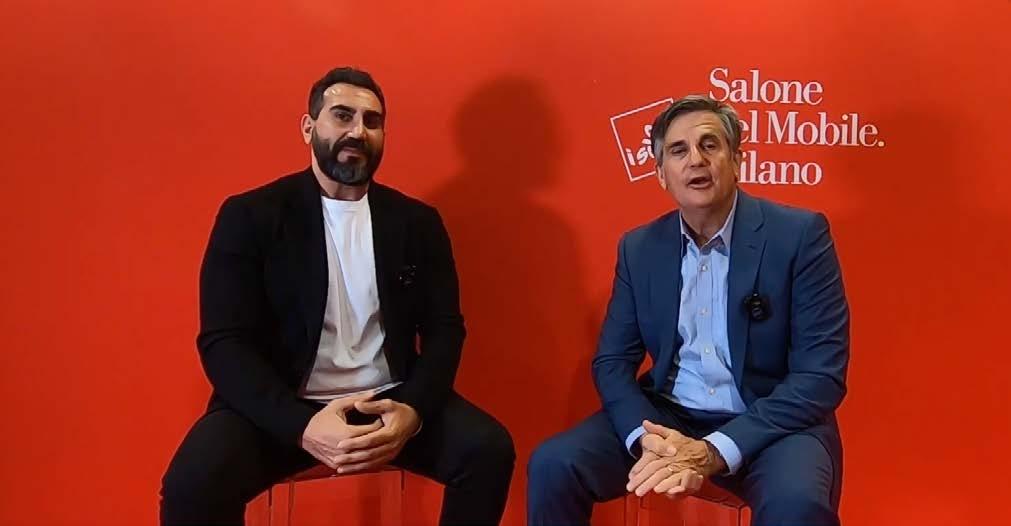
LightFair 2023|NYC|Javits Center

HLB Lighting Design: Samuel DeChamplain Bridge|Bird Migration Season
