ROBERT STEPHENS & PAUL WARING PRINCIPALS OF STEPHENS WARING YACHT DESIGN
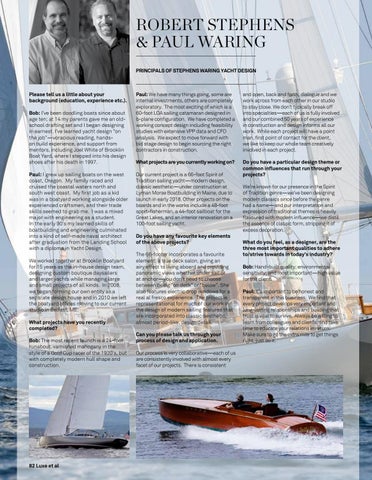
Please tell us a little about your background (education, experience etc.). Bob: I’ve been doodling boats since about age ten; at 14 my parents gave me an oldschool drafting set and I began designing in earnest. I’ve learned yacht design “on the job”—voracious reading, handson build experience, and support from mentors, including Joel White of Brooklin Boat Yard, where I stepped into his design shoes after his death in 1997. Paul: I grew up sailing boats on the west coast, Oregon. My family raced and cruised the coastal waters north and south west coast. My first job as a kid was in a boatyard working alongside older experienced craftsmen, and their trade skills seemed to grab me. I was a mixed major with engineering as a student. In the early 90’s my learned skills of boatbuilding and engineering culminated into a kind of self-made naval architect after graduation from the Landing School with a diploma in Yacht Design. We worked together at Brooklin Boatyard for 15 years as the in-house design team, designing custom boutique daysailers and larger yachts while managing large and small projects of all kinds. In 2008, we began forming our own entity as a separate design house and in 2010 we left the boatyard offices moving to our current studio in Belfast, ME. What projects have you recently completed? Bob: The most recent launch is a 24-foot runabout, varnished mahogany in the style of a Gold Cup racer of the 1920’s, but with completely modern hull shape and construction.
82 Luxe et al
Paul: We have many things going, some are internal investments, others are completely exploratory. The most exciting of which is a 60-foot LOA sailing catamaran designed in b-plane configuration. We have completed a working concept design including feasibility studies with extensive VPP data and CFD analysis. We expect to move forward with bid stage design to begin sourcing the right contractors in construction.
and open, back and forth, dialogue and we work across from each other in our studio to stay close. We don’t typically break off into specialties—each of us is fully involved and our combined 50 years of experience in construction and design informs all our work. While each project will have a point man, first point of contact for the client, we like to keep our whole team creatively involved in each project.
What projects are you currently working on?
Do you have a particular design theme or common influences that run through your projects?
Our current project is a 66-foot Spirit of Tradition sailing yacht—modern design, classic aesthetic—under construction at Lyman Morse Boatbuilding in Maine, due to launch in early 2018. Other projects on the boards and in the works include a 48-foot sport-fisherman, a 44-foot sailboat for the Great Lakes, and an interior renovation on a 100-foot sailing yacht. Do you have any favourite key elements of the above projects? The 66-footer incorporates a favourite element: a true deck salon, giving an airy effect to living aboard and providing panoramic views whether under sail or at anchor—you don’t need to choose between being “on deck” or “below”. She also features electric drop windows for a real al fresco experience. The project is representational for much of our work in the design of modern sailing features that are incorporated into classic aesthetic, almost period-like, design detail. Can you please talk us through your process of design and application. Our process is very collaborative—each of us are consistently involved with almost every facet of our projects. There is consistent
We’re known for our presence in the Spirit of Tradition genre—we’ve been designing modern classics since before the genre had a name—and our interpretation and expression of traditional themes is heavily flavoured with modern influence—we distil the essence of classic form, stripping it of excess decoration. What do you feel, as a designer, are the three most important qualities to adhere to/strive towards in today’s industry? Bob: Hand-built quality; environmental sensitivity; and most important—high value for the client. Paul: It’s important to be honest and transparent in this business. We find that every project develops very important and long-lasting relationships and building that trust is vital to survive. Always be willing to learn from colleagues and clients, and take time to educate your relations in return. Make sure to go the extra mile to get things right, just do it.