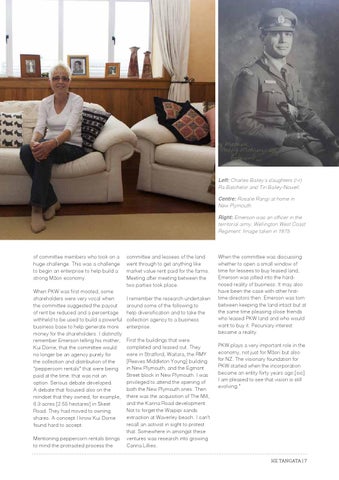
Left: Charles Bailey's daughters (l-r) Ra Batchelor and Tiri Bailey-Nowell. Centre: Rosalie Rangi at home in New Plymouth. Right: Emerson was an officer in the territorial army, Wellington West Coast Regiment. Image taken in 1975.
of committee members who took on a huge challenge. This was a challenge to begin an enterprise to help build a strong Māori economy. When PKW was first mooted, some shareholders were very vocal when the committee suggested the payout of rent be reduced and a percentage withheld to be used to build a powerful business base to help generate more money for the shareholders. I distinctly remember Emerson telling his mother, Kui Dorrie, that the committee would no longer be an agency purely for the collection and distribution of the “peppercorn rentals” that were being paid at the time; that was not an option. Serious debate developed. A debate that focused also on the mindset that they owned, for example, 6.3 acres [2.55 hectares] in Skeet Road. They had moved to owning shares. A concept I know Kui Dorrie found hard to accept. Mentioning peppercorn rentals brings to mind the protracted process the
committee and lessees of the land went through to get anything like market value rent paid for the farms. Meeting after meeting between the two parties took place. I remember the research undertaken around some of the following to help diversification and to take the collection agency to a business enterprise. First the buildings that were completed and leased out. They were in Stratford, Waitara, the RMY [Reeves Middleton Young] building in New Plymouth, and the Egmont Street block in New Plymouth. I was privileged to attend the opening of both the New Plymouth ones. Then there was the acquisition of The Mill, and the Karina Road development. Not to forget the Waipipi sands extraction at Waverley beach. I can’t recall an activist in sight to protest that. Somewhere in amongst these ventures was research into growing Canna Lillies.
When the committee was discussing whether to open a small window of time for lessees to buy leased land, Emerson was jolted into the hardnosed reality of business. It may also have been the case with other firsttime directors then. Emerson was torn between keeping the land intact but at the same time pleasing close friends who leased PKW land and who would want to buy it. Pecuniary interest became a reality. PKW plays a very important role in the economy, not just for Māori but also for NZ. The visionary foundation for PKW started when the incorporation became an entity forty years ago.[sic] I am pleased to see that vision is still evolving.”
HE TANGATA | 7