swing.” She went on to say that she, brother Craig, and neighborhood kids played with the swing set on hot summer days like it was the best thing ever. One thing became apparent from that interview: Leno understands nothing about living in “the hood.” But more importantly, he didn’t grasp a philosophy that most Black women do – often you have to make twice as much with only half the resources to work with. American society has defined attributes of beauty and success in very narrow terms for centuries. Eurocentric features such as a pointed nose, fair skin, and small, yet proportionate measurements are still are the norm on the covers of fashion magazines. And traditional characteristics of success for men have included aggression, vocal confidence, and competitiveness. For woman of all racial backgrounds, the tolerance of the same traits in women is a great deal lower, requiring different strategies. Unfortunately, the challenge has been even greater for Black women, who have fallen outside the traditional parameters on both looks and achievement characteristics. And although Black women have crashed through the barriers, becoming successful in almost every industry, there has been
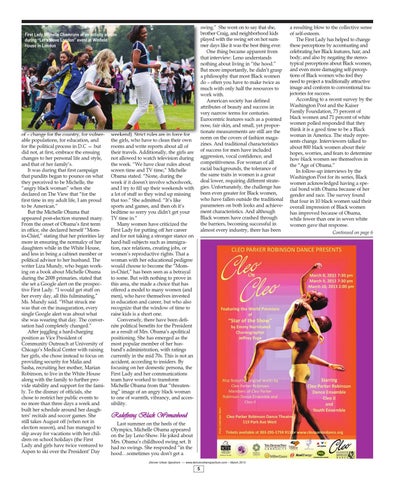
First Lady Michelle Obamruns at an acticity station during “Let’s Move London” event at Winfield House in London
of – change for the country, for vulnerable populations, for education, and for the political process in D.C — but did not, at first, embrace the ensuing changes to her personal life and style, and that of her family’s. It was during that first campaign that pundits began to pounce on what they perceived to be Michelle, the “angry black woman” when she declared on The View that “for the first time in my adult life, I am proud to be American.” But the Michelle Obama that appeared post-election stunned many. From the onset of Obama’s first term in office, she declared herself “Momin-Chief,” stating that her priorities lay more in ensuring the normalcy of her daughters while in the White House, and less in being a cabinet member or political advisor to her husband. The writer Liza Mundy, who began working on a book about Michelle Obama during the 2008 primaries, stated that she set a Google alert on the prospective First Lady. “I would get stuff on her every day, all this fulminating,” Ms. Mundy said. “What struck me was that on the inauguration, every single Google alert was about what she was wearing that day. The conversation had completely changed.” After juggling a hard-charging position as Vice President of Community Outreach at University of Chicago’s Medical Center with raising her girls, she chose instead to focus on providing security for Malia and Sasha, recruiting her mother, Marian Robinson, to live in the White House along with the family to further provide stability and support for the family. To the dismay of officials, she chose to restrict her public events to no more than three days a week and built her schedule around her daughters’ recitals and soccer games. She still takes August off (when not in election season), and has managed to slip away for vacations with her children on school holidays (the First Lady and girls have twice ventured to Aspen to ski over the President’ Day
weekend). Strict rules are in force for the girls, who have to clean their own rooms and write reports about all of their travels. Additionally, the girls are not allowed to watch television during the week. “We have clear rules about screen time and TV time,” Michelle Obama stated. “None, during the week if it doesn’t involve schoolwork, and I try to fill up their weekends with a lot of stuff so they wind up missing that too.” She admitted. “It’s like sports and games, and then oh it’s bedtime so sorry you didn’t get your TV time in.” Many women have criticized the First Lady for putting off her career and for not taking a stronger stance on hard-ball subjects such as immigration, race relations, creating jobs, or women’s reproductive rights. That a woman with her educational pedigree would choose to become the “Momin-Chief,” has been seen as a betrayal to some. But with nothing to prove in this area, she made a choice that has offered a model to many women (and men), who have themselves invested in education and career, but who also recognize that the window of time to raise kids is a short one. Conversely, there have been definite political benefits for the President as a result of Mrs. Obama’s apolitical positioning. She has emerged as the most popular member of her husband’s administration, with ratings currently in the mid 70s. This is not an accident, according to insiders. By focusing on her domestic persona, the First Lady and her communications team have worked to transform Michelle Obama from that “threatening” image of an angry black woman to one of warmth, vibrancy, and accessibility.
Redefining Black Womanhood
Last summer on the heels of the Olympics, Michelle Obama appeared on the Jay Leno Show. He joked about Mrs. Obama’s childhood swing set. It had no swings. She responded “in the hood…sometimes you don’t get a
Denver Urban Spectrum — www.denverurbanspectrum.com – March 2013
5
a resulting blow to the collective sense of self-esteem. The First Lady has helped to change these perceptions by accentuating and celebrating her Black features, hair, and body; and also by negating the stereotypical perceptions about Black women, and even more damaging self-perceptions of Black women who feel they need to project a traditionally attractive image and conform to conventional trajectories for success. According to a recent survey by the Washington Post and the Kaiser Family Foundation, 73 percent of black women and 71 percent of white women polled responded that they think it is a good time to be a Black woman in America. The study represents change. Interviewers talked to about 800 black women about their hopes, worries, and fears to determine how black women see themselves in the “Age of Obama.” In follow-up interviews by the Washington Post for its series, Black women acknowledged having a special bond with Obama because of her gender and race. The survey found that four in 10 black women said their overall impression of Black women has improved because of Obama, while fewer than one in seven white women gave that response. Continued on page 6