to help NASA succeed in the space race. La La Land made $151 million and Hidden Figures earned $169 million domestically. Neither cost more than $30 million to produce. That’s a budget out of reach for most independent efforts, and something Hollywood has likewise become recalcitrant with in recent years. Meanwhile, supposedly niche genre offerings turned into nine-figure earners in North America. Conventional wisdom would suggest these types of runs are unusual, but not when they’re derived from the quality of Split ($138 million) and Get Out ($176 million), both of which Blumhouse Productions spent less than $10 million to produce. Each also featured top-notch talent in front of and behind the camera with Split benefitting from M. Night Shyamalan’s compelling screenplay and a feast of scenery for James McAvoy to chew on; then Jordan Peele’s Get Out more ambitiously challenged audiences (even those supposedly aggrieved liberal ones) on hot button social issues in a clever and entertaining way. None of these movies cater to the same broad audience, yet all of them found plenty of box office dollars in a moviegoing era that is now drowning in summer tentpole sameness. All that crossed the $100 million threshold in the U.S. differed from their peers. The first non-Star Wars tentpole targeted a decidedly older and mostly female demographic—Fifty Shades Darker. Beauty and the Beast, meanwhile,
granted Disney another $500 million-earner in the U.S. And like La La Land, it was a musical and thus considered a niche genre. Also similar to La La Land, Beauty and the Beast sets up no prequels, sequels, or shared universes. Rather, it gives a definitive, satisfying story. Logan remains, though, the most striking of the traditional 2017 blockbusters. From its inception, it was intended to be contrarian with its extreme violence and language. But in addition to these blue flourishes was the surprising realization that this was not necessarily a sequel or part of a larger universe; it was a hopelessly nihilistic standalone Western about mortality. James Mangold has repeatedly, and explicitly, explained in the press how his blood-splattered anti-superhero movie was liberated to make something of a higher ambition simply by not trying to appeal to everyone else or by jumping on the industry’s bandwagons. In one interview
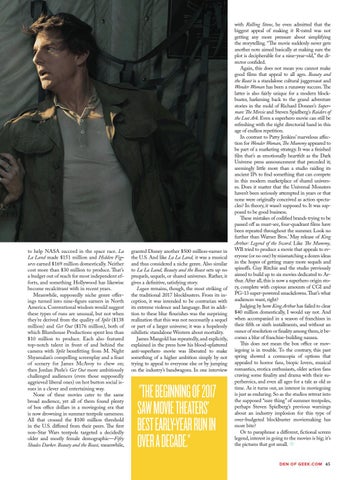
"THE BEGINNING OF 2017 SAW MOVIE THEATERS’ BEST EARLY-YEAR RUN IN OVER A DECADE."
with Rolling Stone, he even admitted that the biggest appeal of making it R-rated was not getting any more pressure about simplifying the storytelling. “The movie suddenly never gets another note aimed basically at making sure the plot is decipherable for a nine-year-old,” the director confided. Again, this does not mean you cannot make good films that appeal to all ages. Beauty and the Beast is a standalone cultural juggernaut and Wonder Woman has been a runaway success. The latter is also fairly unique for a modern blockbuster, harkening back to the grand adventure stories in the mold of Richard Donner’s Superman: The Movie and Steven Spielberg’s Raiders of the Lost Ark. Even a superhero movie can still be refreshing with the right directorial hand in this age of endless repetition. In contrast to Patty Jenkins’ marvelous affection for Wonder Woman, The Mummy appeared to be part of a marketing strategy. It was a finished film that’s as emotionally heartfelt as the Dark Universe press announcement that preceded it; seemingly little more than a studio raiding its ancient IPs to find something that can compete in this modern marketplace of shared universes. Does it matter that the Universal Monsters haven’t been seriously attempted in years or that none were originally conceived as action spectacles? In theory, it wasn’t supposed to. It was supposed to be good business. These mistakes of codified brands trying to be passed off as must-see, four-quadrant films have been repeated throughout the summer. Look no further than Warner Bros.’ May release of King Arthur: Legend of the Sword. Like The Mummy, WB tried to produce a movie that appeals to everyone (or no one) by mismatching a dozen ideas in the hopes of getting many more sequels and spinoffs. Guy Ritchie and the studio previously aimed to build up to six movies dedicated to Arthur. After all, this is now a superhero origin story, complete with copious amounts of CGI and PG-13 super-powered smackdowns. That’s what audiences want, right? Judging by how King Arthur has failed to clear $40 million domestically, I would say not. And when accompanied in a season of franchises in their fifth or sixth installments, and without an ounce of resolution or finality among them, it becomes a blur of franchise-building nausea. This does not mean the box office or moviegoing is in trouble. To the contrary, this past spring showed a cornucopia of options that appealed to horror fans, biopic lovers, musical romantics, erotica enthusiasts, older action fans craving some finality and drama with their superheroics, and even all ages for a tale as old as time. As it turns out, an interest in moviegoing is just as enduring. So as the studios retreat into the supposed “sure thing” of summer tentpoles, perhaps Steven Spielberg’s previous warnings about an industry implosion for this type of over-budgeted blockbuster moviemaking has more bite? Or to paraphrase a different, fictional screen legend, interest in going to the movies is big; it’s the pictures that got small. DEN OF GEEK.COM 45