THE HIDDEN HISTORY BEHIND THE TORONTO DIY PUNK VENUE
Atousa Blair
In 1977, Toronto’s first punk club, Crash ’n’ Burn, opened in the basement of the Centre for Experimental Art and Communication. The opening of Crash ’n’ Burn allowed for the evolution of punk in Toronto’s music scene and marked the beginning of a new era of music in the city. Since then, several other DIY venues have come and gone in Toronto’s music scene, proving that it is rare for DIY venues to maintain the longevity achieved by Soybomb, which has been around for over eleven years. Even Crash ’n’ Burn only lasted a mere three months before complaints from other residents in the building forced its closing.
A Home for Punks In contrast to other DIY venues in Toronto, Soybomb is first and foremost a home. As described by owner and founder Jason Wydra, Soybomb is equivalent to the house of your childhood friend who had the most lenient parents. Despite being a home to several people (currently six), Soybomb throws a house party a couple of times a month, featuring great bands and cheap beer. Unlike other venues in the city, Soybomb is not run as a business — Wydra charges a mere $200 as a venue fee to promoters, which does not cover minimum wage for the amount of hours put into each show, and the amount of money put into developing the space over the years. “I am never going to make my money back, but that’s not
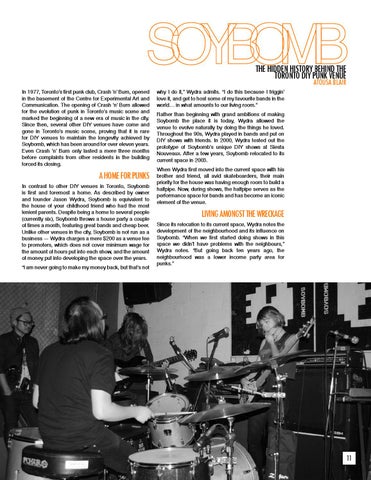
why I do it,” Wydra admits. “I do this because I friggin’ love it, and get to host some of my favourite bands in the world… in what amounts to our living room.” Rather than beginning with grand ambitions of making Soybomb the place it is today, Wydra allowed the venue to evolve naturally by doing the things he loved. Throughout the 90s, Wydra played in bands and put on DIY shows with friends. In 2000, Wydra tested out the prototype of Soybomb’s unique DIY shows at Siesta Nouveaux. After a few years, Soybomb relocated to its current space in 2003. When Wydra first moved into the current space with his brother and friend, all avid skateboarders, their main priority for the house was having enough room to build a halfpipe. Now, during shows, the halfpipe serves as the performance space for bands and has become an iconic element of the venue.
Living Amongst the Wreckage Since its relocation to its current space, Wydra notes the development of the neighbourhood and its influence on Soybomb. “When we first started doing shows in this space we didn’t have problems with the neighbours,” Wydra notes. “But going back ten years ago, the neighbourhood was a lower income party area for punks.”
11