Wallace: W~,~.Jj~~psg~l~ H~ tftg~~~~J~
Keynote address at Union 150th outlines three keys to success
Brother William Wallace's keynote dress to 130 dinner guests at the Sesquicentennial Celebration of the Union Chapter on September 10 draws a beautiful fraternal picture of what Delta Upsilon is all about. The banquet, in the Old Chapel on the stately Union campus in Schenectady, marked the full revival of Delta Upsilon at Union. Alumni, parents, faculty and administrators watched as 23 men were initiated to join the 16 men who had steered the Union Chapter back after some conduct problems. After reviewing the establishment of the Union Chapter 150 yearsago, and theforces that shaped it and other fraternities since, Brother Wallace turned his attention to what has kept the Union Chapter going through. thick and thin:
What are these ideals, the ideals that have kept this chapter of Delta Upsilon together for 150 years? You who are brothers remember them from pledge education, but for those of you who are not DU's, the goals of Delta Upsilon Fraternity are these: The The The The
promotion of friendship development of character diffusion of liberal culture advancement of justice
These high ideals, where they have been practiced, have provided the fabric which has held undergraduate chapters together through decade after decade of changes in our society. They have set a high moral tone for the chapters, established a pattern of giving and service, encouraged participation in chapter and college activities and promoted lifelong friendships. Inasmuch as fraternity chapters are but a microcosm of the world outside, it is not surprising that those who leave the chapters not only build successfully on their fraternity experiences to become productive citizens, but also retain a strong interest in their college and fraternity. The Union Chapter can be proud of its influence on its graduates through the years. It has produced alumni who have been good citizens and leaders in their chosen fields of endeavor. But more than this, of particular importance to Union College and Delta Upsilon Fraternity they have given and continue to give generously of their time and resources in support of their college and fraternity.
8
The successive generations ers who called the Lamont House home for more than fifty years owe a great debt of gratitude to Brother Oppenheimer who spearheaded the raising of funds and the construction of that magnificent house in 1906. Many brothers contributed the funds that paid for the building but it was Brother Oppenheimer who gave leadership. In more recent years Brother Ralph Fisher, '31 who is responsible for this gathering tonight, saw the chapter's desperate need for a permanent home, a house with "Delta Upsilon" on the door for which the brothers could take responsibility. He personally undertook the challenge of finding a suitable house. Since then he has worked tirelessly in the face of many frustrations and obstacles to obtain an appropriate house that will once again give the men of the Union Chapter of Delta Upsilon a permanent home. He has not attained his goal yet, but it seems near and his enthusiasm has already encouraged more than 70 alumni to contribute to the cause. We all owe him a great debt of gratitude for the work that he has done and continues to do. As an undergraduate I remember the support that the chapter received from several alumni who visited us frequently and provided guidance and encouragement. Rex Moon '44 who at that time worked in the Admissions Office, Walt Haberbush and Ralph Semerad, whose wife is here tonight, stand out in my memory, but there were many other brothers who provided support, encouragement and direction during the chaotic period at the end of World War II. I remember the period well, for I joined Delta Upsilon in 1945 just before the end of the war. The chapter was small, about 12 men including transferees from other colleges who were members of the Navy V-12 unit that made up most of the student body. We had no house, since the college had taken over all of the fraternity houses. But I was attracted to the men who made up the fraternity and what they stood for. Thisgroup had held the fraternity together during the war years. Fraternity life consisted of weekly meetings where we learned more about the Fraternity and gave support to one another. This was all to change drastically in 1946 as the college was flooded with
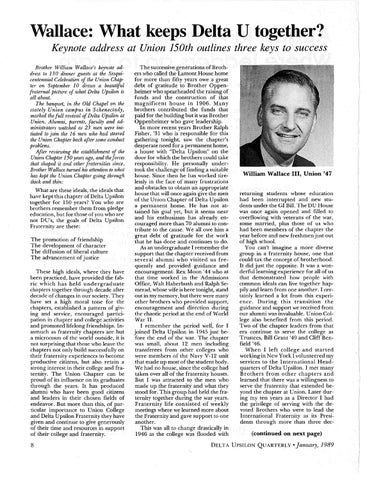
William Wallace III, Union '47 returning students whose education had been interrupted and new students under the GI Bill. The DU House was once again opened and filled to overflowing with veterans of the war, some married, plus those of us who had been members of the chapter the year before and new freshmen just out of high school. You can't imagine a more diverse group in a fraternity house, one that could tax the concept of brotherhood. It did just the opposite. It was a wonderfullearning experience for all of us that demonstrated how people with common ideals can live together happily and learn from one another. I certainly learned a lot from this experience. During this transition the guidance and support we received from our alumni was invaluable. Union College also benefited from this period. Two of the chapter leaders from that era continue to serve the college as Trustees, Bill Grant '49 and Cliff Benfield '46. When I .left college and started working in New York I volunteered my services to the International Headquarters of Delta Upsilon. I met many Brothers from other chapters and learned that there was a willingness to serve the fraternity that extended beyond the chapter at Union. Later during my ten years as a Director I had the privilege of serving with the devoted Brothers who were to lead the International Fraternity as its Presidents through more than three dec-
(continued on next page)
DELTA UPSILON QUARTERLY'JanUm), 1989