8
news
Issue 10 • March 9, 2012 • deltacollegian.net
Students concerned by gas prices
MARCH: Legislation to reduce education expenses considered
by haley pitto
continued from PAGE 1
hpitto2@hotmail.com
Stockton resident and San Joaquin Delta College student Diolinda Asuncion spends about $100 on gasoline for her 1998 Mercedes at least once a week. It’s more than she can afford since she’s a single mother and full-time Delta College student trying to make ends meet. “It’s outrageous! I’m a single parent trying to get through college to better my life and gas prices are not helping,” said Asuncion. Asuncion could take the bus, but like many other Delta College students she agrees that it is an unreliable source of transportation especially when she has her 14-year-old son to worry about as well. When asked how much she pays for a full tank, Asuncion laughed and replied “The question is can I afford to pay for a full tank?” Like everyone else who drives a car or truck, Asuncion is affected by the ever-increasing gas prices. “I can’t afford to get a full tank,” Asuncion said. “I’m trying to get an extra job; my paycheck working at the campus library just isn’t cutting it,” she said. Fellow Delta College student Felipe Granados shares Asuncion’s concerns. “I commute from Tracy so it’s about at 25 minute drive both ways; my 98 Explorer isn’t the best on gas either,” she said. With gas prices on the rise, older cars that used to be gas savers are now sucking money out of people’s wallets. “It’s ridiculous! I used to pay $40 for a full tank [of gas], now its $100,” said Granados.
If gas prices continue to increase Granados said it would have an effect on his everyday routine. “I’m going to have to find different means to get [to school].” Not only would it affect how Granados gets to school, but what he does with his hard earned cash. “All my money right now goes to gas. There are no personal expenses; I can’t even afford to get McDonalds,” he said. Taylor Maruca, a Livermore resident and second semester Delta College student commutes two hours to and from school. Maruca said the pinch every time she has to fill up her 2000 Chrysler Sebring even though it averages 23 miles to the gallon. “Most of my paycheck goes to gas,” said Maruca. “If prices go up anymore I’ll have to cut back in driving, but there’s no other way I can get to school because the bus doesn’t come all the way to Livermore. I’ll have to cut back on driving around town.” This is difficult for Maruca, between the rising gas prices and the sliding economy her paycheck is smaller while the price at the pump seems to get larger each visit. “They are hiring more people at my work so there are fewer hours and in return it cuts back on my paycheck,” she said. While many students feel the price at the pump is unfair, 41 year old Delta student Vince Serna has a different opinion. “I understand it, it’s a business, things happen,” said Serna. “Gas prices are what they are so I pay what I need to pay; it’s easier than struggling for subsidies.”
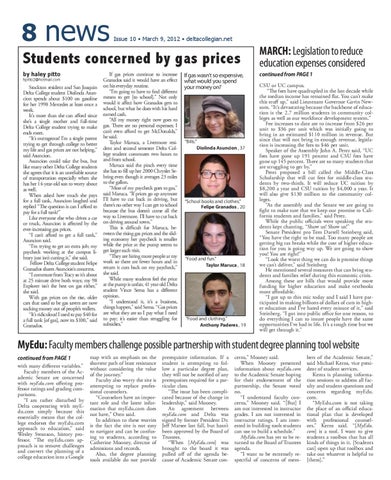
If gas wasn’t so expensive, what would you spend your money on?
“Bills.” Diolinda Asuncion , 37
“School books and clothes.” Felipe Granados , 20
“Food and fun.” Taylor Maruca , 18
“Food and clothing.“ Anthony Paderes , 19
CSU or UC campus. “The fees have quadrupled in the last decade while the median income has remained flat. You can’t make this stuff up,” said Lieutenant Governor Gavin Newsom. “It’s devastating because the backbone of education is the 2.7 million students in community colleges as well as our workforce development system.” Fee increases to date are to increase from $26 per unit to $36 per unit which was initially going to bring in an estimated $110 million in revenue. But since that will not bring in enough revenue, legislation is increasing the fees to $46 per unit. Speaker of the Assembly John A. Perez said, “UC fees have gone up 191 percent and CSU fees have gone up 145 percent. There are so many students that are struggling to get by.” Perez proposed a bill called the Middle-Class Scholarship that will cut fees for middle-class students by two-thirds. It will reduce UC tuition by $8,200 a year and CSU tuition by $4,000 a year. It will also give $130 million to the community colleges. “As the assembly and the Senate we are going to fight to make sure that we keep our promise to California students and families,” said Perez. While the public officials were speaking the students kept chanting, “Show us! Show us!” Senate President pro Tem Darrell Steinberg said, “You have the right to be mad. Too many people are getting big tax breaks while the cost of higher education for you is going way up. We are going to show you! You are right!” “Look the worst thing we can do is promise things we can’t deliver,” said Steinberg He mentioned several measures that can bring students and families relief during this economic crisis. Among these are bills that would provide more funding for higher education and make textbooks more affordable. “I got up to this mic today and I said I have participated in making billions of dollars of cuts in higher education and I’ve hated every minute of it,” said Steinberg. “I got into public office for one reason, to do everything I can to insure people have the same opportunities I’ve had in life. It’s a tough time but we will get through it.”
MyEdu: Faculty members challenge possible partnership with student degree planning tool website continued from PAGE 1 with many different variables.” Faculty members of the Academic Senate are concerned with myEdu.com offering professor ratings and grading comparisons. “I am rather disturbed by Delta cooperating with myEdu.com simply because this essentially means that the college endorses the myEdu.com approach to education,” said Wesley Swanson, history professor. “The myEdu.com approach is to remove challenges and convert the planning of a college education into a Google
map with an emphasis on the shortest path of least resistance without considering the value of the journey.” Faculty also worry the site is attempting to replace professional counselors. “Counselors have an important role and the latest information that myEdu.com does not have,” Oren said. In addition to these worries is the fact the site is not easy to navigate and can be confusing to students, according to Catherine Mooney, director of admissions and records. Also, the degree planning tools available do not provide
prerequisite information. If a student is attempting to follow a particular degree plan, they will not be notified of any prerequsites required for a particular class. “The issue has been complicated because of the change in leadership,” said Mooney. An agreement between myEdu.com and Delta was signed by former President Dr. Jeff Marsee last fall, but hasn’t been approved by the Board of Trustees. “When [MyEdu.com] was brought to the board it was pulled off of the agenda because of Academic Senate con-
cerns,” Mooney said. When Mooney presented information about myEdu.com to the Academic Senate hoping for their endorsement of the partnership, the Senate voted no. “I understand faculty concerns,” Mooney said. “[But] I am not interested in instructor grades. I am not interested in instructor ratings. I am interested in building tools students can use to build a schedule.” MyEdu.com has yet to be returned to the Board of Trustees agenda. “I want to be extremely respectful of concerns of mem-
bers of the Academic Senate,” said Michael Kerns, vice president of student services. Kerns is planning information sessions to address all faculty and student questions and concerns regarding myEdu. com. “MyEdu.com is not taking the place of an official educational plan that is developed with professional counselors,” Kerns said. “[MyEdu. com] is a tool. I want to give students a toolbox that has all kinds of things in it. [Students can] open up that toolbox and take out whatever is helpful to [them].”