Nunavut Mining Highlights
World-Class Mines and Developing Resources An overview of Nunavut’s exploration and mineral industry in 2015
Photo courtesy Government of Nunavut and Agnico Eagle
Submitted by Government of Nunavut, Minerals and Petroleum Resources Division
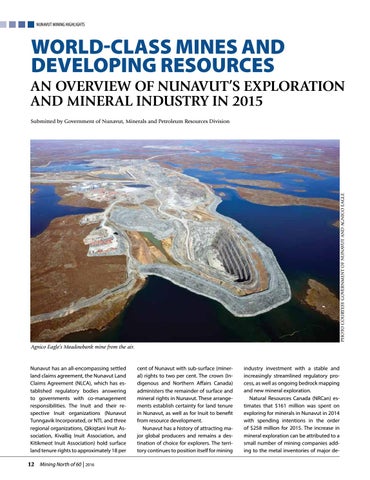
Agnico Eagle’s Meadowbank mine from the air.
Nunavut has an all-encompassing settled land claims agreement, the Nunavut Land Claims Agreement (NLCA), which has established regulatory bodies answering to governments with co-management responsibilities. The Inuit and their respective Inuit organizations (Nunavut Tunngavik Incorporated, or NTI, and three regional organizations, Qikiqtani Inuit Association, Kivalliq Inuit Association, and Kitikmeot Inuit Association) hold surface land tenure rights to approximately 18 per
12 Mining North of 60 | 2016
cent of Nunavut with sub-surface (mineral) rights to two per cent. The crown (Indigenous and Northern Affairs Canada) administers the remainder of surface and mineral rights in Nunavut. These arrangements establish certainty for land tenure in Nunavut, as well as for Inuit to benefit from resource development. Nunavut has a history of attracting major global producers and remains a destination of choice for explorers. The territory continues to position itself for mining
industry investment with a stable and increasingly streamlined regulatory process, as well as ongoing bedrock mapping and new mineral exploration. Natural Resources Canada (NRCan) estimates that $161 million was spent on exploring for minerals in Nunavut in 2014 with spending intentions in the order of $258 million for 2015. The increase in mineral exploration can be attributed to a small number of mining companies adding to the metal inventories of major de-