What on Earth Is a Pollinator? By Bruce Deckert Today Magazine Editor-in-Chief
THE COLLINSVILLE Pollen Trail is a newer addition to the heart of Canton’s celebrated artistic center, with a name that hearkens to the town’s roots as headquarters of the Collins Company. For anyone who knows something about flowers, the terms pollen and pollinate and pollination are likely common enough — but what exactly is a pollinator? As the philosophers and dictionary writers are inclined to say, let’s define terms — in this case, the word pollinator. Pollinators are insects and animals — such as bees, wasps, moths, butterflies, hummingbirds, other birds and bats — that are responsible for transporting pollen and thus pollinating plants, including flowers and trees. Pollinators make it possible for plants to reproduce, bear fruit and thus produce essential food for people around the world. If love makes the world go round, pollinators are an eloquent part of the global botanical love language. The movement of pollen is vital for the array of flowers and trees and other plants to become fertilized and produce fruit and seeds — including about 1,000 plants grown for food, beverages, fibers, spices and medicines, according to botanists. In the United States, some experts estimate that certain pollination — by honeybees, native bees and other insects — generates products worth $40 billion annually. Not all the plant-based foods that humans eat require pollinators, but most do, according to scientists. One estimate asserts that from 75% to 95% of the planet’s flowering plants need help with pollination — in other words, they depend on larvae and butterflies and bugs in the air, oh my! For the uninitiated, the preceding sentence is a paraphrased nod
VALLEY INTEL
And How Important Are Pollinators?
to the classic Wizard of Oz line — “Lions and tigers and bears!” Now, let’s return to our regularly scheduled article: “With each plant it is a bit different,” says Canton resident Karen Berger, the volunteer manager of the Pollen Trail project. “Grains and many trees are wind-pollinated, some plants are self-pollinated — but most of our food, beverage, herbs and spice plants require pollinators. … Some plants require a specific pollinator, some are open access.” What happens when unchecked development or chemical misuse kills pollinators and/or makes them scarce?
———————————————————————————————— • Collinsville Pollen Trail takes root — Page 11 ————————————————————————————————
Without pollination on a small scale, botanists say, a fruitbearing tree will become … fruitless. On a large scale, a deficiency of pollination could result in a significant shortage of food that is considered to be significant by many chefs, connoisseurs and regular human consumers. An abundant diversity of plant-based foods are dependent on pollinators for their growth: apples, almonds, blueberries, chocolate, melons, peaches, potatoes, pumpkins, vanilla and more. If pollinators ceased to exist, these pollinator-based fruits and food products would essentially disappear. Some foods and drinks are a team pollination effort — such as coffee, the popular global beverage. Berger’s research indicates that coffee self-pollinates, but production is boosted 25% by insects — yes, those sometimes pesky, sometimes detrimental, yet often helpful creatures that inhabit the planet along with we human beings. +
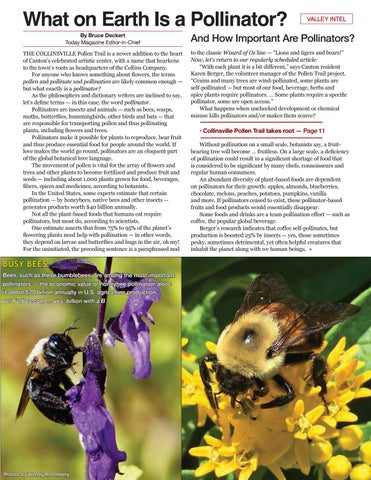
BUSY BEES Bees, such as these bumblebees, are among the most important pollinators — the economic value of honeybee pollination alone is about $20 billion annually in U.S. agriculture production, per Forbes.com … yes, billion with a B
Photos by Wendy Rosenberg
TODAY MAGAZINE – www.TodayPublishing.net – APRIL 2021
17