BLTDM/BTDM/FTDM/HTDM/MTDM/STDM/TTDM–2015
n
n n
n
financial institutions. Concepts include understanding the source and purpose of financial statements, the impact of management decisions on statements, and the analysis and interpretation of data for planning purposes. HOSPITALITY SERVICES: (HOSPITALITY AND TOURISM CLUSTER) Hospitality services include marketing and management functions and tasks that can be applied in hotels, motels, lodging services, related convention services, and related food and beverage services. MARKETING COMMUNICATIONS: (MARKETING CLUSTER) Marketing communications are marketing functions and tasks that inform, remind, and/or persuade a target market of ideas, experiences, goods/services, and/or images. SPORTS AND ENTERTAINMENT MARKETING: (MARKETING CLUSTER) Sports and entertainment marketing includes marketing functions and tasks that can be applied in amateur or professional sports or sporting events, entertainment or entertainment events, selling or renting of supplies and equipment (other than vehicles) used for recreational or sporting purposes, products and services related to hobbies or cultural events, or businesses primarily engaged in satisfying the desire to make productive or enjoyable use of leisure time. TRAVEL AND TOURISM: (HOSPITALITY AND TOURISM CLUSTER) Travel and tourism includes marketing and management functions and tasks that can be applied in enterprises engaged in passenger transportation, travel service, attracting and serving the traveling public, arranging tours or acting as independent ticket agencies, and other services incidental to the travel or tourism industry.
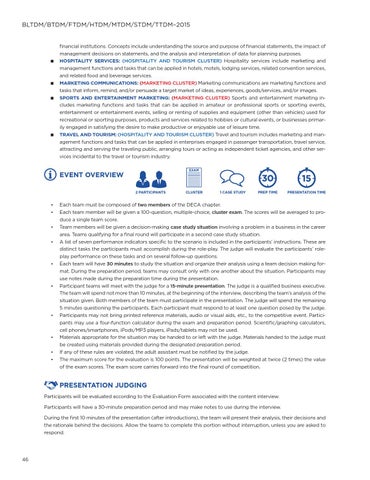
EVENT OVERVIEW 2 PARTICIPANTS
CLUSTER
1 CASE STUDY
PREP TIME
PRESENTATION TIME
• Each team must be composed of two members of the DECA chapter. • Each team member will be given a 100-question, multiple-choice, cluster exam. The scores will be averaged to produce a single team score. • Team members will be given a decision-making case study situation involving a problem in a business in the career area. Teams qualifying for a final round will participate in a second case study situation. • A list of seven performance indicators specific to the scenario is included in the participants’ instructions. These are distinct tasks the participants must accomplish during the role-play. The judge will evaluate the participants’ roleplay performance on these tasks and on several follow-up questions. • Each team will have 30 minutes to study the situation and organize their analysis using a team decision making format. During the preparation period, teams may consult only with one another about the situation. Participants may use notes made during the preparation time during the presentation. • Participant teams will meet with the judge for a 15-minute presentation. The judge is a qualified business executive. The team will spend not more than 10 minutes, at the beginning of the interview, describing the team’s analysis of the situation given. Both members of the team must participate in the presentation. The judge will spend the remaining 5 minutes questioning the participants. Each participant must respond to at least one question posed by the judge. • Participants may not bring printed reference materials, audio or visual aids, etc., to the competitive event. Participants may use a four-function calculator during the exam and preparation period. Scientific/graphing calculators, cell phones/smartphones, iPods/MP3 players, iPads/tablets may not be used. • Materials appropriate for the situation may be handed to or left with the judge. Materials handed to the judge must be created using materials provided during the designated preparation period. • If any of these rules are violated, the adult assistant must be notified by the judge. • The maximum score for the evaluation is 100 points. The presentation will be weighted at twice (2 times) the value of the exam scores. The exam score carries forward into the final round of competition.
PRESENTATION JUDGING Participants will be evaluated according to the Evaluation Form associated with the content interview. Participants will have a 30-minute preparation period and may make notes to use during the interview. During the first 10 minutes of the presentation (after introductions), the team will present their analysis, their decisions and the rationale behind the decisions. Allow the teams to complete this portion without interruption, unless you are asked to respond.
46