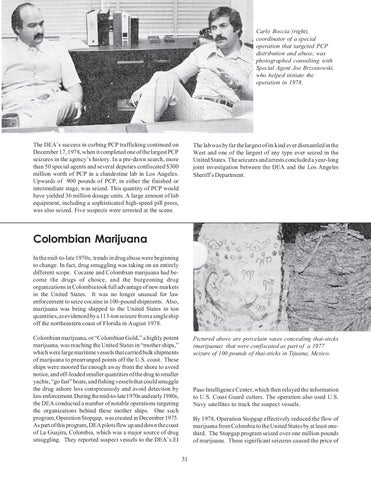
Carlo Boccia (right), coordinator of a special operation that targeted PCP distribution and abuse, was photographed consulting with Special Agent Joe Brzostowski, who helped initiate the operation in 1978.
The DEA’s success in curbing PCP trafficking continued on December 17, 1978, when it completed one of the largest PCP seizures in the agency’s history. In a pre-dawn search, more than 50 special agents and several deputies confiscated $300 million worth of PCP in a clandestine lab in Los Angeles. Upwards of 900 pounds of PCP, in either the finished or intermediate stage, was seized. This quantity of PCP would have yielded 36 million dosage units. A large amount of lab equipment, including a sophisticated high-speed pill press, was also seized. Five suspects were arrested at the scene.
The lab was by far the largest of its kind ever dismantled in the West and one of the largest of any type ever seized in the United States. The seizures and arrests concluded a year-long joint investigation between the DEA and the Los Angeles Sheriff’s Department.
Colombian Marijuana In the mid-to-late 1970s, trends in drug abuse were beginning to change. In fact, drug smuggling was taking on an entirely different scope. Cocaine and Colombian marijuana had become the drugs of choice, and the burgeoning drug organizations in Colombia took full advantage of new markets in the United States. It was no longer unusual for law enforcement to seize cocaine in 100-pound shipments. Also, marijuana was being shipped to the United States in ton quantities, as evidenced by a 113-ton seizure from a single ship off the northeastern coast of Florida in August 1978. Colombian marijuana, or “Colombian Gold,” a highly potent marijuana, was reaching the United States in “mother ships,” which were large maritime vessels that carried bulk shipments of marijuana to prearranged points off the U.S. coast. These ships were moored far enough away from the shore to avoid notice, and off-loaded smaller quantities of the drug to smaller yachts, “go fast” boats, and fishing vessels that could smuggle the drug ashore less conspicuously and avoid detection by law enforcement. During the mid-to-late 1970s and early 1980s, the DEA conducted a number of notable operations targeting the organizations behind these mother ships. One such program, Operation Stopgap, was created in December 1975. As part of this program, DEA pilots flew up and down the coast of La Guajira, Colombia, which was a major source of drug smuggling. They reported suspect vessels to the DEA’s El
Pictured above are porcelain vases concealing thai-sticks (marijuana) that were confiscated as part of a 1977 seizure of 100 pounds of thai-sticks in Tijuana, Mexico.
Paso Intelligence Center, which then relayed the information to U.S. Coast Guard cutters. The operation also used U.S. Navy satellites to track the suspect vessels. By 1978, Operation Stopgap effectively reduced the flow of marijuana from Colombia to the United States by at least onethird. The Stopgap program seized over one million pounds of marijuana. These significant seizures caused the price of 31