Iowa
Breeders
Neola, Iowa
Gelbvieh-Angus-Balancer Black & Polled Private Treaty Sales Breed-leading Performance from Quality Genetics
Kevin Gunderson: 402-510-8103
Al Schulz: 402-676-5292
HH Triple H Farms H
Feature
Feed Yard Profit Drivers – Do Your Cattle Measure Up? “We see a $300 value within groups of cattle…and that’s all based on genetics,” states Dan Dorn of the Decatur County Feed Yard in Oberlin, Kansas. The Decatur County Feed Yard is a 40,000 head feed yard that works with commercial producers who retain ownership of their cattle. They have a goal “to continuously improve your herd’s profitability.”
Roy & Nancy Holste 3113 260th Street Clarinda, IA 51632 712-303-0263 • 712-303-1947 Bulls and Heifers for sale Private Treaty
Kenyon Cattle LLC & Little Sioux Gelbvieh/ Red Angus • Bulls for sale at Seedstock Plus Sales • Females for sale Private Treaty Jack Welle 2645 180th Ave. Milford, Iowa 51351 Home: 712-338-2143 • Cell: 712-251-4641 E-mail: jwelle@evertek.net
Martens Gelbvieh
Gary Martens 2126 500th St • Walnut, IA 51577
712.764.5007 (H) • 712.249.5744 (C) martensgl@yahoo.com
Annual Bull and Female sale in March with the Southwest Iowa Gelbvieh Group
60 | February 2014
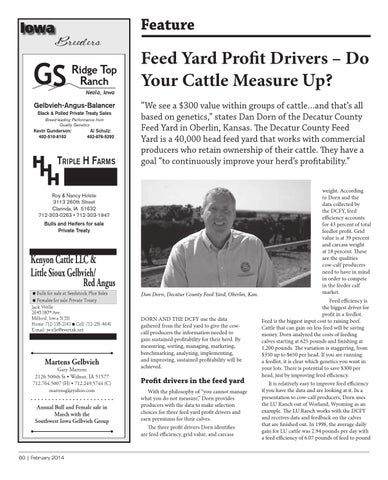
Dan Dorn, Decatur County Feed Yard, Oberlin, Kan.
DORN AND THE DCFY use the data gathered from the feed yard to give the cowcalf producers the information needed to gain sustained profitability for their herd. By measuring, sorting, managing, marketing, benchmarking, analyzing, implementing, and improving, sustained profitability will be achieved.
Profit drivers in the feed yard With the philosophy of “you cannot manage what you do not measure,” Dorn provides producers with the data to make selection choices for three feed yard profit drivers and earn premiums for their calves. The three profit drivers Dorn identifies are feed efficiency, grid value, and carcass
weight. According to Dorn and the data collected by the DCFY, feed efficiency accounts for 43 percent of total feedlot profit. Grid value is at 39 percent and carcass weight at 18 percent. These are the qualities cow-calf producers need to have in mind in order to compete in the feeder calf market. Feed efficiency is the biggest driver for profit in a feedlot. Feed is the biggest input cost to raising beef. Cattle that can gain on less feed will be saving money. Dorn analyzed the costs of feeding calves starting at 625 pounds and finishing at 1,200 pounds. The variation is staggering, from $350 up to $650 per head. If you are running a feedlot, it is clear which genetics you want in your lots. There is potential to save $300 per head, just by improving feed efficiency. It is relatively easy to improve feed efficiency if you have the data and are looking at it. In a presentation to cow-calf producers, Dorn uses the LU Ranch out of Worland, Wyoming as an example. The LU Ranch works with the DCFY and receives data and feedback on the calves that are finished out. In 1998, the average daily gain for LU cattle was 2.94 pounds per day with a feed efficiency of 6.07 pounds of feed to pound