The Magazine of the Dayton Bar Association | FEBRUARY 2018 | Vol. 67, No. 6
Dayton
Bar Briefs
By Magistrate Brandon C. McClain Dayton Municipal Court
Barristers of the Month Erin & Michael Rhinehart Esq. pg 6
Appellate Practice Justice Judith L. French "Behind the Curtain" pg 8
Civil Trial & ADR Ohio's Open and Obvious Doctorine pg 12
Dayton
CONTENTS
Bar Briefs
February 2018 | Vol. 67, No. 6
Dayton Bar Association Board of Trustees 2017 – 2018
Brian L. Wildermuth President
David P. Pierce First Vice President
Hon. Mary L. Wiseman Second Vice President
Cara W. Powers Secretary
Jonathon L. Beck Treasurer
Cassandra L. Andres Rice Member–at–Large
Angelina N. Jackson Member–at–Large
Hon. Timothy N. O’Connell Member–at–Large
Fredric L. Young Member–at–Large
Susan D. Solle
Immediate Past President
John M. Ruffolo, ex officio Bar Counsel
Sally Dunker, ex officio Executive Director
DAYTON BAR BRIEFS is published by the Dayton Bar Association, 600 Performance Place, 109 N. Main St., Dayton, OH 45402–1129, as its official publication for all members. Comments about this publication and editorial material can be directed to the Bar Association office by the fifth day of the month preceding the month of publication. The DAYTON BAR BRIEFS is published September through July. Paid subscription: $30 / year
By Susan D. Solle Esq., DBA Immediate Past President
6
BARRISTER OF THE MONTH ERIN & MICHAEL RHINEHART ESQ.
By Michelle T. Sundgaard Esq.
8
APPELLATE COURT PRACTICE COMMITTEE
10
DBA RISING STAR CASSANDRA & MICHAEL RICE ESQ.
Justice Judith L. French "Behind the Curtain"
By Anne P. Keeton Esq. & Susan D. Solle Esq.
By Thomas J. Intili Esq.
12
CIVIL TRIAL PRACTICE & ADR COMMITTEE
By Ben Felton Esq. & Austin LiPuma Esq.
14
20
A "Comparative" Look at Ohio's Open & Obvious Doctrine
COVER ARTICLE Thurgood Marshall: A Civil Rights Superhero
By Magistrate Brandon C. McClain
FROM THE JUDGES DESK
Judge Langer's Criminal Law Top 10 List
By The Honorable Dennis J. Langer
24
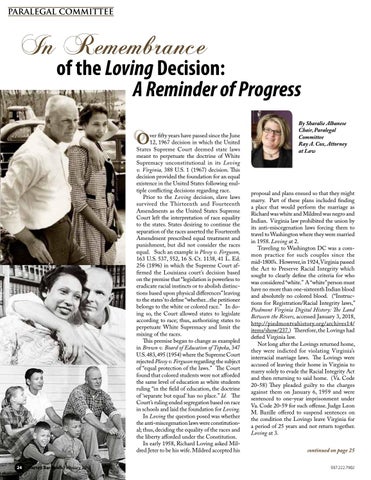
PARALEGAL COMMITTEE In Remembrance of the Loving Decision: A Reminder of Progress
By Sharalie Albanese, Paralegal
Departments 5 FEBRUARY 2018 COMMITTEE MEETINGS 16 CONTINUING LEGAL EDUCATION 31 CLASSIFIEDS & MARKETPLACE Upcoming Events 9 DBA FREE PHOTO SESSIONS
Tues. March 20th - Thurs. March 22nd| Call 937.222.7902 to schedule | DBA Seminar Room
Sally Dunker, Executive Director Shayla M. Eggleton, Communications Manager Phone: 937.222.7902 Fax: 937.222.1308
17
2018 PROBATE LAW INSTITUTE
Fri. March 9th | 8:30-4:15pm | Sinclair Community College
The contents expressed in the publication of DAYTON BAR BRIEFS do not necessarily reflect the official position of the Dayton Bar Association.
23
THE CHANCERY CLUB LUNCHEON
Fri. February 9th | Doors open 11:30am | The Old Courthouse | Limited Seating, RSVP 937.222.7902
31
MARK YOUR CALENDARS
Important DBA Save-the-Dates, You Don't Want to Miss!
Library of Congress ISSN #0415–0945
2
Features 4 TRUSTEES MESSAGE Schools, Drugs and the Fourth Amendment
Dayton Bar Briefs February 2018
937.222.7902
DBA ANNUAL PARTNERS Providing annual financial support and partnership in our mission to further the administration of justice, enhance the public’s respect for the law, and promote excellence & collegiality in the legal profession.
PLATINUM PARTNERS Jack W. and Sally D. Eichelberger Foundation
Eichelberger, longtime Oakwood residents to enhance the legal profession, the arts and the Greater Dayton community through the awarding of grants. Jack Eichelberger was a well-known Dayton attorney and real estate investor. Trustees: Dave Greer, Gary Froelich and Neal Zimmers.
Eichelberger Foundation Estabrook Charitable Trust
Estabrook Charitable Trust Administered by Porter Wright Morris & Arthur LLP | Bruce Snyder - Trustee Annual Grants to the DBA (This support makes these events affordable for all members): • Bench Bar Conference • Diversity Day • Annual Meeting
Faruki Ireland Cox Rhinehart & Dusing P.L.L. www.ficlaw.com With offices in Cincinnati & Dayton Faruki Ireland Cox Rhinehart & Dusing P.L.L. is a premier business litigation firm with offices in Dayton and Cincinnati. The firm’s national practice handles complex commercial disputes of all types, including class actions; antitrust; securities; unfair competition (trade secrets and covenants not to compete); employment; advertising, media and communications; attorney malpractice; data privacy and security; intellectual property and product liability. While its trial practice is national, the firm has always been, and continues to be, committed to the local legal community.
GOLD PARTNER Thompson Hine LLP www.thompsonhine.com Established in 1911, Thompson Hine is a business law firm dedicated to providing superior client service. The firm has been recognized for ten consecutive years as a top law firm in the country for client service excellence in The BTI Client Service A-Team: Survey of Law Firm Client Service Performance. With offices in Atlanta, Cincinnati, Cleveland, Columbus, Dayton, New York and Washington, D.C., Thompson Hine serves a premier business worldwide.
www.daybar.org
er!
rtn l Pa
ua Ann A 2 B a D 22.790 e 7.2 com o be rg | 93 t r e .o unk aybar D d y l Sal er@ February 2018 Dayton Bar Briefs act sdunk t n Co
3
TRUSTEES MESSAGE
Schools, Drugs and the
Fourth Amendment
LL
ate last spring, when my youngest son’s junior year of high school was coming to a close, I received a letter from his high school informing us that it was going to begin random drug and alcohol testing of all of the students beginning the following school year. The lawyer in me immediately screamed (silently) – that is a Fourth Amendment violation! A second later I realized, wait, Carroll is a private school, so probably not. Then I switched back to parent mode and asked my son how he felt about it. His response, a shrug of the shoulders and “it doesn’t matter to me,” was followed later by some questions. “Is this legal?” “Can public schools do this?” Good questions. First, as suspected, the Fourth Amendment is not implicated by searches conducted by a private school. Fourth Amendment protections generally apply to actions by the state or those acting in concert with the state. Because Carroll is a private school, it is not a state actor and therefore, its actions in conducting suspicionless drug and alcohol testing does not implicate the Fourth Amendment.1 This is true even if the private school receives some state and federal funding. 2 Surprising to me, the U.S. Supreme Court in Bd. of Educ. v. Earls has also permitted public schools to conduct random drug testing of their students involved in extra-curricular activities, including not only athletics, but academic teams, clubs, bands, etc.3 This case came seven years after the Supreme Court found in Vernonia Sch. Dist. 47J v. Acton that a policy testing student athletes was constitutional because of a rampant drug problem in the school led by the athletes as “role models” and due to the particular dangers to student athletes using drugs.4 The Court held in both cases that because public schools are state agencies, searches conducted by public school officials do of course implicate the Fourth Amendment. This means the testing policy must be reviewed by the Court for “reasonableness.” In a criminal context, reasonableness equates to probable cause, but in other circumstances, a search is reasonable when it is supported by “’special needs’ beyond the normal need for law enforcement.”5 The Court explained that “while schoolchildren do not shed their constitutional rights when they enter the schoolhouse,” the school’s “custodial and tutelary responsibility” for its students satisfies this “special needs” requirement.6
4
Dayton Bar Briefs February 2018
By Susan D. Solle Esq. DBA Immediate Past President Dinsmore & Shohl, LLP
The Court in Earls then conducted a balancing test between the intrusion of the students’ privacy and the governmental interest in conducting the tests. As to privacy, the students involved in extra-curricular activities were found to have lessened expectation of privacy due to the inherent nature of the activities (off-campus travel with special rules and occasional communal undress), and a urinalysis was found not to be intrusive. Further, the results were only disclosed to the parents, and not turned over to law enforcement or used for discipline; the purpose was to identify issues and provide counseling or other intervention. The Court then found, as it had in the past, that preventing and deterring students’ drug use was an important, maybe even compelling, government interest. The majority of the Court briefly stated that testing only those students involved in extra-curricular activities was a reasonable means to prevent drug use in the school.7 The dissent, however, focused on this aspect of the school’s policy, pointing out that the risk of drug use is present for all students, and in fact, students involved in extra-curricular activities are less likely to develop substance abuse problems.8 Justice Ginsburg pointed out that the drug problem at the school in Vernonia was not only of greater magnitude, but much more closely related to the athletes who would be tested (even though she also wrote the dissent in that case). The dissent urged that the policy at issue in Earls was an unreasonable invasion of the students’ privacy under the circumstances presented. In the sixteen years since the Supreme Court decided Earls, public school districts around the country and the state have instituted random drug testing programs for students participating in extra-curricular activities. With the opioid epidemic plaguing the country, and significantly our community recently, I expect the number of schools initiating such policies to grow. continued on page 5
ENDNOTES: 1 Commonwealth v. Considine, 448 Mass. 295, 299-301, 860 N.E.2d 673, 677-78, 2007 Mass. LEXIS 21 (finding private school officials’ warrantless search of a student’s hotel room on a school trip did not violate Fourth Amendment because a private school is not a state actor); L.P. v. Marian Catholic High Sch., 852 F.3d 690, 696-697, 2017 U.S. App. LEXIS 5480, *13-16 (finding private school officials are not state actors for purposes of a §1983 case related to school drug testing). 2 L.P., supra at 696.
3 Bd. of Educ. v. Earls, 536 U.S. 822, 853-854, 122 S. Ct. 2559, 2577, 153 L. Ed. 2d 735, 759-760 (2002).
4 Vernonia Sch. Dist. 47J v. Acton, 515 U.S. 646, 655-665, 115 S. Ct. 2386, 2391-2397, 132 L. Ed. 2d 564, 575-582, (1995). 5 Earls, 536 U.S. at syllabus (a). 6 Id. at 829-30. 7 Id. at 837-38.
8 Id. at 853, citing N. Zill, C. Nord, & L. Loomis, Adolescent Time Use, Risky Behavior, and Outcomes 52 (1995).
937.222.7902
DBA Committee Meetings February 2018
TRUSTEES MESSAGE: Schools, Drugs and the Fourth Amendment continued from page 4 More and more Catholic schools, free from Fourth Amendment scrutiny, have also begun conducting random drug testing of all students. Like the school in Earls, Carroll’s Health and Wellness Initiative was launched with the primary purpose of prevention and intervention for students who draw positive results. The most compelling motivation of the policy in my view is to give the students a way “out” of peer pressure, and a good “excuse” to avoid drugs and alcohol. So, I was able to answer my son that, as it turns out, any school can conduct random drug and alcohol testing, albeit public school policies are more limited and subject to the reasonableness inquiry set forth by the Supreme Court in Earls. Now if your kids happen to ask, you will know too.
Juvenile Law Monday, February 5th @ 4:00pm Diversity Issues Tuesday, February 6th @ Noon Estate Planning, Trust & Probate Law
Wednesday, February 7th @ 4:00pm
Young Lawyers Division
Wednesday, February 7th @ TBA
Domestic Relations
Thursday, February 8th @ Noon
Real Property Thursday, February 8th @ Noon Public Service & Congeniality
Friday, February 9th @ 11:30am
Federal Practice
Monday, February 12th @ Noon
Labor & Employment Law
Tuesday, February 13th @ Noon
Appellate Court Practice
Wednesday, February 14th @ Noon
Workers’ Compensation/Social Security
Thursday, February 15th @ Noon
Criminal Law & Its Enforcement
Wednesday, February 21st @ Noon
Civil Trial Practice & ADR@ The PUB, The Greene Wednesday, February 21st @ 4:30pm Corporate Counsel @ Bravo Italian Resturant
Thursday, February 22nd @ 4:30pm
Dedicated to protecting the rights of children, individuals and families. Areas of Practice: Medical Malpractice Birth Trauma Injured Children Catastrophic Brain Injury
Robert W. Lipp III Rated by Super Lawyers
www.daybar.org
Plaintiff Medical Malpractice
Call Today! 937.294.3600 www.LippLaw.com rlipp@lipplaw.com February 2018 Dayton Bar Briefs
5
BARRISTER OF THE MONTH
Erin E. Rhinehart Esq. & Michael N.Rhinehart Esq.
EE
ver since I moved to Dayton, the name Rhinehart seemed to pop up everywhere I went. I remember sitting in the Fourth Floor Faculty Lounge at the University of Dayton School of Law, listening to a panel of attorneys discussing the topic of being successful in internships and clerkships as law students. I sat there and listened intently as a confident, experienced lawyer gave advice that, little did I know at the time, would lead me to success. Erin Rhinehart gave us advice through her own experiences; advice which I’ve carried with me through law school and my career. Her advice can be summed up in a few words: put in the work, take chances, and make your own success. Erin may not realize this, but her advice guided me to my first legal job and the next time I would hear the name Rhinehart. By following Erin’s advice, I began interning at the United States District Court for the Southern District of Ohio and subsequently began participating in the Federal Bar Association. Michael Rhinehart’s poise and intelligence helped the interns, like myself, understand the professionalism behind the walls of the Federal Court. Michael was always, and still is, open to questions or
6
Dayton Bar Briefs February 2018
discussions. I watched and learned as he, in his own ways, exemplified hard work, taking chances, and making his own success. Michael is currently an attorney for the United States District Court for the Southern District of Ohio in Dayton. He is also an adjunct professor at the University of Dayton School of Law where he has taught a number of classes over the years, such as the Tort Litigation Medical Malpractice Capstone, Interviewing, Counseling, & Negotiation, and the Criminal Law Lab. Michael graduated from the University of Dayton School of Law in 2003, and his dedication to the Law School shows his ability to give law students an opportunity to learn from an experienced, local attorney. The hard work Michael has continuously portrayed through his legal career has certainly led him to his current success. Prior to law school, Michael earned his Bachelor of Arts in Political Science from the University of Louisville. After law school, Michael became an Associate Attorney with the law firm Freund Freeze & Arnold. He then had the opportunity to become a Judicial Law Clerk for the Ohio Fourth District Court of Appeals, and before he began with the United States District Court, Michael
worked at the law firm Dinkler Pregon. Michael continues to show his dedication to the Dayton community. He is active in the legal community where he sits on the Dayton Chapter Board of Directors of the Federal Bar Association. He is also active with the Dayton Bar Association as the Federal Practice Committee Vice-Chair and as an Editorial Board Member. Michael is an exceptional attorney, and he continues to exemplify his professionalism in this community by representing his leadership skills by example day in and day out. Now, believe it or not, that is only half of the dynamic duo from the Rhinehart family. Michael and Erin attended the University of Dayton School of Law together. Prior to law school, Erin attended Miami University where she earned her Bachelor of Arts in Political Science. She then graduated from the University of Dayton School of Law in 2004. Erin began working at Faruki+, directly out of law school and now as a Partner of the law firm, she continues to excel in her practice. Erin has a diverse litigation practice, leading her firm’s media continued on page 7
937.222.7902
BARRISTER OF THE MONTH: Erin & Michael Rhinehart Esq. continued from page 6
and communication practice, which includes branding, advertising law, social media issues, First Amendment issues, and privacy issues, just to name a few. Erin defends clients in state and federal consumer and mass tort class action lawsuits, and she advises her clients on various contract issues. I could go on and on, but it is clear that Erin is a wellverse attorney, dedicated to representing her clients. Like Michael, Erin previously taught as an Adjunct Professor at the University of Dayton School of Law. Similarly to the mentoring she has done to me, Erin taught various courses focusing on the practical application of lawyering skills. Her dedication to the law school does not end there. For years and without hesitation, Erin has mentored students by speaking on panels, speaking at student organization events, and agreeing to have coffee or lunch to share her real life experiences. Now, Erin is formally a mentor through the law school’s Leadership Honors Program, but as many of us already know, she doesn’t need a formal mentorship to lead students in the right direction. Erin has been recognized as a Super Lawyers “Rising Star” since 2014 and named to Benchmark Litigation’s “Under 40 Hot List”. Among other awards and honors, Erin was awarded the President’s Choice Award of the Ohio Women’s Bar Association in 2017. These and the many other awards Erin has received do not do justice to show the impact Erin has on this community. She knows the importance of being a mentor and having mentors, and more importantly,
www.daybar.org
she understands the importance of having a voice and working for what you want. Separate from the legal community, Erin and Michael are both Associate Board Members of the Boonshoft Museum of Discovery for the Dayton Society of Natural History. One thing they understand is that work-life balance is exactly that, a balancing act. When it comes to their two children, performing this balancing act is worth the day-to-day struggle. In fact, you would never know they have to work hard to juggle work, community involvement, and their personal lives. To me, they show joy, poise, and professionalism. For those of us in the community that know Michael and Erin, it is easy for us to see their qualities and dedication to the practice of law. However, we do not always have the opportunity to see them from each other’s perspective. Michael says: “There are so many characteristics I admire about Erin, including her relentless drive, extraordinary work ethic, and dedication to her family, firm, community, and profession. Most of all, however, I admire her boldness, her lack of fear of just about anything, and the fact that she is always working toward achieving some goal.” From her perspective of Michael, Erin says: “One of Michael’s great strengths – in life and in the law – is that he listens more than he talks. He is often quiet, reserved; but, when he decides to speak up, his insights are spot on. Active listening and restraint are, unfortunately, rarities in this profession. But, they are among the few
skills that propels one from being a good lawyer, to a great one. Michael is, in my humble opinion, a great one.” I have personally had the privilege of getting to know Erin and Michael Rhinehart over the last several years, and almost every time I see them, I learn something new, whether about them, about the law, or about myself. That is the impact they have on others. When they talk, I want to listen and learn. Since the year I met Erin and Michael, our interactions have yet to change. Michael will still have an open ear and listen to my banter, and Erin will find time to meet me for lunch, listen to my questions, and give me guidance. What I always take with me is if I put in the work and take chances, then I will make my own success.
By Michelle T. Sundgaard Esq. DBA Editorial Board Pickrel Schaeffer & Ebeling Co., LPA
February 2018 Dayton Bar Briefs
7
APPELLATE COURT PRACTICE
Justice Judith L. French “Behind the Curtain” JJ
ustice Judith French began her career in private practice, specializing in environmental law and later serving as in-house counsel for a large manufacturing company. But the pride of her career is public service. For the past two decades, she has served the State of Ohio as a lawyer for a state agency, an assistant attorney general, counsel to the Governor, and as a judge. While at the Attorney General’s Office, Justice French argued two cases before the United State Supreme Court. She was elected to the Tenth District Court of Appeals in 2004 and authored more than 800 legal opinions for that Court. She was appointed to the Supreme Court of Ohio in December of 2012 and elected to her first full term in 2014. During the Appellate Practice Committee’s recent CLE “Roundup,” Justice French graciously stopped by to share her thoughts on practice before Ohio’s highest court, as well as to offer a glimpse “behind the curtain” at the process used when reaching decisions. Each of the justices reviews all requests for jurisdiction, or discretionary appeals. Out of every one hundred requests, the justices generally agree on about eighty, leaving about twenty percent of jurisdictional applications open for discussion. So, what can you do to ensure your issue gets before Ohio’s High Court? Focus your jurisdictional briefing on the public interest, says Justice French. Explain to the court why the issue affects many people across the state, not just the parties before the court. Does the issue affect a widespread industry? Is the law well-settled, so much so that it may be something to consider again? And do the appellate district courts address the issue in the same way? Justice French prides herself in having visited all eighty-eight of Ohio’s counties multiple times, in part to understand and know what is of general public interest to Ohioans. Once a case is before the court, know that a case is truly made in the briefing. As the appellee, continue to argue against the propriety of a discretionary appeal. Justice French noted that improvidently accepted appeals are to be avoided, and usually come about because some bit of evidence that was suggested in the jurisdictional briefing is not, in fact, in the record. (Another plug for preserving your record for appeal.) To avoid improvidently accepted appeals, Justice French’s office takes a layered approach, with at least two people, including the Justice, looking at the case to determine whether it is an improvidently accepted appeal in the making. Though a case is made in the briefing, know that the Bench will be “hot” at oral argument. You must prepare thoroughly for oral argument. Justice French reads everything – and we do mean everything – in preparation for oral argument. Both she and one of her clerks read all of the briefing. She studies a bench memorandum prepared by the clerk with his or her independent thoughts on the case. Justice French encourages nay-sayers – she does not want to hear what her staff thinks she might want to hear. Her goal is to develop a thoroughly tested and tempered decision. Before oral argument, Justice French also looks at the record and at all the relevant research on the issues at hand. Her process is not unique – all of the justices come to oral argument well-prepared. Remember that oral argument is not for you, as the lawyer, but for the justices. Keep the extent of their preparation in mind when preparing for oral argument, and know that the justices are ready to jump into the issues. A complete recitation of the facts is not necessary. What is necessary is that counsel be prepared to answer the age-old questions plaguing appellate counsel the world over: “Do we have a final appealable order?” and “What is our standard of review?” As you argue, know that you do not need to use all of your time. (Or, for that matter, write to your page limit.) If you notice a lull in questioning, it is likely time to wrap-up your argument. As appellee, make sure you answer the questions asked of the appellant. Oral argument should feel like a conversation with the Court, and if you’re having fun, you know you prepared sufficiently. continued on page 9 8
Dayton Bar Briefs February 2018
937.222.7902
APPELLATE COURT PRACTICE: Justice Judith L. French "Behind the Curtain" continued from page 8 But what happens after oral argument “behind the curtain”? The justices go from the courtroom to the robing room, and then directly into conference. The conference is held with the seven justices and the official court reporter. No one else is present. The justices sit in order or seniority in chairs bearing their names. The Chief Justice sits at the head of the table and begins discussion. Each justice speaks in order of seniority without interruption. Once each justice has had their say, the case is opened for discussion. Justice French observed that these discussions are always cordial and professional, but at times can be very spirited. Once discussion is closed, the justices vote in reverse order of seniority, with the Chief Justice breaking any tie. Then it comes to deciding who will write the opinion for the Court. At the United States Supreme Court, the senior member of the majority decides who will write the decision. In Ohio, it’s marbles. Each justice has their own marble with a number on it. The marbles are placed in a leather bottle. Justice O’Donnell, as senior associate justice, draws a marble from the bottle and hands it to Justice French, who then announces which justice will be writing for the majority. If a dissent is to be written, the dissenters agree among themselves, with each free to write a separate opinion. Hopefully understanding the process undertaken “behind the curtain” and what the justices are looking for to get into and succeed in their court will help you next time you have a matter of public or great general interest. The Appellate Committee would again like to express our gratitude to Justice French for sharing her wisdom and insights with the DBA. By Anne P. Keeton Esq. Chair, Appellate Court Practice Freund, Freeze & Arnold, A Legal Professional Association
By Susan D. Solle Esq. Vice-Chair, Appellate Court Practice Dinsmore & Shohl, LLP
www.daybar.org
Time to update your professional photo?
DBA Photo Sessions
Tuesday, March 20th - Thursday, March 22nd DBA Seminar Room Photographer, Julie Noeth wallingphotography.net
Call 222.7902 to RSVP!
F DB REE
!
AM BEN EMBE EFI R T
February 2018 Dayton Bar Briefs
9
DBA RISING STAR
Rising Star
above the Bar
Cassandra A. Rice Esq. & Michael D. Rice Esq. II
n observance of St. Valentine’s Day, we recognize as February’s Rising Stars of the Bar two of our young members, Michael D. Rice and Cassandra A. Rice, joined not merely as brethren of the bar, but also by the bonds of marriage. Born in Cincinnati, Cassandra graduated from William Henry Harrison High School in 2005. After high school, Cassandra received her bachelor of arts degree at Purdue graduating in just 3½ years, instead of the customary four, with a double major in psychology and sociology. Understanding the value of an educational dollar, Cassandra’s motivation for attending college year-round was to lessen her college expenses and hasten her entrance to the legal profession. Cassandra’s legal ambitions occurred early in life. She decided to become a lawyer at age 8, inspired by her Aunt Carolyn Hallanger, an accomplished general practice attorney, who over her career was admitted to practice in no less than five states as she followed her husband from one career-advancing job to another. At that tender age, Cassandra also became an avid watcher of Law and Order and a fan of Sam Waterston’s character, Jack McCoy, the passionate Manhattan assistant district attorney. Cassandra entered the University of Dayton School of Law in the fall of 2009 after a short stint as a social worker in Lafayette. In that position, Cassandra provided respite to parents of physically and mentally challenged children. Thanks to Cassandra, and her colleagues, families were given occasional breathers from the extraordinary demands of challenged-kid parenting to engage in one form of recreation or another. Although not in her section, Cassandra met Michael on just her third day at U.D. They dated throughout law school, but sparingly during their first year due to the demands of
10
Dayton Bar Briefs February 2018
their studies and the fact that they had different professors and were in separate study groups. After her graduation in 2012, Judge Gregory Singer hired Cassandra as his staff attorney, a position she held for three years. Over that period, she was principally responsible for motion practice on Judge Singer’s civil docket. Her charge was to review the parties’ motions and memoranda, confirm their accuracy, and determine the controlling law. After discussing the outcome with Judge Singer, it was Cassandra’s task to draft a decision for the judge’s review and approval. In 2015, Cassandra moved comfortably into the practice of law at Gottschlich & Portune, where she handles a variety of litigation, probate, employment and municipal law matters. In a recent case, Cassandra second-chaired a bench trial with Gary Gottschlich, a probate case in Washington County where the central issue was the inheritance of real property as between the widow and the children of the decedent’s first marriage. Predictably, Gary and Cassandra were victorious, and with some guidance from Gary, Buzz Portune, Mary Lentz, John Mohr, Martin Foos and Martina Dillon, more such triumphs are certain to come. Cassandra’s partner in life, Michael Rice, is a local boy and the son of Timothy G. Rice, who before his retirement was a senior in-house attorney at Dayton Power & Light Co. Born in Dayton, and raised in Beavercreek, Michael graduated from Beavercreek High School in 2003. He graduated from Ohio University in 2007 with a bachelor of arts degree in public administration. He remained in Athens to obtain a masters in public administration in 2008. His academic accomplishments at Ohio University were outgrowths of his passion for government and politics. During school breaks, Michael worked in the Montgomery
Photos via Michael Carr of Carrs Photography
County Recorder’s Office, first for Judy Dodge, and then for Willis Blackshear. In 2004, Michael worked on the John Kerry presidential campaign. Two years later, he worked on Judy Dodge’s first campaign for a seat on the Montgomery County Commission. Like Cassandra, Michael entered U.D. Law School in the fall of 2009. Though unlike Cassandra, Michael’s decision to pursue law as a career did not come to him divinely as an eight year-old. Rather, it was influenced in part by the financial crisis of 2008 and the dearth of employment opportunities that followed. Mercifully, the job market had improved markedly upon Michael’s graduation with Cassandra in 2012, when Judge Dennis Langer hired him to be his staff attorney. In that position, Michael’s job duties, much like Cas-
continued on page 11
937.222.7902
DBA RISING STARS: Cassandra & Michael Rice Esq. continued from page 10
sandra’s, centered on the court’s civil docket. Proximity on the job only enhanced Cassandra’s and Michael’s love affair. On October 4, 2014, they were married in the vestibule of Memorial Hall. Judge Singer officiated the ceremony. The following December, Michael left Judge Langer’s court for Dungan & LeFevre in Troy. At the firm, Michael collaborates with Steve Justice and Glen McMurry on a variety of litigation matters, including business, employment, appellate, administrative and habeas corpus cases. Like Steve and Glen, Michael is active in local Federal Bar Association activities, including his service as chair of the Young Lawyers Division. In 2016-17, Michael and Cassandra held similar positions with the Dayton Bar Association as co-chairs of its YLD. As the old saying goes, first comes love, then comes marriage, and so it is that after becoming the first pregnant lawyer in Gottschlich & Portune’s history, Cassandra purchased a baby carriage for son, Cameron, now seven months old. To be sure, the Rices are a team. While Cassandra was in trial in Washington County, Michael assumed responsibility for himself and for Cameron in her absence. Undoubtedly, the day will come when it is Cassandra’s turn to cover for Michael while he lawyers in some remote locale. In the meantime, their love for each other, for Cameron, and the practice of law can only lead to prosperous futures for all of them. Their stars are surely rising. Interests of marital and near-marital tranquility should compel us lawyers not to bill too many hours on February 14th, so on that day, leave work early and have a Happy Valentine’s Day everyone!
By Thomas J. Intili Esq. DBA Editorial Board Intili & Groves Co., LPA
www.daybar.org
welcome new members Get Involved!
ATTORNEY
Janet E. Hales Esq. Advocates for Basic Legal Equality, Inc. Admitted to Ohio Bar: 5/92 Carly M. Sherman Esq. Frost Brown Todd, LLC Admitted to Ohio Bar: 11/17
DAYTON Bar Association
LAW STUDENT
Jacob J. Stephens
LEGAL ADMINISTRATOR
Melanie S. Walker Crossman & Maciorowski, LLC
Trust
HERBERT M. EIKENBARY What is The Eikenbary Trust? The late Herbert M. Eikenbary granted the bulk of his estate to fund Grants and Loans to lawyers under the age of 35 who practice/ reside in Montgomery County. These Grants and Loans are to aid young, deserving lawyers who are in need of financial assistance. Through the efforts of the Trustee's and the Dayton Bar Association's counsel, we have been successful with the Court to better effectuate the purpose of Mr. Eikenbary's Will by increasing the amount of loans made to young attorneys, which was originally only $500.00, to $4,000 per grant. The maximum available individual loans, are up to $6,000.00 at 4% interest. This is indeed a big difference from the original loan amount of $500, but the interest amount has remained the same so the financial burden will not be weighted heavily.
How to Apply? Application forms are available from the Herb Eikenbary Loan & Grant Program through the Eikenbary Advisory Committee of the Dayton Bar Association. If you would like to take advantage of these programs, contact:
Sally Dunker, DBA Executive Director Dayton Bar Association 109 N. Main St., Suite 600 Dayton, OH 45402-1129
February 2018 Dayton Bar Briefs
11
CIVIL TRIAL PRACTICE & ADR
A “Comparative” Look at Ohio’s Open & Obvious Doctrine G G
enerally speaking, a landowner in Ohio owes a duty of ordinary care in maintaining his premises in a reasonably safe condition. This duty typically requires a landowner to warn of any latent or hidden dangers to those lawfully on the premises. However, Ohio’s “open and obvious” doctrine obviates this duty to warn, absent attendant circumstances, resulting in a complete bar to any claim for negligence. Under this doctrine, “the owner or occupier may reasonably expect that person entering the premises will discover [open and obvious] dangers and take appropriate measures to protect themselves.” Armstrong v. Best Buy Co., 99 Ohio St. 3d 79. The underlying rationale for the open and obvious doctrine is that one is reasonably expected to discover such a danger and protect herself from it. Simmers v. Bentley Constr. Co., 64 Ohio St. 3d 642, 644. By serving as a bar to recovery, Ohio takes a strict approach in applying the open and obvious doctrine in premise liability cases. Should Ohio take such a stringent approach by completely barring recovery, or should one’s inability to avoid an open and obvious hazard factor into the jury’s consideration in apportioning fault between the parties? While once recognized as a bar to recovery, the West Virginia Supreme Court of Appeals abolished that position. Hersh v. E-T Enterprises, Ltd., 232 W.Va. 305. “In the ordinary premises liability case against the owner or
12
Dayton Bar Briefs February 2018
possessor of the premises, the finder of fact may consider whether a plaintiff failed to exercise reasonable self-protective care when encountering an open and obvious hazard on the premises; the plaintiff ’s confrontation of an open and obvious hazard is merely an element to be considered by the jury in apportioning the relative fault between the parties.” Id. Ohio’s southern neighbor, Kentucky, takes the position that the open and obvious doctrine should focus on the breach of duty element as opposed to whether or not a duty is owed at all. Shelton v. Kentucky Easter Seal Society, Inc., 413 S.W.3d 901. Like West Virginia, the Kentucky Supreme Court in Shelton stands for the notion that an injury stemming from an open and obvious hazard should be considered by the jury in allocating comparative fault. As the majority notes, “[this approach] brings Kentucky even further into the modern era of tort law and takes one more step in our journey toward a fairer system less burdened by the vestiges of contributory negligence. We may walk slowly in the law, but we should never walk backward. Perpetuating the confusion engendered by the open-andobvious doctrine would be a step backward.” Id. Justice Scott’s dissent acknowledged the majority followed the common law trend throughout the country. Id. To the West, Indiana applies the fundamentals of comparative fault in determining whether a premise owner will be exposed to
liability. Specifically, determinations as to the “obviousness” and “openness” of an alleged danger soundly stay within the province of the jury. Here, a landowner’s duty is not vanquished by the mere existence of a potential, obvious danger. Instead, “the duty of [a landowner] to exercise reasonable care for safety of invitees is an active and continuing one; it does not cease simply because invitee learns of unsafe conditions on premises, but an invitee's knowledge may be considered in determining his or her fault.” See Get-N-Go, Inc. v. Markins, 550 N.E.2d 748 (Ind. 1990). To the East, Pennsylvania, a court may determine that a landowner is relieved from a duty to an invitee when the danger is such that “reasonable minds could not differ as to the conclusion.” Carrender v. Fitterer, 503 Pa. 178, 469 A.2d 120 (1983). However, the Supreme Court of Pennsylvania has repeatedly affirmed that this determination is to be primarily left in the hands of the jury. Additionally, the open and obvious doctrine is not to be construed as an impermeable, unbreakable shield. In adopting the position as articulated in Section 343 A(1), Restatement (Second) of Torts (comment F), instances where an invitee is still likely to encounter a danger despite the apparent obviousness may subject a landowner to liability. continued on page 13
937.222.7902
CIVIL TRIAL PRACTICE: A "Comparative" Look at Ohio's Open and Obvious Doctorine continued from page 12 To the North West, Michigan has also adopted a more lenient application of the open and obvious doctrine. The interplay between “obviousness”, “openness”, and “duty” has often been conflated. The Supreme Court of Michigan has attempted to clarify this in holding that “the open and obvious doctrine should not be viewed as some type of ‘exception’ to the duty generally owed by invitees, but rather as an integral part of the definition of that duty.” Lugo v. Ameritech Corp., Inc., 464 Mich. 512 (2001). In other words, the assessment of the obviousness of a danger along with the resultant harm caused by the danger is to be viewed in its totality. While a certain pothole may very well be open and obvious, a ten foot drop after accidentally stepping in said pothole cannot be viewed as a reasonable protection provided by the open and obvious doctrine. Id. When comparing the open and obvious doctrine in neighboring states, Ohio’s approach through Armstrong and its progeny is more austere. With that said, it is axiomatic that all persons, including invitees, use ordinary care under any and all circumstances. However, what “ordinary care” means should www.daybar.org
R.L. EMMONS AND ASSOCIATES, INC. be assessed by fact finders to determine who is in the best position to use such care. By Ben Felton Esq. Civil Trial Committee Dyer Garofalo Mann & Schultz
842–A E. Franklin Street Dayton, Ohio 45459
Profession pport Services Firm
Polygraph Asset Searches Criminal Defense By Austin LiPuma Esq. Civil Trial Committee Dyer Garofalo Mann & Schultz
Process Service Witness Locates / Interviews Surveillance Civil Case Prep General Investigation DAYTON: 937 / 438–0500 Fax: 937 / 438–0577 February 2018 Dayton Bar Briefs
13
COVER ARTICLE By Magistrate Brandon C. McClain Dayton Municipal Court
II
t has been said the measure of a superhero is his nemesis.1 If so, Thurgood Marshall, a civil rights leader who dedicated his life to pursuing equality for all, was immeasurable. Before he was the first African-American Supreme Court Justice, Mr. Marshall was a soldier in the war of equality for all. I am unapologetically grateful for Thurgood Marshall and his involvement in the Civil Rights Movement. Many of the civil rights enjoyed today are largely the result of the personal risks taken by Thurgood Marshall in pursuit of equality for all. For Mr. Marshall, who would become known as the “Great Dissenter,� many of his objectors brought the possibility of death directly to his doorstep-literally. Arguably, Marshall was never more at risk than when he entered into Groveland, Florida in 1948. This story of gross injustice is about the race-based victimization of four African-American men: Earnest Thomas, Charles Greenlee, Samuel Shepherd and Walter Irvin. They became known as the Groveland Four. The Groveland Four were accused of raping 17-year-old Norma Padgett- an accusation that would lead to a mob destroying homes in a nearby African-American community and inconceivable carnage.2 While in custody, Greenlee, Irvin and Shepherd were tortured to coerce a confession.3 Thomas escaped custody, but was subsequently hunted down by a posse of men, led by Lake County Sheriff Willis V. McCall, and fatally shot.4 His death was ruled a justifiable homicide.5 Amidst significant concern, the national office of the NAACP sent Attorney Frank Williams to represent the three remaining men.6 Following a trial, Shepherd, Irvin and Greenlee were convicted by continued on page 15
14
Dayton Bar Briefs February 2018
937.222.7902
COVER STORY: Thurgood Marshall: A Civil Rights Super Hero continued from page 14 an all-white jury following ninety minutes of deliberation.7 Shepherd and Irvin were condemned to death, with 16-year-old Greenlee receiving life in prison.8 Shepherd and Irvin appealed. Following appeals, which were led by Thurgood Marshall, the United States Supreme Court overturned their convictions and ordered a new trial.9 While being transported from Raiford State Prison to Lake County for a new trial, Shepherd and Irvin were shot by Sheriff McCall.10 Shepherd was mortally wounded, with Irvin surviving by pretending to be dead.11 Sheriff McCall was never charged for the incident. In the second trial, Irvin was represented by Thurgood Marshall. Upon accepting the case, Mr. Marshall was cautioned by a member of the governor’s staff a Lake County Deputy Sheriff planned to kill him.12 This was not the first time Thurgood Marshall had his life threatened. Routinely, Marshall’s followers would stand guard during the night to protect him from the Ku Klux Klan, which relentlessly attempted to frustrate his efforts of representing the unfairly accused.13 Their efforts did not work. Mr. Marshall would stay in Lake County, even amidst danger, and provide legal representation to Irvin. Unlike the first trial, the venue was changed from Lake County to Marion County and a new defense was presented.14 Unfortunately, like the first trial, the verdict was the same. After only nine minutes of deliberation, the jury found Irvin guilty.15 The case was appealed once more, but this time, the United States Supreme Court declined to hear it.16 Irvin once again found himself condemned to death. In 1954, just prior to Irvin’s scheduled execution, a stay was granted.17 In November of 1954, newly elected Governor Leroy Collins commuted Irvin’s sentence to life in prison.18 Despite losing the second trial, Marshall did enough to persuade Governor Collins to commute Irvin’s death sentence to life in prison.19 Greenlee would be paroled in 1962, with Irvin remaining incarcerated until 1968.20 Irvin died in 1970. Greenlee died in 2012. The Groveland Four would not receive closure, an apology or exoneration during their lifetimes. The Florida Legislature, only recently, formally apologized and exonerated the men, by legislation, in April of 2017.21 While our nation has progressed substantially since the injustices inflicted upon the Groveland Four, racism is still alive in 2018. Thankfully, so is the legacy of Thurgood Marshall. From 1934 to 1961, Mr. Marshall was an www.daybar.org
attorney for the NAACP. However, that was not his only role. He was also a symbol of hope for the hopeless. He argued thirty-two cases before the United States Supreme Court, prevailing in twenty-nine.22 Whether reflecting upon the impact of Chambers v. Florida (1940), Smith v. Allwright (1944), Brown v. Board of Education of Topeka (1954) or any other landmark case argued by Thurgood Marshall, it is evident his hands helped sculpt the opportunities for advancement many enjoy today. For this very reason, I was eager to see how the film entitled Marshall, which was released to movie theaters in February of 2017, compared to the legacy of Supreme Court Justice Thurgood Marshall. The movie focuses only on the trial of Joseph Spell, an African American butler, who was accused of raping Eleanor Strubing, the socialite wife of his employer, during the 1940’s. Through the movie, the audience is only shown a glimpse of the grandeur of Marshall. Regrettably, the glimpse created a cliff hanger - hence, the jury is still deliberating. As an audience member, I wanted more background on Marshall’s life to build character depth. However, my wants can wait. Hopefully, Marshall will operate as a springboard for additional movies to be made detailing the legacy of Thurgood Marshall - A Civil Rights Superhero. This article is dedicated to the memory of Supreme Court Justice Thurgood Marshall, who was sworn in fifty years ago, on February 2, 1967, as an Associate Justice of the United States Supreme Court. To him, Mr. Thurgood Marshall, I say thank you. ENDNOTES: 1 Mark Lyons
2 The Documentary Institute, Freedom Never Dies: The Legacy of Harry T. Moore, PBS, http://www.pbs.org/harrymoore/terror/groveland.html. 3 Id. 4 Id.
5 King, G. (2012). Devil in the Grove: Thurgood Marshall, the Groveland Boys, and the Dawn of a New America. New York: Olive Editions. 6 Id. at The Documentary Institute 7 Id.
8 Id. 9 Id.
10 Id. 11 Id.
12 Gonzalez, Eloisa. “Book highlights Thurgood Marshall’s fight to defend the last of the Groveland Four”. Orlando Sentinel. 28 Apr. 2012. Web. 10 Jan. 2018.
13 Murphy, Bruce. “Untitled Book Review.” Rev. of Devil in the Grove: Thurgood Marshall, the Groveland Boys and the Dawn of a New America, by Gilbert King, Washington Independent Review of Books 11 Jan. 2018: Online. 14 Id. at The Documentary Institute 15 Id. 16 Id. 17 Id. 18 Id.
19 Id. at Gonzalez 20 Id.
21 Brandon Larrabee News Service of Florida. “Senate Tries to Bring 'Peace' with Groveland Four Apology.” Miamiherald, Miami Herald, 27 Apr. 2017, www. miamiherald.com/news/politics-government/state-politics/article147279614. html.
22 History.com Staff. “Thurgood Marshall.” History.com, A&E Television Networks, 2009, www.history.com/topics/black-history/thurgood-marshall.
February 2018 Dayton Bar Briefs
15
daybar.org/cle Staying on Target: Recent Changes to Ohio’s Gun Laws (video replay)
save the date!
Thursday, February 22, 2018 | Noon-1:00pm 1.0 CLE Hr | Seminar #1718-089 M $35 | NM $45 | PP $0 Presenter: Nadia A. Klarr Esq., Taft Stettinius & Hollister LLP This presentation will provide an overview of Ohio’s gun laws, including a discussion of open carry, preemption, legislative initiatives, recent updates to concealed carry laws, and penalties for violation of Ohio’s gun laws.
UDSL & DBA presents: Women in the Law Saturday, April 7, 2018 @ 9:00-12:00pm
2018 Diversity Day
Friday, April 13, 2018 @ Sinclair Community College
2018 Domestic Relations Institute
Friday, April 20, 2018 @ Sinclair Community College
Estate Planning Probate and Trust Committee presents: Lightning Round: Debatable and Untested Complex Topics in the Probate and Trust Code Wednesday, February 7, 2018 | 4:00-5:00pm 1.0 CLE Hr | Seminar #1718-087 CommitteeM $25| M $35 | NM $45 | PP $0 Presenters: James Jacobson Esq., Pickrel Schaeffer & Ebeling Co., LPA and John Cloud Esq., Rogers & Greenberg, LLP Topics include: • Treatment of UTMA custodial accounts that were in-effect prior to the statutory change in Ohio and new accounts in postponing a child’s receipt of inheritance or gift until age 25; • Treatment of asset transfers via trust, TOD or other transfers of assets that leave no probate estate and dis advantage creditors under Ohio’s Fraudulent Transfer Act;
Workers Compensation and Social Security Committee presents: 4th and 10: OSHA and the NFL Thursday, February 15, 2018 | Noon-1:00pm 1.0 CLE Hr | Seminar #1718-086 CommitteeM $25| M $35 | NM $45 | PP $0 Presenter: Douglas Jenks Esq., Auman, Mahan & Furry Recent OSHA case law and the implications for professional football in the United States.
Juvenile Law Certification (video replay) Friday, February 16, 2018 | 9:00-4:45pm 6.0 CLE Hrs | Seminar #1718-085 M $215 | NM $300 | PP $0 If you were not on the Juvenile Court appointment list by February 16th, or have never been on the appointment list, you must attend this seminar for certification.
Recent Ethics Violations & the Ethical Perils of Social Media (video replay) Wednesday, February 21, 2018 | 1:00-4:15pm 3.0 CLE Hrs. Professional Conduct | Seminar #1718-088 M $105 | NM $150 | PP $0 Presenters: John Ruffolo Esq., DBA Bar Counsel and Glen R. McMurry, Partner Dungan & LeFevre Co, LPA 16
Dayton Bar Briefs January 2018
Estate Planning, Trust and Probate 101 (video replay) Wednesday, February 28, 2018 | 1:00 - 4:15pm 3.0 CLE Hrs | Seminar #1718-090 M $105 | NM $150 | PP $0 Speakers: Kristina Rainer Esq., Roberson Law; Sarah Worley Esq., Dungan & LeFevre Co., LPA; Brittany O'Diam Esq. and Kimberly Estess Esq. (both) O'Diam & Stecker Law Group, Inc. Topics include: • Basics of Trust and Will Drafting • Basic Probate and Trust Administration • Basics of Guardianships • Medicaid Basics for Estate Planners and Update
Writing for Advocates with Judge Merz (video replay) Friday, March 2, 2018 | 9:00-12:15pm 3.0 CLE Hrs | Seminar #1718-091 M $105 | NM $150 | PP $0 This 3-hour seminar presented by Judge Michael Merz, will provide a judge’s perspective on what’s good, what’s bad, and what could be better in your written advocacy. Designed for new and experienced litigators. *see details on page 17
2018 Probate Law Institute
Friday, March 9, 2018 | 8:30-4:15pm | 6.0 CLE Hrs Seminar #1718-092 | Sinclair Community College, Building 12 EARLY BIRD RATE Register by March 1s! M $215 | NM $300 | PP $30 After March 1st: M $240 | NM $325 | PP $30 *Materials will be available in electronic format. **Printed Materials are $30, with sales ending March 6th.
Online CLE Visit: daybar.org/cle/online-cle.php
Can't Stop By?
GO ONLINE!
12
Take up to
hours self-study credit
Anywhere you see this logo!
Let the DBA help you conveniently meet your CLE requirements! The DBA and OMBAC, have partnered with FastCLE so that you may easily earn up to twelve CLE credit hours per reporting period.
6.0 CLE Hrs
Friday, March 9, 2018
Sinclair Community College
2018
Probate Law Institute Agenda 8:30am
9:30am
Presenters
Slayer Statute 2.0
Trust Alert: Maximizing Tax Benefits Without the FET
10:30am
Break
10:45am
Probate Case Law Update
Adam M. Fried Esq., Reminger Co., LPA, Cleveland Andrew Keck, CTO ProFile Discovery, Columbus Edwin P. Morrow Esq., U.S. Bank, Cincinnati Hon. Jack Puffenberger, Judge, Lucas County Probate Court Elizabeth Weinewuth Esq., Vorys, Cincinnati
Pricing
11:45am
Lunch
1:00pm
Montgomery County Probate Court “Hour of Power”: Guardianship and Other Current Issues at the Court
Register by March1st ! Members $215/$230 day of NonMember $300/$315 day of Passport $30/$45 day of
2:00pm
Break
Printed Materials $30 order by March 6th (Select this option if you would like printed materials.)
2:15pm
Erosion of Attorney-Client Privilege: Fiduciary Exception
3:30pm
Cyber and Social Media Discovery: From Policy to Trial Presentation
4:15pm
Adjourn
EARLY BIRD RATE
After March 1st Member $240/$255 day of NonMember $325/$340 day of Passport $30/$45 day of
*Electronic materials will be available at no cost.
Register Seminar#092 www.daybar.org/cle 937.222.7902 Dayton Bar Association
109 N. Main St., Ste. 600, Dayton, OH 45402
www.daybar.org
February 2018 Dayton Bar Briefs
17
Stewards of the Law:
Walter Reynolds on Mentoring, Diversity and Community By Ray Miller, Publisher The Columbus & Dayton African American News Journal
T T
he first thing you need to know about Walter Reynolds is that he believes in paying it forward. From his first experience with law as a young African-American man growing up in Georgia to his appointment as the first African-American president of the Dayton Bar Association, Walter has consistently given back to his community. As a mentor and leader, Walter combines his impressive background with a dose of good humor. Q&A with Walter Reynolds, Partner-InCharge of Porter Wright Morris & Arthur LLP, Dayton
What inspired you to become a lawyer?
I was inspired to become a lawyer because of my father’s adverse situation with our judicial system. I vividly recall growing up in Georgia, where my father was cited for some type of traffic violation. He received a call indicating that there was no reason for him to show up for that hearing. So he didn’t. Unbeknownst to him, that was not the case. He was ultimately arrested and incarcerated for a short time. I was moved by that situation because I felt that had we been able to afford a lawyer, who could represent my father competently, whatever defense he would have had, he would have been able to present it. Not necessarily that he would have won, but he would have been able to present that defense. He was not afforded that opportunity. He was not able to take full advantage of the laws and rights provided by our justice system because of his lack of knowledge. That memory stayed with me. My whole goal originally was to become a criminal lawyer; I knew nothing about civil law. My goal was to help those who couldn’t afford the price of a very competent lawyer.
How did you become a civil attorney?
In my second year of law school at the University of Dayton, I started to suffer difficulty with my vision. I had to start sitting in the 18
Dayton Bar Briefs February 2018
was interested in diversity. One of the things that we started during my tenure as President was the Diversity Issue Committee, where we always have an African-American co-chair and a Caucasian co-chair. This led to the annual Diversity Day sponsored by the Dayton Bar Association.
front of the class and, in order to be assured of getting that seat, I would get to class early. The professor was a lawyer named John Henry, who was the managing partner of a civil firm, Estabrook Finn & McKee. I started talking with him, and he thought I was a very diligent student since I was one of the first to arrive in his class and I paid attention. He invited me to interview at his law firm in the summer of 1977, and they offered me a summer clerkship; I was offered full-time employment at the end of the summer. Estabrook merged with Porter Wright, and I’ve been with the firm ever since. Estabrook did not do criminal law work; it was a business law firm. My whole motivation for becoming a lawyer changed at that point because of this unique opportunity that was put in front of me. You were the first African-American President of the Dayton Bar Association. Tell us more about that. It goes back to the managing partner of the firm, John Henry. He was an advocate for the legal profession. John felt that lawyers have a duty to our community and to the profession. The firm insisted that every associate be a member of the Ohio State Bar Association and the Dayton Bar Association. After I became involved in the committees, people started to identify me as a person who can move up the ranks in the bar. I ultimately became the President of the organization. Because I grew up in the South and am African-American, I
Did you encounter any challenges as an African-American in the law community? Other trailblazers before made the road a lot smoother. They were people like Judge John Petzold, who was a former Bar President and believed early on that I could one day be President of the Bar. When you have people who are your advocates, you may not even notice the rough spots. I had people like Judge Petzold, Charlie Faruki and Judge Jeffrey Froelich, who were well respected in the community, behind me. It made my ability to assume the role as President and to govern a lot easier. If there were concerns or issues, they really never came to my attention. I had other people who believed it was time for the Bar to have its first African-American President and I had paid my dues and therefore they were supporting me. How does that inspire or impact your drive to mentor others? Because others helped me, I worked to help others. I’ve worked with or mentored many leaders within the law community who eventually became presidents of the Dayton Bar Association themselves. The most recent African-American president is an attorney who works at LexisNexis, Kermit Lowery. I met Kermit when he was a second-year law student at the University of Dayton. Every Saturday, I would volunteer to meet with about four law students to work with them on how to take the exams, how to prepare better for class, and the importance of having a study group. Kermit was one of the students. continued on page 19
937.222.7902
Stewards of the Law: Walter Reynolds Esq. continued from page 18
I have reached out to help others, but also in doing that, the Bar Association is better because of the diversity that we’ve had. Can you tell me more about DBA Diversity Day? When we first started to do a diversity day, we hired a client to make a video that focused on the importance of diversity. We had little skits that we would play to prepare people for Diversity Day. All of the judges closed court for the whole day, and encouraged all of their staff to attend, and all of the major law firms to set aside a time to attend Diversity Day. Because all of the judges were going to be there, the lawyers who liked to be seen with judges and liked to be seen by judges will attend. During the event, we talked about the importance of diversity in our legal profession; we talked about the importance of diversity in the majority firms; and we talked about the importance of increasing diversity in our law schools. Our speakers would talk about the number of African-Americans who were in law school, the problems in terms of graduating, the graduation rates, the bar passage rates, and the employment opportunities. The idea was to identify and implement solutions and eliminate barriers to make sure the people begin to appreciate that we really have more in common than we have differences. It’s important for the legal profession that we have diversity, inclusiveness and equality in the law. We are stewards of the law, and if we don’t do it, then what example are we setting for others?
www.daybar.org
What do you wish you’d known as a young lawyer?
I wish I had been better at writing. You don’t pick that skill up as a young lawyer. Being a good writer goes back deeper, all the way back to the training you have in your undergrad school and the training you have in your law school, and then when you get to be a lawyer you apply that training. Writing is something you do from the very first day you become a lawyer to your last day in practice.
Thurgood Marshall is a source of inspiration for you. Can you tell me more about that?
I have three kids, two daughters and a son. My son’s name is Alexander Marshall Reynolds, and Marshall is taken from Thurgood Marshall. As a lawyer and as a person who grew up in the sixties, I realized how important the work of Thurgood Marshall was. He was the lead attorney on Brown vs. Board of Education, the decision from the Supreme Court that overruled separate but equal. He was the first African-American to be appointed to the Supreme Court. His work as the attorney for the NAACP, where he argued most of these major civil rights cases in the Supreme Court, should be admired by any lawyer who believes in the rule of law. While we don’t have a holiday for him, some of the things that Thurgood Marshall did are just as important for this country as what Dr.
King did. Thurgood Marshall used the law, where Dr. King used the moral authority. Whether you’re black or white, you have to appreciate the things that Thurgood Marshall did. Through his advocacy, our country was able to avoid some of the disruptions that a lot of the apartheid systems had. Our country was able to move to a more perfect place by Mr. Marshall’s use of the law. Think about what we’ve been able to do. I grew up in a society where you had swimming pools that were for blacks and you had swimming pools that were for whites. You had water fountains that were for blacks and you had water fountains that were white. All of that changed because of Brown vs. Board of Education and the advocacy of Thurgood Marshall. We talk about diversity, we talk about inclusiveness, and we talk about equality, but these are concepts Thurgood Marshall was instrumental in creating back in the fifties and the sixties and that still are important today. What better name could my son have than Marshall? *To read the rest of this article from the September 2017 Edition of Columbus and Dayton African American News Journal, in its entirety, please contact: Ray Miller, Publisher of The Columbus & Dayton African American, 503 S. High St., Ste. 102, Columbus, Ohio 43215, editor@columbusafricanamerican.com.
February 2018 Dayton Bar Briefs
19
FROM THE JUDGES DESK
JUDGE LANGER’S Criminal Law
Top
10 List
By Hon. Dennis J. Langer Montgomery Cty Common Pleas Court
year I have the pleasure of conducting an end-ofEEach the-year Criminal Law Update Seminar at the Dayton Bar Association. My “Top 10 List” for 2017:
1
WHERE A JUROR MAKES A CLEAR STATEMENT INDICATING HE OR SHE RELIED ON RACIAL STEREOTYPES OR ANIMUS TO CONVICT A DEFENDANT, THE SIXTH AMENDMENT REQUIRES THE “JUROR NO-IMPEACHMENT RULE” GIVE WAY TO PERMIT THE TRIAL COURT TO CONSIDER THE JUROR’S STATEMENT AND ANY RESULTING DENIAL OF THE JURY TRIAL GUARANTEE. So held the U.S. Supreme Court in United States in Pena-Rodriguez v. Colorado, 137 S.Ct. 855 (March 6, 2017). The rule that jurors are forbidden to impeach their verdict goes back to Common Law and is codified in Ohio Evid. R. 606(B). However, Justice Anthony Kennedy, writing for the majority, made clear that not every offhand comment indicating racial bias will justify setting aside the “Juror No-Impeachment Rule.” There must be a showing that the juror made statements exhibiting overt racial bias that cast serious doubt on the fairness and impartiality of the jury’s deliberations and resulting verdict. The juror’s statement must show racial animus was a significant motivating factor in the juror’s vote to convict.
2
UNDER THE OHIO CONSTITUTION, VIOLATION OF THE “KNOCK-AND-ANNOUNCE RULE” IN EXECUTING A SEARCH WARRANT WILL NOT RESULT IN THE SUPPRESSION OF THE EVIDENCE. In Hudson v. Michigan, 547 U.S. 586 (2006), the U.S. Supreme Court held the Fourth Amendment’s exclusionary rule does not apply to an officer’s violation of the “Knock-and-Announce Rule.” Ohio’s version of this rule is forth in R.C. 2935.12. (“When executing a search warrant, the peace officer . . .executing the warrant . . . may break down an outer or inner door or window of a dwelling house or other building, if, after notice of his intention to . . . execute the warrant . . . he is refused admittance.”) Article I, Section 14 of the Ohio Constitution guarantees the "right of the people to be secure . . . against unreasonable searches and seizures." On a few occasions, the Ohio Supreme Court has held this Ohio constitutional right affords defendants greater protection than the Fourth Amendment. Not this time. In State v. Bembry, 2017-Ohio-8114 (October 10, 2017), the Court found Hudson to be persuasive and held that under the Ohio Constitution, the exclusionary rule is not a remedy to a police officer’s violation of the “Knock-and-Announce Rule.”
20
Dayton Bar Briefs February 2018
3
THE TEST TO DETERMINE WHETHER A SUSPECT IS IN “CUSTODY” – THEREBY TRIGGERING THE REQUIREMENT OF THE MIRANDA WARNINGS - IS NOT WHETHER THE SUSPECT WOULD HAVE FELT “FREE TO LEAVE.” In City of Cleveland v. Oles, 2017-Ohio-5834 ( July 19, 2017), the Ohio Supreme Court held that the fact a person is placed in the front seat of a police cruiser during a traffic stop - and thus, does not “feel free to leave” - is not alone determinative of whether the person is entitled to the Miranda warnings. Rather, Chief Justice O’Connor, writing for the majority, held the relevant inquiry is whether under totality of the circumstances a reasonable person in the suspect's position would have understood himself or herself to be in “custody.”
4
THE FELONY LEVEL FOR COCAINE POSSESSION IS DETERMINED BY THE TOTAL WEIGHT, INCLUDING “FILLER MATERIALS.” In a dramatic turn of events, on March 6, 2017, in State v. Gonzales, 2017-Ohio-777 - “Gonzales I” - the Ohio Supreme Court reversed its “Gonzales I” decision, rendered three months earlier, which had held that in determining the weight of the cocaine – and, thus, the severity of the crime - the “mixture filler material” had to be excluded.
5
IN THE KIDNAPPING STATUTE, "SAFE PLACE UNHARMED” INCLUDES NOT ONLY PHYSICAL, BUT PSYCHOLOGICAL HARM AS WELL. Kidnapping is reduced from a first-degree felony (F1) to a second-degree felony (F2) if the defense proves the victim was released in a "safe place unharmed.” The question: If the victim is released without physical harm, but with psychological harm, does the lesser F2 penalty apply? In State v. Mohamed, 2017-Ohio-7468 (May 3, 2017), Ohio Supreme Court answered in the negative. It noted that when the legislature wants to limit “harm” to physical harm, it has done so explicitly – as in the assault statute (“no person shall knowingly cause physical harm to another.”) Because it did not do so in the Kidnapping statute, the legislature must have intended that if the Kidnapping victim suffers even psychological harm, the defendant should be receive the higher F1 penalty.
continued on page 21
937.222.7902
FROM THE JUDGES DESK: Judge Langer's Criminal Law Top 10 List continued from page 20
6
A TRIAL COURT COMMITS ERROR WHEN IT GIVES A SPECIAL JURY INSTRUCTION THAT A POLICE OFFICER’S TESTIMONY SHOULD BE GIVEN NO DIFFERENT WEIGHT THAN ANY OTHER ORDINARY PERSON. Such an instruction on police credibility, the Second Appellate District held in State v. Tscheiner, 2017-Ohio-7641 (September 15, 2017), runs afoul of the principle that a judge may not single out a particular witness or group of witnesses to discuss their credibility, since such discussion exerts undue influence on the jury.
7
TRIAL COURT MAY ERR IN REFUSING TO GIVE THE SPECIAL TELFAIRE EYEWITNESS JURY INSTRUCTION IF THERE ARE “INFIRMITIES” IN THE EYEWITNESS IDENTIFICATION. This instruction can be found in Ohio Jury Instructions, 409 OJI CR 409.05. In State v. Garrett, 2017-Ohio-8492 (Nov. 9, 2017), the Second Appellate District held a trial court is not required to give this instruction in all cases involving eyewitness identification. However, the court may commit err in refusing to give Telfaire Instruction if there are “infirmities” in the eyewitness identification. Such “infirmities” include • conflicting and confusing eyewitness testimony on the defendant's personal traits and apparel • circumstances limiting the eyewitness's observations of the defendant • the eyewitness's inability to identify the defendant during a photographic array • improper influences upon the eyewitness during the identification procedure
8
VINDICTIVENESS ON THE PART OF THE SENTENCING JUDGE IS NOT PRESUMED WHEN THE JUDGE IMPOSES A HARSHER SENTENCE UPON A DEFENDANT, WHO HAS REJECTED A PLEA OFFER AND INVOKED HIS OR HER RIGHT TO A JURY TRIAL. The United States Supreme Court in North Carolina v. Pearce, 395 U.S. 711 (1969) held that a rebuttable presumption of vindictiveness arises when a defendant successfully appeals a conviction and, upon retrial and conviction for the same offense, the judge imposes a more severe sentence. However, the Ohio Supreme Court in State v. Rahab, 2017-Ohio-1401, (April 18, 2017), has held this “presumption of vindictiveness” does not apply where a defendant receives a harsher sentence following his or her rejection of a plea offer. In such a case, the burden is on the defendant to prove actual vindictiveness. The reasons the “presumption of vindictiveness” does not apply: • There is no “reasonable likelihood” that the increased sentence is the product of actual vindictiveness on the part of the judge – as was the case in North Carolina v. Pearce. • A trial court that sentences a defendant following a jury trial in a case in which there has not been a previous jury trial - has more information upon which to base its sentencing decision than does a court that imposes an agreed sentence arising out of plea negotiations.
www.daybar.org
• There’s a recognition that a defendant may receive a more lenient sentence in return for a guilty plea. Corbitt v. New Jersey, 439 U.S. 212 (1978). • Acceptance of responsibility is an appropriate sentencing consideration. • A plea bargain is, after all, a bargain. For the bargain to be worth anything to the defendant, the defendant must have a reasonable probability of receiving a more lenient sentence than he or she would receive following trial and conviction.
9
A COMMUNITY-CONTROL-REVOCATION HEARING IS A NEW “SENTENCING HEARING.” In State v. Jackson, 2016-Ohio-8127 (December 15, 2016), the Ohio Supreme Court held that in a revocation hearing, the court essentially sentences the defendant anew. Thus, the court must comply with the relevant sentencing statutes, including affording the defendant the right of allocution before imposing a sentence for violating the conditions of community control.
10
THE OHIO VICTIM RIGHTS AMENDMENT. On the ballot last November, it passed overwhelmingly with 83% of the voters in favor of it. And it passed notwithstanding the united opposition of the Ohio Prosecuting Association, the Ohio Association of Criminal Defense Attorneys, the Ohio Bar Association, and the ACLU. Some notable provisions of Victim Rights Amendment, Article I, Sec. 10a: • It applies not only to the adult, but to the juvenile justice system as well. • “Victim” means not only the person against whom the offense is committed, but also any person directly and proximately harmed by the offense. • The victim has the right be heard in any public proceeding involving the release of the defendant, plea, sentencing, disposition, or parole, or in any public proceeding in which a right of the victim is implicated. • The victim has the right to refuse an interview, deposition, or other discovery request made by the defense. • The victim has the right to proceedings free from unreasonable delay and a prompt conclusion of the case. • Victim’s rights “shall be protected in a manner no less vigorous than the rights afforded to the accused.” • The victim may petition the Court of Appeals to enforce her/ his right, and the Court of Appeals must promptly consider and decide the petition. • The amendment does not create any cause of action for damages by the victim.
February 2018 Dayton Bar Briefs
21
OSBA LAW YOU CAN USE
Consumer Information Column
Public Utility Rates: Who's in Charge? TT
he days may be getting longer but the weather is getting colder and as a result, utility costs can soar this time of year. For the prudent consumer, it is vital to know how, why and by whom utilities are regulated. Retired attorney Stephen M. Howard, formerly with Vorys, Sater, Seymour and Pease LLP, provides an overview of utilities and rates in Ohio and explains why a lawyer can come in handy when those services are in dispute. Who Controls Utility Rates? The Public Utilities Commission of Ohio (PUCO) sets the rates for investor-owned utilities (IOUs) which provide most of the utility services in Ohio. These include companies like FirstEnergy, AEP Ohio, Duke Energy Ohio, Dayton Power & Light, Columbia Gas, Dominion East Ohio, Vectren Energy Delivery of Ohio, AT&T Ohio, Cincinnati Bell, Frontier and CenturyLink and many other private companies. Some cities and villages provide utility services (usually water and sewer) and their rates are set by the city or village council. The remaining utility services are provided by nonprofit associations like the rural electric cooperatives (co-ops) or, in a few instances, by gas cooperatives where the customers own or are members of the cooperative. Their rates are set by a member-elected governing board. (The Ohio State Bar Association has more information on rural electric co-ops.) While most basic telephone services from traditional telephone companies were set on the basis of cost of service, many nonbasic telephone services are based upon market conditions. Cable television providers are not regulated by the PUCO but are or will be issued video service authorizations by the director of the Department of Commerce. The Ohio electric utilities and some natural gas utilities have conducted auctions to secure and price electricity and natural gas for their cus-
22
Dayton Bar Briefs February 2018
tomers. Some of these auctions have resulted in standard choice offers (SCOs) where specific competitive retail energy suppliers are supplying electricity and/or gas to specific individual customers and the utility is only charging for the use of its distribution system to bring the electricity or gas to customers. PUCO The PUCO is a state agency located in Columbus that has responsibility for regulating the rates and services of Ohio's regulated utilities. It consists of five commissioners, each of whom is appointed by the governor for a fiveyear term from a list of candidates provided by a special nominating council. Each commissioner is required to have experience in the fields of economics, law, finance, accounting, engineering or sciences. PUCO commissioners are assisted by a staff consisting of accountants, economists, engineers, rate analysts, attorneys and other support staff members. The staff not only advises the commissioners but also has a very important role in the rate-setting process. Some utility services are still monopolies with no competitive market for setting prices or quality standards. To prevent these monopolies from over-charging customers, the Ohio legislature created the PUCO in 1913. The PUCO was empowered to regulate the rates and services of utilities by balancing the interests of utility customers with those of utility investors. Now, as some utility services are becoming competitive, the legislature is beginning to deregulate them. For a utility company that is competing with others in the marketplace (much like any other company), the market would replace the need for regulation by the PUCO. How PUCO Sets Rates Rate cases at the PUCO usually are initiated by the public utility, although they may
be initiated by customers or the PUCO itself. Generally, the utility begins the process by notifying the PUCO and the mayors of the affected areas of an intended rate increase. After the utility files a standardized application with numerous exhibits explaining why the increase should be approved, PUCO staff members analyze the information contained in the application and make field visits to review the utility's property, invoices and accounting books. Approximately five to seven months later, the PUCO staff files a document detailing its findings, conclusions and recommendations. This is called a staff report. Other parties such as the Office of the Ohio Consumers’ Counsel (a state agency representing residential consumers), commercial customers, industrial customers, cities, as well as the applicant utility itself, may file objections to the staff report. Hearings are then scheduled so that witnesses supporting the positions of the parties for and against the rate increase may be cross-examined. At the end of the hearings, written arguments (briefs) are submitted. After reviewing the application, staff report, and the record of the hearing and briefs, the PUCO renders its decision to grant, modify or deny the rate increase. The entire rate case process usually takes between 10 and 12 months. Any party dissatisfied with the PUCO’s decision may appeal to the Supreme Court of Ohio. The appeal process may take more than a year. Shopping Around A consumer can shop around and buy a portion of his or her energy service from a non-utility unless the customer is served by a municipal electric or gas system, receives service from a cooperative, does not opt out or decline to participate in a local governmental continued on page 23
937.222.7902
OSBA LAW YOU CAN USE: Public Utility Rates Who's in Charge? continued from page 22 aggregation program, or lives in an area that is not served by one of the four largest gas companies. Currently, a customer of an Ohio electricity utility or a gas customer who receives service from one of the four largest gas utilities (Columbia Gas, Dominion East Ohio Gas, Duke Energy Ohio or Vectren Energy Delivery of Ohio) may qualify to choose his/ her own third-party electric or gas supplier. The electric or gas supplier, or marketer, would charge the customer only for the electricity or gas itself. That supplier’s rates are not regulated by the PUCO. However, a comparison of such electric and gas rates contained in an “apples-to-apples” chart is available on the PUCO’s website. Programs that allow a customer to choose his/her own gas supplier are known as “Customer Choice” or “Energy Choice” programs. Customers who participate in Customer Choice or Energy Choice programs must continue to receive the actual physical delivery of electricity or natural gas from the public
utility. Customers pay the utility base rates to cover the cost to transport the electricity or gas to the customer’s premises. Not all gas companies offer Customer Choice programs and not all Customer Choice programs are available to every customer. In addition, a customer may be able to be part of a governmental aggregation group where the customer’s local government, such as a city, village, county or township, may purchase utility services on behalf of its citizens who do not choose to opt out or decline participation in such a program. If a customer does not opt out or decline to participate in the governmental aggregation group, the local governmental unit will do the shopping for such citizens who remain in the governmental aggregation group. Attorney Assistance The PUCO (1-800-686-7826) and the Office of the Ohio Consumers’ Counsel (1877-742-5622) both offer services to try to
resolve disputes between public utilities or competitive retail energy suppliers and their customers, especially residential customers, without involving attorneys. However, when those attempts are not successful or when the dispute involves a nonresidential account or issue, an experienced attorney can often be a valuable resource in navigating the customer through the PUCO rules and the commissionapproved tariff of a public utility that governs the relationship between a public utility and its customers. *This "Law You Can Use" consumer legal information column was provided by the Ohio State Bar Association. Articles appearing in this column are intended to provide broad, general information about the law. This article is not intended to be legal advice. Before applying this information to a specific legal problem, readers are urged to seek advice from a licensed attorney.
The Chancery Club Luncheon The DBA wishes to thank the Eichelberger Foundation for their generosity in sponsoring these luncheons.
Contact Chris Today to RSVP!
RSVP for the first Chancery Club Luncheon of 2018!
Friday, February 9, 2018 The Old Courthouse | Doors open 11:30am Caterer: Francos Ristorante Italiano Speaker: Dean Andrew L. Strauss, University of Dayton School of Law
calbrektson@daybar.org | 937.222.7902
Upcoming Luncheons: Friday, March 16, 2018 Friday, April 6, 2018 Friday, May 11, 2018
www.daybar.org
February 2018 Dayton Bar Briefs
23
PARALEGAL COMMITTEE
In Remembrance
of the Loving Decision: A Reminder of Progress O O
ver fifty years have passed since the June 12, 1967 decision in which the United States Supreme Court deemed state laws meant to perpetuate the doctrine of White Supremacy unconstitutional in its Loving v. Virginia, 388 U.S. 1 (1967) decision. This decision provided the foundation for an equal existence in the United States following multiple conflicting decisions regarding race. Prior to the Loving decision, slave laws survived the Thirteenth and Fourteenth Amendments as the United States Supreme Court left the interpretation of race equality to the states. States desiring to continue the separation of the races asserted the Fourteenth Amendment prescribed equal treatment and punishment, but did not consider the races equal. Such an example is Plessy v. Ferguson, 163 U.S. 537, 552, 16 S. Ct. 1138, 41 L. Ed. 256 (1896) in which the Supreme Court affirmed the Louisiana court’s decision based on the premise that “legislation is powerless to eradicate racial instincts or to abolish distinctions based upon physical differences” leaving to the states’ to define “whether...the petitioner belongs to the white or colored race.” In doing so, the Court allowed states to legislate according to race; thus, authorizing states to perpetuate White Supremacy and limit the mixing of the races. This premise began to change as exampled in Brown v. Board of Education of Topeka, 347 U.S. 483, 495 (1954) where the Supreme Court rejected Plessy v. Ferguson regarding the subject of “equal protection of the laws.” The Court found that colored students were not afforded the same level of education as white students ruling “in the field of education, the doctrine of ‘separate but equal’ has no place.” Id. The Court’s ruling ended segregation based on race in schools and laid the foundation for Loving. In Loving the question posed was whether the anti-miscegenation laws were constitutional; thus, deciding the equality of the races and the liberty afforded under the Constitution. In early 1958, Richard Loving asked Mildred Jeter to be his wife. Mildred accepted his
24
Dayton Bar Briefs February 2018
By Sharalie Albanese Chair, Paralegal Committee Ray A. Cox, Attorney at Law
proposal and plans ensued so that they might marry. Part of these plans included finding a place that would perform the marriage as Richard was white and Mildred was negro and Indian. Virginia law prohibited the union by its anti-miscegenation laws forcing them to travel to Washington where they were married in 1958. Loving at 2. Traveling to Washington DC was a common practice for such couples since the mid-1800’s. However, in 1924, Virginia passed the Act to Preserve Racial Integrity which sought to clearly define the criteria for who was considered “white.” A “white” person must have no more than one-sixteenth Indian blood and absolutely no colored blood. (“Instructions for Registration/Racial Integrity laws,” Piedmont Virginia Digital History: The Land Between the Rivers, accessed January 3, 2018, http://piedmontvahistory.org/archives14/ items/show/237.) Therefore, the Lovings had defied Virginia law. Not long after the Lovings returned home, they were indicted for violating Virginia’s interracial marriage laws. The Lovings were accused of leaving their home in Virginia to marry solely to evade the Racial Integrity Act and then returning to said home. (Va. Code 20-58) They pleaded guilty to the charges against them on January 6, 1959 and were sentenced to one-year imprisonment under Va. Code 20-59 for such offense. Judge Leon M. Bazille offered to suspend sentences on the condition the Lovings leave Virginia for a period of 25 years and not return together. Loving at 3. continued on page 25
937.222.7902
PARALEGAL COMMITTEE: In Remembrance of the Loving Decision continued from page 24 These sentences were based on the premise, as stated by Judge Bazille: Almighty God created the races white, black, yellow, malay, and red, and he placed them on separate continents. And but for the interference with this arrangement there would be no cause for such marriages. The fact that he separated the races shows that he did not intend for the races to mix. Id. Although the Lovings appealed this decision, both the District Court for the Eastern District of Virginia and the Supreme Court of Appeals of Virginia upheld the sentences, citing the court’s conclusion in Naim v. Naim, 197 Va. 80, 87 S. E. 2d 749, “the State’s legitimate purpose was to ‘preserve the racial integrity of its citizens’, and to prevent ‘the corruption of blood.” The State of Virginia argued the statutes in question did not violate the Fourteenth Amendment as they prescribed equal punishments for the violation of said laws. Loving
www.daybar.org
at 9. The premise being that the Fourteenth Amendment related to equal punishment under the law for whites and blacks rather than granting equality of the races. The United States Supreme Court rejected this thought process as having “no legitimate overriding purpose” due to its “racial classifications” believing such rationalizations sought to sustain the doctrine of White Supremacy. Id at 12. The Court ruled that, “Under our Constitution, the freedom to marry, or not marry, a person of another race resides with the individual and cannot be infringed by the State”, thus, reversing the convictions. Id. Anti-miscegenation laws targeted, not only black Americans, but also Native Americans and Asians among others. Many equate Loving v. Virginia with love; however, this case was not about love. Loving was the decision so many had longed for as the Supreme Court finally recognized the liberty guaranteed all U.S. citizens by the Constitution; specifically, the Fourteenth Amendment.
June 12, 2017 marked the 50th anniversary of this groundbreaking decision. Since this decision, our nation has made great strides in race relations. Although such is true, the present unrest proves the nation still suffers from racial divide. As we struggle to reach beyond the divisions that plague our nation, it is important that we do not forget those who have sacrificed so much and fought so hard to achieve equality for all peoples.
February 2018 Dayton Bar Briefs
25
26
Dayton Bar Briefs February 2018
937.222.7902
www.daybar.org
February 2018 Dayton Bar Briefs
27
law-related organizations
Greater Dayton Volunteer Lawyers Project DOMESTIC RELATIONS LAW
Looking for Litigation Experience or the Chance to Learn Domestic Relations Law? You can spend time practicing your skills before a Judge – no prior courtroom or divorce experience needed!
E
ach year the Greater Dayton Volunteer Lawyers Project (GDVLP) assists low-income individuals in our community, many of them victims of domestic violence, get a divorce and a fresh start in living their lives free of abuse. The GDVLP surrounds you with paralegal support and mentoring needed to make this a convenient, efficient and effective way to satisfy your desire to serve the community and get experience before a Judge – and you can earn CLE, too! Kathy Miller is the GDVLP paralegal who manages its domestic relations initiatives. At all times she is the primary point of contact for your clients. She reviews client applications and, once she has a half dozen or so clients who are income-qualified for divorce services in a County within the GDVLP service area (Montgomery or one of its six surrounding counties – Champaign, Clark, Darke, Greene, Miami or Preble), she looks for an attorney to serve pro bono. Kathy schedules all the clients in at a time and location convenient for you and prepares draft complaints for you and the client to review at these appointments. Kathy files all of the complaints you’ve reviewed with the clients with the Court and everyone waits for the opposing spouses to be served. Once everyone has been served, all of your clients are scheduled for their final hearings before the Judge. In most instances, all clients are scheduled the same morning to make the hearings efficient for you and the Court. Kathy prepares all final decrees for you to review and handles all the paperwork to make the clients and the Court happy. Because your clients are screened in advance to ensure limited assets are at issue, almost all divorces assigned to you through the GDVLP will be uncontested. When an opposing spouse does respond to the complaint and raises issues for the Court to decide, you have two choices: keep the client (and we’ll find you a mentor, if you’d like one) or ask us to reassign the case to an attorney who practices regularly in the field of domestic relations law. Once your final hearings are held and final decrees are issued, your work is done! Each group of clients takes you about 6-8 hours of service. Kathy can make sure you get one hour of CLE credit for each 6 hour block of service, so each clinic will net you 1-1.25 hours of CLE! If you have questions or wish to volunteer, please email Kathy@gdvlp.org. Thank you for your service to the community!
28
Dayton Bar Briefs January 2018
By Kelly A. Henrici Esq. Executive Director Greater Dayton VLP
Greater Dayton Volunteer Lawyers Project - cont. Countless Men, Women and Children are Denied Justice Every Day Simply Because They are Poor Please tell us what you are willing to accept as pro bono work. Personal Representation of an Indigent Client: Divorce/Family Law Bankruptcy Consumer Issues Contract/Warranty disputes SS, SSI, SSD Tort Defenses Predatory Lending Stalking Protection Orders Civil Protection Orders Wage Claims Employment Disputes Guardianships Probate Homeownership Disputes Landlord/Tenant Disputes Health Care (Insurance Claims, Nursing Home Issues Other Or, you can choose from the options below: Acceptance of 1-2 Clinics (Batched Cases) per year - GDVLP provides paralegal, secretarial and runner services for these cases. Please specify Divorce, Chapter 7 Bankruptcy, or Expungement Assistance to 1-2 Non Profit Corporations in the Western Ohio Region Acceptance of 3-5 Guardianships with guardians provided through The Guardianship Program (person only) In addition: I will be available to provide pro bono civil legal assistance to victims if there is a community emergency (tornado, natural disaster)
Please return this form to VLP: By Mail: 610 Performance Place, 109 N. Main St., Dayton OH 45402 By Fax: to (937) 461-4731 By Phone: (937) 461-3857 By E-mail: kelly@gdvlp.org Name:________________________________________________ Firm:_________________________________________________ Address:______________________________________________ Preferred County for Pro Bono Service:_____________________ Phone:_______________________ Fax:____________________ Email:________________________________________________ Attorney Registration #:__________________________________
University of Dayton School of Law
29
members on the move If you are a member of the DBA and you’ve moved, been promoted, hired an associate, taken on a partner, received a promotion or award, or have other news to share, we’d like to hear from you. News of CLE presentations and political announcements are not accepted. Members on the Move announcements are printed at no cost, and must be submitted via email and are subject to editing. We also request a current, high-resolution, directory-style photo to accompany your announcement. These monthly accouncements are printed as space is available. Send to DBA Communication Manager, Shayla M. Eggleton: publications@daybar.org.
Casper & Casper is pleased to announce that one of its partners, WILLIAM P. ALLEN, has recently been recognized as a Super Lawyer. Will has been with the firm 19 years. Other firm partners, Rhys J. Richards and Lisa S. Hollifield have been recognized as Rising Stars. Rhys Richards joined the firm in 2007 and Lisa Hollifield joined in 2003.
Pickrel, Schaeffer and Ebeling is pleased to announce that FREDERICK B. HATTON has been named Principal with the firm. Frederick has been with the firm since 2013 and has been practicing law for nearly 20 years. He works in the firm’s Business, Tax and Real Estate Law Team. He represents a broad range of businesses in a variety of areas. Fred also counsels individual and business clients in real estate transactions including sale, purchase, and lease transactions from due diligence and contract negotiation through document drafting, review, and closing. Fred has represented businesses in financial transactions as both lenders and borrowers and therefore understands such transactions from both perspectives.
Pickrel, Schaeffer & Ebeling, Co., LPA is pleased to announce that ANDREW C. STORAR, past president of the firm, has been selected as a 2018 Ohio Super Lawyer. Andy has over 30 years of experience representing entrepreneurs, individuals and businesses in a wide range of industries. Andy serves on many non-profit and charitable organizations. He is past president of the Kettering Education Foundation, Former President of Places Board of Directors Inc., former President of the Ohio State Bar Foundation, and former member of the Ohio State Bar Association Board of Governors.
Twelve lawyers from the THOMPSON HINE LLP Dayton office have been recognized by Super Lawyers. Eight have been selected to 2018 Ohio Super Lawyers and four lawyers have been selected to 2018 Ohio Rising Stars. The twelve lawyers recognized for 2018 from Thompson Hine’s Dayton office are: Dayton Super Lawyers: Stephen J. Axtell; Wray Blattner; Mark A. Conway; Robert M. Curry; Christine M. Haaker; Scott A. King; Thomas A. Knoth and Mark P. Levy. Dayton Rising Stars: Susan C. Cornett; Jon S. Hawkins; Terry W. Posey, Jr. and Jessica E. Salisbury-Copper
The Law Office of DEAN EDWARD HINES Co., LPA, Attorney at Law, is pleased to announce that Dean passed the OSBA Family Law Specialist Exam and is now an OSBA Board Certified Family Law Specialist. Dean will continue to provide quality legal services in regards to Fedearl and State Taxation
Pickrel, Schaeffer & Ebeling, Co., LPA is pleased to announce that MICHAEL W. SANDNER has been elected as President of Pickrel, Schaeffer and Ebeling effective January, 2018. Mike is a shareholder in the Firm’s Litigation Department and has been with the firm for nearly 25 years. He concentrates his practice in the areas of commercial, construction, consumer and civil litigation. He has been named an Ohio Super Lawyer Rising Star, 40 under 40 award recipient, 2003 graduate of Leadership Dayton and holds the highest rating with Martindale Hubbell. He is also a member of the Ohio and Federal Bar Associations, and the Ohio Association of Civil Trial Attorneys. 30
Dayton Bar Briefs February 2018
DAYTON Bar Association
follow us! @Dayton_Bar
@DaytonBarAssociation
937.222.7902
classifieds For info concerning Classified Ad and Display Ad Space in the Dayton Bar Briefs or any other DBA Publication, contact DBA Communications Manager, Shayla M. Eggleton: publications@daybar.org or 937.222.7902. Discount Rates available for consecutive and/or combined Online + Display + Classified advertising!
INCREASE YOUR VISIBILITY!
ASSOCIATE ATTORNEY
Falke & Dunphy, LLC has immediate opening for associate attorney with practice experience relating to trial work and or probate to share office space as independent contractor with some referrals possible. Send resume to following: Falke & Dunphy, LLC, 30 Wyoming St., Dayton, OH 45409-2721.
LEGAL SECRETARY
Altick & Corwin, Co., LPA, a full service downtown Dayton Ohio firm seeks a highly motivated and qualified legal secretary to assist with a creditor bankruptcy practice. The ideal candidate will have 5+ years of experience working in a law firm. The candidate should be knowledgeable about all aspects of litigation and creditor bankruptcy work. Experience working with a bankruptcy trustee and having knowledge of rea l estate law is a plus. Experience includes proficiency in MS Word, Excel and Adobe Acrobat. Must have a strong work ethic and able to communicate with attorneys, clients and court personnel. Excellent benefits and salary based on experience. Hours are 8:30am to 5:00pm with one hour for lunch. Please send your resume to the attention of Sandra Wieman, One South Main St. Suite 1590, Dayton, Ohio 45402 or email wiemans@altickcorwin.com.
contact Shayla about DBA Advertising opportunities: publications@daybar.org 937.222.7902
advertiser index ComDoc Inc..............................................28 Eikenbary Trust.....................................11 Ferneding Insurance................................9 LCNB Bank................................................13 The Lipp Firm Co., LPA..............................5 National Processing Solutions.............25
LOCAL COURT RULES
Dayton Municipal Court has proposed changes to the Local Court Rules. Please visit the Dayton Municipal Court at http://www.daytonmunicipalcourt.org/ for notice of and an opportunity to view and comment on proposed local court rules.
OBLIC...........................................backcover
MEDIATION/ARBITRATION
ThinkTV.....................................................19
William H. Wolff, Jr., LLC Retired Trial and Appellate Judge Phone: (937) 293-5295; (937) 572-3185 judgewolff@woh.rr.com
R.L. Emmons & Associates.....................13 Rogers McNay Insurance.........................7 Trisha M. Duff - Mediations...................12
OFFICE SHARE SPACE AVAILABLE
Established downtown, AV rated, law office near Courthouse has space available for one to two lawyers and support staff. Only applicants with an established practice will be considered. Potential for referrals. Send inquiries to info@dayton-lawyers.net.
OFFICE SPACE
1204 East Dorothy Lane. Four offices available at $600/month/office. Furnished or unfurnished. Take one, two, three or four offices. Rent includes all utilities, two remodeled baths, secretarial area, reception area, conference room, Dayton Racquet Club athletic membership. About 2400 sq. ft. Email dave@SchmidtDayton.com for info and pics.
Save the Dates: The Chancery Club Luncheon(s), The Old Courthouse Doors open at 11:30am Fri.(s) February 9, March 16, April 6, May 11
Wills for Heroes, Dayton VA, 4100 W. Third St., Bldg. 305 Saturday, February 24, 2018 2018 Probate Law Institute, Sinclair Community College, Bldg 12 Friday, March 9, 2018 UDSL & DBA presents: Women in the Law, Location TBA Saturday, April 7, 2018 @ 9:00-12:00pm
www.daybar.org
2018 Diversity Day Luncheon, Sinclair Community College, Bldg 12 Friday, April 13, 2018 2018 Domestic Relations Seminar, Sinclair Community College, Bldg 12 Friday, April 20, 2018 Celebration of Life Memorial Luncheon, Sinclair Community College, Bldg 12 Tuesday, May 15, 2018 Annual Meeting, Sinclair Community College, Bldg 12 Friday, June 15, 2018 50Year Honoree Luncheon, Sinclair Community College, Bldg 12 Wednesday, October 10, 2018 February 2018 Dayton Bar Briefs
31
Dayton Bar Association 600 Performance Place 109 N. Main St. Dayton, OH 45402–1129 ADDRESS SERVICE REQUESTED
PRSRT STD U.S. POSTAGE PAID Permit No. 41 DAYTON, OHIO