+10
Report on Rehabilitation Research
Questions, answers, solutions.
Revolutionizing rehabilitation, maximizing life A message from Mark Rochon President and CEO One in two. It’s a statistic that always jumps out at me—that one in two of us will be touched by disability, either personally or through someone in our immediate family circle. However, one person in two is the reality in today’s society, with a rapidly aging population and an increase in the incidence and prevalence of people who live with multiple chronic conditions. As a result of medical advances, living with a disability is often a fact of life for the growing number of people surviving heart disease, cancer, stroke and traumatic injury. As a consequence, more and more people will need rehabilitation in the years to come—and we will need new and more effective treatments, and assistive devices and technologies to support people, help them remain in their homes for as long and as safely as possible, and support their caring family members. Rehabilitation research—one of the most important frontiers in healthcare today—is all about meeting these needs. Toronto Rehab’s program of research is uniquely equipped to lead the charge. In just 10 years, we have built one of the most comprehensive rehabilitation research programs in the world. We’ve attracted a remarkable team of scientists, clinicianscientists, students and postdoctoral fellows, drawn by our first-rate facilities and the culture of collaboration between researchers and clinicians across all our sites. We also value our collaborations with our affiliate, the University of Toronto, and with other post-secondary institutions and private sector partners. It’s remarkable how research filters throughout Toronto Rehab, and the way that we’re integrating research and patient care. Featured in this report are stories that illustrate how our research can help people recover more effectively, stay healthy and stay home. We also report on the important work undertaken to assess and recommend improvements to the delivery of health services. An excellent example of research that knits
together a wide range of disciplines is the work We believe, and others agree, that these are we are leading in the use of artificial intelligence promising solutions to pressing problems. to help individuals with cognitive issues cope Our scientists work to quickly apply or better at home. Imagine a house that can detect commercialize findings. As you will read, we if someone has fallen and, someday soon, even are delivering new products to market, helping monitor a person’s nutritional intake, medication people who need them to maintain their use, heart rate and blood pressure. Toronto independence while creating good jobs and Rehab’s fall-detection supporting a knowledge“As a result of medical advances, based economy. system was cited by The Economist as one of several living with a disability is often You may have seen advances in computer-vision Toronto Rehab’s latest a fact of life for the growing software that are “begetting public awareness number of people surviving a host of new ways for campaign, launched in machines to view the world.” heart disease, cancer, stroke and 2010 to build awareness We believe that our about the hospital and traumatic injury.” discoveries and innovations how rehabilitation saves will enhance the efficacy and – Mark Rochon life. It describes our bold cost-effectiveness of health vision to revolutionize services delivery. For example, our portable sleep rehabilitation—and maximize life. We do this apnea device—much less expensive than an every day through quality and innovative overnight test in a sleep lab—provides an easier, clinical care and groundbreaking research. more convenient way to diagnose obstructive Making this research possible are the Ontario sleep apnea. Our new electronic hand hygiene Ministry of Health and Long-Term Care, and monitoring system prompts healthcare other ministries, agencies and foundations. professionals to wash their hands. The goal: to These include the Ontario Ministry of Research prevent hospital-acquired infections that are and Innovation, the Ontario Innovation Trust, so costly to patients and the healthcare system. the Canadian Institutes of Health Research, the Canada Foundation for Innovation, and the Ontario Neurotrauma Foundation. We are also deeply grateful to the generous individuals and corporations who support our research with their contributions to the Toronto Rehab Foundation. We also thank the International Scientific Advisory Committee (ISAC), which provides an objective assessment of our research program and advises on directions to accelerate future growth. With our tremendous research staff, we are producing solutions that will revolutionize rehabilitation and maximize life for millions of Canadians, and millions more worldwide, living with disabling injury and illness or age-related conditions.
+10 On the front cover
Jennifer Hsu of the Winter Research Group is studying how to prevent falls in winter. She is one example of how Toronto Rehab researchers are dealing with issues on everyone’s minds. On the pages of this report, you will meet other researchers who are are working to revolutionize rehabilitation and maximize life for people everywhere affected by disabilities and age-related conditions. Top of mind for all our researchers are the people who will benefit from Toronto Rehab research, from patients to family caregivers.
Contents 2 3 4 6 11 12 16 20 25 26 31 32 36 40 44 48 52
Answering questions, offering solutions Scott Fraser: a timely answer to a devastating problem Research in the news Retraining the brain Matthew Linton: exploiting brain plasticity Preventing falls on stairs Dealing with dementia Fighting disease with exercise Wendy Angelo: an “amazing journey” The scourge of sleep apnea Mary Grzywna: breathing easier, getting on with life Helping people hear better Senior drivers: staying safe on the roads The cold weather challenge Taking care of caregivers Rehab innovations Open for business: the world’s most advanced rehabilitation research environment
54 55 56 60
Eric Wan: helping a star to shine Governance Who we are Acknowledgement of support
Answering questions, offering solutions Introduction by Dr. Geoff Fernie VP, Research
Not long ago, I was guiding a visitor through one of our labs when he turned to me with a personal question. His father had fallen down the stairs at home and the family had no idea how it had happened. “We’re all very worried,” he told me. “How can we prevent this kind of thing from happening?” So many of us have questions relating to the challenges that come with older age, disability and disease. In this report, you’ll find some of those questions, posed by people living in the community, “So many of us have questions patients and families. relating to the challenges that their Research at come with older age, disability Toronto Rehab is dealing with and disease.” – Dr. Geoff Fernie issues that are on everyone’s minds. Our research is highly relevant to people’s lives. We’re producing practical solutions to real-life challenges so we can maximize life. One of our goals is to help people recover from injury or illness so that they can return home as soon as possible and participate in work or other activities. In the first section of this report, you’ll read about novel treatment approaches that involve stimulating the brain— and harnessing its innate ability to recover after injury. You’ll meet a young man who is back at work after taking part in a study investigating a new way of dealing with brain injury. Another goal is to support people safely in their own homes so that they never need to occupy a hospital bed or enter a nursing home. We do this by preventing injury and illness, and helping people adjust to the limitations that can come with older age. Falls are a major concern
2
with advancing age. On these pages, you’ll find surprising insights into why people fall. Innovations like insoles to help people keep their balance as they walk, are now on the market. And we don’t only focus on the individual; every day, we think about the wider environment, from the design of streets to winter apparel. The fact is that, during winter, mortality rates, injury rates and the incidence of acute and chronic illness all increase, making this season particularly hazardous for older adults. Our observations and practical recommendations will allow older people—and the general population—to stay safe and active in winter. Supporting family members is another big focus. Incredibly, over one-quarter of Ontario families have been providing constant care for someone at home for more than two years. We’re determined to ease the burden on family caregivers, and on professional caregivers such as nurses, who experience high rates of back injury. As you’ll read, Toronto Rehab scientists are addressing these urgent needs through some highly innovative projects. And we’re having a real impact. Our research is already producing new and more effective treatments, assistive devices and technologies. We’re generating new knowledge and sharing our approaches—like our award-winning research-based cardiac rehab home program— with others. On top of that, we’re shaping practices and policies, such as building codes. The next few years will bring an explosion of new ideas that can be developed and tested in our gleaming new research labs. We now occupy the most advanced rehabilitation research facility anywhere in the world. It’s a place where researchers have the tools to recreate real-life conditions. This allows us to safely and
ANSWERING QUESTIONS, OFFERING SOLUTIONS
accurately study and measure the difficulties people encounter in the real world and produce solutions that make a difference. Ten years ago, Toronto Rehab’s research program was created with a grant from the Ontario Ministry of Health and Long-Term Care (hence the title of this report, +10). Today, hundreds of projects are unfolding and showing promise in all kinds of different directions. It’s all so exciting that I can’t wait to get cracking in the morning—and to tackle the questions on everyone’s minds. And so, we present you with 10 of those questions and some of the answers and solutions we’re producing.
Scott Fraser a timely answer to a devastating problem “Will I ever be able to eat normally again and to enjoy meals at home with my wife and son?” For more than two years while hospitalized after a traumatic brain injury that left him unable to swallow, this question consumed Scott Fraser’s thoughts. The answer came in an unexpected way: his wife Lorraine stumbled upon it in a copy of Toronto Rehab’s +8 Report on Rehabilitation Research that she found in a lounge a few doors down from her husband’s room in a Toronto area hospital. A story about a man with a similar swallowing problem led the couple to Dr. Catriona Steele, director of Toronto Rehab’s Swallowing Rehabilitation Research Laboratory. Fraser enrolled in a research study, being conducted by Dr. Steele, to test a new swallowing therapy involving tongue-pressure exercises. He was more than willing to give it a try. His swallowing
problems—a condition called dysphagia—were devastating. “It was very, very depressing,” he says of the time he was unable to drink liquids and eat regular, solid food. It all began in November 2007 when Fraser’s family was involved in a car crash with an impaired driver. Fraser was left with many challenges, including dysphagia. Tube feeding directly into his stomach deprived him of the taste, texture and social aspects of eating, but it kept him alive and nourished. Eventually, he graduated to drinking thickened liquids and eating puréed foods by mouth but he didn’t like the taste and texture. Every meal was a painfully slow process. Fraser had to swallow twice for each mouthful of food and wash it down with a sip of thickened liquid. To prevent food and liquid from going down his airway and to his lungs, which can cause
Scott and Lorraine Fraser: “our quality of life has improved”.
pneumonia, he had to tuck his chin to his chest every time he swallowed. In the Toronto Rehab study, Fraser learned a series of tongue-pressure exercises using his tongue to squeeze a bulb positioned in his mouth. In 24 sessions, he mastered the exercises that Dr. Steele calls “boot camp for the tongue,” regained his swallow and moved a giant step closer to being able to go home from hospital. Dysphagia often occurs with conditions such as brain injury, stroke, Parkinson’s disease and multiple sclerosis. It also increases as people age (up to 80 per cent of people in nursing homes have swallowing problems). A major contributor is a loss of muscle strength in the head, neck and especially the tongue, which is composed entirely of muscle. “We want to be able “We want to be able to train those muscles so to train those muscles that a person’s swallowing so that a person’s improves without needing to think about it every time swallowing improves they swallow,” says Dr. Steele. without needing to “After a brain injury, think about it every there’s enough to worry about,” says Lorraine Fraser. time they swallow.” “My husband has had to – Dr. Catriona Steele learn to walk again, his quality of speech has been affected and he has some cognitive challenges. So to have his swallowing resolved is a huge thing. Dr. Steele has no idea how our quality of life has improved. Her research has helped our family tremendously.” In the summer of 2010, after two-and-a-half years in hospital and treatment at Toronto Rehab, where he participated in the study, Fraser was discharged home. Every day, he enjoys meals with his family. He can safely drink liquids and eat the most challenging food including meat, popcorn and nuts. “I have the same food as Lorraine and my son Kyle, and I can eat my meal in half an hour. I enjoy these times with my family. It’s very important to me.” n
+ 1 0 R E P O R T O N R E H A B I L I TAT I O N R E S E A R C H
3
Research in the news Toronto Rehab’s research program is constantly making news, whether it’s for our innovative new therapies and technologies,
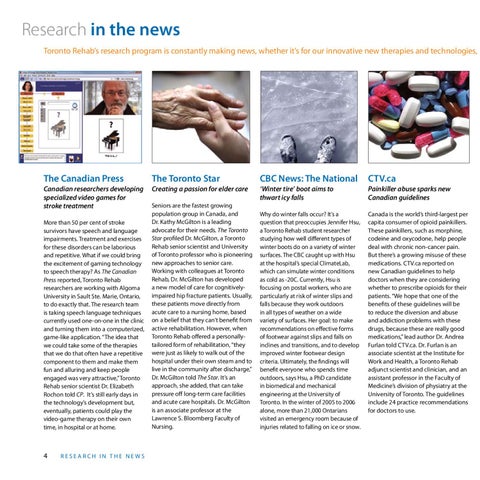
The Canadian Press
The Toronto Star
CBC News: The National
CTV.ca
Canadian researchers developing specialized video games for stroke treatment
Creating a passion for elder care
‘Winter tire’ boot aims to thwart icy falls
Painkiller abuse sparks new Canadian guidelines
Why do winter falls occur? It’s a question that preoccupies Jennifer Hsu, a Toronto Rehab student researcher studying how well different types of winter boots do on a variety of winter surfaces. The CBC caught up with Hsu at the hospital’s special ClimateLab, which can simulate winter conditions as cold as -20C. Currently, Hsu is focusing on postal workers, who are particularly at risk of winter slips and falls because they work outdoors in all types of weather on a wide variety of surfaces. Her goal: to make recommendations on effective forms of footwear against slips and falls on inclines and transitions, and to develop improved winter footwear design criteria. Ultimately, the findings will benefit everyone who spends time outdoors, says Hsu, a PhD candidate in biomedical and mechanical engineering at the University of Toronto. In the winter of 2005 to 2006 alone, more than 21,000 Ontarians visited an emergency room because of injuries related to falling on ice or snow.
Canada is the world’s third-largest per capita consumer of opioid painkillers. These painkillers, such as morphine, codeine and oxycodone, help people deal with chronic non-cancer pain. But there’s a growing misuse of these medications. CTV.ca reported on new Canadian guidelines to help doctors when they are considering whether to prescribe opioids for their patients. “We hope that one of the benefits of these guidelines will be to reduce the diversion and abuse and addiction problems with these drugs, because these are really good medications,” lead author Dr. Andrea Furlan told CTV.ca. Dr. Furlan is an associate scientist at the Institute for Work and Health, a Toronto Rehab adjunct scientist and clinician, and an assistant professor in the Faculty of Medicine’s division of physiatry at the University of Toronto. The guidelines include 24 practice recommendations for doctors to use.
More than 50 per cent of stroke survivors have speech and language impairments. Treatment and exercises for these disorders can be laborious and repetitive. What if we could bring the excitement of gaming technology to speech therapy? As The Canadian Press reported, Toronto Rehab researchers are working with Algoma University in Sault Ste. Marie, Ontario, to do exactly that. The research team is taking speech language techniques currently used one-on-one in the clinic and turning them into a computerized, game-like application. “The idea that we could take some of the therapies that we do that often have a repetitive component to them and make them fun and alluring and keep people engaged was very attractive,” Toronto Rehab senior scientist Dr. Elizabeth Rochon told CP. It’s still early days in the technology’s development but, eventually, patients could play the video-game therapy on their own time, in hospital or at home.
4
RESEARCH IN THE NEWS
Seniors are the fastest growing population group in Canada, and Dr. Kathy McGilton is a leading advocate for their needs. The Toronto Star profiled Dr. McGilton, a Toronto Rehab senior scientist and University of Toronto professor who is pioneering new approaches to senior care. Working with colleagues at Toronto Rehab, Dr. McGilton has developed a new model of care for cognitivelyimpaired hip fracture patients. Usually, these patients move directly from acute care to a nursing home, based on a belief that they can’t benefit from active rehabilitation. However, when Toronto Rehab offered a personallytailored form of rehabilitation, “they were just as likely to walk out of the hospital under their own steam and to live in the community after discharge,” Dr. McGilton told The Star. It’s an approach, she added, that can take pressure off long-term care facilities and acute care hospitals. Dr. McGilton is an associate professor at the Lawrence S. Bloomberg Faculty of Nursing.
advances in knowledge, or expertise on disability, disease and aging. Some of the latest media coverage is listed below.
Canadian Business Online
Global News
The Globe and Mail
Most comprehensive study of its kind shows impact of brain injury on women’s reproductive health
Sole support
Rehab reprieve: games add a little fun to recovery
After a brain injury, women often ask how the injury will affect their fertility, pregnancy and postpartum health. New findings, reported in Canadian Business Online, provide some much-needed answers. The insights come from a study which examined the health outcomes of 104 pre-menopausal women five to12 years after moderate to severe brain injury. It found that women with traumatic brain injury (TBI) were more likely to experience menstrual disturbances, but did not appear to have significantly more problems with getting pregnant when compared to women without brain injury. However, women with TBI had fewer children, reported lower levels of perceived health, and experienced more postpartum difficulties. “Our findings provide important information for women who have experienced a traumatic brain injury, and for health professionals working with these women,” says Dr. Angela Colantonio, a senior scientist at Toronto Rehab and lead author of the study, published in the Journal of Women’s Health. Dr. Colantonio holds the Saunderson Family Chair in Acquired Brain Injury Research at Toronto Rehab and is a professor of occupational science and occupational therapy at the University of Toronto.
It’s an all-too-common scenario: an elderly person falls, breaks a hip, has surgery and then, because of limited mobility, moves to a nursing home. And there’s an even bleaker scenario: 20 per cent of people who break a hip die within a year. As Global News reported, Toronto Rehab scientists have developed a simple footwear insole to improve balance and reduce the risk of falls and fractures. Sole Sensor™ enhances balance by heightening foot-sole sensation, explains Dr. Stephen Perry, a Toronto Rehab adjunct scientist and associate professor of kinesiology and physical education at Wilfrid Laurier University. The special insole has a raised ridge that surrounds the perimeter of the foot, stopping just short of the large toe. The ridge is designed to enhance the sole’s sensory perception—something that declines with age— by stimulating tiny sensors located in the outer edges of the sole. Published results show that Sole Sensor reduced the number of falls by half. In Canada, fall-related injuries cost the economy an estimated $2.8-billion a year. (For more on Sole Sensor, see page 50.)
Playing on a Nintendo Wii gaming system can help patients recover upper-arm function after stroke, new findings show. The Globe and Mail reported on a study comparing 10 stroke patients who used Wii gaming technology with 10 patients who did standard recreational therapy, such as playing cards or bingo. After using the Wii for just eight hours over two weeks, patients showed greater arm speed and strength, compared to those in the recreational therapy group. “Just having that variety of different tools you can use that are adapted to the level of the individual and to their own personal interest is where the field needs to go,” study co-author Dr. Mark Bayley, a Toronto Rehab scientist, told The Globe. Repetitive exercises are important for regaining upper-arm function, but they can get tedious, so making it more fun makes sense, added Dr. Bayley, head of the hospital’s Neuro Rehabilitation Program where the study was conducted. The findings were published in the journal Stroke. A larger study is now underway, headed by Dr. Gustavo Saposnik of the Stroke Outcomes Research Unit at Li Ka Shing Institute at St. Michael’s Hospital, to determine if Wii should be widely used in stroke rehab.
+ 1 0 R E P O R T O N R E H A B I L I TAT I O N R E S E A R C H
5
1 Retraining the brain
Q.
Last year, I had a bad fall from a ladder and fractured my skull. The brain injury has affected my ability to solve problems. I’m hoping to get back as much of this function as possible. I’ve read about the adult brain’s remarkable capacity to change. – Roger in Toronto*
6
RETRAINING THE BRAIN
How can we retrain the human brain?
*Some names have been changed for confidentiality.
Brenda Colella is a member of the Cognitive Neurorehabilitation Sciences Lab. Researchers are working to improve recovery for brain injury survivors, like Sue Stewart (at right in inset picture). Stewart experienced a serious brain injury in 2005.
A. Dr. Robin Green has simple advice for her Toronto Rehab patients in the months and years following treatment for traumatic brain injuries: “Use it or lose it.”
8
RETRAINING THE BRAIN
For Dr. Green, ‘using it’ involves ongoing stimulation of the brain to maximize recovery. It begins while the patient is still in hospital. Dr. Green, a Toronto Rehab scientist and neuropsychologist, is currently leading a major study with brain injury patients to investigate the effects of doubling therapy on the brain’s ‘plasticity’—its ability to change and recover in response to stimulation. But Dr. Green is also looking at the impact of intensive brain stimulation when patients go home. She’s already shown that less cognitive stimulation is associated with greater chronic
atrophy of the brain after severe brain injury. On the positive side, this work suggests that engaging in stimulating activities—such as returning to work or school, or even meditating— preserves an important part of the brain and its functioning. It all relates to neuroplasticity. Brain cells communicate through chemical messengers at ‘synapses’, the junctions between neurons. Dr. Green says that it’s possible to change the strength of these connections and even grow new synapses through stimulation, thereby preserving intact areas of the brain that would otherwise
A study being conducted at Toronto Rehab will show what happens when therapy hours are doubled for patients with traumatic brain injury.
be isolated when they are disconnected from damaged ones. “We can push cells to make new associations or reconnect with old ones,” she says. The findings of Lesley Miller, a student of Dr. Green’s who recently received her PhD at the University of Toronto, revealed that patients who got more cognitive stimulation in the five to 12 months after a brain injury maintained greater volume of the hippocampus, a part of the brain that’s critical in functions such as memory, over that same time period and longer. “Cells need input to remain viable,” Dr. Green says, adding that the level and type of stimulation
Dr. Robin Green
can be tailored to a person’s abilities, environment and available resources. A recent review of the literature on meditation and the brain by Dr. Green suggests that meditation may be particularly effective for patients recovering from brain injury because it engages the brain, improves its structure and can be selfadministered. Dr. Geoff Fernie, Toronto Rehab’s vice president, research, says that it’s important to keep the mind active, through everything from “We can push cells to playing electronic make new associations or games to simply reconnect with old ones.” being in a stimulating environment. “You – Dr. Robin Green need to exercise your brain the same way you exercise your heart,” he says, noting that this can make brain injury survivors more independent and productive, and less demanding on the healthcare system. The same may be true for people with other neurological disorders such as stroke and dementia, and also for the elderly, Dr. Green says. Older people are especially prone to negative neuroplasticity, she says, because they are often removed from their previous professional and social situations, as well as experiencing hearing and vision problems and low self-esteem. “If we can stop the behavioural withdrawal from activities,” Dr. Green says, “we can minimize the likelihood of healthy areas of the brain becoming understimulated and ultimately losing their functional capacity.” Dr. Green and colleagues recently expounded on this idea in a paper published in the journal Neuropsychological Rehabilitation. Dr. Green holds a Tier 2 Canada Research Chair in Traumatic Brain Injury/Cognitive Rehabilitation Neuroscience at the University of Toronto. An associate professor in the Department of Psychiatry, she leads the Social and Cognitive Sciences field of the Graduate Department of Rehabilitation Sciences. n
+ 1 0 R E P O R T O N R E H A B I L I TAT I O N R E S E A R C H
9
Electrostimulation sparking brain changes When Dr. Milos R. Popovic dreams of brilliant The idea is that, after many repetitions, the control systems, it’s not supercomputers or patient can perform the movement on his or NASA mission control he’s thinking of—it’s the her own—without the device. human brain. But how can this be? “The brain is the most sophisticated control “The combination of the desire to move system anywhere in existence,” says the and the sensory feedback flowing to the biomedical engineer and Toronto Rehab senior brain causes changes in the brain’s circuitry,” scientist. Dr. Popovic says. “It forces the brain to adapt Dr. Popovic marvels, in particular, at the and form new neural pathways to control phenomenon known as ‘neuroplasticity’ —the movement. Neuronal cells are forced to take brain’s remarkable ability to more responsibility.” adapt and perform new tasks, It’s possible something else is “The brain is the most even after an injury. going on too. “The brain creates sophisticated control stem cells all the time. And those And he’s developed a way system anywhere in new stem cells have to decide to make use of this ‘plasticity’ to help stroke and spinal cord whether they will become existence.” injury survivors who have lost neurons or supporting tissue in – Dr. Milos R. Popovic the brain. If there’s a lot of activity key functions, like the ability to grasp, reach or walk. someplace, they will probably go “With these injuries, the brain is damaged there to assist.” Dr. Popovic hopes to prove this and some of its control mechanisms are gone,” hypothesis with brain-imaging studies. he explains. “Motor or sensory commands It’s clear that patients are benefiting, and cannot be relayed from the brain to the significantly so, from Dr. Popovic’s novel use of muscles, or from the muscles back to the brain. functional electrical stimulation (FES). The new But the fact is that some of the neuronal cells treatment approach has already helped some can be retrained to do new tricks.” stroke and spinal cord injury survivors to reach Here’s how Dr. Popovic and Toronto Rehab’s and grasp again—in some cases, years after Neural Engineering and Therapeutics Team are injury. teaching injured brains to perform new tasks— with extraordinary results: First, the patient is asked to imagine a movement that he or she wants to do but cannot, such as grasping a glass. “This engages the brain in creating signals. But the signals Dr. Milos R. cannot go anywhere due to the injury.” Popovic At the same time, an external device is used to stimulate the person’s muscles with tiny bursts of electricity. This causes the desired movement to actually happen. “As the hand moves, the patient gets sensory feedback from the movement, plus visual feedback from seeing his or her hand move.” The whole process is repeated many times.
10
RETRAINING THE BRAIN
In a landmark study published this year in the journal Neurorehabilitation and Neural Repair, Dr. Popovic and colleagues proved the power of FES therapy. Tested in a randomized clinical trial, their approach worked considerably better than conventional occupational therapy alone to increase spinalcord injured patients’ ability to pick up and hold objects. What’s more, the nine study participants who received stimulation therapy also saw big improvements in their independence and ability to perform everyday activities such as dressing and eating. “This has real implications for people’s quality of life and independence, and for their caregivers,” says Dr. Popovic. “Even small improvements in the ability to perform daily activities can have a large impact on people’s lives.” Dr. Popovic’s team is working hard to put its approach into widespread use at hospitals, physiotherapy clinics and in people’s homes. The researchers have almost completed a prototype of a stimulator for clinicians to use (See Rehab innovations on page 50). At Toronto Rehab, Dr. Anthony Burns, medical director of the hospital’s Spinal Cord Rehabilitation Program, says he will work with Dr. Popovic “to make this intervention available to our patients, and to answer important questions such as the duration of the effect.” Dr. Popovic holds the Toronto Rehabilitation Institute Chair in Spinal Cord Injury Research. He is an associate professor in the Institute of Biomaterials and Biomedical Engineering at the University of Toronto. n
Go to www.torontorehab.com to watch lab video from our recent study in which patients with spinal cord injury received stimulation therapy.
Matthew Linton exploiting brain plasticity
Matthew and Stefanie Linton (at right) watch the Super Bowl with friends. Matthew Linton believes in the capacity of the brain to regenerate itself with intensive therapy. He’s living it. On Victoria Day weekend in 2009, while staying at a Collingwood chalet, Linton fell from a deck and hit his head on a concrete slab below. Friends found him unconscious and roused him, but he later fell into a coma. Flown by air ambulance to a Toronto hospital, doctors found massive internal bleeding and damage in his brain. They operated to relieve the pressure, but told his wife Stefanie, family and friends to say goodbye. “There was no expectation that I would
survive, or that I would ever have a functional life,” says Linton. He attributes his recovery to enrolling in a research program at Toronto Rehab that capitalizes on the ‘plasticity’ of the brain to repair and recover functions that might otherwise have been lost. Specifically, the research project is examining the value of intensifying treatment by doubling the amount of therapy. Results will show whether recovery is greater or faster, and whether the ‘intensity’ is tolerated or too tiring. When Linton arrived at Toronto Rehab two weeks after regaining consciousness, he was paralyzed on his left side and had little shortterm memory or ability to read. “I signed up for
everything I could possibly do to get better,” he says. For eight weeks, Linton’s physical, occupational and speech therapies were doubled to six hours a day. The treatment was exhausting, he says. “It was the most difficult thing I’ve ever done in my life.” But there was constant improvement, against all odds. Since leaving Toronto Rehab, Linton has maintained a “managed lifestyle” of exercise, a strict diet, lots of rest and constant stimulation, such as listening to audio books. He continues to cope with fatigue, headaches, balance problems, memory lapses and blind spots in his eyes. Yet a positive attitude, strong support from those around him and a determination to “never stop trying” have allowed him to return to a near-normal life. The 31-year-old has resumed his career parttime in venture capital and corporate finance, and recently started his own consultancy “There was no expectation in the field. He’s that I would survive, or mindful that his that I would ever have a “truly exceptional” functional life.” improvement is not shared by all of – Matthew Linton those with injuries as severe as his. “We’ve got a long way to go before we have a solid understanding of how the brain works.” His recovery to date has been “a miraculous surprise,” Linton adds. With his unflinching commitment to achieving the best possible quality of life and the support of family, the rehabilitation and research community, he hopes this progress will continue well into the future. n
+ 1 0 R E P O R T O N R E H A B I L I TAT I O N R E S E A R C H
11
Q.
2 Preventing falls on stairs
My 82-year-old mother recently came to stay. One day, she decided to take a shower. After gathering her toiletries, she started down the stairs to our basement bathroom. I was in another room when I heard an awful noise—the sound of my mother falling. I found her at the bottom of the stairs. She had broken her arm. But we both knew it could have been a whole lot worse. – Alex in Toronto
12
P R E V E N T I N G FA L L S O N S TA I R S
What can we do to prevent people from falling on stairs?
Dr. William McIlroy is producing astounding insights into how people act on stairs. The aim: to generate new knowledge that can help prevent falls, which are a very common cause of injury among older people.
A. It’s incredible to think that every year in North America more than a million people are sent to hospital because of falls on stairs.
Many of those injuries are extremely serious. In fact, falls on steps and stairs account for about 60 per cent of hip fractures, which can have disastrous, even fatal, consequences. In addition, devastating head injuries are much more likely to occur when falling on stairs, compared to falls on level surfaces. And the numbers are only getting more worrying. In the United States, deaths from falls on stairs are increasing at six per cent per year.
14
P R E V E N T I N G FA L L S O N S TA I R S
“In Canada, we suspect it’s even worse. So this is a big problem,” says Dr. Geoff Fernie, vice president, research, at Toronto Rehab. “Stairs can be very dangerous places, and yet we don’t always treat them with appropriate respect,” says Dr. William McIlroy, a senior scientist and Mobility Team leader at Toronto Rehab and professor in the Department of Kinesiology at the University of Waterloo. Dr. McIlroy’s career in balance research was initially inspired by his grandmother, who tripped on a curb and broke her hip. “She never recovered from the fracture,” he recalls, “which is all too common in older people.” Dr. McIlroy’s studies are yielding astounding insights into how people act on stairs. In a newly completed study, he put ‘eye trackers’ on people to determine where they look while climbing or descending a laboratory staircase. The findings
In a study with University of Waterloo colleagues, Dr. William McIlroy (right) found that people rarely look at the handrail even while using it.
were surprising. People tended to look only at the first step or two and the last, ignoring the ones in between. And they rarely looked at the handrail even while using it. The brain, it seems, relies on an internal map of what a staircase looks like. “This can get you into
Dr. Brian Maki
“Stairs can be very dangerous places, and yet we don’t always treat them with appropriate respect.” – Dr. William McIlroy
trouble if you are on stairs with any variation. If even one stair is slightly higher, it creates a tremendous fall risk.” Carrying things on the stairs is also risky. Amazingly, Dr. McIlroy has found that people tend to cling to an object like a coffee cup rather than grab for the handrail when losing balance. “For some reason, the central nervous system has difficulty letting go of objects. This is true even if people are holding something inconsequential like a plastic tube.” Understanding stair behaviour will allow researchers to develop personalized therapy programs that improve strength and balance, and change behaviours (discouraging holding of objects on stairs, for example). These are not currently a regular component of rehabilitation programs. Improving handrail design can also help prevent falls. Research by Dr. Brian Maki, a Toronto Rehab senior scientist, shows that older people rely more on arm movements for balance and are twice as likely to use handrails as younger adults. But they are also much less likely to look at the rail and more likely to make errors such as missing the rail, or hitting it with the back of the hand. One of Dr. Maki’s solutions is a cueing system designed to improve ability to grab the rail effectively in response to sudden loss of balance. It can also prompt people to grab the rail before losing balance. As someone approaches a custom-built handrail, a row of LED lights flashes and a voice recording is triggered, attracting the person’s attention. A study testing the system on 120 older adults has just been completed. “We’re still analyzing the data but it looks like the verbal cueing in particular is effective in getting people to use the handrail,” says Dr. Maki, a senior scientist at Sunnybrook Research Institute and director of the Centre for Studies in Aging at Sunnybrook, as well as a professor at the University of Toronto. Other studies by Dr. Maki have led to changes to building-code requirements for handrail height, shape and size, to help ensure that people are able to use the rails effectively to maintain balance. Drs. Maki and McIlroy are also eager to start
using Toronto Rehab’s new state-of-the-art stair laboratory. The new lab, opening in 2011, will launch a new generation of research. It features eight steps fixed to a sophisticated motion platform that moves on cue to cause a stumble or fall. A harness system attached to the ceiling keeps research subjects safe while sensors in the stairs and LED markers on the body collect key data. “We will know exactly how you move on the stairs, how close you come to tripping and we can watch what happens when you do fall,” Dr. Fernie explains.
In June 2011, Toronto Rehab will host a special international symposium bringing together more than 30 experts in the field. Together, says Dr. Fernie, they will develop a coordinated strategy on how best to use the new stair lab to answer crucial research questions that will help prevent falls on stairs. n Born in the Russian city of Salsk, not far from the Black Sea, Dr. Dimitry Sayenko used to work with cosmonauts. Now, he’s helping people with spinal cord injuries to stand and balance. Find out more at www.torontorehab.com
Computer vision keeping an eye on mobility When patients go home after rehabilitation, there’s something potentially dangerous waiting for them: stairs. Ongoing research by Dr. Sonya Allin, a Toronto Rehab adjunct scientist, will provide vital information to decrease the danger of a fall on stairs. Dr. Allin is developing lowcost computer vision technology to monitor people’s mobility, including their stair use, Dr. Sonya Allin in the home. “The goal is to develop a system that determines when a person is at risk, delivers information to a therapist and prompts the person to take corrective action,” says Dr. Allin, a postdoctoral fellow in the Department of Occupational Therapy at the University of Toronto. For instance, the system might indicate that someone is going down the stairs too quickly or failing to lift their feet enough to safely clear the stairs. The
person could then be advised on how to minimize risk. Dr. Allin has a personal connection to her research. Her 70-year-old father suffers from a condition called foot drop (difficulty raising the foot at the ankle) that causes him to stumble. “I do worry that he might fall on the stairs in his house,” she says. She hopes to start testing the system in 2011 in the homes of people recovering from hip replacement surgery. Meanwhile, Dr. Alex Mihailidis and PhD student Jasper Snoek are using similar technology for a different goal—saving researchers time and money. Their computer-vision technology sifts through video footage collected in public settings and automatically identifies unusual stair behaviours like slips, trips and misuse of handrails. “Right now, researchers who study falls have to manually review each video, perhaps watching hundreds of hours of tape just to find one fall,” says Dr. Mihailidis, a senior scientist at Toronto Rehab and associate professor in the Department of Occupational Science and Occupational Therapy at the University of Toronto. “These are great examples of how we can apply artificial intelligence to collect much larger volumes of data in real-life settings,” says Dr. Mihailidis, who holds the Barbara G. Stymiest Chair in Rehabilitation Technology Research at Toronto Rehab.
+ 1 0 R E P O R T O N R E H A B I L I TAT I O N R E S E A R C H
15
Q.
3 Dealing with dementia
A few months ago, I learned that my mother has dementia. She is still living at home but getting increasingly forgetful. Things go missing and turn up in odd places. The other day, the TV remote vanished. It was in the bathroom. Sometimes, my mother sits down for a meal, forgetting that she has already eaten. She is happy in her home and wants to live there for as long as possible. My siblings and I want that too, but we worry about her.
How can we help people with dementia who are living at home?
– Sylvie in Toronto
16
DEALING WITH DEMENTIA
Student Yulia Eskin is with a Toronto Rehab-University of Toronto team developing ‘intelligent’ assistive technologies to support seniors, those with disabilities and their caring family members—like these ones—in daily living.
A. As an engineering graduate in 1996, Dr. Alex Mihailidis was looking for a challenging area of research that would have a meaningful impact in his field— and on people’s lives.
He found it in a chance encounter at a conference with a fellow engineer whose wife had early-onset Alzheimer’s disease. There was little available in terms of technologies to help his wife cope in the home, the man said. For Dr. Mihailidis, who had started a master’s in biomedical engineering, the story struck a chord—and charted a lifelong career path. To assist people with dementia and their caregivers, he thought, a computer could model, monitor and then offer prompts for the various steps involved in routine tasks such as hand
18
DEALING WITH DEMENTIA
A nutritional detection system, now under development, uses computer vision to monitor what a person eats and drinks to guard against malnutrition and dehydration.
washing, dressing and meal preparation. a number that will double in the next generation. Today, Dr. Mihailidis is on the leading edge Providing greater assistance in the home can of research in the use of artificial intelligence, enhance quality of life and independence, computer visioning and voicereduce caregiver burden and lower Dementia affects 20 healthcare costs, Dr. Mihailidis says. recognition to support older people and those with disabilities per cent of people by For his master’s, he created The in daily living. The internationally which ‘prompts’ users to the time they are 80, COACH, recognized senior scientist, who carry out the different steps involved and more than 40 per in hand washing. Through his PhD leads Toronto Rehab’s Artificial Intelligence and Robotics Team, is cent by the age of 90. developing a range of ‘intelligent’ devices to allow people to live longer and more safely at home. “People want to remain in their communities and they do better in their own homes,” says Dr. Mihailidis, holder of the hospital’s Barbara G. Stymiest Chair in Rehabilitation Technology Dr. Alex Mihailidis Research and an associate professor of occupational science and occupational therapy at the University of Toronto. “We have to have concrete ways of supporting them there.” Dementia affects 20 per cent of people by the time they are 80, and more than 40 per cent by the age of 90, amounting to 500,000 Canadians today,
and beyond, he adapted and took on more complex aspects of the technology, applying artificial intelligence and advanced theoretical computer techniques. His hand washing system is today being tested at an Alzheimer’s clinic. The team is adapting it for tooth brushing and other activities. There’s also a system, under development, that monitors what—and how often—a person eats and drinks, to guard against dehydration and malnutrition. “Because an intelligent home learns and adapts to the habits of its occupants, it can interact with a person if his or her behaviour does not fit with typical patterns and, if necessary, alert caregivers,” Dr. Mihailidis explains. Different devices could stand alone or be incorporated into the very architecture of a home—a concept he calls “brick computing”. Sensors embedded in floor tiles, for example, would monitor and record someone’s blood pressure, respiration, heart rate and body temperature through the soles of the feet. Dr. Mihailidis has also developed a device that detects if someone has fallen. It ‘learns’ and tracks the actions of the user—and can interact with the person and call for help. Fifteen years ago, says Dr. Mihailidis, people in his field saw little need for such technologies. Today it’s a different picture, with collaborators around the world focused on various aspects of the ‘intelligent’ home. “You can’t go to a conference where someone isn’t presenting on this topic.” Dr. Mihailidis envisages a practical and commercially viable product that incorporates prompts for a range of tasks and can be tailored to individuals. Now 36, he’s optimistic such technology is “totally doable” in his lifetime, adding that he sees a day when he himself will benefit from his research. “I’ve got to make sure I get the technology perfect.” n
Semantic dementia is a rare kind of dementia that tends to strike people in their 50s and 60s who are otherwise quite functional. Dr. Elizabeth Rochon is working on a language therapy that is showing promising results. Read the article at www.torontorehab.com
Powered mobility helping people to get around It’s a cruel paradox. Many nursing home residents with dementia need powered wheelchairs and scooters to get around—but aren’t allowed to use them because of the risks to themselves and fellow residents. “If they bump into another Dr. Rosalie Wang resident, the result could be serious injury or even fatal,” explains Dr. Rosalie Wang, a member of Toronto Rehab’s Technology Team and postdoctoral fellow with the Intelligent Assistive Technology and Systems Lab at the University of Toronto (U of T). But a high proportion of people in long-term care can’t walk or use a manual wheelchair because of a physical disability, Dr. Wang points out. “So our challenge is to develop technology that will allow nursing home residents with dementia to use powered wheelchairs safely.” It’s estimated that at least half of residents in longterm care are cognitively impaired. Developing a powered wheelchair that’s safe for this population is harder than it might seem. For starters, the system must be absolutely reliable; even a single collision is unacceptable. The Toronto Rehab-U of T team initially experimented with collision-avoidance systems based on infrared and ultrasound sensors, but rejected them as too unreliable. Ultimately, the researchers came up with a completely different design. “The prototype looked a bit like a bumper car, with a wide bumper or ‘skirt’ at the bottom containing an array of micro-sensors,” says Dr. Geoff Fernie, vice president, research, at Toronto Rehab. “If the chair hit something, the ‘skirt’ would collapse without applying any force to the obstacle and the chair would stop. It was ugly but effective.”
To see how the prototype worked in a long-term care environment, Dr. Wang recruited six residents with different degrees of cognitive impairment and asked them to “test drive” the prototype, with some residents testing it for up to several months. The results were unexpected. “We thought users would warm to this device,” says Dr. Fernie. “In fact, they were embarrassed to be seen trundling around slowly in something that looked like a tank.” Adds Dr. Wang: “Users felt a certain social stigma because of the chair’s speed and appearance. They felt ‘different’ because their wheelchairs were obviously different—slow and cumbersome—and this perception was reinforced by well-meaning remarks by staff and residents.” There were even surprising reactions to the idea itself. Some residents said they actually enjoyed having other people push them in manual wheelchairs because it gave them more opportunity to socialize. Of course, the power wheelchair—once perfected—should offer residents new opportunities to link up with others and socialize. Lessons learned from on-site research are now being incorporated into the next prototype, which is being developed by Tuck-Voon How, a former U of T graduate student and now research developer at the Intelligent Assistive Technology and Systems Lab. The wheelchair uses computer vision and has improved sensor capabilities and faster processing speeds to avoid obstacles. Meanwhile, Dr. Wang is field-testing an upgraded interface that helps users navigate by giving audio and visual prompts, as well as touchbased feedback from the joystick, which will not move in any direction where the system ‘senses’ an obstacle. Users are responding positively. “These trials remind us that technology is only part of the solution,” says Dr. Wang. “To help people with cognitive impairments become more mobile by using power wheelchairs, we have to pay close attention to what they tell us, as well as to social and organizational issues.” Dr. Wang’s new research in this area is partially supported by CanWheel, a cross-Canada research collaboration formed to enhance the mobility of older wheelchair users.
+ 1 0 R E P O R T O N R E H A B I L I TAT I O N R E S E A R C H
19
Q.
4 Fighting disease with exercise
I was diagnosed with Type 2 diabetes several years ago. I take medication to control my diabetes and I keep a close eye on my blood glucose levels. I also try to follow a healthy diet and have taken off some weight. But I do not get much physical activity. I’m considering joining an exercise program for seniors. – Maria in Windsor
20
FIGHTING DISEASE WITH EXERCISE
Does exercise really pay off for people with diabetes?
Dr. Pearl Yang is tracking the progress of people with diabetes as they complete Toronto Rehab’s Diabetes, Exercise and Healthy Lifestyle program. Suzanne Parsons (at left in inset picture, sharing a laugh with family) participated in the program.
A. With a disease like diabetes, it’s all too tempting to just take medication and hope for better health. But there’s another approach with a big payoff— and Toronto Rehab research shows how and why it works.
22
“Exercise works as well as medication in reducing blood sugar levels and it has only positive side effects. You lose weight, you gain muscle strength and you feel better,” says Dr. Paul Oh, a scientist and medical director of Toronto Rehab’s Cardiac Rehabilitation and Secondary Prevention Program. The new research quantifies those benefits. Researchers tracked the progress of 62 people with Type 2 diabetes, the most common kind, as they completed Toronto Rehab’s Diabetes, Exercise and Healthy Lifestyle program. Participants work out in a weekly class, and four times a week at home using a personalized program of walking and resistance training. It’s one of the largest
FIGHTING DISEASE WITH EXERCISE
research-based exercise and education programs for people with diabetes in Canada. And the results are remarkable. After completing the program, participants showed significant improvement on several key measures: • • • • •
blood sugar levels dropped 9.5 per cent on average aerobic capacity improved 17 per cent on average average weight loss was 3.4 pounds body fat dropped from an average 32 to 31per cent questionnaires showed lower depression scores and higher quality-of-life scores.
The lowered blood sugar levels can mean people
Explaining how a glucometer works: blood sugar levels were one of the key areas that showed significant improvement in a study of people with diabetes.
need less medication or, in the case of prediabetics, none at all. “It’s easier to give a pill but lifestyle changes can work just as well,” says Dr. Oh. “People just need the right support to stay with it and make it successful.” The improvements in aerobic capacity, weight and body fat can be ultimately lifesaving because they lower the risk of heart disease. Diabetes is one of the greatest risk factors for coronary heart disease. “But regular exercise can cut your risk in half,” Dr. Oh explains. Another key finding: people who started the program with higher depression scores typically
Dr. Paul Oh
did less exercise. “Knowing this, we can start to tailor the program to meet their needs and help them stick with it,” says Dr. Pearl Yang, the Toronto Rehab researcher who led the study. The program is continually being fine-tuned to improve outcomes with each new research result. Scientists want to know how much exercise is required, at what intensity and duration. Dr. Yang’s research has found that resistance “Exercise preserves all training can control blood the systems of the body, sugar levels whether at high or low intensity. from muscles and bones “What’s most important is to heart and brain.” to find the protocol that’s right for each person,” she – Dr. Paul Oh says. “Adherence is key.” Dr. Oh, meanwhile, is reaching out to family doctors to spread the message about diabetes and exercise. Working with the Canadian Diabetes Association, he’s developing a tool kit of posters, prescription pads and information sheets for national distribution. In his eight years at Toronto Rehab, Dr. Oh has seen thousands of cardiac and stroke patients benefit from structured exercise programs. The evidence is irrefutable, he says. Exercise works. Now he’s developed a similar program for women with breast cancer, supported by a oneyear grant from Pfizer Canada. The program has been modified to meet the specific needs of this group ensuring, for example, that they can exercise safely during chemotherapy or radiation treatments. “The research has just begun but anecdotally it works and people love it.” In fact, says Dr. Oh, exercise is good for virtually every disease and disability, as well as healthy aging. “Past the age of 40 we’re all unfortunately on a downward path. Exercise preserves all the systems of the body from muscles and bones to heart and brain. There is good evidence that it helps with almost everything.” n
+ 1 0 R E P O R T O N R E H A B I L I TAT I O N R E S E A R C H
23
Changing unhealthy behaviours The behaviours of today are tomorrow’s diseases, says Toronto Rehab senior scientist and cardiologist Dr. David Alter. The most obvious warning sign: “the rising tide of obesity.” Almost 24 per cent of Canadians are now obese, up from 11.1 per cent in 1976. Obesity causes numerous health conditions and is a leading cause of preventable death. “The root causes of obesity are not all that complicated,” says Dr. Alter, pointing to sedentary behaviour and unhealthy diets. But the solutions are more complicated. Our healthcare system, for instance, is primarily set up to deal with disease. “We tend to go to hospitals for things like angioplasty, bypasses and stents. When we visit the doctor, we tend to go because of complaints and symptoms—not for a two-hour lifestyle coaching lesson.” As research director of Toronto Rehab’s Cardiac Rehabilitation and Secondary Prevention Program, Dr. Alter says there’s a huge opportunity to save lives and reduce the burden on our healthcare system—if we act now. “What’s at stake is our health, our productivity in the workplace and our healthcare system. There is a sustainability crisis. Our population is becoming more sedentary, and getting more obese. The burden of disease is growing, and it’s getting more costly to our system.” The costs of obesity alone are staggering. Dr. Alter co-authored a study last year with Queen’s University researcher Diana Withrow
that showed obese people have medical costs used by 70 to 80 per cent of U.S. employers. It that are about 30 per cent greater than their identifies a person’s individual risk and provides normal weight peers. educational materials and telephone coaching Governments can change behaviours in healthy behaviours such as diet, exercise, through policies, such as banning public stress management and smoking cessation. smoking and taxing cigarettes. Another way is In the healthcare setting, hospitals need to through workplace programs better understand a person’s “When we visit the doctor, readiness to change behaviour that target people who are still healthy and productive. we tend to go because of and to stick with lifestyle Unfortunately, Canadian programs, says Dr. Alter. He is complaints and symptoms devising patient surveys and employers lag behind their —not for a two-hour U.S. counterparts in this other tools to help hospitals area, according to Dr. Alter’s lifestyle coaching lesson.” do this. research. Another way hospitals “In Canada, we have yet – Dr. David Alter can change behaviour and to really develop workplace increase adherence is through programs that target lifestyle and behaviours; outreach programs, Dr. Alter stresses. “On-site whereas, in the U.S., as a solution to rising costs, services are not the be-all and end-all, mostly employers have implemented many more selfbecause they rely on patients to proactively care programs, laced with incentives for their come in to seek care.” employees to become more active and healthy.” Toronto Rehab, for instance, is sharing its Dr. Alter cites a phone-based, lifestyle successful cardiac rehab home program with modification program, which he says is now distant providers to further extend the reach. Last year, the hospital guided a Cambridge, Ontario ambulatory specialty clinic through the steps of setting up a cardiac home program. “We are still learning what makes people change their habits, but tailoring programs to the individual certainly maximizes the possibility for change,” adds Dr. Alter, who is also a senior scientist at the Institute for Clinical Evaluative Sciences (ICES) and an associate professor at the University of Toronto. n
Dr. David Alter
24
FIGHTING DISEASE WITH EXERCISE
Wendy Angelo an “amazing journey”
Wendy Angelo with husband, Van, at their son’s wedding. Just a year ago, Wendy Angelo had trouble walking even just a few blocks. At 63, she was overweight and endured painful osteoarthritis in her knees. Then came a diagnosis of prediabetes. “I sat in the doctor’s office and thought, oh no, not another chronic disease!” People with pre-diabetes have blood glucose levels that are higher than normal but not high enough to be diagnosed as diabetes. They often go on to develop Type 2 diabetes. Angelo knew how serious the diagnosis could be. An aunt had died in her 60s from complications of diabetes. “I figured I had to do something,” Angelo says. That “something” was Toronto Rehab’s
research-based Diabetes, Exercise and Healthy Lifestyle program. Over six months, it transformed the retired schoolteacher into an avid exerciser who now walks 20 kilometres a week with ease. Angelo had always avoided exercise because of her knee pain. Toronto Rehab staff carefully drafted her ‘exercise prescription,’ a personalized program that began with slow walking. Walking once a week in class and four times a week on her own, she increased first her distance and then her speed. As her leg muscles strengthened and she lost weight, the knee pain subsided. Next came the resistance training. For the
first time in her life, she started regularly lifting weights. Exercise leaders adapted the exercises as needed to protect Angelo’s knees, getting down on the floor beside her to show proper technique. “The personal interaction was key. Going to class every Monday, I felt so revitalized,” Angelo enthuses. She and her classmates had the benefit of a program informed by rigorous research. They also had the support of a whole healthcare team that included a dietitian, psychologist and doctor who gave education sessions on everything from diet to stress management and glucometers. Partway through the program, Angelo’s sister suffered a heart attack, a painful motivator to keep exercising. Another, sweeter motivation was her son’s impending wedding. “She really wanted to look great for that wedding,” says Angelo’s case manager, cardiac rehab supervisor Diane Nixon. “And she did!” Angelo dropped 20 pounds on the program and the compliments “I kept to the rules flowed on wedding day. Her energy levels and and I saw the results.” sleep have improved – Wendy Angelo and, most important, her blood glucose levels have dropped enough that she does not require medication. “I kept to the rules and I saw the results,” she says proudly. “It’s very empowering.” On the last day of class, Angelo handed Diane Nixon a thank you card. “It was an amazing journey,” she wrote, “and a wonderful opportunity to take a part in my own care.” n
+ 1 0 R E P O R T O N R E H A B I L I TAT I O N R E S E A R C H
25
Q.
5 The scourge of sleep apnea
My husband snores loudly and shifts a lot in bed at night. He says he often feels sleepy during the day. I’m wondering if he might have sleep apnea. I’m trying to get him to go to his doctor. – Abiba in Toronto
26
THE SCOURGE OF SLEEP APNEA
How important is it to test for sleep apnea and to treat it?
Dr. Clodagh Ryan of Toronto Rehab’s Sleep Research Laboratory, where scientists are researching the relationship between sleep apnea and cardiovascular diseases. The consequences of sleep apnea can be serious. With couples, the partner is often affected too when sleep is disrupted.
A. Imagine waking up hundreds of times during the night—and not even knowing it.
“In severe cases, people with obstructive sleep apnea could be waking up 500 or 600 times a night—and they don’t remember,” says Dr. Douglas Bradley, a senior investigator and director of the Sleep Research Laboratory at Toronto Rehab. Even in more routine cases, people with sleep apnea wake about 120 to 180 times during a
28
THE SCOURGE OF SLEEP APNEA
seven-hour night. The disorder causes a person to stop breathing repeatedly during sleep because of recurrent collapse of the throat. Common symptoms are loud snoring, restless sleep and daytime sleepiness. About five to 10 per cent of otherwise healthy people are believed to have obstructive sleep apnea—but very few are diagnosed. “A lot of people don’t make the connection between being very sleepy in the daytime and having obstructive sleep apnea,” says Dr. Bradley. It’s vital that the connection be made because the consequences of obstructive sleep apnea can be serious. Studies by Dr. Bradley and others show
that people with the disorder are at increased risk of high blood pressure, strokes, heart attacks and heart failure. Those with daytime sleepiness have a car crash rate that is three to four times greater than those who do not have sleep apnea. Their risk of industrial accidents is also higher. And there’s something else. Dr. Bradley’s research also suggests that obstructive sleep apnea plays a role in inhibiting recovery from stroke. There are more than 50,000 strokes in Canada every year. Dr. Bradley has shown that stroke patients who have sleep apnea spend much longer in rehabilitation and do not recover as well physically compared to stroke patients
Researchers are studying whether use of a continuous positive airway pressure (CPAP) mask, placed over a person’s nose during sleep, can improve recovery in people with strokes.
About five to 10 per cent of otherwise healthy people are believed to have obstructive sleep apnea— but very few are diagnosed.
without the sleep disorder. Obstructive sleep apnea is common among stroke patients; as many as 70 per cent have the disorder. Dr. Bradley has been investigating whether treating sleep apnea in disabled people with stroke and heart disease can improve their recovery from these conditions. “If we treat their sleep apnea, we may improve these people’s functional capacity and shorten their hospitalization,” he explains. His team recently completed a randomized trial involving stroke patients with obstructive sleep apnea. Half of the patients received continuous positive airway pressure (CPAP), a small mask
placed over the patient’s nose during sleep that alleviates obstructive sleep apnea, while the other half did not receive CPAP. The study, expected to be published in 2011, will compare patient outcomes. The lead author is Dr. Clodagh Ryan, a Toronto Rehab adjunct scientist who conducted the study with Dr. Bradley and colleagues. The latest research coming out of Toronto Rehab is also shedding new light on who is most at risk for sleep apnea in the general, otherwise healthy population. Here, too, there are revelations. Being overweight or obese is already known to be the major risk factor. But many people with sleep apnea are not obese or overweight. Thanks to Dr. Bradley’s work, we now know that sedentary living is another major risk factor. “The longer you sit, the more fluid you accumulate in your legs, just by gravity,” explains Dr. Bradley. “And when you go to bed at night, you lift your legs up which causes the fluid to shift. One of the places the fluid goes is into your neck, where it causes the throat to narrow.” It’s worrying news for people who spend long hours in front of a computer. But Dr. Bradley’s research also opens the door to potentially new ways to treat sleep apnea. Some people could deal with fluid build-up through exercise, diuretics (medications to reduce fluid levels) or compression stockings that prevent fluid build-up in the legs. Already, these novel approaches are being actively followed up by Dr. Bradley and his associates. Dr. Stefania Redolfi at Pitié-Salpêtrière Hospital in Paris, France, who worked at Toronto Rehab as a research fellow with Dr. Bradley, has just published a fascinating study investigating the effect of wearing compression stockings on obstructive sleep apnea. Although the study is small, it showed, in six non-obese men with obstructive sleep apnea, that wearing compression stockings for just one day caused a marked decrease in the amount of fluid moving from their legs to their necks at night, along with
a 40 per cent decrease in the severity of their obstructive sleep apnea. This finding, says Dr. Bradley, proves that fluid retention in the legs during the day, and its movement into the neck overnight, is a treatable cause of obstructive sleep apnea. “Further studies will be needed to determine whether such effects become greater with longer use of compression stockings, and whether such stockings will be useful in the general obstructive sleep apnea population including those who are obese.” Meanwhile, Dr. Bradley and his colleague, Dr. Sandy Logan, are probing the effects of diuretics on obstructive sleep apnea. Their current focus: patients with drug-resistant hypertension. It’s already known that these individuals have greater fluid movement out of their legs at night and much more severe obstructive sleep apnea than people whose blood pressure is more easily controlled. A trial, now underway, will determine whether diuretics can reduce the severity of their obstructive sleep apnea. All the evidence emerging from Dr. Bradley’s lab underlines how important it is to detect obstructive sleep apnea in the first place. But Dr. Bradley points out that only about 15 per cent of people with the condition are diagnosed. One reason is the limited number of sleep labs where people can be tested, particularly outside of Ontario. “People are often on waiting lists for more than a year, sometimes even two years, just to get a sleep study—never mind getting treated. A lot of people simply give up,” says Dr. Bradley. It’s one of the reasons he is working with Drs. Hisham Alshaer and Geoff Fernie to develop a portable device that can be used to detect sleep apnea at home (see article on page 49). Dr. Bradley also holds appointments at the University of Toronto, Toronto General Hospital/ University Health Network and Mount Sinai Hospital. n
+ 1 0 R E P O R T O N R E H A B I L I TAT I O N R E S E A R C H
29
Treating sleep apnea in people with heart failure A multi-year international study is underway to determine whether heart failure patients who have obstructive or central sleep apnea do better when their sleep apnea is treated. The treatment involves adaptive servoventilation (ASV), a ‘smart’ version of continuous positive airway pressure (CPAP) that applies air pressure through a mask worn over the nose at night. The air pressure prevents the throat from collapsing in “This is a potentially the case of obstructive historic trial in which apnea, and assists breathing in the case of we will truly find out central sleep apnea. whether treating sleep Spanning 45 sites apnea in heart failure in eight countries, study—led by patients saves lives.” the Toronto Rehab senior – Dr. Douglas Bradley scientist Dr. Douglas Bradley—will involve up to 1,000 patients. Funding is from the Canadian Institutes of Health Research and industry-partner Philips Respironics Inc., which manufactures the ASV device. “We’re reading all the sleep studies in our core laboratory at Toronto Rehab,” says Dr. Bradley. “This is a potentially historic trial in which we will truly find out whether treating sleep apnea in heart failure patients saves lives.”
Heart failure (known as congestive heart failure) is the third most common cause of death in Canada. It is a condition in which the heart cannot pump enough blood throughout the body. People with heart failure are often tired and short of breath. About 50 per cent of heart failure patients have either obstructive or central sleep apnea. The study will also determine whether treating sleep apnea reduces hospitalization rates, which are high in this group of patients. The need for hospital care is usually related to the development of edema (fluid retention) in the lungs, that leads to shortness of breath, and
the legs, that leads to swelling of the ankles. In people with sleep apnea, the recurrent episodes of apnea and oxygen deprivation expose their hearts to stresses that do not allow their hearts to rest at night and benefit from the restorative effects of sleep, says Dr. Bradley. The ASV device treats the disorder by delivering positive airway pressure to patients when they stop breathing. This prevents obstructive apneas by forcing the throat to stay open, and central apneas by assisting breathing when the device detects that patients stop breathing. “The device has sensors in it that detect when you are breathing and when you are not. If you stop breathing, it kicks in to help you breathe. But it turns off if you are breathing on your own. It’s like a cardiac pacemaker, but made for the lungs.” There’s another special feature. Some people with heart failure flip back and forth between obstructive and central sleep apnea. The ASV device “can tell when you do this and provide the necessary level of support.” In addition to Canada, countries participating in the randomized trial include: Brazil, Germany, Ireland, Italy, Spain, the United Kindom, and the United States. The first patients were enrolled in the fall of 2010. n
Dr. Douglas Bradley
30
THE SCOURGE OF SLEEP APNEA
Mary Grzywna breathing easier, getting on with life
Mary Grzywna (second from right) takes a break from a bridge game with friends. Mary Grzywna will never forget the day in June 2000 when everything went wrong. First, she burned the food she was preparing for a party the next day. Later, at a restaurant, she couldn’t understand the menu—or find her car when she came out. “I couldn’t figure out what was going on with me,” she says. It turned out that Grzywna had experienced a stroke. “I was really upset because I didn’t believe I’d had a stroke,” says Grzywna, who was taken to hospital by ambulance and ultimately transferred to Toronto Rehab’s Neuro Rehabilitation Program for stroke rehabilitation. Although the stroke had no physical effects, Grzywna was alarmed to discover perceptual
problems. “When the occupational therapist asked me to say the alphabet, I could only get to G or H,” she recalls. “When she showed me a picture of asparagus, I knew what it was, but I couldn’t produce the word.” Along with speech therapy, Grzywna was given something else—a sleep test. The results revealed that she had sleep apnea, a disorder that causes repetitive pauses in breathing, leading to oxygen deprivation of the brain, and sleep disruption. “I knew that I had trouble sleeping. I would wake up several times during a night to catch my breath,” she says. Grzywna agreed to take part in a research
study testing the benefits of treating sleep apnea in stroke rehabilitation patients with a device known as continuous positive airway pressure (CPAP). CPAP consists of a small mask placed over the patient’s nose during sleep to eliminate sleep apnea and restore normal oxygen delivery to the injured brain. During her stay at Toronto Rehab, Grzywna’s words and numbers returned. When friends came to visit, she was relieved to discover that she could play bridge with them. “I was lucky,” she says. Some of this improvement was probably due to elimination of her sleep apnea and improved oxygen delivery to the brain by CPAP. After one month, Grzywna went home— with her trusty CPAP device. It was always by her bed and with her when she travelled. “I knew that I had trouble “I used it faithfully sleeping. I would wake for over five years,” up several times during a says the retired nurse coordinator. night to catch my breath.” “Then, when it died, I found that I could – Mary Grzywna sleep normally. I had lost weight and I think that helped too.” Since weight loss can alleviate sleep apnea, it’s likely that some of Grzywna’s ongoing improvement was due to alleviation of sleep apnea by weight loss. Today, at 75, Grzywna leads a full life. Bridge is still a big part of it. She’s also a voracious reader who can’t believe she ever had trouble with the alphabet. n
+ 1 0 R E P O R T O N R E H A B I L I TAT I O N R E S E A R C H
31
Q.
6 Helping people hear better
My hearing has started to go downhill now that I’m in my 80s. I finally got hearing aids two years ago. But I almost never wear them. I find them difficult to put in. They don’t really seem to help all that much and I’m tired of going back to the audiologist to have them adjusted. – Anne in Toronto
32
HELPING PEOPLE HEAR BETTER
What can we do to help people hear better?
Dr. Gurjit Singh of Toronto Rehab’s Communication Team is determined to remove barriers to hearing-aid use. This 81-year-old piano teacher (in inset picture) is among those who get hearing aids but seldom wear them because of frustrations with the devices.
A. Hearing aids are sometimes disparaged for being awkward or unsightly but they have come a long way since the days of King Goa VI.
During his reign in the early 1800s, the Portuguese ruler used his throne as a hearing aid. The arms of the chair were shaped like lions’ heads. Subjects spoke into the lion’s mouth and their words were carried through a tube that ran into the King’s ear. By the first quarter of the 1900s, a typical carbonbased hearing aid was the size of a car battery, says researcher Dr. Gurjit Singh, a member of Toronto Rehab’s Communication Team. “Compare that to today, when we have hearing devices that are small enough to be entirely positioned in the ear canal.” So why do hearing aid adoption rates remain so
34
HELPING PEOPLE HEAR BETTER
Understanding manual dexterity and hearing-aid use is one of the issues being investigated by University of Toronto-Toronto Rehab researchers.
low? Roughly one in 10 people who could benefit Data from the U.S. suggest that dexterity is from hearing aids actually gets them, says Dr. Singh. indeed an issue for some hearing aid users. That’s What’s more, 20 per cent of those who do get not surprising, considering that hearing loss and hearing aids stop using them. It’s a sad fact, given arthritis are both among the most common chronic the importance of hearing in our daily lives—and conditions facing older people in North America. Dr. Singh is determined to do something about it. So how can we make it easier for people to use The mysteries surrounding hearing loss hearing aids, which can be tricky to insert in the have always fascinated Dr. Singh, who was an ear when you can’t really see what you’re doing? audiologist at a hearing clinic before he began Dr. Singh set out to understand what types of work on his PhD. “I had all kinds of questions I controls are better suited to aging hands. He wanted to answer, such as why is tested a variety of buttons, switches, there such variability with success 20 per cent of those toggles and remote controls. when people use hearing aids?” A key finding of his study: “Even if a who do get hearing Today, his research is all about button was smaller, as long as the user aids stop using them. has some kind of ‘haptic’ feedback, removing barriers to hearing aid success. As a PhD student, or sensation, he or she had more Dr. Singh looked at what he believes is one of confidence that they were controlling the device.” the barriers to hearing aid use: manual dexterity Based on his findings, he developed problems faced by older people. recommendations for which types of controls “The combined effects of diminished hand should be used in the future. function and hearing aid miniaturization translate Last summer, the Toronto Rehab researcher and into a potential crisis in handling difficulties,” he University of Toronto postdoctoral fellow received wrote in a recent paper. a special federal grant that, he hopes, will remove
another barrier to hearing-aid use by bringing the hearing clinic closer to the patient via the Internet. Currently, getting a hearing aid involves three to four visits to a clinic. “Hearing aids have to be tailored to the individual. On return visits to the clinic, the audiologist fine-tunes the hearing aid,” explains Dr. Singh. But for some people, especially those who have mobility issues or live in remote areas, or even those who simply have heavy demands on their time, return visits can be a real challenge. This may be one of the reasons people discontinue use of their hearing aids—a situation that is “not ideal, given all that we know about the importance of keeping socially active and having networks of support which are important for successful aging,” says Dr. Singh. Unsolved hearing problems also make it harder to prevent and treat many other health problems because most care involves communication. Dr. Singh is using funding from Elevate, a new program to keep top PhD holders in Ontario, to study what he describes as a “potentially revolutionary” way of delivering hearing-aid services over the Internet. The new technology —developed by his industrial partner Unitron Hearing/Sonova Holding AG—is a breakthrough because it lets audiologists remotely program people’s hearing aids. In his study, Dr. Singh is looking at several issues, including clinical outcomes and the effect of the new remote technology on patient-
Dr. Kathy Pichora-Fuller
clinician interactions. “This new technology could potentially revolutionize the way professionals work with their patients, enabling audiologists to connect with people in the actual environments in which they work or live. It shouldn’t replace all faceto-face interactions, but there’s the potential to greatly improve access for patients and to address untreated hearing loss.” With this and other recent advances, Ontario has the potential to become a world leader in the delivery of hearing-related services using
telecommunication technologies, says Dr. Singh. The grant supporting his communication technology research is managed by MITACS, a national research network that connects Canadian businesses with the next generation of skilled workers. Dr. Singh’s academic supervisor is Dr. Kathy Pichora-Fuller, a Toronto Rehab adjunct scientist. Dr. Pichora-Fuller collaborated on Dr. Singh’s manual dexterity research, along with Drs. Heather Carnahan, Donald Hayes and Herbert von Schroeder. n
Hearing loss why people aren’t listening Kathy Pichora-Fuller has had a life-long fascination with language. It began at the age of 12 when she invented a secret language with friends, inspired by the aliens in Star Trek “who had all kinds of interesting languages.” At university, she studied literature, languages and linguistics. She did a master’s degree in audiology and speech sciences, before earning a doctorate in psychology. “Communication is our connection to people,” says Dr. Pichora-Fuller, a Toronto Rehab adjunct scientist and University of Toronto (U of T) psychology professor. “It defines our identity and creates our relationships with other people.” Today, her research is about helping people with hearing loss communicate with others. Untreated hearing problems can lead to social isolation, depression, poorer quality of life, even reduced longevity, she says. And hearing loss is on the rise. “The population is aging and there is a marked increase in hearing loss with age,” says Dr. Pichora-Fuller. Typically, hearing loss starts in our 40s, yet studies show it takes people between 10 and 20 years from the time they first notice hearing problems to the time they enter the door of a hearing clinic. Dr. Pichora-Fuller is trying to understand the reasons for this “limbo time” during which people’s lives, and their ability to communicate, begin to be affected. “People start to have a tough time at work meetings, dinner parties, church or club meetings.” As an audiologist, Dr. Pichora-Fuller doesn’t blame
hearing-aid technology. She points to innovations such as wireless communication that allows better coordination between a person’s two hearing aids, and noise-reduction features that help people to hear in crowded, noisy situations. “Hearing technology has come a very long way, yet people still aren’t lining up to get a hearing aid,” says Dr. Pichora-Fuller. In fact, hearing-aid adoption rates have remained about the same for the past 40 years, she says. Dr. Pichora-Fuller wants to know what’s holding people back from getting the help they need. “Is it stigma about hearing loss, or stigma about aging, or is it both?” To find out, she is conducting a study involving people aged 55 and older. Among the various groups being studied are people who have just received a recommendation to get their first hearing aid. Others in the study include those who would benefit from a hearing aid—but who have not yet been to a hearing clinic. “Are the people who are not running to get hearing aids feeling more fear of aging?” asks Dr. PichoraFuller, who is collaborating on the study with U of T psychology professor Dr. Alison Chasteen and the Canadian Hearing Society. The next step will be to develop interventions that encourage people to take action to deal with their hearing loss. “We want to find ways to improve their readiness to try,” explains Dr. Pichora-Fuller. “Hearing is important, but it’s communication that’s really important to our lives.”
+ 1 0 R E P O R T O N R E H A B I L I TAT I O N R E S E A R C H
35
Q.
7 Senior drivers staying safe on the roads I am 84 years old and depend on my car to get around. I have had joint replacements and using public transit is not an option for me. I feel confident behind the wheel, but I no longer like to drive at night. – Lee in Ottawa
36
What can we do to help older people drive safely for as long as possible?
S E N I O R D R I V E R S : S TAY I N G S A F E O N T H E R O A D S
Novlette Fraser is working on a study that will lead to a screening tool which family doctors can use to identify older drivers who are safe and unsafe to drive. Margaret Granger (in inset picture) uses her car daily and is participating in the study.
A. It’s one of the toughest calls a physician can make—deciding when it’s time for an elderly patient to hang up the car keys.
Driving means independence for many adults, so taking the privilege away is a serious blow to a person’s autonomy. Yet, at the moment, there’s no clear-cut way for physicians to decide when someone is no longer safe to drive. With a huge increase in the elderly population just around the
38
corner as baby boomers reach retirement age, it’s a problem that urgently needs a solution. “As drivers move into older age—past 70 or 75 let’s say—they tend to have a higher risk of crash per kilometre driven,” says geriatrician Dr. Gary Naglie, a Toronto Rehab senior scientist and chief of medicine at Baycrest. “However, it’s important to treat this statistic with great caution. It’s true that some older people have chronic medical conditions, or are taking medications, which made them less safe. However, most older people are safe, experienced drivers.” The frustration for doctors is the lack of a reliable, easy-to-use tool to help them identify who is safe behind the wheel and who is not, says Dr. Naglie. To help develop such a tool, Dr. Naglie and Dr. Mark Rapoport of Sunnybrook Health Sciences
S E N I O R D R I V E R S : S TAY I N G S A F E O N T H E R O A D S
Centre are leading the Toronto portion of a research study tracking over 1,000 elderly drivers at centres in Canada, Australia and New Zealand. Now in its second year, the study is already accumulating valuable information from interviews with participants, as well as a range of data from GPS-like devices installed in their cars. Dr. Naglie says the Candrive (Canadian Driving Research Initiative for Vehicular Safety in the Elderly) study takes a unique approach. “Previous studies have been based on driving information supplied by drivers,” he explains. “This can be unreliable. Our data collection methods give us exact distances driven by participants, as well as what kind of roads they travelled on and the speed limits on those roads.” The sophisticated tracking technology can also register data
Sophisticated tracking technology is being used to collect data in this study of older drivers. Dr. Gary Naglie (left) is one of the study investigators.
Dr. Andrea Furlan
The frustration for doctors is the lack of a reliable, easy-touse tool to help them identify who is safe behind the wheel and who is not. – Dr. Gary Naglie
Driving distractions
about weather conditions and driving behaviours. For example, it will be possible to tell if participants are braking forcefully or more gradually. When the five-year study is completed, researchers will use the data to design a simple, reliable tool that physicians can use to identify unsafe drivers—and those who are fit to drive. There’s another category of driver to think about too: older people who drive just fine under the right conditions. “Some drivers are perfectly safe on quiet neighbourhood streets but may not do so well on a busy, unfamiliar highway at night,” says Dr. Geoff Fernie, vice president, research, at Toronto Rehab. “One solution would be to institute a graduated delicensing program. Instead of saying ‘you can’t drive anymore,’ maybe we should say, ‘you need to be tested to see if you can drive safely on local streets in daylight.’” A program of this sort is already in effect in Quebec, where some seniors hold restricted licenses, allowing them to drive only during daylight hours or near home. But for the approach to be most effective, regulators need a realistic, affordable method of testing that can be implemented anywhere. To help design such a method, Toronto Rehab is seeking funding for a driving simulator module for its new research facilities, the most advanced rehabilitation research environment in the world. The facilities include an underground lab where people can be studied safely in life-like situations. “With these new facilities, we can provide an extremely sophisticated driving simulator at a relatively modest cost because of the way the facility is designed,” says Dr. Fernie. “We’ve got simulation and driving experts on our team, and we’ve got real patients with well-characterized conditions, such as strokes, mild dementia and arthritis. As a result, we’re in a perfect position to study this and other driving-safety issues.” n
Proposed driving simulator (cutaway view) GPS systems. Hands-free phones. Audio devices. How do these electronic systems in our cars affect our ability to drive? “We’ve known for a long time that distractions lead to unsafe driving. Now we need to understand the effect that different hands-free electronic systems have on drivers,” says Dr. Geoff Fernie, Toronto Rehab’s vice president, research. Toronto Rehab scientists believe that a driving simulator can help answer these questions. “We want to develop evidence-based performance standards so that automakers can design systems that truly benefit drivers,” says Dr. Fernie. A driving simulator can also be used for research into the effects of opioids on drivers’ risk-taking behaviour. Opioids are a type of medication often prescribed for chronic pain. Canadians are the third-largest per capital users of opioids in the world, after the United States and Germany. “Opioids are very effective,” says Dr. Andrea Furlan, a physiatrist and Toronto Rehab adjunct scientist. “However, they can cause side effects, including sleepiness, dizziness and a kind of euphoria which may be linked to risk-taking behaviour.” At present, little is known about the effect of opioids on driving safety. An associate scientist at the Institute for Work and Health, Dr. Furlan is an assistant professor in the Department of Medicine’s Division of Physiatry at the University of Toronto.
+ 1 0 R E P O R T O N R E H A B I L I TAT I O N R E S E A R C H
39
Q.
8 The cold weather challenge
I enjoy winter, especially the beauty of the snow. But as an 80-year-old who recently had knee surgery, winter can be a challenge for me. My doctor has told me that I must be very careful not to slip. So I walk with a cane and, on very snowy days, I try not to go outside. – Dharum in Toronto
40
T H E C O L D W E AT H E R C H A L L E N G E
What can we do to help older people and those with injuries get around more safely in winter?
Student Oliver Chung is working with Toronto Rehab’s Winter Research Group to help older people, those with disabilities and other individuals cope better with the challenges of winter. Cold weather is particularly hazardous for older people.
A. Toronto Rehab’s ClimateLab can replicate a range of environmental conditions, including freezing winter. Work is underway to examine how the body responds to cold and how to improve slip-resistance in winter footwear.
Freezing temperatures, ice and snow are a fact of life in northern climates. So are the illnesses, cardiovascular distress, slips and falls they bring. But to the scientists in Toronto Rehab’s Winter Research Group, these hazards of the Canadian cold are not necessarily inevitable.
A growing body of research at the hospital is focusing on how to keep people safe in winter, with findings that will have a practical impact on everything from the design of pedestrian road crossings in cold climates to what people wear in
42
T H E C O L D W E AT H E R C H A L L E N G E
severe weather conditions. and falls on ice and snow send 21,000 people to “We are introducing a greater level of science emergency rooms in Canada each winter. to winter,” says Dr. Geoff Fernie, Toronto Rehab’s Meanwhile, there is little science behind the vice president, research. “Everything gets worse in boots, shoes and other devices that claim to be winter: more people get injured, more people get designed for winter conditions, she says, which sick, the death rate goes up, depression happens. leads to a false sense of security. The special There’s a lot to learn.” traction devices that can be New areas of research “Everything gets worse in winter: strapped under the soles of and findings by the group shoes and boots, for example, more people get injured, more include studies on how can actually be problematic, people get sick, the death rate people walk on ice and Hsu explains. The cleats snow, whether hats and meant to offer stability are goes up, depression happens. special face masks can often in the wrong place, There’s a lot to learn.” keep people warmer their configurations are and healthier, and how – Dr. Geoff Fernie incorrect and they don’t grip pedestrian crossings can be surfaces such as concrete. made safer in winter. Ironically, the cleats themselves can even be trip For example, Jennifer Hsu, a PhD candidate in hazards for wearers. biomedical and mechanical engineering at the The ClimateLab at Toronto Rehab is perfect for University of Toronto and a member of the team, testing out such products and devices. The stateis making progress with her work to improve of-the-art lab, which can simulate conditions from winter slip-resistance in footwear. The boot and frozen winter (-20C) to stifling summer (+35C), shoe industry is now collaborating with the team. has been used to test winter attire and to examine Slips and falls generate the largest number of how the body responds to cold. insurance claims of any type of accident, Hsu says, Dr. Yue Li, the biomedical engineer who leads
the Winter Research Group, has recently used the lab to look at the impact of wearing winter hats on people of different ages, as well as the use of a special face mask to keep users warm (see sidebar). She has also started a study on the effect of the cold on hand functioning, an important issue given the ubiquitous use of hand-held computers among the general population and the many jobs people do outdoors and in cold places. Dr. Fernie says that Canada, and especially Toronto Rehab’s Winter Research Group, “lead the world in understanding the intersection of medicine and engineering.” A review of the literature on pedestrian winter accessibility by Dr. Fernie’s team found that guidelines for promoting universal accessibility in snow and ice conditions need to be established. As temperatures drop, people walk faster, Dr. Fernie explains, and some 80 per cent of pedestrians cross roads illegally, often because the snow and ice are not cleared for walkers as they are for cars. He says that a Toronto Rehab report, now before Toronto City Council, suggests amendments to pedestrian crossings, such as lengthening cross-walk times and revising curb-
cuts so the road surface rises to meet the sidewalk. Toronto Rehab’s focus on making indoor and outdoor spaces more liveable, particularly in winter, is part of a unique cross-border project in universal design that also involves the Center for Inclusive Design and Environmental Access (IDEA Center) at the University at Buffalo: The State University of New York. The U.S. Department of Education’s National Institute on Disability and Rehabilitation Research recently announced that the U.S.-Canada research partnership has been renewed for another five years. Dr. Fernie says that universal design guidelines for winter are critically needed. “Until now, winter has been an evidence-free zone,” he says. The important research at Toronto Rehab “to strengthen people’s muscles, improve balance and enhance nervous systems only helps if the environment cooperates,” Dr. Fernie adds. “The world is challenging.” He says that improving the environment and clothing in winter can also have a big impact on those who are healthy and fit but end up trapped in their homes out of fear of illness and injury. There is a good deal of commercial interest in Toronto Rehab’s cold climate clothing and footwear studies, Dr. Fernie says, which could have an impact on what people wear in the near future. “One day soon, you will not only put winter tires on your car but winter soles on your feet.” n
Masking the effects of winter Wondering how to stay safe and warm on the coldest day? You might consider wearing a heat and moisture exchange mask, originally developed for people who participate outside in cold weather activities, including sports, hunting and ice fishing. Toronto Rehab scientists are exploring the potential benefits of the fabric-style mask for a wider population. The face mask is designed to warm cold air before the wearer breathes in. It has a small pouch or chamber, positioned at the front of the mouth, which is criss-crossed with coils of fine copper wires. In tests conducted at Toronto Rehab, this pouch was shown to act as a “passive heating system” when air was breathed in and out through it, says biomedical engineer Dr. Yue Li. Dr. Li says that having a steady supply of warm, moist air to breathe can mitigate the effects of inhaling cold and dry air—and the stress to the cardiovascular system that freezing temperatures bring. Significantly, Toronto Rehab’s results showed that blood pressure increased more in cold when a mask was not used, says Dr. Li. The mask being studied is made by Tennesseebased AirGuard Medical Products Co.
Dr. Yue Li
+ 1 0 R E P O R T O N R E H A B I L I TAT I O N R E S E A R C H
43
Q.
9 Taking care of caregivers
When my father was in his 80s and in declining health, I was involved in helping to care for him so that he could continue to live at home with my mother. As he became less mobile, looking after him became more demanding. He needed assistance to walk and to use the stairs, and could never be left on his own. I found the situation stressful. I worried all the time that he would fall or hurt himself. – Suzu in Toronto
44
TA K I N G C A R E O F C A R E G I V E R S
What can we do to help people care for someone at home?
Emily King is part of a team developing innovative assistive devices and advanced technologies to help family and friends care for loved ones at home.
A. More than one-quarter of Ontario families have been providing constant care for someone at home for more than two years.
Nearly half of family caregivers report a high level of physical and mental stress while 14 per cent experience physical discomfort or pain. “We’ve always been concerned about institutional caregivers, nurses in particular, because they get injured more than any other profession. But this pales in comparison to the situation of family caregivers at home because they work on their own in crowded spaces without proper equipment or training, and they
46
TA K I N G C A R E O F C A R E G I V E R S
look after people with heavier and heavier care needs,” says Dr. Geoff Fernie, Toronto Rehab’s vice president, research. Toronto Rehab scientists are tackling this challenge head on with the help of a $4.6-million grant from the Ontario Ministry of Research and Innovation. Teams of engineers, computer scientists, designers and clinicians are working together to develop innovative assistive devices and advanced technologies made specifically to help family and friends care for loved ones at home. “We are addressing the urgent need to help caregivers with the physically demanding tasks of lifting, moving, toileting and dressing the people they care for, as well as monitoring their safety,” explains Dr. Fernie. “We are coming up with solutions that are practical, affordable and easy to install without home modification.” Toronto Rehab is partnering with St. Elizabeth Health Care and the Toronto Central Community
Researchers use motion-tracking technology to understand challenges faced by family caregivers who deliver care in the home.
Care Access Centre on the project. Together, they are also working with private industry partners to bring these new products to market quickly and at a reasonable cost for consumers. Initially, the research project will focus on the development of four products: an easy-to-assemble mobility system of handrails and supports to help the person receiving care to walk safely and as independently as possible an overhead lifting system to help caregivers with the heavy tasks of repositioning in bed or a chair, lifting, moving, bathing, dressing and toileting people who cannot move independently due to illness or injury a toileting chair that accommodates clothing removal, positioning over the toilet, cleaning the person and putting their clothing back on
an intelligent fall detection and emergency response system that does not require the care recipient to wear or use a push-button alarm. Once Toronto Rehab’s new state-of-the-art research facilities are fully open in 2011, many more products to assist with care in the home will be developed, tested and brought to market. As part of the project, PhD student Emily King has been working with Dr. Fernie and his team to gather information about the needs of family caregivers and health professionals who deliver care in the home. Through a series of home visits and focus groups, she learned that “family and professional caregivers want to provide the best quality of life, support, dignity and independence to the person they are caring for. But they’re doing an extremely challenging job with little advance notice and very few resources,” says King. “The focus of this project is to make their lives easier and make the caregiving they do safer. That’s incredibly important.” After a hospital stay, more and more people are choosing to live and receive care at home. A recent survey found that 70 per cent of Canadians want to ‘age in place’. With the number of people over the age of 65 expected to double in the next two decades, home care is the fastest growing sector of the healthcare system in Canada, according to the Canadian Home Care Association. Already, one in five people in Ontario are caregivers and 15 per cent of those caregivers are
Tilak Dutta
A recent survey found that 70 per cent of Canadians want to ‘age in place’.
frail or disabled themselves. Dr. Fernie believes that advanced technologies and assistive devices will support caregiving in the home, and help to ensure that vulnerable caregivers don’t overtax themselves and end up sick or injured. He also hopes that this kind of research will take some of the pressure off hospitals and longterm care facilities. “About one-third to one-half of
individuals assessed as ‘high need’ for long-term care placement could be safely and cost-effectively supported at home.” In addition to the quality of life benefits that home care products will provide for caregivers and care recipients, Dr. Fernie says that the manufacturing of these technologies will create new opportunities for economic growth in the assistive devices sector and generate jobs. n
The trouble with lifting Nurses sustain the highest level of back injuries compared to any other profession, including construction workers, loggers and miners. “The problem of nurses with back injuries is huge—it’s an epidemic,” says Tilak Dutta, a Toronto Rehab research associate, Technology Team member and PhD candidate. Back injury is the most common complaint among nurses and 80 per cent of these injuries occur during the transfer, lifting or repositioning of a patient. A 2005 Statistics Canada study found that in the previous year, 37 per cent of nurses had experienced pain serious enough to prevent them from carrying out their normal daily activities, and one in 10 nurses reported severe or unbearable pain. Dutta is determined to make things better for nurses. He hopes his research will help them avoid back injuries that can be costly, both in terms of quality of life and economically. “The question is, despite the availability of mechanical patient lifts over the past 25 years or so, why do we continue to see such high levels of back injuries among nurses?” One reason is that due to time pressure, some nurses may not be using the overhead or floor lifts. Obesity is another factor: in Canada, there has been a 225 per cent increase in obesity since 1985 and the prevalence of obesity among new nursing home admissions has increased from 15 to 25 per cent over a 10-year period. “People are bigger now—not only the patients but the caregivers too, which means they’ve got more load on their spines to start with.” Another complication is that pushing, pulling and turning a floor lift, and getting a sling under a patient in order to lift the person, causes caregiver back stress
that can lead to injury. In a series of studies on sling insertion, and on the use of overhead versus floor lifts, Dutta found that “an overhead lift resulted in much lower back load for the caregiver, whether the person was working alone or with a second caregiver.” Dutta is now analyzing data from a study comparing a Toronto Rehab invention called SlingSerter™—a novel pneumatic sling insertion device—to the conventional method of rolling a patient to tuck a sling under them for lifting purposes (see Rehab innovations on page 50). Older nurses are at greater risk for back injury than younger nurses, yet Dutta has discovered that more experienced nurses have lower levels of back loading “because they have learned tips and tricks to reduce the amount they are bending, and their movements are more fluid and efficient compared to younger nurses and nursing students.” He is also working on an intriguing project to determine if height can be measured precisely enough to be used as a tool for monitoring cumulative back loading in caregivers, and then adjusting their routines to avoid injury. “The spine actually shrinks over the course of a day based on the amount of load it is under,” Dutta explains. Experts now agree that cumulative load over the course of the day is a greater risk factor for injury than a single lifting activity. “If we can find a way to measure cumulative load and prevent shrinking a little, it’s a good indication that the caregiver will be at less risk of injury too.” Adds Dutta’s PhD supervisor, Toronto Rehab senior scientist Dr. Geoff Fernie: “Getting sound evidence on best practice to avoid back injuries when lifting patients is very important. That’s where Tilak’s research is starting to make a real impact.”
+ 1 0 R E P O R T O N R E H A B I L I TAT I O N R E S E A R C H
47
10 Rehab innovations
Q. A
Over the years, I’ve seen my parents through several hospitalizations and watched them deal with older age. There have been lots of frustrating times, both for my parents and for the people looking after them. – Duncan in Toronto
48
R E H A B I N N O VAT I O N S
What new ideas and practical products are out there to help people who need them now?
A.
Practical products delivering on ideas
We believe that great ideas are not enough. At Toronto Rehab, researchers work closely with industry partners to put our ideas into action. The goal: to get products to people who need them. Our busy labs and workshops are feeding a pipeline of new commercial products, including patient-lifting devices and an array of rehabilitation and home care tools:
Rehab robot Stroke patients require extensive practice to rebuild upper-body strength and motor skills. Therapists typically spend a lot of time guiding patients through repetitive exercises. With this new robotic device, patients will be able to do these exercises on their own at any time of day—in a hospital room or even at home. The device uses haptic (or sensation) technology so that users actually ‘feel’ resistance when they push on a robotic arm. With the benefit of artificial intelligence, the system can adapt to users’ needs, adjusting exercises when necessary. The rehab robot was developed by senior scientist Dr. Alex Mihailidis and others at Toronto Rehab and the University of Toronto in collaboration with Quanser Inc. Testing of a new prototype is expected to begin in 2011, following a survey of over 200 therapists in Australia, Canada and the U.S. that helped to inform new design specifications.
Sleep apnea detection device This portable sleep apnea detection device will provide an easier, less expensive way to diagnose obstructive sleep apnea, a condition that affects five to 10 per cent of otherwise healthy Canadians. Right now, people being tested for sleep apnea must spend a night at a sleep lab, which can be inconvenient and uncomfortable. Many labs have long waiting lists. With this portable, easy-to-use device, people will be tested at home while they sleep. A lightweight open mask with a small microphone senses and analyzes the sounds of breathing to produce a diagnosis. The device has now been tested on more than 50 people with impressive results that closely match those obtained in sleep labs. This year prototypes will be built for testing in the home. MaRS Innovation is helping Toronto Rehab to commercialize the device. Obstructive sleep apnea is strongly linked to cardiovascular disease—yet only a small percentage of cases are diagnosed.
Institutional safety poles For many older people and those with mobility difficulties, a simple pole that stretches from floor to ceiling is an indispensable aid for getting into and out of bed. Without a pole, some patients are at risk of falling and unable to be self-sufficient. Yet in hospitals, these poles are difficult to install because they cannot be securely attached to the false ceilings so common in healthcare institutions. Enter StandEASi™, which is specially designed for hospital and long-term care facilities. Instead of attaching to the ceiling, the D-shaped device attaches to and sticks out from the wall. It can be easily removed from the wall brackets to swap the installation from one side of the bed to the other side, or for use by patients in other beds. Recently installed at Toronto Rehab’s E.W. Bickle Centre for Complex Continuing Care, StandEASi is getting an enthusiastic response from patients and caregivers alike. It allows caregivers to perform physical tasks with less stress and risk of injury. StandEASi will be available for sale and use by other institutions in 2011.
+ 1 0 R E P O R T O N R E H A B I L I TAT I O N R E S E A R C H
49
Rehab innovations
Sole Sensor™
Fall-detection system
SlingSerter™
RoboNurse
In an aging society, falling is a growing problem. Just one bad fall can mark the start of a downward spiral in an older person’s health and quality of life. The cost of treating falls also puts a heavy burden on the healthcare system. Sole Sensor™ is a simple footwear insole proven to improve balance and prevent falls. It does this by heightening sole sensation, which dulls as we age. Sole Sensor has a raised ridge that surrounds the perimeter of the foot, stopping just short of the large toe. If the wearer sways back and forth, the raised edge applies pressure to the side of the foot, so that the wearer can adjust his or her body movements to prevent a fall. Sole Sensor is now available in select pharmacies and specialty home healthcare stores across Canada, and online at www.well.ca. Manufactured by AJ Hart Enterprises, the insole was co-developed by researchers at Toronto Rehab and Sunnybrook Health Sciences Centre in collaboration with Dr. Stephen Perry, a Toronto Rehab adjunct scientist based at Wilfrid Laurier University. For more, see www.hartmobility.com
This high-tech emergency response and fall detection system is in the final stages of development. The technology includes a ceilingmounted camera and uses artificial intelligence to ‘learn’ and track the actions and patterns of the user. If the system senses that a person has fallen or stopped moving, it automatically calls out a series of questions with yes/no answers. If the person says that help is needed or no response is heard, the system can alert relatives or dial an emergency number. The latest version has now been tested in private homes and, in 2011, is expected to be tested in a seniors condominium. Once an industrial partner is secured, the system will take a year or two to commercialize. The inventors are Toronto Rehab senior scientist Dr. Alex Mihailidis and his team at Toronto Rehab and the University of Toronto.
Poised to go to market, this novel patient lifting system is designed to make it easier and safer to move patients. SlingSerter™ uses compressed air to shoot a strap-ina-sleeve under an immobile person. The strap ‘crawls’ between the person and the bed. Once the lifting straps are in place—typically at the shoulders, mid-section and legs— the patient can be attached to a lift and raised a few inches so that a full lifting sling can be effortlessly placed underneath them. The SlingSerter reduces the likelihood of injury from placing lifting slings under a patient. The SlingSerter straps are designed to be pulled out with ease, creating no friction. Several hundred devices have been tested and Toronto Rehab is working with the manufacturer, Andrew J Hart Enterprises Limited, to make SlingSerter commercially available in 2011.
This patient-lifting robot is designed to preserve the backs of caregivers who are dealing with a growing population of obese patients. RoboNurse can lift extremely heavy patients out of bed and move them to another part of the hospital. With matching grants from the Canadian and Chinese governments, Toronto Rehab is working with Chinese manufacturers to make the robot commercially available. Hart Enterprises, along with electronic controls specialists Quanser Inc., are the Canadian private-sector partners. Production of the first prototypes will take place in 2011 with a goal of making the robot available in 2013 to healthcare facilities around the world. The Canadian partners will get the European and North American markets, while the Chinese will cater to the Asian markets.
50
R E H A B I N N O VAT I O N S
Aspirometer Swallowing problems (dysphagia) can be dangerous. If food or liquid slips into the windpipe or lungs, the result can be fatal pneumonia. The ‘Aspirometer’ is a new screening device that measures vibrations on the surface of the neck to detect abnormal ‘swallows’. If someone is found to be at risk of aspiration, precautions can be put in place to keep pneumonia at bay. Recent results show the device can accurately distinguish between healthy and abnormal swallows. A licensing agreement is now being negotiated, and it’s hoped that largescale clinical trials can begin soon in hospitals across North America. Toronto Rehab senior scientist Dr. Catriona Steele, who has been researching the device with its developer, Dr. Tom Chau, a scientist at Holland Bloorview Kids Rehab, sees an immediate need for the screening tool in emergency rooms. Swallowing problems affect many people, including 50 per cent of people who have had strokes.
Hand hygiene monitoring system This much-needed new approach to hospital infection control is jumping into clinical trials this year. The urgency? Every year in Canada, one in 10 patients will catch something in hospital, and roughly half of these infections are because someone did not wash their hands. Toronto Rehab’s new hand hygiene prompting system is designed to monitor and modify caregivers’ hand hygiene behaviour. A portable electronic device, worn by the caregiver, interacts with ceilingmounted ‘emitters’ in zones where hand hygiene monitoring is critical. If the user forgets to wash his or her hands, the electronic device vibrates or gives a verbal reminder. Backed by a new grant from the Canadian Institutes of Health Research (CIHR), the system will be tested in a 50-bed unit at Toronto Rehab’s E.W. Bickle Centre for Complex Continuing Care to measure how much the technology improves hand hygiene compliance.
HandyAudit™
Electrical stimulation
HandyAudit™ is a simple, easy-touse electronic system for measuring hand hygiene compliance. It was created at Toronto Rehab to help institutions efficiently monitor and report hand hygiene compliance rates. The current paper-based observation system requires one hand hygiene auditor to simultaneously monitor the hand washing practices of up to four healthcare workers at once, and to decide when they have made an error. HandyAudit saves time and reduces human error. Auditors simply record actions of health providers using a small electronic device and HandyAudit automatically calculates compliance according to provincial guidelines. It can also be used to calculate compliance rates in other jurisdictions. More than 20 academic hospitals and infection control groups across Ontario are now using HandyAudit. For more, see www.handyaudit.com
A Toronto Rehab start-up company called Simple Systems is working to commercialize a stimulator device used to reawaken paralyzed muscles. The stimulator was developed by senior scientist Dr. Milos R. Popovic and colleagues to help people paralyzed from stroke and spinal cord injury to regain the ability to reach, grasp and walk (see Electrostimulation: sparking brain changes on page 10). The start-up is seeking funds to take a prototype forward for therapeutic use in hospitals, physiotherapy clinics and homes. Already tested in studies, it’s thought the device could be available within a year of being funded. Dr. Popovic sees a huge market. In North America alone, half-a-million patients have strokes every year. By reducing disability and increasing independence, stimulation therapy can help people to be more productive—and less reliant on costly attendant care, adds Dr. Popovic.
+ 1 0 R E P O R T O N R E H A B I L I TAT I O N R E S E A R C H
51
Open for business the world’s most advanced rehabilitation research
A motion simulator can mimic everyday environmental challenges faced by older people and those with disabilities.
Motion tracking systems. 3D streetscapes. Snow and ice. Tilting floors. These are just some of the extraordinary features of Toronto Rehab’s new research and development facilities, opening in 2011. With over 65,000 square feet of new and renovated labs, workshops and other research spaces, the $36-million facilities take rehabilitation research to a whole new level. A central feature is the huge hydraulic motion simulator, located deep below the hospital’s University Centre. One of the most advanced simulators in the world, it rolls, tilts and even has a moveable ice floor. “We’ve brought the real world into the lab,” says Dr. Geoff Fernie, vice president, research, “so that researchers can safely and accurately study how
52
OPEN FOR BUSINESS
older adults and people with disabilities interact with their environment.” The goal: to develop practical solutions that will help people live as fully and independently as possible. Using a large crane, several labs can be lifted on and off the simulator base, providing different ‘settings’ in which to carry out studies—such as busy streetscapes, stairs and snowy surfaces. “This is revolutionary because, until now, scientists have been limited by a lack of research facilities where ideas can be cultivated, tested and applied in the real world,” says Dr. Fernie. One of the new labs, called StreetLab, allows study participants to move through 3D streetscapes of downtown Toronto—or anywhere else in the world. With a curved projection screen that extends onto the floor, a
realistic soundscape—and sensations like bumpy sidewalks or vibrations from a passing streetcar— StreetLab provides a multi-sensory experience. Unlike a regular lab, StreetLab allows scientists to present people with realistic scenarios while manipulating certain aspects of the environment. For instance, traffic signals, ‘intelligent’ vehicles and streams of virtual pedestrians can be adjusted to interact with the research participant. Landmarks and signage can be altered. This will allow researchers to better understand how people with head injuries and dementia, for instance, use cues to navigate at busy intersections. Then there’s StairLab, where scientists can conduct studies to better understand how people manage on stairs—a common place for falls. StairLab features a staircase and handrails loaded with equipment so that scientists can precisely measure how people use stairs and handrails, and develop practical solutions. In real life, people who fall on stairs don’t always know exactly what happened. But StairLab tracks every aspect of a fall. WinterLab can generate the worst of winter— sub-zero temperatures, snow and winds up to 30 km/hour. A real ice floor means scientists can study winter slips and falls—without exposing study participants to risks of the outside world. The simulator base can be tilted to create slopes, or moved suddenly to safely throw people off balance. And safety is paramount. Anyone taking part in a research study is strapped into a body harness connected to an overhead robot that will move with them as they go about their tasks. A pulley mechanism, like a seatbelt, tightens immediately, but gently, to prevent injury in the event of a fall. In coming months, WinterLab will be used for myriad projects, including development and testing of new winter clothing and footwear and improvements to mobility aids, such as wheelchairs and walkers, so that they perform better on inclined and winter surfaces. As experiments are conducted in these labs,
At a glance newly created
environment researchers can measure exactly what’s going problem: developing and testing products in on in people’s bodies, such as eye movements, people’s real homes is intrusive and inefficient. heart rate, and electrical brain and muscle activity. “If we develop a product to make it easier for Motion-tracking equipment—like the kind used in your mother to manage at home, she probably Hollywood to animate characters—can measure wouldn’t like us to drill holes in her walls to install people’s body positions as they move about doing it, and have researchers hanging around and different tasks. hiding in cupboards and taking measurements,” “We’re bringing together the latest technology says Dr. Fernie. “Now we can do this kind of thing and brightest minds to advance rehabilitation in a real-life setting.” research in a really CareLab This lab offers a unprecedented way,” says convenient way to study new “We’re bringing together Dr. Jennifer Campos, lead the latest technology and lifting and other devices for scientist of the Challenging the hospital room. Instead of brightest minds to advance disturbing patients and staff Environment Assessment Lab (CEAL), the subterranean rehabilitation research in a in actual patient rooms, the laboratory which houses the really unprecedented way.” new CareLab offers a simulated motion simulator. environment in which to do this. Above ground, other new – Dr. Jennifer Campos It consists of a typical patient labs offer life-like settings care room, complete with ensuite in which to develop new therapies and wellbathroom. This lab will also be used to continue designed products. These include: Toronto Rehab’s development of products to HomeLab This ‘home within a lab’ is a setting reduce the transmission of infections. where researchers can create and test new tools FallsLab With a 2D motion platform that can to help older people and those with disabilities make the whole lab shake, FallsLab can be used stay at home longer and more safely. The lab to safely study balance control. Sophisticated resembles a typical single-storey dwelling. With measurement systems track subjects while they functional plumbing and wiring, people can are walking, standing or sitting down. “We can occupy the living space and test innovations. find out, for instance, if a new treatment promotes All can be observed from an overhead catwalk. better recovery, or whether new footwear keeps HomeLab gets around a long-standing people more stable,” says Dr. Fernie. StreetLab
StairLab
WinterLab
or renovated research spaces • CareLab • Challenging Environment Assessment Lab (houses StairLab, StreetLab and WinterLab) • ClimateLab • Communication Function Lab • Electronics and Instrumentation Development Workshop • FallsLab • HomeLab • Intelligent Assistive Technology and Systems Lab • Mechanical Workshop • Rapid Prototyping Workshop • Rehabilitation Engineering Lab • Research and Design Studio • StairLab • StreetLab • Swallowing/Rehabilitation Research Lab • WinterLab There are also newly created or renovated spaces to study sleep, stroke, mobility and biomechanics, to name but a few other areas of investigation. A cutting-edge design studio and workshops provide a unique environment where products, such as assistive devices and rehabilitation robots, can be designed, prototyped, studied and tested with patients. Workshop services are available for use by Toronto Rehab’s academic and commercial partners as a way of testing innovative solutions quickly and efficiently before commercialization. The new workshops and labs are attracting significant interest, both from academia and private industry. “We have academic collaborators from many countries around the world, as well as industry partners interested in product development,” says Dr. Campos. Toronto Rehab’s research facilities are located at the hospital’s University and Lyndhurst Centres, and the Rehabilitation Sciences building of the University of Toronto (U of T). Built in collaboration with U of T, the new spaces came into being thanks to contributions from the Canada Foundation for Innovation, the Ontario Innovation Trust, Ontario Ministry of Research and Innovation, Toronto Rehab Foundation and our corporate partners. n
+ 1 0 R E P O R T O N R E H A B I L I TAT I O N R E S E A R C H
53
Eric Wan helping a star to shine For months, Erin Wan lay in a hospital bed unable to speak or move. Paralyzed from the neck down, he could only nod and shake his head. Few could understand what the 18-year-old was thinking or feeling. One day, someone gave him a TV remote, adapted for people with quadriplegia. It allowed him to change a TV channel by moving his cheek. It was the closest Wan had felt to happiness since contracting a rare illness that immobilized most of his body. “It was a huge step forward because I went from not being able to do anything at all—even just to be able to change the channel, it gave me a lot of joy,” Wan recalls. Fourteen years later, Wan is one of the bright lights in the University of Toronto’s engineering faculty. His ambition is to help children with severe disabilities by designing technology that brings them exactly what he craved: independence. In recognition of his academic achievement and the quality of his research, Wan has won the 20102011 Toronto Rehabilitation Institute Scholarship in Rehabilitation-related Research for Graduate Students with Disabilities. The scholarship will help Wan pursue a master’s degree by providing him with $20,000 plus additional funding for educational expenses incurred as a result of his disability. It was a rare reaction to a routine measles vaccination in 1996 that caused paralysis in Wan’s limbs. The high school student, whose “We need people with world had revolved disabilities as core around computers and competitive researchers violin practice, was forced to withdraw working with us.” from school. He moved – Dr. Geoff Fernie to a rehabilitation hospital where, at first, he couldn’t breathe without a respirator. There were setbacks and bouts of despair. But Wan was eventually able to finish high school, a nurse accompanying him to classes. Then he entered the University of Toronto where, today, he is pursuing twin degrees in electrical computer and biomedical engineering. “Eric is a star student,” Dr. Geoff Fernie,
54
Toronto Rehab’s vice president, research, said in presenting the scholarship to Wan. “We need people with disabilities as core competitive researchers working with us.” Wan has spent the past six years studying under Dr. Tom Chau, Canada Research Chair in Paediatric Rehabilitation Engineering and head of Holland Bloorview’s Paediatric Rehabilitation Intelligent Systems Multidisciplinary (PRISM) lab. Under Dr. Chau’s direction, Wan found his research niche in computer software development aimed at improving the lives of children with disabilities. Wan was part of a team that developed the software for a project—called the Virtual Music Instrument—that allows people with limited use of their limbs to ‘play’ music without physically holding a musical instrument. The program works like the musical equivalent to a Wii sports game. When the user makes a motion in front of a computer screen, musical notes ring out. Sitting in front of his computer, Wan demonstrates how the slightest movement can prompt a computer-generated version of Twinkle, Twinkle Little Star. Making music again has been therapeutic. “I played violin for eight years. And then I couldn’t. It was something I missed for a long time.” Wan wants to use his scholarship to forge a career developing these kinds of assistive technologies. He knows firsthand which innovations can help—and which ones fail. His own path in academia was fraught with logistical barriers. Ten years ago, Wan used Morse code and voice recognition to write papers, and a mouth stick to flip pages of a textbook. Both were slow and cumbersome. Today, his textbook material is scanned onto a computer and he uses a reflective sticker mounted on his eyeglasses to navigate and control his computer curser. But two bouts of pneumonia forced him to drop courses, slowing his studies further. It took 10 years to complete his undergraduate degree. Such setbacks often prevent gifted students with disabilities from pursuing research careers, says Nancy Lawson, who chairs the Toronto Rehab committee that awards the scholarship. Believed to be the first of its kind in Canada,
E R I C WA N : H E L P I N G A S TA R T O S H I N E
Eric Wan (seated) with Dr. Tom Chau and colleagues the scholarship is made possible by TD Bank Financial Group, which has pledged $550,000 to date for the TD Grant in Medical Excellence: A Scholarship in Rehabilitation-related Research for People with Disabilities. The prize covers tuition but also expenses incurred by people with disabilities—from notetakers and specialized software to taxis. The goal: to alleviate barriers and make it possible for more students with disabilities to pursue research careers. People with disabilities are under-represented in the fields of science, technology, engineering and mathematics, according to a 2010 study by the National Educational Association of Disabled Students. The study said Canada fared poorly compared to U.S. institutions in recruiting, retaining and training students with disabilities. One shining exception in the bleak landscape, the report said, was Toronto Rehab’s scholarship. “Other Canadian institutions should follow the lead of Toronto Rehab and undertake initiatives that actively support students with disabilities in science and technology fields while helping raise the profile of young scientists.” For Wan, research has opened the world to him again. Last fall, the Virtual Music Instrument Team at Holland Bloorview won a da Vinci Award, the ‘Oscars’ for researchers developing assistive technologies. Wan travelled to the reception in Dearborn, Michigan. He flew there—his first airplane trip since the age of 10. “It was great to fly. I really enjoyed that.” n
Governance International Scientific Advisory Committee
Research and Education Committee of the Board
Carol L. Richards, OC, PhD, DU, PT, FCAHS – Chair
P. Bradley Limpert, LLB, MASc (Biomedical Engineering) – Chair
Holder of the Université Laval Research Chair in Cerebral Palsy Professor, Department of Rehabilitation and CIRRIS Research Centre Faculty of Medicine, Université Laval
Anne Martin-Matthews, PhD Scientific Director, Institute of Aging, Canadian Institutes of Health Research Professor, Department of Sociology, The University of British Columbia
Bruce M. Gans, MD Executive Vice President & Chief Medical Officer Kessler Institute for Rehabilitation, West Orange, NJ, USA National Medical Director for Rehabilitation, Select Medical Corporation Professor of Physical Medicine and Rehabilitation UMDNJ-New Jersey Medical School
Partner, Barrister and Solicitor, Patent Agent, Cameron MacKendrick LLP
Barbara G. Stymiest, FCA Group Head, Strategy, Treasury & Corporate Services, RBC
Karen Louie, JD, LLM Vice President, General Counsel and Secretary Harlequin Enterprises Limited
Mark Rochon, BCom (Hons), MHSc President and CEO, Toronto Rehabilitation Institute
Sandy Wise, MEd President, Sandy Wise & Associates Inc.
Jerker Rönnberg, PhD Professor and Director, Linnaeus Centre for Research on Hearing and Deafness (HEAD) and Swedish Institute for Disability Research Department of Behavioural Sciences and Learning (IBL) Linköping University, Linköping, Sweden
John Steeves, PhD Professor, ICORD (International Collaboration On Repair Discoveries) University of British Columbia and Vancouver Coastal Health
Thomas MacMillan Chairman, CIBC Mellon
Trent Gow, BA (Hons), MA (Econ) Consultant
Ex-officio
Martin Ferguson-Pell, PhD Professor and Dean, Faculty of Rehabilitation Medicine, University of Alberta
William C. Mann, OTR, PhD Distinguished Professor and Chair, Department of Occupational Therapy & PhD Program in Rehabilitation Science Director, Rehabilitation Outcomes Research Center Veterans Health Administration
Geoff Fernie, PhD, PEng, FCAHS Vice President, Research, Toronto Rehabilitation Institute
Susan Jewell, RN, BA, MHSc Vice President, Patient Care and Chief Nursing Executive Toronto Rehabilitation Institute
+ 1 0 R E P O R T O N R E H A B I L I TAT I O N R E S E A R C H
55
Research faculty Senior Scientists
Adjunct Scientists
Alex Mihailidis, PhD, PEng Angela Colantonio, PhD, OT Reg (Ont) Brian Maki, PhD, PEng Catriona M. Steele, PhD, CCC-SLP, Reg. CASLPO Cheryl Cott, BPT, PhD David Alter, MD, PhD, FRCP Dina Brooks, BSc (PT), PhD Douglas Bradley, MD, FRCPC Elizabeth Rochon, PhD Gary Naglie, MD, FRCPC, FGSA Geoff Fernie, PhD, PEng, FCAHS Katherine McGilton, RN, PhD Milos R. Popovic, PhD, PEng Robin Green, PhD, CPsych Molly Verrier, Dip(P&OT), MHSc Susan Jaglal, PhD Susan Rappolt, PhD, OT Reg (Ont) William McIlroy, PhD
Alastair Flint, MD, FRCPC, FRANZCP Alex Shaw, PhD Andrea Furlan, MD, PhD Brian Levine, PhD Brian Murray, MD FRCP(C) D, ABSM Cliff Klein, PhD Clodagh Ryan, MB, MD, MRCPI, CCSCST Deirdre Dawson, PhD Denise Reid, PhD Doug Richards, MD, Dip SM Ethne Nussbaum, PhD, MEd, BScPT Fraser Shein, PhD, PEng G. Ross Baker, PhD Gary J. Gerber, PhD, CPsych George Mochizuki, PhD Graham Strong, MSc, OD Heather Carnahan, PhD Jack Goodman, BPHE, MSc, PhD James (Jay) Pratt, PhD Jan Angus, RN, PhD Jill Cameron, PhD Joel Katz, PhD, CPsych John Zettel, PhD Julie Mendelson, PhD Julio Furlan, MD, PhD Karl F. Zabjek, PhD Kathleen Pichora-Fuller, Aud(C), PhD Krista Lanctôt, PhD Kristiina M. Valter McConville, PhD Lora M. Giangregorio, PhD Mary Fox, RN, PhD Mary K. Nagai, MD, PhD Matthew Muller, MD, PhD, FRCPC Michel Landry, PhD Michelle Keightley, PhD Nancy Salbach, PhD Nicole Anderson, PhD, CPsych Nizar Mahomed, MD, ScD
Scientists Catharine Craven, MD, FRCPC Jennifer Campos, PhD Kei Masani, PhD Mark Bayley, MD, FRCPC Nora Cullen, MD, MSc, FRCPC Paul Oh, MD, FRCPC Pia Kontos, PhD Sander Hitzig, PhD Shabbir M. H. Alibhai, MD, MSc, FRCP(C) Walter Wodchis, PhD William Gage, PhD
56
WHO WE ARE
Pamela Houghton, PhD Pascal van Lieshout, PhD Richard Staines, PhD Ron Baecker, PhD Sandra Black, MD, FRCPC Scott Thomas, PhD Shaun Boe, MPT, PhD Sherry L. Grace, PhD Sonya Allin, PhD Stephen Perry, PhD Tim Bressmann, PhD Tom Chau, PhD, PEng Veronica Wadey, BEd, MD, MA, FRCSC Ze’ev Seltzer, DMD
Postdoctoral Fellows Albert Vette, PhD Avril Mansfield, PhD Boaz M. Ben-David, PhD Cheryl Bradbury, PhD Dimitry Sayenko, PhD Elias Guestrin, PhD Gurjit Singh, PhD Jocelyn Harris, PhD Kathryn Sibley, PhD Laura Middleton, PhD Luigi Taranto, MD Lyn Sibley, PhD Masae Miyatani, PhD Mika Nonoyama, PhD Rosilene Coelho, MD, PhD Sandra McKay, PhD Santa Concepción Huerta Olivares, PhD Takatoshi Kasai, MD, PhD Veronique Boscart, PhD
Research support Aaron Marquis Research Associate
César Márquez Chin, MASc Research Associate
Janis Andrews, RN, BSc Project Manager
Lisa Zeng, BSc Research Associate
Samantha Fazio Data Entry Clerk
Abdolazim Rashidi, HND Elec, TS Research Technologist
Charlene Chu, RN, H. BScN Research Associate
Jason Escobar, BCom Financial Analyst
Lois Ward, AOS (NY) Manager, Research Operations
Samantha Singh, BSc Research Associate
Adam Sobchak Industrial Designer
Chen Wu, MSc Research Associate
Jasmin Corbie, BA Research Associate
Louise Brisbois BA (Hons) Research Assistant
Sandra Lian, BCom Senior Financial Analyst
Ailene Kua, MSc Research Assistant
Chip Rowan, MSc Research Coordinator
Jen Tinning, MASc, PEng Research Technician
Maggie Szeto, BEd Research Associate
Sandra Sokoloff, MLIS Administrative Assistant
Alex Karabanow BAA, BSc Manager, Research Ethics
Christina Taggart, MA Research Associate
Jennifer Yong-Yow, BAS Computer Support Specialist
Marissa Malkowski, MA Research Assistant
Sara O’Neil BEd, MSc Research Assistant
Alexander Levchenko, PhD, PEng Control Systems Specialist
Clemence Tsang, BSc (Hons) Research Associate
Jessica Neuman, MA Research Coordinator
Michael Belshaw, MASc Research Associate
Shaghayegh Bagher, BASc Research Assistant
Colin Brackenridge Senior Machinist
Jordanne Dalgeish, BA (Hons) Research Associate
Mohammad Ghotbi, MPH Research Assistant
Shazareen Khan, BSc (Hons) Research Associate
Colin Harry Research Technologist
Jude Delparte, MSc Research Coordinator
Shoshana Teitelman, BSc Administrative Assistant
Daeniell Miller, BSc Research Ethics Officer
Judy Gargaro, BSc, MEd Project Coordinator
Naaz Desai, MSc Research Coordinator / Physiotherapist
Dan Smyth, BASc, PEng CAD Specialist
Julia Fraser, BSc Research Assistant
Daniel Hill, RPSGT Sleep Lab Technologist
Julie Mendelson, PhD Scientific Writer / Editor
Darek Wojtowicz, MCSE Computer Support Specialist
Kadeen Johns, BA Research Admin Assistant
Barry Baichoo, BSc, RPSGT Sleep Technician
Dayle Levine, BPHE Manager, Infrastructure and Special Projects
Karen Lepper, BA (Hons), CRA Research Coordinator
Bart Scieranski, CCNA,VCP Senior Technical Support Specialist
Diana Frasca, MSc Research Assistant
Kent Lee, BArchSc Senior Technical Support Specialist
Egor Sanin, BSc Research Engineer
Laura Laird, BA Research Secretary
Pushpinder Saini, MA, CPsych Psychometrist
Farnoosh Farahani, BSc Research Associate
Laura Langer, BSc (Hons) Research Assistant
Rachel Fine, BA Research Associate
Fiona Rankin, BSc, RPSGT Sleep Technician
Le-Anh Ngo Chiang, MSc Psychometrist
Rebecca Cliffe Polacco, MHSc Research Associate
Bridgette Murphy, MSW Knowledge Translation Officer
Geetha Sanmugalingham, BSc, BHA Administrative Assistant
Li Chen, CGA Senior Financial Analyst
Romeo Colobong, MA Research Associate
Bruno Maruzzo, MBA, PEng Commercialization Officer
Jae Ho Lee Research Assistant
Lily Miguel-James, MA Psychometrist
Ruth Rutherford, BSc, BEd, RPSGT Chief Technician Sleep Lab
Carolyn Go, BSN, PhD Research Associate
Janessa Dee, BSc Research Associate
Amy Chen, BSc Research Associate Andrea Brown, BSc, CDT Research Assistant Angie Andreoli, MSc Research Coordinator Anitha Gaddam, BSc Admin Coordinator Anna J. Bowes, PhD Research Associate Babak Taati, PhD Research Associate
Betty Chan, BSc Research Associate Bhavnita Mistry, MA Research Coordinator Brenda Colella, MA Research Coordinator
Lindsie Blencowe, MSc, CCRA Research Coordinator
Natalia Nugaeva, PhD Research Assistant Novlette Fraser, MA Research Associate Olga Yaroslavtseva Research Associate Olivia Garay, BA, RPSGT Sleep Technician Pam Holliday, BSc (PT), MSc Research Associate Patricia Aznar, HBSc Research Associate
Sonja Molfenter, MSc Research Associate Stephanie Smith, BSc (Hons) Research Technician Steven Pong, MDes Industrial Designer Sue Woodard Research Secretary Susan Gorski, MHSc, PEng Chief Engineer, CEAL Suzanne Lafolla, MScPT Physiotherapist Tara Anderson, MSc, CSEP-CEP Patient-Research Liaison Tiffany Fei, BSc Research Associate Vanessa Daisy, BSc, RPSGT Sleep Technician Vera Zivanovic, MD Research Associate Yue Li, PhD Research Associate Zina Bezruk Research Secretary
+ 1 0 R E P O R T O N R E H A B I L I TAT I O N R E S E A R C H
57
Graduate students Anderson, Nicole
Carnahan, Heather
Colantonio, Angela
Giangregorio, Lora
Department of Psychology Andree-Ann Cyr (PhD) Brandon Vasquez (PhD) Emma Guild (Phd)
Graduate Department of Rehabilitation Science Eric Hagemann (MSc)
Department of Kinesiology, University of Waterloo Kayla Hummel (MSc) Deena Lala (MSc)
Angus, Jan
Ontario Institute for Studies in Education Catharine Walsh (MEd) Maya Sardesai (MEd) Oleg Safir (MEd) Samim Al Quadhi (MEd)
Graduate Department of Rehabilitation Science Veronica Law, MSc Sara Salehi (MSc) Catherine Wiseman-Hakes (PhD) Hwan Kim (PhD) Tatyana Mollayeva (PhD)
Lawrence S. Bloomberg Faculty of Nursing Craig Dale (PhD) Marnie Kramer-Kile (PhD)
Baecker, Ron Department of Computer Science Jessica David (MSc)
Bradley, Douglas Institute of Biomaterials and Biomedical Engineering Hisham Alshaer (PhD) Institute of Medical Science Joseph Gabriel (MSc)
Bressmann, Tim Department of Speech-Language Pathology Janette Quintero, MSc Kyle Stevens, MSc Bojana Radovanovic (MSc) Brett Ayliffe (MSc) Marc Yarascavich (MSc)
Brooks, Dina Graduate Department of Rehabilitation Science Kerseri Scane (MSc) Institute of Medical Science Susan Marzolini (PhD)
Cameron, Jill Graduate Department of Rehabilitation Science Marco Raggi (MSc) Marina Bastawrous (MSc) Victrine Tseung (PhD)
Institute of Medical Science Ryan Brydges (PhD)
Chau, Tom Department of Electrical and Computer Engineering Justin Chan (MASc) Mohammad Nikjoo (PhD) Sarah Power (PhD) Graduate Department of Rehabilitation Science and Institute of Biomaterials and Biomedical Engineering Andrea McCarthy, MSc Denine Ellis, MSc Heidi Schwellnus (PhD) Institute of Biomaterials and Biomedical Engineering Ahmed Faress (MASc) Amanda Fleury (MASc) Andrew Myrden (MASc) Celeste Merey (MHSc) Colleen Smith (MASc) Eric Wan (MASc) Hayley Faulkner (MASc) Idris Aleem (MHSc) Larissa Schudlo (MASc) Leslie Mumford (MHSc) Luke Gane (MHSc) Rachel Zhang (MHSc) Sanaz Rezaei ( MASc) Natasha Alves, PhD Negar Memarian, PhD Bassma Ghalil (PhD) Brian Leung (PhD) Saba Moghimi (PhD) Department of Mechanical and Industrial Engineering Alex Posatskiy (MASc)
Colantonio, Angela / Comper, Paul Graduate Department of Rehabilitation Science Michael Hutchison (PhD)
Cott, Cheryl Graduate Department of Rehabilitation Science Laura Moll (PhD)
Fernie, Geoff Department of Mechanical and Industrial Engineering Catharine Hancharek (PhD) Emily King (PhD) Jennifer Hsu (PhD) Graduate Department of Rehabilitation Science Rosalie Wang, PhD Institute of Biomaterials and Biomedical Engineering Daniel Vena (MHSc) Kathleen Denbeigh (MASc) Larry Crichlow (MASc) Rowa Karkoli (MASc) Kaveh Momen (PhD) Tilak Dutta (PhD)
Gage, William School of Kinesiology and Health Science York University Amy Underhill (MSc) Alexander Smilansky (MSc) Jeevaka Kiriella (MSc) Brian Street (PhD) Dmitry Verniba, MSc (PhD) Martin Vergara, MSc (PhD)
Grace, Sherry L. School of Kinesiology and Health Science York University Shamila Shanmugasegaram (PhD) Shannon Gravely-Witte (PhD) Yvonne Leung (PhD)
Green, Robin Department of Psychology, York University Alexandra Oatley (PhD) Graduate Department of Rehabilitation Science Yuko Koshimori, MSc Lesley Miller, PhD Diana Frasca (PhD)
Jaglal, Susan Department of Health Policy, Management & Evaluation Chamila Adhihetty, MSc Sara Guilcher (PhD) Sarah Munce (PhD) Graduate Department of Rehabilitation Science Sonia Pagura (PhD)
Keightley, Michelle Department of Occupational Science and Occupational Therapy Nick Reed (PhD) Stephanie Green (PhD) Graduate Department of Rehabiliation Science Sabrina Agnihotri (MSc)
Lanct么t, Krista Department of Pharmacology Graham Mazereeuw (MSc) Mahwesh Saleem (MSc) Walter Swardfager (PhD)
Levine, Brian Department of Psychology Nadine Richard, PhD
58
WHO WE ARE
Primary Supervisor University of Toronto Department or Institute (unless otherwise stated) Graduate Research Student: Degree completed, (Degree) in progress
Maki, Brian
Naglie, Gary
Rappolt, Susan
Verrier, Molly
Institute of Medical Science Kenneth Cheng (PhD) Erik Prout (PhD) Tim Pauley (PhD)
Department of Health Policy, Management & Evaluation Oana Predescu (MSc)
Graduate Department of Rehabilitation Science Kristina Guy (MSc) Sukvinder Kalsi-Ryan, PhD Andresa Marhino (PhD)
McConville, Kristiina
Department of Kinesiology & Physical Education Wilfrid Laurier University Brittany McGregor (MSc) Jennifer Childs (MSc) Jessica Berrigan MSc Justin Silverman (MSc) Pierre-Denis Plante (MSc)
Graduate Department of Rehabilitation Science Tanya Eimantas, MSc Karen Fisher (MSc) Tracy Paulenko (MSc) Evelyn Durocher (PhD) Lynn Rutledge (PhD) Mary Kita (PhD)
Department of Electrical and Computer Engineering Ryerson University Matija Milosevic (PhD)
McGilton, Kathy Lawrence S. Bloomberg Faculty of Nursing Charlene Chu (PhD) Rola Moghabghab (PhD)
McIlroy, William Department of Kinesiology, University of Waterloo Rupesh Patel, MSc Amanda Marlin (MSc) Emily Brown (MSc) Kit Beyer (PhD) Veronica Miyasike da Silva (PhD) Graduate Department of Rehabilitation Science James Tung, PhD Bimal Lakhani (PhD) Ivan Solano (PhD) Mike Sage (PhD)
Mihailidis, Alex Department of Computer Science Yulia Eskin (MSc) Jasper Snoek (PhD) Michael Tsang (PhD) Institute of Biomaterials and Biomedical Engineering Tuck Voon How, MASc Victor Monroy, MASc Elaine Lu (MHSc) Isaac Chang (MASc) Ahmad Akl (PhD) Stephen Czarnuch (PhD) Vicky Young (PhD) Graduate Department of Rehabilitation Science Amy Hwang (MSc)
Perry, Stephen
Graduate Department of Rehabilitation Science Amanda Chisholm (PhD)
Pichora-Fuller, Kathy Department of Psychology Gurjit Singh, PhD Huiwen Goy (PhD) Katherine Dupuis (PhD) Payam Ezzatian (PhD)
Popovic, Milos R. Institute of Biomaterials and Biomedical Engineering David Agnelo (MASc) Noel Wu (MASc) Albert Vette, PhD César Márquez Chin (PhD) Cheryl Lynch (PhD) Robart Babon Pilipos (PhD) Steve McGie (PhD) Takashi Yoshida (PhD) Department of Mechanical and Industrial Engineering Egor Sanin, MASc
Richards, Doug
Institute of Medical Science Sharon Gabison (PhD)
Graduate Department of Exercise Science Ming Tsai (PhD)
Wodchis, Walter
Rochon, Elizabeth Department of Speech-Language Pathology Jennifer Cupit, PhD Rozanne Wilson (PhD) Bjanka Pokorny (PhD)
Staines, Richard Department of Kinesiology, University of Waterloo Alison Smith, PhD
Steele, Catriona Department of Speech-Language Pathology Minn-Nyoung Yoon (PhD) Sonja Molfenter (PhD)
Strong, Graham
Department of Health Policy, Management & Evaluation Chelsea Hellings (MA) Kevin Walker (MA) Shannon Reynolds (MA) Dina Franchi (PhD) Gustavo Mery (PhD) Maude Laberge (PhD) Sara Clemens (PhD)
Zabjek, Karl Graduate Department of Rehabilitation Science Justin Chee, MSc (PhD) Olinda Habib (PhD) Institute of Biomaterials and Biomedical Engineering Regina Leung (MSc)
School of Optometry, University of Waterloo Nicholas Lorentz (MSc) Patricia Hernendez (MSc)
Thomas, Scott Graduate Department of Exercise Science Shazareen Khan (MSc)
Department of Electrical and Computer Engineering Diane Kostka (MHSc)
Graduate Department of Rehabilitation Science Pearl Yang, PhD
Pratt, Jay
van Lieshout, Pascal
Department of Psychology Davood Ghara Gozli (MA) Naseem Al-Aidroos, PhD Greg West (PhD) Scott Young, PhD
Department of Physiology Meredith Kuipers (MSc)
Department of Speech-Language Pathology Anneke Slis (PhD) Heidi Diepstra, MEd (PhD)
+ 1 0 R E P O R T O N R E H A B I L I TAT I O N R E S E A R C H
59
Acknowledgement of support We acknowledge the support of the following agencies and organizations during 2010-2011 Andrew J Hart Enterprises Inc. ArjoHuntleigh Canada Inc. A-Tech Instruments Ltd. Baffin Inc. BHM Medical Inc. BioDiscovery Toronto Bosch Rexroth AG Canada Foundation for Innovation Canada Post Corporation Canadian Health Services Research Foundation Canadian Institutes of Health Research Canadian Paraplegic Association Canadian Stroke Network (NCE) CDW Healthcare Composotech Structures Inc. Council of Academic Hospitals of Ontario (CAHO) ECHO: Improving Women’s Health in Ontario (agency of MOHLTC) Government of Canada HandyMetrics Health Care, Technology and Place Heart and Stroke Foundation of Ontario Hocoma AG, Switzerland IBM Canada Ltd. International Development of Technology b v International Science and Technology Partnerships Canada Inc. Japan Osteoporosis Foundation Lakehead University Lenovo (Canada) Inc. MaRS MaRS Innovation Micrylium Mount Sinai Hospital National Institute on Disability and Rehabilitation Research (USA) National Institutes of Health Natural Sciences and Engineering Research Council of Canada ONF-REPAR Partnership Ontario Innovation Trust Ontario Mental Health Foundation Ontario Ministry of Health and Long-Term Care Ontario Ministry of Research and Innovation Ontario Neurotrauma Foundation Ontario Research Fund – Research Excellence Program Ontario Stroke Strategy of South Eastern Ontario Otto Bock
60
ACKNOWLEDGEMENT OF SUPPORT
Panel on Research Ethics (CIHR, NSERC, SSHRC) Phoenix Technology Inc. Phonak AG Physicians’ Services Incorporated Foundation Physiotherapy Foundation of Canada Quanser Consulting Inc. Respironics, Inc. Saint Elizabeth Health Care Shandong Relax Health Industry Co Ltd. Shanghai Jiaotong University Shanghai Ninth People’s Hospital Shoppers Home Health Care Sunnybrook Health Sciences Centre Spinal Cord Injury Solutions Network St. Michael’s Hospital T.H.E. Medical Toronto Central CCAC Toronto Rehab Foundation University Health Network University of Alberta University of British Columbia University of Toronto Vicon Vizcan Systems Workplace Safety and Insurance Board ————————————————————————————
Funding 2010-2011
Ontario Ministry of Health and Long-Term Care Toronto Rehab Foundation External Research Grants Total (does not include infrastructure awards)
$ 3,000,000 $ 1,100,000 $ 6,934,063 $11,034,063
————————————————————————————
Publications
Journal articles 224 Book chapters 1 Total 225 ————————————————————————————
Research Ethics Board (REB)
Oversight of current studies Independent ethics assessment of new proposals
229 67
www.ficcdat.ca
FICCDAT
June 5 - 8, 2011 Toronto, Canada
Festival of International Conferences on Caregiving, Disability, Aging and Technology
Six Conferences for the Price of One! Growing Older With A Disability RESNA / 3rd International Conference on Technology and Aging Advances in Neurorehabilitation Caregiving in the 21st Century 34th Canadian Medical and Biological Engineering Conference
Post-Festival International Conference on Stairway Usability and Safety June 9 - 10, 2011
International Conference on Best Practices in Universal Design
Register as a Delegate. Purchase an Exhibit Booth. Go to www.ficcdat.ca Co-hosted by:
Festival Sponsors:
MARCH OF DIMES CANADA
Editor Margaret Polanyi
Diamond Sponsor Platinum Sponsor
Design David Wyman, Wyman Design
Lead Photography Mark Ridout Photography
Additional photography and illustration Jim Atkinson/MediMedia Group; iStockphoto; Shutterstock; Stephen Pond / newsteam; S.K. Advani and Mario Potter, IDT Some images in this report have been electronically altered.
Toronto Rehabilitation Institute | A teaching and research hospital affiliated with the University of Toronto | 416-597-3422 | www.torontorehab.com Š 2011 Toronto Rehabilitation Institute | ISSN 1910-6831