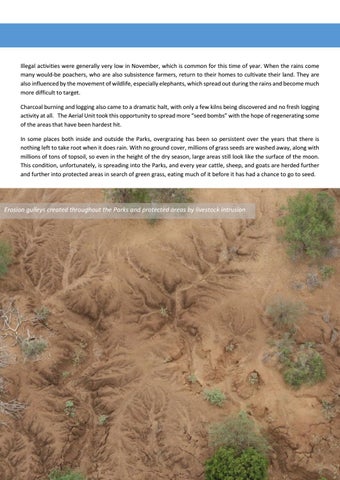
Illegal activities were generally very low in November, which is common for this time of year. When the rains come many would-be poachers, who are also subsistence farmers, return to their homes to cultivate their land. They are also influenced by the movement of wildlife, especially elephants, which spread out during the rains and become much more difficult to target. Charcoal burning and logging also came to a dramatic halt, with only a few kilns being discovered and no fresh logging activity at all. The Aerial Unit took this opportunity to spread more “seed bombs� with the hope of regenerating some of the areas that have been hardest hit. In some places both inside and outside the Parks, overgrazing has been so persistent over the years that there is nothing left to take root when it does rain. With no ground cover, millions of grass seeds are washed away, along with millions of tons of topsoil, so even in the height of the dry season, large areas still look like the surface of the moon. This condition, unfortunately, is spreading into the Parks, and every year cattle, sheep, and goats are herded further and further into protected areas in search of green grass, eating much of it before it has had a chance to go to seed.
Erosion gulleys created throughout the Parks and protected areas by livestock intrusion