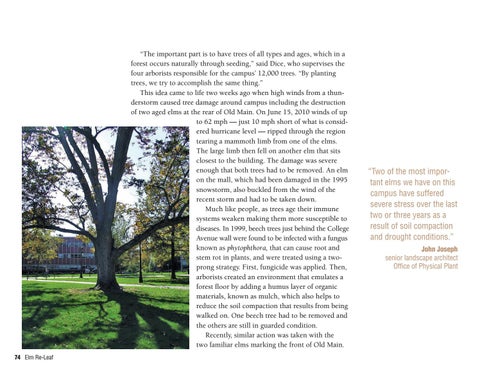
“The important part is to have trees of all types and ages, which in a forest occurs naturally through seeding,” said Dice, who supervises the four arborists responsible for the campus’ 12,000 trees. “By planting trees, we try to accomplish the same thing.” This idea came to life two weeks ago when high winds from a thunderstorm caused tree damage around campus including the destruction of two aged elms at the rear of Old Main. On June 15, 2010 winds of up to 62 mph — just 10 mph short of what is considered hurricane level — ripped through the region tearing a mammoth limb from one of the elms. The large limb then fell on another elm that sits closest to the building. The damage was severe enough that both trees had to be removed. An elm on the mall, which had been damaged in the 1995 snowstorm, also buckled from the wind of the recent storm and had to be taken down. Much like people, as trees age their immune systems weaken making them more susceptible to diseases. In 1999, beech trees just behind the College Avenue wall were found to be infected with a fungus known as phytophthora, that can cause root and stem rot in plants, and were treated using a twoprong strategy. First, fungicide was applied. Then, arborists created an environment that emulates a forest floor by adding a humus layer of organic materials, known as mulch, which also helps to reduce the soil compaction that results from being walked on. One beech tree had to be removed and the others are still in guarded condition. Recently, similar action was taken with the two familiar elms marking the front of Old Main. 74 Elm Re-Leaf
“Two of the most important elms we have on this campus have suffered severe stress over the last two or three years as a result of soil compaction and drought conditions.” John Joseph senior landscape architect Office of Physical Plant