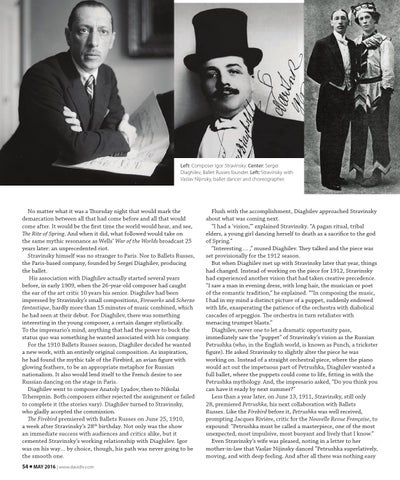
Left: Composer Igor Stravinsky. Center: Sergei Diaghilev, Ballet Russes founder. Left: Stravinsky with Vaslav Nijinsky, ballet dancer and choreographer.
No matter what it was a Thursday night that would mark the demarcation between all that had come before and all that would come after. It would be the first time the world would hear, and see, The Rite of Spring. And when it did, what followed would take on the same mythic resonance as Wells’ War of the Worlds broadcast 25 years later: an unprecedented riot. Stravinsky himself was no stranger to Paris. Nor to Ballets Russes, the Paris-based company, founded by Sergei Diaghilev, producing the ballet. His association with Diaghilev actually started several years before, in early 1909, when the 26-year-old composer had caught the ear of the art critic 10 years his senior. Diaghilev had been impressed by Stravinsky’s small compositions, Fireworks and Scherzo fantastique, hardly more than 15 minutes of music combined, which he had seen at their debut. For Diaghilev, there was something interesting in the young composer, a certain danger stylistically. To the impresario’s mind, anything that had the power to buck the status quo was something he wanted associated with his company. For the 1910 Ballets Russes season, Diaghilev decided he wanted a new work, with an entirely original composition. As inspiration, he had found the mythic tale of the Firebird, an avian figure with glowing feathers, to be an appropriate metaphor for Russian nationalism. It also would lend itself to the French desire to see Russian dancing on the stage in Paris. Diaghilev went to composer Anatoly Lyadov, then to Nikolai Tcherepnin. Both composers either rejected the assignment or failed to complete it (the stories vary). Diaghilev turned to Stravinsky, who gladly accepted the commission. The Firebird premiered with Ballets Russes on June 25, 1910, a week after Stravinsky’s 28th birthday. Not only was the show an immediate success with audiences and critics alike, but it cemented Stravinsky’s working relationship with Diaghilev. Igor was on his way… by choice, though, his path was never going to be the smooth one.
Flush with the accomplishment, Diaghilev approached Stravinsky about what was coming next. “I had a ‘vision,’” explained Stravinsky. “A pagan ritual, tribal elders, a young girl dancing herself to death as a sacrifice to the god of Spring.” “Interesting … ,” mused Diaghilev. They talked and the piece was set provisionally for the 1912 season. But when Diaghilev met up with Stravinsky later that year, things had changed. Instead of working on the piece for 1912, Stravinsky had experienced another vision that had taken creative precedence. “I saw a man in evening dress, with long hair, the musician or poet of the romantic tradition,” he explained. ““In composing the music, I had in my mind a distinct picture of a puppet, suddenly endowed with life, exasperating the patience of the orchestra with diabolical cascades of arpeggios. The orchestra in turn retaliates with menacing trumpet blasts.” Diaghilev, never one to let a dramatic opportunity pass, immediately saw the “puppet” of Stravinsky’s vision as the Russian Petrushka (who, in the English world, is known as Punch, a trickster figure). He asked Stravinsky to slightly alter the piece he was working on. Instead of a straight orchestral piece, where the piano would act out the impetuous part of Petrushka, Diaghilev wanted a full ballet, where the puppets could come to life, fitting in with the Petrushka mythology. And, the impresario asked, “Do you think you can have it ready by next summer?” Less than a year later, on June 13, 1911, Stravinsky, still only 28, premiered Petrushka, his next collaboration with Ballets Russes. Like the Firebird before it, Petrushka was well received, prompting Jacques Rivière, critic for the Nouvelle Revue Française, to expound: “Petrushka must be called a masterpiece, one of the most unexpected, most impulsive, most buoyant and lively that I know.” Even Stravinsky’s wife was pleased, noting in a letter to her mother-in-law that Vaslav Nijinsky danced “Petrushka superlatively, moving, and with deep feeling. And after all there was nothing easy
54 MAY 2016 | www.davidlv.com
52_56_think_RiotsofSpring.indd 54
4/25/16 9:16 AM