Hokopanopano Ka Toi Moriori (Reigniting Moriori Arts): Memory Work on Rēkohu (Chatham Islands)—Kingsley Baird
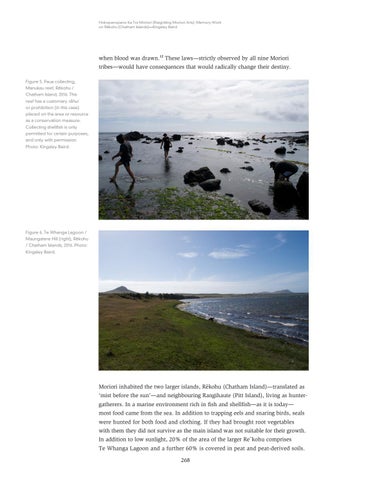
when blood was drawn.12 These laws—strictly observed by all nine Moriori tribes—would have consequences that would radically change their destiny. Figure 5. Paua collecting, Manukau reef, Rēkohu / Chatham Island, 2016. This reef has a customary rāhui or prohibition (in this case) placed on the area or resource as a conservation measure. Collecting shellfish is only permitted for certain purposes, and only with permission. Photo: Kingsley Baird.
Figure 6. Te Whanga Lagoon / Maungatere Hill (right), Rēkohu / Chatham Islands, 2016. Photo: Kingsley Baird.
Moriori inhabited the two larger islands, Rēkohu (Chatham Island)—translated as ‘mist before the sun’—and neighbouring Rangihaute (Pitt Island), living as huntergatherers. In a marine environment rich in fish and shellfish—as it is today— most food came from the sea. In addition to trapping eels and snaring birds, seals were hunted for both food and clothing. If they had brought root vegetables with them they did not survive as the main island was not suitable for their growth. In addition to low sunlight, 20% of the area of the larger Re¯kohu comprises Te Whanga Lagoon and a further 60% is covered in peat and peat-derived soils. 268