Hokopanopano Ka Toi Moriori (Reigniting Moriori Arts): Memory Work on Rēkohu (Chatham Islands)—Kingsley Baird
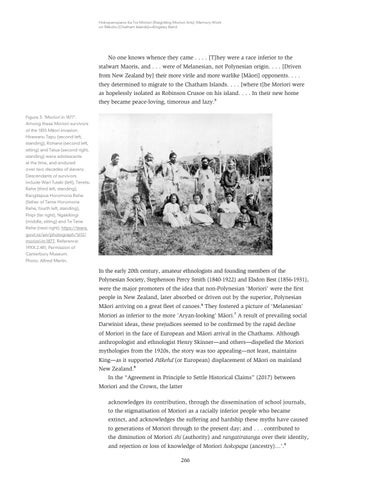
No one knows whence they came . . . . [T]hey were a race inferior to the stalwart Maoris, and . . . were of Melanesian, not Polynesian origin. . . . [Driven from New Zealand by] their more virile and more warlike [Māori] opponents. . . . they determined to migrate to the Chatham Islands. . . . [where t]he Moriori were as hopelessly isolated as Robinson Crusoe on his island. . . . In their new home they became peace-loving, timorous and lazy.5 Figure 3. ‘Moriori in 1877’. Among these Moriori survivors of the 1835 Māori invasion. Hirawanu Tapu (second left, standing), Rohana (second left, sitting) and Tatua (second right, standing) were adolescents at the time, and endured over two decades of slavery. Descendants of survivors include Wari Tutaki (left), Teretiu Rehe (third left, standing), Rangitapua Horomona Rehe (father of Tame Horomona Rehe, fourth left, standing), Piripi (far right), Ngakikingi (middle, sitting) and Te Tene Rehe (next right). https://teara. govt.nz/en/photograph/1612/ moriori-in-1877, Reference: 19XX.2.481, Permission of Canterbury Museum. Photo: Alfred Martin.
In the early 20th century, amateur ethnologists and founding members of the Polynesian Society, Stephenson Percy Smith (1840-1922) and Elsdon Best (1856-1931), were the major promoters of the idea that non-Polynesian ‘Moriori’ were the first people in New Zealand, later absorbed or driven out by the superior, Polynesian Māori arriving on a great fleet of canoes.6 They fostered a picture of ‘Melanesian’ Moriori as inferior to the more ‘Aryan-looking’ Māori.7 A result of prevailing social Darwinist ideas, these prejudices seemed to be confirmed by the rapid decline of Moriori in the face of European and Māori arrival in the Chathams. Although anthropologist and ethnologist Henry Skinner—and others—dispelled the Moriori mythologies from the 1920s, the story was too appealing—not least, maintains King—as it supported Pākehā (or European) displacement of Māori on mainland New Zealand.8 In the “Agreement in Principle to Settle Historical Claims” (2017) between Moriori and the Crown, the latter acknowledges its contribution, through the dissemination of school journals, to the stigmatisation of Moriori as a racially inferior people who became extinct, and acknowledges the suffering and hardship these myths have caused to generations of Moriori through to the present day; and . . . contributed to the diminution of Moriori ihi (authority) and rangatiratanga over their identity, and rejection or loss of knowledge of Moriori hokopapa (ancestry)…’.9 266