allowing them to bridge older digital protocols such as MADI or CobraNet to a modern Audio over IP network, and dedicated convertors are available for nearly any format. This permits audio flows to remain entirely in the digital domain, avoiding signal-degradation from intermediate A/D and D/A conversions.
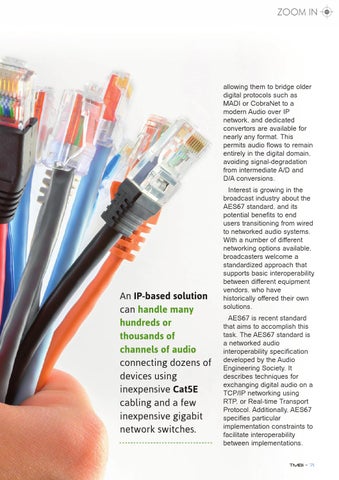
An IP-based solution can handle many hundreds or thousands of channels of audio connecting dozens of devices using inexpensive Cat5E cabling and a few inexpensive gigabit network switches.
Interest is growing in the broadcast industry about the AES67 standard, and its potential benefits to end users transitioning from wired to networked audio systems. With a number of different networking options available, broadcasters welcome a standardized approach that supports basic interoperability between different equipment vendors, who have historically offered their own solutions. AES67 is recent standard that aims to accomplish this task. The AES67 standard is a networked audio interoperability specification developed by the Audio Engineering Society. It describes techniques for exchanging digital audio on a TCP/IP networking using RTP, or Real-time Transport Protocol. Additionally, AES67 specifies particular implementation constraints to facilitate interoperability between implementations. TMBi - 71