Eye on DP
Dana Hills High Has Great Abs Marine ecology students embark on abalone culture and restoration project By Andrea Swayne Dana Point Times
B
ooks, videos, lectures and tests are the so-called nuts and bolts of the high school classroom experience. Students can learn from these tools and matriculate with sufficient knowledge of any subject just fine. But what happens when a teacher introduces hands-on experiences into a lesson plan? It’s no secret this is where the real enlightenment happens. Dana Hills High School science teacher Randy Hudson is well aware of the difference a rich first-hand experience can have on his students, and has always looked for ways to incorporate such activities into his classes. That’s why he introduced a green abalone culture and restoration project to this year’s syllabus. Hudson enlisted the help of marine biologist Nancy Caruso, founder of science education nonprofit Get Inspired Inc., to start their green abalone aquaculture tanks. Dana Hills is one of seven participating schools—the only one in the Capistrano Unified School District—and 1,100 students that have, with Caruso’s help, fostered between five and 35 abalone, depending on their tank size. One school is also cultivating white sea bass, she said. Over the last decade, Caruso has worked to restore kelp forests off the beaches of Orange County. This latest project takes that effort one step forward by growing the abalone she hopes will eventually be reintroduced into their natural habitat and feeding grounds in the kelp beds. The gist of the program is to use green abalone—a threatened species, once plentiful off the coast of Dana Point—as a tool in the classroom to teach kids about biology, ecology and how the species fits into our local offshore kelp forest ecosystem as they grow and care for them throughout the school year. At the end of the year, the team hopes to be able to release the class specimens into the Laguna Beach Marine Life Protected Area (MLPA) to help restore the wild population. Caruso said she is the first person in 22 years who has requested a permit from
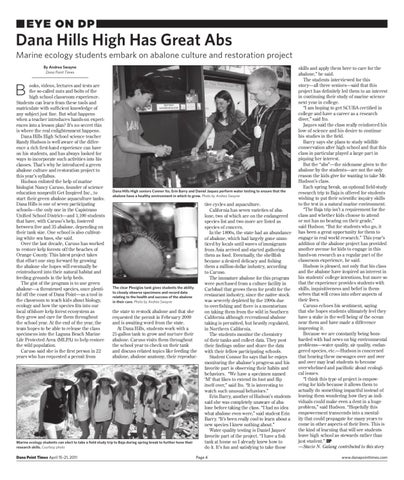
Dana Hills High seniors Connor Ito, Erin Barry and Daniel Jaques perform water testing to ensure that the abalone have a healthy environment in which to grow. Photo by Andrea Swayne
The clear Plexiglas tank gives students the ability to closely observe specimens and record data relating to the health and success of the abalone in their care. Photo by Andrea Swayne
the state to restock abalone and that she requested the permit in February 2009 and is awaiting word from the state. At Dana Hills, students work with a 21-gallon tank to grow and nurture their abalone. Caruso visits them throughout the school year to check on their tank and discuss related topics like feeding the abalone, abalone anatomy, their reproduc-
Marine ecology students can elect to take a field study trip to Baja during spring break to further hone their research skills. Courtesy photo
Dana Point Times April 15–21, 2011
tive cycles and aquaculture. California has seven varieties of abalone, two of which are on the endangered species list and two more are listed as species of concern. In the 1800s, the state had an abundance of abalone, which had largely gone unnoticed by locals until waves of immigrants from Asia arrived and started gathering them as food. Eventually, the shellfish became a desired delicacy and fishing them a million-dollar industry, according to Caruso. The immature abalone for this program were purchased from a culture facility in Carlsbad that grows them for profit for the restaurant industry, since the native stock was severely depleted by the 1990s due to overfishing and there is a moratorium on taking them from the wild in Southern California although recreational abalone taking is permitted, but heavily regulated, in Northern California. The students monitor the chemistry of their tanks and collect data. They post their findings online and share the data with their fellow participating schools. Student Connor Ito says that he enjoys monitoring the abalone’s progress and his favorite part is observing their habits and behaviors. “We have a specimen named ‘M’ that likes to extend its foot and flip itself over,” said Ito. “It is interesting to watch such unusual behaviors.” Erin Barry, another of Hudson’s students said she was completely unaware of abalone before taking the class. “I had no idea what abalone even were,” said student Erin Barry. “It’s been really cool to learn about a new species I knew nothing about.” Water quality testing is Daniel Jaques’ favorite part of the project. “I have a fish tank at home so I already knew how to do it. It’s fun and satisfying to take those
Page 4
skills and apply them here to care for the abalone,” he said. The students interviewed for this story—all three seniors—said that this project has definitely led them to an interest in continuing their study of marine science next year in college. “I am hoping to get SCUBA certified in college and have a career as a research diver,” said Ito. Jaques said the class really reinforced his love of science and his desire to continue his studies in the field. Barry says she plans to study wildlife conservation after high school and that this class in particular played a large part in piquing her interest. But the “abs”—the nickname given to the abalone by the students—are not the only reason the kids give for wanting to take Mr. Hudson’s class. Each spring break, an optional field-study research trip to Baja is offered for students wishing to put their scientific inquiry skills to the test in a natural marine environment. “The Baja trip isn’t a requirement for the class and whether kids choose to attend or not has no bearing on their grade,” said Hudson. “But for students who go, it has been a great opportunity for them to engage in real world research.” This year’s addition of the abalone project has provided another avenue for kids to engage in this hands-on research as a regular part of the classroom experience, he said. Hudson is pleased, not only that his class and the abalone have inspired an interest in his students’ college intentions, but more so that the experience provides students with skills, inquisitiveness and belief in themselves that will cross into other aspects of their lives. Caruso echoes his sentiment, saying that she hopes students ultimately feel they have a stake in the well being of the ocean near them and have made a difference improving it. Because we are constantly being bombarded with bad news on big environmental problems—water quality, air quality, endangered species, etc.—Hudson is concerned that hearing these messages over and over and over may lead students to become overwhelmed and pacifistic about ecological issues. “I think this type of project is empowering for kids because it allows them to actually do something impactful instead of leaving them wondering how they as individuals could make even a dent in a huge problem,” said Hudson. “Hopefully this empowerment transcends into a mentality that could propagate for many years to come in other aspects of their lives. This is the kind of learning that will see students leave high school as stewards rather than just student.” DP —Stacie N. Galang contributed to this story www.danapointtimes.com